www.impactjournals.com/oncotarget/ Oncotarget, 2016, Vol. 7, (No. 49), pp: 81292-81304
The prognostic value of long non coding RNAs in non small cell
lung cancer: A meta-analysis
Manni Wang1,*, Xuelei Ma1, Chenjing Zhu1,*, Linghong Guo1, Qingfang Li1, Ming Liu1, Jing Zhang2
1State Key Laboratory of Biotherapy and Cancer Center, West China Hospital, Sichuan University, Chengdu, PR China 2West China Hospital, Sichuan University, Chengdu, PR China
*These authors contributed equally to this work
Correspondence to: Xuelei Ma, email: [email protected]
Keywords:lncRNAs, NSCLC, prognosis, meta-analysis
Received: July 13, 2016 Accepted: September 29, 2016 Published: November 08, 2016
ABSTRACT
Background: Reports have demonstrated the prognostic function of long non-coding RNAS (lncRNAS) in patients with cancer. However, their prognostic functions in non small cell lung cancer (NSCLC) remain controversial. We therefore performed a meta-analysis on six lncRNAs (PVT1, AFAP1-AS1, LINC01133, ANRIL, MEG3 and UCA1) to clarify their prognostic roles in NSCLC.
Results: Thirty-six studies involving 6267 patients with NSCLC and 34 lncRNAs were included. Of the listed lncRNAs, 20 were shown to negatively affect patients’ overall survival while the high expression of 13 lncRNAs indicated better survival outcomes.
Materials and Methods: The log-rank p value and Kaplan–Meier survival curves of survival outcomes were extracted for hazard ratio (HR) calculation. Survival outcomes were measured by overall survival (OS) and event free survival (EFS) which were then analyzed by calculating pooled hazard ratios. The heterogeneity was detected by Q statistic and I-squared statistic.
Conclusions: The abnormal expression of lncRNAs may significantly affect NSCLC patients’ survival and may serve as a novel predictive factor for prognosis of NSCLC patients.
INTRODUCTION
Lung cancer is one of the most common causes of cancer-related deaths worldwide and non small cell lung cancer (NSCLC) accounts for 80% of all cases [1]. GLOBOCAN 2012 reported that there were approximately 14.1 million cancer patients in the world and 8.2 million of them died in 2012, most of which were population from less developed countries [2]. Patients with lung cancer are usually diagnosed at advanced stages with relatively poor prognosis. The estimated overall 5-year survival rate of advanced stage lung cancer is 0–14% [3, 4], while the 5-year survival rate of early stage NSCLC can be as high as 83%., which informs us that the early diagnosis and the
finding of new molecular targets for NSCLC are the key to
improve clinical strategies and outcomes of NSCLC [5]. Long non-coding RNAs (lncRNAs) are non-protein-coding
RNA molecules with a length of more than 200 nucleotides
and often expressed in a spatial, temporal and tissue-specific
pattern [6, 7]. In the past, lncRNAs were merely viewed as transcriptional ‘‘noise’’ [8]. Recently, a growing number
of genome-wide transcriptome studies have identified
about 3000 lncRNASs and at the same time indicated their diverse biological functions in both normal and degenerated tissues, including cell growth, differentiation and disease progression [9]. lncRNAs may act as primary regulators of the molecular interaction with DNA-binding proteins and epigenetically regulate the expression of target genes [10]. So far, controversy about the prognostic role of lncRNAs in NSCLC still exists. Some studies drew
statistically insignificant conclusions [11, 12], while
some studies showed that lncRNAs could be important
biomarkers for the assessment of overall survival and
research number, a single study may not be able to reflect
the facts accurately. Therefore, we conducted a meta-analysis to identify the exact role of lncRNAs in NSCLC patients’ prognosis. At the same time, we summarized in our study the relation of different lncRNAs to patients’
prognosis. Kaplan–Meier survival analysis and log-rank
tests were performed in our enrolled studies to further evaluate the correlation between lncRNA expression and the prognosis of NSCLC patients. Pooled results indicated that lncRNAs played an important role in NSCLC overall survival time, which provided us with new insights in the therapeutic strategies of NSCLC.
RESULTS
Study selectionAfter full-text assessment of all included articles, we excluded studies that did not use EFS or OS as survival
parameters. Studies that lacked information for calculation
with methods developed by Parmar, Williamson , and Tierney (Parmar et al., 1998; Williamson et al., 2002; Tierney) were also excluded. The initial search returned 128 articles, from which 36 duplicated records were removed. Abstracts of the remaining 92 articles were carefully read by two authors independently and we
excluded 60 unqualified literatures: laboratory studies
(n = 12), review articles (n = 11), other biomarkers
(n = 2) and other types of cancer (n = 35). Next we went through the full texts of the remaining 32 studies
and 25 with adequate data for calculation were finally enrolled. The flow chart of selection process is shown in
Figure 1. The supplementary search returned 46 articles, 11 of which contain useful information.
Characteristics of included studies
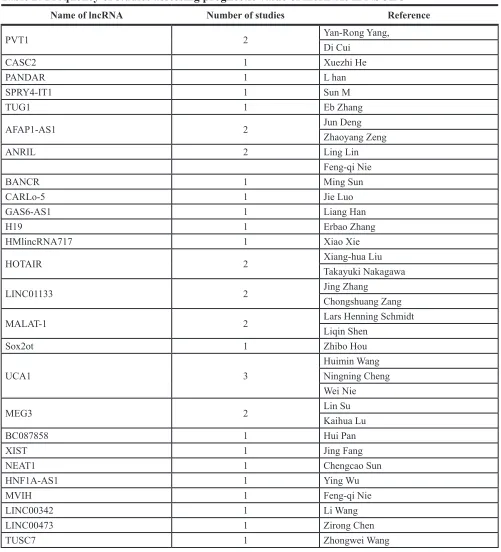
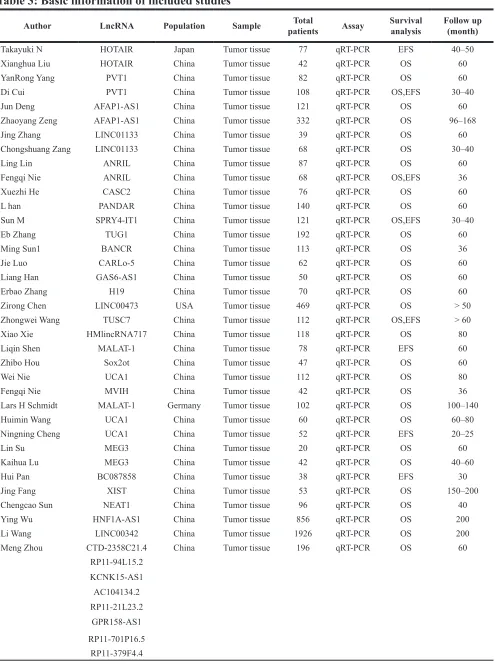
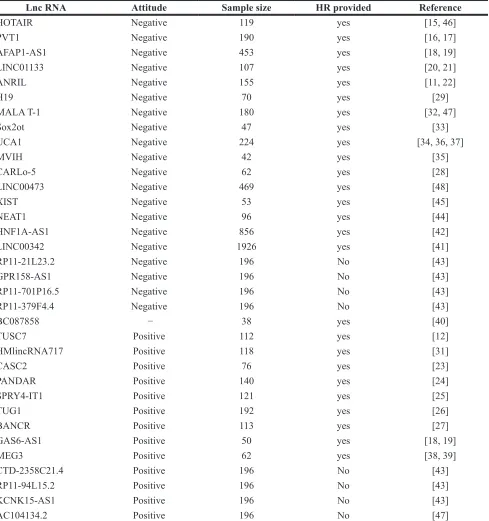
Among the 36 studies, one article [11] used progression free survival instead of disease free survival, we therefore combined DFS and PFS together and use event free survival EFS as prognosis parameter of our study. 28 studies used overall survival OS as prognosis parameter, one study used event free survival EFS and four contained OS as well as EFS. All 36 studies used the quantitative real-time reverse transcription-PCR (qRTPCR) method to measure the expression of lncRNAs in tumor samples. All the included studies analyzed the prognosis of 6267 patients with NSCLC and the correlation between 34 lncRNAs levels and survival outcomes. All necessary data of included trials are listed in Table 1 and Table 2.
The number of patients enrolled in each study ranged from 20 to 1926, and the follow-up duration varied from 25 months to 200 months. Among them, 33 studies involved participants from China [11–43] and three studies involved patients respectively from Japan [44], Germany
[45] and USA [46]. All studies investigated patients with NSCLC and qRT–PCR was used to detect lncRNAs expression in tumor tissues.
Overall Analyses
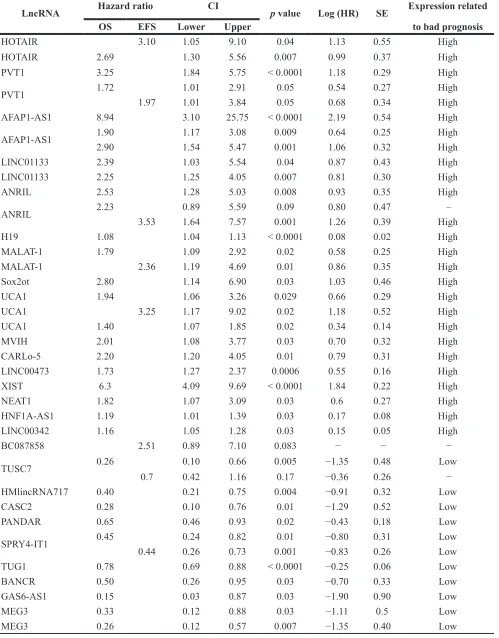
20 lncRNAs were shown to negatively affect patients’ overall survival while 13 lncRNAs were associated with better survival outcomes. One study
[11] on ANRIL (Nie et al: OS HR = 2.23 , 95% CI:
0.89–5.59, P = 0.09) showed no significant prognostic
effect of lncRNAs expression on patients’ overall survival. Wang et al. [12] observed no correlation between the
expression of TUSC7 and patients’ DFS, but significant
correlation between TUSC7 expression and patients’ OS. The BC087858 expression level was also associated with prognosis but it just reached the marginal statistical
significance (P =0.083) [38]. All HRs, 95% CI and
P values of included studies are listed in Table 3.
After careful reading of 92 literatures of the first
search after duplicates were removed and all literatures returned from the second search, we summarized all lncRNAs up to date whose prognostic roles in NSCLC were investigated (Table 4). Of the 34 lncRNAs presented, eight( RP11-21L23.2, GPR158-AS1, RP11-701P16.5, RP11-379F4.4, CTD-2358C21.4, RP11-94L15.2,
KCNK15-AS1 and AC104134.2) lacked information for calculation but their influences on prognosis were clearly
demonstrated in the study [41].
Subgroup analysis
Among the 20 listed lncRNASs, eight (HOTAIR,
PVT1, AFAP1-AS1, LINC01133 and ANRIL, UCA1, MALAT-1, MEG3) have been studied by two or more articles. We then carried out meta analyses and obtained
the combined HRs. While other studies have sufficient information for pooled analysis, studies on HOTAIR and MALAT-1 looked into OS and EFS separately and we
were therefore unable to conduct relevant meta analysis.
PVT1
We performed meta-analysis on articles choosing
lncRNA PVT1 as a prognostic marker. The two studies
included in meta-analysis [14, 15], both conducted multivariate Cox regression analysis and the data such
as HR is therefore directly extracted and put into pooled
analysis. The median follow-up period is 41 months [14] and 32 months [15] respectively and the information of a total number of 190 patients were collected. There was evidence of considerable heterogeneity in these two groups (P = 0.11, I2 = 62%) so the random effect
model was selected. A combined HR of 2.34 (95% CI:
a conclusion that high expression of long non-coding RNAS PVT1 is a predictor of poorer overall survival (Figure 2).
AFAP1-AS1
Two studies [16, 17] described the elevated expression of long non-coding RNAS AFAP1-AS1 as predictive of poor OS in NSCLC (n = 332). Deng et al enrolled 121 patients diagnosed with NSCLC who had
never received any therapy before surgery. Multivariate
Cox regression analysis was performed and HR for
high AFAP1-AS1 expression was 8.947 (95% CI = 3.115–25.694, P = 0.000). Zang et al included two independent cohorts, GSE31210 (N = 226) [47] and GSE37745 (N = 106) [48] which had complete follow-up data. This article presented Kaplan-Meier curve with precise number of patients and the death ratio in high and low expression group, instead of Cox regression
[image:3.612.61.542.74.261.2]analysis result. The combined HR (HR = 2.22,95% CI:
[image:3.612.130.479.431.704.2]Figure 1 :The flow chart of selection process.
Table 1: Criteria for the inclusion of prognostic lncRNA studies
Study design Prospective or retrospective cohort
Time of study After 2006
Tumor type Non-small cell lung cancer (NSCLC)
Assay type Tumor tissue or blood sample
RNA measurement qRT-PCR or ISH
Outcome type Overall Survival (OS) or Disease Free Survival (DFS)
Included results Univariate and multivariate survival analysis (Cox proportional hazards
regression model) including HRs, 95% CIs and P value / Kaplan Meier survival curves with enough data for calculation
Population size ≥ 30
Length of follow-up ≥ 1 year
Source Peer-reviewed journals
Language English
1.51–3.25, P < 0.0001) from subsequent pooled analysis of these two cohorts is shown in Figure 3.
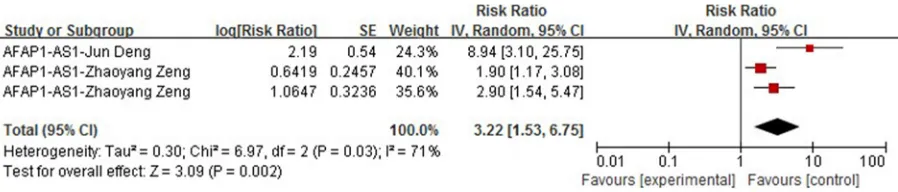
We then carried out meta analysis with these two articles containing three groups of data and the
subsequent combined HR is shown in Figure 4. Significant
heterogeneity among selected studies according to Q-test (chi2 = 6.97) and I-squared result (I2 = 71%, P = 0.03) was observed, so the random model was applied to
calculate a pooled HR (HR = 3.22,95% CI: 1.53–6.75,
P =0.002), which indicated that an elevated expression level of AFAP1-AS1 was a strong predictor of poorer OS.
LINC01133
[image:4.612.58.559.70.622.2]We included two studies investigating the correlation of LINC01133 expression with patients
Table 2: Frequency of studies assessing prognostic
value of lncRNAs in NSCLC
Name of lncRNA Number of studies Reference
PVT1 2 Yan-Rong Yang,
Di Cui
CASC2 1 Xuezhi He
PANDAR 1 L han
SPRY4-IT1 1 Sun M
TUG1 1 Eb Zhang
AFAP1-AS1 2 Jun Deng
Zhaoyang Zeng
ANRIL 2 Ling Lin
Feng-qi Nie
BANCR 1 Ming Sun
CARLo-5 1 Jie Luo
GAS6-AS1 1 Liang Han
H19 1 Erbao Zhang
HMlincRNA717 1 Xiao Xie
HOTAIR 2 Xiang-hua Liu
Takayuki Nakagawa
LINC01133 2 Jing Zhang
Chongshuang Zang
MALAT-1 2 Lars Henning Schmidt
Liqin Shen
Sox2ot 1 Zhibo Hou
UCA1 3
Huimin Wang
Ningning Cheng Wei Nie
MEG3 2 Lin Su
Kaihua Lu
BC087858 1 Hui Pan
XIST 1 Jing Fang
NEAT1 1 Chengcao Sun
HNF1A-AS1 1 Ying Wu
MVIH 1 Feng-qi Nie
LINC00342 1 Li Wang
LINC00473 1 Zirong Chen
Table 3: Basic information of included studies
Author LncRNA Population Sample patientsTotal Assay Survivalanalysis Follow up(month)
Takayuki N HOTAIR Japan Tumor tissue 77 qRT-PCR EFS 40–50
Xianghua Liu HOTAIR China Tumor tissue 42 qRT-PCR OS 60
YanRong Yang PVT1 China Tumor tissue 82 qRT-PCR OS 60
Di Cui PVT1 China Tumor tissue 108 qRT-PCR OS,EFS 30–40
Jun Deng AFAP1-AS1 China Tumor tissue 121 qRT-PCR OS 60
Zhaoyang Zeng AFAP1-AS1 China Tumor tissue 332 qRT-PCR OS 96–168
Jing Zhang LINC01133 China Tumor tissue 39 qRT-PCR OS 60
Chongshuang Zang LINC01133 China Tumor tissue 68 qRT-PCR OS 30–40
Ling Lin ANRIL China Tumor tissue 87 qRT-PCR OS 60
Fengqi Nie ANRIL China Tumor tissue 68 qRT-PCR OS,EFS 36
Xuezhi He CASC2 China Tumor tissue 76 qRT-PCR OS 60
L han PANDAR China Tumor tissue 140 qRT-PCR OS 60
Sun M SPRY4-IT1 China Tumor tissue 121 qRT-PCR OS,EFS 30–40
Eb Zhang TUG1 China Tumor tissue 192 qRT-PCR OS 60
Ming Sun1 BANCR China Tumor tissue 113 qRT-PCR OS 36
Jie Luo CARLo-5 China Tumor tissue 62 qRT-PCR OS 60
Liang Han GAS6-AS1 China Tumor tissue 50 qRT-PCR OS 60
Erbao Zhang H19 China Tumor tissue 70 qRT-PCR OS 60
Zirong Chen LINC00473 USA Tumor tissue 469 qRT-PCR OS > 50
Zhongwei Wang TUSC7 China Tumor tissue 112 qRT-PCR OS,EFS > 60
Xiao Xie HMlincRNA717 China Tumor tissue 118 qRT-PCR OS 80
Liqin Shen MALAT-1 China Tumor tissue 78 qRT-PCR EFS 60
Zhibo Hou Sox2ot China Tumor tissue 47 qRT-PCR OS 60
Wei Nie UCA1 China Tumor tissue 112 qRT-PCR OS 80
Fengqi Nie MVIH China Tumor tissue 42 qRT-PCR OS 36
Lars H Schmidt MALAT-1 Germany Tumor tissue 102 qRT-PCR OS 100–140
Huimin Wang UCA1 China Tumor tissue 60 qRT-PCR OS 60–80
Ningning Cheng UCA1 China Tumor tissue 52 qRT-PCR EFS 20–25
Lin Su MEG3 China Tumor tissue 20 qRT-PCR OS 60
Kaihua Lu MEG3 China Tumor tissue 42 qRT-PCR OS 40–60
Hui Pan BC087858 China Tumor tissue 38 qRT-PCR EFS 30
Jing Fang XIST China Tumor tissue 53 qRT-PCR OS 150–200
Chengcao Sun NEAT1 China Tumor tissue 96 qRT-PCR OS 40
Ying Wu HNF1A-AS1 China Tumor tissue 856 qRT-PCR OS 200
Li Wang LINC00342 China Tumor tissue 1926 qRT-PCR OS 200
Meng Zhou CTD-2358C21.4 China Tumor tissue 196 qRT-PCR OS 60
RP11-94L15.2 KCNK15-AS1 AC104134.2 RP11-21L23.2
GPR158-AS1 RP11-701P16.5
Table 4: Summary of hazard ratios of lncRNA expression in NSCLC
LncRNA Hazard ratio CI p value Log (HR) SE Expression related
OS EFS Lower Upper to bad prognosis
HOTAIR 3.10 1.05 9.10 0.04 1.13 0.55 High
HOTAIR 2.69 1.30 5.56 0.007 0.99 0.37 High
PVT1 3.25 1.84 5.75 < 0.0001 1.18 0.29 High
PVT1 1.72 1.01 2.91 0.05 0.54 0.27 High
1.97 1.01 3.84 0.05 0.68 0.34 High
AFAP1-AS1 8.94 3.10 25.75 < 0.0001 2.19 0.54 High
AFAP1-AS1 1.90 1.17 3.08 0.009 0.64 0.25 High
2.90 1.54 5.47 0.001 1.06 0.32 High
LINC01133 2.39 1.03 5.54 0.04 0.87 0.43 High
LINC01133 2.25 1.25 4.05 0.007 0.81 0.30 High
ANRIL 2.53 1.28 5.03 0.008 0.93 0.35 High
ANRIL 2.23 0.89 5.59 0.09 0.80 0.47 –
3.53 1.64 7.57 0.001 1.26 0.39 High
H19 1.08 1.04 1.13 < 0.0001 0.08 0.02 High
MALAT-1 1.79 1.09 2.92 0.02 0.58 0.25 High
MALAT-1 2.36 1.19 4.69 0.01 0.86 0.35 High
Sox2ot 2.80 1.14 6.90 0.03 1.03 0.46 High
UCA1 1.94 1.06 3.26 0.029 0.66 0.29 High
UCA1 3.25 1.17 9.02 0.02 1.18 0.52 High
UCA1 1.40 1.07 1.85 0.02 0.34 0.14 High
MVIH 2.01 1.08 3.77 0.03 0.70 0.32 High
CARLo-5 2.20 1.20 4.05 0.01 0.79 0.31 High
LINC00473 1.73 1.27 2.37 0.0006 0.55 0.16 High
XIST 6.3 4.09 9.69 < 0.0001 1.84 0.22 High
NEAT1 1.82 1.07 3.09 0.03 0.6 0.27 High
HNF1A-AS1 1.19 1.01 1.39 0.03 0.17 0.08 High
LINC00342 1.16 1.05 1.28 0.03 0.15 0.05 High
BC087858 2.51 0.89 7.10 0.083 − − −
TUSC7 0.26 0.10 0.66 0.005 −1.35 0.48 Low
0.7 0.42 1.16 0.17 −0.36 0.26 −
HMlincRNA717 0.40 0.21 0.75 0.004 −0.91 0.32 Low
CASC2 0.28 0.10 0.76 0.01 −1.29 0.52 Low
PANDAR 0.65 0.46 0.93 0.02 −0.43 0.18 Low
SPRY4-IT1 0.45 0.24 0.82 0.01 −0.80 0.31 Low
0.44 0.26 0.73 0.001 −0.83 0.26 Low
TUG1 0.78 0.69 0.88 < 0.0001 −0.25 0.06 Low
BANCR 0.50 0.26 0.95 0.03 −0.70 0.33 Low
GAS6-AS1 0.15 0.03 0.87 0.03 −1.90 0.90 Low
MEG3 0.33 0.12 0.88 0.03 −1.11 0.5 Low
overall survival. Ling et al studied a cohort of 79 pairs of NSCLC tumor tissues, including 39 lung squamous cell cancer (LSCC) and 40 lung adenocarcinoma (LAD). Both studies conducted Kaplan-Meier survival analysis
and no significant heterogeneity was observed (I2 = 0%,
P = 0.91). Further meta analysis using the fixed effect
model revealed that high expression of LINC01133 could develop as an independent factor for predicting
the prognosis of NSCLC patients (HR = 2.29, 95% CI:
1.42–3.71, P = 0.0007) (Figure 5).
ANRIL
Two studies involved the multivariate Cox regression analysis of prognostic parameters including the expression of ANRIL in NSCLC patients. Ling et al (N = 87) and Nie et al (N = 68) had clinical follow-ups of 60 months and 36 months respectively. In Nie’s study,
the ANRIL over-expression did not show a significant influence on OS (HR = 2.23, 95% CI: 0.89–5.59,
P = 0.09). In order to clarify the impact of ANRIL expression on patients’ survival, we performed a pooled analysis. We observed no heterogeneity between studies (I2 = o%, P = 0.82) and therefore fixed effect model was applied
to calculate the association between high tumoral ANRIL
expression and OS (HR 2.42, 95% CI: 1.40–4.19,
P = 0.002). These results suggest that high expression of ANRIL could predict worse prognosis of NSCLC patients regarding overall survival and may be an independent
prognostic marker (Figure 6).
UCA1
Two article about lncRNA UCA1 studied OS and were therefore included in meta-analysis [14, 15]. Both studies conducted multivariate Cox regression
analysis and the data such as HR is therefore directly
extracted and put into pooled analysis. We observed no heterogeneity between studies (I2 = 0%, P = 0.32) and
therefore fixed effect model was applied. A combined HR of 1.49 (95% CI: 1.17–1.91, P = 0.001) for those patients with high expression of PVT1 was observed. We could then conclude that high expression of lncRNA UCA1 can be used as a predictor of poorer overall survival (Figure 7).
MEG3
We carried out meta analysis with two articles describing the correlation between elevated expression of Meg3 and
overall survival. The subsequent combined HR is shown in
Figure 4. No heterogeneity among selected studies according to Q-test (chi2 = 0.14) and I-squared result (I2 = 0%, P = 071)
was observed, so the fixed model was applied to calculate a pooled HR (HR = 0.28, 95% CI = 0.15–0.53, P < 0.0001), which indicated that elevated expression of MEG3 could positively affect patients’ overall survival (Figure 8).
DISCUSSION
The current meta-analysis investigating the correlation between lncRNAs and cancer prognosis, demonstrated that the over-expression of lncRNAs was an effective predictor of survival in a variety of cancers, in terms of both OS and EFS. For NSCLC, it is of great
interest to identify its prognostic biomarkers, which can help cast light on the stratification of patients and make
clinical decisions. In recent years, an increasing number of studies have proved the aberrant expression of lncRNAs in human cancer including NSCLC [49].
Our study included 36 recently published articles and a total number of 6267 patients, which is considered powerful enough to consolidate and perform the subgroup analyses. In this study, we listed 34 lncRNAs
that were potential prognostic biomarkers for prognosis (Table 3). Our meta-analysis looked into six lncRNAs
(PVT1, AFAP1-AS1, LINC01133 and ANRIL, UCA1, MALAT-1, MEG3) whose prognostic roles have been clearly demonstrated in two or more articles. The
combined HRs suggested that elevated expressions
of PVT1, AFAP1-AS1, LINC01133, ANRIL, UCA1,
MALAT-1 and MEG3 were significantly correlated
with patients’ poor prognosis (Figures 2, 4, 5, 6, 7, 8). Although one study on ANRIL alone showed no statistical
significance (HR = 2.23, 95% CI: 0.89–5.59, P = 0.09), the pooled outcome of two studies added convincing evidence that increased expression of ANRIL indicates shorter
overall survival time (HR = 2.42, 95% CI: 1.40–4.19,
P = 0.002). Due to the limitation of the study number,
these conclusions need more clinical trials for verification.
The heterogeneity of the population was probably due to the difference in source of population, the cut-off value of lncRNAs and the duration of follow-ups.
Distinct from earlier studies, this meta-analysis have summarized the prognostic role of all published lncRNAs in NSCLC and carried out pooled analysis on some certain lncRNAs with enough data. To the
best of our knowledge, this is the first meta-analysis
summarizing information about the prognostic value of all available lncRNAs in NSCLC patients. We strictly followed the literature inclusion criteria and all enrolled literatures were examined independently by two authors. Furthermore, we paid substantial attention to the details of study design and data reporting in quality assessment. We extracted data only of multivariate analysis to avoid
the influence of heterogeneity among the included studies
and to further explore the potential role of lncRNAs as
prognostic biomarkers of NSCLC. As for Kaplan Meier
survival curves, we carefully selected studies with valid information and strictly followed methods developed by Parmar, Williamson, and Tierney. Blurred curves were
retouched with Microsoft Paint to make it precise for
origins. It was proven that the type of samples could
influence the experimental outcomes in terms of RNASs
detection [50]. All enrolled studies used qRT-PCR to measure lncRNAs which made pooled data from different studies more persuasive considering the consistent
measurement background. Last but not least, all returned
studies of our search strategy have been covered in this study which demonstrated the prognostic value of various lncRNA expression in NSCLC.
However, some details of our study need to be further refined. To start with, the number of eligible articles is relatively small, which lead to the relative insufficiency of
studies in subgroup analyses. The possible cause for this was
that studies reporting positive results were more likely to be
published or that published literatures in other languages were missed during our search process. For the same reason, publication bias and sensitivity analyses were not performed,
which might lead to the lack of statistical power. Second,
the main ethnicities of the patients in our analysis were Asian. Thus, standardized analyses are expected in order to apply our results to other populations. Third, although
all four sets of pooled outcomes of HR for OS in patients
with high lncRNA expression were proven to be statistically
significant (all HR > 2), some independent outcomes are not
strong enough to have clinical value. Because empirically,
[image:8.612.81.531.226.315.2]a predictive HR value of more than 2.0 was considered to
Figure 2: Forrest plots of studies evaluating hazard ratios of high PVT1 expression as compared to low expression.
Figure 3: Forrest plots of studies evaluating hazard ratios of high AFAP1-AS1 expression as compared to low expression with 2 cohorts of one study.
[image:8.612.96.513.361.530.2] [image:8.612.84.533.598.694.2]be statistically strong [51]. Although these results remain
to be verified by larger numbers of clinical trials, they still possess statistic validity to reflex the general correlation of
lncRNA expression with OS. The prognostic performance
of lncRNAs in NSCLC has been proven. However, further
clinical studies are warranted to Figure out the complicated
molecular networks through which lncRNAs act to exert an influence on NSCLC patients.
MATERIALS AND METHODS
Search strategy
[image:9.612.88.521.186.267.2]A comprehensive search was done via Pubmed database for literatures that analyzed the prognostic value of lncRNAs in NSCLC patients. Studies were selected using the varying combination of the following
[image:9.612.96.526.331.421.2]Figure 6: Forrest plots of studies evaluating hazard ratios of high ANRIL expression as compared to low expression.
Figure 7: Forrest plots of studies evaluating hazard ratios of high UCA1 expression as compared to low expression.
[image:9.612.104.512.473.559.2] [image:9.612.109.505.613.696.2]keywords: long non-coding RNAs, prognosis, lung cancer
or NSCLC. The last search update was performed on May 19th , 2016. A second search was done on September 13th,
2016, using the following words: long non-coding RNAs,
survival, lung cancer or NSCLC. Additional studies mentioned in those review articles were manually added to our evaluation list.
Inclusion criteria
We referred to the guidelines of Preferred Reporting Items for Systematic Reviews and Meta-Analysis (PRISMA) Statement issued in 2009 as well as the
checklist of the Dutch Cochrane Centre represented by
[image:10.612.66.555.64.585.2]MOOSE [52]. We then came up with a criteria for studies
Table 5: Summary of lncRNAs in the prognosis of NSCLC and authors’ attitudes
Lnc RNA Attitude Sample size HR provided Reference
HOTAIR Negative 119 yes [15, 46]
PVT1 Negative 190 yes [16, 17]
AFAP1-AS1 Negative 453 yes [18, 19]
LINC01133 Negative 107 yes [20, 21]
ANRIL Negative 155 yes [11, 22]
H19 Negative 70 yes [29]
MALA T-1 Negative 180 yes [32, 47]
Sox2ot Negative 47 yes [33]
UCA1 Negative 224 yes [34, 36, 37]
MVIH Negative 42 yes [35]
CARLo-5 Negative 62 yes [28]
LINC00473 Negative 469 yes [48]
XIST Negative 53 yes [45]
NEAT1 Negative 96 yes [44]
HNF1A-AS1 Negative 856 yes [42]
LINC00342 Negative 1926 yes [41]
RP11-21L23.2 Negative 196 No [43]
GPR158-AS1 Negative 196 No [43]
RP11-701P16.5 Negative 196 No [43]
RP11-379F4.4 Negative 196 No [43]
BC087858 − 38 yes [40]
TUSC7 Positive 112 yes [12]
HMlincRNA717 Positive 118 yes [31]
CASC2 Positive 76 yes [23]
PANDAR Positive 140 yes [24]
SPRY4-IT1 Positive 121 yes [25]
TUG1 Positive 192 yes [26]
BANCR Positive 113 yes [27]
GAS6-AS1 Positive 50 yes [18, 19]
MEG3 Positive 62 yes [38, 39]
CTD-2358C21.4 Positive 196 No [43]
RP11-94L15.2 Positive 196 No [43]
KCNK15-AS1 Positive 196 No [43]
AC104134.2 Positive 196 No [47]
that are considered eligible for our full-text evaluation: (i)
studies about the relation between lncRNAs expression in tumor or blood samples and prognosis of patients with NSCLC; (ii) the survival outcomes were measured with overall survival (OS) or event free survival (EFS) including disease free survival (DFS) and progression free survival ( PFS). The inclusion criteria is shown in Table 5.
Studies were excluded based on any of the following
conditions: (i) review articles, laboratory articles or letters;
(ii) articles about the prognosis of other tumors or other
markers. When two articles involving the same medical
center with similar data, the article with a larger sample size was selected. Two authors independently selected studies, and disagreements were resolved by consulting a third author.
Data extraction
All data were extracted independently by two authors and any disagreements were resolved by consensus and consultation with a third investigator. We extracted the results of multivariate Cox hazard regression analysis
provided in the articles. However, if these data were not directly available, we extracted the log-rank p value and Kaplan–Meier survival curves of survival outcomes with
the number of patients at risk in each expression group for further calculation. The following data were extracted: name of first author, investigated lncRNAs, number of patients, HR with 95% CI, P value, population, sample site, assay and survival outcome parameter.
Statistical methods
All HRs and 95% confidence interval(CI) were calculated with Tierney’s method. The logHR and SE (logHR) (SE) were recorded for aggregation of the
survival outcomes of different long non-coding RNAs.
Pooled analysis of the survival outcomes of specific
lncRNAs was then performed. A test of heterogeneity of
combined HRs was carried out using Cochran’s Q test
and Higgins I-squared statistic. P value of < 0.05 or
I2 > 50% was considered statistically significant. A
random effect model (Der Simonian and Laird method) was applied if heterogeneity was observed (P < 0.05 or
I2 > 50%), otherwise the fixed effect model was used [53].
All P values were two sided and a P value of less than
0.05 was considered to be statistically significant.
CONFLICTS OF INTEREST
None.REFERENCES
1. Ramalingam S, Pawlish K, Gadgeel S, Demers R,
Kalemkerian GP. Lung cancer in young patients: analysis
of a Surveillance, Epidemiology, and End Results database.
Journal of clinical oncology. 1998; 16:651–657.
2. Globocan (2012) IARC. http://globocan.iarc.fr/Pages/fact_ sheets_cancer.aspx. Accessed July 18, 2014.
3. Chansky K, Sculier JP, Crowley JJ, Giroux D, Van Meerbeeck J, Goldstraw P. The International Association for the Study of Lung Cancer Staging Project: prognostic
factors and pathologic TNM stage in surgically managed non-small cell lung cancer. Journal of thoracic oncology.
2009; 4:792–801.
4. van Rens MT, de la Riviere AB, Elbers HR and van Den
Bosch JM. Prognostic assessment of 2,361 patients who underwent pulmonary resection for non-small cell lung
cancer, stage I, II, and IIIA. Chest. 2000; 117:374–379. 5. Yanaihara N, Caplen N, Bowman E, Seike M, Kumamoto K,
Yi M, Stephens RM, Okamoto A, Yokota J, Tanaka T,
Calin GA, Liu CG, Croce CM, et al. Unique microRNA
molecular profiles in lung cancer diagnosis and prognosis. Cancer cell. 2006; 9:189–198.
6. Derrien T, Johnson R, Bussotti G, Tanzer A, Djebali S,
Tilgner H, Guernec G, Martin D, Merkel A, Knowles DG,
Lagarde J, Veeravalli L, Ruan X, et al. The GENCODE v7
catalog of human long noncoding RNAs: analysis of their
gene structure, evolution, and expression. Genome research.
2012; 22:1775–1789.
7. Harrow J, Frankish A, Gonzalez JM, Tapanari E, Diekhans M, Kokocinski F, Aken BL, Barrell D, Zadissa A, Searle S, Barnes I, Bignell A, Boychenko V, et al. GENCODE: the reference human genome annotation for The ENCODE Project. Genome research. 2012; 22:1760–1774.
8. Guttman M, Donaghey J, Carey BW, Garber M, Grenier JK, Munson G, Young G, Lucas AB, Ach R, Bruhn L, Yang X, Amit I, Meissner A, et al. lincRNAs act in the circuitry controlling pluripotency and differentiation. Nature. 2011;
477:295–300.
9. Khalil AM, Guttman M, Huarte M, Garber M, Raj A,
Rivea Morales D, Thomas K, Presser A, Bernstein BE, van Oudenaarden A, Regev A, Lander ES, Rinn JL. Many human large intergenic noncoding RNAs associate with chromatin-modifying complexes and affect gene expression. Proceedings of the National Academy of Sciences of the
United States of America. 2009; 106:11667–11672.
10. Rinn JL, Kertesz M, Wang JK, Squazzo SL, Xu X,
Brugmann SA, Goodnough LH, Helms JA, Farnham PJ, Segal E, Chang HY. Functional demarcation of active and silent chromatin domains in human HOX loci by noncoding RNAs. Cell. 2007; 129:1311–1323.
11. Nie FQ, Sun M, Yang JS, Xie M, Xu TP, Xia R, Liu YW,
Liu XH, Zhang EB, Lu KH, Shu YQ. Long noncoding
RNA ANRIL promotes non-small cell lung cancer cell proliferation and inhibits apoptosis by silencing KLF2 and P21 expression. Molecular cancer therapeutics. 2015;
14:268–277.
12. Wang Z, Jin Y, Ren H, Ma X, Wang B, Wang Y.
Downregulation of the long non-coding RNA TUSC7 promotes NSCLC cell proliferation and correlates with poor prognosis. American journal of translational research. 2016;
13. Liu XH, Liu ZL, Sun M, Liu J, Wang ZX, De W. The long non-coding RNA HOTAIR indicates a poor prognosis and
promotes metastasis in non-small cell lung cancer. BMC
cancer. 2013; 13:464.
14. Yang YR, Zang SZ, Zhong CL, Li YX, Zhao SS, Feng XJ. Increased expression of the lncRNA PVT1 promotes tumorigenesis in non-small cell lung cancer. International journal of clinical and experimental pathology. 2014;
7:6929–6935.
15. Cui D, Yu CH, Liu M, Xia QQ, Zhang YF, Jiang WL. Long non-coding RNA PVT1 as a novel biomarker for diagnosis
and prognosis of non-small cell lung cancer. Tumour biology. 2015.
16. Deng J, Liang Y, Liu C, He S, Wang S. The up-regulation
of long non-coding RNA AFAP1-AS1 is associated with the poor prognosis of NSCLC patients. Biomedicine & pharmacotherapy = Biomedecine & pharmacotherapie.
2015; 75:8–11.
17. Zeng Z, Bo H, Gong Z, Lian Y, Li X, Li X, Zhang W, Deng H, Zhou M, Peng S, Li G, Xiong W. AFAP1-AS1,
a long noncoding RNA upregulated in lung cancer and promotes invasion and metastasis. Tumour biology. 2015. 18. Zhang J, Zhu N, Chen X. A novel long noncoding RNA
LINC01133 is upregulated in lung squamous cell cancer
and predicts survival. Tumour biology. 2015; 36:7465–
7471.
19. Zang C, Nie FQ, Wang Q, Sun M, Li W, He J, Zhang M, Lu KH. Long non-coding RNA LINC01133 represses KLF2,
P21 and E-cadherin transcription through binding with
EZH2, LSD1 in non small cell lung cancer. Oncotarget. 2016; 7:11696–707. doi: 10.18632/oncotarget.7077.
20. Lin L, Gu ZT, Chen WH, Cao KJ. Increased expression of
the long non-coding RNA ANRIL promotes lung cancer cell metastasis and correlates with poor prognosis. Diagnostic
pathology. 2015; 10:14.
21. He X, Liu Z, Su J, Yang J, Yin D, Han L, De W, Guo R.
Low expression of long noncoding RNA CASC2 indicates a poor prognosis and regulates cell proliferation in non-small cell lung cancer. Tumour biology. 2016.
22. Han L, Zhang EB, Yin DD, Kong R, Xu TP, Chen WM,
Xia R, Shu YQ, De W. Low expression of long noncoding RNA PANDAR predicts a poor prognosis of non-small cell lung cancer and affects cell apoptosis by regulating Bcl-2.
Cell death & disease. 2015; 6:e1665.
23. Sun M, Liu XH, Lu KH, Nie FQ, Xia R, Kong R, Yang JS,
Xu TP, Liu YW, Zou YF, Lu BB, Yin R, Zhang EB, et al.
EZH2-mediated epigenetic suppression of long noncoding
RNA SPRY4-IT1 promotes NSCLC cell proliferation and metastasis by affecting the epithelial-mesenchymal
transition. Cell death & disease. 2014; 5:e1298.
24. Zhang EB, Yin DD, Sun M, Kong R, Liu XH, You LH, Han L, Xia R, Wang KM, Yang JS, De W, Shu YQ,
Wang ZX. P53-regulated long non-coding RNA TUG1 affects cell proliferation in human non-small cell lung
cancer, partly through epigenetically regulating HOXB7 expression. Cell death & disease. 2014; 5:e1243.
25. Sun M, Liu XH, Wang KM, Nie FQ, Kong R, Yang JS,
Xia R, Xu TP, Jin FY, Liu ZJ, Chen JF, Zhang EB, De W, et al. Downregulation of BRAF activated non-coding RNA is associated with poor prognosis for non-small cell lung cancer and promotes metastasis by affecting
epithelial-mesenchymal transition. Molecular cancer. 2014; 13:68. 26. Luo J, Tang L, Zhang J, Ni J, Zhang HP, Zhang L, Xu JF,
Zheng D. Long non-coding RNA CARLo-5 is a negative prognostic factor and exhibits tumor pro-oncogenic activity in non-small cell lung cancer. Tumour biology. 2014;
35:11541–11549.
27. Zhang E, Li W, Yin D, De W, Sun S, Han L. c-Myc-regulated long non-coding RNA H19 indicates a poor
prognosis and affects cell proliferation in non-small-cell lung cancer. Tumour biology. 2015.
28. Han L, Kong R, Yin DD, Zhang EB, Xu TP, De W, Shu YQ.
Low expression of long noncoding RNA GAS6-AS1 predicts a poor prognosis in patients with NSCLC. Medical
oncology (Northwood, London, England). 2013; 30:694. 29. Xie X, Liu HT, Mei J, Ding FB, Xiao HB, Hu FQ, Hu R,
Wang MS. LncRNA HMlincRNA717 is down-regulated
in non-small cell lung cancer and associated with poor prognosis. International journal of clinical and experimental
pathology. 2014; 7:8881–8886.
30. Shen L, Chen L, Wang Y, Jiang X, Xia H, Zhuang Z. Long
noncoding RNA MALAT1 promotes brain metastasis by inducing epithelial-mesenchymal transition in lung cancer.
Journal of neuro-oncology. 2015; 121:101–108.
31. Hou Z, Zhao W, Zhou J, Shen L, Zhan P, Xu C, Chang C, Bi H, Zou J, Yao X, Huang R, Yu L, Yan J. A long noncoding
RNA Sox2ot regulates lung cancer cell proliferation and is a prognostic indicator of poor survival. The international
journal of biochemistry & cell biology. 2014; 53:380–388. 32. Nie W, Ge HJ, Yang XQ, Sun X, Huang H, Tao X, Chen WS,
Li B. LncRNA-UCA1 exerts oncogenic functions in non-small cell lung cancer by targeting miR-193a-3p. Cancer
letters. 2016; 371:99–106.
33. Nie FQ, Zhu Q, Xu TP, Zou YF, Xie M, Sun M, Xia R, Lu KH. Long non-coding RNA MVIH indicates a poor prognosis for
non-small cell lung cancer and promotes cell proliferation and
invasion. Tumour biology. 2014; 35:7587–7594.
34. Cheng N, Cai W, Ren S, Li X, Wang Q, Pan H, Zhao M, Li J,
Zhang Y, Zhao C, Chen X, Fei K, Zhou C, et al. Long non-coding RNA UCA1 induces non-T790M acquired resistance to EGFR-TKIs by activating the AKT/mTOR pathway in EGFR-mutant non-small cell lung cancer. Oncotarget. 2015;
6:23582–23593. doi: 10.18632/oncotarget.4361.
35. Wang HM, Lu JH, Chen WY, Gu AQ. Upregulated
lncRNA-UCA1 contributes to progression of lung cancer and is closely related to clinical diagnosis as a predictive
36. Su L, Han D, Wu J, Huo X. Skp2 regulates non-small cell lung
cancer cell growth by Meg3 and miR-3163. Tumour biology.
2016; 37:3925–3931.
37. Lu KH, Li W, Liu XH, Sun M, Zhang ML, Wu WQ, Xie WP, Hou YY. Long non-coding RNA MEG3 inhibits
NSCLC cells proliferation and induces apoptosis by
affecting p53 expression. BMC cancer. 2013; 13:461. 38. Pan H, Jiang T, Cheng N, Wang Q, Ren S, Li X, Zhao C,
Zhang L, Cai W, Zhou C. Long non-coding RNA BC087858 induces non-T790M mutation acquired resistance to EGFR-TKIs by activating PI3K/AKT and MEK/ERK pathways and EMT in non-small-cell lung cancer. Oncotarget. 2016;
7:49948–49960. doi: 10.18632/oncotarget.10521.
39. Wang L, Chen Z, An L, Wang Y, Zhang Z, Guo Y, Liu C.
Analysis of Long Non-Coding RNA Expression Profiles
in Non-Small Cell Lung Cancer. Cellular physiology and
biochemistry. 2016; 38:2389–2400.
40. Wu Y, Liu H, Shi X, Yao Y, Yang W, Song Y. The long non-coding RNA HNF1A-AS1 regulates proliferation and
metastasis in lung adenocarcinoma. Oncotarget. 2015;
6:9160–9172. doi: 10.18632/oncotarget.3247.
41. Zhou M, Guo M, He D, Wang X, Cui Y, Yang H, Hao D,
Sun J. A potential signature of eight long non-coding RNAs predicts survival in patients with non-small cell lung cancer.
Journal of translational medicine. 2015; 13:231.
42. Sun C, Li S, Zhang F, Xi Y, Wang L, Bi Y, Li D. Long non-coding RNA NEAT1 promotes non-small cell lung cancer progression through regulation of miR-377–3p-E2F3
pathway. Oncotarget. 2016; 7:51784–51814. doi: 10.18632/
oncotarget.10108.
43. Fang J, Sun CC, Gong C. Long noncoding RNA XIST acts as an oncogene in non-small cell lung cancer by epigenetically repressing KLF2 expression. Biochemical and
biophysical research communications. 2016; 478:811–817. 44. Nakagawa T, Endo H, Yokoyama M, Abe J, Tamai K,
Tanaka N, Sato I, Takahashi S, Kondo T, Satoh K. Large noncoding RNA HOTAIR enhances aggressive biological
behavior and is associated with short disease-free survival in human non-small cell lung cancer. Biochemical and
biophysical research communications. 2013; 436:319–324. 45. Schmidt LH, Spieker T, Koschmieder S, Schaffers S,
Humberg J, Jungen D, Bulk E, Hascher A, Wittmer D,
Marra A, Hillejan L, Wiebe K, Berdel WE, et al. The long
noncoding MALAT-1 RNA indicates a poor prognosis in non-small cell lung cancer and induces migration and tumor
growth. Journal of thoracic oncology. 2011; 6:1984–1992.
46. Chen Z, Li JL, Lin S, Cao C, Gimbrone NT, Yang R, Fu DA,
Carper MB, Haura EB, Schabath MB, Lu J, Amelio AL, Cress WD, et al. cAMP/CREB-regulated LINC00473 marks
LKB1-inactivated lung cancer and mediates tumor growth. The Journal of clinical investigation. 2016.
47. Okayama H, Kohno T, Ishii Y, Shimada Y, Shiraishi K, Iwakawa R, Furuta K, Tsuta K, Shibata T, Yamamoto S, Watanabe S, Sakamoto H, Kumamoto K, et al. Identification
of genes upregulated in ALK-positive and EGFR/KRAS/ ALK-negative lung adenocarcinomas. Cancer research.
2012; 72:100–111.
48. Botling J, Edlund K, Lohr M, Hellwig B, Holmberg L, Lambe M, Berglund A, Ekman S, Bergqvist M, Ponten F, Konig A, Fernandes O, Karlsson M, et al. Biomarker discovery in non-small cell lung cancer: integrating gene expression profiling, meta-analysis, and tissue microarray validation. Clinical cancer research. 2013; 19:194–204. 49. Wapinski O, Chang HY. Long noncoding RNAs and human
disease. Trends in cell biology. 2011; 21:354–361.
50. Saito M, Schetter AJ, Mollerup S, Kohno T, Skaug V, Bowman ED, Mathe EA, Takenoshita S, Yokota J, Haugen A, Harris CC. The association of microRNA
expression with prognosis and progression in early-stage,
non-small cell lung adenocarcinoma: a retrospective
analysis of three cohorts. Clinical cancer research. 2011;
17:1875–1882.
51. Hayes DF, Isaacs C, Stearns V. Prognostic factors in breast cancer: current and new predictors of metastasis. Journal of mammary gland biology and neoplasia. 2001; 6:375–392. 52. Stroup DF, Berlin JA, Morton SC, Olkin I, Williamson GD,
Rennie D, Moher D, Becker BJ, Sipe TA, Thacker SB. Meta-analysis of observational studies in epidemiology:
a proposal for reporting. Meta-analysis Of Observational Studies in Epidemiology (MOOSE) group. Jama. 2000;
283:2008–2012.
53. DerSimonian R, Laird N. Meta-analysis in clinical trials