Technology (IJRASET)
A survey: Data Extraction on Web Using Semantic
Annotation
Abirami.S
K.S. Rangasamy College of Technology, Tiruchengode
Abstract: The world wide consortium (W3C) standard body provide the semantic Web, has been deploy technology and tool for retrieve context result from semantic database. The goal of Web is to extend the web facilities of web annotation, universally accessible content and web trust. In the web community, the various strategies are used to build annotation system for web content. In this paper discuss few techniques be fond of clustering and ontology based association, semantic similarity and matcher to provide the enhanced service to user.
Keywords: Semantic web, Annotation, Ontology.
I. INTRODUCTION
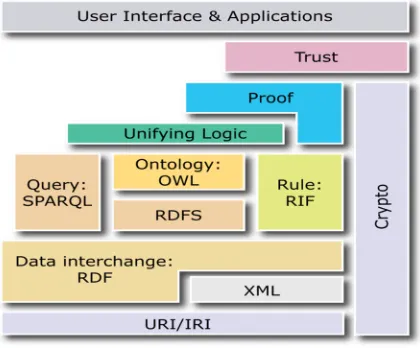
[image:2.612.202.412.445.619.2]Semantic search is trying to improve the accuracy of relevant search result from database, whether on web. And Semantic Search provides the contextual meaning to understand by user from large databases. Semantic search is developed based on context search, location search, intent search, variation of words in the document, specialized queries, concept matching natural language queries to provide the relevant search result to user [1].semantic search having the set of techniques to retrieve the highly relevant result from enriched structured data source is Ontology as found on the Semantic[2]. Semantic stack is the advance approach of the layered approach. At the bottom in XML, a language that lets one write structured Web document with a user-defined vocabulary. XML is particularly suitable for sending across the Web.RDF is a basic data model, entity relationship model for simple statement about Web object. Proof layer is involved detective process and validation process. This layer provides the proofs in Web language. Being located at the top of the fig 1.1, trust is a high level and critical concepts: the Web will only achieve its full probable when users have trust in its security and in the quality of information provided.
Figure 1.1 Semantic Stacks
A. The ontology layer is instantiated with two alternatives: the current standard Web ontology language, OWL and rule-based language. Thus an alternatives stream in the development of the Semantic Web appears.
B. DLP is the intersection of OWL and Horn logic, and serves as a common foundation.
Technology (IJRASET)
towards a semantic web of thing, 3.5subscriber’s data and semantic web for end user services in network, 3.6 framework for the graph based enrichments of documents, 3.7Finally we 3.7 conclude these paper.
II. KNOWLEDGE REPRESENTATION
The knowledge of data is represented in three type of ontology’s,
A. Domain ontology
B. Concept ontology
[image:3.612.214.405.228.399.2]C. Topic ontology
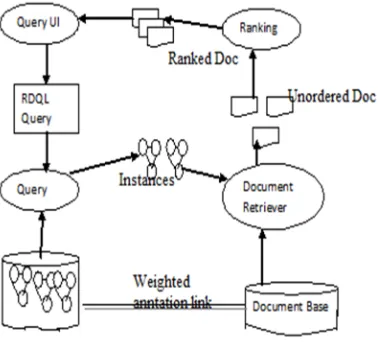
Figure 2 Ontology Based Information Retrieval
This materialized through three small root class hierarchies that ontology subclasses are
1) The root of all domain classes that can be used (directly or after sub classing) to create instance that describe entities referred to in the documents is known as Concepts.
2) To create instances is that act as proxies of documents from the information source to be upon are known as Document.
3) The root for class hierarchies that are used as classification schemes, and are never instantiated is known as Taxonomy [3].
III. AUTOMATIC ANNOTATION
Technology (IJRASET)
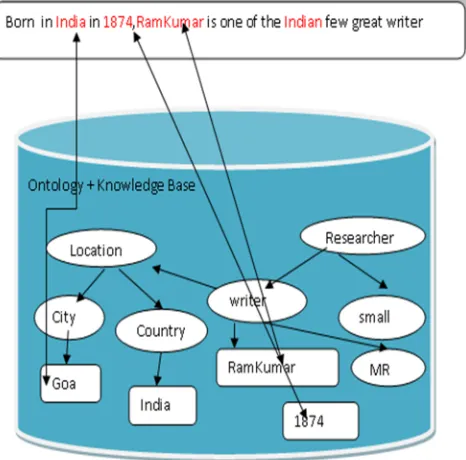
[image:4.612.191.424.141.371.2]Whenever the label of instances is found, an annotation is created between the instances and the document. Document can be annotated with classes. i.e label coincidence between different instances or classes. The annotation retrieval and ranking method based on the weight property. The ranking algorithm found by adaptation of the classic vector model. In the classical model, keywords appearing in a document are assigned a relevant weight for the document.
Figure 3 Semantic Annotation
Similarity annotations are assigned weights that considered to be for the document meaning. Weights are computed automatically by an adaptation of the IF-TDF algorithm, based on the frequency of occurrence of the instances in each document. A separate keyword property to be used, in addition to label, for instances frequency computation, but not for automatic annotation, in order to avoid polymeric ambiguities that lead to incorrect annotations.
IV. OVERVIEW OF SEMANTIC TECHNIQUES:
A. Clustering And Ontology Concepts Association
In [4] discuss about the service discovery is based on the clustering and ontology concepts association. The inclusion and deletion concepts performed by service description vector. The advanced algorithm is modification of service description vector. This is relevant to the ontology concepts these techniques adapt the hierarchy clustering method. The hierarchy method is providing the classification of the set of similar web services are grouped together. And the sub clusters are to be form the hierarchy. Since we want to have informative clusters of the web services descriptions. Also, the approach of Heb and Kushmerick [5], of using information contained in the service description to dynamically create the hierarchy clustering is the best clustering approach for service classification. The SUMO ontology concepts are used to form the cluster includes association with the relevant information.
B. Semantic Similarity-Based Matching
The [4] semantic similarity based matching is enhancing the service request from user. The semantic similarity based matching employs LSI based service matching and ontology based request enhancement. The enhancement is facilitates to service request with relevant ontology terms. And the service refinement phase [6] is generate the service description vectors provides the similarity measure of the semantically enhances service request.
Technology (IJRASET)
concepts and finds matching of relation between web service documents and parameters. LSI is arithmetic come up to use imprison of term relationship and basic domain semantics [14].LSI extends the Vector Space Model (VSM) in accounting to regulate and association between the relevant terms. The discovery of web services refers to the query language is used to form the web service request. There are two ways to form a web service requests,
1) Syntactic web service
2) Semantic web service
Syntactic web service is a basic method text to form a web service request. Syntactic web service query language such as XQuery,XSLT,GOL and Luecene among others.
C. Matcher
In [7] describe the matching ontology is possible to check if a matcher is compliant with a specification, like for SPQRL querying or OWL reasoning. This test set can be criticized on three main aspects:
1) Lack of realism: The tests are mechanically generated.
2) Lack of variability: This always uses the same seed ontology altered in the exact same way.
3) Lack of discriminability: The tests are not difficult is adequate to discriminate well matchers.
Evaluating ontology matching systems [8] is provide the test generation, ontology matching. This evaluated by parameters weighted. The evaluation of the matcher based on the output alignments and reference alignments and some measures. The measures are precision, recall and F-measures. The space ontology matching is one problem occurred by altering ontology [7].This method used to provide the meaning.
D. Spitfire: Towards A Semantic Web Of Thing
The [15] web of thing is endowed with semantic application concerning internet-connected sensors. This technique is furnishing the easy building, searching and reading a web page today. The real world intergraded sensor information on the web is directly accessed by the publishing the sensor related data on the web. This will helps people to find the relevant information. The internet of thing (IOT) is based on combination of the open interfaces, data format and large scale intergraded technology. The semantic sensor web on the internet requires all the sensors are connected to the internet. The machine could discover the semantic of the sensor data and related data. SPITFIRE is overcome the some problems in retrieve the sensor related data on the web. Vocabularies to integrate the description of sensor data and thing with link open data (LOD) cloud. Semantic entities as a generalization for thing high level states and conditional from embedded sensors. The sensor description intergraded with LOD cloud. Sensors and thing to allow the user to use the technology at large scale by the creation of sensor descriptions. The abstraction for thing requires their high level states, integration with sensors and given current state of the search for thing. SPITFIRE addresses these requirements.
E. Subscriber’s Data And Semantic Web For End User Services In Network
A [16] novel architecture to provide the provisioning of new added services and based on the subscriber data.In [16] Fig 1 represented in four layers are access layer, data repository layer, information layer and service layer. The next generation telecommunication networks settings are included in Wideband Code Division Multiple Access (WCDMA) and Wi-Fi. The data repositories already exist in presence server and address book. They may be new, such as consumption data repositories that maintain end user’s consumption profiles. The information layer hides the information repositories. Data repositories with semantic intelligence and provides an intelligent interface to access these repositories. The services layer includes intelligent search engine (ISE) that provide an interface for application to query the KB. The individual ISE connects to one or more IRs in the same domain. The requirement [16] are classified into types are KB building related and intelligent search related.
F. Framwork For The Graph Based Enrichement Of Documents
1) Context Extraction: The [17] combining of natural language processing techniques and similarity measures to get the list of relevant terms known as context. The each one of these term are ranked according to the frequency and location in the document structure.
Technology (IJRASET)
term can only be paired with single URI. To disambiguate the correct URI by applying the graph based filtering algorithm to obtain the relevance of each keyword
3) Context based graph filtering: Formerlyan instance is identified; its semantic description is extended with a sub graph of the linked data. This algorithm visiting more depth level than in the URI identification and selecting relevant instances based on the occurrence of the context term within the relation of those instances. Finally store the annotated term in repository. In [18] describes the distributed environment to retrieve the enriched document by using to enable the different finalities and different combination of approaches to selecting and ranking the documents. In [18] Fig 3 given the architecture for distribute environment the partners communicate with others reside in the peers. The architecture mainly using the mAKEr software maintain the relevant term of the document. The document are ranked based on the relevant to their “similarity” with the enriched document, merge the list of relevant document to form a single list. These done by using the Automatic Key Extraction (AKE) this perform the document merging, matching to the similar terms.
In [19] ontology driven the enrich document to provide the intelligent knowledge model. And also provide the standard based document retrieval .Technologies for ontology driven enriched document are following given,
OCML
Web ONTO
Lois
Knote
The OCML is the Operation Knowledge modeling language, its represents the ontology and knowledge model. Web ONTO is a tool provide the visualization, browsing, editing, supporting, maintaining the ontology and knowledge model specified in the OCML.The Lois is the form based interface for the knowledge retrieval .The Knote is the form based interface for the populating the ontology. The DBpedia knowledge extraction framework [20] defines the globally unique identifier over the web to provide the rich RDF description of the entity. The entity belongs to the human readable in different 30 languages, relation to another resoures, classification in four type hierarchies and data level links to other web data sources. In these paper using the different types of frameworks are used Architecture of the extraction framework; the components of extraction are Page collection, Destination, Extractor, Parser, Extraction job and Extraction manager.
V. CONCLUSIONS
In this survey, we reviewed papers related to Semantic Web search: semantics for search, ontology-based search, query languages and knowledge base systems that enable Semantic web search. The paper complements existing surveys with new systems, more detailed and recent specifications on some of systems. Our conclusions drawn from this survey include:
This survey paper address the two major aspects related to semantic based service discovery: semantic based service categorization and semantic based service selection. We propose the ontology guided categorization of web services into functional categories for service discovery. For semantic based service selection, we employ ontology linking (semantic Web) and LSI thus extending the indexing procedure from syntactical information to a semantic level. We also extend the work of analysis based on ontology framework and investigated additional mapping tools to better express a service request to search for relevant concepts. The ontology matching evaluation is providing the ontology alignment test generator which is extensible and flexible. In the future ,we will extend our analysis to allow the service request that are formed using specialized query language and match these request to semi annotation or automated annotation service that are described using formats such as SAWSDL, OWL ,among others.
REFERENCES
[1] John, Tony (March 15, 2012). "What is Semantic Search?",Techulator. Retrieved July 13, 2012.
[2] Ruotsalo, T. (May 2012). "Domain Specific Data Retrieval on the Semantic Web",ESWC2012. Retrieved August 14, 2012.
[3] Miriam Fernández, David Vallet, and Pablo Castells “Automatic Annotation and Semantic Search from Protégé”,Universidad Autónoma de Madrid, Escuela Politécnica Superior
[4] Aabhas V. Paliwal, Student Member, IEEE, Basit Shafiq, Member, IEEE, Jaideep Vaidya, Member, IEEE, Hui Xiong, Senior Member, IEEE, and Nabil Adam, Senior Member, IEEE “Semantics-Based Automated Service Discovery”,IEEE TRANSACTIONS ON SERVICES COMPUTING, VOL. 5, NO. 2, APRIL-JUNE 2012
Technology (IJRASET)
Services Computing (SCC), July 2007.[7] Jérôme Euzenat a,∗, Maria-Elena Roşoiu a, Cássia Trojahn b,1” Ontology matching benchmarks: Generation, stability,and discriminability”,Web Semantics: Science, Services and Agents on the World Wide Web 21 (2013) 30–48
[8] Jérôme Euzenat, Pavel Shvaiko, Ontology Matching, Springer-Verlag, Heidelberg, DE, 2007.
[9] Jérôme Euzenat, Christian Meilicke, Heiner Stuckenschmidt, Pavel Shvaiko, Cássia Trojahn dos Santos, “Ontology alignment evaluation initiative” ,six years of experience, J. Data Semantics XV (2011) 158–19
[10] Jérôme Euzenat, Marc Ehrig, Anja Jentzsch, Malgorzata Mochol, Pavel Shvaiko, “Case-based recommendation of matching tools and techniques”, deliverable 1.2.2.2.1, Knowledge Web, 2006
[11] S. McIlraith, T. Son, and H. Zeng, “Semantic Web Services,” IEEE Intelligent Systems, vol. 16, no. 2, pp. 46-53, Mar. 2001. [12] S. McIlraith and D. Martin, “Bringing Semantics to Web Services,” IEEE Intelligent Systems, vol. 18, no. 1, pp. 90-93, Jan. 2003.
[13] D. Martin, M. Paolucci, S. McIlraith, M. Burstein, D. McDermott, D. McGunneess, B. Barsia, T. Payne, M. Sabou, M. Solanki, N. Srinivasan, and K. Sycara, “Bringing Semantics to Web Services: The OWL-S Approach,” Proc. First Int’l Workshop Semantic Web Services and Web Process Composition, July 2004.
[14] P.W. Foltz and S.T. Dumais, “Personalized Information Delivery: An Analysis of Information Filtering Methods,” Comm. ACM, vol. 35, no. 12, pp. 51-60, 1992.
[15] Dennis Pfisterer, Kay Römer and Daniel Bimschas” SPITFIRE: Toward a Semantic Web of Things”, IEEE Communications Magazine, November 2011, PP. 41-48.
[16] Fatna Belqasmi, Concordia University Chunyan Fu and Tekelec” Subscriber Data and Semantic Web for Provisioning Novel End-User Services in Telecommunication Networks”, IEEE Communications Magazine, March 2012,PP 42-50
[17] Juan C. Vidal ⇑, Manuel Lama and Estefania Otero-Garcia “Graph-based semantic annotation for enriching educational content with linked data”, Knowledge-Based Systems 55 (2014), PP. 29–42
[18] F. Bueno, A. García-Serrano, J.L. Martínez-Fernandez, “Enrichment of text documents using information retrieval techniques in a distributed environment”, Expert Systems with Applications 37 (12) (2010) 8348–8358.
[19] E. Motta, S. Buckingham Shum, J. Domingue, Ontology-driven document enrichment: principles, tools and applications, International Journal of Human– Computer Studies 52 (6) (2000) 1071–1109