5
VIII
August 2017
Distributed Model Predictive Load Frquency
Control of Multi Area Power System after
Deregulation using Fuzzy Logic Controller
Kota Priya Nandini1, Mrs. K. Bhavana (Asst. Professor)2
1,2Dept. of Electrical and Electronics Engineering
P.V.P.Siddhartha Institute of Technology, Kanuru, 520 007, Vijayawada, India
Abstract: Reliable load frequency control (LFC) is very important for a modern power system with multi-source power generation and has been the primary focus of studies on advanced control theory and applications. This paper proposes a distributed model predictive control (DMPC) scheme for the load frequency control (LFC) problem of the deregulated multi-area interconnected power system with contracted and un-contracted load demands. The traditional LFC of interconnected power system is modified to take into account the effect of bilateral contracts on the dynamics. The MPC is based on a simplified system model of the Nordic power system, and it takes into account limitations on tie-line power flow, generation capacity, and generation rate of change. The participation factors for each generator are optimization variables, and suggestions are made as to how one can ensure tie-line power transfer margins through slack-variables, and pricing information through the objective function. In the proposed scheme, the limit position of the governor valve is modelled by a fuzzy model and the local predictive controllers are incorporated into the non-linear control system. The effectiveness of the proposed non-linear constraint DMPC was demonstrated by simulations.
Keywords: Deregulation, Distributed model predictive control, Generation Rate Constraint, Interconnected power system, Load frequency control.
I. INTRODUCTION
A modern power system is a large-scale, geographically dispersed, and complexly interconnected system with distributed generators. The main objectives of the load frequency control (LFC) of such a system are to maintain the system frequency at the scheduled value and ensure zero area control error (ACE), so that the generated power and load on the system remain balanced. Various advanced LFC schemes have been developed over the last few decades, such as modern optimal control theory-based proportional–integral–derivative schemes, full state feedback control strategy, adaptive and variable structure schemes, robust schemes, intelligent schemes, and networked control schemes. Pandey et al. present a literature survey of LFC schemes for both conventional and distribution power systems. Since modern power systems are increasingly growing in size and utilize multiple power sources, traditional centralized controllers are becoming less reliable and more difficult to use for the required computations. The failure of such controllers results in the breakdown of the entire system LFC. Conversely, in a distributed framework, each subsystem is controlled by an independent controller. This also reduces the computational load and affords flexibility of the system structure. However, it is very important when using a distributed control framework to employ an optimal global power system strategy.
II. MULTI-AREA POWER SYSTEM AFTER DEREGULATION
A large-scale power system consists of a number of interconnected control areas which are connected by tie-lines. Each area typically consists of GENCOs and DISCOs. Here, for the sake of clarity, the formulation presented in this section is based on the three-area deregulated power system with two GENCOs and two DISCOs in each area, which is shown as Figure 1. All the symbols of power system used in the paper are provided in NOMENCLATURE. The notation Δ is used to indicate a deviation from steady state.
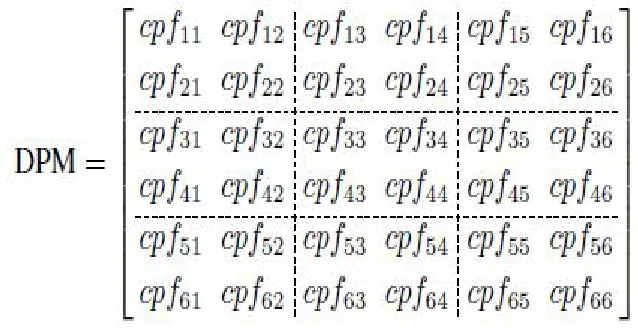
Generally, GENCOs sell power to various DISCOs at competitive prices in the deregulated environment. This makes various combinations of GENCO-DISCO contracts possible in practice. To make the visualization of contracts easier, we introduce the concept of a “DISCO participation matrix” (DPM). DPM is a matrix with the number of rows equal to the number of GENCOs and the number of columns equal to the number of DISCOs in the system. Each entry in the DPM, known as a contract participation factor (cpf), represents the fraction of a DISCO total contracted load demands being met by a GENCO.
Where the block diagonals of DPM correspond to local demands and the off diagonal blocks correspond to the demands of the DISCOs in one area to the GENCOs in another area. Since the DISCOs cannot and will not abide strictly the terms of contract in the process of power allocation, there do exist the un-contracted power load demands. The un-contracted power load demands will be absorbed by the GENCOs which locate in the same area as that DISCO. From this perspective, how to allocate the un-contracted power load demands become the key point to build the dynamic model, because there are two GENCOs in each control area. The “area participation factor (apf)” well solves this challenge. The un-contracted power load demands are distributed to GENCOs on the basis of apfs. After taking into account both DPM and apfs, the excepted output power change of each GENCO can be defined as: u i i c i c i c i c i c i c i
mech
cpf
p
cpf
p
cpf
p
cpf
p
cpf
p
cpf
p
apf
p
p
[image:3.612.145.464.237.401.2]
1 1 1 2 2 3 3 4 4 5 5 6 6 (1)All the GENCOs can be denoted in matrix form as:
Where APM is the area participation matrix. Here, the corresponding APM is given as follows:
Besides being used to determine the excepted output power change of each GENCO, DPM is also used to compute the excepted tie-line power change (contracted value). Consider any control area i interconnected to control area j (j ̸= i) through the tie-line. Then, the excepted value of the tie-line power deviation can be obtained as:
III. PC CONTROLLER
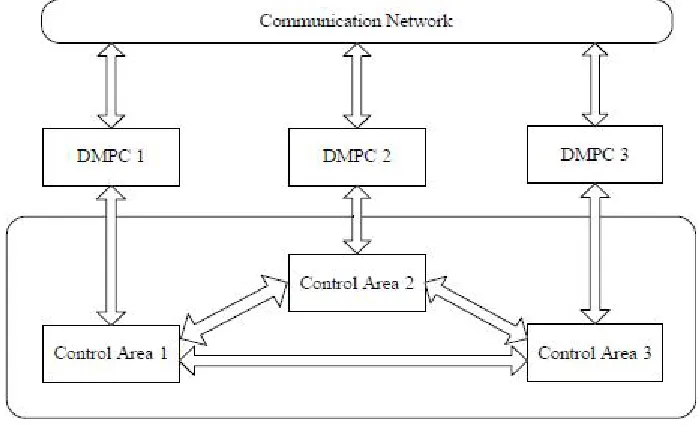
[image:4.612.134.483.488.701.2]The distributed model predictive controller for LFC of the deregulation three-area interconnected power system with constraints, contracted and un-contracted load demands are designed in this section. Each DMPC controller solves a local optimization problem, while exchanging the information with other controllers. The block diagram of DMPC for three-area interconnected power system is illustrated in Figure 2. For each subsystem i, the optimization problem can be written as:
1))
(
)
(
(
)
(
)
(
)
(
)
(
j j ij j ij i ii c ti ii c ii i ii i iii
t
A
x
t
B
u
t
F
P
G
P
E
w
t
A
x
t
B
u
t
[image:5.612.179.449.127.676.2]x
IV. FUZZY LOGIC CONTROLLER
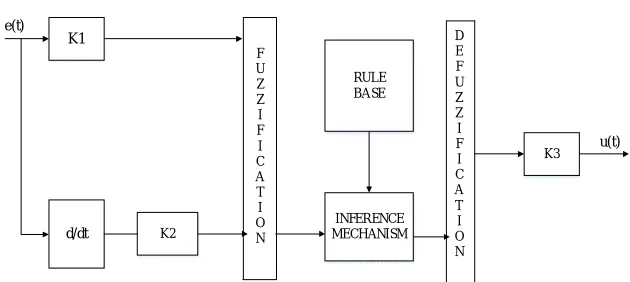
In the previous section, control strategy based on PI controller is discussed. But in case of PI controller, it has high settling time and has large steady state error. In order to rectify this problem, this paper proposes the application of a fuzzy controller shown in Figure 4. Generally, the FLC is one of the most important software based technique in adaptive methods.
As compared with previous controllers, the FLC has low settling time, low steady state errors. The operation of fuzzy controller can be explained in four steps.
[image:6.612.150.465.225.366.2]A. Fuzzification B. Membership function C. Rule-base formation D. Defuzzification. K1 d/dt K2 K3 F U Z Z I F I C A T I O N RULE BASE INFERENCE MECHANISM e(t) u(t) D E F U Z Z I F I C A T I O N
Figure 4: basic structure of fuzzy logic controller
In this paper, the membership function is considered as a type in triangular membership function and method for defuzzification is considered as centroid. The error which is obtained from the comparison of reference and actual values is given to fuzzy inference engine. The input variables such as error and error rate are expressed in terms of fuzzy set with the linguistic terms VN, N, Z, P, and Pin this type of mamdani fuzzy inference system the linguistic terms are expressed using triangular membership functions. In this paper, single input and single output fuzzy inference system is considered. The number of linguistic variables for input and output is assumed as 3.The numbers of rules are formed as 9. The input for the fuzzy system is represented as error of PI controller. The fuzzy rules are obtained with if-then statements. The given fuzzy inference system is a combination of single input and single output. This input is related with the logical operator AND/OR operators. AND logic gives the output as minimum value of the input and OR logic produces the output as maximum value of input.
V. SIMULATION RESULTS
A. Case 1: Free Transaction and No Contract Violation with MPC & Fuzzy-MPC Controller
This subsection illustrates the scenario where both GENCOs and DISCOs abide strictly to the terms of contract. The contract between the DISCOs and the GENCOs for power distribution is based on the following DPM:
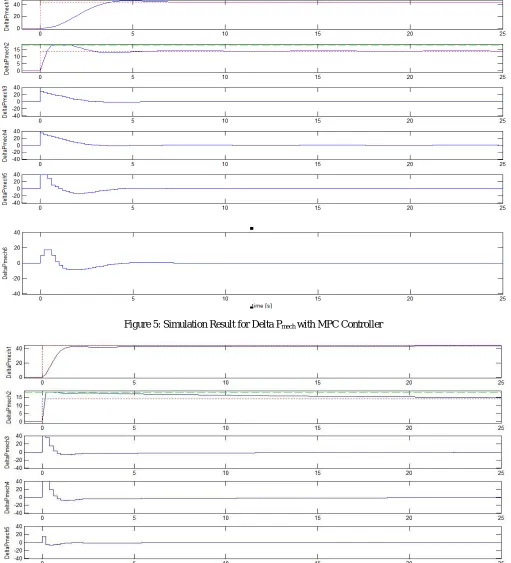
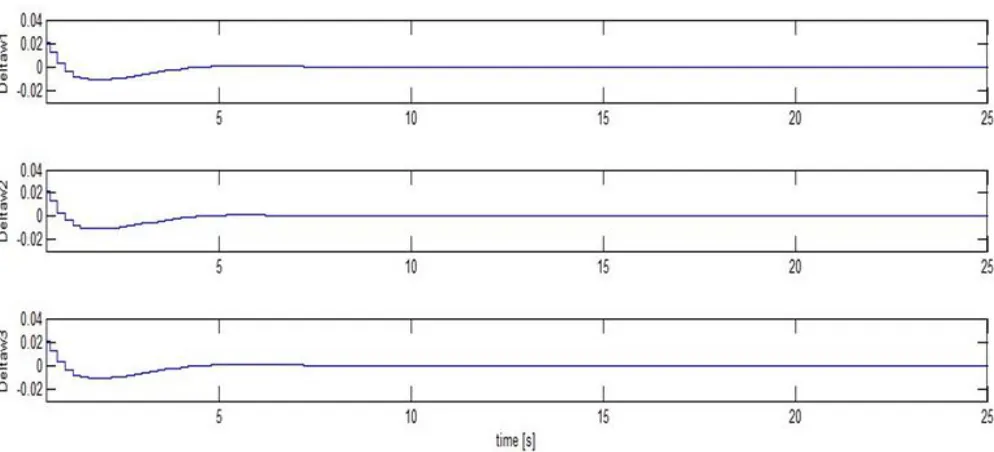
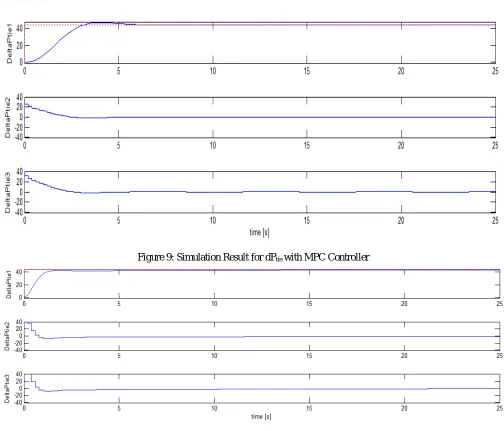
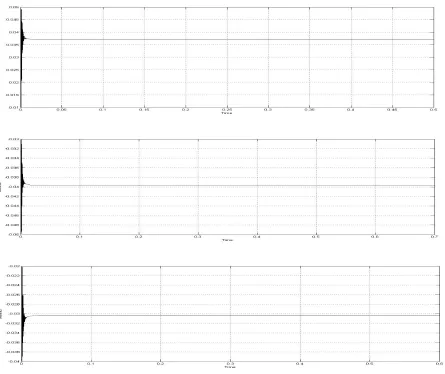
deviation of each area converges to zero, while the generation rate of GENCO unit and the load reference set point are within the specified bounds. Moreover, all the load reference set points approach zero at steady state. This is because there are no un-contracted load demands in this case.
Figure 6: Simulation Result for Delta Pmech with MPC-Fuzzy Controller
Figure 7: Simulation Result for dwwith MPC Controller
[image:8.612.55.556.485.678.2]Figure 9: Simulation Result for dPtie with MPC Controller
Figure 10: Simulation Result for dPtie with Fuzzy-MPC Controller
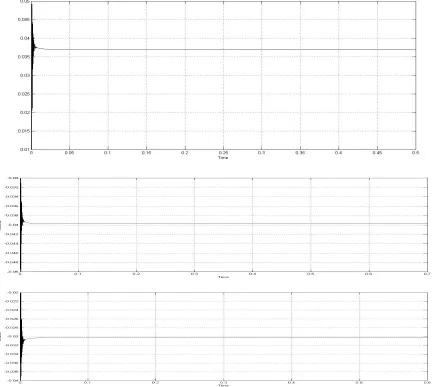
Figure 12: Simulation Result for ACEwith Fuzzy-MPC Controller B. Case2:With Contract Violation with MPC & Fuzzy-MPC Controller
[image:10.612.92.524.319.706.2]Figure 14: Simulation Result for dPtie with Fuzzy-MPC Controller VI. CONCLUSION
This paper proposed DMPC with fuzzy modelling for a complex DISCO power system. The total non-linearity due to the position limits of the governor valve was modelled by a fuzzy model. This modelling technique more accurately represents the system non-linearity and also considers the special nonminimum characteristics of the hydro power plant. The DMPC scheme is applied to the LFC problem of the deregulated three-area interconnected power system with contracted and uncontracted load demands. Analysis and simulation results have confirmed the benefits of the designed DMPC controller in achieving the comparative control performance with the cent-MPC and computation performance with the decent-MPC, while respecting GRC and load reference setpoint constraint.
REFERENCES
[1] Miaomiao Ma, Chunyu Zhang, Xiangjie Liu and Hong Chen, “Distributed Model Predictive Load Frequency Control of Multi-Area Power System after Deregulation”, IEEE TRANSACTIONS ON INDUSTRIAL ELECTRONICS
[2] G. T. C. Sekhar, R. K. Sahu, A. Baliarsingh, and S. Panda, “Load frequency control of power system under deregulated environment using optimal firefly algorithm,” Int. J. of Elec. Power Energy Syst., vol. 74, pp. 195–211, Jan. 2016.
[3] V. Donde, M. A. Pai, and I. A. Hiskens, “Simulation and optimization in an AGC system after deregulation,” IEEE Trans. Power Syst., vol. 16, no. 3, pp. 481–489, Aug. 2001.
[4] F. Daneshfar, “Intelligent load-frequency control in a deregulated environment: continuous-valued input, extended classifier system approach,” IET Gener. Transm. Dis., vol. 7, no. 6, pp. 551–559, Jun. 2013.
[5] M. H. Khooban and T. Niknam, “A new intelligent online fuzzy tuning approach for multi-area load frequency control: Self adaptive modified bat algorithm,” Int. J. of Elec. Power Energy Syst., vol. 71, pp. 254–261, Oct. 2015.
[7] W. Tan, Y. C. Hao, and D. H. Li, “Load frequency control in deregulated environments via active disturbance rejection,” Int. J. of Elec. Power Energy Syst., vol. 66, pp. 166–177, Mar. 2015.
[8] N. Chuang, “Robust H1 load-frequency control in interconnected power systems,” IET Control Theory Appl., vol. 10, no. 1, pp. 67–75, Jan. 2016.
[9] L. L. Dong, Y. Zhang, and Z. Q. Gao, “A robust decentralized load frequency controller for interconnected power systems,” ISA Transactions, vol. 51, no. 3, pp. 410–419, May. 2012.