A Comparative Study on the Effect of used Crossover
Operator on Performance of GA as a Web Page
Classifier
Neda Sabouri
Department of Computer Engineering, Science and Research Branch, Islamic Azad University, Tehran, Iran
Hamid Haj Seyyed Javadi
Department of Mathematics and Computer Science, Shahed University, Tehran,
Iran
Toktam Zhiani Asoudeh
Department of Computer Engineering, Science and Research Branch, Islamic Azad University, Tehran, Iran
ABSTRACT
By incredible and uncontrollable growth in amount of web pages on the World Wide Web, providing an infrastructure due to searching among them leads to appearance of topic specific crawling of the web. Process of focused crawlers is base on an automatic web page classification mechanism of belonging or not belonging the page to a particular topic. The Genetic algorithm (GA) is a common optimization and search technique, used as classifier of web pages. Crossover operation as one of the GA operators, by producing 2 children out of parents of past generation and determination of next generation through combining produced child, plays important roles in performance of this algorithm. Up to now many different crossover operators such as single-point, two-point and ring are presented. In this paper, we compare the effect of mentioned crossover operators on performance of GAalgorithm as a web page classifier.
General Terms
Specific crawling, focused crawler, high performance
Keywords
Genetic algorithm, web mining, Crossover Operator, Classification
1.
INTRODUCTION
The incredible increase in the amount of information on the World Wide Web converts it to an environment with potential to extract useful information and causes using tools such as web mining for having easy and quick access to pages related user’s specific topic.
For this purpose, classification as one of web mining techniques has been used for determining belonging or not belonging the web page to user’s specific topic automatically. GA as an evolutionary algorithm, improves response of problem randomly but purposeful and is used as web pages classifier [1].
Application of GA to web page classification starts with Riberio et al [2] who has proposed a web page classifier of “if condition then class i” and applied fuzzy classification. Pietramala et al [3] have introduced a GA, called Olex-GA, for the induction of rules of the form:
If a document like d, has at least one of retrieved words of positive pages whereas not include none of the terms retrieved
from negative pages then d will belong to positive class else it will be placed in negative class.
Ozel et al [4] in 2010 , has developed a GA based automatic web page classification system which uses both html tags and terms belong to each tag as classification features and learns optimal classifier from the positive and negative web pages in the training dataset.
Because of significant role of the crossover operator in genetic algorithm performance [5], So far much research has been done in comparing the effects of different crossover operators.
Kellegoz and Toklu [6] have used GA for solving job scheduling problem and reducing waiting time and compared the performance of proposed algorithm with 11 different crossover operators such as single-point, two-point.
Kaya [7], in 2011 has presented two new crossover operators, sequential and random mixed and survived their performance in Solving problems in the concrete construction industry and compared with crossover operators such as single-point. In the same year He has proposed an other crossover called ring [8] and has been tested by a number of test functions with various level of difficulty and compared with single-point, two-point, heuristic crossover operators.
Chinassri [9] in 2012 for scheduling the university courses has used GA with 3 different crossover operators: cycle, order and partially matched.
In this study, the role of different crossover operators (single-point, two-point and ring), is used by GA for classification web pages and presented by Ozel et al [4], is investigated. So Tests are conducted on two different collections which consist of related course and project homepages from Cornell, Texas, Washington and Wisconsin universities in computer science as well as some irrelevant pages from them. The experiments indicated that using two-point crossover operator has higher accuracy and F-measure value and thus higher performance than the other two operators.
This paper is organized as follows:
It is again emphasized that classification of web pages by GA is used in this study, is completely based on Ozel et al [4] presented algorithm.
2.
Feature Extraction
After evaluation of all train web pages in learning process, since the increasing features, a lot of problems such as high execution time, are occurred and with respect to this issue of important words basically appear under Header, Anchor, Bold, Italic, Emphasize, Strong, Paragraph tags [2,11,12], only the words in above tags are extracted and by type classified into categories Title, Bold, Anchor, List, Paragraph and Header. <i>, <em>, <b>, <strong> are located in Bold category, <h1>, <h2>,… in Header, <Title> in Title, <Li> in
List , <a> in Anchor and <p> in paragraph categories. Afterwards in order to reduce the number of features, ampersand and stop words are removed and by using porter’s algorithm the word will be replaced by its stemmed [13]. Finally (Tag, Term) pairs will be considered as features of algorithm. If the tags are nested, their shared words will be considered as distinct features [4].
3.
Creation of Training Pages Vectors
Provided classification algorithm is used for determining belonging or not belonging the page to a particular topic. Related and unrelated pages to the topic, respectively, are called positive and negative.
Each of pages in positive and negative classes is classified into two parts: training and testing pages.
After evaluation of positive and negative pages and extraction of their features, for each page, document vector is constructed and represented as [4]:
D = (d1N1,…,d1Nn,d2N1,…,d2Nn,…,dMN1,…,dMNn)
Where dij denotes the counting occurrences of term i in tag j.
Then each document vector is normalized by dividing sum of all values in the vector to its maximum value. So the values in a document vector lie between 0 and 1 .
4.
Genetic Algorithm
Genetic algorithm consists of 4 main parts [4]:
(i) Determination of chromosome structure, (ii) Generation of initial population, (iii) Evaluation of a population, reproduction (crossover, mutation, determination of new generation) and (iv) repeating 3 and 4 steps number of generation (gen-size) times to achieve an optima classifier.
4.1
Determination of Chromosome
Structure
Each chromosome as a point in the search space and a possible solution for problem is representing as [4]:
C = (c1N1,…, c1Nn, c2N1,…,c2Nn,…,cMN1,…, cMNn)
Where cij, real number in the range [0,1], denotes the weight
of term i in tag j.
4.2
Generation of initial population
To start this algorithm, we should randomly generate pop-size (number of chromosomes in the population) chromosomes [4].
4.3
Determination of fitness function
Since in classification based on GA the goal is to find the best chromosome, with respect to the fitness value, and using it as classifier, a function must be provided to determine the fitness of each existing chromosome.Used fitness function acts based on cosine similarity [14] and
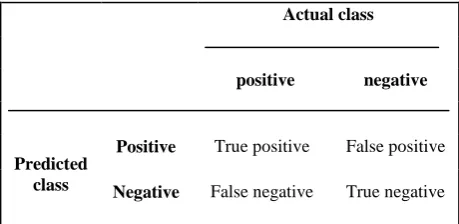
[image:2.595.317.547.209.321.2]contingency matrix [2, 15] (given in Table 1) [4].
Table 1. Contingency matrix for binary classification system
The cosine similarity between a chromosome vector (c) and a document vector (d), represents the degree of similarity between them and is shown as sim(c,d) .
( 1 )
M
1 i
M
1 i
N
1 j
d ij2 N
1 j
cij2 M
1 i
N
1 j d ij
cij
=
| D |×| C |
D . C C,D)= Sim (
cand d are normalized , so since cij ≥ 0 and dij ≥ 0 ,
sim(c,d) varies from 0 to 1.
To evaluate fitness of a chromosome, the sim values of the chromosome and all documents in training data set are computed. A threshold value is determined by taking the difference between the average and the standard deviation of computed sims.
The fitness evaluation of a chromosome is performs in four steps [4]:
1) sim of that chromosome to each of web page document in training dataset is computed.
2) The difference between the average and standard deviation of computed sims is taken as a threshold value. It should be mentioned that a number of threshold values were used and is observed that the chosen threshold equation performs well for this GA.
Actual class
positive negative
Predicted class
Positive True positive False positive
3) If the sim between a web page and the chromosome is greater than obtained threshold value, the web page is classified as a positive document otherwise it’s labeled as negative.
4) Fitness value of the chromosome is determined by [2]:
( 2
) TPR× TNR
= Fitness
Where True-Positive-Rate and True-Negative-Rate values are computed as (based on contingency matrix):
( 3
) Negatives
ives+False True Posit
ives True Posit
= TPR
( 4
) Positives
ives+False True Negat
ives True Negat
= TNR
According to Table 1, True Positives (True Negatives) mean the positive (negative) documents that were correctly labeled by the classifier and false positives (False Negatives) are the negative (positive) documents that were incorrectly labeled.
4.4
Reproduction
In this step, selection, crossover and mutation operators are used.
4.4.1
Selection
By this operator, some of existing chromosomes are chosen for reproduction. Among the different selection methods, a biased roulette wheel is used [4]. Base on this operator (1) For each chromosome i :
1) probability pi, is computed by :
( 5
)
size pop
1 i
Fi Fi
= P i
Where Fi is the fitness value of chromosome i.
2) Cumulative probability Ci, is obtained by
( 6
)
j
1 i
F j
= Ci
(2) A random number r, uniformly distributed in [0,1] is generated pop-size times and each time the kith chromosome is selected if Ck-1 < r ≤ Ck .
if 0 ≤ r ≤ C1, C1 else if Cpop-size ≤ r ≤ 1 then Cpop-size will be
chosen.
4.4.2
Crossover
Crossover is a genetic operator that combines two chromosomes (parents) to produce a new chromosome, hoping to reach more appropriate chromosomes.
There are a number of different crossover operators can be used in GA.
In this study, single-point, two-point and ring crossover operators are investigated. For this purpose, first the two parental chromosomes are selected randomly among the chosen chromosomes at the selection step. A random number r, uniformly distributed in [0,1], is generated to determine whether combination should be occurred or not.
4.4.2.1
Single-point crossover
A random integer number (p) in (0, m×n) is generated, if r ≤ p(c) then selected chromosomes are spilt at p point and combined with each other. Otherwise no crossover is performed and the randomly chosen parents are taken as children without any change [4,6,7].
4.4.2.2
Two-point Crossover
Two random integer number p, q in (0, m×n) are generated. If r ≤ p(c) then selected chromosomes are split at p and q points and elements between them will be exchanged. Otherwise no crossover is performed and the randomly chosen parents are taken as children without any change [8].
4.4.2.3
Ring Crossover
A random integer number p in (0, 2× m×n) is generated. If r ≤ p(c) , Firstly, two selected chromosomes are combined with a form of ring, then the first child is created by cutting the obtained ring of r point to the length of m×n and the other one is created by reversing the remaining genes. Otherwise no crossover is performed and the randomly chosen parents are taken as children without any change [9].
After applying each above crossover operation, the randomly chosen parent chromosomes are excluded from the chromosome list generated in the selection step and the crossover operation continues until the list becomes empty.
4.4.3
Mutation
After the crossover operation, all of resulting chromosomes are subjected to the mutation operation such that for each gene cij in the chromosome C, a random number r from the interval
[0,1] is generated and the gene is mutated as follows [4]:
(
7
)
If r ≤ P(M) Random value
in [0,1] c′ij =
Otherwise cij
Where c′ij is the new value of the gene cij after the mutation,
P(M) is the mutation probability whose value is determined experimentally in test step.
4.4.4
Evaluation the Fitness of resulting
chromosomes
In this step fitness of resulting chromosomes (as new generation) are evaluated [4].
4.4.5
Determination of the new generation
4.5
Classifier selection
The above processes are repeated gen-size (predefined parameter) times and the best chromosome, with respect to the fitness value, is returned to be used as the classifier [4].
5.
Experimental results
In this section different crossover operators used by obtained classifier on test dataset and their effects on classification performance are tested.
5.1
Dataset
Used datasets consists of related course and project homepages from Cornell, Texas, Washington and Wisconsin universities in computer science as well as some irrelevant pages from them. These pages were obtained from the webkb [10] project (well-known and freeware datasets).
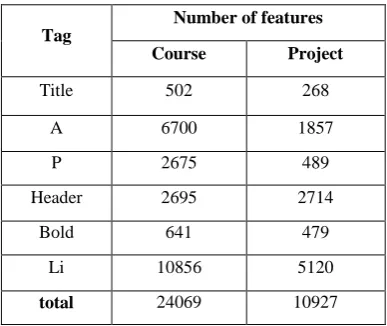
[image:4.595.313.539.298.379.2]The goal is to classify above homepages to positive (relevant pages to above universities) and negative (irrelevant pages). So all pages are classified into 2 classes: Test and train where Number of pages in each class and count of features for each dataset, respectively, are given in Table 2 and Table 3.
Table 2. Number of documents in the datasets
Total train Test
Class Dataset
1051 158
72 Course(positive)
Course
575 246 Not course (negative)
504 69 17
Project (positive)
Project
[image:4.595.55.288.350.445.2]314 104 Not project (negative)
Table 3. Number of features for each dataset
Number of features Tag
Project Course
268 502
Title
1857 6700
A
489 2675
P
2714 2695
Header
479 641
Bold
5120 10856
Li
10927 24069
total
5.2
Determination of GA Parameters
Genetic algorithm parameters were determined experimentally such that gen-size = 500, pop-size = 30, P(C) = 0.8 and P(M) = 0.1 were good choices for this classifier. For each experiment, the learning phase was repeated 10 times and the average of results were reported.5.3
Crossover operators comparisons
In this study for measuring and comparing the effect of different crossover operators on performance of the classifier, two most commonly values, accuracy and F-measure are used. For this purpose , first statistical method χ2 is applied to determine the weight of each term in training homepages of each dataset (all positive and negative pages with N Number) where denotes the dependence of feature F to positive homepages class cj [16].( 8
) C+D))
D)×(A+B)×( ((A+C)×(B+
2
)=N (
2F,Cj
(AD-CB)
χ
Where A, B, C, D values are computed base on Table 4.
Table 4. A, B, C, D variables calculation
Documents contains F
feature
Documents without F
feature
Pages in cj class A C
Other pages B D
5.3.1
Accuracy Comparison
The accuracy of the learned classifier with different crossover operators is computed as [2,4]:
(9) s
+ Negative Positives
Negatives ives+True
True Posit =
accuracy
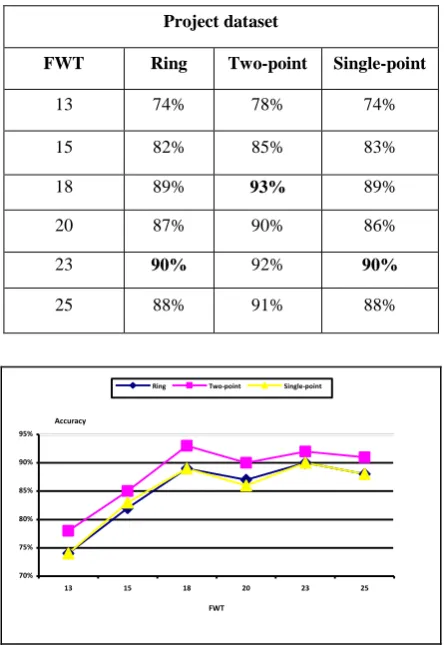
Results of course and project dataset are presented in Table 5, Figure 1 and Table 6, Figure 2, respectively and the highest accuracy value for each classifier in each dataset is written in boldface.
[image:4.595.70.264.473.636.2]According to Table 5, for all feature weight thresholds (FWT), accuracy of classifiers with two-point and ring are higher than single-point crossover.
Table 5. Effect of FWT on accuracy for course dataset
Course dataset
Single-point Two-point
Ring FWT
90% 91%
90% 25
92% 92%
92% 40
93% 95%
94% 58
93% 95%
93% 70
92% 94%
95%
85
90% 91%
94% 105
88% 90%
[image:4.595.319.538.589.754.2]86% 88% 90% 92% 94% 96%
25 40 58 70 85 105 150
FWT accuracy
[image:5.595.60.276.84.251.2]R ing T wo - po int S ingle - po int
Fig 1: Accuracy values for course dataset
[image:5.595.56.280.316.639.2]On the other hand due to the Table 6, accuracy of classifier with two-point crossover is highest.
Table 6. Effect of FWT on accuracy for project dataset
Project dataset
Single-point Two-point
Ring FWT
74% 78%
74% 13
83% 85%
82% 15
89%
93%
89% 18
86% 90%
87% 20
90%
92%
90%
23
88% 91%
88% 25
70% 75% 80% 85% 90% 95%
13 15 18 20 23 25
FWT Accuracy
[image:5.595.326.531.485.658.2]Ring Two-point Single-point
Fig 2: Accuracy values for project dataset
Based on above experimental results, it can be concluded that for both datasets, two-point crossover operator is leading to higher accuracy than the other two crossover operators. The best FWT depends on used dataset and ratio of negative and positive pages in training dataset.
5.3.2
F-measure comparison
The F-measure as another commonly used value for measuring performance of classifiers is defined as [2,4]:
(
10
)×
2
=
measure
-Recall
Precision+
Recall
Precision×
F
Where precision and recall are computed as :
( 11
) s
e Positive ives+ Fals True Posit
ives True Posit =
Precision
( 12
) s
e Negative ives+ Fals
True Posit
ives True Posit =
Recall
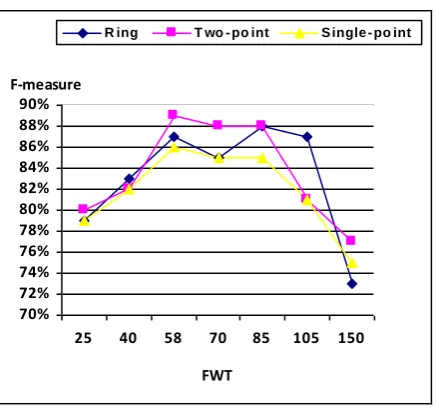
The F-measure value for course and project dataset are shown in Table 7, Figure 3 and Table 8, Figure 4 respectively and the highest value for each classifier in each dataset are written in boldface.
According to Table 7, maximum F-measure of classifier with single-point, two-point and ring crossover operators are respectively 86%, 89% and 88%.
In project dataset, according to Table 8, are 65%, 68% and 58%.
Base on presented results, it’s specified that the classifier with two-point crossover has higher performance than the other two crossover operators.
Table 7. Effect of FWT on F-measure of course dataset
Course dataset
Single-point Two-point
Ring FWT
79% 80%
79% 25
82% 82%
83% 40
86% 89%
87% 58
85% 88%
85% 70
85% 88%
88%
85
81% 81%
87% 105
75% 77%
70% 72% 74% 76% 78% 80% 82% 84% 86% 88% 90%
25 40 58 70 85 105 150
FWT F-measure
[image:6.595.59.278.67.273.2]R ing T wo - po int S ingle - po int
[image:6.595.58.279.298.663.2]Fig 3: F-measure values for course dataset
Table 8. Effect of FWT on F-measure of project dataset
Project dataset
Single-point Two-point
Ring FWT
43% 47%
46% 13
50% 55%
52% 15
65% 68%
58%
18
45% 53%
50% 20
54% 59%
54% 23
29% 32%
29% 25
30% 35% 40% 45% 50% 55% 60% 65% 70%
13 15 18 20 23 25
FWT F-measure
Ring Two-point Single-point
Fig 4: F-measure values for project dataset
6.
Conclusion
In this paper we have study on the effect of used crossover operator on performance of GA as a web page classifier. So we have used single-point, two-point and ring crossover operators and evaluated the performance of them. According to the results, it was found that used classifier with two-point crossover, not only will lead to higher accuracy than the two other operators, but also has the highest rate of F-measure.
Meanwhile, the running time of used classifier is the same for 3 mentioned crossover operators.
7.
References
[1] Holland, J. 1975. Adaptation in Natural and Artificial Systems: An Introductory Analysis with Applications to Biology, Control, and Artificial Intelligence”, Cambridge, MA: MIT Press (1992).
[2] Ribeiro, A., Fresno, V., Garcia-alegre, M., Guinea, D. and Carlos, J. 2003. Web page classification, A soft computing approach, Lecture Notes in Artificial Intelligence, 2663, pp.103-112.
[3] Pietramala, A., Policicchio, V., Rullo, P. and Sidhu, I. 2008. A Genetic Algorithm for Text Classification Rule Induction, Lecture Notes in Artificial Intelligence, 5212, pp. 188-203.
[4] Özel, S. 2010. A Web Page Classification System Based on a Genetic Algorithm Using Tagged-Terms as Features”, Expert Systems with Applications.
[5] Reeves, C. and Rowe, J. 2003. Genetic Algorithms Principles and Perspectives, Kluwer Academic Publishers. Dordrecht.
[6] Kellegoz, T., Toklu, B. and Wilson, J. 2008. Comparing efficiencies of genetic crossover operators for one machine total weighted tardiness problem, Applied Mathematics and Computation , Vol 199, pp. 590–598. [7] Kaya, M. 2011. The effects of two new crossover
operators on genetic algorithm performance, Applied Soft Computing, 11, pp. 881–890.
[8] Kaya, Y., Uyar, M. and Tekin, R. 2011. A Novel Crossover Operator for Genetic Algorithms: Ring Crossover, Computing Research Repository Journal, Vol .abs/1105.0.
[9] Chinnasri, W. 2012. Performance comparison of Genetic Algorithm's crossover operators on University Course Timetabling Problem , Computing Technology and Information Management, vol.2, pp. 781-786.
[10] Craven, M., Dipasquo, D., Freitag, D., Mccallum, A., Mitchell, T., Nigam, K. and Slattery, S. 1998. Learning to Extract Symbolic Knowledge from the World Wide Web, The 15th national conference on artificial intelligence, pp. 509-516.
[11] Kim, S. and Zhang, B. 2003. Genetic mining of html structures for effective web document retrieval, Applied Intelligence, 18, pp. 243-256.
[12] Trotman, A. 2005. Choosing document structure weights, Information Processing and management, 41(2), pp. 243-264.
[13] Porter, M. 1980. An algorithm for suffix stripping”, Program, 14(3), pp. 130-137.
[14] Salton, Wong and Yang. 1975. A vector space model for automatic indexing, Communications of the ACM ,18(11),pp. 613-620.
[15] Kamber, M. and Han, J. 2008. Data mining: Concepts and Techniques (2nd ed), San Francisco, Morgan Kaufman publisher, ISBN 1-55860-901-6.