Journal of Child Language
http://journals.cambridge.org/JCL
Additional services for
Journal of Child
Language:
Email alerts: Click here Subscriptions: Click here Commercial reprints: Click here Terms of use : Click here
The acquisition of German relative clauses: A
case study*
SILKE BRANDT, HOLGER DIESSEL and MICHAEL TOMASELLO
Journal of Child Language / Volume 35 / Issue 02 / May 2008, pp 325 348 DOI: 10.1017/S0305000907008379, Published online: 16 April 2008
Link to this article: http://journals.cambridge.org/abstract_S0305000907008379
How to cite this article:
SILKE BRANDT, HOLGER DIESSEL and MICHAEL TOMASELLO (2008). The acquisition of German relative clauses: A case study*. Journal of Child Language, 35, pp 325348 doi:10.1017/S0305000907008379
The acquisition of German relative clauses:
A case study*
S I L K E B R A N D T
Max-Planck-Institute for Evolutionary Anthropology
H O L G E R D I E S S E L
University of Jena
A N D
M I C H A E L T O M A S E L L O
Max-Planck-Institute for Evolutionary Anthropology
(Received18December2005. Revised16January2007)
A B S T R A C T
This paper investigates the development of relative clauses in the speech of one German-speaking child aged 2 ; 0 to 5 ; 0. The earliest
relative clauses we found in the data occur in topicalization
constructions that are only a little different from simple sentences : they contain a single proposition, express the actor prior to other participants, assert new information and often occur with main-clause word order. In the course of the development, more complex relative constructions emerge, in which the relative clause is embedded in a fully-fledged main clause. We argue that German relative clauses develop in an incremental fashion from simple non-embedded sentences that gradually evolve into complex sentence constructions.
I N T R O D U C T I O N
The acquisition of relative clauses has been studied extensively over the past forty years (e.g. Sheldon, 1974 ; Tavakolian, 1981 ; Goodluck & Tavakolian, 1982 ; Hamburger & Crain, 1982 ; Clancy, Lee & Zoh, 1986 ; Crain, McKee & Emilliani, 1990 ; Correˆa, 1995 ; Goodluck & Stojanovic´, 1997 ; McKee,
[*] Addresses for correspondence : Silke Brandt & Michael Tomasello, Max-Planck-Institut fu¨ r evolutionaere Anthropologie, Deutscher Platz 6, 04103 Leipzig, Germany. Email : [email protected], [email protected]. Holger Diessel, University of Jena, Ernst-Abbe-Platz 8, 07743 Jena, Germany. [email protected]
McDaniel & Snedeker, 1998 ; Diessel & Tomasello, 2000, 2005 ; Kidd & Bavin, 2002 ; Diessel, 2004 ; Ozeki & Shirai, in press). Most of these studies investigate the acquisition of relative clauses in the framework of generative grammar. Diessel (2004) and Diessel & Tomasello (2000, 2005) provide the first usage-based analysis of the development of relative clauses, in which constructions are the basic elements of grammar. A construction is a complex linguistic sign combining a grammatical pattern with a particular meaning (cf. Goldberg, 1995). Using corpus data from four English-speaking children aged 2 ; 0 to 5 ; 0, Diessel & Tomasello observed that children’s early relative clauses appear in presentational constructions consisting of a copular clause and a finite or non-finite relative clause in which the subject is gapped or relativized, as in the following examples (cf. Diessel, 2004 : 131, 139) :
(1) Here’s a tigerthat’s gonna scare him. (2) This is the sugarthatgoes in there.
(3) This is the horse sleeping in a cradle, their bed. (4) Dere’s was a kitty walking by.
Although these sentences consist of two clauses, they describe only a single state of affairs. The copular clause does not denote an independent situation, but functions to focus the interlocutors’ attention on a particular referent that is semantically integrated in the relative clause (cf. Lambrecht, 1988). Since the relative clause contains the only proposition, it is semantically more elaborated than the copular clause ; very often the relative clause asserts new information like a main clause. Starting from such simple structures, children gradually produce more complex relative constructions that become increasingly different from simple main clauses. The whole development can be characterized as a process of clause expansion whereby a simple sentence is gradually transformed into a bi-clausal construction (cf. Diessel, 2004).1
Interestingly, there are a number of studies suggesting that the development of relative clauses in other languages takes a similar pathway. For instance, Dasinger & Toupin (1994) noticed the predominance of presentational relative constructions in the speech of Spanish- and Hebrew-speaking children, which they collected in a picture book task, and Hudelot (1980) reports that the vast majority of children’s spontaneous
relative clauses in French are attached to the predicate nominal of a copular clause. Moreover, Hermon (2005) argued that there are striking parallels in the development of relative clauses in English and Indonesian : like English-speaking children, Indonesian-speaking children begin to produce relative clauses in structures that denote only a single state of affairs.
Generalizing across these studies, one might hypothesize that there is a general cross-linguistic pattern of development whereby relative clauses evolve from simple non-embedded sentences.2 Starting from this
hypothesis, the current paper examines the development of relative clauses in German. First, we will discuss formal and functional differences and similarities between embedded and non-embedded clauses in German. Then we will investigate how the similarities might facilitate the step from the use of non-subordinate main clauses to subordinate relative clauses.
German is a so-called verb-second language, in which the main clause includes the finite verb in second position ;3 but in subordinate clauses the
finite verb occurs after all other elements at the end of the clause. This makes the development of German relative clauses particularly interesting in the light of the above hypothesis : if German relative clauses evolve from simple non-embedded sentences, like relative clauses in English, it seems reasonable to assume that the development of German relatives originates from grammatical constructions with main clause (i.e. verb-second) word order.
In German grammar, relative clauses are commonly defined as
subordinate clauses including the finite verb in final position ; but the position of the finite verb is only one of the features that characterize German relative clauses. In addition, the following features must be taken into account : (1) relative clauses provide information about a nominal referent in the previous clause ; (2) they include a case-marked relative pronoun that indicates the syntactic function of the nominal referent in the relative clause ; (3) the relative pronoun is generally the first word in the relative clause ; and (4) the antecedent of the relative pronoun is the immediately preceding NP (cf. Eisenberg, 2004). Interestingly, although all of these features are necessary to define German relative clauses, the
[2] That does not mean that relative clauses generally evolve from presentational constructions. In fact, Ozeki & Shirai (in press) have shown that in contrast to English-speaking children, Japanese-speaking children use relative clauses only rarely in presentational constructions. However, reanalyzing Ozeki & Shirai’s data, Diessel (2007) argues that although the development of Japanese relative clauses does not originate from presentational constructions, early Japanese relatives occur in constructions that are similar to children’s early relative constructions in English in that they contain only a single proposition.
position of the finite verb is sometimes the only surface feature that distinguishes them from simple main clauses, as in the following examples :
(5) Da ist Michael, der mir gestern geholfen hat.
There is Michael, who me yesterday helped has
‘ There is Michael who helped me yesterday. ’
(6) Da ist Michael, der hatmir gestern geholfen.
There is Michael, who/he has me yesterday helped ‘ There is Michael who helped me yesterday. ’
On the surface, the sentences in (5–6) are identical except for the position of the finite verb : both sentences are combined by an anaphoric pronoun resuming the immediately preceding NP at the beginning of the second clause. However, based on the position of the finite verb, (5) can be classified as a complex sentence construction including a relative clause, whereas (6) consists of two main clauses combined by a case-marked anaphoric demonstrative pronoun that is morphologically indistinguishable from a relative pronoun. While the two constructions are commonly divided into separate clause types (based on the position of the finite verb), there can be no doubt that the verb-second construction in (6) resembles the relative construction in (5).4 In fact, as can be seen in (7) there are verb-second
constructions that are indistinguishable from relative clauses : (7) Dort sitzt ein Mann, der schla¨ ft?
There sits a man, who/he sleeps
‘ There is a man who is sleeping ? ’
Example (7) has the same structure as examples (5) and (6) ; it consists of two clauses that are combined by an anaphoric pronoun at the beginning of the second clause. But since the second clause includes only two words, the anaphoric pronoun and an intransitive verb, the position of the finite verb is not sufficient to indicate the clause type : the verb occurs in second position but is also the final element of the clause. In other words, example (7) is ambiguous between an interpretation as main and relative clause.
Since children are very sensitive to surface similarities (Gentner, 1989), it seems reasonable to assume that they recognize the structural overlap between main and relative clauses, which in turn may influence the acquisition process. More precisely, since there are main clauses that are only a little different from relative clauses, one might hypothesize that these constructions provide a starting point for the development of German relatives. Thus, we decided to include verb-second constructions into our database if they were only minimally different from relative clauses (see
below). Following Gaertner (1998), we refer to these structures as V2-relatives, but without committing ourselves to a particular grammatical analysis.
Although V2-relatives do not exhibit the same syntactic properties as ordinary relative clauses (e.g. V2-relatives cannot be center-embedded), on the surface they are so similar to verb-final relatives that they are often classified as a particular type of relative clause (cf. Schuetze-Coburn, 1984 ; Lambrecht, 1994 ; Auer, 1998 ; Weinert, 2004). While this analysis may not be compatible with a theoretical approach in which main and subordinate clauses are discrete categories defined by syntactic tests, it can easily be accommodated by the usage-based approach, in which grammatical categories are grounded in the speaker’s experience with language. Since experience-based categories are constantly changing (both in history and in the lifetime of a person), it is reasonable to assume a fluid transition between main- and subordinate clauses (cf. Lehmann, 1988 ; Diessel, 2004). In other words, while V2-relatives may not pass the categorical tests of relative clauses, they are relevant to the development of German relatives because they are at the borderline between main and subordinate clauses, which makes them interesting for our study.
If the acquisition of German relative clauses originates from simple sentences, as we hypothesize, V2-relatives may help the child to bootstrap from simple main clauses into complex relative constructions. Assuming that children draw on their previous knowledge of simple sentences in their first attempts to produce relative clauses, we would predict a developmental shift from V2-relatives to verb-final constructions. In other words, the particular properties of German relative clauses allow us to test our central hypothesis that the earliest relative clauses evolve through small extensions from simple main clauses.
In what follows, we describe the development of relative clauses in the speech of one German-speaking child aged 2 ; 0 to 5 ; 0. Concentrating on verb-final constructions, Rothweiler (1993) examined the development of German relatives in spontaneous child speech, but since her data include only a few dozen (verb-final) relatives collected from children after the age of 2 ; 9, her data are not sufficient to characterize the early development of German relative clauses. Apart from Rothweiler’s observational study, there are a few experimental studies on the acquisition of German relative clauses, but they concentrate on particular types of relative clauses and consider only older children (cf. Grimm & Wintermantel, 1975).
D A T A
family in Leipzig ; his caregivers have higher education and speak Standard German. The data consist of 383 one-hour recordings of child–adult interactions between the ages of 2 ; 0 and 5 ; 0. During the first year of the study, the recordings were made five times a week and were supplemented by diary utterances collected by Leo’s caregivers. After the age of 3 ; 0, Leo was recorded five times a month. Overall, the corpus includes nearly half a million words and 6,300 diary utterances, which is the largest and densest database that has ever been compiled of a single child. The transcripts were automatically tagged by a German version of the CHILDES MOR-program (cf. MacWhinney, 2000), developed by Behrens (2000) and linked to the corresponding sound files.
Since we hypothesized that the development of relative clauses originates from simple main clauses, we searched for two target structures : ordinary relative clauses and V2-relatives, which we limited to constructions that are only minimally different from ordinary relative clauses (see below). The two target structures were identified by the following criteria :
’ They consist of two finite clauses.
’ The second clause provides information about a nominal referent in the previous clause.
’ The second clause includes a case-marked anaphoric pronoun that indicates the syntactic function of the nominal referent in the second clause.
’ The anaphoric pronoun is generally the first constituent in the second clause.
’ The antecedent of the anaphoric pronoun is the immediately
preceding NP.
V2-relatives are defined as constructions that differ from ordinary relative clauses only by the position of the finite verb. The following criteria were used to distinguish relatives from structurally more distinct V2-constructions :
’ V2-relatives include a demonstrative pronoun that is formally
indistinguishable from a relative pronoun. Constructions including other types of pronouns were disregarded.
’ V2-relatives include the demonstrative pronoun in the first position of the clause. Constructions including a demonstrative pronoun in a different position were disregarded.
’ V2-relatives modify a nominal expression in the immediately
PP, the relative clause may be attached to a nominal expression across an intervening NP).
’ V2-relatives serve to provide information about a nominal referent. Constructions functioning as questions or other types of speech acts were disregarded.
Using the PERL program we automatically extracted all structures from the transcripts that include a relative/demonstrative pronoun following a lexical NP.5 The output of the search files was subsequently checked for mistakes
by the first and second authors. Based on the criteria stated above, the first and second authors agreed on all target structures that were entered into the analysis. Since the PERL output contained utterances that did not qualify as relative clauses according to our definition, the first author compared one automatically extracted search file to a list of relative clauses that were manually extracted from one 1-hour recording. None of the manually extracted relative clauses were missing.
Overall, there are 786 child relative clauses in the transcripts. Table 1 provides an overview of the data. For demonstrating and investigating developmental shifts, we have divided the data into five broad age periods, namely 2 ; 0–2 ; 6, 2 ; 6–3 ; 0, 3 ; 0–3 ; 6, 3 ; 6–4 ; 0 and 4 ; 0–5 ; 0. As can be seen in this table, Leo begins to produce relative clauses very early (the first relative clause included in the transcripts appears at 2 ; 2), but initially relative clauses are rare. Between the ages of 2 ; 0 and 2 ; 6, only 0.12 % of Leo’s utterances include a relative clause, but in the following years the proportion increases steadily up to a level of 0.86 % between 4 ; 0 and 5 ; 0.
In addition to Leo’s relative clauses, we collected and analyzed a subset of his caregivers’ relative clauses. These data come from five different periods of the study, when Leo was 2 ; 0, 2 ; 7, 3 ; 2, 3 ; 9 and 4 ; 10, and include a total of 330 relative clauses. Table 2 provides an overview of the caregivers’ data. As can be seen in this table, the caregivers’ utterances include a larger
T A B L E1.Total number of Leo’s relative clauses
Age
Total number of utterances in Leo’s corpus
Total number of Leo’s relative clauses
2 ; 0–2 ; 6 77,870 92 (0.12 %)
2 ; 6–3 ; 0 55,921 309 (0.55 %)
3 ; 0–3 ; 6 13,429 90 (0.67 %)
3 ; 6–4 ; 0 11,574 96 (0.82 %)
4 ; 0–5 ; 0 22,910 199 (0.86 %)
Total 181,704 786 (0.43 %)
proportion of relative clauses than Leo’s data and their relative constructions are more evenly distributed over the time period of the study.
C O D I N G
All target constructions were coded for three features : (1) the position of the finite verb ; (2) the syntactic role of the head ; and (3) the syntactic role of the relativized element. We will discuss these features in turn.
The position of the finite verb
Since some verb-second constructions are ambiguous between verb-final and verb-second relative clauses (see above), we divided Leo’s relative clauses into three types : (1) verb-final relatives ; (2) verb-second relatives ; and (3) ambiguous relatives. No other word orders, such as V3, appeared in the data. An example of each type is given (8a–c) :
(8) a. Der Mann, der Peter geholfen hat. Verb-final relative
The-NOM man who-NOM Peter helped has ‘ The man who helped Peter. ’
b.Der Mann, der hat Peter geholfen. Verb-second relative The-NOM man who-NOM/he has Peter helped
‘ The man who helped Peter. ’
c. Der Mann, der schla¨ft. Ambiguous The-NOM man who-NOM/he sleeps
‘ The man who sleeps. ’
The syntactic role of the head
Like English relative clauses, German relative clauses can be attached to any nominal element in the main clause. Five different types of relative
T A B L E 2.Total number of Leo’s caregivers’ relative clauses included in this study
Age (Leo)
Total number of utterances in Leo’s caregivers’ corpus
Total number of Leo’s caregivers’ relative clauses
2 ; 0 5,377 82 (1.5 %)
2 ; 7 4,946 58 (1.2 %)
3 ; 2–3 ; 3 4,209 62 (1.5 %)
3 ; 9–3 ; 10 4,012 61 (1.5 %)
4 ; 10–4 ; 11 4,266 67 (1.6 %)
clauses have been distinguished, based on the syntactic role of the head noun : (1) SUBJ-relatives, which are attached to the subject of the main clause ; (2) OBJ-relatives, which are attached to the direct object of the main clause ; (3) OBL-relatives, which are attached to the noun phrase of a prepositional phrase in the main clause ; (4) NP-relatives, which are attached to an isolated head noun ; and (5) PN-relatives, which are attached to the predicate nominal of a copular main clause. An example of each type is given in (9a–e) ;
(9) a. Der Mann, der dir geholfen hat, SUBJ-relative
The-NOM man who-NOM you-DAT helped has heißt Mu¨ ller.
is :called Mu¨ ller
‘ The man who helped you is called Mu¨ ller. ’
b.Peter kennt den Mann, der dir OBJ-relative Peter knows the-ACC man who-NOM you-DAT
geholfen hat. helped has
‘ Peter knows the man who helped you. ’
c. Peter spricht mit dem Mann, OBL-relative Peter talks to the-DAT man
der dir geholfen hat. who-NOM you-DAT helped has ‘ Peter talks to the man who helped you. ’
d.Der Mann, der dir geholfen hat. NP-relative The-NOM man, who-NOM you-DAT helped has
‘ The man who helped you. ’
e. Das ist der Mann, der dir PN-relative That is the-NOM man who-NOM you-DAT
geholfen hat. helped has
‘ That’s the man who helped you. ’
The syntactic role of the relativized element
The head of the relative clause must be distinguished from the relativized syntactic role within the relative clause. In German, the relativized syntactic role is indicated by the case feature of the relative pronoun.6 Five different
types can be distinguished : (1) subject relatives, which include a relative pronoun in nominative case ; (2) direct-object relatives, which include a
relative pronoun in accusative (or dative) case ;7(3) indirect-object relatives,
which include a relative pronoun in dative case and a ditransitive verb ; (4) oblique relatives, which include a preposition and a relative pronoun in dative or accusative case ;8and (5) genitive relatives, which include a relative
pronoun in genitive case functioning as attribute of the following noun. In V2-relatives, demonstrative pronouns express the same range of syntactic roles. In order to distinguish the relativized syntactic role from the head of the relative clause, we used capital letters for the syntactic role of the head and small letters for the syntactic role of the relativized element (cf. 10a–e) :
(10) a.Der Mann, der uns gesehen hat. subj-relative
The-NOM man, who-NOM us-DAT seen has ‘ The man who saw us. ’
b.Der Mann, den wir gesehen haben. obj-relative The-NOM man, who-ACC we-NOM seen have
‘ The man who we saw. ’
c.Der Mann, io-relative
The-NOM man,
dem wir das Buch gegeben haben. who-DAT we-NOM the-ACC book given have ‘ The man who we gave the book to. ’
d.Der Mann, dessen Frau uns gen-relative The-NOM man, whose-GEN wife us-ACC
gesehen hat. seen has
‘ The man whose wife has seen us. ’
e.Der Mann, mit dem wir obl-relative The-NOM man with whom-DAT we-NOM
gesprochen haben. talked have
‘ The man to whom we talked. ’
R E S U L T S
Verb-final and verb-second relatives
Leo’s data include 465 verb-final relatives and 247 verb-second relatives ; in addition, there are 71 relative clauses that are ambiguous between the two
[7] There are a few transitive verbs that occur with a dative object (e.g.der Mann, dem wir geholfen haben‘ The man, whom.DAT we helped have ’), but usually the direct object occurs in accusative case.
interpretations. That the two types of relative clauses are closely related is suggested by the fact that Leo often switches between them. In fact, as can be seen in (11a–b) and (12a–b), a few relative clauses differ only in the placement of the finite verb. Both pairs of examples occurred in the same transcripts, but were separated from each other by several turns. The co-occurrence of these constructions does not imply that Leo uses them at random. On the contrary, in accordance with the use of these constructions in adult language, he mainly uses V2-relatives in utterances that express new information and are communicatively more important than verb-final relative clauses, which are commonly backgrounded.
(11) a.Und da ist der Fisch,_ Zahnschmerzen/ein Wal,
And there is the fish_ toothache/a whale, der hat Zahnschmerzen.
that-NOM has toothache-PL
‘ And there is the fish,_toothache/a whale, that has toothache. ’ (Leo 2 ; 9)
b.Wo ist ein Wal, der Zahnschmerzen hat ? Where is a whale that-NOM toothache-PL has ‘ Where is a whale that has toothache ? ’
(Leo 2 ; 9)
(12) a.Im Schlangenhaus ist sicher auch einer dabei, In.the snake.house is surely also somebody present der passt auf.
who-NOM watches out
‘ In the snake house there is surely also somebody present who is watching out. ’
(Leo 4 ; 11)
b.Bei’n Schlangenhaus ist auch jemand, der aufpasst. At.the snake.house is also somebody who-NOM out.watches ‘ At the snake house there is also somebody who is watching out. ’ (Leo 4 ; 11)
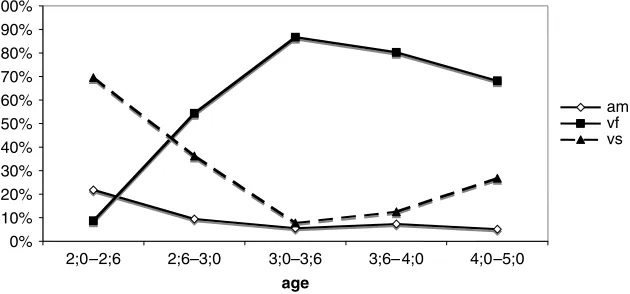
relative clauses occur with the finite verb in final position.9 A x2-test,
excluding relatives with ambiguous word order, shows that the distributions of verb-second and verb-final relatives are significantly different from one another at different age levels (x2(4, N=712)=144.146, p<0.001),
suggesting that the development of German relative clauses involves a crucial shift from verb-second to verb-final constructions, which seems to take place around the age of 3 ; 0. In other words, the data are consistent with our hypothesis that the development of relative clauses originates from main clause structures.
The head of the relative clause
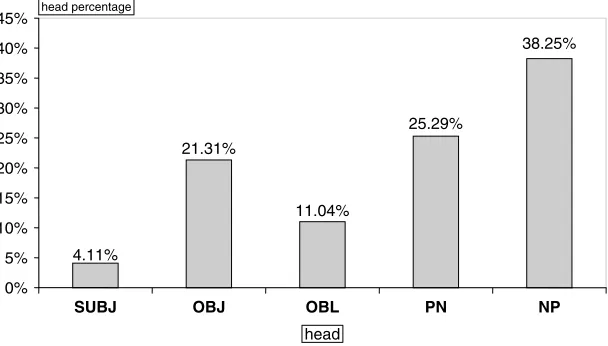
Turning to the external syntactic properties of Leo’s relative clauses, we find that they are often headed by an isolated NP. As can be seen in Figure 2, 38.3 % of Leo’s relatives are NP-relatives, i.e. relative clauses that are attached to an isolated noun phrase. Apart from NP-relatives, PN-relatives (25.3 %) and OBJ-PN-relatives (21.3 %) are quite common ; but OBL-relatives (11.0 %) and especially SUBJ-relatives (4.1 %) are rare.
Following Diessel & Tomasello (2000), we assume that SUBJ-, OBJ- and OBL-relatives are semantically more complex than NP- and PN-relatives. SUBJ-, OBJ- and OBL-relatives occur in constructions containing two propositions, one in the main clause and another one in the relative clause. But PN- and NP-relatives occur in sentences that only contain a single
proposition expressed by the relative clause ; the main clause is
0% 10% 20% 30% 40% 50% 60% 70% 80% 90% 100%
2;0–2;6 2;6–3;0 3;0–3;6 3;6– 4;0 4;0–5;0
age
[image:13.431.66.381.62.209.2]am vf vs
Fig. 1. The development of verb-final (vf), verb-second (vs) and ambiguous (am) relative clauses.
propositionally empty in these constructions (cf. Lambrecht, 1988). Together, PN- and NP-relatives account for 63.5 % of the data, which means that the majority of Leo’s relative clauses function semantically like simple sentences, just like the majority of children’s early relative clauses in English.
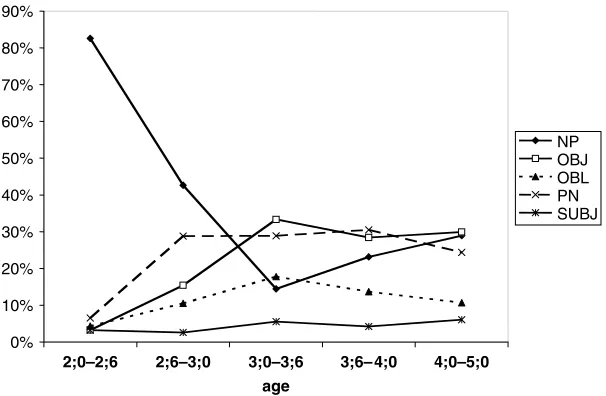
If we look at the development of the various types of relative clauses, we find that NP-relatives are especially frequent among Leo’s early relative clauses. As can be seen in Figure 3, between the ages of 2 ; 0 and 2 ; 6 more than 80 % of Leo’s relative clauses are attached to an isolated head noun, but then OBJ-, OBL- and PN-relatives become more frequent, suggesting that his early relative clauses gradually evolve into more complex subordinate constructions. Ax2-test, excluding relatives that are structurally ambiguous,
reveals a significant difference in the distribution of the various heads across age levels (x2(16,N=779)=134.805,p<0.001), suggesting that the
syntactic function of the head is an important determinant of the development of relative clauses.
Note that SUBJ-relatives remain infrequent throughout the study ; at no time of the development do they account for more than 5 % of Leo’s relative clauses. However, compared to children’s SUBJ-relatives in English, Leo uses a relatively large proportion of SUBJ-relative clauses. Overall, a mean proportion of only 0.7 % are SUBJ-relatives in the English data (cf. Diessel, 2004 : Ch. 6), while Leo’s SUBJ-relatives account for 4.1 % of his relative clauses. This may be due to the fact that SUBJ-relatives are not generally center-embedded in German. A number of studies have argued that English-speaking children tend to avoid SUBJ-relatives because they
4.11%
21.31%
11.04%
25.29%
38.25%
0% 5% 10% 15% 20% 25% 30% 35% 40% 45%
SUBJ OBJ OBL PN NP
head percentage
[image:14.431.59.363.62.235.2]head
interrupt the main clause, which is difficult to process (cf. Correˆa, 1995 ; Kidd & Bavin, 2002). But since German has flexible word order, SUBJ-relatives are not generally center-embedded in the main clause. If the subject occurs at the end of the sentence it can be modified by a right-branching relative clause. Our data support the proposed hypothesis : only 12.5 % of Leo’s SUBJ-relatives are center-embedded ; the rest are right-branching structures that follow the main clause (cf. (13)), suggesting that the relatively large number of SUBJ-relatives is related to the fact that they do not generally interrupt the main clause in German.
There is an alternative explanation that one can derive from a proposal by Limber (1973). According to Limber, English speakers make little use of SUBJ-relatives because the subject is usually a given or topical element, frequently expressed by a pronoun, which does not need a (restrictive) relative clause. If we follow this line of argumentation, one might hypothesize that German speakers use a larger proportion of SUBJ-relatives than English speakers because the subject is less topical in German than in English. We think that this is a plausible explanation. In English, the subject is almost always the topic of the clause, but in German subjects are only topical if they occur prior to other participants at the beginning of the clause. If the subject occurs at the end of the sentence, it does not function as topic and becomes more easily available for a relative clause.
0% 10% 20% 30% 40% 50% 60% 70% 80% 90%
2;0–2;6 2;6–3;0 3;0–3;6 3;6– 4;0 4;0–5;0 age
[image:15.431.71.374.60.258.2]NP OBJ OBL PN SUBJ
(13) Jetzt fehlt nur noch eine kleine Karte, wo Sachen drauf sind. Now missing only still a small card where things on are ‘ Now only a small card where these things are on is still missing. ’ (Leo 4 ; 10)
Overall, the structure of Leo’s relative clauses is similar to the structure of children’s early relative clauses in English, but there are also some interesting differences. In English, the vast majority of children’s relative clauses are attached to the predicate nominal of a copular clause, but in Leo’s data the majority of the early relative clauses are attached to an isolated noun phrase. Both constructions are semantically simple sentences, but serve different discourse–pragmatic functions. PN-relatives characterize a referent that is established in focus position, whereas Leo’s NP-relatives are usually attached to an NP that resumes a previous discourse referent, as in (14) :
(14) CHI: A¨ hm, dafu¨r kriegt sie die Scheibe.
Ah for.that gets she the disk
‘ Ah for that she will get the disc. ’
MOT: Sie will die Glocke.
She wants the bell ‘ She wants the bell. ’
CHI: Nein, sagt diese.
no says this
‘ No, says this one. ’
CHI: Nee, ich leg’s einfach mal hin.
no I put.it just MODAL down
‘ No, I will just put it down. ’
MOT: Leo.
Leo ‘ Leo. ’
CHI: Nein, die Scheibe.
no the disc
‘ No, the disc. ’
MOT: Es ist Wilhelmines Glo¨ckchen.
it is Wilhelmine’s bell ‘ It is Wilhelmine’s bell. ’
CHI: Die Scheibe.
CHI: Ne Scheibe, die kann man auch darunter
a disk that-ACC can you-NOM also under
rollen lassen. roll let
‘ A disc that you can roll under there. ’ (Leo 4 ; 6)
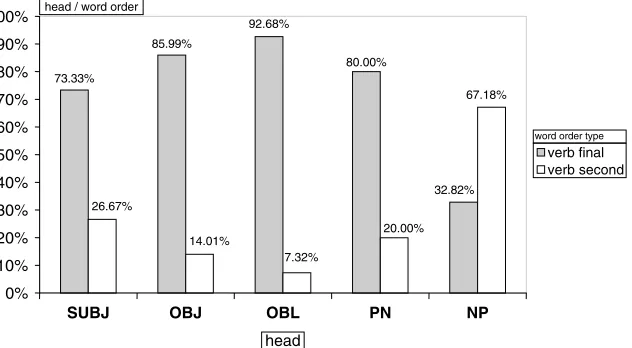
Leo’s NP-relatives can be seen as topicalization constructions that assert new information about a continuing discourse topic. Their information status is reflected in their word order : as can be seen in Figure 4, most of Leo’s NP-relatives occur with verb-second word order, while all other types of relative clauses are more frequent with verb-final word order. Interestingly, the vast majority (72 %) of the NP-relatives in the input also occur with verb-second word order.10
The relativized syntactic role
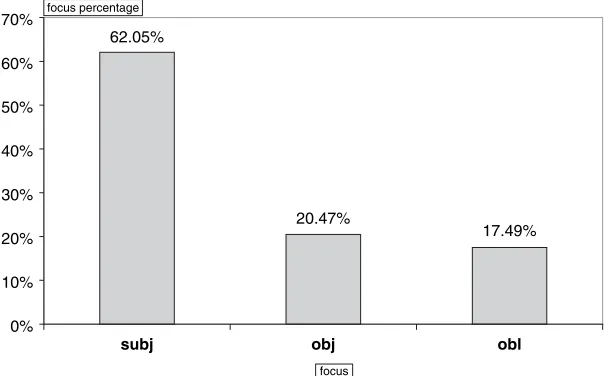
Having examined the external properties of Leo’s relative clauses, we now turn to their internal syntactic features. Figure 5 shows the percentage of the various relativized syntactic roles in Leo’s relative clauses. As can be seen in this figure, the majority of his relatives are subj-relatives ; they account for 62 % of the data. Twenty percent are obj-relatives, and 17 % are
73.33%
85.99%
92.68%
80.00%
32.82% 26.67%
14.01%
7.32%
20.00%
67.18%
0% 10% 20% 30% 40% 50% 60% 70% 80% 90% 100%
SUBJ OBJ OBL PN NP
verb final verb second head / word order
head
[image:17.431.68.384.62.236.2]word order type
Fig. 4. Verb-second and verb-final word orders in different types of Leo’s relative clauses.
obl-relatives ; io-relatives and gen-relatives do not occur in Leo’s data. In the input, there are only a few instances of io- and no gen-relatives.
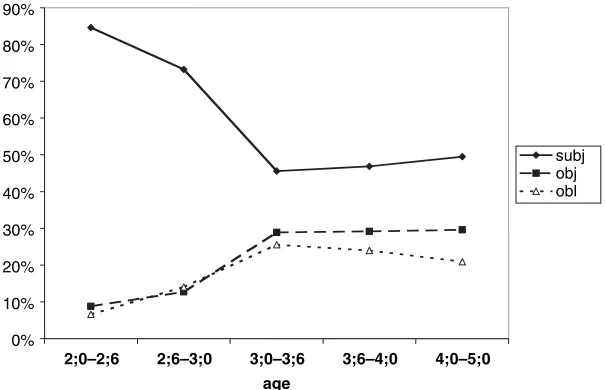
If we look at the development of the various types of relative clauses, we find that subj-relatives are especially frequent among the earliest relative clauses. As can be seen in Figure 6, the proportion of subj-relatives decreases from 85 % between 2 ; 0 and 2 ; 6 to 45 % between 3 ; 0 and 3 ; 6 and then remains relatively stable. A x2-test, excluding relatives that are
structurally ambiguous, reveals a significant difference in the distribution of the relativized syntactic roles across age levels (x2 (8, N=772)=70.665,
p<0.001), suggesting that the syntactic function of the relativized syntactic role affects the development of Leo’s relative clauses.
Overall, the proportions of the various types of relative clauses in Leo’s data are similar to the proportions of children’s relative clauses in English. In both languages, the majority of children’s relative clauses are subj-relatives, which are especially frequent among the earliest relative clauses. Interestingly, Leo’s caregivers’ data include a much smaller proportion of subj-relatives than Leo’s early speech samples : Only 52 % of the caregivers’ relative clauses are subj-relatives, 36 % are obj-relatives and 11 % are obl-relatives. Even if we exclude verb-second relative clauses and only look at the verb-final relatives, the general pattern stays the same : the child produces more subj- than obj-relatives while we find the reverse pattern in his input. Diessel (2004) reports similar proportions of relative clauses in the ambient language of English-speaking children ; in
62.05%
20.47%
17.49%
0% 10% 20% 30% 40% 50% 60% 70%
subj obj obl
focus percentage
[image:18.431.58.362.61.249.2]focus
both languages, children produce a much higher proportion of subj-relatives than their caregivers. Why do children use so many subj-relative clauses ?
Diessel & Tomasello (2005) argue that English-speaking children have fewer difficulties with subj-relatives than with obj-relatives and obl-relatives because they involve the same word order as simple main clauses. If the subject is relativized, the agent is the first referent of the relative construction, preceding the patient and all other semantic roles, but if the direct object or a prepositional phrase is relativized, the agent is only second after some other semantic role. In other words, in subj-relatives agent and patient occur in the same order as in simple main clauses, but in obj- and obl-relatives the order is reversed.
(15) a.The man who kissed the woman. AGENT VERB PATIENT
b.The man who the woman kissed. PATIENT AGENT VERB
Alternatively, one might hypothesize that subj-relatives are dominant in early child language because children tend to use relative clauses with animate head nouns. As Mak, Wietske & Schriefers (2002) have shown, subj-relatives are the only relative clauses that are commonly attached to an animate NP ; i.e. obj- and obl-relatives are almost always attached to
0% 10% 20% 30% 40% 50% 60% 70% 80% 90%
2;0–2;6 2;6–3;0 3;0–3;6 3;6–4;0 4;0–5;0 age
[image:19.431.70.373.60.255.2]subj obj obl
inanimate NPs. Kidd, Brandt, Lieven & Tomasello (in press) observed the same tendency in English and German children’s early relative clauses.
In German, verb-final relative clauses do not have the same word order as main clauses ; but like most German main clauses, subj-relatives express the agent as the first referent of the relative clause, while obj- and obl-relatives include the agent only after some other semantic role (cf. 16a–b). Thus, like subj-relatives in English, subj-relatives in German are similar to main clauses in that they express the agent prior to the other participants. This is in accordance with our hypothesis that children produce their first relative clauses based on their previous knowledge of simple main clauses.
(16) a.Der Mann, der die Frau geku¨ sst hat.
The man who-NOM the woman kissed has
AGENT PATIENT VERB
b.Der Mann, den die Frau geku¨ sst hat The man who-ACC the woman kissed has
PATIENT AGENT VERB
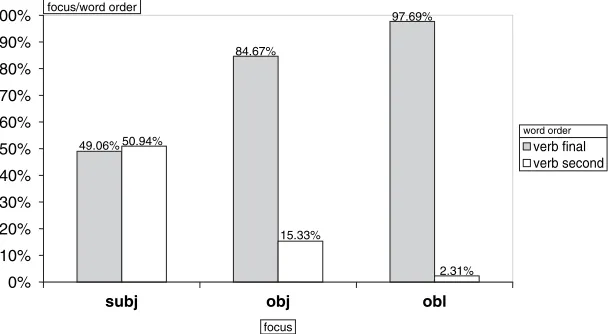
Interestingly, as indicated above, Leo’s subj-relatives include a much higher proportion of verb-second word order than his obj- and obl-relatives. As can be seen in Figure 7, subj-relatives commonly occur with both word orders, half of them are verb-final and the other half are verb-second, but obj-relatives and obl-relatives occur primarily with verb-final word order.
49.06%
84.67%
97.69%
50.94%
15.33%
2.31%
0% 10% 20% 30% 40% 50% 60% 70% 80% 90% 100%
subj obj obl
verb final verb second focus/word order
focus
[image:20.431.60.364.61.228.2]word order
If we assume that the different word orders correlate with different types of information (see above), Figure 7 suggests that obj- and obl-relatives are more often backgrounded or pragmatically presupposed than subj-relatives. What could be the reason for this ? We suggest that subj-relatives frequently occur with main-clause word order because they express a predication about a referent that typically functions as the agent of the activity denoted by the relative clause (cf. 17), whereas obj-relatives and obl-relatives express a predication about patients, objects, locations and other discourse roles (cf. 18–19). Since naturally occurring conversations tend to focus on human interactions, information about the activities of agents is usually more prominent than information about patients, objects and locations. In other words, subj-relatives tend to be more prominent than obj- and obl-relatives because they are about agents, which is reflected in the frequent use of main-clause word order.
Note, however, that, apart from the semantic factor, there is also a structural factor that accounts for the large proportion of verb-final word order in obl-relatives. While subj- and obj-relatives are introduced by an anaphoric pronoun that can occur with both word orders (verb-second and verb-final), obl-relatives are often introduced by the question word wo
‘ where ’, which only occurs with verb-final word order.
(17) Die Biene, die holt ein Mittagessen. subj-relative
The bee who-NOM/he gets a lunch
‘ The bee who is getting lunch. ’ (Leo 2 ; 4)
(18) Und Tomate in den Kuchen, den obj-relative
And tomato in the-ACC cake that-ACC
du gebacken hast.
you baked have
‘ And the tomato in (to) the cake that you have baked. ’ (Leo 2 ; 11)
(19) Dieses Haus, wo die Leute wohnen. obl-relative
This house where the people live
‘ This house where the people live. ’ (Leo 2 ; 10)
restricted to intransitive clauses ; subj-relatives including a transitive verb are rare and tend to provide background information like obj-relatives. In accordance with these findings, Diessel (2004) reports that English-speaking children tend to use intransitive verbs in relative clauses ; in particular, the earliest relative clauses are almost exclusively used with intransitive verbs. Like English-speaking children, Leo uses subj-relatives primarily with intransitive verbs. At the age of 2 ; 6, seven out of eight subj-relatives include an intransitive verb ; later the proportion of transitive subj-relatives increases, but intransitive subj-relatives remain dominant throughout the time period of this study.
D I S C U S S I O N
To summarize, Leo begins to produce relative clauses shortly after his second birthday. Most of his early relative clauses carry the following features :
1. They are attached to an isolated head noun. 2. They occur with the finite verb in second position. 3. They contain an anaphoric pronoun in nominative case. 4. They usually assert new information.
5. They are intransitive.
The whole structure can be seen as a topicalization construction in which the relative clause functions to characterize the nominal referent of the head noun, which typically resumes a referent from the previous discourse. These topicalization constructions are only a little different from simple main clauses : they include a single verb, occur with the finite verb in second position, denote the agent prior to other participants and tend to provide new information. However, they also share important properties with ordinary relatives : they include an anaphoric pronoun at the beginning of the clause that continues a nominal referent of the immediately preceding NP.
Like lexical expressions, grammatical constructions are linguistic signs (or symbols) that are connected in mental grammar by associative links indicating structural and semantic relationships between them. As argued in Diessel & Tomasello (2005), children acquire this network in a piecemeal bottom-up fashion, starting with constructions that are only minimally different from simple main clauses, which they already know. In this view, V2-relatives play a key role in the development of German relative clauses because they have properties of both main and relative clauses, which may help the child to bridge the gap between simple sentences and complex relative constructions (for a detailed description of this proposal see Diessel (2004 : Ch. 2)).
The development of Leo’s relative clauses is parallel to the development of relative clauses in English. In both languages, children’s early relative clauses function semantically like simple main clauses ; but the source constructions are somewhat different. While English-speaking children produce most of their early relative clauses in focus constructions, consisting of a relative clause and a copular clause (cf. Diessel &
Tomasello, 2000), most of Leo’s early relative clauses occur in
topicalization constructions, consisting of a relative clause and an isolated head noun. However, despite these differences, Leo’s data are in accordance with our general hypothesis that the development of relative clauses follows a general cross-linguistic pattern that originates from simple main clauses. Like children’s early relative clauses in English, French, Spanish, Hebrew and Indonesian, Leo’s early relative clauses develop in an incremental fashion from constructions that are only a little different from simple sentences. It seems that across languages, children draw on their previous knowledge of simple main clauses in the acquisition of relative constructions.
However, we need to acknowledge that, in spontaneous speech, the production of grammatical constructions is determined not only by linguistic complexity but also by communicative factors. For instance, children may not use a particular type of relative clause because the structure is tied to a particular communicative situation that does not occur in parent–child interactions or because there are alternative constructions that are easier to produce. In other words, it is conceivable that children never use a particular construction for communicative reasons, although they have no difficulties in comprehending it.
predominant until the age of 4 ; 0, when the recordings stopped, suggesting that verb-final relatives emerged only later. The other two major findings reported in the current paper were also evident in Simone’s data. Like Leo, the child produced a very large number of relative clauses that were headed by isolated NPs and that relativized subjects early in development. As she grew older, the percentage of relatives modifying other kinds of heads (e.g. subjects, objects and predicate nominals) and relativizing objects and obliques increased. The developmental pattern reported here thus seems to hold for other German-speaking children as well as across different languages.
R E F E R E N C E S
Abbot-Smith, K., Lieven, E. & Stoll, S. (2005). A construction-based analysis of child directed speech in German and Russian. Paper presented at the ‘ DGfS Jahrestagung ’, University of Cologne.
Auer, P. (1998). Zwischen Parataxe und Hypotaxe : „abha¨ngige Hauptsa¨tze“ im gesprochenen und geschriebenen Deutsch. Zeitschrift fu¨r Germanistische Linguistik 26, 284–307.
Behrens, H. (2000). Anleitung zur Kodierung und Disambuigierung von Erwerbsdaten des Deutschen. Unpublished manuscript, Max-Planck-Institute for Evolutionary Anthropology, Leipzig.
Brandt, S. (2004). The acquisition of relative clauses in German and English. The very first steps. Unpublished master’s thesis, University of Leipzig.
Clancy, P., Lee, H. & Zoh, M. H. (1986). Processing strategies in the acquisition of relative clauses. Universal principles and language-specific realizations.Cognition24, 225–62. Correˆa, L. M. (1995). An alternative assessment of children’s comprehension of relative
clauses.Journal of Psycholinguistic Research24, 183–203.
Crain, S., McKee, C. & Emiliani, M. (1990). Visiting relatives in Italy. In L. Frazier & J. G. deVilliers (eds),Language processing and language acquisition, 335–56. Dordrecht : Kluwer. Dasinger, L. & Toupin, C. (1994). The development of relative clause functions in narratives. In R. Berman & D. I. Slobin (eds), Relating events in narratives : a crosslinguistic developmental study, 457–514. Hillsdale, NJ : Lawrence Erlbaum.
Diessel, H. (2004). The acquisition of complex sentences. Cambridge, UK : Cambridge University Press.
Diessel, H. (2006). Demonstratives, joint attention, and the emergence of grammar.
Cognitive Linguistics17, 463–89.
Diessel, H. (2007). A construction-based analysis of the acquisition of East Asian relative clauses.Studies in Second Language Acquisition29, 311–20.
Diessel, H. & Tomasello, M. (2000). The development of relative clauses in spontaneous child speech.Cognitive Linguistics11, 131–51.
Diessel, H. & Tomasello, M. (2005). A new look at the acquisition of relative clauses.
Language81, 1–25.
Eisenberg, P. (2004). Grundriss der deutschen Grammatik Band 2 : Der Sat, 2nd ed. Stuttgart : Metzler.
Fox, B. A. & Thompson, S. A. (1990). A discourse explanation of the grammar of relative clauses in English conversations.Language66, 297–316.
Gaertner, H. M. (1998). Are there V2 relative clauses in German ?Journal of Comparative Germanic Linguistics3, 97–141.
Goldberg, A. (1995).Constructions : A construction grammar approach to argument structure. Chicago : University of Chicago Press.
Goodluck, H. & Stojanovic´, D. (1997). The structure and acquisition of relative clauses in Serbo-Croation.Language Acquisition5, 285–315.
Goodluck, H. & Tavakolian, S. (1982). Competence and processing in children’s grammar of relative clauses.Cognition11, 1–27.
Grimm, H. & Wintermantel, M. (1975). Ueber das Verstehen von Relativsatzstrukturen. In H. Grimm, H. Schoeler & M. Wintermantel (eds), Zur Entwicklung sprachlicher Strukturformeln bei Kindern. Weinheim : Beltz.
Hamburger, H. & Crain, S. (1982). Relative acquisition. In S. Kuczaj (ed.), Language development. Vol. 1 : syntax and semantics. Hillsdale, NY : Erlbaum.
Hermon, G. (2005). Issues in the acquisition of relative clauses. The grammar of relative clauses in early child language. Paper presented at the ‘ Workshop on the typology, acquisition, and processing of relative clauses ’, Max Planck Institute for Evolutionary Anthropology, Leipzig.
Hudelot, C. (1980). Qu’est-ce que la complexite´ syntaxique ? L’exemple de la relative.La Linguistique16, 5–41.
Kidd, E. & Bavin, E. L. (2002). English-speaking children’s comprehension of relative clauses : evidence for general-cognitive and language-specific constraints on development.
Journal of Psycholinguistic Research31, 599–617.
Kidd, E., Brandt, S., Lieven, E. & Tomasello, M. (in press). Object relatives made easy : a crosslinguistics comparison of the constraints influencing young children’s processing of relative clauses.Language and Cognitive Processes.
Lambrecht, K. (1988). There was a farmer had a dog : syntactic amalgams revisited.
Proceedings of the Annual Meeting of the Berkeley Linguistics Society14, 319–39. Lambrecht, K. (1994).Information structure and sentence form : topic, focus, and the mental
representations of discourse referents. Cambridge, UK : Cambridge University Press. Lehmann, C. (1988). Towards a typology of clause linkage. In J. Haiman & S. A. Thompson
(eds),Clause combining in grammar and discourse, 181–227. Amsterdam : John Benjamins. Limber, J. (1973). The genesis of complex sentences. In T. E. Moore (ed.), Cognitive
development and the acquisition of language, 169–85. New York : Academic Press. MacWhinney, B. (2000).The CHILDES-project: tools for analyzing talk. Mahwah, NJ :
Erlbaum.
Mak, W. M., Wietske, V. & Schriefers, H. (2002). The influence of animacy on relative clause processing.Journal of Memory and Language74, 50–68.
McKee, C., McDaniel, D. & Snedeker, J. (1998). Relatives children say. Journal of Psycholinguistics Research27, 573–96.
Ozeki, H. & Shirai, Y. (in press). The consequences of variation in the acquisition of relative clauses : an analysis of longitudinal production data from five Japanese children. In Y. Matsumoto, D. Oshima, O. Robinson & P. Sells (eds), Diversity in language : Perspectives and implications. Stanford : CSLI Publications.
Rothweiler, M. (1993). Der Erwerb von Nebensa¨ tzen im Deutschen. Eine Pilotstudie. Tu¨ bingen : Max Niemeyer.
Schuetze-Coburn, S. (1984). On the boards of subordination : signaling relative clauses in spoken German.Proceedings of the Annual Meeting of the Berkeley Linguistics Society10, 650–59.
Sheldon, A. (1974). The role of parallel function in the acquisition of relative clauses in English.Journal of Verbal Learning and Verbal Behavior13, 272–81.
Tavakolian, S. L. (1981). The conjoined clause analysis of relative clauses. In S. L. Tavakolian (ed.), Language acquisition and linguistic theory, 167–87. Cambridge : MIT Press.