doi:10.4236/cs.2011.23021 Published Online July 2011 (http://www.SciRP.org/journal/cs)
Linearized Phase Detector Zero Crossing DPLL
Performance Evaluation in Faded Mobile Channels
Qassim Nasir1, Saleh Al-Araji2
1Department of Electrical and Computer Engineering, University of Sharjah, Sharjah, UAE
2Communication Engineering Department, Khalifa University of Science, Technology and Research, Sharjah, UAE
E-mail: [email protected], [email protected]
ReceivedFebruary 13, 2011; revised April 15, 2011; accepted April 22, 2011
Abstract
Zero Crossing Digital Phase Locked Loop with Arc Sine block (AS-ZCDPLL) is used to linearize the phase difference detection, and enhance the loop performance. The loop has faster acquisition, less steady state phase error, and wider locking range compared to the conventional ZCDPLL. This work presents a Zero Crossing Digital Phase Locked Loop with Arc Sine block (ZCDPLL-AS). The performance of the loop is analyzed under mobile faded channel conditions. The mobile channel is assumed to be two path fading channel corrupted by additive white Gaussian noise (AWGM). It is shown that for a constant filter gain, the frequency spread has no effect on the steady state phase error variance when the loop is subjected to a phase step. For a frequency step and under the same conditions, the effect on phase error is minimal.
Keywords:Non-uniform Sampling, Digital Phase Locked Loops, Zero Crossing DPLL, Mobile Faded
Channels
1. Introduction
Phase Lock Loops (PLLs) are used in a wider range of communication applications such as carrier recovery synchronization, and demodulation [1]. A PLL is a clo- sed loop system in which the phase output tracks the phase of the input signal. It consists of a phase detector, filter, and voltage controlled oscillator. Digital Phase locked Loops (DPLLs) were introduced to minimize some of the problems associated with the analogue counter part such as sensitivity to DC drift and the need for periodic adjustments [1,2]. Conventional Zero Cros- sing DPLL (ZCDPLL) is the most widely used due to its simplicity in modeling and implementation [3,4].
In this paper an Arc-Sine ZCDPLL is analyzed under mobile faded channel. The purpose of including the Arc- -Sine in the loop is to linearize the phase difference de-tection. The peak detector guarantees the input amplitude to the Arc-Sine block to remain between –1 and +1. It has been shown that the AS-ZCDPLL loop offers im-proved performance in the lock range and acquisition with reduced steady state phase error [5]. The proposed ZCDPLL-AS can be characterized by a linear difference equation in module (π/2) sense.
The mobile radio channel is characterized by fast Ray-
leigh fading and random phase distribution. This consid-erably degrades the tracking performance and increase the jitter of the loop. In this paper, the performance of ZCDPLL-AS with phase and frequency step inputs in the mobile radio environment is studied. The ZCDPLL-AS, in this work is considered as part of a mobile receiver. The mobile channel is assumed to be a two path fading channel corrupted by additive white Gaussian noise (AWGN). The fading in each path of the channel follows Rayleigh distribution and has power spectral density as given by Jakes [6].
2 2πm 1
m S f
f f
f
where fm = vfc/c is the Doppler frequency that depends
on the speed of the vehicle v and carrier frequency fc. The performance of the proposed algorithm will be evaluated for Doppler frequencies of 6 Hz, 100 Hz and 222 Hz, corresponding to a pedestrian (3.5 km/hr) and vehicular channels with speeds of 54 km/hr and 120 km/hr respectively.
1
k
the probability density function (pdf) of the steadys- tate phase error is derived and calculated numerically in Section 3. Experimental simulation results are presented in Section 4 and finally conclusion are given, in Section 5.
2. ZCDPLL-AS System Operation in Mobile
Faded Channels
The ZCDPLL-AS is composed of a sampler as a phase detector, inverse sine block, a digital loop filter, and a Digital Controlled Oscillator (DCO) as shown in Figure 1 [5]. The input signal to the loop is taken as x(t) = s1(t) +
n(t) , where s1(t) is the noise free input signal to the loop after passing through the mobile channel. If s(t) = Asin(ω0t + θi(t)), n(t) is Additive white Gaussian Noise (AWGN); θi (t) = θ0+Ω0t , from which the signal dynam-ics are modeled; θ0 is the initial phase which we will assume to be zero; Ω0 is the frequency offset from the nominal value ω0. Then s1(t) = r(t)sin(ω0t + θi(t) +φch(t)), r(t) is Rayleigh faded envelope and φch(t), is a uniform
distribution channel phase.
The input signal is sampled at time instances tk deter-mined by the Digital Controlled Oscillator (DCO). The DCO period control algorithm as given by [7-10] is
0 1
k k k
T T c t t (1)
where T0
2π0
is the nominal period, ck1 is the output of the loop digital filter D(z). The sample value of the incoming signal x(t) at tk is
k 1
k kx t s t n t (2) or
k k k
x s n (3) where sk sin
0tki
tk
, The sequence xk ispassed through the Arc-Sine block with output . The output is passed through a digital filter D(z) whose output is used to control the period of the DCO.
1
sin
k xk
k
c y
The time instances tk can be rewritten as
1
0
1 0
, 1, 2,3,
k k
k i i
i i
t T kT c k
(4)Thus
1
0 0 ,
0
sin k
k k i k ch k k
i
x r w kT c
ni
i
(5)
The phase error is defined to be [5]
1
, 0
0
k
k k ch k
i
w c
(6)Also
1 1 , 1 0
0
k
k k ch k
i
w c
(7)D(z) DCO
ck−1 tk
xk−1 yk−1
xk S’(t)
x(t)
n(t)
S(t)
S/H
Rayleigh faded Channel Peak Detector Register
[image:2.595.312.537.77.196.2]I ARC-SINEBlock
Figure 1. Block diagram of the ZCDPLL-AS.
Taking the difference of (7) and (8) results in
1 1 , 1 ,
k k k k ch k ch k w c0 k
(8)
The Arc-Sine (sin1) block has been added to lin-earize the equation and avoid the nonlinear behaviour of the systems [5]. The output of the Arc-Sine block can be expressed as 1
k sin xk
y k
, 1 xk 1 and
π 2 yk π 2
. The z transform of the output of the digital filter is
C z D z Y z
(9)where Y z
is the z transform of y t
. The order of the loop is determined by the type of the digital filter. For first order, the digital filter is simply a gain block
D z G1, where is the block gain. However, for
second order loop, 1
G
1
1 2 1z
D z G G
k
.
Let us consider a first order AS-ZCDPLL loop, then the digital filter output which controls the DCO is given by
1
k
c G y (10) Then the stochastic difference equation describing the loop behaviour is given by
1 1 , 1 , 0 1
k k k k ch k ch k w r Gk k nk (11)
For phase step input where k1k for , (11)
becomes
0
k
1 , 1 , 0 1
k k ch k ch k w r Gk k nk
k
(12)
And for frequency step and for , (12) becomes k
0
t
0
k
1 , 1 ,
1 0
k k ch k ch k
k k k
wr G n T
(13)
141
1 k
1 0 1 0
k k w r Gk k w r G nk
(14)
1 1
k k wr Gk k nk T
0
k
(15)
For both cases, the probability density function of steady state phase error became a function of two inde-pendent random variables r(k) and n(k).
3. Phase Error Probability Density Function
(pdf)
3.1. Phase Step without Noise
In steady state k1 , (14) can be rewritten as
1 1 0 1
k r Gk
k (16)
If the expected value of 0 1k is 1, then the
ex-pected value of k
w G r
is zero for all values of k. This will lead to rapid convergence of the steady state. Since the probability density function of rk is Rayleigh then
2 2
2 2e s,
k
r
r
s r
P r r
0 (17)
which has an average of π 2s . Therefore, the
opti-mum value of the gain is Gopt
1 0 s
2π. Let b =, where , n is integer. Then the tran-sition pdf can be shown as to be 0 1
sin
G z
znπ
2 2 2 k+1
2 2 2 e .
s k u z b s u z u P z b
u z (18)
3.2. Phase Step plus Noise
Let y Z 0 1G nk be a Gaussian random variable with a mean of z and variance 2 2 2
0G1 n
,where 2
n
is
the variance of the noise n(t). Then the pdf of y is given by
2 2 2 2 0 1 2 0 1 1 e 2π n y z G y n P y G
(19)
So
1 , 0 sin
k y br bk w G1 z
(20) When z0,k1
π, k
z n
will be zero mean Gaussian. Also when 1 will be Gaussian with mean of z. The transition pdf can be rewritten as [4]
2 2 2 2 0 1 1 π 2 0 1 1 e
π 2π
n k k u n G n u P n G
(21)
Given k z, then
1 1 1 0
0 2π
sin ,
k z G rk z G nk
(22)
Define a random variable Y as
1 0
0 2π k
Y z G n
(23)
Y will be Gaussian with mean
z2π
01
and variance 2 21 n
G
. Therefore
2 0 2 2 2
1
2π 1
2 1 1 e 2 n y z G Y n P y G
(24)
1 ' , ' sin
k Y b r bk G z
1 (25)
Since k is a discrete time continuous variable
Mar-kov process, its conditioned on an initial condition error
0
satisfies Chapman-Kolmogrov equation, then
1 1
0
d
k k k k
z
P P P
z
z (26)
Equation (23) is valid whether k and rk1are
mutu-ally independent or not. This is solved numericmutu-ally as was done in [4]. The transition pdf
r
P z is stored in a matrix starting with P z0
0
z 0
, Pk1
0
is calculated from Pk
0
with k = 1,2,···, until the values of successive k differ by a prescribed small amount.4. Simulation Results
The performance of the loop was evaluated in simulation by subjecting it to phase as well as frequency steps. The input signal s(t) = sin(2000_t) is considered as modula-tion free and the DCO center frequency is 1000 Hz. In the simulation process, the Signal to Noise Ratio is de-fined as SNRdb = 10log 1
n2
, where n2 representsnoise variance. The loop is studied under phase step in the presence of noise. It is noticed from Figure 2, and as
derived in section (2), that the steady state phase error variance depends on the value of the filter gain, as shown in Figure 3. The increase in gain causes the phase error
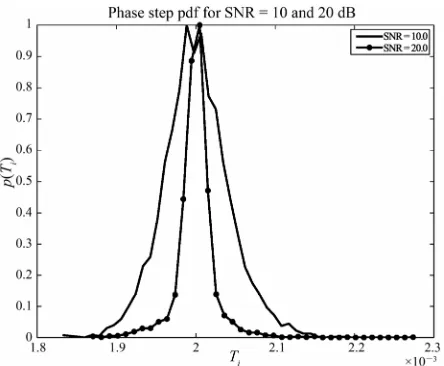
to increase sharply which results in degradation in sys-tem’s performance. The effect of SNR on the phase error variance is shown in Figure 4. This variance is directly
proportional to SNR as shown in Figure 5. As shown
from the figure, the loop performance due to phase jitter improves as SNR increases. The frequency spread has no direct effect on the steady state phase error variance if the filter gain is kept constant, as shown in Figure 6.
step size if the filter gain is kept constant. The Doppler spread will increase the jitter if the spread is increased as shown in Figure 6. The loop probability density function
of the phase performance when subjected to a frequency step is shown in Figure 7 for different frequency offsets,
while Figure 8 is for different wireless channel Doppler
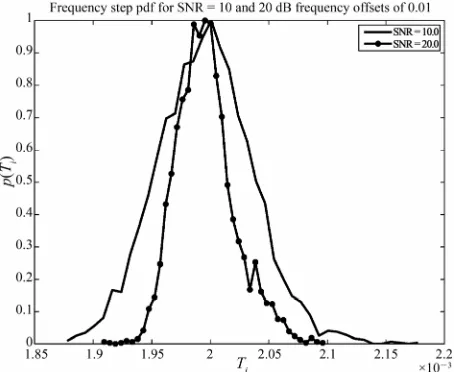
[image:4.595.313.535.76.259.2]spreads. It is seen from the figures that the impact of frequency offset and channel speed of variations (Dop-pler spread) on the system performance is minimal. The loop performance, when a frequency step is applied to the loop, is also affected by the channel SNR as shown in
Figure 9. The variance of timing error in the loop is
[image:4.595.57.285.264.452.2]in-creased as the loop gain G1 is increased and this primary-
[image:4.595.309.535.295.475.2]Figure 2. Probability Density Function (pdf) of DCO Period when SNR = 10 dB and when Phase step is applied with different values of filter gain G1.
Figure 3. Variance of DCO period against filter gain G1.
[image:4.595.309.535.503.686.2]Figure 4. Probability Density Function (pdf) of DCO period for SNR = 10, 20 dB and when phase step is applied.
Figure 5. Variance of DCO period versus input signal SNR.
[image:4.595.58.286.506.705.2]143
[image:5.595.57.286.76.269.2]Figure 8. Probability Density Function (pdf) of DCO period for SNR = 20 dB with frequency step with doppler spread of 6 and 100 Hz.
Figure 7. Probability Density Function (pdf) of DCO period for SNR = 20 dB with Frequency step with different fre-quency spreads.
Figure 9. Probability Density Function(pdf) of DCO period for SNR = 10 and 20 dB with frequency step of frequency offset of 0.01.
Figure 10. Variance of DCO period versus the loop gain G1
for different frequency offsets.
ly depends on the value frequency step input as shown in
Figure 10.
5. Conclusions
The ZCDPLL-AS loop is studied under phase and fre-quency steps in the presence of noise. It is shown that the frequency spread, under phase step condition, has no direct effect on the steady phase error variance if the filter gain is kept constant. For frequency step, the error is slightly affected under the same conditions. From the results, it has been shown that the variance of the DCO period increases with the Doppler spread. The system was tested with Doppler spreads of 6 Hz, 100 Hz, and
222 Hz. ZCDPLL-AS loop has been tested and has shown to give improved locking and acquisition per-formance.
6. References
[1] F. M. Gardner, “Phaselock Techniques,” 3rd Edition, John Wiley and Sons, Hoboken, 2005.
[2] Q. Nasir and S. R. Al-Araji, “Optimum Perfromance Zero Crossing Digital Phase Locked Loop using Multi-Sam- pling Technique,” IEEE International Conference on Electronics, Circuits and Systems, Sharjah, 14-17 De-cember 2003, pp. 719-722.
[image:5.595.59.286.317.503.2] [image:5.595.309.535.319.500.2]Range Using Chaos Control Technique,” AutoSoft - Intel-ligent Automation and Soft Computing, Vol. 12, No. 2, 2006, pp. 183-186.
[4] Q. Nasir, “Extended Lock Range Zero Crossing Digital Phase Locked Loop with Time Delay,” EURASIP Jour-nal on Wireless Communications and Networking, Vol. 2005, No. 3, 2005, pp. 413-418.
[5] Q. Nasir and S. R. Al-Araji, “Performance Analysis of Zero Crossing DPLL with Linearized Phase detector,” International Journal of Information and Communication Technology, Vol. 1, No. 3, 2009,pp. 45-51.
[6] W. C. Jakes, “Microwave Mobile Communication,” John Wiley and Sons, Hoboken, 1974.
[7] Q. Nasir, “Chaos Controlled ZCDPLL for Carrier Recov-ery in Noisy Channels,” Wireless Personal
Communica-tions, Vol. 43, No. 4, December 2007, pp. 1577-1582.
doi:10.1007/s11277-007-9328-6
[8] H. C. Osborne, “Stability Analysis if an Nth Power Pha- se-Locked Loop—Part I: First Order DPLL,” IEEE Transactions on Communications, Vol. 28, No. 8, 1980, pp. 1343-1354.doi:10.1109/TCOM.1980.1094771 [9] H. C. Osborne, “Stability Analysis if an Nth Power
Phase-Locked Loop—Part II: Second- and Third-Order DPLL’s,” IEEE Transactions on Communications, Vol. 28, No. 8, 1980, pp. 1355-1364.
doi:10.1109/TCOM.1980.1094772