The Reliability Programme
Final report
Contents
Summary ... 4
Background ... 5
The Ofqual Reliability of Results Programme ... 6
Aims and objectives ... 6
Programme structure ... 6
Advisory groups ... 7
Activities... 8
Summary of results from the programme ... 8
Evidence of reliability in Key Stage 2 National Curriculum testing ... 8
Key Stage 2 science pre-tests... 8
The 2008 Key Stage 2 English reading pre-test ... 11
Classification accuracy in results from the 2009 and 2010 Key Stage 2 National Curriculum tests ... 13
Evidence of reliability in GCE and GCSE... 15
Test-related component / unit reliability... 15
Marking-related variability... 22
Teacher assessment reliability ... 24
Qualification level reliability ... 25
Grading-related variability... 26
Evidence of reliability in workplace-based qualifications ... 26
Review of reliability theories and models ... 27
Representing and reporting of assessment results and measurement errors ... 28
International approaches to representing and reporting of assessment results and errors ... 28
Reporting of measurement uncertainty and reliability in USA... 29
Public perceptions of reliability... 31
Surveys of perceptions of A levels and GCSEs... 31
Qualitative investigations of perceptions of reliability ... 32
Quantitative investigation of public perceptions of reliability... 34
Communicating about reliability with the public ... 38
Raising public awareness of reliability... 38
Interpretation and communication of reliability evidence ... 39
Classification accuracy in Key Stage 2 National Curriculum tests... 40
Reliability policy and its implications for awarding organisations... 42
Views on preliminary recommendations from TAG ... 45
Views on reporting reliability information from an international perspective ... 46
Technical Advisory Group report ... 47
Recommendations to Ofqual... 47
Areas for further work... 49
Policy Advisory Group report ... 50
Communicating reliability evidence and improving public understanding... 50
Stakeholder perspectives on reliability ... 50
Ways of understanding and communicating reliability evidence... 50
Handling media stories... 50
Ways of improving public understanding of reliability and increasing public confidence ... 51
Implications of findings from the Reliability Programme ... 52
Recommendations to Ofqual... 53
Further research and policy development ... 54
Further research ... 54
Developing Ofqual reliability policy ... 56
Summary
The Office of Qualifications and Examinations Regulation (Ofqual) in England has been conducting a two-year research programme, the Reliability of Results
Programme, to investigate the reliability of results from national tests, public examinations and other qualifications in order to develop regulatory policy on
reliability. Since it started in 2008, the programme has made substantial progress in the following areas.
Generating evidence of reliability: A substantial number of empirical studies
have been undertaken to generate evidence of reliability for a selection of Key Stage 2 National Curriculum tests (NCTs); a range of GCE and GCSE units, components and qualifications; and a number of vocational qualifications.
Reviewing test theories and models: The programme has produced a number of
research reports that review measurement theories and models used to study reliability and techniques used to produce and interpret reliability measures under the frameworks of classical test theory (CTT), generalizability theory (G-theory), and item response theory (IRT).
Interpreting and communicating reliability evidence: Views on how reliability
evidence should be interpreted and communicated in the contexts of the assessments used in England have been collected from both assessment professionals and other main stakeholders.
Exploring public perceptions of unreliability in examination results: A substantial
amount of information about public perceptions of reliability and the
examinations system as a whole has been produced through qualitative studies using workshops, focus groups and discussion groups, and quantitative studies using online questionnaire surveys.
Developing policy on reliability: Findings from the programme have been under
evaluation and areas where regulation on reliability may play a role are being explored.
This report, which is built on an interim report of the programme (Opposs and He, 2010), is intended to:
summarise the main findings from the programme
identify areas where further work will be needed
outline potential areas that Ofqual will be exploring during the development of
Background
England is a country in which much educational assessment takes place (Black and Wiliam, 2005). There are the following major assessment occasions in the English system:
whole cohort National Curriculum assessments (NCAs) for 11-year-olds in
English and mathematics
public examinations, including standardised qualifications typically taken at the
ages of 16 and 18
large and diverse suites of vocational qualifications, which may be taken by
candidates in schools, further education institutions or in workplaces as part of on-the-job training.
Some assessment systems (such as the National Curriculum assessments and the 16-plus examinations – mainly GCSEs) produce data that are also used as
accountability measures for institutions and individual professionals, in addition to providing information about individual student attainments in specific subject areas.
Reliability, in educational measurement terms, refers to the consistency of results on a given measure from repeated measurements under equivalent conditions and is an important indicator of the quality of an assessment. Although results have a huge impact on learners' lives, as with any measurements, assessment results contain inaccuracies. Although it is generally realised that assessment results contain inaccuracies and substantial work has been carried out to study the reliability of assessments, there is considerable variability in how measurement uncertainty is represented and reported in different parts of the world (see Bradshaw and Wheater, 2010). While in the USA and some other countries assessment results are
this, Ofqual has been conducting a two-year research programme, the Reliability of Results Programme, involving:
generating evidence of reliability of results from national tests, public
examinations, and other qualifications
interpreting and communicating reliability evidence
exploring public perceptions of unreliability in examination results
developing policy to regulate the reliability of assessments with a view to
improving the national assessment systems further.
The Ofqual Reliability of Results Programme
Aims and objectives
The primary aim of the Ofqual Reliability of Results Programme is to gather evidence to inform developing regulatory policy on reliability. The main objectives of the
programme include the following:
to generate evidence of reliability of results from a number of major National
Curriculum assessments, public examinations and qualifications offered by assessment agencies and awarding organisations in England
to stimulate, capture and synthesise technical debate on the interpretation of
reliability evidence generated from this programme and other reliability studies
to investigate how results and the associated errors are reported internationally,
and what procedures are adopted by assessment providers to communicate results and measurement errors to the users
to explore public understanding of and attitudes towards assessment
inconsistency
to stimulate national debate on the significance of the reliability evidence
generated by this programme and by other reliability studies
to help improve public understanding of the concept of reliability
to develop Ofqual policy on reliability.
Programme structure
Strand 1: Generating evidence on the reliability of results from a selection of
national qualifications, examinations and other assessments in England through empirical studies
Strand 2: Interpreting and communicating evidence on reliability
Strand 3: Investigating public perceptions of reliability and developing regulatory
policy on reliability.
Advisory groups
A Technical Advisory Group (TAG) and a Policy Advisory Group (PAG) were appointed to provide support to the programme. TAG is made up of educational assessment experts and has been primarily advising work on Strands 1 and 2, regarding:
the methodologies to be used for the programme
the selection of qualifications, examinations and other assessments to be
investigated
the reviewing of reports from research projects funded under this programme.
The group has made recommendations to Ofqual with regard to its policy on reliability at the end of the programme.
The Policy Advisory Group is made up of representatives from a wide range of stakeholders, including assessment experts, assessment providers, employers, communications experts, teachers, students and parents. PAG has been providing advice on work for Strand 3 of the programme, particularly in the areas of
engagement with key stakeholders and communication of reliability evidence to the public. The group met twice during the second year of the programme. The main objectives of the group are:
to gain full understanding of progress of the Reliability Programme
to understand stakeholder perspectives on the reliability of results from
England's test, examination and qualification systems
to explore ways to understand reliability evidence and communicate it to a
to explore ways of improving public understanding of reliability and increasing
public confidence in the examinations system
to discuss the adequacy and appropriateness of recommendations from TAG
to make recommendations to Ofqual.
Activities
A variety of activities have been undertaken under the programme to meet the programme objectives, including:
commissioning research projects to awarding organisations and research
institutions to generate evidence on reliability of results from National
Curriculum assessments, public examinations and vocational qualifications; reviewing measurement theories and models used to study reliability; reviewing techniques used for producing and interpreting reliability measures; gauging public perceptions on reliability; and investigating international approaches to the representation and reporting of assessment results and measurement errors
participating in national and international conferences to exchange ideas and
experiences with other assessment researchers, policy-makers and practitioners on issues related to reliability
organising technical seminars involving assessment experts and
communications experts to discuss issues related to reliability and reach consensus on the interpretation, evaluation and communication of reliability evidence to the wider public
participating in and organising public events to raise public awareness of
assessment reliability and to help the public to understand the concept of reliability.
Summary of results from the programme
Evidence of reliability in Key Stage 2 National Curriculum testing
Key Stage 2 science pre-teststests, correlation coefficients between parallel forms, Kappa statistics for individual tests, and classification accuracy and consistency indices for individual tests and between parallel forms, were produced using widely used procedures. Measures of reliability have been appropriately interpreted in the context of National Curriculum assessment in England.
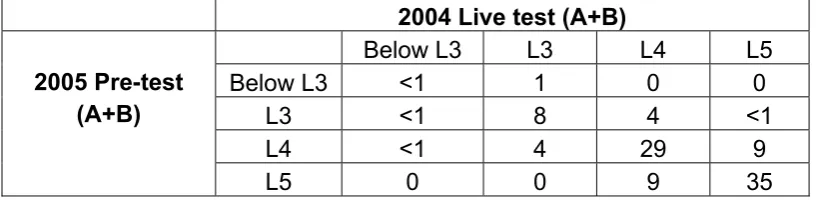
The Key Stage 2 science test consists of two papers (Paper A and Paper B). These papers each carry 40 marks and consist of a mixture of objective, short answer and longer response questions. The papers each have a time allowance of 45 minutes. Scores from the two papers are combined to produce a composite score, which is then used to assign a level representing the achievement in science by the pupil. Each year a subset of pupils takes an equivalent test, which is used as the following year’s live test shortly before the current year’s live test. By using the levels from the pre-test and the live test to produce a cross-tabulation of results for the pupils for each year studied, the researchers were able to investigate the consistency of the levels awarded to the pupils from the two tests (see Maughan et al., 2009, for a detailed description of the level-setting procedures used for the live test and the pre-test). As an example, Table 1 compares the percentages of pupils that were
[image:9.595.77.486.489.589.2]assigned to different levels by the 2004 live test (A+B) and the 2005 pre-test (A+B). The percentages of pupils who were awarded the same level on each version of the test (the bold numbers in the table) can be added up to provide an indication of the overall consistency between the live test and the pre-test, which is 73% in this case.
Table 1: Percentages of pupils who were classified into the different performance
categories by the 2005 pre-test (A+B) and the 2004 live test (A+B) (based on Maughan et al., 2009)
2004 Live test (A+B)
Below L3 L3 L4 L5
Below L3 <1 1 0 0
L3 <1 8 4 <1
L4 <1 4 29 9
2005 Pre-test (A+B)
L5 0 0 9 35
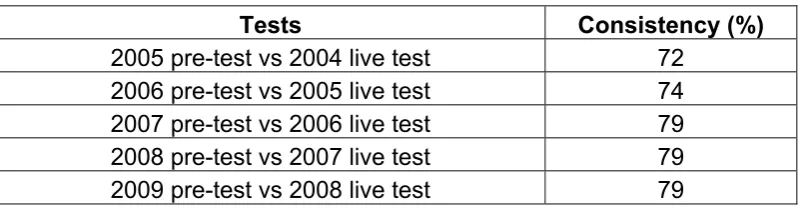
Table 2 shows the percentage agreement in classification by the tests for each of the years investigated. There would appear to have been an improvement in the
Table 2: Percentages of pupils who were classified into the same performance categories by the pre-tests (A+B) and live tests (A+B) (based on Maughan et al., 2009)
Tests Consistency (%)
2005 pre-test vs 2004 live test 72
2006 pre-test vs 2005 live test 74
2007 pre-test vs 2006 live test 79
2008 pre-test vs 2007 live test 79
2009 pre-test vs 2008 live test 79
Maughan et al. (2009) also computed the correlation coefficient for each pair of the pre-tests and live tests. Table 3 lists the raw score correlation coefficients for each pair and Cronbach’s alpha for individual tests. Cronbach’s alpha is a measure of consistency in test scores. Specifically, Cronbach’s alpha refers to the degree that groups of items in a test produce consistent or similar scores for individual test-takers (or consistency in test scores from different set of items). As items in a test can be viewed as a sample from a domain of potential items, Cronbach’s alpha may be viewed as a measure of the extent that the scores from test-takers on a test
[image:10.595.83.481.137.242.2]represent the expected scores from the entire domain. If items in a test also require human marking, Cronbach’s alpha will also to some degree reflect the variability in test scores associated with the inconsistency in marking between markers. Values of the Cronbach’s alpha for live test papers have been published by the Qualifications and Curriculum Development Agency (QCDA) on its website.
Table 3: Raw score correlation coefficients between the pre-tests and live tests, and Cronbach’s alpha for individual tests (based on Maughan et al., 2009)
Year of
comparison Tests Correlation
Cronbach’s alpha
04/05 Pre-test (A+B) vs live test (A+B) 0.85 0.92 vs *
05/06 Pre-test (A+B) vs live test (A+B) 0.81 0.93 vs 0.92
06/07 Pre-test (A+B) vs live test (A+B) 0.85 0.92 vs 0.93
07/08 Pre-test (A+B) vs live test (A+B) 0.86 0.94 vs *
08/09 Pre-test (A+B) vs live test (A+B) 0.88 0.94 vs*
* Cronbach’s alpha for live test was not available.
[image:10.595.76.531.524.644.2]the combined effect of errors from sources associated with items in the specific test and markers. The correlation between two tests, on the other hand, reflects the contributions to the overall inconsistency in results from both test items in the individual test forms and markers, and the occasions under which the tests were administered (that is, including test item-related, marker-related and occasion-related errors).
Maughan et al. (2009) also investigated the decision accuracy and consistency of results based on a single administration of the test using item response theory. Decision accuracy is defined as the proportion of pupils that would be awarded the same performance levels by both the true scores and the observed scores on the test. Decision consistency refers to the proportion of pupils that would be awarded the same performance levels by two sets of observed scores on two parallel forms of the same test. Since students taking the National Curriculum tests are classified into different National Curriculum performance levels, classification accuracy would be an appropriate indicator of the reliability of the tests. For the 2009 pre-test, the decision accuracy and consistency were estimated to be 0.89 (or 89%) and 0.84 (or 84%) respectively. Misclassification, which is defined as 1-decision accuracy, is frequently used to indicate the level of inconsistency in awarding the performance levels by the true scores and observed scores. For the 2009 pre-test, this is 0.11 (or 11%).
Maughan et al. (2009) also used Newton’s (2009) concept of classification ‘correctness’ and the method that Newton proposed to investigate level misclassification further.
The 2008 Key Stage 2 English reading pre-test
Used as a case study to illustrate how various reliability measures can be estimated and interpreted, Hutchison and Benton (2009) investigated the reliability of the 2008 Key Stage 2 English reading pre-test, which was conducted in 2007 (see also later discussions). The test was made up of 34 items, allowing a total of 50 marks to be achieved. For the sample of pupils from 60 schools involved in their analysis, the test had a mean of 28.5 and a standard deviation of 9.1. Table 4 shows Cronbach’s alpha and IRT-based classification accuracy and consistency for the test. The reliability measures for this test are generally lower than those for the science tests discussed previously. This is expected as this test was shorter and contained more open-ended questions requiring human marking than the science tests. An IRT-based
Table 4: Internal consistency reliability and IRT-based classification accuracy and consistency of the 2008 Key Stage 2 English Reading pre-test (based on Hutchison and Benton, 2009)
Number of pupils
Cronbach’s
alpha IRT accuracy (%) IRT consistency (%)
1387 0.88 83 76
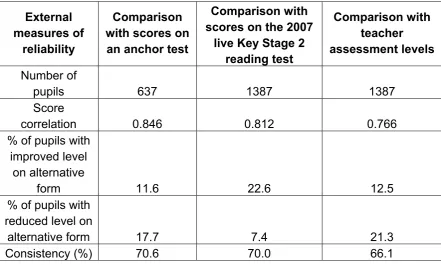
Hutchison and Benton (2009) also compared the results for the pupils from the pre-test with the results from an anchor pre-test, the live pre-test and teacher assessment (TA). Teacher assessment levels were collected as part of their assessment development trials. Table 5 shows some additional reliability indices for the pre-test. The
[image:12.595.78.520.410.675.2]correlations between the pre-test scores and the anchor test scores and between the pre-test and the live test scores were higher than the correlation between the pre-test and the teacher assigned levels. In terms of classification consistency, the values are again lower than those for the science tests.
Table 5: Correlations and consistencies between the 2008 Key Stage 2 Reading pre-test and the other assessments (based on Hutchison and Benton, 2009)
External measures of
reliability
Comparison with scores on an anchor test
Comparison with scores on the 2007
live Key Stage 2 reading test
Comparison with teacher assessment levels
Number of
pupils 637 1387 1387
Score
correlation 0.846 0.812 0.766
% of pupils with improved level
on alternative
form 11.6 22.6 12.5
% of pupils with reduced level on
alternative form 17.7 7.4 21.3
Classification accuracy in results from the 2009 and 2010 Key Stage 2 National Curriculum tests
On 8 November 2010, Ofqual held a seminar at the Institute of Education in London to gain a further understanding of the reliability of Key Stage 2 National Curriculum tests through discussions of results from analyses of the 2009 and 2010 live
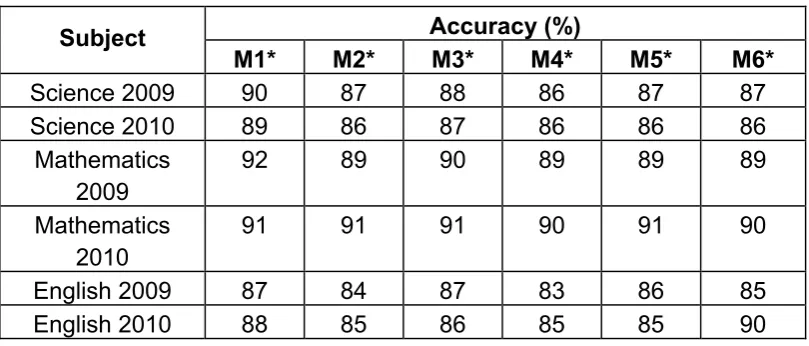
assessment data using a number of widely used methods (He, Hayes and Wiliam, 2011). Six different methods under both the CTT and IRT frameworks have been used in the study to estimate classification accuracy. These involved modelling (conditional) error score distribution, estimating true score distribution, estimating observed score distribution based on modelled true score distribution using either simulations or numerical integration, and comparing modelled true score distribution with observed score distribution, taking into account cut scores set for the
performance categories, to derive classification accuracy. The data analysed are from the 2009 and 2010 live test series. These include mark distributions for the populations and item level data for each subject for a sample of over 3000 students for each series.
The Key Stage 2 mathematics test has three subtests: Test A, Test B and a mental test. Test A and Test B are each worth 40 marks. Calculators are allowed for Test A but not for Test B. The mental test is worth 20 marks. Scores from the three subtests are combined to form the composite score for mathematics. The English test has two components, a reading component and a writing component. Both the reading and writing components are worth 50 marks. Again scores on the two subtests are aggregated to produce the overall score for the subject. As in the science tests, the composite score for each subject is used to assign a National Curriculum level for the subject to the pupil.
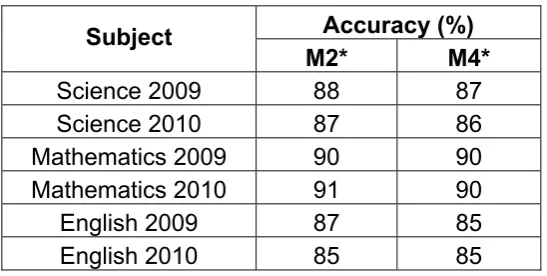
Table 6 shows the values of Cronbach’s alpha for the three subjects for the samples, with highest values for the mathematics tests and the lowest for the English tests. For individual subjects, the values are similar in 2009 and 2010. For the science tests, values of Cronbach’s alpha are also similar to those estimated for the pre-tests for 2005–9 (see previous discussions and Maughan et al., 2009). These values are relatively high for tests of this kind, and significantly higher than those reported in earlier years.
comparable with those from recent studies by other researchers (Hutchison and Benton, 2009; Maughan et al., 2009; Newton, 2009). These values are substantially higher than those suggested for the tests in the early years of testing (see Wiliam, 2001). This increase in classification accuracy may partly reflect that the reliability of Key Stage 2 National Curriculum tests has improved and partly reflect that the structure of the tests has changed (see also Maughan et al., 2009).
Table 6: Sample sizes and Cronbach’s alpha for the 2009 and 2010 Key Stage 2 live tests
Sample size Number of items Cronbach’s alpha
Subject
2009 2010 2009 2010 2009 2010
Science 3395 26017 79 73 0.928 0.926
Mathematics 3265 3649 100 100 0.968 0.964
[image:14.595.77.482.390.563.2]English 3189 3656 40 38 0.910 0.919
Table 7: Classification accuracy for samples from the 2009 and 2010 Key Stage 2 live tests estimated using different methods.
Accuracy (%) Subject
M1* M2* M3* M4* M5* M6*
Science 2009 90 87 88 86 87 87
Science 2010 89 86 87 86 86 86
Mathematics 2009
92 89 90 89 89 89
Mathematics 2010
91 91 91 90 91 90
English 2009 87 84 87 83 86 85
English 2010 88 85 86 85 85 90
*M1 to M6: the different methods
Table 8: Classification accuracy for the populations for the 2009 and 2010 Key Stage 2 live tests estimated using two different methods
Accuracy (%) Subject
M2* M4*
Science 2009 88 87
Science 2010 87 86
Mathematics 2009 90 90
Mathematics 2010 91 90
English 2009 87 85
English 2010 85 85
*M2 and M4: two of the six different methods
Evidence of reliability in GCE and GCSE
Ofqual commissioned a number of research projects to investigate the reliability of GCE and GCSE components and qualifications.
Test-related component / unit reliability
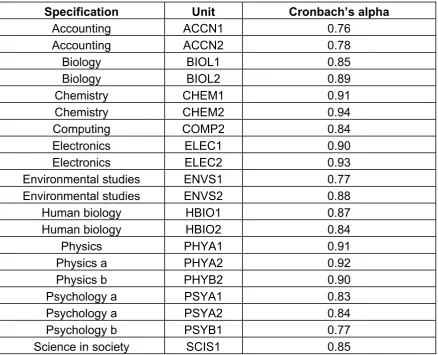
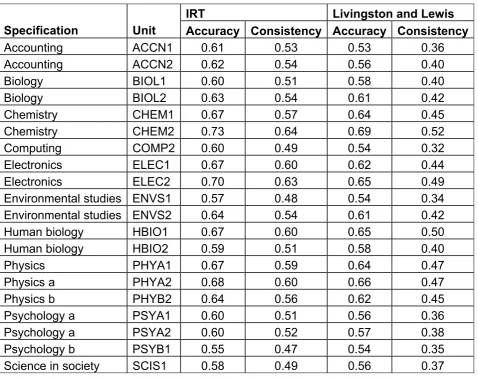
Wheadon and Stockford (2011) from the Assessment and Qualifications Alliance (AQA) investigated the reliability of AQA’s GCSE and A level units / components from a range of qualifications from the November 2008 to June 2009 examination series in the form of classification accuracy and consistency. Most of the units studied were composed of objective, short-answer or structured response test items that were considered to allow the assumption of reliable marking. The researchers used two approaches to derive the reliability estimates: an IRT approach proposed by Lee (Lee and Kolen, 2008; Lee, 2010) and a CTT approach developed by Livingston and Lewis (1995). Table 9 shows values of Cronbach’s alpha for a selection of GCE units investigated by the researchers, which range from 0.76 for ACCN1 (Accounting) to 0.94 for CHEM2 (Chemistry). It was recognised that Cronbach’s alpha could
Table 9: Cronbach’s alpha for the considered AS level units (from Wheadon and Stockford, 2011)
Specification Unit Cronbach’s alpha
Accounting ACCN1 0.76
Accounting ACCN2 0.78
Biology BIOL1 0.85
Biology BIOL2 0.89
Chemistry CHEM1 0.91
Chemistry CHEM2 0.94
Computing COMP2 0.84
Electronics ELEC1 0.90
Electronics ELEC2 0.93
Environmental studies ENVS1 0.77
Environmental studies ENVS2 0.88
Human biology HBIO1 0.87
Human biology HBIO2 0.84
Physics PHYA1 0.91
Physics a PHYA2 0.92
Physics b PHYB2 0.90
Psychology a PSYA1 0.83
Psychology a PSYA2 0.84
Psychology b PSYB1 0.77
Science in society SCIS1 0.85
reliability coefficient such as Cronbach’s alpha and the standard deviation of the raw scores). Higher values of the grade bandwidth:SEM ratio will generally be associated with higher classification accuracy or consistency.
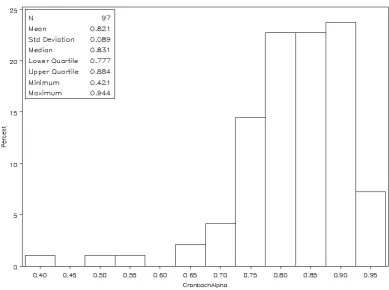
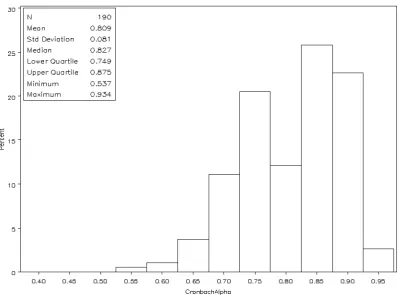
Figure 1: Distribution of Cronbach’s alpha for 97 GCE units / components studied (from Bramley and Dhawan, 2011)
Table 10: Classification accuracy and consistency in GCE units / components (based on Wheadon and Stockford, 2011)
IRT Livingston and Lewis
Specification Unit Accuracy Consistency Accuracy Consistency
Accounting ACCN1 0.61 0.53 0.53 0.36
Accounting ACCN2 0.62 0.54 0.56 0.40
Biology BIOL1 0.60 0.51 0.58 0.40
Biology BIOL2 0.63 0.54 0.61 0.42
Chemistry CHEM1 0.67 0.57 0.64 0.45
Chemistry CHEM2 0.73 0.64 0.69 0.52
Computing COMP2 0.60 0.49 0.54 0.32
Electronics ELEC1 0.67 0.60 0.62 0.44
Electronics ELEC2 0.70 0.63 0.65 0.49
Environmental studies ENVS1 0.57 0.48 0.54 0.34
Environmental studies ENVS2 0.64 0.54 0.61 0.42
Human biology HBIO1 0.67 0.60 0.65 0.50
Human biology HBIO2 0.59 0.51 0.58 0.40
Physics PHYA1 0.67 0.59 0.64 0.47
Physics a PHYA2 0.68 0.60 0.66 0.47
Physics b PHYB2 0.64 0.56 0.62 0.45
Psychology a PSYA1 0.60 0.51 0.56 0.36
Psychology a PSYA2 0.60 0.52 0.57 0.38
Psychology b PSYB1 0.55 0.47 0.54 0.35
Table 11: IRT estimation of the proportion of candidates with a particular grade (other than the highest or lowest grade) with true scores either in that grade, or the one adjacent (from Wheadon and Stockford, 2011).
Specification Unit Accuracy plus / minus
one grade
Accounting ACCN1 0.89
Accounting ACCN2 0.92
Biology BIOL1 0.92
Biology BIOL2 0.95
Chemistry CHEM1 0.98
Chemistry CHEM2 0.99
Computing COMP2 0.96
Electronics ELEC1 0.95
Electronics ELEC2 0.95
Environmental studies ENVS1 0.90
Environmental studies ENVS2 0.97
Human biology HBIO1 0.93
Human biology HBIO2 0.91
Physics PHYA1 0.96
Physics a PHYA2 0.97
Physics b PHYB2 0.93
Psychology a PSYA1 0.94
Psychology a PSYA2 0.94
Psychology b PSYB1 0.90
Science in society SCIS1 0.91
Bramley and Dhawan (2011) also reported values of Cronbach’s alpha for 190 GCSE units / components, ranging from 0.537 to 0.934 (see Figure 2). Wheadon and
Stockford (2011) also investigated the classification accuracy and consistency for a range of GCSE units.
Bradley and Dhawan (2011) also used a simplified IRT (Rasch) approach to investigate grade classification consistency (accuracy) for a number of GCE and
GCSE components / units (see Table 12). In Table 12,Rß is the Rasch ’Person
Figure 2: Distribution of Cronbach’s alpha for 190 GCSE units / components (from Bramley and Dhawan, 2011)
[image:20.595.104.536.523.709.2]Johnson and Johnson (2011) explored the potential of using generalizability analysis to study component reliability for a range of GCE and GCSE components for a selection of subjects with varying assessment structure in terms of different numbers of questions in different components and different marks assigned to different
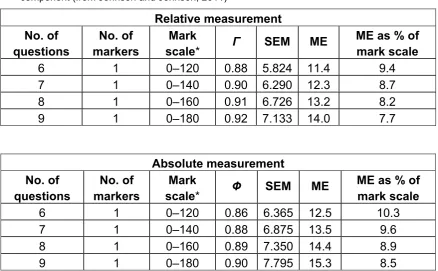
questions in the component. The advantage of using G-theory to investigate reliability is that the relative contributions from different error sources to the overall error of measure for a test can be identified (see Johnson and Johnson, 2009, 2011). Further, G-theory can be used to explore the effect of various factors such as the number of tasks and the number of markers on the reliability of the test. For example, Table 13 shows how the relative and absolute reliability coefficients for a GCSE
component vary with the number of questions in the question paper. In Table 13, Гis
the generalizability coefficient (for relative measurement – ranking test-takers relative
to each other); Ф is the absolute reliability coefficient (for absolute measurement –
locating individuals absolutely on the measurement scale, irrespective of others),
SEM is the standard error of measurement, and ME is the margin of error calculated
[image:21.595.79.518.371.642.2]as 1.96 SEM.
Table 13: Changes of reliability coefficients with the number of questions for a GCSE component (from Johnson and Johnson, 2011)
Relative measurement No. of
questions
No. of markers
Mark
scale* Г SEM ME ME as % of mark scale
6 1 0–120 0.88 5.824 11.4 9.4
7 1 0–140 0.90 6.290 12.3 8.7
8 1 0–160 0.91 6.726 13.2 8.2
9 1 0–180 0.92 7.133 14.0 7.7
Absolute measurement No. of
questions
No. of markers
Mark
scale* Ф SEM ME ME as % of mark scale
6 1 0–120 0.86 6.365 12.5 10.3
7 1 0–140 0.88 6.875 13.5 9.6
8 1 0–160 0.89 7.350 14.4 8.9
9 1 0–180 0.90 7.795 15.3 8.5
development and improve assessment quality. It is noticed that the reliability
measures reported for the various studies are for units only. In view of the structure of qualifications and the inter-relationships between units / components in a
qualification, the qualification level reliability indices (coefficient alpha or classification accuracy and consistency) would be substantially higher than those for individual units or components.
Marking-related variability
[image:22.595.105.523.439.633.2]Bramley and Dhawan (2011) investigated inconsistency in examination results due to variability in marking between markers using operational data for live monitoring in both paper-based and on-screen marking systems. They reported discrepancies and correlations between markers (Assistant Examiners – AEs) and Team Leaders (TLs) for the paper-based marking system or between definitive and awarded marks for seed scripts for the on-screen marking system for a range of GCE and GCSE units / components with different number of questions and maximum marks in the units / components (see Tables 14 and 15. Seed scripts, for which the ‘definitive’ mark on each item has been established by a panel of senior examiners, are scripts that are inserted into each AE’s marking allocation at intervals to monitor marking quality). The researchers compared the marker-related SEM with the test-related SEM for the units / components studied and found that for the components investigated, test-related unreliability was generally higher than marker-test-related unreliability.
Table 15: Distribution of differences between definitive and awarded marks for seed scripts in selected units / components for the on-screen monitoring system (from Bramley and Dhawan, 2011)
Johnson and Johnson (2011) used an example to demonstrate how G-theory analysis can be used to explore the effect of the number of questions and the
[image:23.595.81.517.499.756.2]number of markers simultaneously on the reliability of a GCSE component (see Table 16). The relative reliability coefficient increases with increasing number of questions and number of markers.
Table 16: Changes in reliability coefficients with number of questions and number of markers for a GCSE component (from Johnson and Johnson, 2011)
Relative measurement No. of
questions
No. of markers
Mark
scale SEM ME
ME as % of mark scale
3 2 0–75 0.89 4.2 8.2 10.8
3 1 0–75 0.86 4.8 9.3 12.2
6 2 0–150 0.93 6.2 12.1 8.0
6 1 0–150 0.91 7.2 14.1 9.3
Absolute measurement
Teacher assessment reliability
Johnson (2011) produced a report investigating the nature and extent of teacher assessment in the different testing and examination systems currently in operation in England, Wales and Northern Ireland and the procedures that are used by
assessment agencies to ensure teacher assessment reliability. The research aimed to address the following teacher assessment issues.
What is the nature of the tasks assigned to teachers as the basis for forming
judgements about learners’ knowledge, skills or abilities?
What rules and procedures are in operation that guide or standardise the
conditions under which learners produce the evidence that their teachers use to assess them?
What is the nature of learners’ work – reports or artefacts – that teachers are
required to assess, and what rules or requirements govern these?
What is the nature of any formal marking schemes that teachers use to arrive at
their assessments, and what procedures are in place for checking reliability?
What methods are employed to check on the reliability of sets of submissions,
and what are the criteria that would trigger action to address discrepancies?
What scaling or other adjustment methods are employed before aggregating
assessment results to arrive at final awards, and what are the potential effects of these on the overall reliability of those final awards?
The report gave a very comprehensive account of the processes involved in teacher assessment, the main factors that could affect the reliability of teacher assessment results, and the quality assurance procedures adopted by assessment providers to ensure reliable teacher assessment results. The author examined the implications of the various aspects of teacher assessment for investigating teacher assessment reliability.
Coursework, tasks and conditions of assessment: The nature of assessment
tasks and conditions under which the tasks are taken have important implications for assessment reliability and validity.
Internal assessment, performance evidence and rating criteria: Results from
External moderation of internal assessments: The issue of comparability in
standards between teachers in the same school and between schools has implications for the reliability in teacher assessment results. Both statistical moderation and external inspections are used to address comparability.
Although the report provided some limited evidence of inconsistency in teacher assessment results, it found very limited empirical evidence on teacher assessment reliability, due primarily to the difficulties in conducting teacher assessment
investigations. The author suggested that generalizability analysis could be used to investigate teacher assessment reliability.
Qualification level reliability
Bramley and Dhawan (2011) investigated the composite reliability for a number of GCE and GCSE qualifications based on the reliabilities of the components and the interrelationships between the components (see Table 17). In Table 17, P (different grade) represents the probability that an examinee with a true score in the middle of a grade band (corresponding to the bandwidth defined previously) might obtain an observed score in a different grade band. The researchers also discussed the difficulty in collecting appropriate data for estimating qualification level reliability. For example, there is generally very limited information about the reliability of
[image:25.595.102.515.479.711.2]coursework, and there are a large number of alternative assessment units for some qualifications.
Grading-related variability
Bramley and Dhawan (2011) used examples to examine the sensitivity of
qualification level outcomes to changes of grade boundary values. They discussed factors that could affect the sensitivity of qualification outcomes, which include the number of components / units to be aggregated, component mark distributions, correlations between components / units, and others.
Evidence of reliability in workplace-based qualifications
Harth and Hemker (2011) from City & Guilds and Cito conducted research on
workplace-based vocational qualifications. Workplace-based vocational assessments present a variety of issues in terms of collecting appropriate data for analysis, such as observations of live performance, the use of a variety of tasks, individualised skills internally assessed, unlimited attempts by candidates, and others, which could
introduce inconsistency in results. Another feature of this type of assessment is that candidates are entered for summative assessment only ‘when ready’ and the
decision to ‘pass’ a candidate is taken in a sense before the assessment takes place (see Harth and Hemker, 2011).
Harth and Hemker (2011) provide a very detailed account of the processes involved in conducting workplace-based assessment, the many factors that can affect the reliability and validity of assessment results, existing procedures that are used to estimate reliably measures for vocational qualifications, and procedures that are used by assessment providers to ensure assessment reliability and validity.
The researchers investigated the reliability of outcomes from three selected
qualifications in two occupational areas: Level 3 Electrotechnical Services (Electrical Installation – Buildings and Structures), Hairdressing NVQ (several pathways at levels 1, 2 and 3) and the new NVQ Certificate / Diploma in Hairdressing / Barbering / Combined Hair Types (several pathways at QCF levels 1, 2 and 3). To gather the necessary data for analysis, methodology was developed for data collection, which involved the use of centre-devised assessment records from candidate portfolios and of internal verifier (IV) reports. Procedures were then developed to estimate the inter-rater agreement, inter-inter-rater reliability and inter-‘item’ reliability for the three
qualifications. The main findings from this research (see Harth and Hemker, 2011) are as follows.
The results suggest that inter-rater (assessor / internal verifier) agreement is
high (with Gower coefficient–proportion agreement, ranging from .90 to .99) and inter-rater (assessor / IV) reliability (Cohen’s kappa) is ‘substantial’ (for
Inter-‘item’ reliability (using a coefficient similar to Cronbach’s alpha and
Guttman’s lambda) could only be estimated for the electrotechnical services and the results show high values.
The procedures presented confirm that it is possible to estimate the reliability of
these qualifications, although changes would need to be made in the types of records used by assessors and the feedback given to candidates if this is to be carried out routinely.
The flexibility required in the structure of these qualifications may prevent these
procedures developed from being applied across all vocational qualifications.
The verification process appears to work effectively in ensuring consistency of
decisions and high inter-rater (assessor / IV) reliability.
Review of reliability theories and models
A number of research projects were also commissioned to review measurement theories and models that are used to study reliability and techniques that are used to produce and interpret reliability indices.
The report produced by Hutchison and Benton (2009) gives an insightful explanation of the measurement process, and a clear description of the different forms of
reliability and the commonly used reliability indices under both CTT and IRT. The report provides a relatively comprehensive list of procedures that are commonly used to estimate these indices. This report also presents a clear description of how
measurement error is related to reliability and how it should be interpreted. Clear descriptions of the assumptions involved in the use of the different forms of reliability measures and the sources of unreliability they account for are also provided in the report. A case study using a Key Stage 2 English reading pre-test was conducted to demonstrate how the various reliability indices can be estimated and interpreted (see previous discussions). The researchers also explored the use of alternative terms of reliability that could be understood by non-technical audiences.
reached before the test is used in live testing situations. G-theory studies can also be used to monitor the results from live testing, to ensure that the required level of score reliability is maintained during testing.
The report produced by He (2009) investigates how the reliability of composite scores is affected by the reliabilities of component scores, weights assigned to individual components and the interrelationships between component scores. He conducted a relatively comprehensive review of the literature on methodologies for researching the reliabilities of tests and examinations, particularly in terms of multivariate techniques applicable for multi-component examinations, which is of great relevance to the examinations featured in the UK. The author looked at ways of forming composite scores from component scores and summarised some of the procedures developed for CTT, G-theory and IRT that are widely used for studying the reliabilities of composite scores composed of weighted component scores.
Representing and reporting of assessment results and
measurement errors
International approaches to representing and reporting of assessment results and errors
An important area that the Reliability Programme has been trying to explore is how assessment results and associated errors are reported internationally, and what procedures are employed by assessment providers to communicate results and errors to the users.
The report produced by Bradshaw and Wheater (2010) provides evidence in these areas. The authors searched relevant literature and examples of assessments to identify how results are represented, what level of detail is reported and what steps are taken to quantify and report on error internationally. They also looked at the rationales that were behind the use of different reporting systems. These researchers developed a taxonomy for classifying approaches to the reporting of assessment results, and used this taxonomy to classify a range of international assessments. Key findings from this study are summarised below (see Bradshaw and Wheater, 2010).
The way results are reported depends on the intended use of the results and to
whom the results are to be reported.
Two opposing issues must be weighed up when deciding on the level of detail
of results reporting. These are:
the increased reliability when few grades are reported
A selection of international assessments have been classified using the
developed taxonomy. The classification is by three main areas:
a description of the assessment, which includes at what stage of
secondary education the assessment is used, the purpose, who makes the award, the mode and method of the assessment, and whether the assessors are external or internal
how the results are represented, for instance by grades, scores or a
profile, and the numbers of these
whether error or uncertainty is reported.
Few examples were located of reporting uncertainty or error in their results to
learners. An introduction of the reporting of error in high-stakes qualifications would need careful handling to ensure this did not result in misinterpretation and a loss of confidence in the system.
Reporting of measurement uncertainty and reliability in USA
Following the report by Bradshaw and Wheater (2010), a group of researchers led by Richard Phelps in the USA were commissioned to investigate how measurement uncertainties were represented and reported in US high-stakes tests (see Phelps et al., 2010). These researchers conducted web-based searches, which were followed up where needed with telephone calls, and contacted key researchers at relevant entities involved in reporting test results in the USA. Using the evidence they collected, these researchers discussed the prevalence of the reporting of
measurement uncertainty in high-stakes tests and the degree of ease or difficulty with which ordinary citizens may access such information. They found that the degree of transparency with measurement uncertainty issues varies. Transparency seems to be greater for educational than for licensure tests, for mostly objective than for mostly essay tests, for larger programmes than for smaller programmes. These researchers also found that transparency seemed to improve if the role of test contractors was greater and the role of state government was smaller.
The researchers found that totality of uncertainty is not reported to all stakeholders in US educational and licensure testing programmes. It would be difficult for the
[image:30.595.107.525.275.756.2]average parent to find a full range of measurement uncertainty statistics for their children’s tests, for example. The researchers conclude that the average parent would not be looking for this degree of technical information, which explains why technical manuals are not found on the home page of testing programme websites. Documents that better respond to the typical consumer’s needs are placed at the forefront and the technical manuals are placed behind. Despite this, they are not hidden and there seems not to be any effort to hide information.
Public perceptions of reliability
Surveys of perceptions of A levels and GCSEs
Ipsos MORI conducts a survey of perceptions of A level and GCSE that is now in its eighth wave (Ipsos MORI, 2010). The most recently reported wave of the survey was conducted in the winter of 2009, and reported findings based on samples of A level and GCSE teachers, students and their parents, and the general public.
Both the 2009 and the 2010 surveys included questions about the reliability and accuracy of examination results (Ipsos MORI, 2010). Large majorities of teachers, parents and students thought that most or all students got the correct grade at GCSEs and A levels (for example, see Figure 4). Respondents also gave reasons that they perceived as being likely to cause candidates to get the wrong grade in examinations, which included:
students performing better or worse than expected in examinations or
coursework
[image:31.595.118.508.452.684.2] inaccurate marking and poorly designed examination papers.
Qualitative investigations of perceptions of reliability
As part of Strand 3 of the Reliability Programme, research projects were commissioned from Ipsos MORI and from the Assessment and Qualifications Alliance (AQA) to investigate public perceptions of reliability using workshops and focus groups. These studies focused on the following aspects of reliability:
the assessment process
factors affecting the performances of students on examinations
the reliability concepts and measurement error
the different types of error in examination results: preventable human mistakes
versus inevitable random measurement error
factors contributing to measurement error in examination results
the level of acceptance towards human error and measurement error in
examination results.
The research conducted by Ipsos MORI in January 2009 used two workshops in London and Birmingham to investigate the opinions of different groups about reliability and unreliability (Ipsos MORI, 2009). Research participants were drawn from teachers, students, parents, members of the general public, employers and examiners. The sessions started with an analogy to an error occurring in medical treatment; this was used as a substantial input to help workshop participants
understand the concepts under discussion. Researchers understood that giving such substantial input to participants whose opinions and attitudes one was trying to discover ran the risk of biasing them. However, the belief was that participants would probably not have developed views on reliability in test scores and so it was felt important to give them contextualisation of this sort. Some of the findings from the research are summarised below.
There was a demarcation in the minds of the public between inevitable errors in
the assessment process and preventable errors. The research participants appeared to accept that a certain amount of error was inevitable in a large examinations system, but they could be intolerant of ‘preventable errors’.
Sometimes participants appeared to be making a distinction between inherent
and preventable error, and at other times did not.
Some research participants stated that their attitude to error depended upon
Participants’ views about error could vary by group and by the perceived cause
of the error. For example, students and teachers could be intolerant of
typographical errors in papers, while examiners could be more sanguine, taking the view that what was important was that any mistakes that did occur were rectified.
There was evidence that students were aware that some inconsistency between
human markers was inherent in subjects such as English. However, there were also statements that such inherent errors should be minimised or even
eliminated.
Students and the general public were able to debate whether and how
examinations can and should sample from the curricula.
Chamberlain from AQA (2010) conducted qualitative research to follow up Ipsos MORI's (2009) work. Chamberlain collected data via ten focus groups, with samples of job-seekers, employees, employers, students for a Postgraduate Certificate in Education (PGCE), and primary and secondary teachers (74 participants in total; 28 male and 46 female). Like Ipsos MORI, Chamberlain designed her research with the assumption that she would have to take steps to mitigate participants' lack of
knowledge of key elements of the reliability concept. Chamberlain used vignettes as a technique to introduce reliability to her research participants. The vignettes were very short stories or scenarios involving fictional characters in specific dilemmas which were related to the research context and relevant to the lives and educational experiences of the participants. Main findings from the study were as follows (see Chamberlain, 2010):
With the exception of the secondary school teachers, the participants had
limited awareness of the concept of reliability. Participants were able to recognise forms of human error in the assessment process but often failed to envisage how this might impact on the reliability of their assessment outcomes.
The participants struggled to see how measurement inaccuracy (Newton, 2005)
could be termed ‘assessment error’ and how it could impact on the reliability of outcomes. Instead, they suggested that measurement inaccuracy was an inevitable part of life, and that to draw attention to its impact on assessment outcomes would not be beneficial.
school teachers spoke extensively about their experiences of challenging
students’ results, and demonstrated their awareness of how errors could occur.
Participants tended to trust examiners to assess their work fairly, believing that
examiners are professional and well-trained subject experts. The participants could recognise, however, that some subjects require more interpretation than others, and thus that the reliability of marking could be variable. The secondary school teachers tended to be less trusting – many acted as moderators
themselves in order to mediate the influence of external examiners, and to gain a better understanding of assessment criteria to pass on to their students.
On the whole, the participants suggested that they would like to be more
informed about assessment reliability, but only through a better understanding of how the assessment process works i.e. knowing what happens to a
candidate’s script after the candidate has completed the examination. There was a notable lack of support for any quantification of reliability and, in particular, publishing a reliability statistic alongside a candidate’s grade. The secondary school teachers were particularly emphatic that any initiative to enhance understanding of reliability should begin with teachers and students, and not with parents or the public at large.
Results from the research indicated that reliability is a difficult concept to
comprehend. The author suggested that ’a qualitative approach to reliability that focuses on students and teachers may be a possible way forward in enhancing the dissemination of reliability information‘ (Chamberlain, 2010, page 3).
Ofqual also held a workshop at the UK Youth Parliament (UKYP) Annual Conference with secondary school students to gauge their knowledge and views on the reliability of examination results and the examination system in general. Various views were expressed by the students regarding the importance of achieving high examination results, confidence in receiving the right grades, factors that would result in a wrong grade being given and actions to take, and ways to improve reliability of examination results.
Quantitative investigation of public perceptions of reliability
findings. The Ipsos MORI (2010) survey only addressed some narrow aspects of reliability of examination results. The research by He et al. (2010) sought to contribute further to a developing understanding of attitudes to reliability and unreliability using an objective online questionnaire survey. The questionnaire was structured into five distinctive topics to measure different aspects of respondents’ knowledge of and attitudes towards unreliability in examination results:
Topic A: Knowledge of and experience in the examination process and
confidence in the national examinations system
Topic B: Understanding of factors that affect the performances of students on
examinations and factors that introduce uncertainty into examination scores
Topic C: Attitudes towards different types of assessment error (including human
mistakes and measurement inaccuracy)
Topic D: Approaches for improving reliability
Topic E: Approaches to trust in general.
Representative respondents were sampled from three key stakeholder groups: A level teachers, A level students aged 16–18, and employers. The achieved sample sizes were 314 for teachers, 358 for students and 210 for employers. Data collected was also analysed to investigate:
how attitudes to unreliability are related to knowledge and understanding of the
reliability concept
how attitudes to unreliability are related to confidence and belief in the
examination system and approaches to trust
how confidence and belief in the examination system are related to trust.
Main findings from the study are as follows.
There was substantial variability in the understanding of reliability concepts and
attitudes to unreliability in examination results among the respondents, both within group and between groups.
the statements. In general, all the five factors listed in the questionnaire were regarded as important in influencing students’ performances in examinations.
To a degree, the respondents also understood the factors that could introduce
uncertainty in examination results. As an example, Figure 6 shows the
percentages of respondents from the three groups who selected either ‘Strongly agree’ or ‘Agree’ for the statements about factors that could introduce
unreliability into examination results.
The respondents showed various degrees of experiences of the examination
process and acceptance of measurement error in examination results.
The level of tolerance of the respondents for measurement uncertainty to some
[image:36.595.124.500.401.627.2]degree was positively correlated to the level of belief about the examination system, knowledge of aspects of unreliability and approaches to trust (see Tables 18–20).
Figure 5: Understanding of factors that affect students’ scores in an examination
0 10 20 30 40 50 60 70 80 90 100
Teachers Students Employers
Group P er c en tag e ag ree m en t (% )
How much the student knows about the subject How well the student is prepared
How difficult the question paper is How well the student feels on the day Who marks the question paper
Figure 6: Understanding of factors that can introduce uncertainty in examination results 0 10 20 30 40 50 60 70 80 90 100
Teachers Students Employers
Group P er c en tag e a g reem e n t ( % )
The occasion (e.g. if assessed on another day, the student might have performed differently
Test questions (e.g. if a different test had been set, the student might not have been disadvantaged by the wording of an essay question)
Marking inconsistency (e.g. if a different marker had been assigned, the student might have achieved a different result)
The awarding process (e.g. if a different team of people had been involved in the process of awarding, different grade boundary marks might have been set)
[image:37.595.74.481.424.527.2]How far do you agree that the following introduces inconsistency into exam results if the exam procedure was repeated?
Table 18: Correlations between scores on different topics for teachers
Topic A Topic B Topic C Topic D Topic E
Topic A 1
Topic B 0.227** 1
Topic C 0.063 0.152** 1
Topic D 0.056 0.153** 0.143* 1
Topic E 0.192** 0.016 0.111 –0.017 1
[image:37.595.74.481.591.693.2]*Significant at p<0.05, ** significant at p<0.01
Table 19: Correlations between scores on different topics for students.
Topic A Topic B Topic C Topic D Topic E
Topic A 1
Topic B 0.352** 1
Topic C 0.125* 0.219** 1
Table 20: Correlations between scores on different topics for employers
Topic A Topic B Topic C Topic D Topic E
Topic A 1
Topic B 0.433** 1
Topic C 0.378** 0.406** 1
Topic D 0.288** 0.378** 0.341** 1
Topic E 0.368** 0.233** 0.259** 0.194** 1
*Significant at p<0.05, ** significant at p<0.01
Communicating about reliability with the public
Boyle et al. (2009) conducted research looking at issues with communicating
unreliability in test scores to the public. These researchers suggested two reasons for the difficulty in communicating the reliability concepts with the public:
the concept of reliability is complex and hard to explain succinctly
unreliability seems like an intrinsically bad news story.
They cited two sources of evidence for these reasons. Firstly, literature describing the media environment that surrounds examination results in England is summarised, which gives a history of assessment organisations' attempts at communicating with the public and is used to make suggestions for how such bodies might communicate better. The second source of evidence is the findings from the 2009 Ipsos MORI work (2009) discussed above, which provides the researchers an initial feel for the tolerance that different sectors of the public have for different sources of
measurement inaccuracy in examination results. The researchers then conclude by suggesting ways to improve each of the issues with unreliability as a media story. The problem of complexity is addressed by allowing people to interact with the message via multiple media, using varied analogies and so on. In terms of the negativity of the story, the suggested response is not to try to make this into a good news story. Rather, the aspiration is to communicate the message that many
assessment results contain an element of unreliability to the public in a manner that allows people to become more sophisticated users of those results.
Raising public awareness of reliability
Ofqual has held public events and participated in public events to raise public
awareness of reliability. For example, Ofqual organised a workshop at the UK Youth Parliament (UKYP) Annual Conference with secondary school students, and
Ofqual reliability seminars
Interpretation and communication of reliability evidence
One of the objectives of the Reliability Programme is to investigate how reliability evidence should be best produced, interpreted, evaluated and communicated to the users of assessment results. In addition to commissioning the various research projects that looked at aspects of assessment reliability, Ofqual also held a seminar
on 7th October, 2009 at the University of Warwick, involving leading assessment
experts and communications experts to discuss these issues (see Ofqual, 2009).
The discussions at the seminar focused on the following major topics:
factors that affect the reliability of results from assessments
definition and meaning of different forms of reliability
theories and models that are used to study reliability
statistical methods that are used to produce reliability estimates
discussion on the empirical evidence of reliability from case studies
representing and reporting assessment results and reliability estimates /
measurement errors
improving reliability and implications
disseminating reliability statistics
educating the public to understand reliability concepts.
questions? How likely was it that the student would have been awarded different grades if marked by a different examiner? How many candidates would have been affected, up or down a grade or level, by an adjustment to the cut-off point? Did all the questions contribute evenly to the overall purpose of the assessment or were some of them more random and should therefore have been given less importance? Did the test measure the performance of those at the top as accurately as those in the middle? Delegates agreed that these were all aspects that should be discussed, whether or not they are included in any stricter definition of ‘reliability’.
The participants realised the importance of a high level of reliability in assessment results. However, there was a balance that must be reached between improving reliability and the impacts on students in terms of what is to be measured, and assessment providers in terms of financial costs. Also, it was agreed that increasing reliability should not compromise validity.
It was realised that there was a need to educate the users of assessment results to understand the concept of reliability and the existence of inevitable measurement uncertainty in results from assessment systems.
Classification accuracy in Key Stage 2 National Curriculum tests
The seminar held on 8th November, 2010 at the Institute of Education in London and attended by a group of assessment researchers from academic and research
institutions, awarding organisations, test development agencies, and Ofqual, was intended specifically to gain a further understanding of the reliability of current Key Stage 2 National Curriculum tests based on analyses of live test data collected from the 2009 and 2010 series (see previous discussions). The seminar discussed a range of topics, including:
different conceptions of assessment validity and threats to validity, including
construct-irrelevant variance and construct under-representation
the relationship between reliability and validity: reliability should be viewed as
one aspect of validity
the implications of inferences to be made from assessment outcomes for the
operational definition of reliability and the choice of reliability indices to assist data interpretation. For example, where assessment results are reported using scores, the use of standard error of measurement would be appropriate; where results are reported using performance categories such as the National
conceptualising and interpreting reliability in the context of National Curriculum
tests in England
factors affecting classification accuracy in test results in general
impact of different methods used for estimation on classification accuracy
measures
current classification accuracy or misclassification (which refers to the degree to
which true scores and observed scores classify test-takers into different performance categories) in results from the Key Stage 2 National Curriculum tests in science, mathematics and English
ways to improve reliability and assessment quality in general.
The seminar also discussed factors that can affect classification accuracy, including:
the measurement precision (SEM) or test reliability (which is generally used to
estimate SEM for CTT); other things being equal, higher measurement precision will result in higher classification accuracy or a lower rate of misclassification
score range and distribution
number of performance categories that are used and the boundary locations of
the categories; other things being equal, higher number of performance categories will result in lower classification accuracy
models that are used and the methods that are used to estimate model
parameters. Different models and model parameters could produce different true score distributions or expected observed score distributions, which will affect the classification accuracy.