http://www.scirp.org/journal/jamp ISSN Online: 2327-4379
ISSN Print: 2327-4352
Numerical Solution of the Diffusion Equation with
Restrictive Pade Approximation
Ahmet Boz*, Fevziye Gülsever
Departments of Mathematics, Dumlupinar University, Kütahya, Turkey
Abstract
The problem of solving the linear diffusion equation by a method related to the Re-strictive Pade Approximation (RPA) is considered. The advantage is that it has the exact value at certain r. This method will exhibit several advantages for example highly accurate, fast and with good results, etc. The absolutely error is still very small. The obtained results are compared with the exact solution and the other methods. The numerical results are in agreement with the exact solution.
Keywords
Restrictive Pade Approximation (RPA), Diffusion Equation, Finite Difference
1. Introduction
In this paper, we apply a new implicit method of high accuracy and the number of li-near systems which to be solved are smaller than that for many famous known implicit methods of small step length. Therefore, our required machine time is less than that for the other implicit methods.
Restrictive Pade Approximation (RPA) for parabolic Partial Differential Equation (PDE) and Partial Difference Equations is a new technique done by İsmail and Elbar-bary [1]. In addition, they studied numerical solution of the Convection Diffusion Equ-ation [2]. RPA for hyperbolic PDE is done by İsmail and Younes [3][4][5]. Restrictive Taylor approximation solution for the parabolic PDE is studied by İsmail and Elbarbary
[6]. Schrodinger and Singularly perturbed parabolic PDE studied by İsmail and Elbee-tar [7][8]. G. Gurarslan [9] studied numerical modelling of linear and nonlinear diffu-sion equations by compact finite difference method.
In this work, we consider the following one dimensional diffusion equation;
( )
, 0t xx
u =u + f u < <x L (1)
How to cite this paper: Boz, A. and Gülsever, F. (2016) Numerical Solution of the Diffusion Equation with Restrictive Pade Approximation. Journal of Applied Mathe-matics and Physics, 4, 2031-2037.
http://dx.doi.org/10.4236/jamp.2016.411202 Received: October 10, 2016
Accepted: November 12, 2016 Published: November 15, 2016 Copyright © 2016 by authors and Scientific Research Publishing Inc. This work is licensed under the Creative Commons Attribution International License (CC BY 4.0).
http://creativecommons.org/licenses/by/4.0/
( )
(
)
, 0t x x
u = D u u < <x L (2)
Subject to the initial condition
(
, 0)
( )
, 0u x = f x < <x L (3)
and boundary conditions
( )
0, 0( )
, 0u t =g x t> (4)
( )
1, 1( )
, 0u t =g x t> (5)
The functions f u
( )
are linear source functions. The function “D u( )
” is thediffu-sion term that plays a crucial role in a wide range of applications in diffudiffu-sionprocess.
[10] [11] [12] The diffusion term D u
( )
appears in several forms. Some of the well known diffusion proses are the fast and the slow diffusion process where the diffusion term is of the form D u( )
=un where n<0 and n>0 respectively.2. Method
2.1. Restrictive Pade Approximation (RPA)
The Restrictive Pade Approximation (RPA) of function f x
( )
is a particular type of rational functions, it can be written in the form [13][14];[
]
( )( )
0 11
1
M i M i
i i
i i
N
f x i
i i
x x
RPA M N x
b x
α
α ε
α
+
= =
=
+
+ =
+
∑
∑
∑
(6)where the positive integer α doesn’t exceed the degree of the numerator N, α =0 1
( )
N,( )
[
]
( )( )
0(
M N 1)
. f xf x −RPA M+α N x = x + + (7)
Let f x
( )
have a Maclaurin Series;( )
0
i i i
f x c x
∞ =
=
∑
(8) From Equations (6)-(8) we get, [1](
1)
0 1 0 1
1 0
N N
i i i i M M N
i i i i
i i i i
c x b x a x x x
α
ε
∞
+ + +
= = = =
+ − − =
∑
∑
∑
∑
(9)The varishing of the first
(
M +N+1)
power of x on the left hand side of (9) implies a system of(
M +N+1)
equations.( )
(
)
(
)
1
1
, 0 1 0 if
0 if 0 r
r r r i i i
i N
M N s M N i s i N s i
i
a c c b r M b i M
c c b ε c i
− =
+ − + − − −
=
= + = = >
+ = = >
∑
∑
(10)Hence we can determine the coefficient, ai and bi as a function of εi,i=0 1
( )
α, where the parameters εi are to be determined, such that [15];( )
i[
]
( )( )
i , 1 1( )
f x
f x =RPA M +α N x i= α (11)
[
]
( )( )
0 1 . 1 M i i i Nf x i
i i
x
PA M N x
x β γ = = = +
∑
∑
(12)The local truncation error form the RPA can be summarized by the following theo-rem.
THEOREM: If the function f x
( )
has an(
n+1)
+h derivative, then for every ar-gument x there exist a number η in the smallest interval I containing the set of points{
x x x0, 1, 2,,xα,x}
, such that;( )
( )
[
]
( )(
1( )
)
(
( )
)
( 1), , , ,
1 !
M N f x M N
x
R α x f x RPA M α N πα R α η α
α
+ +
= − + =
+ (13)
where ∏α+1=x x
(
−x1)(
x−x2) (
x−xα)
and RM N, ,α is the local truncation error for the RPA [1].2.2. Restrictive Pade Approximation of the Exponential Matrix
The exponential matrix exp(rA) can be formally defined by the convergent power series,
( )
2 2 3 3 00
exp ,
2! 3! !
n r
n
r r r
rA I rA A A A A I
n
∞ =
= + + + +=
∑
= (14) where A is(
N− ×1) (
N−1)
matrix.In the case of Restrictive Pade Approximation of single function the term εi in Eq-uation (4) can be reduced to the square matrix εi in the case of Restrictive Pade ap-proximation of the exponential matrix, where
1, 2, 1, 0 0 i i i N i ε ε ε ε − = for example,
[ ]
exp( )( )
1 1 11 1
1 1 .
2 2
rA
RPA r I ε A r I ε A r
−
= + − + +
(15)
3. Method of Solution
We consider the diffussion for f u
( )
= −u [16]. Thus, we use the equation;t xx
U =U −U (16)
Subject to the initial condition;
(
, 0)
sin , 0 1U x = x < <x (17)
and boundary conditions;
( )
( )
0, 0, 0
1, 0, 0
U t t
U t t
= >
The exact solution of the Equation (16) is given by:
( )
2, e tsin
U x t = − x (19)
Condiser the diffusion Equation (16) with the initial and boundary condition. The open rectangular domain is covered by a rectangular grid with spacing h and k in the x and t directions respectively. The grid point
( )
x t, denoted by(
ih jk,)
and U ih jk(
,)
=Ui j,where i=0 1
( )
N j is non-negaive integer.The exact solution of grid representation of (6) is given by [3];
(
)
(
2)
, 1 exp 1 ,
i j x i j
U + = k D − U (20)
The approximation of the partical derivatives 2 x
D at the grid point
(
ih jk,)
will take the usual form:(
, 1)
2
1 , ,
2 1
2
i j i j i j x
D U U U
h + −
= − + (21) and according to central finite difference for mulation
1 2 1
i i i
U=U+ − U +U− (22)
The result of making this approximation is to replace (20) by the following equation
( )
1
2
exp ,
j j k
U rA U r
h
+ = = (23)
where
(
1, , 2, , , 1,)
T, 1j
j j N j
U = U U U − Nh= and
( ) ( )
2 2
2 2 2
2 2 2
2 2 2
2 2
1 1
2 2 1 0
1 2 2 1
1 2 2 1
1 2 2 1
0 1 2 2 N N
h h
h h h
h h h
A
h h h
h h − × −
− + − − − + − − − + − = − − + − − − + (24)
We use the
[ ]
exp( )( )
1 1 11 1
2 2
rA
RPA r I ε A r I ε A r
−
= + − + +
⋅ (25)
Equation to approximate the exponential matrix in Equation (23), then the approx-imate solution of grid representation of Equation (16) can take the form.
(
)
(
(
)
)
(
)
(
)
(
(
)
)
(
)
2 2 2
1, 1 , 1 1, 1
2 2 2
1, , 1,
1 1
1 1 1 1
2 2
1 1
1 1 1 1
2 2
i i j i i j i i j
i i j i i j i i j
h rU h r U h rU
h rU h r U h rU
ε ε ε
ε ε ε
− + + + + − + − − + − − + + − − = + − + − − + + + − (26)
The constrat matrix ε1 must determined by using the only one fact that the exact
solution is given at first level. First choice of ε1= εi j, was the tridiagonal form:
, 1 , , 1 i i i i i i i
1 i j, : i i, i, i j, 0
ε =ε ε =ε ε = otherwise.
Other implicit methods can be derived if we use the possible Restrictive Pade Ap-proximation RPA [M/N], with non-negative integers M and N.
4. Findings
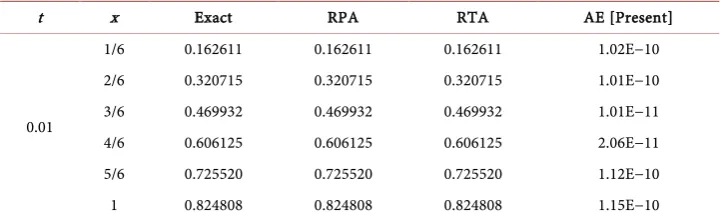
The accuracy of Restrictive Pade Approximation method are compared in tables for various values of the time t. Tables give exact value, approximate value for compact fi-nite difference method, approximate value for Restrictive Taylor Approximation, Re-strictive Pade Approximation and absolute error for ε = 0.0032408523. Comparison of the RPA results with RTA method for k = 0.0001, N = 6, r = 0.0036 given below in tables.
[image:5.595.193.554.323.433.2]The absolute error (AE) is give by the following formula: AE= Exact value−Approximate value. We tabulated all AE values at Table 1, Table 2 and Table 3.
Table 1. Absolute error (AE) for RPA at t = 0.01.
t x Exact RPA RTA AE [Present]
0.01
[image:5.595.193.553.465.565.2]1/6 0.162611 0.162611 0.162611 1.02E−10 2/6 0.320715 0.320715 0.320715 1.01E−10 3/6 0.469932 0.469932 0.469932 1.01E−11 4/6 0.606125 0.606125 0.606125 2.06E−11 5/6 0.725520 0.725520 0.725520 1.12E−10 1 0.824808 0.824808 0.824808 1.15E−10
Table 2. Absolute error (AE) for RPA at t = 0.1.
t x Exact RPA RTA AE [Present]
0.1
1/6 0.135824 0.135824 0.135824 1.26E−9 2/6 0.267884 0.267884 0.267884 1.16E−9 3/6 0.392520 0.392520 0.392520 2.01E−11 4/6 0.506278 0.506278 0.506278 1.25E−10 5/6 0.606005 0.606005 0.606005 1.21E−9
[image:5.595.193.555.596.705.2]1 0.688938 0.688938 0.688938 1.66E−9
Table 3. Absolute error (AE) for RPA at t = 1.
t x Exact RPA RTA AE [Present]
1.00
5. Discussion & Conclusion
In this article, a numerical algorithm was applied in the one dimensional diffusion equ-ation. Computed results were compared with other paper results in Table 1, Table 2
and Table 3. Especially, we compared it with Restrictive Taylor approximation method, because these methods have same properties.But as we have seen from the computa-tional results, Restrictive Pade approximation method has more efficient results than restrictive Taylor approximation method. The proposed method results are quite satis-factory.
References
[1] İsmail, H.N.A. and Elbarbary, E.M.E. (1998) Restrictive Pade Approximation and Parabolic Partial Difference Equations. International Journal of Computer Mathematics, 66, 343-351.
http://dx.doi.org/10.1080/00207169808804645
[2] İsmail, H.N.A. and Elbarbary, E.M.E. (1999) Highly Accurate Method for the Convection- Diffusion Equations. International Journal of Computer Mathematics,72,271-280.
http://dx.doi.org/10.1080/00207169908804850
[3] İsmail, H.N.A., Elbarbary, E.M.E. and Hassan, A.Y (2000) Highly Accurate Method for Solving Initial Boundary Value Problem for First Order Hyperbolic Differential Equation.
International Journal of Computer Mathematics, 77, 251-261.
http://dx.doi.org/10.1080/00207160108805063
[4] Ismail, H.N.A. and Hassan, A.Y. (2000) Restrictive Pade Approximation for Solving First Order Hyperbolic Partial Differential Equation. Journal of Institute of Mathematics and Computer Sciences, India, 11, 63-71.
[5] Ismail, H.N.A. and Hassan, A.Y. (2000) Restrictive Pade Approximation for Solving First Order Hyperbolic Partial Differntial Equation in Two Space Dimensions. Journal of Ma-thematics and Computer Science, India, 11, 159-166.
[6] Ismail, H.N.A. and Elbarbary, E.M.E. (2001) Restrictive Taylor Expansion and Parabolic Partial Differential Equations. International Journal of Computer Mathematics, 78, 73-82.
http://dx.doi.org/10.1080/00207160108805097
[7] Ismail, H.N.A. and Elbeeatar, A.A. (2001) Restrictive Pade Approximation for the Solution of Singularity Perturbed Parabolic PDE. Journal of Mathematics and Computer Science,
India, 12, 153-161.
[8] Ismail, H.N.A. and Elbeetar, A.A. (2002) Restrictive Pade Approximation for the Solution of Schrodinger Equation. International Journal of Computer Mathematics, 79, 603-613.
http://dx.doi.org/10.1080/00207160210951
[9] Gurarslan, G. (2010) Numerical Modelling of Linear and Nonlinear Diffusion Equations by Compact Finite Difference Method. Applied Mathematics and Computation, 216, 2472- 2478. http://dx.doi.org/10.1016/j.amc.2010.03.093
[10] Gurarslan, G. and Sari, M. (2011) Numerical Solutions of Linear and Nonlinear Diffusion Equation by a Differential Quadrature Method (DQM). International Journal for Numeri-cal Methods in Engineering, 27, 69-77. http://dx.doi.org/10.1002/cnm.1292
[11] Meral, G. and Tezer-Sezgin, M. (2009) Differential Quadrature Solution of Nonlinear Reac-tion-Diffusion Equation with Relaxation-Type Time Integration. International Journal of Computer Mathematics, 86, 451-463. http://dx.doi.org/10.1080/00207160701600127
Reaction-Diffusion and Wave Equations Using Several Time-Integration Schemes. Interna-tional Journal for Numerical Methods in Biomedical Engineering, 27, 461-632.
http://dx.doi.org/10.1002/cnm.1305
[13] Ismail, H.N.A. and Elsayed, E.M. (1995) Restrictive Pade Approximation. Journal of Faculty of Education, Ain Shams University, Special Issue for the 1st National Conference of Ma-thematical & Physical Sciences and Applications, Cairo, 63-76.
[14] Ismail, H.N.A. and Elsayed, E.M. (1995) Differential and Integral Properties of Pade and Restrictive Pade Approximations. Journal of Faculty of Education, Ain Shams University, Special Issue for the 1st National Conference of Mathematical & Physical Sciences and Ap-plications, Cairo, 77-90.
[15] Ismail, H.N.A. and Ekmekkawy, A.Y. (2001) Restrictive Pade Approximation for Solving Singularly Perturbed Initial-Boundary Value Problem for First-Order Hyperbolic Partial Differential Equation. 9th International Technology ASAT-9, Cairo, 61-69.
[16] Wazwaz, A.-M. (2007) The Variational Iteration Method: A Powerful Scheme for Handling Linear and Nonlinear Diffusion Equations. Computers and Mathematics with Applications, 54, 933-939. http://dx.doi.org/10.1016/j.camwa.2006.12.039
Submit or recommend next manuscript to SCIRP and we will provide best service for you:
Accepting pre-submission inquiries through Email, Facebook, LinkedIn, Twitter, etc. A wide selection of journals (inclusive of 9 subjects, more than 200 journals)
Providing 24-hour high-quality service User-friendly online submission system Fair and swift peer-review system
Efficient typesetting and proofreading procedure
Display of the result of downloads and visits, as well as the number of cited articles Maximum dissemination of your research work
Submit your manuscript at: http://papersubmission.scirp.org/