© 2016, IRJET | Impact Factor value: 4.45 | ISO 9001:2008 Certified Journal
| Page 367
Detection of Bundle Branch Block using Firefly Algorithm
Padmavathi Kora
Associate Professor, Department of ECE
Gokaraju Rangaraju Institute of Engineering Technology, Hyderabad
---***---Abstract. Abnormal cardiac-beat identification is a key process in thedetection of heart ailments. This work proposes a technique for the de-tection of Bundle Branch Block (BBB) using Firefly Algorithm (FFA) as optimization technique in combination with Levenberg-Marquardt Neu-ral Network (LMNN) classifier. BBB is developed when there is a block along the electrical impulses travel to make heart to beat. The FFA can be effectively used to find changes in the ECG by identifying best fea-tures (optimized features). For the detection of normal and Bundle block beats, these FFAc features are given as the input for the LMNN classifier.
Keywords: ECG, Bundle Branch Block, Firefly Algorithm, LMNN clas-sifier
1 Introduction
Electro-Cardiogram (ECG) is used to find to the electrical endeavor of a human Heart. The analysis of the Heart ailments via the medical professionals is done by following a standard changes in the ECG signal. On this project our aim is to automate the above process in order that it results in proper analysis of heart diseases. Early prognosis and treatment is of great significance due to the fact that immediate treatment can save the life of the sufferer. BBB is a kind of coronary heart block in which disruption to the drift of impulses through the right or left bundle of His, delays activations of the proper ventricle that widens QRS complex and makes changes in QRS morphology. The changes in the morphology can be observed through the changes in the ECG. Good performance relies on the correct detection of ECG features.
Detection of BBB using ECG involves three main steps: preprocessing, fea-ture extraction and classification. The first step in preprocessing mainly concen-trates in removing the noise from the signal using filters. The next step in the preprocessing is the ’R’ peak detection then these ’R’ peaks are used to segment the ECG file into beats. The samples which are extracted from each and ev-ery beat contains non-uniform samples. The non-non-uniform samples in every beat are resized into uniform samples of measurement 200 with the aid of utilizing a manner called re-sampling. The re-sampled ECG beat contains 200 samples.
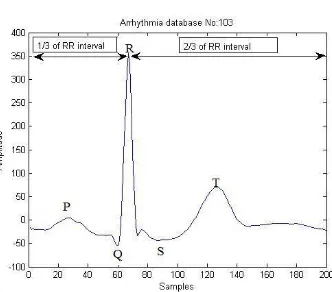
In the feature extraction procedure, a fraction of signal around the R peak is extracted as the time-domain features since the R peak of ECG signals is an im-portant index for cardiac diseases. To ensure the important characteristic points of ECG like P, Q, R, S and T are included, a total of 200 sampling points before and after the R peak are collected as one ECG beat sample. Fig 2 provides information regarding amplitudes and relative time intervals of ECG. These changes in the ECG are called morphological transitions.The mor-phology (P,QRS complex,T,U wave) of ECG changes due to the abnormalities in the heart. BBB is one such morphological abnormality seen in the heart dis-eases. In the previous studies morphological features are extracted for clinical observation of heart diseases. The feature extraction using traditional techniques generally yield a large number of features, and many of these might be insignif-icant. Therefore, the common practice is to extract key features useful in the classification.
This paper presents meta-heuristic swarm based FFA as a feature optimization method instead of using traditional feature optimization techniques. A large number of heuristic techniques have been designed to solve feature optimization problem. Some of the methods among all these are Genetic Algorithm (GA) [7], Particle Swarm Optimization (PSO) [6], Bacterial Foraging Optimization (BFO) [4], [5], [3], Firefly Algorithm (FFA)[14] etc.
Meta-heuristic algorithms are proven to outperform the gradient based algo-rithms for real world optimization problems. Firefly algorithm [1] is one such newly designed algorithm mimicking flashing mechanism of fireflies. A detailed explanation and formulation of the firefly algorithm is given in section IV.
Traditional Particle Swarm Optimization has one disadvantage of getting trapped into the local optimum. Sometimes it is unable to come out of that state.
© 2016, IRJET | Impact Factor value: 4.45 | ISO 9001:2008 Certified Journal
| Page 368
PSO. The following comparative measures were used to study the (i) Accuracy of the final solution, (ii) Convergence speed. Such com-parison shows the superiority of the proposed algorithm. This algorithm outper-formed both PSO and FFA over a few ECG benchmarks sets for the classification problem. The ECG classification flow diagram is shown in the Fig. 1.
2 Pre Processing
2.1 Data Collection and Noise Removal
To prove the performance of FFPSO, the usual MIT BIH arrhythmia database [10] is considered. The data used in this algorithm confines to 11 recordings that consists of 5 normal, 3 LBBB and 3 RBBB for a duration of 60 minutes at 360 Hz sampling rate. The file numbers of 11 recordings for normal and BBB. De-noising of ECG data is a preprocessing step that removes noise and makes ECG file useful for subsequent steps in the algorithm. The Sgolay FIR smoothing filter is used for filtering.
3 Feature extraction
In the feature extraction procedure, a fraction of signal around the R peak is extracted as the time-domain features since the R peaks of ECG signal are an important index for cardiac diseases. To ensure the important characteristic points of ECG like P, Q, R, S and T are included, a total of 200 sampling points before and after the R peak are collected as one ECG beat sample. The sam-ples that are extracted from each beat contains non uniform samples. The non uniform samples in each beat are converted into uniform samples of size 200 by using a technique called resampling. The resampled ECG beat samples/features is shown in Fig. 2.
4 Feature Optimization
4.1 Particle Swarm Optimization (PSO)
[image:2.595.448.544.63.439.2]PSO [12] is a kind of swarm based optimization method developed by Eberhart and Kennedy inspired from the behavior of a flock of birds. Each particle in the group flies in the search domain with a velocity and it tries to attain the best ve-locity according to its own previous best(pbest) and its companions’ best(gbest) flying experience.
Fig. 1: ECG classification using FFPSO
The advantage of using PSO over other optimization techniques is its sim-plicity. And very few parameters need to be adjusted. Due to this, PSO has been widely used in a variety of applications. In an n-dimensional search space, Xi = (x1, x2, x3,...,xn), let the particles be initialized with positions Xi and velocities Vi and the fitness is calculated based on particle positional coordinates as theinput values.
[image:2.595.353.519.602.748.2]© 2016, IRJET | Impact Factor value: 4.45 | ISO 9001:2008 Certified Journal
| Page 369
Then the particles are moved into new positions using the equa-tions below:
( ) ( ) ( ( )))
( ( )) ( )
( ) ( ) ( ) ( )
4.2 Firefly Algorithm (FFA):
This algorithm was designed by a mathematician X.S.Yang in the year 2007. FFA was formulated by mimicking the flashing (mating) activity of fireflies.
Even though this algorithm is similar to the PSO [17], Artificial Bee Colony (ABC) Optimization [16] and Ant Colony Optimization (ACO) [18], proved to be much simpler in algorithm implementation.
Fireflies are small insects, which are capable of producing light to attract a prey(mate). They release small rhythmic light flashes. The light intensity at-traction ’I’ of fireflies decreases with the distance ’r’. Hence, most fireflies are visible only up to several hundreds of meters. To execute this algorithm the fitness function is articulated based on the fluorescence light behavior of fire-flies. For simplicity, it is imagined that light intensity attractiveness of firefly is determined by its brightness ’I’ which is in turn connected with the fitness function.
4.3 Attractiveness and Light Intensity
At a particular position ’r’, the brightness ’I’ of a firefly can be chosen as I (r), proportional to the fitness, for a maximization problem. So the I (r) varies ac-cording to the well known inverse square law.
Fireflies attractiveness β is proportional to the I (r) seen by surrounding fireflies can be defined as
β = β0e−γr2 (4)
where γ is the light absorption coefficient.
4.4 Distance
The distance between any 2 fireflies is estimated using the distance formula.
√∑( )
( )
Firefly ’i’ is moved towards brighter firefly ’j’ and its movement is calculated by
4.5 Movement
( ) ( )
The first term in eq .(6) denotes the the current location of a firefly, the second term is used for determining the attractiveness (β) of a firefly (attractive firefly), towards the attractive neighboring fireflies and the third term indicates the random walk of a firefly (random part).
when firefly ’i’ lacks the brighter firefly ’j’ then it will go for a random walk as in Eq. (7), in search of the best candidate, where the coefficient α is a randomization variable, and ’rand’ is a random number consistently spread over the space (0, 1).
The pseudo code for firefly algorithm is given below
Pseudo code:Firefly Algorithm
1. Generate the initial population randomly.
2. Calculate the fitness of initial population based on light intensity of fireflies.
3. While (t<termination criteria is satisfied) 4. For i=1:p (p fireflies)
5. For j=1:p
6.Calculate light intensity(I) using eq. (3).
7.Distance between two fireflies is calculated using eq.(5).
8.If (I(i) < I(j))
I(r) =
Is
(3)
r
2
© 2016, IRJET | Impact Factor value: 4.45 | ISO 9001:2008 Certified Journal
| Page 370
9. Firefly i is moved towards firefly j using eq. (6).
10.Determine new solutions.
11.Else
12.Firefly i is moved randomly towards j using eq. (7).
13.End If
14.End for j.
15.End for i.
16.End while
17.Sort the fireflies according to light intensity values of the new solution.
The main objective of FFPSO feature selection stage is to reduce the features of the problem before the supervised neural network classification. Among all the wrapper algorithms used, FFPSO, which solves optimization problems using the methods of flashing behavior of fireflies, has emerged as a promising one.
5 Classification of BBB with Firefly features
The extracted features from FFPSO algorithm(20 features) are classified using different types of classification techniques such as KNN ,SVM ,Neural Network classifiers.
5.1 Levenberg-Marquardt Neural Network(LM NN)
In this work for the detection of BBB, back propagation Levenberg-Marquardt Neural Network(LMNN) was used. This NN provides rapid execution of the net-work to be trained, which is the main advantage in the neural signal processing applications [9].
The NN was designed to work well if it was built with 20 input neurons, 10 neurons in the hidden layer and 3 neurons in the output layer.
The performance of this algorithm is compared with Scalar Conjugate Gradi-ent(SCG) NN. The LMNN
algorithm is a robust and a very simple method for approximating a function. SCG NN method provides conjugate directions of search instead of performing a linear search. The network is trained with 1800 ECG beats, and tested with 1006 ECG beats. The total number of iterations are set to 1000 and mean square error less than 0.001. The main advantage of this algorithm is that the time required to train the network is less.
6 Results
ECG features before optimization=[1 2 3 ...200]; Optimized features (column numbers) = [41, 14, 198, 17, 189, 139, 22, 81, 177, 1, 171, 82, 134, 40, 49, 38, 80, 86, 129, 138] ;
These reduced feature are given as input for the Neural Network so that its convergence speed and final accuracy can be increased.
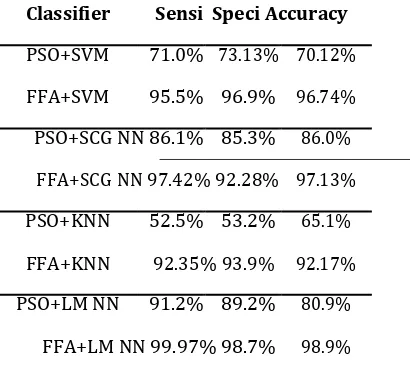
The ECG beats after segmentation are re-sampled to 200 samples/beat. Instead of using morphological feature extraction techniques, in this paper FFPSO is used as the feature extraction technique. using FFPSO ECG beat features are optimized to 20 features. The FFPSO gives optimized features (best features) for the classification. The performance of FFPSO is compared with classical FFA,PSO, techniques. The FFA, PS0, FFPSO features are classified using SVM, KNN, SCG NN, LM NN as in the Table 1.
– Count of Normal beats used for classification - 9,193.
– Count of RBBB beats user for classification-3,778.
– Count of LBBB beats user for classification-6,068.
– Total number of beats used for classification-19,039.
– Count of correctly classified beats-18,800.
– Total misclassified beats-239.
© 2016, IRJET | Impact Factor value: 4.45 | ISO 9001:2008 Certified Journal
| Page 371
T rue_N egative
Specif icity = T rue_N egative + F alse_P ositive X100 (8)
T rue_P ositive
Sensitivity = T rue_P ositive + F alse_N egative X100 (9)
T P + T N
Accuracy = T P + T N + F P + F N X100 (10)
– TP(True_Positive) = Count of all the correctly classified Normal beats.
– TN(True_Negative)=Count of all beats the correctly classified Abnormalbeats.
– FP(False_Positive)= Count of Normal beats which are classified as Abnor-mal.
[image:5.595.36.241.441.628.2]– FN(False_Negative)=Count of Abnormal beats which are classified as Nor-mal.
Table 1: Classification with LM NN classifier Classifier Sensi Speci Accuracy
PSO+SVM 71.0% 73.13% 70.12%
FFA+SVM 95.5% 96.9% 96.74%
PSO+SCG NN 86.1% 85.3% 86.0%
FFA+SCG NN 97.42% 92.28% 97.13%
PSO+KNN 52.5% 53.2% 65.1%
FFA+KNN 92.35% 93.9% 92.17%
PSO+LM NN 91.2% 89.2% 80.9%
FFA+LM NN 99.97% 98.7% 98.9%
In the training mode we applied multilayer NN and checked the network performance and decided if any changes were required to the training process or the data set or the network architecture. First, check the training record,’trainlm’ Matlab function.
7 Conclusion
It’s evident from the outcome that hybrid FFA technique out performs the other two optimization approaches in terms of accuracy and convergence
rates. In the present study, we evolved a simple computational design for the detection of BBB with the use of the FFA computational algorithm. The FFA algorithm has been compared with the PSO . From our results at the we observed an in-crease in the accuracy, convergence speed. The FFA technique proven to provide correct results than original PSO for all the examined facts.
References
1. Mishra, Anurag, et al. "Optimized gray-scale image watermarking using DWT-SVD and Firefly Algorithm." Expert Systems with Applications 41.17 (2014), pp. 7858-7867.
2. Sahu, Rabindra Kumar, Sidhartha Panda, and Saroj Padhan. "A hybrid firefly algorithm and pattern search technique for automatic generation control of multi area power systems." International Journal of Electrical Power and Energy Systems 64 (2015), 9-23.
3. Ahmad N. K. Nasir, M. O. Tokhi, and N. Maniha Abd. Ghani,“Novel Adaptive Bacteria Foraging Algorithms for Global Optimization,”Applied Computational Intelligence and Soft Computing, vol.2014,7 pages,2014.
4. K. M. Passino, Biomimicry of bacterial foraging for distributed optimization and control,IEEE Control Syst. Mag., vol. 22, no.3, pp. 52 âĹŠ 67, Jun. 2002. 5. Y. Liu and K. M. Passino,“Biomimicry of social
foraging bacteria for distributed optimization: Models, principles, and emergent behaviors”, J. Optimization Theory Applicat., vol. 115, no. 3, pp. 603 − 628, Dec.2002.
6. J. Kennedy and R. Eberhart, "Particle swarm optimization," in Proc.IEEE Int. Conf. Neural Netw., 1995, pp. 1942-1948.
7. T. Back, "Evolutionary algorithms in theory and practice: Evolution strategies, evol. programming," in Proc. Genetic Algorithms, London, U.K.: Oxford Univ. Press, 1996.
8. M. Ibn Ibrahimy, R. Ahsan, and O. O. Khalifa, "Design and optimization of levenberg-marquardt based neural network classifier for emg signals to identify hand motions,"Measurement Science Review, vol. 13, no. 3, pp.142-151,2013.
9. S. Sapna, A. Tamilarasi, and M. P. Kumar, "Backpropagation learning algorithm based on levenberg marquardt algorithm,"CS and IT-CSCP, vol. 2012, pp. 393-398, 2012.
© 2016, IRJET | Impact Factor value: 4.45 | ISO 9001:2008 Certified Journal
| Page 372
(2000). Physiobank, physiotoolkit, and physionet com-ponents of a new research resource for complex physiologic signals. Circulation, 101(23), e215-e220.
11. Eberhart RC, Kennedy J. A new optimizer using particle swarm theory. In: Proc. ISMMH S. pp. 39-43,1995.
12. F. Melgani, Y. Bazi, "Classification of Electrocardiogram Signals With Support Vector Machines and Particle Swarm Optimization", IEEE transactions on infor-mation technology in biomedicine, VOL. 12, NO. 5, SEPTEMBER, 2008. 13. Abd-Elazim, S. M., and Ali, E. S. (2013). A hybrid
particle swarm optimization and bacterial foraging for optimal power system stabilizers design. International Journal of Electrical Power and Energy Systems, 46, pp.334-341.
14. Horng, Ming-Huwi, et al. Firefly meta-heuristic algorithm for training the radial basis function network for data classification and disease diagnosis. INTECH Open Access Publisher, 2012. 15. Yang, Xin-She. "Chaos-enhanced firefly algorithm
with automatic parameter tun-ing." Recent Algorithms and Applications in Swarm Intelligence Research (2012): 125.
16. Pal, S. K., Rai, C. S., and Singh, A. P. "Comparative study of firefly algorithm and particle swarm optimization for noisy non-linear optimization problems". Interna-tional Journal of Intelligent Systems and Applications (IJISA), 4(10), 50, 2002. 17. J. Kennedy, R. C. Eberhart, "Particle swarm
optimization", IEEE International Conference on Neural Networks, Piscataway, NJ., pp.942-1948, 1995.