© 2017, IRJET | Impact Factor value: 5.181 | ISO 9001:2008 Certified Journal | Page 1002
BIOMETRIC EAR RECOGNITION SYSTEM
Neha Kuduk
1, Akshada Hinge
2, Kirti Kshirsagar
3Guided by : Prof. AshokKumar Kalal
1Student, Dept. of Computer Engineering, Alard college of Engineering, Maharashtra, India
2Student, Dept. of Computer Engineering, Alard college of Engineering, Maharashtra, India
3Student, Dept. of Computer Engineering, Alard college of Engineering, Maharashtra, India
---***---Abstract –Biometric authentication using ear image is
new research area. Many unique features of human are explored but not many are used. This project focuses on one such area, that is Authentication using ear image. While sign up user will provide user name, password, email id. Also user will register his ear image using HD camera. In this application, user will be authenticated, using user name, password and ear image captured from camera. In 1st step of log in user will be authenticated based on user name and password. User will capture his ear Image it will be converted to 3D and this image will be saved in drive. In 2nd step of user will provide his ear image using HD camera, and authentication will be done by matching real time ear image with ear image stored while sign-up.
1.Introduction -In earlier projects the ear as the basis
for a new class of biometrics, there is the need to show that it is viable (i.e., Universal, unique, Permanent, Collectable). In the same way any one can prove that fingerprints are unique or not, there is no separate way to visualize that each human has a unique pair of ears. Instead, an assertion that this is probable can be made based on supporting evidence from two experiments conducted by Alfred Iannarelli. It is obvious that the structure of the ear does not change radically over time. Medical literature reports that ear size increase after the first four months of birth is proportional. It turns out that even though ear size increases is proportional, gravity can cause the ear to undergo stretching in the not horizontal direction. Due to this most marked in the lobe of the ear, and measurements show that the change is non-linear. The rate of stretching is nearly five times more than normal during the slot from four months to the age of eight, after which it is constant until around 70 when it again increases. Since every individual has ears, it is rational to show that the ear is unique. The ear is also collectable using various means. The ear has several universal key points which can be used for identification. The main challenge in ear recognition systems is producing an automated method to extract those specific key points.
2. Literature survey –
Person Identification Using Ear Biometrics :
Author -Md. Mahbubur Rahman, Md. Rashedul Islam,
Nazmul Islam Bhuiyan, Bulbul Ahmed, Md. Aminul Islam.
Checking contents from images is one of the most important work of vision systems. To this, the stability of tracking Systems greatly depends on the detection of targets. A different class of biometrics depend on ear characteristics there was launched for use in the construction of passive identification Systems by Alfred Iannarelli. Identification by ear biometrics is promising because it is traceable like face recognition, but instead of the problems to extract face biometrics, it uses robust and simply extracted biometrics like those in fingerprinting. The ear is a unique feature of human beings. In this paper, described a system that tracks and detects ear features simply and robustly. First of all, appropriate threshold value is identified and then ear boundary is recognized. After that edge linking is complete. Data taken from the ear image is compared with the database. Ear detection algorithm is quite simple and, hence, has low computation complexity and can be applied in many real-time applications.
An evaluation of face and ear biometrics :
Author -Barnabas Victor, Kevin Bowyer and Sudeep
Sarkar.
Face detetction depend on the features of component verification is not lightly researched subject in computer vision. The ear has been proposed as a biometric, with claimed advantages over the face. Here used the PCA approach to images of the face and ear with similar collection of subjects. Testing was done with three different gallery/probe combinations.For faces we have:
© 2017, IRJET | Impact Factor value: 5.181 | ISO 9001:2008 Certified Journal | Page 1003
and found that even a simple fusion technique yields improved performance over either the face or ear alone.
Image-based ear biometrics Smartphone App for patient identification in field settings :
Author –Sarah Adel Bargal, Alexander Wells, Cliff R.
Chan, Samuel Howes, Stan Sclaroff, Elizabeth Ragan, Courtney Johnson and Christopher Gill.
This paper present, a work in progress of a computer vision application that would directly impact the delivery of healthcare in underdeveloped countries. Describe the development of an image-based Smartphone application prototype for ear biometrics. The application prototype for ear biometrics. The application targets the public health problem of managing medical records at on-site medical hospitals in not more developed countries where most of the peoples do not take Identities. The domain presents challenges for an ear biometric system, including varying scale, rotation, and radiance. It was unclear which feature descriptors would work very good for the various application, so a comparative study of three ear biometric extraction technique was performed, one of which was used to built an iOS application prototype to create the identity of humans using a Smartphone camera image. A pilot study was then conducted on the developed application to test feasibility in naturalistic settings.
3-dimensional ear recognition based iterative closest point with Stochastic clustering matching :
Author - Khamiss Masaoud, S. Algabary, Khairuddin
Omar and Md Jan Nordin.
Ear recognition is a latest technology and future trend for human identification. So, the false detection rate and matching recognition are very challenging due to the ear complex geometry. The advantage of the study is to presented a combination of Iterative Closest Point (ICP) and Stochastic Clustering Matching (SCM) algorithm for 3D ears matching based on biometrics field with a good steadiness to decrease the negative detection rate. The corresponding ear extracts from the side range image and characterized by 3D features. The proposed method used mat lab simulation and defined the average can define similar detection time 35ms and identification is similar to 98.25% for the collection of different database. The result shows that the proposed
combined method get results than the existing of ICP or SCM in terms of recognition time and correctness in training.
An Improved Normalization Method for Ear Feature Extraction :
Author - Wang Shu-zhong.
As a latest biometric recognition technology, the theory and application research of ear identification has attracted more and more attention of scholars in recent years. Image-preprocessing and normalization of ear image is very important for the feature extraction. In this paper apply the improved morphological filtering method to preprocessing the ear image. And propose the angle normalization method by geometrical parameters. This method has the scope of scaling invarience, translation invariance and rotation invariance. The normalization results are reasonable and good for later feature extraction. Perform the angle normalization by the geometrical parameters, so the description of ear characteristic data will not affected by the image scaling, translation, rotation changes. It better solve the attitude problem. The normalization results are reasonable and good for later feature extraction.
Ear pattern recognition and compression using SURF and SVM :
Author – Ummer Akber Tali, Ashish Sharma
© 2017, IRJET | Impact Factor value: 5.181 | ISO 9001:2008 Certified Journal | Page 1004
Human ear recognition using geometric features:
Author – Mudit Moghey, Ajinkya R. Ghadge, Sagar J. Dalvi.
Biometrics is the study of automatic technique for recognizing human beings based on physical or behavioral traits. To find good biometric features, technique has been researched extensively in recent years. Among several biometric features, ear is stable because it does not vary with age and emotion. The ear recognition work depends on ear height, reference line cut points, corresponding angles and internal ear curve. The study is worked on the ear in variable orientation and shows a greater accuracy than existing dominant approach. The recognition accuracy is increased by using many of the training images for database. Face detection by itself, applying the similar approach, gave a 63% rank one recognition rate, but when complimented with ear images in a multimodal system improved to 94% rank one recognition rate.
Ear as a biometric :
Author – Mr. Santosh H. Suryawanshi.
Biometric is the science of identifying or verifying the identity of a person based on physiological or behavioral characteristics. Biometrics identification methods have proved to be very efficient, more natural and easy for users than traditional methods of human identification. The main aim of the project is to develop a biometric authentication system using the ear. The process will including some steps from development of the image to the point where not negative identification can be made using the system. The image will be acquired using a digital camera. The photo is then process started , stored and used for the detection process. After the raw data is obtained, the Region of Interest(ROI) which is the area containing the ear image is chosen. Feature extraction filters the uniqueness data out of the raw data combines them into biometric feature.
Human recognition through ear biometrics using Average ear :
Author – Gopal Singh Tandel, Soumya Mukharejee, Om Prakash Patel.
Human ear has focused on researcher’s attention most recently because of its stable biometrics structure. In
this paper, implemented human recognition system through 2D ear images and proposed a novel algorithm for person identification by ear based on average ear method. Algorithm is verified on University of Science and Technology Beijing (USTB) data set of 60 subjects on 180 ear images. Always considered different sources of easily available database and finding of different authors in the same direction. This paper is very useful for those who are budding researches in this area.
3D ear identification based on Sparse representation:
Author – Lin zhang, Zhixuan Ding, Hongyu Li, Ying Shen.
Biometrics depend on personal authentication is an very effective method for automatically recognizing, with a high confidence, a person’s identity. Recently 3D ear shape has attracted tremendous mostly working in research field due to its improved feature and ease of developing skills. However, the existing ICP (Iterative Closet Point) – based 3D ear matching methods prevalent in the literature are very efficient to effectively deal with the one-to-many human verification case. Within this paper, aim is to fill this gap by proposing a novel effective fully automatic 3D ear identification system. At first propose an accurate and efficient template-based ear detection method. By utilizing such a method, the extracted ear regions are represented in a common canonical coordinate system verified by the ear contour pattern, which provides much the following phases of feature extraction and classification. For each extracted 3D ear, a feature vector is produced as its representation by using PCA-based local feature descriptor.
3. Advantages –
The use of the ear has certain advantages. These include:
1) It is passive. Unlike the fingerprint and iris, it can be easily captured from a distance without a fully cooperative subject.
© 2017, IRJET | Impact Factor value: 5.181 | ISO 9001:2008 Certified Journal | Page 1005
3) The ear’s size is small and more constant color are described traits for different pattern recognition. The equal distribution of color means that almost all information is stored when converting the original image into gray scales.
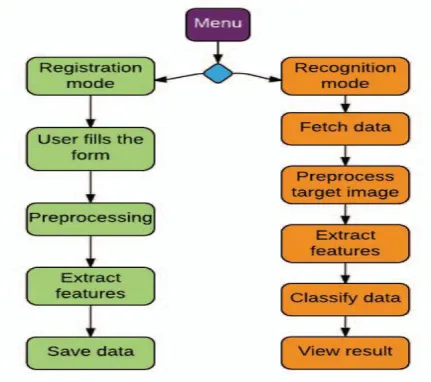
Fig -1: Application flow
4. Review of system
Our ear recognition system can work in two independent modes as shown in Fig. 1. To register new user or add a new ear image into database the system works in registration mode. Here the image is pre-processed, features are extracted and feature vector is stored into system.
Recognition mode is used to recognize user from input image. First the image acquisition is done with the use of built-in camera. Next preprocessing and feature extraction take place. After feature extraction, the obtained feature vector is classified and result is displayed on mobile device.
5. CONCLUSIONS - This system is going to authenticate
the person who is new or/and already have a login username and password with is stored and processed 3D image of ear. This system provides more authentication facility with the more secure authorization of the application. We conclude that ear biometrics can be used for identification and for the further development it is a good biometric and is comparable to that of face.
6.REFERENCES
[1] Dong j, mu z. ’Multi-pose ear recognition based on
force field transformation’. In: second international symposium on intelligent information technology application (iita). Vol. 3; 2008. P. 771 –775.
[2] Guo y, xu z. ’Ear recognition using a new local
matching approach’. In: 15th ieee international conference on image processing (icip); 2008. P. 289 –292.
[3] Liu h, zhang d. ’Fast 3d point cloud ear
identification by slice curve matching’. In: 3rd international conference on computer research and development (iccrd); 2011. P. 224.
[4] Arbab-zavar b, nixonms, hurleydj. ’On model-based
analysis of ear biometrics’. In: first ieee international conference on biometrics: theory, applications, and systems, 2007. (btas 2007); 2007. P. 1 –5.
[5] Nageshkumar M., P. K. Mahesh, and MN Shanmukha
Swamy “ An efficient secure multimodal biometric fusion using palmprint and face image “ arXiv preprint arXiv: 0909 2373 (2009).
[6] Md. Mahbubur Rahman, Md. Rashedul Islam,
Nazmul Islam Bhuryan, Bulbul Ahmed, Md. Aminul Islam, “Person Identification Using Ear Biometrics “ International Journal of The Computer, the Internet and Management Vol. 15: 2 ( May- August, 2007 ) pp 1 – 8.
[7] Anika Pug, Christoph Busch. “ Ear Biometrics: A
Survey of Detection, Feature Extraction and Recognition Methods, “ IET Biometrics, vol. 1, no.2, pp.114-129,2012.
[8] Victor. Bamabas. Kevin Bowyer, and Sudeep Sarka.
“ An evaluation of face and ear biometrics. “Pattern
Recognition, 2002. Proceedings 16th International
Conferenceon. Vol. 1. IEEE, 2002.
[9] Liu, Heng, and Jingqi Yan. “Multi-view ear shape
[image:4.595.53.269.180.371.2]© 2017, IRJET | Impact Factor value: 5.181 | ISO 9001:2008 Certified Journal | Page 1006
2007. SITIS07. Third International IEEE Transactions on 25.9 (2003): 1160-1165.
[10] Chen, Hui, and Bir Bhanu. “Human ear recognition