© 2018, IRJET | Impact Factor value: 6.171 | ISO 9001:2008 Certified Journal | Page 1834
The Most Used Technological Tools by Telecommunications Students
in ISUTIC
Campos Calenga Pataca
Assistant Professor,
Dept. of Telecommunications Engineering, Higher Institute of Information and Communication
Technologies (ISUTIC), Angola.
---***---Abstract -
The teaching and learning process has faced great challenges due to the speed of transformation of society. In this sense, the integration of technologies in the style of teaching and learning is an essential factor that stimulates the assimilation of contents by the students, who in the current dynamics are active protagonists in the production of knowledge. This work evaluates the technological tools most used by students of the 3rd year of the Telecommunications course at the ISUTIC (Higher Institute of Information and Communication Technologies), in order to outline a strategy for integrating technological tools into the teaching and learning process.Key Words: technological tools, Facebook, WhatsApp, YouTube, teaching and learning, ICT.
1. INTRODUCTION
The advent of ICT information and communication technologies has transformed virtually all walks of life, including in the education sector. Today, higher education has faced enormous challenges resulting from the deep and dynamic changes in digital society and market needs [16].
A few years ago, mobile devices have penetrated the daily activities of the people, creating new needs and at the same time, new opportunities for modern services through these devices. This results in the search for alternative projects in educational processes. In these circumstances, the m-learning (mobile m-learning) appears with the main feature to enable access to digital educational content, educational activities and services not only through desktops, but also through mobile devices (cell phone, Tablet, Smartphone iPad, PDA, wireless and laptops, etc.), without restrictions of time or geographical space [1], [7], [8], [11], [14], [21].
ICTs have had a major influence on teaching and learning processes, mainly because of the tools they produce. Khan [9] emphasizes that ICTs are inseparable from instructional objectives in a freer dialectic relationship, with the object of activity to establish the methodological level of all activity. Schneckenberg cited by Christou et al [4], emphasizes that one of the common uses of web 2.0 is to build collaborative online learning communities for diverse populations of learners. Web 2.0 tools, such as wikis, blogs, social networks, and computer programs, enable learners to contribute their personal views, ideas, and reflections to creating collective and collective online content [4].
This work aims to analyze the main technological tools most used by students of the 3rd year of the Telecommunications
course at the Higher Institute of Information and Communication Technologies (ISUTIC), with the purpose of their integration into the teaching and learning process.
2. CONTEXTUALIZATION
The application potential of technological tools in teaching and learning methods are an ongoing challenge of modern higher education institutions, for these innovative methods encourage students to create and develop a scientific and reflective spirit. Technological tools provide a unique opportunity for students to enhance their digital communication skills [22]. Among several technological tools were selected for the present study seven: Facebook, Instagram, LinkedIn, Skype, Twitter, WhatsApp and YouTube.
Facebook - is the most popular social network in the world, with more than 2.06 billion users [19]. This platform has a number of interesting tools, most often under-utilized, which can be very useful tools for teaching and learning process [16]. Allows any user to create a public or private group to share text, image, and video conversations. In the contest of engineering education design, these capabilities can be used for group discussions on the approach to a subject, content sharing, or even participate in the burning issues in society solution [2].
© 2018, IRJET | Impact Factor value: 6.171 | ISO 9001:2008 Certified Journal | Page 1835 LinkedIn - is the world's largest professional social network.
Provides skills to present an understandable CV and share the status or dynamics of updates in the professional context. Some relevant data related to LinkedIn are: 467 million users in 2017, available in 24 languages, geographically available in 200 countries and territories, has more than 10,000 full-time employees and offices or offices in 30 cities worldwide, 57% users are male, 40 million students and recent graduates are LinkedIn users, the countries with the largest number of users are USA, India, Brazil, UK and Canada
(https://www.linkedin.com/pulse/linkedin-numbers-2017-statistics-meenakshi-chaudhary).
Skype - is a text and video message sharing tool capable of providing video conferencing [13]. It is a desktop application that combines VoIP technology with the organization of a database of participants, similar to social networks [6]. Skype allows you to make calls using the microphone and speakers of a computer by calling to a computers that have skype as well as to fixed and mobile phones worldwide using SkypeOut system beyond the instant message system (convenient in case of low connection), the application still allows teleconferences - voice only, connecting up to 100 people simultaneously, or videoconferences with up to 10 people [18], [3]. It has been able to realize the fiction of the videophone by combining simplicity of use and low cost, provided a computer with microphone, sound card, speakers and broadband Internet access is available [6]. Lee cited by [18] considers the following potentialities of Skype: it does not need advanced hardware beyond a desktop or laptop with internet access; is quite affordable while prevail internet signal; with the massive use of technological devices, does not require high knowledge or new skills to its users; promotes authentic and collaborative learning; Skype promotes synchronous and asynchronous communication between language teachers and students; via Skype, lesson materials can be updated and adapted quickly and easily, which is beneficial for teachers who wish to teach because of the location of the students.
Twitter - is a social networking services microblogs, created in March 2006 by Jack Dorsey, Evans Williams, Biz Stone and Noah Glass, and released in July of the same year [23]. The company Twitter is based in San Francisco and has more than 25 offices worldwide available in multilingual [2]. A user may follow any other user, while the user followed may not necessarily match his follower. This tool provides a good platform for designing and conducting academic activities, especially in the social sciences and humanities [9], [23]. However, press for short messages by limiting each post to 140 characters.
WhatsApp - is a social network that provides instant messaging to mobile device users [2]. It was created in 2009 by Jan Koum and Brian Acton [23], the WhatsApp Company based in Mountain View, California USA and gained greater popularity in mobile phone users. WhatsApp messages
feature the following features: multimedia, group chat, unlimited message, compromise platform, short messages can be offline, free, requires no PIN or username [23]. WhatsApp can be used as an important tool in teaching-learning and training. Khan [9] lists some strategies that can be used by teachers and instructors as facilities for the WhatsApp tool: to create groups to communicate with their members about the subject being studied; share important information from classes; send video lessons and audio; send self-study tasks; being connected with students out of class and reminding them of pending tasks and subsequent units; controlling students' participation in discussions and group work; being in contact with caregivers or family members when they are absent for a long period or do not comply with the activities.
YouTube - is the platform to share videos, created in February 2005 by Steve Chen, Chad Hurley and Jawed Karim [17]. The site, which at that time had the slogan "Broadcast Yourself" was considered the best invention of the year by the American magazine Times; and in November 2006, Google acquired the network for $ 1.65 billion [5]. YouTube's primary functionality is to provide users with the original search, viewing, and sharing of videos [20]. It also provides forum services to connect people globally [17]. Available in more than 88 countries and in 76 languages, Google has defined YouTube's largest consumers and their preferred options and intentions regarding the platform. The new generation audience hold a common interests such as: share, create, connect and communicate, with 71% of the public has less than 35 years old and 52% are men [2], [5], [13].
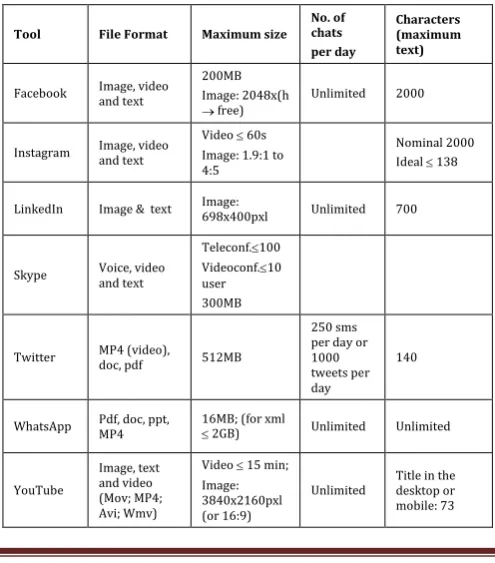
[image:2.595.307.555.501.783.2]The comparison of the main features of these technological tools is shown in Table 1.
Table -1: Main characteristics of technological tools
Tool File Format Maximum size No. of chats per day
Characters (maximum text)
Facebook Image, video and text
200MB Image: 2048x(h free)
Unlimited 2000
Instagram Image, video and text
Video 60s Image: 1.9:1 to 4:5
Nominal 2000 Ideal 138
LinkedIn Image & text Image: 698x400pxl Unlimited 700
Skype Voice, video and text
Teleconf.100 Videoconf.10 user 300MB
Twitter MP4 (video), doc, pdf 512MB
250 sms per day or 1000 tweets per day
140
WhatsApp Pdf, doc, ppt, MP4 16MB; (for xml 2GB) Unlimited Unlimited
YouTube
Image, text and video (Mov; MP4; Avi; Wmv)
Video 15 min; Image: 3840x2160pxl (or 16:9)
© 2018, IRJET | Impact Factor value: 6.171 | ISO 9001:2008 Certified Journal | Page 1836
3. METHODOLOGY
This is an exploratory descriptive study, with a quantitative approach, carried out in the second half of 2017, with a population sample of students enrolled in the subject of Mobile Communications, 3rd year of the ISUTIC Telecommunications course. ISUTIC (Higher Institute of Information and Communication Technologies) is an Autonomous Public Higher Education Institution, based in the Province of Luanda - Republic of Angola.
The instrument for data collection comprised a semi-structured questionnaire composed of two parts: one related to the type of mobile device that each student carries out on a daily basis, and the other part related to the purpose of the use of Facebook, Instagram, LinkedIn, Skype, Twitter, YouTube and WhatsApp, from a universe of 100 most used ICT tools (http://c4lpt.co.uk/top100tools/), [10]. 110 students participated in the study.
4. RESULTS AND DISCUSSION
The average age of participants was 23 years and only 14.55% of the females.
Students Age
7 (6.36%)
65 (50.09%) 23 (
12 (10.9%) 3 (2.73%)
0 20 40 60 80
Less than 20 years From 20 to 23 years From 24 to 27 years From 28 t0 32 years More than 32 years
[image:3.595.46.284.394.505.2]20.9%)
Fig -1: Age range of students involved in this research
The distribution of students by gender is shown in Fig. 2, with 16 female students (14.55%) and 94 male students (85.45%), revealing the poor adherence of the female gender to the engineering courses, specifically to Telecommunications engineering. This discrepancy does not record both the engineering course Informatics, also taught in ISUTIC despite the male gender is predominant.
Students Gender
16, 15%
94, 85%
Male Female
Fig -2: Distribution of students by gender
The first questionnaire was on the type of mobile device that each student sport on a daily basis (smartphone, tablet, 3G or 2G mobile phone).1
Q1D – What kind of mobile device do you use (smartphone,
tablet, 3G or 2G mobile phone)?
The answers to this question following results: 36.36% student has a smartphone, tablet sports 10.91%, 41.82% have 3G mobile phone (3rd generation) and 10.91% android 2G mobile phone, as shown in Fig. 3.
36.36%
10.91% 41.82%
10.91%
0 10 20 30 40 50
St
u
d
ent
s
ca
rr
ier
s
Mobile Devices
Smartphone Tablet 3G Mobile 2G Mobile
Fig -3: Type of mobile device used by students
Q2D – For what purposes do you use your mobile device?
The answers to this question reveal that in general the students use their mobile device for academic purposes, communication and entertainment, so this use varies according to the period throughout the year, as shown in Fig. 4.
80%
10% 10%
0 20 40 60 80
Acade mic
Ente rtain
ment
Com mun
icatio n
Type of general use of mobile
Fig -4: Using general (purpose) of the mobile students a) In the academic period
1
Q1D 1st question related to the Device;
[image:3.595.381.517.496.620.2]© 2018, IRJET | Impact Factor value: 6.171 | ISO 9001:2008 Certified Journal | Page 1837
5%
80%
15%
0 20 40 60 80
Acade mic
Ente rtain
ment
Com mun
icatio n
[image:4.595.109.240.101.234.2]Type of general use of mobile
Fig -4: Using general (purpose) of the mobile students b) In the vacations period
Q3D – What academic activities do you use your mobile
device for?
The answers to this question show that students with mobile devices that support Internet tools and applications use them to search the internet (36%), share the subject with colleagues (25%), and discuss topics via chat with colleagues (23%) while others use their mobile device as a support tool (12%). This result is illustrated in Fig. 5.
Specific use for academic purposes
36% 25% 12%
23% 3%
1%
0% 10% 20% 30% 40% Search for a subject on the internet
(YouTube, googlescholar) Use as a support tool (calculator,
dictionary) Participate in videoconferences between colleagues and teachers
Fig -5: Specific use of mobile devices for academic purposes by students
The second questionnaire was related to the most used tool by the students among the 7 selected: Facebook, Instagram, LinkedIn, Skype, Twitter, YouTube and WhatsApp.
Q1T – Which of the following technological tools do you use
on your mobile device (Facebook, Instagram, LinkedIn, Skype, Twitter, WhatsApp and YouTube)?
[image:4.595.309.558.109.291.2]The results summarized as a percentage in Table 2 indicate that almost all students with high-performance mobile devices use YouTube (78.18%), Facebook (77.27%) and WhatsApp (72.73%) half uses Twitter (45.45%), while the less used tools are LinkedIn (19.1%), Instagram (18.18%) and Skype (0.64%). These results are also shown in Fig. 6.
Table -2: Use of technological tools by students
No Technological tool Ranking on the internet, 2017 http://c4lpt.co.uk/top100tools/
% of students
using it
1 YouTube 1 78.18%
2 Facebook 8 77.27%
3 WhatsApp 13 72.73%
4 Twitter 5 45.45%
5 LinkedIn 7 19.1%
6 Instagram 34 18.18%
7 Skype 11 0.64%
78.18% 72.27% 72.73%
45.45%
19.10% 18.18% 0.64% 0.00%
20.00% 40.00% 60.00% 80.00%
St
u
d
en
ts
u
se
rs
Technological tools Use of different technological tools
Facebook YouTube WhatsApp Twitter LinkedIn Instagram Skype
Fig -6: Tools most used by students approached
Q2T – How often do you use technological tools for
academic purposes?
[image:4.595.325.545.166.401.2]The answers to this question reveal that the tools most frequently used by students are WhatsApp (66.36% daily), Facebook (67.27%) and YouTube (56.36%); while the less used ones are Skype and LinkedIn. The summary of this subject is presented in Table 3.
Table -3: Frequency of use of technological tools by students
Tools
Never used
Rarely (1 or 2x per week)
Frequently (3 to 5x per week)
Every day Total
Nº % Nº % Nº % Nº % Nº %
Facebook 0 0 19 17.27 74 67.27 17 15.45 110 100
Instagram 29 26.36 68 61.82 12 10.9 1 0.91 110 100
LinkedIn 27 24.55 79 71.82 4 3.64 0 0 110 100
Skype 63 57.27 45 40.9 2 1.82 0 0 110 100
Twitter 13 11.82 66 60 21 19.09 8 7.27 110 100
WhatsApp 12 10.9 5 4.55 20 18.18 73 66.36 110 100
YouTube 0 0 28 25.45 62 56.36 20 18.18 110 100
[image:4.595.53.277.423.551.2] [image:4.595.304.565.570.706.2]© 2018, IRJET | Impact Factor value: 6.171 | ISO 9001:2008 Certified Journal | Page 1838
5. CONCLUSIONS AND RECOMENDATIONS
It was observed that despite the heterogeneous nature, each student has at least one mobile device with access to several technological tools. The most popular technology tools among the students are YouTube (78.18%), Facebook (77.27%), WhatsApp (72.73%) and Twitter (45.45%), with the first three being used by all students who have mobile devices that can support them.
Most students use these tools often for academic purposes, such as searching the internet, sharing it with colleagues, and discussing topics via chat with colleagues.
Faced with these evidences, it is fundamental to create conditions to enable and persuade teachers to use these tools in the teaching and learning process in all disciplines, as they will contribute to improve the collaborative work among the subjects of the process, creativity and active construction of knowledge by the students.
Finally, the use of technological tools already known by the students in the teaching-learning activities should be the vision of all teachers who now have the task of preparing intellectual, professional and culturally future generations.
REFERENCES
[1] C. D. Barbosa, “O uso de simuladores via smartphone no
ensino de ciência como ferramenta pedagógica na abordagem de conteúdos contextualizados de Física,” Scientia Plena, Vol. 13 Nº 1, 2017. Available online at: www.scientiaplena.org.br.
[2] R. Brisco, R. I. Whitfield and H. Grierson, “The Use Of
Social Network Sites In A Global Engineering Design Project,” in 21st International Conference On Engineering Design, ICED17 21-25, pp.59-68, August 2017, The University Of British Columbia, Vancouver, Canada.
[3] V. Cho and W. Lam, “The power of LinkedIn: Will
professionals leave their organizations for professional advancement because of their use of LinkedIn?,” in Pacific Asia Conference on Information Systems PACIS 2017 Proceedings. 290. Available online at: http://aisel.aisnet.org/pacis2017/290.
[4] C. S. Christou, et al., “A Cost-Effective Computer
Supported Collaborative Learning for Online Education,” in Global Engineering Education Conference (EDUCON) IEEE, pp. 1138-1144, 10-13, Abu Dhabi – UAE, Aplil 2016.
[5] A. da Silva, et al., “O YouTube como Plataforma de
Marketing: Um Estudo Bibliográfico,” Revista Educação, Gestão e Sociedade, ISSN 2179-9636, Ano 7, número 26, p.1-16, junho de 2017. Available online at: www.faceq.edu.br/regs.
[6] A. P. P. M. de Carvalho, “O Skype na Pesquisa
Pós-Colonial: Reinvenções de um Pesquisador Estrangeiro,” Revista Periferia: Educação, Cultura & Comunicação, v.8 n.1, p.123-137, jan-jun 2016.
[7] L. I. Elefteryja and P. Stavros, “Learning out of the class:
creating e-courses for mobile devices,” in International Conference on Interactive Mobile Communication Technologies and Learning (IMCL), IEEE, pp.47-50. November 13-14, 2014, Thessaloniki – Greece.
[8] C. Jacobs, M. Wilson, and C. Barker, “Using the latest
developments in mobile technology to improve students’ engagement with assessment feedback,” in International Conference on Interactive Mobile Communication Technologies and Learning (IMCL), IEEE, pp.124-126. November 19-20, 2015, Thessaloniki – Greece.
[9] I. A. Khan, Intakhab Alam, “Utilization of different
technologies and media in learning writing skill in English,” European Journal of Education Studies, volume 2, issue 6, ISSN: 2501-1111, pp.143-156, 2016. Available online at: www.oapub.org/edu.
[10] A. Lekka and J. Pange, “What ICT tools do undergraduate
students use,” International Conference on Interactive Mobile Communication Technologies and Learning (IMCL), IEEE, pp.386-388. November 19-20, 2015, Thessaloniki – Greece.
[11] O. Maese y S. Alamillo, “Diseño, construcción y
validación de un cuestionario para identificar las aplicaciones de los dispositivos móviles que se usan los alumnos dentro del aula y su nivel de dominio,” Pedagogía 2017, Simposio 11, pp. 222-231, La Habana – Cuba, 2017.
[12] A. Mariano, et al., “Antecedentes do Marketing Boca a
Boca Digital Efetivo: Um Estudo Aplicado ao Instagram,” VII Simpósio de Engenharia de Produção do Vale do São Francisco 28 a 30 de Março de 2017 Juazeiro – Brasil, p. 1-10.
[13] R. I. Muyingo, “Usage and Gratification of Social Media in
Higher Education: A Survey on the Perceptions of International Students,” in Turkey, Online Journal of Communication and Media Technologies Volume: 7 – Issue: 3, pp.159-181, July – 2017.
[14] J. Nouri and T. C. Pargman, “Characterizing Learning
Mediated by Mobile Technologies,” Transactions on Learning Technologies, IEEE, Vol. 8, Nº 4, December 2015. Pp.357-366.
[15] R. Othon and M. Coelho, “A influência do self reality
© 2018, IRJET | Impact Factor value: 6.171 | ISO 9001:2008 Certified Journal | Page 1839
Available online at:
http://revistas.comunicacionudlh.edu.ec/index.php/ryp .
[16] L. F. Quintanilha, “Inovação pedagógica universitária
mediada pelo Facebook e Youtube: uma experiência de ensino-aprendizagem direcionado à geração-Z,” Educar em Revista, Curitiba – Brasil, v.33, n.65, p. 249-263, Jul/Set. 2017.
[17] M. Razak, A. Hussain and M. M. Hamdi, “Usability study
of youtube websites for Malaysian teenagers,” in The 2nd International Conference on Applied Science and Technology 2017 (ICAST’17), Published by the American Institute of Physics, pp.020121-1 – 020121-5, 2017. View online: https://doi.org/10.1063/1.5005454.
[18] R. Souzanza and M. S. Bagheri, “Hybrid Learning: The
Impact of Interacting Through Skype on Iranian Learners’ Speaking Ability,” Information Technologies and Learning Tools, Vol 58, №2, pp. 118-126, ISSN: 2076-8184, 2017.
[19] The Statistics Portal, 2017. (http://www.statista.com).
[20] T. Trzcinski and P. Rokita, “Predicting Popularity of
Online Videos Using Support Vector Regression,” IEEE Transactions on Multimedia, Volume: 19, Issue: 11, pp.2561-2570, Nov. 2017.
[21] K. Y. Zamri and N. N. A. Subhi, “10 User Interface
Elements for Mobile Learning Application Development,” in International Conference on Interactive Mobile Communication Technologies and Learning (IMCL), IEEE, pp.44-50. November 19-20, 2015, Thessaloniki – Greece.
[22] A. Zarei, et al., “Mobile Learning for Engineering
Education Reform,” Sains Humanika 9: 1-2 (2017) 1-6, ISSN: 2289-6996, 2017. Available online at: www.sainshumanika.utm.my .
[23] O. K. Boyinbode, O. C. Agbonifo and A. Ogundare,
“Supporting Mobile Learning with WhatsApp based on Media Richness,” Circulation on Computer Science, Vol. 2, Nº 3, pp. (37-46), April 2017. Available from: https://doi.org/10.22632/ccs-2017-251-89.
Campos Calenga Pataca is Assistant Professor in the Department of Telecommunications Engineering of the Higher Institute of Information and Communication Technologies. MSc in Telecommunications (2008, Agostinho Neto University of Angola), is currently writing his thesis in PhD program in Education Technologies of the University of Havana.