© 2017, IRJET | Impact Factor value: 5.181 | ISO 9001:2008 Certified Journal
| Page 2618
THE EXPERIMENTAL STUDY AND BEHAVIOUR OF CONCRETE BY
PARTIAL REPLACEMENT OF CEMENT WITH GGBS AND FINE
AGGREGATE WITH COPPER SLAG
AISHWARYA P G
M-Tech student, department of civil engineering(computer aided structural engineering), REVA university
Bangalore
---***--- ABSTRACT: The substitution of normal assets in the produce of cement and sand is the present issue in the present development situation. Copper slag and Ground Granulated Blast furnace Slag (GGBS) are mechanical by-product materials created from the way toward assembling copper and iron. Utilization of Copper slag and GGBS does decrease the cost of development as well as diminishes the effect on condition by devouring the material by and large considered as waste product. Henceforth in the present review an attempt has been made to limit the cost of cement and sand with concrete mix grade M40 by concentrate the mechanical conduct of this concrete blend by halfway supplanting with cutting edge mineral admixtures, for example, Copper slag and GGBS in concrete mix. In this review, halfway supplanting of Cement with GGBS and Sand with Copper Slag considered. Exploratory review is directed to assess the workability and quality attributes of hardened concrete, properties of concrete have been surveyed by halfway supplanting cement with GGBS, and sand with Copper Slag. The cement has been supplanted by GGBS in like manner in the scope of 0% (), 5%, 10%,and 15% by weight of cement for M40 mix. The sand has been supplanted by Copper slag in like manner in the scope of 0% ,10%, 20%, and 30%,by weight of cement for M40 mix. Concrete mixes were delivered, tried and analyzed regarding compressive, flexural, split tensile strength and durability of concrete with the conventional concrete.
Key words: Copper slag, GGBS, compressive, split tensile , flexural strength, durability tests, workability
I. INTRODUCTION
© 2017, IRJET | Impact Factor value: 5.181 | ISO 9001:2008 Certified Journal
| Page 2619
on picking up quality over a more extended period underway conditions. This outcomes in lower warmth of hydration and lower temperature rises, and makes maintaining a strategic distance from cool joints less demanding, however may likewise influence development plans where speedy setting is required. Utilization of GGBS essentially diminishes the danger of harms created by alkali–silica response (ASR), gives higher imperviousness to chloride entrance — decreasing the danger of fortification consumption — and gives higher imperviousness to assaults by sulphate and different chemicalsII. OBJECTIVES
In this review, Copper slag and GGBS are utilized as a sand and cement as incomplete substitution of material in concrete blend. A definitive concentration of this work is to find out the execution of concrete blend containing Copper slag and GGBS and contrast it and the controlled concrete blend. furthermore, ideal estimation of copper slag and GGBS is additionally contrast and controlled concrete blend. This is required to give:-
To halfway supplant sand with Copper slag and cement with GGBS in concrete as it straightforwardly impacts
economy in development.
To outline and extent the concrete blend for M40 Grade concrete, according to the proposal of IS :10262:2009.
To discover the Volume extents of the concrete blends by incompletely supplanting Sand with Copper slag and
cement with GGBS.
To check the variety of Compressive Strength, Split Tensile Strength and Flexural Strength, durability test,
comes about by incomplete supplanting the sand 0% to 30% with Copper Slag and the cement 0% to 15% with GGBS contrasted and controlled concrete and plotting the comparing graphs independently.
Environmental amicable transfer of waste copper and steel slag
III. Material used in experimental work
4.1 Cement: 53 grade ordinary port land cement is used
4.2 Fine aggregate: The material which finishes through BIS test sieve number 4 (4.75mm) is named as fine aggregate typically regular sand is utilized as a fine aggregate at spots where characteristic sand is not accessible crushed stone(M-sand) is utilized as fine aggregates. It fits in with IS 383 1970 goes under zone II
4.3 Coarse aggregate: The material which is held on BIS test sieve number 4 (4.75mm) is named as coarse aggregate. The crushed stone is by and large utilized as a stone aggregate. Coarse aggregate utilized is locally accessible crushed angular aggregate of size 20mm and 10mm are utilized for this test work.
4.4 Copper slag: Copper slag is a industrial by-product material created from the way toward manufacturing copper.
4.5 Ground granulated blast furnace slag(GGBS): GGBS is a waste industrial by-product from the blast furnace used to make iron
4.6 Water: distilled water can be used for making concrete
4.7 Super plasticizers: Conplast SP 430
Table 4.1:Physical properties of copper slag
SPECIFIC GRAVITY OF VALUE OF ‘G’
FINE AGGREGATE 2.53
COPPER SLAG 3.34
COARSE AGGREGATE 2.69
CEMENT 3.068
GGBS 3.47
SUPERPLASTICIZERS 1.21
WATER ABSORPTION OF %
FINE AGGREGATE 1.39
COPPER SLAG 0.83
© 2017, IRJET | Impact Factor value: 5.181 | ISO 9001:2008 Certified Journal
| Page 2620
FINESS MODULUS %
FINE AGGREGATE 3.26
COPPER SLAG 4.135
COARSE AGGREGATE 8.191
Table4.2: chemical composition of copper slag
Constituents In %
Sio2 34.94
Tio2 0.15
Al2o3 5.80
Total iron as Fe 39.29
Na2o 1.51
K2o 0.98
Sulphates as So3 1.35
Mno 0.12
Table4.3: chemical composition of GGBS
Constituents In %
SiO2 33.52
FeO 1.28
Al2O3 19.81
CaO 34.77
MgO 7.38
MnO 0.45
TiO2 0.88
S 0.89
K2O 0.39
Na2O 0.23
IV. MIX DESIGN
Mix Design The blend extent decided for this review is M40 grade (1:1.92586:2.78176:0.4) with water-cement
proportion of 0.4. In this test Cubes of standard size 150x150x150mm and Cylinders of standard measurement 150mm and stature 300mm and Prisms of size 500x100x100mm were threw and cured for 7 and 28 days and tried according to code Seems to be: 516-1959.
V. Result and discussion
5.1 Compressive Strength Test
Compressive strength of cubes 150*150*150mm size.
Compressive strength formula
Compressive strength
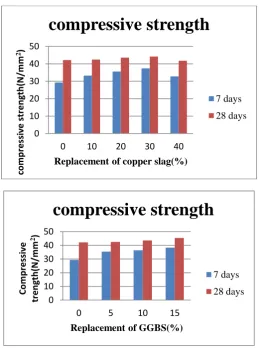
Table5.1: compressive strength of copper slag and GGBS
Compressive strength 150*150*150mm
0f cubes
0% 10% CS 20% CS 30% CS 40%
CS GGBS 5% GGBS 10% GGBS 15%
7 days 29.2777 33.2183 35.5533 37.3851 32.74 35.407 36.333 38.333
© 2017, IRJET | Impact Factor value: 5.181 | ISO 9001:2008 Certified Journal
| Page 2621
Fig 5.1:compressive strength of copper slag and GGBSTable5.2:compressive strength of 30% GGBS and 15% copper slag(optimal value)
Fig 5.2: compressive strength of optimal value 0
10 20 30 40 50
0 10 20 30 40
co
m
p
re
ssi
ve
st
re
n
gth
(N
/m
m
2)
Replacement of copper slag(%)
compressive strength
7 days
28 days
0 10 20 30 40 50
0 5 10 15
Co
m
p
re
ssi
ve
tr
e
n
gth
(N
/m
m
2)
Replacement of GGBS(%)
compressive strength
7 days
28 days
0 20 40 60
0 15,30
comp
ress
ive
st
reng
th
(N/mm
2)
Replacement of copper slag and GGBS(%)
compressive strength
7 days 28 days Compressive strength
150*150*150mm 0f cubes
0% 30% CS and
15% GGBS
7 days 29.2777 38.2592
© 2017, IRJET | Impact Factor value: 5.181 | ISO 9001:2008 Certified Journal
| Page 2622
5.2 Split tensile TestSplit tensile strength of cylinder 150*300mm size.
Split tensile Strength Test formula.
Split Tensile Strength Test
Where P = applied load
D = diameter of the specimen L = length of the specimen
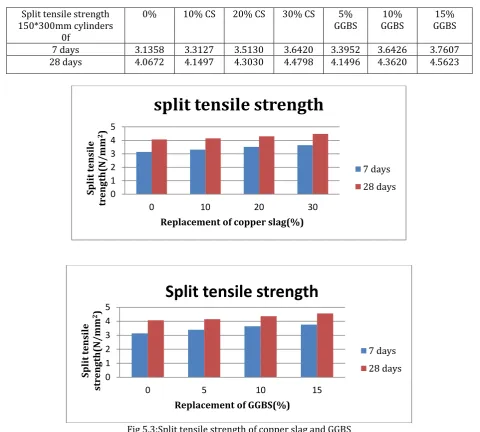
[image:5.595.65.546.234.666.2]Table6.3:Split tensile strength of copper slag and GGBS
Fig 5.3:Split tensile strength of copper slag and GGBS
Table5.4:Split tensile strength of 30% of copper slag and 15% of GGBS( Optimal value) 0
1 2 3 4 5
0 10 20 30
Sp
lit
tens
il
e
tr
eng
th
(N/mm
2)
Replacement of copper slag(%)
split tensile strength
7 days 28 days
0 1 2 3 4 5
0 5 10 15
Sp
lit
tens
il
e
st
reng
th
(N/mm
2)
Replacement of GGBS(%)
Split tensile strength
7 days 28 days Split tensile strength
150*300mm cylinders 0f
0% 10% CS 20% CS 30% CS 5%
GGBS GGBS 10% GGBS 15%
7 days 3.1358 3.3127 3.5130 3.6420 3.3952 3.6426 3.7607
28 days 4.0672 4.1497 4.3030 4.4798 4.1496 4.3620 4.5623
Split tensile strength 150*300mm cylinders
0f
0% 30% CS and
15% GGBS
7 days 3.1358 3.8078
© 2017, IRJET | Impact Factor value: 5.181 | ISO 9001:2008 Certified Journal
| Page 2623
Fig 5.4 split tensile strength(Optimalvalue)5.2 flexural strength
Flexural strength of prism 500*100*100mm size
Flexural strength formula
Flexural Strength Test
Where,
P = load in Newton
l = length of rectangular prism in mm b = breadth of rectangular prism h = height of rectangular prism
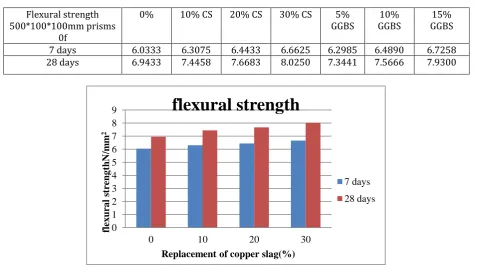
Table5.5:Flexural strength of copper slag and GGBS 0
1 2 3 4 5
0 15,30
Sp
lit
tens
il
e
st
reng
th
(N/mm2)
Replacement of copper slag and GGBS(%)
Split tensile strength
7 days 28 days
0 1 2 3 4 5 6 7 8 9
0 10 20 30
flex
ura
l
st
re
ng
thN/m
m
2
Replacement of copper slag(%)
flexural strength
7 days
28 days Flexural strength
500*100*100mm prisms 0f
0% 10% CS 20% CS 30% CS 5%
GGBS GGBS 10% GGBS 15%
7 days 6.0333 6.3075 6.4433 6.6625 6.2985 6.4890 6.7258
© 2017, IRJET | Impact Factor value: 5.181 | ISO 9001:2008 Certified Journal
| Page 2624
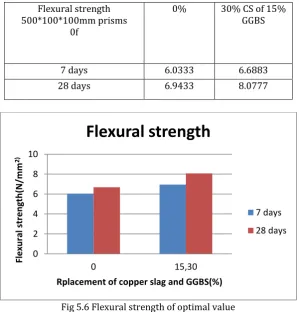
Fig 5.5 Flexural strength of copper slag and GGBSTable5.6: Flexural strength of 30% of copper slag and 15% of GGBS(Optimal value)
[image:7.595.156.456.317.630.2]
Fig 5.6 Flexural strength of optimal value
VI. CONCLUSION
The partial replacement of cement by GGBS and sand by Copper slag gives the economy in the development
however it additionally encourages effective usage of the CS and GGBS which is produced in enormous amounts from the steel and iron industries.
The workability of concrete was observed to be increments with the expansion in GGBS in concrete
The workability of concrete was observed to be increments with the expansion in Copper slag up to 30% in
cement.
Maximum compressive strength, split tensile and flexural strength has been acquired for substitution of
cement by 15% of GGBS and sand by 30% of copper slag. Compressive strength of GGBS and copper slag was accomplished more quality than the control Mix.
The expansion of copper slag and GGBS for the replacement of sand and cement shows resistance against
sulphate attack contrasted with control blend 0
2 4 6 8 10
0 5 10 15
fl
e
xu
ral
str
e
n
gth
(N
/m
m
2)
Replacement of GGBS(%)
Variation Flexural strength
7 Days
28 Days
0 2 4 6 8 10
0 15,30
Fl
e
xu
ral
str
e
n
gth
(N
/m
m
2)
Rplacement of copper slag and GGBS(%)
Flexural strength
7 days
28 days Flexural strength
500*100*100mm prisms 0f
0% 30% CS of 15%
GGBS
7 days 6.0333 6.6883
© 2017, IRJET | Impact Factor value: 5.181 | ISO 9001:2008 Certified Journal
| Page 2625
The replacement of cement by GGBS and sand by CS builds the compressive strength as well as decreased the
use of cement substance and sand content.
VII. References
1]Arivalagan .s ( 2014)”sustainable studies on concretes with GGBS as a replacement material in cement” Jordan journal of civil engineering , volume 8, NO .3, 2014
[2]SuvarnaLatha.k, SeshagiriRao. M, Srinivasa Reddy .V.( 2012) “Estimation of GGBS and HVFA Strength Efficiencies in concrete with Age. International Journal of engineering and Advanced Technology (IJEAT) ISSN: 2249-8958, Volume 2, Issue-2, December 2012.
[3]Sonail.K, G adpalliwar,S. Deotale.R, Abhijeet .R, Narde. “To study the partial replacement of cement by GGBS & RHA and Natural sand by Quarry Sand in concrete” IOSR Journal of Mechanical and Civil Engineering (IOSR- JMCE) e- ISSN: 2278-1684,P-ISSN: 2330-334X, Volume 11, Issue 2 Ver ii( Mar- ar. 2014 ) pp 69-77
[4]VenuMalagavelli “ high performances concrete with GGBS and ROBO sand “International journal of engineering science and technology vol.2 (10), 2010, 5107-5113.
[5]Mahesh Patel Prof. P. S. Rao T. N. Patel “Experimental investigationonstrengthof high performances concrete with GGBS and Crusher sand.”
6]TAMILARASAN .V.S.”Workability studies on concrete with GGBS as a replacement material for cement with and without superplasticiser ”International Journal of Advanced Research in Engineering and Technology (IJARET), ISSN 0976 –6480(Print), ISSN 0976 – 6499(Online) Volume 3, Number 2, July-December (2012), © IAEME.
[7]As per specification for granulated slag for the manufacture of Portland slag cement. (IS:12089-1987). [8]The percentage replacement of cement as per IS 455:1989 (25-65%cement replacement).
[9]R R Chavan & D B Kulkarni, Performance of copper slag on strength properties as partial replace of fine
aggregate in concrete Mix Design, International Journal of Civil and Structural Engineering Volume 1 No.4 (2011). [10]. Arivalagan.S, Experimental Study on the Flexural Behavior of Reinforced Concrete Beams as Replacement of Copper Slag as Fine Aggregate, Journal Of Civil Engineering And Urbanism Volume 3 (2013).