© 2018, IRJET | Impact Factor value: 6.171 | ISO 9001:2008 Certified Journal
| Page 3817
SELF-HEALING COCRETE
Kusuma K.
1, Amit Kumar Rai
2, Prashant Kumar
3, Harini K.
4, Harshita M.N
51,2,3,4
Dept.of Civil Engineering, JSSATE Bangalore, India
5
Assitant Professor Dept. of Civil Engineering, JSSATE Bangalore, India
---***---Abstract
-Cracks in concrete are impreventable, and it isintrinsic weakness of concrete. Through these cracks, water and others salts can seep. It initiates corrosion, further reducing the life of the concrete. So there was a requirement to develop an intrinsic bio-material, a self-repairing technique which can rectify the cracks and fissures developed in concrete. Bio-concrete is a material which can successfully rectify cracks in concrete. This technique is highly desirable because the activity of crack remediation is eco-friendly and natural. The paper discusses the plugging of artificial crack in cement concrete using Bacillus megaterium. The effect on compressive strength, water absorption and water permeability of cement concrete cubes due to the mixing of bacteria is also discussed in this paper. It was found that the use of Bacillus Megaterium improves the compressive strength and stiffness of concrete. It also shows that there is reduction in water absorption and water permeability when compared to conventional concrete. The bacteria which is going to be introduced in concrete, should have the property of alkali-resistance and it also should form endospore, so that it can withstand the stresses produced in concrete while mixing, transporting and placing.
Key Words
:
Bacillus megaterium 1, compressive strength 2, Bio-concrete 3, water permeability 4, water absorption 5.1. INTRODUCTION
Concrete, it is the most widely used material for the construction. Concrete is weak in tension and strong in compression and cracks are inevitable in concrete. Once cracks form in concrete it may reduce the lifespan of the concrete structures. Micro-cracks and pores in concrete are highly undesirable because they provide an open pathway for the ingress of water and deleterious substances which leads to the corrosion of reinforcement and reduces the strength and durability of concrete. Various repair techniques are available to repair the cracks, but they are highly expensive and time consuming process. There are moderate techniques to repair the cracks in concrete by itself called Self-Healing Concrete. This bacterial remediation technique surpasses other techniques as it is bio-based, eco-friendly, cost-effective and durable. Concrete is a highly alkaline material, the bacteria added is capable of withstanding alkali environment. Bacteria with calcium nutrient source are added into the concrete at the time of mixing. If any cracks will be formed in concrete, bacteria precipitate calcium
carbonate. This will seal the cracks. Urease positive bacteria have been found to influence the precipitation of calcium carbonate (calcite) by the production of urease enzyme. This results in increase in pH in calcite precipitation. Crack size more than 0.8mm is more difficult to be repaired however with the use of bacteria, cracks can heal with the calcite precipitation. This innovative environmental friendly method was first used for the repair of cracks to prevent leaching in channels (Gollapudi et al. 1995). Urease positive bacterium - Bacillus megaterium, Bacillus pasteurii, Bacillus sp. CT-5, Bacillus subtilis, Bacillus aerius, Sporosarcina pasteurii, AKKR5, Shewanella Species, Bacillus flexus etc. Bacteria used in this work - Bacillus megaterium of 105 cells/ml of water.
These bacteria based self-healing agent is believed to remain hibernated within the concrete for up to 200 years. The bacterial-spores start microbial activities when they come in contact with water and oxygen due to the development of cracks in concrete. Recently, the self-healing approaches have been exhibiting promising results in remediating the cracks in the earlier stages of formation of cracks.
1.1 Materials
Cement –Cement is a binder material, Ordinary Portland Cement (OPC) of 53 grade was used. The physical and chemical properties of cement are as per IS:12269 (1987b).
Fine aggregate– River sand passing through 4.75mm IS sieve and confirming to zone-1 of IS:383 (1987a) was used. The specific gravity was found to be 2.3.
Coarse aggregates –It is crushed stones of maximum size 20mm and retained on 4.75mm IS sieves. The specific gravity was found to be 3.13.
Water – Potable water for conventional concrete.
Bacterial water - consisting of 105 cells of Bacillus
megaterium/ ml of water.
© 2018, IRJET | Impact Factor value: 6.171 | ISO 9001:2008 Certified Journal
| Page 3818
Ingredients Cement Fine
aggregate Coarse aggregate water Quantity
(Kg/m3)
340 657.6 1335.94 171.7
Ratio 1 1.93 3.93 0.51
1.2 Bacteria
Cement and water have a very high pH value of around 13 when it mixed together. In such high pH environment most micro-organisms die. The bacteria which need to be added should fit such special norms i.e., it should be alkali resistant and it should also be able to withstand the harsh environmental conditions of the concrete.
They are identified as;
Bacillus megaterium
Bacillus pasteurii
Bacillus sp. CT-5
Bacillus subtilis
Bacillus aerius
Sporosarcina pasteurii
AKKR5
Shewanella Species
Bacillus flexus
It is found to be, that Bacillus megaterium can precipitate maximum amount of calcite when compared to other urease positive bacteria, which results in more increase in compressive strength and higher efficiency of crack-healing.
2. ISOLATION OF BACILLUS MEGATERIUM
Bacillus megaterium is present everywhere in the environment around us. It can be found in various food and different types of surfaces like clinical specimens, paper etc.
The method which is described below can be used to isolate strains of Bacillus megaterium from the soil. Primarily it starts with plating of heat treated soil suspensions on glucose mineral base agar. In a conical flask 10g Glucose; 1g (NH4)2SO4 or KNO3; 0.8g K2HPO4;
0.2g KH2PO4; 0.5g MgSO4·7H2O; 0.05g CaSO4·7H2O; 0.01g
FeSO4·7H2O; 12g agar; added to distilled water and the
solution is made to 1 litre; and the pH is adjusted to 7. Plates are incubated at 30 °C. White, round, smooth and shiny colonies 1–3 mm in diameter may develop on the nitrate (KNO3) medium in 36–48 hours. However, not all
strains can use nitrate, therefore the recommendation to use the ammonium ((NH4)2SO4) medium in parallel.
Colonies are detected by their appearance and suspects should be observed microscopically for the typically large cells of this species.
3. BIO-CONCRETE MECHANISM
In self-healing concrete, ingredient is mixed with bacterial water replacing potable water. Bacterial water has a concentration of 105 cells of Bacillus megaterium per ml of
water. The bacterium goes into dormant state, when cracks occur in future by obvious reason, the bacteria get exposed to the air and water and they start precipitating calcite crystals. The spores of such bacteria have a thick cell which can help them to remain intact up to 200 years while waiting for a better environment to germinate.
This process of calcite precipitation is influenced by the decomposition of urea by bacteria, with aid of the bacterial urease enzyme. As a result of metabolism of bacteria species give urease, that catalyses urea to ammonia and carbonate. Further these components hydrolyze to carbonic acid and ammonium chloride that leads to the formation of calcium carbonate (calcite crystal).
CO(NH2)2 + H2O → NH2COOH + NH3 (1)
NH2COOH + H2O → NH3 + H2CO3 (2)
H2CO3 ↔ HCO3- + H+ (3)
2NH3 + 2H2O ↔ 2NH4+ + 2OH- (4)
HCO3- + H+ + 2NH4+ + 2OH- ↔ CO32- + 2NH4+ + 2H2O (5)
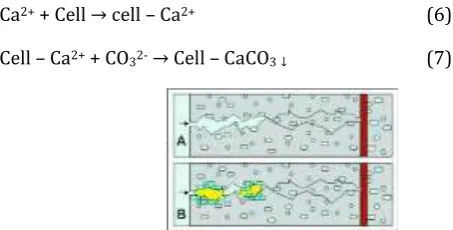
Observations render that, in calcite precipitation a key role is played by surface of bacteria, it is negatively charged and of neutral pH. The calcium ion with positive charge can combine with surface of bacteria there by encouraging nucleation.
Ca2+ + Cell → cell – Ca2+ (6)
Cell – Ca2+ + CO32- → Cell – CaCO3↓ (7)
Fig -1 (Bacterial self healing process)
4. EXPERIMENTAL PROCEDURE
Mix design of M25 concrete using IS-codes: The concrete mix design as per IS:10262 (2009) and IS:456 (2000).
Basic tests on cement
[image:2.595.311.538.500.615.2]© 2018, IRJET | Impact Factor value: 6.171 | ISO 9001:2008 Certified Journal
| Page 3819
to depth of 33-35mm from the top of the Vicat mould. The object of conducting this test is to find out the amount of water to be added to the cement to get paste of normal consistency, i.e., the paste of certain standard solidity, which is used to fix the quantity of water to be mixed in cement before performing tests for setting time, soundness and compressive strength.
Setting time:setting time is divided into two parts:
(1) Initial setting time:This is the time taken by the cement paste to lose its plasticity. (2) Final setting time:This is the time taken
to reach the stage when the paste becomes a hard mass.
Specific gravity: It is defined as the ratio between the mass of given volume of material and mass of an equal volume of water. One of the methods of determining the specific gravity is by the use of liquid such as water free ex-kerosene which doesn’t react with cement. For this test a specific gravity bottle may be employed or a standard Le-chatelier flask may be used.
Fineness:The degree of fineness of cement is a measure of the mean size of grains in cement. The rate of hydration and hydrolysis, and consequent development of strength in cement mortar depends on the fineness of cement. The finer cement has quicker action with water and gains early strength though its ultimate strength remains unaffected.
Basic tests on aggregates
Specific gravity: It is defined as the ratio between the mass of given volume of material and mass of an equal volume of water at the same temperature.
Water absorption: it influences the behavior of aggregates in concrete in several important aspects. A highly absorption aggregate, if used in dry condition, will reduce the effective water-cement ratio to an appreciable extent and even make the concrete unworkable unless a suitable allowance is made. Hence the determination of water absorption of aggregate is necessary to determine the net water-cement ratio.
Water content: It is the amount of water contained in aggregate. This can be determined by comparing natural weight of aggregate with oven dried weight.
⁄
Where is the fraction of total evaporable moisture content of sample
Wis the mass of the original sample
D is mass of dried sample.
Sieve analysis: It is the method used for aggregates to access the particle size distribution (that is also called gradation). It is performed by using series of sieves. The granular material is allowed to pass through a series of sieves of progressively smaller meshes size and taking the weight of aggregates that is stopped by each sieve as the fraction of whole mass.
Slump test: It is a measure indicating the consistency or workability of cement concrete. A concrete is said to be workable if it can be easily mixed, placed, compacted and finished. A workable concrete should not show any segregation or bleeding. Segregation is said to occur when coarse aggregate tries to separate out from the final material and the concentration of coarse aggregate at one place occurs. This results in large voids, less durability and strength. Bleeding of concrete is said to be occur when excess water comes up at the surface of the concrete, this causes small pores through the mass of the concrete and is undesirable.
Casting cubes of different size and shape: A control concrete mixture and bacterial concrete mixture was designed as per IS:10262 (2009) and IS:456 (2000) to have a slump of 25-50 mm. For bacterial concrete mix, the cell concentration of 105 cells of Bacillus megaterium per ml of water
was used.
Compression test: Control concrete and bacterial concrete mixture was designed as per IS:10262 (2009) and IS:456 (2000) to have a slump of 25-50 mm. For bacterial concrete mix, the cell concentration of 105 cells of Bacillus megaterium
per ml of water was used. Concrete cube specimens of size 100*100*100 mm were cast to develop 28 days compressive strength 25 MPa.
© 2018, IRJET | Impact Factor value: 6.171 | ISO 9001:2008 Certified Journal
| Page 3820
approximately 140 Kg/cm2/min until the
specimen failed to sustain the load. The maximum load was recorded and area of cross-section of the specimen was calculated. Compressive strength is calculated by dividing maximum load to the area of cross-section. This test was conducted on 4 specimens and average value was taken.
Compressive strength (N/mm2) =
Water absorption test: The test is conducted as per ASTMC 642-97[36] to determine the increased resistance towards water penetration in concrete. Cubic moulds of 70 mm size were prepared with and without bacteria. The specimens are cured for 28 days. After curing, the surfaces of the samples were allowed to dry and their saturated surface masses were determined after immersion. For this purpose, the specimens were oven dried at 115±5 and water absorption of the specimens was calculated using the following formula:
Absorption after immersion (%) =( )
Where
A is the mass of oven dried sample in air.
B is the mass of the sample after immersion with a dry surface.
Water permeability test: Permeability test is aimed to determine the depth of water
penetration under pressure. In this study, the test is performed by clamping the cube specimens 152.4 mm height and 165 mm diameter in size between two flanges with special circular gaskets. The water under controlled pressure (0.5 N.mm-1)
is applied to the surface of the concrete specimens. The specimens are placed in the apparatus for 72h; then the water penetration is measured by breaking the specimens.
5. RESULTS
5.1 Compressive Strength
When compressive strength is compared, it is clear that bacterial concrete performed better than conventional concrete. The increase in compressive strength of bacterial concrete was found to be greater than conventional concrete by 11.96%.
Fig 2- comparison of compressive strength between conventional concrete [B1] and bacterial concrete [B2].
5.2 Water Absorption
The water absorption of the bacterial concrete surface has improved when compared with conventional concrete because of precipitation of calcite on the surface of specimen. The decrease in water absorption was found to be 0.45%.
Fig 3- comparison of water absorption between conventional concrete [A1] and bacterial concrete [A2].
5.3 Water Permeability
The depth of penetration of water in bacterial concrete is also decreased when compared to conventional concrete due to the filling of micro-pores by calcite.
Fig 3- comparison of water penetration between conventional concrete [C1] and bacterial concrete [C2].
30 35 40
B1 B2
compressive strength at 28 days in N/mm2
0 0.5 1 1.5 2 2.5 3 3.5 4
A1 A2
% of water absorption
0 1 2 3 4 5
C1 C2
[image:4.595.311.559.51.173.2] [image:4.595.309.562.311.467.2] [image:4.595.311.552.591.727.2]© 2018, IRJET | Impact Factor value: 6.171 | ISO 9001:2008 Certified Journal
| Page 3821
5.4 Preparation Of Cracks In Concrete Cube SpecimenAnd Quantification Of Crack Healing By Bacteria
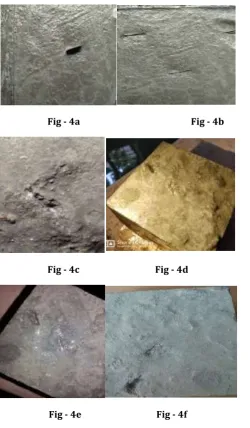
[image:5.595.43.294.286.715.2]The bacterial concrete cube specimen was casted with bacterial cell concentration of 105 cells per ml of mixing water with bacillus megaterium. All the ingredient required for M25 concrete mix were weighed and mixed. Further specimen was casted instantly after mixing.Crack was introduced in the cube specimen by using a thin metal sheet of thickness 0.3mm of 10 mm depth in the fresh concrete. Further the sheet was removed before final setting of concrete such that crack was clearly seen in the specimen. After 24 hours, the specimen was removed from mould and kept for curing in water. Every week the specimen was removed from curing tank and photographs were taken to visualize the healing of crack. Any presence of white precipitates shows the crack is getting healed.
Fig - 4a Fig - 4b
Fig - 4c Fig - 4d
Fig - 4e Fig - 4f
Fig - 4a- Introducing crack in fresh concrete
Fig - 4b- removing metal sheet before final setting time
Fig - 4c- partial healing of crack at 7 days
Fig - 4d- partial healing of crack at 14 days
Fig - 4e- partial healing of crack at 21 days
Fig - 4f- partial healing of crack at 28 days
6. ADVANTAGES AND DISADVANTAGES OF
SELF-HEALING CONCRETE
6.1 Advantages
The use of self-healing concrete significantly enhances the strength of concrete.
It has lower permeability when compared to conventional concrete.
It has also lower water absorption when compared to conventional concrete.
It offers great resistance against freeze and thaw attacks.
The chances of corrosion of reinforcement are reduced to negligible.
Redressing of cracks can be done efficiently.
Overall maintenance cost of this concrete is low.
6.2 Disadvantages
There is no design of bacterial concrete is mentioned in IS codes or any other codes.
Cost of this concrete is comparatively higher than conventional concrete; it’s about 10-30% more than conventional concrete.
The germination of bacteria is not suitable in every environment.
The investigations involved to observe calcite precipitation are costly.
Bacteria that are used in concrete are not good for human health; hence its usage should be limited to the structure.
7. CONCLUSION
The importance of this work is to introduce the urease positive bacteria (the bacteria which can precipitate calcium carbonate) such as Bacillus subtilis, bacillus pasterui, bacillus megaterium and to understand the healing procedure of cracks in concrete by them.
The study reviewed about different types of bacteria that can be used for remedying cracks in concrete.
The study has also showed that there is enhancement of compressive strength of concrete.
It also showed that use of such bacteria has positive effect on water absorption, sportivity and water permeability in concrete.
© 2018, IRJET | Impact Factor value: 6.171 | ISO 9001:2008 Certified Journal
| Page 3822
improvement in the durability of building materials.
8. REFERENCES
[1] . Krishnapriya, D.L. Venketesh Babu, Prince Arulraj g.,
Isolation and identification of bacteria to improve the strength of concrete, Microbiological research 174 (2015) 48-55.
[2] Nafise Hosseini Balam, Davood Mostofinejad,
Mohamadreza Eftekar, Effect of bacterial remediation on compressive strength, water absorption, and chloride permeability of lightweight aggregate concrete, Construction and building material 145 (2017) 107-116.
[3] Kunamineni Vijay, Meena Murmu, Shrish V. Deo,
Bacteria based self healing concrete, Construction and building materials 152 (2017) 1008-1014.
[4] Mian Luo, Chuan-xiang Qian, Rui-yang Li, Factors
affecting crack repairing capacity of bacteria-based self-healing concrete, S Construction and Building materials 87 (2015) 1-7.
[5] J.Y. Wang, H. Soens, W. Verstraete, n. De Belie,
Self-healing concrete by use of microencapsulated bacterial spores, Cement and concrete research 56 (2014) 139-152.
[6] Ramakrishnan V, Ramesh KP, and Bang SS. South
Dokata School of Mines and Technology, USA,
Bacterial Concrete, Proceedings of SPIE, Vol. 4234 pp. 168-176,Smart Materials.
[7] Ramchandran SK, Ramakrishnan V, and Bang SS.
South Dokata School of Mines and Technology, USA Remediation of concrete using Microorganisms ACI Materials Journal, 98(2001) 3-9.
[8] Bouzoubaa N, Zhang MH, Malhotra VM. Mechanical
properties and durability of concrete made with HVFA blended cements using a coarse FA. Cement and Concrete Research. 31(2001) 1393-1402
[9] Chiara Barabesi, Alessandro Galizzi, Giorgio
![Fig 2- comparison of compressive strength between conventional concrete [B1] and bacterial concrete [B2]](https://thumb-us.123doks.com/thumbv2/123dok_us/8131854.797107/4.595.311.552.591.727/fig-comparison-compressive-strength-conventional-concrete-bacterial-concrete.webp)