Tandem-Repeat Typing for
Mycobacterium tuberculosis
and Its Direct
Application to Clinical Material
Jessica L. de Beer,aOnno W. Akkerman,bAnita C. Schürch,a,c,dArnout Mulder,aTjip S. van der Werf,b,eAdri G. M. van der Zanden,f
Jakko van Ingen,gDick van Soolingena,d,h
National Tuberculosis Reference Laboratory (IDS), Centre for Infectious Disease Control (CIB), National Institute for Public Health and the Environment (RIVM), Bilthoven, The Netherlandsa; University of Groningen, University Medical Center Groningen, Department of Pulmonary Diseases & Tuberculosis, Groningen, The Netherlandsb; Radboud University Medical Centre/NCMLS, Centre for Molecular and Biomolecular Informatics, Nijmegen, The Netherlandsc; Erasmus Medical Center, Department of Viroscience, Rotterdam, The Netherlandsd; University of Groningen, University Medical Center Groningen, Department of Internal Medicine, Infectious Diseases, Groningen, The Netherlandse; Laboratory for Medical Microbiology and Public Health, Enschede, The Netherlandsf; Department of Medical Microbiology, Radboud University Medical Centre, Nijmegen, The Netherlandsg; Department of Pulmonary Diseases, Radboud University Medical Centre, Nijmegen, The Netherlandsh
Variable-number tandem-repeat (VNTR) typing with a panel of 24 loci is the current gold standard in the molecular typing of Mycobacterium tuberculosiscomplex isolates. However, because of technical problems, a part of the loci often cannot be ampli-fied by multiplex PCRs. Therefore, a considerable number of single-locus PCRs have to be performed for the loci with missing results, which impairs the laboratory work flow. Therefore, the original in-house method described by Supply et al. in 2006 was reevaluated. We modified seven primers and the PCR master mixture and obtained a strongly optimized in-house 24-locus VNTR typing method. The percentage of instantly complete 24-locus VNTR patterns detected in the routine flow of typing activ-ities increased to 84.7% from the 72.3% obtained with the typing conducted with the commercially available Genoscreen MIRU-VNTR typing kit. The analytical sensitivity of the optimized in-house method was assessed by serial dilutions ofM. tuberculosis in bronchoalveolar lavage fluid. A 1:10 dilution of the different strains tested was the lowest dilution for the detection of a com-plete 24-locus VNTR pattern. The optimized in-house 24-locus VNTR typing method will reduce the turnaround time of typing significantly and also the financial burden of these activities.
S
ince the introduction of standardized variable-numbertan-dem-repeat (VNTR) typing in 2006 by Supply et al. (1),
labo-ratories worldwide have implemented this method. Compared to the level of discrimination of the formerly used restriction frag-ment length polymorphism (RFLP) typing method, that of 24-locus VNTR typing has proven to be sufficient to trace the
trans-mission of tuberculosis (TB) in low-burden settings (1,2). The
advantages of VNTR typing over RFLP typing include simplified comparison of the results and applicability to small amounts of DNA, by which the turnaround time decreased from an average of 44 days to 15 days at our laboratory. However, in the first world-wide proficiency study of VNTR typing, the level of interlabora-tory reproducibility was only 60% and intralaborainterlabora-tory reproduc-ibility was only 72%. A second worldwide proficiency study revealed important improvements after the adjustment of some technical elements in the methodology and a higher degree of
standardization (6). Still, laboratories applying VNTR typing face
several technical challenges. First and foremost, some of the 24 loci may not be amplified in the multiplex PCRs and have to be amplified with a single-locus PCR; this holds true both for the commercially available MIRU-VNTR typing kit (Genoscreen, Lille, France) and for the house methods. In practice, this in-volves a significant increase in the workload and turnaround time. The need for an optimized, fast, and high-quality VNTR typing method is high, especially for municipal health services and clini-cians. The results of typing are used to steer the direction of source case finding and eventually to support the activities of the elimi-nation of TB transmission. For the clinician, the most important information extracted from the results of typing is whether the patient has a TB relapse or an exogenous TB reinfection.
Given the common use worldwide of the standardized VNTR typing method, we have attempted to improve the original
in-house VNTR method described by Supply et al. (1). In addition,
we have determined the minimum amount of DNA required for
successful VNTR typing ofMycobacterium tuberculosisin clinical
material.
MATERIALS AND METHODS
Samples.For optimization of the in-house 24-locus VNTR typing tech-nique, we used the DNA of two differentM. tuberculosisstrains, control strain H37Rv and a strain from the National Tuberculosis Reference Lab-oratory (NLA000901369). For the final quality check of the optimized in-house method, we used the panels used in the first (3) and second (6) proficiency studies on VNTR typing.
To detect the effect of the implementation of the optimized in-house technique rather than the commercial method used, we included the re-sults of routine typing ofM. tuberculosisisolates as part of the national surveillance in The Netherlands conducted at the National Tuberculosis Reference Laboratory, National Institute for Public Health and the Envi-ronment (RIVM), Bilthoven, The Netherlands. The percentage of com-plete 24-locus VNTR patterns obtained with the commercial typing kit
Received10 December 2013Returned for modification19 December 2013
Accepted28 January 2014
Published ahead of print5 February 2014
Editor:S. A. Moser
Address correspondence to Jessica L. de Beer, [email protected].
Copyright © 2014, American Society for Microbiology. All Rights Reserved. doi:10.1128/JCM.03436-13
on May 16, 2020 by guest
http://jcm.asm.org/
from January 2010 to November 2011 was compared with that obtained with the optimized in-house method from November 2011 to July 2013.
DNA isolation.DNA isolation was performed with the QIAamp DNA Minikit (Qiagen, Hilden, Germany) according to the manufacturer’s pro-tocol for DNA purification from blood and body fluids. From a positive culture medium, 1 ml was centrifuged for 15 min (11,800⫻g). The pellet was used as the input for the DNA isolation procedure. From a solid medium, 1 colony was suspended in MilliQ water to serve as the starting material. The DNA was eluted from the column in 30l of elution buffer and diluted to a final concentration of 10 ng/l.
Twenty-four-locus VNTR typing by the commercial kit.The com-mercial 24-locus VNTR typing kit from Genoscreen (Lille, France) was used in accordance with the manufacturer’s instructions. This technique was used in a diagnostic setting until November 2011.
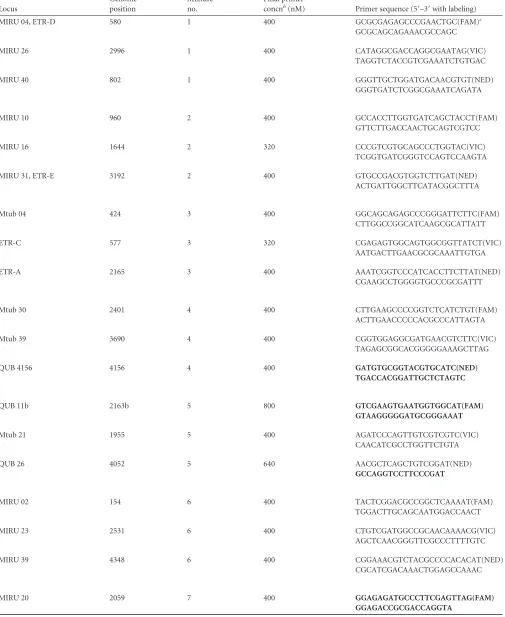
Optimized in-house method for 24-locus VNTR typing.The original set of primers described by Supply et al. was evaluated by the optimized in-house method for 24-locus VNTR typing. Seven primers affecting the amplification of 4 loci of the complete 24-locus VNTR set were replaced with new primers designed with Primer3Plus (3). The sequences of these new primers are in bold inTable 1; the other primers used are identical to those described by Supply et al. (1). The final concentrations of the for-ward and reverse primers for a particular locus were identical.
Three different commercially available PCR master mixtures were used to amplify the DNA control samples, i.e., PuReTaq Ready-To-Go PCR Beads (GE Healthcare, Little Chalfont, United Kingdom), Multiplex PCR 5⫻Master Mix (Westburg Benelux Office, Leusden, The Nether-lands), and AmpliTaq Gold 360 Master Mix (Applied Biosystems, Foster City, CA).
A DNA input of 2l was used to perform the amplification reac-tions.The PCR products obtained with the optimized in-house method of 24-locus VNTR typing were visualized by gel electrophoresis (2% aga-rose).
All VNTR analyses were performed according to standard laboratory procedures by three experienced technicians.
We considered implementation only when a specific combination of PCR master mixture and primers met the following criteria. (i) Twenty-four loci in monoplex reactions had to produce the expected amplicon sizes for the DNA controls used, and (ii) triplex PCRs had to produce identical amplicon sizes, as detected with a capillary electrophoresis (CE) DNA analyzer (ABI 3730).
Implementation in a diagnostic setting.For final implementation in a diagnostic setting, national surveillance, the lengths of PCR products were detected with a CE DNA analyzer (ABI 3730) with the addition of an internal lane size standard, the GeneScan 1200 Size Standard (Applied Biosystems, Foster City, CA).
Samples used for analytical sensitivity testing.In a recent publica-tion by Akkerman et al. (4), 14 molecular assays were compared forM.
tuberculosiscomplex detection in pooled bronchoalveolar lavage fluid
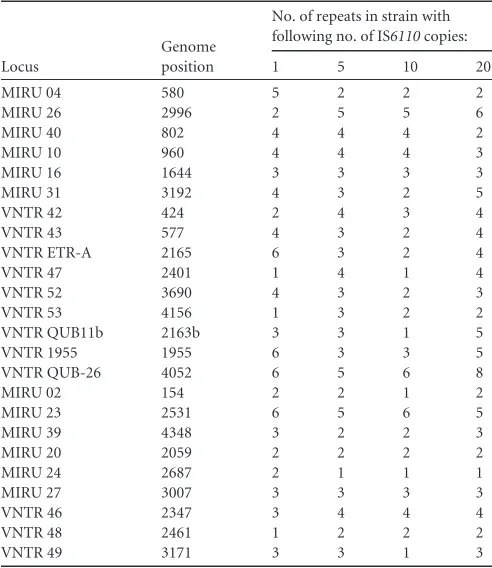
(BALF). Serial dilutions of fourM. tuberculosisstrains with various num-bers of copies (1, 5, 10, and 20) of the IS6110element were used to deter-mine the analytical sensitivity of the optimized 24-locus VNTR typing method in BALF. All VNTR analyses were performed in triplicate.
Statistical analysis.The statistical significance of differences between the two tests performed was determined by Pearson’s chi-square test on a two-by-two table of method versus result.
RESULTS
Optimization of the in-house 24-locus VNTR typing method.
The results of amplification by PuReTaq Ready-To-Go PCR Beads (GE Healthcare, Little Chalfont, United Kingdom) did not meet the criteria because multiple nonspecific amplicons with unex-pected lengths were obtained. The results of amplification by the
Multiplex PCR 5⫻Master Mix (Westburg Benelux Office,
Leus-den, The Netherlands) also did not meet the expectations. In this
case, the optimum annealing temperatures for the different loci were too far apart to be useful in a multiplex PCR.
The amplification results of the AmpliTaq Gold 360 Master Mix (Applied Biosystems, Foster City, CA) yielded the amplicon sizes expected for all of the 24 loci. Even in a multiplex reaction, the amplicons were clear in the analysis of the results in the CE DNA analyzer.
Thus, the final PCR mixture of the optimized 24-locus VNTR
typing method consisted of 12.5l of AmpliTaq Gold 360 Master
Mix for each reaction with a total volume of 25l.Table 1depicts
the loci combined in the multiplex PCR mixtures and the final primer concentrations. The PCR program used was 10 min at 96°C; 40 cycles of 1 min at 96°C, 1 min at 60°C, and 1 min at 75°C; and a final step of 7 min at 72°C.
Quality of the optimized in-house 24-locus VNTR typing method.The interlaboratory reproducibility of the optimized in-house 24-locus VNTR typing method was tested before the imple-mentation of this method in the daily routine. The results ob-tained with the panels used in the first and second worldwide
studies of VNTR typing proficiency (5) organized by the RIVM
were good; the interlaboratory reproducibility was 100%, and the intralaboratory reproducibility was 97%.
Implementation of the optimized in-house VNTR typing
method.In a 20-month period (November 2011 to June 2013)
after the introduction of the optimized in-house 24-locus VNTR
typing method, 1,401M. tuberculosisstrains were typed by this
method. The percentage of instantly complete VNTR patterns
de-tected was 84.7% (n⫽1,186). The performance of the
commer-cial 24-locus VNTR typing method was mapped retrospectively.
In a 22-month period (January 2010 to October 2011), 1,638M.
tuberculosisstrains were typed in the daily routine. The percentage of complete 24-locus VNTR patterns detected by this test was
72.3% (n⫽1,184). The percentage of initial complete results of
the optimized in-house 24-locus VNTR typing method was
shown to be significantly higher (P⬍0.001) and was related to
better yields for the loci for which new primers were designed. The incomplete VNTR patterns detected were caused by miss-ing results for one or more alleles because of amplification failure or because of the false detection of two different numbers of re-peats for one or two alleles. Of the incomplete patterns detected by
the commercial 24-locus VNTR method, 91.6% (n⫽416) were
due to missing results and 8.4% (n⫽38) were due to the detection
of double alleles. By the optimized 24-locus VNTR method, these
were 80.9% (n⫽174) and 19.1% (n⫽41), respectively.
The analytical sensitivity of VNTR typing by the optimized 24-locus VNTR method was tested with DNA from serial
dilu-tions of the fourM. tuberculosis strains in BALF. The 24-locus
VNTR patterns of the fourM. tuberculosisstrains used to prepare
dilutions are given inTable 2. Undiluted samples and 1:10
dilu-tions of all four strains yielded a complete 24-locus VNTR pattern by the optimized in-house method. With the 1:100 dilution of
BALF with a strain with a single copy of IS6110, one of the three
VNTR analyses yielded results for only 22 loci instead of 24; for the
other three strains with higher IS6110copy numbers, this dilution
showed the complete VNTR pattern thrice. Also, with the 1:1,000
dilution of BALF with the strain with a single copy of IS6110, one
of the triplicates showed an incomplete VNTR pattern of 23 loci. The 1:1,000 dilution of the other samples tested showed a
tripli-cate of complete patterns for the strains with 5 and 10 IS6110
copies but three times showed an incomplete VNTR pattern with
on May 16, 2020 by guest
http://jcm.asm.org/
TABLE 1Primer sequences used in the optimized 24-locus VNTR typing methoda
Locus
Genome position
Mixture no.
Final primer
concnb(nM) Primer sequence (5=–3=with labeling)
MIRU 04, ETR-D 580 1 400 GCGCGAGAGCCCGAACTGC(FAM)c
GCGCAGCAGAAACGCCAGC MIRU 26 2996 1 400 CATAGGCGACCAGGCGAATAG(VIC)
TAGGTCTACCGTCGAAATCTGTGAC MIRU 40 802 1 400 GGGTTGCTGGATGACAACGTGT(NED)
GGGTGATCTCGGCGAAATCAGATA
MIRU 10 960 2 400 GCCACCTTGGTGATCAGCTACCT(FAM) GTTCTTGACCAACTGCAGTCGTCC MIRU 16 1644 2 320 CCCGTCGTGCAGCCCTGGTAC(VIC)
TCGGTGATCGGGTCCAGTCCAAGTA MIRU 31, ETR-E 3192 2 400 GTGCCGACGTGGTCTTGAT(NED)
ACTGATTGGCTTCATACGGCTTTA
Mtub 04 424 3 400 GGCAGCAGAGCCCGGGATTCTTC(FAM) CTTGGCCGGCATCAAGCGCATTATT ETR-C 577 3 320 CGAGAGTGGCAGTGGCGGTTATCT(VIC)
AATGACTTGAACGCGCAAATTGTGA ETR-A 2165 3 400 AAATCGGTCCCATCACCTTCTTAT(NED)
CGAAGCCTGGGGTGCCCGCGATTT
Mtub 30 2401 4 400 CTTGAAGCCCCGGTCTCATCTGT(FAM) ACTTGAACCCCCACGCCCATTAGTA Mtub 39 3690 4 400 CGGTGGAGGCGATGAACGTCTTC(VIC)
TAGAGCGGCACGGGGGAAAGCTTAG QUB 4156 4156 4 400 GATGTGCGGTACGTGCATC(NED)
TGACCACGGATTGCTCTAGTC
QUB 11b 2163b 5 800 GTCGAAGTGAATGGTGGCAT(FAM)
GTAAGGGGGATGCGGGAAAT
Mtub 21 1955 5 400 AGATCCCAGTTGTCGTCGTC(VIC) CAACATCGCCTGGTTCTGTA QUB 26 4052 5 640 AACGCTCAGCTGTCGGAT(NED)
GCCAGGTCCTTCCCGAT
MIRU 02 154 6 400 TACTCGGACGCCGGCTCAAAAT(FAM) TGGACTTGCAGCAATGGACCAACT MIRU 23 2531 6 400 CTGTCGATGGCCGCAACAAAACG(VIC)
AGCTCAACGGGTTCGCCCTTTTGTC MIRU 39 4348 6 400 CGGAAACGTCTACGCCCCACACAT(NED)
CGCATCGACAAACTGGAGCCAAAC
MIRU 20 2059 7 400 GGAGAGATGCCCTTCGAGTTAG(FAM) GGAGACCGCGACCAGGTA
(Continued on following page)
on May 16, 2020 by guest
http://jcm.asm.org/
⬎10 missing loci for the strain with 20 IS6110copies. At dilution one step higher, 1:10,000, incomplete VNTR patterns were
ob-tained for all of the strains.Table 3shows the results in
quantita-tion values of theM. tuberculosisdetection tests for the analytical
sensitivity of VNTR typing determined at a 1:100 dilution.
DISCUSSION
We have optimized the VNTR typing method. The combination of seven redesigned primers and the use of a suitable master
mix-ture contributed to the high percentage (84.7%) of complete 24-locus VNTR typing profiles in the first multiplex PCR run. This practical improvement is considerable, as fewer strains have to be reamplified by single-target PCRs, and this reduces the workload and turnaround time.
Another important aspect of this improvement is cost effi-ciency. The high cost of the commercially available VNTR kit and a lack of access to a CE DNA analyzer hamper its use in many laboratories. The optimized in-house method may be an impor-tant alternative, because the products of single-locus PCRs can be analyzed on a gel without the need of a sophisticated DNA ana-lyzer, and the yield of complete VNTR profiles obtained by this inexpensive approach is better than that obtained by the commer-cial method. In a recent proficiency study of VNTR typing, the sizing of VNTR PCR products yielded almost the same degree of
reliability as the commercial method (6).
[image:4.585.39.546.78.259.2]For the daily practice of molecular epidemiological studies of TB and to reduce the laboratory turnaround time, an adequately
TABLE 1(Continued)
Locus
Genome position
Mixture no.
Final primer
concnb(nM) Primer sequence (5=–3=with labeling)
MIRU 24 2687 7 400 GGGCGAGTTGAGCTCACAGAA(VIC) CGACCAAGATGTGCAGGAATACAT MIRU 27 3007 7 400 GCGATGTGAGCGTGCCACTCAA(NED)
TCGAAAGCCTCTGCGTGCCAGTAA
Mtub 29 2347 8 400 GCCAGCCGCCGTGCATAAACCT(FAM) AGCCACCCGGTGTGCCTTGTATGAC ETR-B 2461 8 800 ATGGCCACCCGATACCGCTTCAGT(VIC)
CGACGGGCCATCTTGGATCAGCTAC Mtub 34 3171 8 320 GGTGCGCACCTGCTCCAGATAA(NED)
GCTCTCATTGCTGGAGGGTTGTAC
aPrimers that differ from those used in the standardized method described by Supply et al. (1) are in bold. b
The final concentrations of the forward and reverse primers for a particular locus were identical.
[image:4.585.40.286.439.723.2]cFAM, 6-carboxyfluorescein.
TABLE 2VNTR patterns of the four strains used to test the analytical sensitivity of the optimized in-house VNTR methoda
Locus
Genome position
No. of repeats in strain with following no. of IS6110copies:
1 5 10 20
MIRU 04 580 5 2 2 2
MIRU 26 2996 2 5 5 6
MIRU 40 802 4 4 4 2
MIRU 10 960 4 4 4 3
MIRU 16 1644 3 3 3 3
MIRU 31 3192 4 3 2 5
VNTR 42 424 2 4 3 4
VNTR 43 577 4 3 2 4
VNTR ETR-A 2165 6 3 2 4
VNTR 47 2401 1 4 1 4
VNTR 52 3690 4 3 2 3
VNTR 53 4156 1 3 2 2
VNTR QUB11b 2163b 3 3 1 5 VNTR 1955 1955 6 3 3 5 VNTR QUB-26 4052 6 5 6 8
MIRU 02 154 2 2 1 2
MIRU 23 2531 6 5 6 5
MIRU 39 4348 3 2 2 3
MIRU 20 2059 2 2 2 2
MIRU 24 2687 2 1 1 1
MIRU 27 3007 3 3 3 3
VNTR 46 2347 3 4 4 4
VNTR 48 2461 1 2 2 2
VNTR 49 3171 3 3 1 3
TABLE 3Analytical sensitivity of VNTR typing performed with 1:100 dilutiona
Assay
Cq with strain with following no. of IS6110
copies:
1 5 10 20
In-house Roche 5 31.20 27.19 27.35 26.21 In-house TaqMan 5 30.43 27.50 26.44 25.30 In-house TaqMan 10 29.86 26.24 25.61 24.40 Lucron 30.31 27.29 26.92 25.57 Pathofinder 29.81 26.77 25.72 24.68 MP MTB 32.66 29.48 28.77 27.81 MP MTB/NTM 32.14 28.95 28.19 27.50 In-house ITS-HRM 24.62 28.33 29.24 28.22 Cobas 32.03 33.00 34.87 31.40 GeneXpert 20.90 24.77 24.57 19.43 Goffin MTB 32.66 29.48 28.77 27.81 Goffin MTB/NTM 32.14 28.95 28.19 27.47
a
Associated with the quantitation cycle (Cq) values of the diagnostic tests performed in the study of Akkerman et al. (4).
on May 16, 2020 by guest
http://jcm.asm.org/
[image:4.585.299.544.543.706.2]performing 24-locus VNTR typing method is of the utmost im-portance. Failing loci hamper the interpretation of VNTR typing results in many countries, and this has introduced a bias into the international comparability of VNTR typing results. Failing loci are not the result of a natural absence of VNTRs, as often assumed, but merely the result of technical problems in the typing technique
used (5).
In the meantime, the commercial 24-locus VNTR method was changed from an eight-reaction system to a six-reaction system. The manufacturer did not disclose information about the techni-cal adjustments.
In this study, we also analyzed the analytical sensitivity of the improved in-house VNTR typing method. The detection of the
24-locus VNTR pattern of theM. tuberculosiscomplex in BALF
showed an analytical sensitivity of 1:10 for the optimized in-house method. A slightly more lenient definition of analytical sensitivity changes the interpretation to an analytical sensitivity of 1:100. An analytical sensitivity of 1:100 can be used for VNTR typing. With the risk of missing a single locus, VNTR typing can still exclude the possibility of transmission and relapses.
In theory, this sensitivity provides the ability to perform typing ofM. tuberculosisdirectly in BALF samples, even with a minimal bacterial load. This may increase the applicability of typing results in the early stage of examinations of TB outbreaks or, in an earlier diagnostic phase, permit better discrimination of whether a pa-tient has a relapse or a new infection. The moment VNTR typing can be performed depends on the bacterial load of the sample,
shown as quantitation cycle values, and can be read fromTable 3
for different diagnostic tests. In practical diagnostics, the number
of IS6110elements is unknown; therefore, the results of the
10-copy IS6110strain can be used and are most representative of the
samples collected in The Netherlands.
This study has some important limitations. First, we could not use a single set of samples to investigate the performance of the standard versus that of the improved VNTR methodology. None-theless, the sets used to assess the performance of both methods are representative of the epidemiology in The Netherlands and were similar with regard to genotype distributions. Second,
ana-lytical sensitivity should ideally be determined with prospectively gathered clinical specimens for which quantitative cultures are performed in parallel. In our national reference laboratory setting, these materials cannot be gathered.
In summary, optimization of the in-house 24-locus VNTR method resulted in 84.7% complete VNTR patterns in a diagnos-tic setting. This improves the laboratory work flow because of the reduction of the number of reamplification reactions. In addition, this technique is much cheaper than the commercial 24-locus VNTR method and is useful for laboratories without a CE DNA analyzer.
REFERENCES
1.Supply P, Allix C, Lesjean S, Cardoso-Oelemann M, Rusch-Gerdes S, Willery E, Savine E, de Haas P, van Deutekom H, Roring S, Bifani P, Kurepina N, Kreiswirth B, Sola C, Rastogi N, Vatin V, Gutierrez MC, Fauville M, Niemann S, Skuce R, Kremer K, Locht C, van Soolingen D.
2006. Proposal for standardization of optimized mycobacterial inter-spersed repetitive unit-variable-number tandem repeat typing of
Mycobac-terium tuberculosis. J. Clin. Microbiol.44:4498 – 4510.http://dx.doi.org/10
.1128/JCM.01392-06.
2.de Beer JL, van Ingen J, de Vries G, Erkens C, Sebek M, Mulder A, Sloot R, van den Brandt A-M, Enaimi M, Kremer K, Supply P, van Soolingen D.2013. Comparative study of IS6110restriction fragment length poly-morphism and variable-number tandem-repeat typing ofMycobacterium
tuberculosisisolates in The Netherlands, based on a 5-year nationwide
sur-vey. J. Clin. Microbiol. 51:1193–1198. http://dx.doi.org/10.1128/JCM .03061-12.
3.Untergasser A, Nijveen H, Rao X, Bisseling T, Geurts R, Leunissen JA.
2007. Primer3Plus, an enhanced web interface to Primer3. Nucleic Acids Res.35:W71–W74.http://dx.doi.org/10.1093/nar/gkm306.
4.Akkerman OW, van der Werf TS, de Boer M, de Beer JL, Rahim Z, Rossen JWA, van Soolingen D, Kerstjens HAM, van der Zanden AGM.
2013. Comparison of 14 molecular assays for detection ofMycobacterium
tuberculosiscomplex in bronchoalveolar lavage fluid. J. Clin. Microbiol.
51:3505–3511.http://dx.doi.org/10.1128/JCM.00843-13.
5.de Beer JL, Kremer K, Ködmön C, Supply P, van Soolingen D, Global Network for the Molecular Surveillance of Tuberculosis 2009.2012. First worldwide proficiency study on variable-number tandem-repeat typing of
Mycobacterium tuberculosiscomplex strains. J. Clin. Microbiol.50:662–
669.http://dx.doi.org/10.1128/JCM.00607-11.
6.de Beer JL, Ködmön C, van Ingen J, Supply P, van Soolingen D.Second worldwide proficiency study on variable number of tandem repeats typing
ofMycobacterium tuberculosiscomplex. Int. J. Tuberc. Lung Dis., in press.