Journal of Chemical and Pharmaceutical Research, 2014, 6(5): 499-511
Research Article
CODEN(USA) : JCPRC5
ISSN : 0975-7384
Study on Morphogenesis of Creative Industry Based on ECHO Model
--Example of Beijing 798
Xiao Yun
Sichuan Academy of Social Sciences
,
Southwest Jiaotong University.
_____________________________________________________________________________________________
ABSTRACT
ECHO model is specially established by John Holland for the morphogenesis of CAS. This model is comprised of 1 basic model and 5 extended models. Seen from the perspective of morphogenesis, the 5 models include the three aspects of CAS morphogenesis, namely, conditions, mechanism and progress. This paper gives a brief account of ECHO model from these three aspects. And it also studies the morphogenesis of creative industry by way of this model and through the example of Beijing 798 Cultural and Creative Industrial District. It demonstrates that creative industrial system is a complex adaptive system which develops spontaneously and evolves progressively; strategies and policies relevant to the development of creative industry should conform to the rules of CAS morphogenesis.
Key words: CAS theory, Morphogenesis, Evolution, Creative industry
_____________________________________________________________________________________________
INTRODUCTION
ECHO model is an important creation of Holland to orient CAS study to objectivity and science. ECHO model draws a systematic picture of CAS, and gives a description of the interaction of agents as well as the realistic picture of evolution. It needs to be particularly noted that, the study on the CAS morphogenesis is of great value in application. Taking Beijing 798 Culture and Creative Industrial District as an example, this paper applies ECHO model to the study of creative industry system and the conclusion has great instructive significance for the study of experience-form-based creative industry both at home and abroad.
OVERVIEW OF ECHO MODEL
In real life, people are exposed to phenomena from complex adaptive system, such as seed growth, human immune system and globalization. The emergence of these systems in nature is changing from small to big and from simple to complex [1]. However, people have little knowledge of the link between gradual expansion of organization and CAS mechanism during the evolution of CAS at present. The reason is that systems of this sort will constantly have symmetry breaking in both form and internal composition in the course of morphogenesis; therefore, it is very difficult to conduct controlled trials and even unachievable at all. The mathematical tool traditionally utilized to study dynamic process--partial differential equation is incapable of describing this process. Turing once attempted to address this problem, but failed to obtain any general conclusion. From then on, the problem remained unchanged without much progress.
Holland established the ECHO model by way of metaphor. He was inspired by the morphogenesis mechanism of metazoa: "Metazoa presents self-ruled continuous expansion and structural diversity in the course of development. Specifically speaking, genes at an open state can be represented by the cellular structure of enzyme they encode. Enzyme is an effective catalyst in inducing intracellular reactions. Different genes, when at an open state, can generate different enzymes and different reactions so that different structures can be produced." [2] If the simple agent aggregate of CAS, similar to metazoa, has intact cells with all functions and can simulate the biological gene regulation mode, then the morphogenesis of CAS can be completed automatically. In order to achieve this, the simple agent must be aggregated into agents; only the aggregate of agents can produce variable structure and can stimulate one group of genes that can be opened and closed to play the role of flexible cells of metazoa. This is the real intention of ECHO model.
For the convenience of our study, we describe and discuss the Holland's ECHO model from three aspects, namely conditions, mechanism and process of CAS morphogenesis.
2.1 Conditions of CAS morphogenesis
As is proposed by Holland, the key of ECHO model lies in that "it stipulates that only when adequate resources are collected and the chromosome strings can be copied, replication can be conducted." [3]. Therefore, collecting adequate resources are the prerequisite of morphogenesis of CAS.
So, how to collect resources? There are two methods. One is to obtain resources through conditional exchange. In models, Holland marks the resources with chromosomes represented by letters (a, b, c, d). When two agents meet, the attack sign of one agent chromosome compares the exchange conditions of another agent chromosome. If the conditions are met for both of them, the resources are exchanged; if not met, the agent with the unmatched conditions "escapes" from the interaction. In this way, each agent involved in this exchange earns something through the intra-agent flow of resources and in the meantime, the mutual vitality becomes further increased. The other is the transformation of resources, which is to transform the agent's own resource into another deficient resource necessary for the system. Transformation of resources provides an important opportunity for the differentiation of agent; in the meantime, a vital dynamic mechanism is provided for the diversity development of system and the complex levels of diversity of morphogenesis.
In addition, one agent performs conditional exchange at its site with other agent, and at the same time it performs conditional exchange with the site itself; the site also has changes in resources which are provided to a certain agent with a demand for a certain resource.
Of course, the conditional exchange and resources transformation are not finished in one time or within a stage, and instead they are on-going during the period of continued existence of the whole system.
2.2 Mechanism of CAS morphogenesis
In the course of collection of adequate resources, one agent can form CAS through aggregation and adhesion mechanism. Aggregation has two denotations, one is clustering, that is to aggregate agents of the same category together into larger agents--meta-agent, such as antibody 1, antibody 2, antibody 3…to form immune system; the other is interaction, in which individual agents form aggregate through interactions, and this aggregation as a whole can form the system’s meta-agent. Meta-agents can interact with each other and the interaction can be described properly by using the characteristics of emergence aggregation of clustering (under the first denotation). For instance, the internal interactions of immune system can produce the personal identity character. Meta-agent can interact within a larger range, at a larger scale and at a higher level to produce meta-agent and then form aggregate of agents. After repetition for several times, the system forms a CAS system with rich hierarchical structures from small to big, from simple to complex and from single layer to multi-layer, and produces the corresponding phenomenon of emergence.
organizational structure can emerge. The second role of signs is to maintain the robustness of system. After the agents start to aggregate through signs, the intra-agent interaction does not stop but is in the middle of constant change; but the change will not change the nature of system or cause system breakdown within a short time. Signs can play the proper role of maintaining the robustness of system.
If it is true that the aggregation characteristics of agents display the limitless possibility of intra-agent interaction, then the adhesion mechanism is the detailed expression of agent aggregation. In fact, adhesion is a kind of aggregation; aggregation signs are adhesion signs. What is more profound about adhesion is the fact that the intra-agent adhesion is not arbitrary: only when the resources of one agent have a certain satisfactory relation with the resources of another agent, adhesion can occur; otherwise, no adhesion will occur between the agents. Secondly, the intra-agent adhesion, once completed, can be seen as one integral movement and interaction. In this way, within the adherent agents differentiation and specialization occur (for instance, the agent specializing in producing a certain type of resources occurs) so that the intra-agent functional coupling is achieved. Thirdly, the interaction of adherent agents relies on the internal and external borders formed by configuration of adherent agents. This also creates conditions for the differentiation and specialization of agents. Of course, signs are still a mechanism commonly present for the interaction of agents, and subsequently producing borders and hierarchical occurrence etc. --These three aspects are the more deep-seated reason for the system's maintenance of its robustness.
2.3 Process of CAS morphogenesis
Without a large amount of aggregation and adhesion, the collection of agent resources will be limited and there will be no evolution and development of CAS. However, let's assume that there is a large amount of CAS aggregation and adequate resources are collected, then how will CAS evolve? As is said previously, the fundamental intention of ECHO model is to confirm the CAS morphogenesis. The so-called morphogenesis refers to the creation, elimination, and evolution of the form of things. It was first classified as a concept in biology. It is asserted in biological morphogenesis that, the cellular shape is undefined in the early stage of cytomorphosis. After a while, the cell will develop into one of the multiple final types which is different from the original. [5] Therefore, it can be said that CAS morphogenesis is the evolution law of CAS.
How does CAS morphogenesis proceed?
The first is the selective mating of agents. When one agent collects adequate resources that can perform self-duplication, the potential mates can propagate, and the two agents are within the interaction range (that is at the same hierarchy or neighboring hierarchy), the two agents can mate with each other. Due to resources exchange (chromosomal chiasma) and mutation, the mating generates two new individuals; the two new individuals are different from the agents arising from the conditional exchange, resources transformation and adhesion mechanism, they increase the multiplicity of agents and create new niche to provide conditions for CAS system to evolve towards new directions or higher hierarchy.
However, selective mating is insufficient to motivate the overall evolution of the system. Duplication of conditions is the key mechanism for morphogenesis.
How does duplication of conditions carry on? As is said previously, Holland depicts the duplication of conditions through the metaphor of metazoa morphogenesis. One important mechanism of metazoa development is that the development of various cells is achieved through the cell division and gene opening and closure etc. The opening and closure of genes, on one hand, are derived from the repression (closure) of genes and depression (opening) of genes by different biomolecules, and, one the other hand, genes themselves can promote or depress the production of various biomolecules through enzymes and control the opening or closure of other genomes through the byproducts of biomolecules. The opening and closure of genes produces the differentiation into different genes in charge of skeletons, four limbs, eyes and heart etc. necessary for the morphogenesis of metazoa and then the development of different organs so that the metazoa with a complete structure is formed.
According to the biological metaphor, Holland first defines an agent as the primitive component of a system, playing the role of an organelle or compartment in agents. He calls this primitive agent "agent-compartments" [6]. In this way, individual agents with a fixed structure can aggregate into a more complex and multi-hierarchical variable structure-agents. The aggregate of agents as a whole can interact with other individual agents or other aggregate of agents. One aggregate of agents consist of multiple "agent-compartments" and the chromosome of agents are the connection in series of chromosomes of all "agent-compartments".
condition, the "agent-compartments" can be duplicated. The following two requirements have to be met if other "agent-compartments" meet the duplication condition: the first one is that these "agent-compartments" must be at the active state (genes are open); the second one is that the active individual agent must have relevant resources to meet the duplication condition. One key point is that if among agents only one active "agent-compartment" meets the duplication condition, the agent can be duplicated; of course, this means that the compartments that are at the inactive state (genes are closed) are not duplicated. In this way, the new later generation "agent-compartments" will be soon considerably different from former generation "agent-compartments" so that the later generations will have different functions or different differentiation and specialization directions with the former generations. However, although the agents are new combination with the former generation compartments, its chromosome remains unchanged, which is aimed to maintain the adaptive capacity which is difficult to obtain in the alternation of generations of individual agents. For instance, skin is different from skeleton in shape, but their chromosomes are the same. Therefore, the aggregate of agents is endowed with plasticity similar to that in metazoa to further induce the morphogenesis of CAS. If two aggregates of agents interact, only any two "agent-compartments" at the external border interact and their interaction will occur like two individual agents.
ECHO model can simulate the CAS morphogenesis under the objective and natural conditions, which is the most successful aspect of ECHO model. Its scientificity lies in that, this model can use many examples of CAS morphogenesis in reality to demonstrate, and creative industrial system is such a typical example.
CREATIVE INDUSTRIAL EVOLUTION-EXCHANGE CONTACT
ECHO model classifies agent interaction into two types. One type is exchange contact including conditional exchange, resources transformation and adhesion interaction; the other is mating contact, including selective mating and conditional duplication. According to this classification and with Beijing 798 Culture and Creative Industrial District as an example, we will analyze how the creative industry evolves by using the ECHO model.
798 Cultural and Creative Industrial District was originally an abandoned factory with an area of over 60 square meters. As early as this century, some cultural and art workers spontaneously entered and became stationed in 798 one after another. During the short period of four to five years, similar to the growth and development of a metazoa, the separate and sporadic studios of artists and cultural workers gradually evolved into a cultural and artistic industrial district with abundant categories and full functions. The district has a big influence nationwide.
798 Cultural and Creative Industrial District, since its establishment, has formed a complex adaptive system, including numerous components, hierarchies, structures and functions. As 798 is derived from the separate artistic "seeds", we will explore the morphogenesis of 798 by focusing on some of the artistic developments. The morphogenesis of artistic industry is undoubtedly the formation of complete chain and complete system of the artistic industry and this system must have robustness. So how is the complete chain of artistic industry constructed? It is an organic system comprised of terminal vendor of materials for art creation, artistic talents training institutions, creative artists, artistic agents, curators, galleries, auction houses, commentators, art funds and art museums etc. After the formation for artistic industrial system, the external effect and spillover effect will aggregate relevant industries and enhance their development and growth; in addition, peripheral systems that surround the artistic industry and relevant industries as well as serve the system will appear such as catering, shopping and leisure etc. How did 798 form such a complete system?
3.1 Resources accumulation
The first is exchange of conditions. With the deepening of great reform and opening to the outside world, in the 1990s 798 like many state-owned enterprises was unable to continue the production and a great number of laid-off workers became the burden of 798. In order to revitalize the asset, 798 was faced with many choices such as transfer to large logistics base or lease to large-scale enterprises for building production base etc., but all ended up infeasible. From the perspective of system theory, 798, under these circumstances, were faced with a divergence. [7] However, it was at a chaotic state about where it should diverge. It happened that some cultural and artistic workers became stationed in 798 at a very low leasing price, and at this time, two large agents had a small amount of exchange of conditions, which created a new possibility for the system divergence, provided new original conditions and accumulated the initial resources.
complete mutation. By the way, it should be noted that in the course of resources transformation of 798, there was not only resources transformation of macro-agents, but also the resources transformation of internal micro-agents within the aggregate of agents. For instance, some workers who were employees of 798 eventually became proficient in process work of all sorts such as preparation of works for artists, transportation and exhibit arrangement. Some workers even set up artistic engineering companies for this purpose and they went abroad to arrange exhibits even more frequently than artists involved in international exhibition. [8]
A small amount of conditional exchange and topical resources transformation create new possibilities for the resources accumulation of 798 creative industrial individual agents and the accomplishment of differentiation and specialization of system.
Literature [9] sets ups a function for the interaction and function change of system individual agents, and it can be used to explain the initial interaction and its results. That is, when the system individual agents are aggregated and the interaction is produced, the function of system functional change is [9]:
( ) ( 1)
f n = n n− (1)
Wherein, f (n) expresses system function and represents the amount of interaction between agents; n represents the
number of individual agents in system.
According to the characteristics of system 1+1>2, it should have:
( 1)
n n− > n (2)
The early 798 only had several cultural and artistic individual agents such as Sui Jianguo, a sculptor. Although there was interaction between those agents, their interaction with other agents in the cultural and artistic community through 798 was little. During the six years or so, there were only these several individual agents; plus the intensity of interaction was not sufficient enough to induce the mutation of system.
3.2 adhesive coupling
Conditional exchange and resources transformation are the important conditions in system evolution, but if not for a large amount of aggregation of system individual agents, it would be impossible for a small amount of conditional exchange and resources transformation to drive the system evolution. Therefore, adhesive coupling is an important stage that the system must go through (it must be noted that conditional exchange and resources transformation are completed through aggregation: conditional exchange and resources transformation produce aggregation; then aggregation further produces conditional exchange and resources transformation).
Adhesion, in essence, is a coupling and means that the constituents are reciprocally complementary, reciprocally conditionally and reciprocally causal in nature, existence and function so that they can be organically integrated. [10] It is signs that materialize the adhesion mechanism of coupling; signs are also the conditions for the screening, differentiation, specialization and cooperation of the aggregate of agents. For instance, when cultural and artistic workers became stationed in 798, the sign was the Bauhaus style here. They connected the tall and expansive plant as well as rich and varied changes in space with the "loft" lifestyle popular abroad. [11]
The early adhesive coupling of 798 was the aggregation of individual cultural and artistic talents, such as Sui Jianguo (sculpture), Hong Huang (publishing) and Liu Suola (music). Due to small amount and homogenization in publishing, music and art, it, as a system, was also faced with divergence stage. After the No. 2 contemporary art collector in China, Robert, became stationed in 798, he immediately became the important sign for painters to aggregate; his "active state" expedited the interaction between 798, the aggregate of artists’ agents. Huang Rui, the famous painter who initiated the star painting school, returned from Japan and became stationed in 798; subsequently Tokyo Gallery, Belgium Ullens Center for Contemporary Art and other world famous galleries and art fund companies successively became stationed in 798, which became the "sign cluster" for painters to aggregate towards 798. As we have mentioned previously, signs are agents, but those agents with information to let individual agent identify whether interaction is possible. When individual agents with sign significance form the sign cluster of agents, a large amount of aggregation of agents will be caused naturally to further motivate the system to develop towards the breaking of symmetry.
( 1) 2
( 1) ( )
1
n
f n f n
n − + + =
− (3)
Or
2
( 1 ) ( ) n
f n f n
n
− − =
(4)
In other word, in the early stage of system, when the number of individual agents is small, the increase or decrease of n has a significant influence upon the system function. As Robert, Huang Rui, the Ullens couple, Tokyo Gallery etc. became stationed, the small n mechanism started to play the effect; therefore, the aggregation amount of agents increased constantly and the system function value increased constantly, so the system soon achieved breaking of symmetry at two directions to produce mutation: the first one is that 798 transformed from an abandoned factory into a gathering area of artists; the second one is that the early aggregation of cultural and artistic workers without a hierarchy became an aggregate with artists as the principal part. --CAS manipulates the symmetry through signs, which can be seen clearly here.
It can be seen that, during this course, conditional exchange and resources transformation are still constantly occurring. In the meantime, the aggregation of artists created new niche for the agent diversification, so based on the same rule, musicians, designers, consultants, fashion brands, jewelry, dining and entertainment and other different cultural and artistic categories successively gathered here. Each type of aggregate became a whole and then became parts of the whole 798. Therefore, 798 became an aggregate of agents. Discriminated according to the cultural golden contents or function of these aggregates, they can constitute various different hierarchies (it can be seen that, in the course of aggregation evolution, the old previous can generate new signs; signs play a great role in generating different aggregates and the hierarchical characteristics of CAS), and then 798 transformed from a CAS with artists as the core into a cultural and artistic area with both artists and many cultural creative industrial agents.
AGGREGATION EVOLUTION OF CREATIVE INDUSTRY-CONTACT MATING
Formulas (1), (2), (3) and (4) are all system functions established based on the self-aggregation of agents, and the self creation and development of system individual agents are not considered. In fact, the formation of mechanism of system individual agents is multiple, both by way of aggregation and by way of the self creation and development by the interaction of system agents. It means that, when aggregation reaches a certain degree, the aggregate of agents not only performs conditional exchange and resources transformation, but also carries out propagation according to the need of system development, which is like metazoa. The single cells at the chaos state need to develop progressively according to the complete shape of metazoa. This is contact mating. So how does the contact mating of 798 carry on?
4.1 Selective mating
Many cases can be given in terms of the selective mating of 798. For instance, 798 has a famous restaurant, named "Tianxiayan (meaning the world's salt)". The joint masters of the restaurant are Ermao (a poet), Cang Xin (a painter) and Huang Ke (a gourmet). It can be said that it is the mating between literature and arts and cuisine. This mating generates a restaurant with a strong atmosphere of literature and arts. When you walk in, you will see "Reform is Dinner" at your left hand of corridor, which is undoubtedly associated with history and Mao Zedong etc. in thinking. On the front wall is the tremendous pop mural "Glory and Dream of 798" by Wang Guangyi. At the corner of the staircase on the second floor stands a large red statue of "Waving Chairman Mao", seeming to receive guests upstairs or wave in salute to guests. On the nearby wall is written the "masterpiece" of the famous "hanger-on" calligrapher Shen Hongfei: "Waiting for dishes is like waiting for a lover that is arriving for the appointment." The menu is also vivid and interesting, like "Wang Xianzhi sparerib" (Wang Xianzhi is calligrapher in Eastern Jin Dynasty and his calligraphy is thin, vigorous and forceful, so it is used to analogize sparerib), "Not spicy enough to appease the resentment", "the first husband of Mapo Tofu"...which is very creative, combining the painter's imagination, the gourmet's appreciation and both of their originality. As a result, these kinds of products of "mating" attract lots of people and the houses are always full of guests.
Selective mating indicates that the system generates emergence through aggregation but also through the interaction within the aggregate to produce new individual agents and further increase the multiplicity of agent so that the system function can be enhanced.
Of course, in addition to 798, all agents in the entire creative industry can perform selective mating to constantly generate new varieties. Animation is the product of "mating" between the previous cartoon and the modern photographic technology; Disney is the product of "mating" between animation and theme park; a theme park is the product of "mating" between culture and tourism. And the new products from microcosmic mating are even more.
4.2 Duplication of conditions
As we have said previously, the study object of duplication of conditions is morphogenesis of CAS system, that is how to develop progressively from individual elements, or metaphorically speaking in the biological sense, how to develop from a sing cell like a metazoa.
Is creative industry able to develop into mature shape like a metazoa? 798 can also indicate how agents in creative industry form a complete creative industrial system through duplication of conditions.
We can regard various agents before the birth of 798 Art District as free agents, including 798 itself, artist population, consultant population, fashion brand population, catering and entertainment population as well as leisure and travel population etc. Obviously, 798 itself is an aggregate of agents and its "agent-compartments" mainly include 798 factory space, environmental conditions (as the place), Seven Star Group (as the property owner) and the aggregate of workers. Of course artists are one of the aggregates of agents, and the "agent-compartments" include individual artists, agents in the category of artists, agents the artists serve and the artist studio etc. As is mentioned previously, when two aggregates of agents meet, only one compartment is at the active state and the duplication conditions of agents are satisfied, duplication occurs. After 798 was abandoned, the factory needed to find a way out, so we believe 798 was at the "active state". At the same time, artists attempted to seek to rent a large space with interestingness at a low price'; according to foreign experiences, space such as industrial heritage could form a "loft" lifestyle. These formed the "duplication of conditions" for agents of artists. It is apparent that a two-way satisfaction relation was formed between the two major aggregates, 798 and artists.
Before the further discussion of 798 evolution, we need to make clear the attack sign and defense sign in ECHO model. As for the two signs, Holland did not given clear definition in the ECHO model, which means that we, when setting the alphabetic strings for the two signs, can present some randomness. In fact, when discussing about the triangular relation of ants, flies and caterpillars, the setting of relevant alphabetic strings appeared comparatively random and vague. When we read more specific studies, this kind of randomness might deprive our study of scientificity.
We believe that, attack signs and defense signs are the references to power relation or transaction relation between agents; this power relation or transaction relation is related to situation and constantly changing. Therefore, it is impossible to give them a fixed value or to establish a fixed functional relation. Holland believes that, different from the direct evaluation of mathematical genetics upon range of application, the favorable figures are implicitly defined, so the power relation or transaction relation should be the implicit range of application. The so-called power relation means that a certain agent in the system can possess without paying the resources of another agent and can even eradicate the former; transaction relation means that one agent, when obtaining the resources from another agent, needs to pay a certain cost for compensation. Therefore, we define the attack sign and defense sign as follows. Attack sign refers to the capability in agent chromosome to defend its existence for the purpose of obtaining the necessary requirements: possessing without payment or exchange for payment. Defense sign refers to the capability of agent to avoid the loss of resources: possessed without payment or non-equivalent exchange. Additionally, the so-called self-defense of its existence and propagation is the maintenance of its existing functions. In addition, within the aggregate of agents, not all agents have the attack sign and defense sign. Some agents may specialize in producing the resources needed by other agents to exchange for the protection from other agent so that its resources will not be possessed without payment or exchanged non-equivalently. What's more, the resources to produce the attack sign and defense sign in the agent chromosome are not separated, and the resources used for attack sign can also be used for defense sign. In other word, the defense capability sometimes equals the attack capability.
desolate, so it was still good to have people rent this place and the rent was very low. Therefore, "leasing the factory at a relatively rent" is a capability for 798 to obtain resources. Therefore, we can nail down the constitutive genes of chromosomes of the two agents, 798 and artists, according to ECHO model.
I. Composition of 798 chromosome and corresponding letters: i. Attack sign --
Leasing factory (a); Relatively low price (b); ii. Defense sign --
Have the ownership and disposition right of the factory (c); iii. Exchange conditions --
Money that meets the relatively low rent (d) iv. Adhesive sign --
Have buildings with certain cultural characteristics (including Bauhaus style). Too ordinary factories cannot make cultural workers adhere to this place (e).
vi. Mating conditions --
Relevant industry such as culture and art. Of course, the formation takes place when the factory is at the critical stage of divergence (f).
vii. Duplication conditions --
Relevant industry such as culture and art (f)
I. Composition of artist chromosome and corresponding letters:
i. The artist capability to obtain resources, of course, relies on art, so the attack sign of artists is -- To develop art itself to ensure the constant improvement of artistic level (h);
A certain amount of money needed for the engagement in art. This is identical to the rent of 798 (d);
Buildings with certain cultural characteristics are more beneficial to the play of imagination. This is also the identical to the adhesive sign of 798 (e).
ii. The defense sign needed by artists according to their economic conditions (many artists are not very rich) to ensure the artistic development and prevent the loss of resources are --
To develop art itself to ensure the constant improvement of artistic level (h) Pay the rent which is not high. It is identical to the "relatively low price" of 798 (b) iii. Exchange conditions of artists --
Rent more cheap space. It is identical to the "relatively low price" of 798 (b); iv. The adhesive signs of artists are --
Relevant industry such as culture and art, including the cultural characteristics of space (f) v. Mating conditions of artists --
Relevant industry such as culture and art (f) vi. Duplication condition of artists is also -- Relevant industry such as culture and art (f)
[image:8.595.152.462.533.716.2]So, the basic ECHO model and interactive relation between 798 and artists is (fig. 3.1)
Fig. 1: Basic ECHO model and interactive relation between 798 and artists
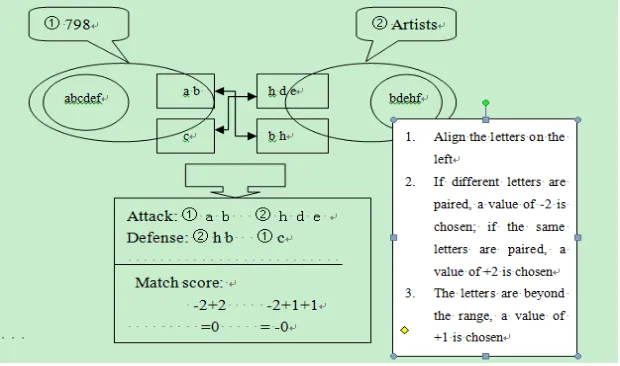
adhesive coupling and selective mating between 798 and artists can be tested according to the method of ECHO model so that fitness between the two can be detected. For instance, conditional exchange –
Fig.2: Conditional exchange between 798 and art aggregate
The exchange conditions of 798 indicates that, it can perform exchange with all attack signs with the beginning of d## ("#" is the symbol of "not care") and artists apparently satisfy this condition; the exchange conditions of artists indicate that, it can perform exchange with all attack signs with the beginning of b## and 798 apparently satisfies this condition.
Although 798 continues to maintain its function of profit-making, the previous production function, through the interaction of the two, starts to transform into the function of artistic creation and the production space starts to transform into the artistic space. According to the rules of conditional duplication, the chromosome of this aggregate of agents is comprised through the connection in series of chromosome A of 798 (abcdef) and chromosome (bdehf) of artists (Art) (as is shown in Fig.2)
Fig.3: 798, Art aggregate and their chromosome connected in series
798 and art aggregate form one aggregate of agents, so the "conditional duplication" starts. The conditions of conditional duplication are: 1. the presence of agent compartments that meet the duplication conditions; 2. the compartment is at the active state. These two major agents mutually meet these two conditions; thus, the aggregation of artists and 798 reproduce new generations through conditional duplication: artists and work studio.
This is the first offspring: 798 space (A) + artists (B) = artist studio (C). So there is: A+B=C
Through conditional exchange, resources exchange and conditional duplication, the generated artist studio further enhances the activity of 798; for the interior of 798, C can be regarded as the newly-produced agent-compartment after the duplication of initial chromosome AB. Because the filial generation as the parental generation has a good match with its parental generation (its chromosome is the same with the parental generation), according to the law of evolution of CAS, the filial generation will enter into the border of the parental generation (Fig.4, next page); they constitute one aggregate of agents; in the meantime, artist studio (C) becomes a new adhesive sign.
Fig.5: Change of system structure of 798 Artistic District after the first conditional duplication
In March, 2002, Robert became stationed in 798 and opened an artistic bookstore (D). This can naturally be seen as the results of the march of the attack sign of D (rent, art, collection, art books) and the defense sign in the chromosome string consisting of A and B (rent, art, artist studio) or adhesive sigh segment (art). Therefore, "D" is placed with the internal border of A and B, and becomes the new adhesive sign (as is shown in Fig.5).
Fig.6: Change in aggregate after the second conditional duplication
Fig.7: Artistic district aggregate arising from multiple conditional duplications
The new aggregate of agents (A+B+...) apparently can be considered as galleries (E), art museums (F) or drawing materials shops, exhibition planning institutions, auction companies, art salons, journals of art review, art funds etc., namely,
A+B+……=E A+B+……=F ...
For these agents, Formulas (1) and (2) can also be used to describe the elevation in the function. Of course, in the course of duplication, the "differentiation" and "specialization" etc. of agents exert a great effect upon the morphogenesis. Due to the aggregation of agents, the resources of all agents can be used for the chromosome duplication of the entire aggregate of agents, and then abundant differentiation and specialization occur. In other word, some agents can specialize in attack without the need to obtain the defense resources and some agents can specialize in defense without the need to obtain the attack resources. As for 798, the so-called differentiation refers to "specialization". Some agents specialize in artistic creation, some agents specialize in creation, some agents specialize in artistic activities planning, some specialize in running gallery, and some specialize in artistic critique etc. Then, external agents specialize in attack and defense and carrying out transaction, while the internal agents focus on transforming surplus resources into scarce resources. For instance, Huang Rui specialized in planning artistic activities, inviting artistic and cultural celebrities from all over the world to 798 and whipping up public opinion etc. to boycott the demolition and divergence of 798 to maintain the existence and development of 798. And others are devoted to the planning and operation of the space etc.
In this way, the constant interaction between agents forms a complete artistic industrial chain and relevant industrial chain at a large scale. Firstly, a great influence has been created overseas and then attention has been drawn from the Chaoyang District Government and Beijing Municipal Government. 798, which would have been demolished and abandoned, succeeded in escaping the adversity and made an ornate turn, and it was determined by Beijing Municipal Government as "Cultural Artistic Creative Industrial District".
What's more, the artists, 798 property owners and relevant artistic agents all need to live, eat and socialize etc. When these duplication conditions are added, the segments of "life" and "association" are added in the chromosomes of original agents. This drives 798 to produce corresponding agents in the catering, leisure and fashion etc. This is what it looks like later.
After such morphogenesis course, 798, like metazoa, has evolved from a single cell into an animate aggregate with complete organs and full functions. 798 previously with only several studios evolved into a cultural artistic and creative industrial aggregation zone with over 400 cultural and artistic enterprises, and it was renowned as one of the three major cultural tourist zones of Beijing together with the Great Wall and Forbidden City.
The expression【13】in Literature [13] is used:
1
( 1 ) ( )
n i i
S E n
=
=
∑
1
( 1 )
n
i
i
S
=
∑
represents the interaction between agents; "n" represents the quantity of agents in the system;
E n
( )
represents the relevancy of system emergency with the scale of n. It indicates that the aggregation, duplication and interaction of agents are very important internal mechanisms for the system emergence.open system free from equilibrium state. During the course of constant interaction and duplication, due to the concentration difference of metabolites and the change of internal and external environments, some agents will be dissociated from the aggregate to become the agents or seeds of a new aggregate. For instance, Sui Jianguo and Huang Rui, who entered 798 in the early stage, later left 798 in succession and become the core of Huantie Art District and other aggregation districts. Let's see what influence is produced by their leaving upon the system functions.
According to Literature [9] "
n
2 Effect", when the aggregation number of system agent is sufficiently large, the increase and decrease of system agents exerts little influence upon the system:2 1
( ) ( 1) (1 )
f n n n n n
= − = −
When n is sufficiently large,
At this time, when n is sufficiently large, an n is subtracted, then
Compared with the previous f(n)
Compared with the n (a large value), this is an extremely small figure; therefore, their leaving exerts an extremely small influence upon the system function. As a matter of fact, although Sui Jianguo and Huang Rui etc. are the very key structural factors in the formation of 798 Cultural and Artistic Industrial District, the influence of their leaving after the formation of the district is next to nothing.
CONCLUSION
Creative industrial system is a complex adaptive system, and its law of evolution is consistent with the morphogenesis course of CAS. Which means it can spontaneously develop like metazoa. It is apparent that Beijing 798 Creative Industrial District is a typical case. Additionally, Songzhuang of Beijing, M50 and Tianzifang of Shanghai, loft 49 of Hangzhou, Dafencun of Shenzhen, Wushipu of Xiamen, animation industry of Tokyo Japan, film industry of American Hollywood, creative industries in British Fleet Street, German Nordrhein-Westfalen and Australian Brisbane etc. all evolved into the present form in this way. At present, our country is implementing the strategy of building up the strength of the country with culture, but in many places the cultural and creative industry is still developing according to the methods used in industrial sector; a large number of studies are conducted according to traditional methods and it is hard to find breakthrough literature. American scholar, Allen J·Scott found the relation between creative industry and CAS theory and briefly described the relation between the two; however, this was only a hypothesis without empirical investigation. [14] Therefore, the cultural and creative industry should be recognized as a CAS system and the cultural industry should be developed and studied accordingly, so that the better-than-expected effects can be achieved.
REFERENCES
[1]Holland J H.Emergence,From Chaos to Order.Oxford:Oxford University Press,1998.p2
[2] [US] John H. Holland. Hidden Order. Translated by Zhao Xiaomu et al. Shanghai Century Publishing Group.
2011. p 120
[3] [US] John H. Holland. Hidden Order. Translated by Zhao Xiaomu et al. Shanghai Century Publishing Group.
2011. p 99
[4] Duan Yong. Self-organizing Philosophy of Life. China Agricultural Science and Technology Press. 2009. p 24 [5] Yang Bin. Soft Science Dictionary. China Social Sciences Press, April 1991, 1st edition.
[6] Holland J H. Hidden Order: How Adaption Builds Complexity. CA: Addison-Wesley,1995.
[7] Ilya Prigogine et al. Order Out of Chaos. Translated by Zeng Qinghong et al. Shanghai Century Publishing Group. 2011. p 160.
[10] Edited by Xu Guozhi. Systems Science and Engineering: Theories and Applications. Shanghai Science and Technology Education Press. 2000. p 143.
[11] Ye Ying. Considerable Change in 798. New Star Press. 2010.200.
[12] Xi Mu. Introduction to Chinese Artwork Market (First Volume). Chinese Bookstore. 2010. p 55-56.
[13] Zhang Siying. Complexity Science, Rules of the Whole Systems and the Qualitative Researches. Complex System and Complexity Science. 2005. 1.