Journal of Chemical and Pharmaceutical Research, 2014, 6(6):900-905
Research Article
CODEN(USA) : JCPRC5
ISSN : 0975-7384
RSSI-based node localization algorithm for wireless sensor network
Wanli Zhang* and Xiaoying Yang
Intelligent Information Processing Lab, Suzhou University, Suzhou, Anhui, China
_____________________________________________________________________________________________ ABSTRACT
In order to overcome the problem of low accuracy of the localization algorithm based on RSSI, an improved RSSI-based location algorithm is presented in this paper. To avoid the influence of the final positioning caused by error of a single RSSI measurement value, first, median model is used to correct each value of RSSI, then, corrected value of RSSI is used to estimate the relative size of the distance between network nodes which can communicate, finally eligible anchor node is used to calculate the position of the unknown node in this algorithm. The algorithm is simple, the nodes without increasing communication overhead during positioning and without hardware extension. Simulation results show that under circumstances of different path loss factor, positioning error of the node reduces the average 80% as compared to the original algorithm, greatly improving the accuracy of the node and greatly improves the accuracy of the node.
Key words: Wireless sensor networks, RSSI ranging, Median model, Node localization
_____________________________________________________________________________________________ INTRODUCTION
Sensor node positioning technology is a key enabling technology for wireless sensor networks in most applications [1].The position information of nodes is indispensable in monitoring and tracking the target, routing based on the position information. According to whether the actual distance or angle is measured between the nodes in the positioning process, the location algorithm can be divided into: location algorithm based on distance and location algorithm is independent of the distance [2]. The typical distance measurement techniques includes the use of RSSI ranging [3], TOA or TDOA ranging and AOA ranging.
Using known transmitted signal strength, the receiving node calculates signal loss in the communication process according to the received signal strength and propagation loss is converted into distance by using the theoretical or empirical signal propagation model in RSSI. Using RSSI information of three anchor nodes, the position of an unknown node can be determined by trilateration. The radio signal is weak ability to adapt to complex environment in the actual application environment, so the accuracy of this method is not high [4]. But with fewer hardware, and many wireless communication module can provide RSSI values directly, RSSI-based ranging method is still widely used [5].
RSSI-BASED LOCATION POSITION ALGORITHM
)
lg(
10
)
(
0 0d
d
n
P
d
P
=
−
p (1))
(d
P
is the signal strength at distanced
;n
p is the path loss factor, in the range 2-4, concerned with the specific environment;P
0is signal strength at reference distanced
0(dbm).Positioning process of positioning algorithm based on distance is described as follows: (1) Anchor node periodically sends its own message: node
ID
、own position information.(2) Unknown node receives a plurality of RSSI value of anchor nodes, then, it calculates the distance between nodes according to the channel model. Firstly, three anchor nodes first received are used to preliminary calculate positions of unknown node.
(3) For all the received messages, each group of three, namely to calculate the position of the unknown node. (4) Finally, all calculations position in the collection is averaged, which is the estimated position of unknown nodes. As can be seen, location positioning algorithm first rough calculates position of unknown nodes, and then gradually increases the positioning accuracy of unknown nodes by a plurality of similar process. As the number of nodes increases, the computational complexity will grow exponentially, not suitable for sensor network localization requirements.
IMPROVED LOCATION ALGORITHM BASED ON RSSI
RSSI-based location algorithm uses the average of all calculated location as position estimation of the unknown nodes, also affected by environmental factors. This makes the algorithm accuracy is not high in energy constrained, environmental change in wireless sensor networks.
First, RSSI-based location algorithm uses the median model to correct RSSI value to avoid affecting in the final positioning caused by error in single RSSI measurement. Then finds the relative relationship of distance between nodes, eliminates the path loss factor for calculating the distance. Finally, the anchor nodes which meet certain angles, but not all anchor nodes are used to calculate the position of the unknown node, which not only reduces the unknown node positioning errors, but also reduces the amount of computation.
A.THE RSSI-BASED MEDIAN MODEL
To avoid the influence of the final positioning caused by error of single RSSI measurement, general, method of statistical is used to process the RSSI measurement data. That is repeated measurement data is used to improve the accuracy of the data. Mean model and the Gaussian model which are commonly used methods are not a good solution to the problem of gross errors.
The median can give them the appropriate weight according to the probability of gross errors in the data appear in the statistics, in order to reduce their impact on the data [7], Therefore, the method using a weighted median is used to decrease positioning errors.
RSSI values obtained are sorted form small to large
RSSI
1<
RSSI
2<
RSSI
3L
<
RSSI
n,then median is represented by the formula(2):
=
+
+
=
=
+)
2
number
even
an
is
n
(
2
1
)
2
1
number
odd
an
is
n
(
1n
t
RSSI
RSSI
n
t
RSSI
RSSI
t t t M,
)
(
,
(2)
decided by the variance [8]. RSSI weight is calculated by using the formula (3).
−
+
−
+
=
∑
= ni i M
M i i
RSSI
RSSI
T
RSSI
RSSI
T
W
1 2 2}
)
(
,
max{
1
1
}
)
(
,
max{
1
1
(3)Among,
n
RSSI
RSSI
T
n i M i∑
=−
=
1 2)
(
. Then each RSSI value is corrected by using equation (4).
i i i
RSSI
W
RSSI
'=
×
(4)
B.THE CORRECTED RSSI VALUE IS USED TO ESTIMATE THE DISTANCE
WSN is regarded as an undirected graph
G
=
(
V
,
E
)
,V
is a collection of sensor nodes in network. If the node u can communicate with node v, then there exists an edgee
(
u
,
v
)
∈
E
, and there has aRSSI
( v
u
,
)
value associated with each edge.u,
v
之Distance between u and v, using the relationship betweend
( v
u
,
)
and)
,
( v
u
RSSI
to find all of the distance relative relationship between sides, estimates distance between thecommunication nodes.
Node j to sends a signal node i, receiving energy which is measured by the node i is represented by formula (5)[8]:
)
lg(
10
0 0 ,d
d
n
RSSI
RSSI
i j=
−
p ij (5)Among, 0
RSSI
is receiving energy with respect to the reference distance
d
0,which can be calculated by space path loss formula [9]。General, 0
d
value is 1m,
n
P is the path loss exponent,which is related to the environment, with the general value is 2 to 4.d
ij is the actual distance between the i and j.This
RSSI
i,j corresponds to an edge of graphG
, considering another sidee
(
m
,
n
)
, there exists:)
lg(
10
0
,n p mn
m
RSSI
n
d
RSSI
=
−
(6) United vertical (5) (6) to give
mn ij n m j i
d
d
RSSI
RSSI
RSSI
RSSI
lg
lg
, 0 , 0=
−
−
(7)So distance relationship between
e
( j
i
,
)
ande
(
m
,
n
)
is:value in the entire network, the minimum RSSI value(
RSSI
min)is found from the collection of RSSI value, TheRSSI
min corresponding to the distance between two points is the longest,Denoted as maxd
. When the distance between two nodes is large to a certain extent, the two nodes will no longer be able to communicate.
d
max should converge to the communication radius of sensor nodes with probability. In this algorithmd
max=
R
. Thusaccording to formula (8), any of edge of G corresponding to distance between two points can be obtained.
R RSSI RSSI
RSSI RSSI
ij
ij
d
lg 0 min
0
10
−−
=
(9) All RSSI value of the algorithm has been amended by using the formula (4).
C. ALGORITHM POSITIONING PROCESS
(1) Anchor node periodically sends its own message: node ID, self-position information.
(2) After the unknown node receives such a message to multiple, record RSSI value of anchor nodes, using the median model to modify each RSSI value.
(3) Distance between nodes is calculated by using the formula (9).
(4) Arbitrarily select three anchor nodes, calculate vertex angle of the unknown node relative to three anchor nodes. When angle of unknown node relative to any two anchor node (acute) are equal to P, the unknown node localization error is minimized [10]. Therefore, the position of the unknown node is calculated by using three anchor nodes
which angle located between
+
−
K
P
K
P
3
,
3
. For each group qualifying anchor nodes, respectively calculate theposition of the unknown node.
(5) Finally, all calculated position all in set are averaged, which is the position of the unknown node estimates. EXPERIMENTAL SECTION
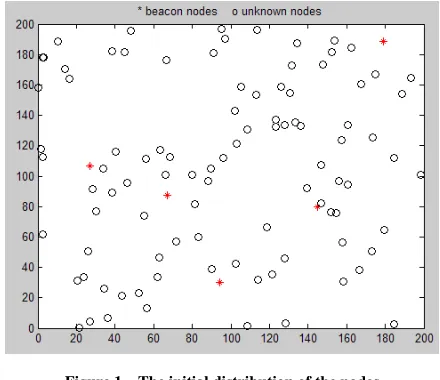
[image:4.595.195.415.541.731.2]The improved algorithm proposed in this paper is simulated by using MATLAB 7.0. Simulation environment set the sensor network located within 200 × 200 area, beacon nodes and unknown nodes are randomly distributed in the simulation area and the initial distribution is shown in Figure 1.
Figure 1 The initial distribution of the nodes
experimental results.
RESULTS AND DISCUSSION
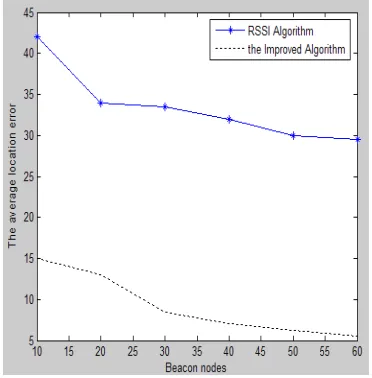
[image:5.595.213.399.188.377.2]To validate the algorithm whether eliminate the effects of path loss factor for positioning, system simulation simulates the two kinds of environment. In simulated environment 1, assuming path attenuation factor of the radio propagation model n = 2.2. In simulated environment 2, assuming path attenuation factor of the radio propagation model n = 4.8. Two kinds of the simulated environment in the above , the beacon nodes are taken sequentially as 10,20,30,40,50,60, the simulation results is illustrated in Figure 1, Figure 2.
Figure 2 The average location error comparison when n = 2.2
Figure 2 The average location error comparison when n = 4.8
As apparent from Figure 1 and Figure 2, the positioning accuracy of improved algorithm is significantly improved. When n = 2.2, the positioning accuracy of improved algorithm is average increase of 70%. When n=4.8, positioning error of RSSI algorithm significantly increased, while the improved algorithm by eliminating the path loss factor, the positioning error is basically the same as n = 2.2.
CONCLUSION
relative relationship of distance between the nodes can calculate the distance between nodes and eliminate the effect of path loss factors. In order to better adapt to the irregular nature of sensor networks, the improved algorithm only selects qualified anchor nodes to locate unknown nodes. The algorithm is less demanding on the hardware. Simulation results demonstrate that range accuracy has been greatly improved than ordinary RSSI ranging without increasing network traffic situation. It meets the localization ranging request of most wireless sensor network. Acknowledgements
This work was supported by Young Talents Fund Project in Anhui Province of China (No. 2012SQRL199ZD, No. 2013SQRL083ZD) and Open platform topics of Suzhou University of China (No. 2012YKF38, No.2011YKF10) and Natural Science Research Project in Anhui Province of China (No. KJ2012Z395).
REFERENCES
[1]Savarese C , Rabaey J M , Beutel J. Locationing in Distributed Ad-Hoc Wireless Sensor Network M Proc.of the 2001 IEEE Int.l Conf.on Acoustics, Speech,and Signal. Salt Lake:IEEE Signal Processing Society,2001,4:2037-2040 [2]He T , Huang C D , Blum B M , et al . Range-free localization schemes in large scale sensor networks M Proc.of the 9th Annual Int.l Conf.on Mobile Computing and Networking. San Die-go:ACM Press,2003:81-95.http://www.cs.virginia.edu/~th7c/paper/APIT_CS-2003-06.pdf
[3]Bahl P,Padmanabhan V N.RADAR:an in-build-ing RF-based user location and tracking system M Proc.of the
IEEE INFOCOM. TelAviv:IEEE Computer and Communications Societies,2000:775-784
[4]Meguerdichian S,Slijepcevic S,Karayan V,et al. Localized algorithms in wireless ad-hoc networks:Location
discovery and sensor exposure MProc.of the 2nd ACM Int.l Symp.on Mobile AdHoc Networking & Computing.
Long Beach:ACM
Press,2001.106-116.http://www.vs.inf.ethz.ch/edu/SS2005/DS/papers/sensornetze/meguerdichian01c.pdf [5]Li D,Wong K D,Hu Y H,et al. IEEE Signal Processing Mag, Mar.2002:17-29
[6]Niculescu D,Nath B.Ad Hoc Positioning System.(APS) [C]//IEEE GLOBECOM.2001:2926-2931 [7]Yang Ling,Shen Yunzhong,Lou Lizhi, Acta Geodaetica et Cartographica Sinica,2011: 28-32. [8]Liu Caiping,Mao Jianxu,Li Renfa,et al. Journal on Communications,2011: 157-164.
[9]T Rappaport1Wireless communications: Principles and practice1 Englewood Cliffs, New Jersey: Prentice-Hall, 2002