Journal of Chemical and Pharmaceutical Research, 2014, 6(7):535-542
Research Article
CODEN(USA) : JCPRC5
ISSN : 0975-7384
Effectiveness evaluation of electronic warfare command and control
system based on grey AHP method
QI Zong-feng
1and Wang Guo-sheng
2*1The State Key Laboratory of Complex Electromagnetic Environment Effects on Electronics and Information System
(CEMEE), Luoyang, China
2Department of Control Engineering, Academy of Armored Forces Engineering, Beijing, China
_____________________________________________________________________________________________
ABSTRACT
The grey AHP effectiveness evaluation problem of electronic warfare command and control system (EWCCS) under complex electromagnetic environment is investigated. First, the evaluation hierarchy structures of EWCCS under complex electromagnetic environment are put forward and can be classified into target hierarchy, rule hierarchy and scheme hierarchy. Then, the grey AHP Algorithm is given as a preliminary knowledge to evaluate the effectiveness evaluation of EWCCS under complex electromagnetic environment. Finally, an effectiveness evaluation example of three EWCC systems under complex electromagnetic environment is considered by using the grey analytic hierarchy process (AHP) Algorithm, and the grey comprehensive evaluations for the three EWCC systems under complex electromagnetic environment and their grades of the grey comprehensive evaluation are proposed.
Key words: Electronic warfare command and control system; complex electromagnetic environment; grey AHP; comprehensive effectiveness evaluation
_____________________________________________________________________________________________
INTRODUCTION
The electronic warfare equipments are more and more important in modern information battles. With the development of the new computer technology, the electronic warfare equipments become more and more complex, pregnable and damageable such that it is difficult to evaluate the performance and effectiveness of the electronic warfare equipments. Cai et al establish the anti-jamming efficiency evaluation model of the tactical communication net and evaluate the anti-jamming efficiency of the tactical communication net by GEM and GAHP in [1]. Cui et al determine the different grey fuzzy weights for different factors by using analytical hierarchy process, and construct grey fuzzy relation matrix by grey fuzzy weight, membership, point grey in [2]. In order to solve the disadvantages
for the efficiency evaluation of the underwater acoustic countermeasure,resulting from the underwater information fuzzy and data scarcity, Tang et al propose the gray analytic hierarchy evaluation method in [3]. Yin et al introduce a
new grey hierarchy evaluation method,used for evaluating of EW performance in multiple airborne platform system, establish the complete performance evaluation index system EW performance in multiple airborne platforms
system,and give the definition and calculation formula of each index in [4].
can reflect the airborne ECM system capacity generally and impersonally in [8].
As one of important electronic warfare equipments, an electronic warfare system under complex electromagnetic environment plays an important role in the modern information battle. Therefore, the effectiveness evaluation problem of electronic warfare command and control system (EWCCS) under complex electromagnetic environment has become a popular topic in the investigation of modern battle theory. Thus in this paper we will investigate the effectiveness evaluation of electronic warfare command and control system under complex electromagnetic environment by using the grey AHP method. First, the evaluation hierarchy structures of EWCCS under complex electromagnetic environment are proposed. Then, the detail grey AHP algorithm is put forward as preliminaries for the effectiveness evaluation of EWCCS under complex electromagnetic environment. And then, the effectiveness evaluation example of three EWCC systems under complex electromagnetic environment is designed by using AHP and the simulation result shows that the grey AHP method is effective and simple for effectiveness evaluation of EWCCS under complex electromagnetic environment.
EVALUATION HIERARCHY STRUCTURES OF EWCCS
According to the features of EWCCS under complex electromagnetic environment, many factors which are related with the performances of EWCCS under complex electromagnetic environment can be found out and can be classified into the target hierarchy, the rule hierarchy and the scheme hierarchy.
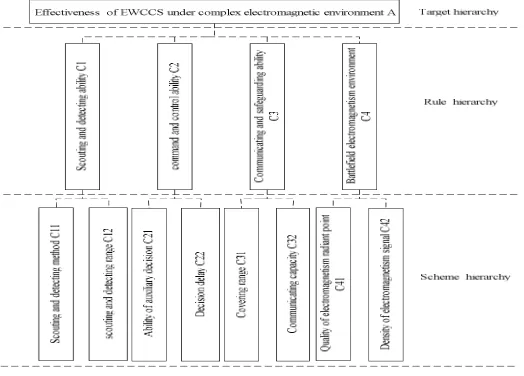
The target hierarchy or the first hierarchy for effectiveness evaluation of EWCCS under complex electromagnetic environment can be denoted by A. The rule hierarchy of EWCCS under complex electromagnetic environment includes scouting and detecting ability C1, command and control ability C2, communicating and safeguarding ability C3, and battlefield electromagnetism environment C4.
For simplicity, we only select two scheme specifications for every component in the rule hierarchy of EWCCS under complex electromagnetic environment. The scheme hierarchy of scouting and detecting ability C1 includes scouting and detecting method C11 and scouting and detecting range C12. The scheme hierarchy of command and control ability C2 include ability of auxiliary decision C21 and decision delay C22. The scheme hierarchy of communicating and safeguarding ability C3 include covering range C31 and communicating capacity C32. The scheme structure of battlefield electromagnetism environment C4 includes quality of electromagnetism radiant point C41 and density of electromagnetism signal C42.
[image:2.595.178.440.475.663.2]Based on the above analysis of EWCCS under complex electromagnetic environment, we can give the hierarchy structure with the target hierarchy, the rule hierarchy and the scheme hierarchy in Fig. 1.
Fig. 1 : The hierarchy structure of EWCCS under complex electromagnetic environment
GREY AHP METHOD
AHP method as follows:
Step 1. Establish the hierarchy structure of the effectiveness evaluation system. The effectiveness evaluation system is usually decomposed into different hierarchies, such as the goal or target hierarchy, the rule hierarchy and the scheme hierarchy, which are denoted by the ladder structure.
Step 2. Establish the pair-wise judgment matrix. Comparing the different factors in the same hierarchy with one of rules in the above hierarchy, we can obtain their important degrees and the corresponding judgment matrices. The values of the pair-wise comparisons in the AHP are determined according to the scale introduced by Saaty. According to this scale, the available values for the pair-wise comparisons are members of the set: {9, 8, 7, 6, 5, 4, 3, 2, 1, 1/2, 1/3, 1/4, 1/5, 1/6, 1/7, 1/8, 1/9}.
Step 3. Extract the relative importance implied by the previous pair wise comparisons. Calculate the corresponding maximum left eigenvector of the judgment matrix is approximated by using the geometric mean of each row and the numbers are normalized by dividing them with their sum.
Step 4. Test the consistency of the relative importance. In the AHP, the pair wise comparisons in a judgment matrix are considered to be adequately consistent if the corresponding consistency ratio (C.R.) is less than 10%.
The C. R. coefficient is calculated as follows:
1) The consistency index (C.I.) needs to be estimated. This is done by adding the columns in the judgment matrix and multiply the resulting vector by the vector of priorities (i.e., the approximated eigenvector) obtained earlier. This yields an approximation of the maximum eigenvalue, denoted by λmax.
[image:3.595.236.344.540.601.2]2) The C. I. value is calculated by using the formula: C.I. = (λmax-n)/(n-1). Next the consistency ratio CR is obtained by dividing the C. I. value by the Random Consistency index (R. I.) as given in Table 1.
Table 1: R.I. values for different values of n
n 1 2 3 4 5 6 7 8 9 10 11 12 13 14 15
R.I. 0 0 0.58 0.9 1.12 1.24 1.32 1.41 1.45 1.49 1.52 1.54 1.56 1.58 1.59
Step 5. Calculate the relative weight of the compared components to their hierarchy, and calculate the relative weight w of the components in the rule hierarchy and the relative weight w of the components in the scheme i hierarchy to the goal hierarchy.
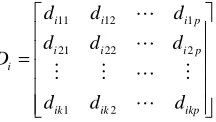
Step 6. Determine the evaluated swatch matrices for the specifications in the scheme hierarchy. Assume that the number of the evaluated systems is p and the number of the specifications under the rule hierarchy C is i k, thus the evaluated swatch matrix can be written by
11 12 1
21 22 2
1 2
i i i p
i i i p
i
ik ik ikp
d d d
d d d
D
d d d
=
L
L
M M L M
L
(1)
Step 7. Assume that there are four evaluated grey species, and their evaluated grades are “excellent, good, common and bad”, which are denoted by e=1, 2, 3, 4, respectively. According to the analysis of the evaluated system, the grey number ⊗i(i=1, 2,3, 4) and the whitenized weight function f xi( )⊗i(i=1, 2,3, 4) of the grey species as follows
[
]
[
]
[
]
[
]
1
1
0.7, 0.9, 1.0
0.7
, 0.7, 0.9 0.2
( ) 1 , 0.9, 1.0
0, 0.7, 1.0 x
x
f x x x
x ⊗ =
−
∈
= − ∈
∉
[
]
[
]
[
]
[
]
2 20.5, 0.7, 0.9
0.5
, 0.5, 0.7 0.2
0.9
( ) , 0.7, 0.9 0.2
0, 0.5, 0.9 x
x
x
f x x
x ⊗ = − ∈ − = ∈ ∉
, when e=2 (3)
[
]
[
]
[
]
[
]
3 30.3, 0.5, 0.7
0.3
, 0.3, 0.5 0.2
0.7
( ) , 0.5, 0.7 0.2
0, 0.3, 0.7 x
x
x
f x x
x ⊗ = − ∈ − = ∈ ∉
, when e=3 (4)
[
]
[
]
[
]
[
]
4 40, 0.3, 0.5
, 0, 0.3 0.3
0.5
( ) , 0.3, 0.5 0.2
0, 0, 0.5 x
x
x
f x x
x ⊗ = ∈ − = ∈ ∉
, when e=4 (5)
where the grey number stands for the grade associated with the specification x, the value of the grey number stands for the interval of the score, the middle value stands for the best scoring value.
Step 8. Determine the evaluated weight matrices. Denote the grey evaluated weight associated with the e-th grey
specie byrije, which can be obtain by ije ije
ij
c
r = c , where
1 ( )
p ije e ijt
t
c f d
=
=
∑
is the grey evaluated coefficient of thesystem specificationCij, and 4 1 ij ije e c c =
=
∑
is the total grey evaluated coefficient. Thus the grey evaluated weightvector which is composed of every grey evaluated weight rije for Cij can be written by
1, 2, 3, 4
ij ij ij ij ij
r =r r r r (6)
Therefore, the grey evaluated matrix R can be obtained from the grey evaluated weight vector i rij for the specification Cij which belongs to C as follows i
1 2 i i i ik r r R r = M (7)
Based on the weight vector w of the specification i Cij which belongs to C , the comprehensive evaluation for i the specification Cij which belongs to C can be given by i
i i i
B =w R (8)
1
2
k
B
B B
B
=
M (9)
Step 9. Determine the grey comprehensive evaluation. The value for the grey comprehensive evaluation is
E=wBC (10)
where C=[90 70 50 30]Tstands for the vector that consists of the score value corresponding to the grey evaluated species.
A NUMERICAL EXAMPLE
Based on the Evaluation hierarchy structure of EWCCS under complex electromagnetic environment in Fig. 1, the AHP algorithm and the grey algorithm, we will calculate the effectiveness evaluation of EWCCS under complex electromagnetic environment.
Assume that the experts give the relative importance of the criteria in the pair-wise judgment matrices of the EWS under complex electromagnetic environment. The corresponding pair-wise judgment matrix among complex electromagnetic environment include scouting and detecting ability C1, command and control ability C2, communicating and safeguarding ability C3, and battlefield electromagnetism environment C4 can be given by the
following table 2. And the weight vector of C1, C2, C3 and C4 is
[
0.553 0.1313 0.2704 0.0454]
T , . . 0.0883 0.1 [image:5.595.192.421.389.458.2]C R = < shows that the relative importance of the pair-wise judgment matrix is consistent.
Table 2: The pair-wise judgment matrix among C1, C2, C3 and C4
A C1 C2 C3 C4 w
C1 1 5 3 7 0.553
C2 0.2 1 0.3333 5 0.1313
C3 0.3333 3 1 6 0.2704
C4 0.1429 0.2 0.1667 1 0.0454
max 4.2359
λ = C I. .=0.0786 C R. .=0.0883<0.1
The corresponding pair-wise judgment matrix between scouting and detecting method C11, and scouting and detecting range C12 in scouting and detecting ability C1 can be given by Table 3. And the weight vector of C11 and
C12 is
[
0.3333 0.6667]
T, C R. .= <0 0.1 shows that the relative importance of the pair-wise judgment matrix is consistent.Table 3: The pair-wise judgment matrix among C11 and C12
C1 C11 C12 w1 C11 1 0.5 0.3333
C12 2 1 0.6667
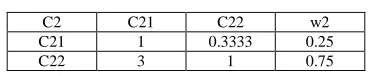
The corresponding pair-wise judgment matrix between ability of auxiliary decision C21, and decision delay C22 in command and control ability C2 can be given by can be given by Table 4. And the weight vector of C21 and C22
[image:5.595.213.403.652.690.2]is
[
0.25 0.75]
T, C R. .= <0 0.1 shows that the relative importance of the pair-wise judgment matrix is consistent.Table 4: The pair-wise judgment matrix among C21 and C22
C2 C21 C22 w2
C21 1 0.3333 0.25
C22 3 1 0.75
The corresponding pair-wise judgment matrix between covering range C31 and communicating capacity C32 in communicating and safeguarding ability C3 can be given by Table 5. And the weight vector of C31 and C32
Table 5: The pair-wise judgment matrix among C31 and C32
C3 C31 C32 w3
C31 1 2 0.6667
C32 0.5 1 0.3333
The corresponding pair-wise judgment matrix between quality of electromagnetism radiant point C41 and density of electromagnetism signal C42 in battlefield electromagnetism environment C4 can be given by Table 6. And the
[image:6.595.253.359.89.122.2]weight vector of C41 and C42 is
[
0.8333 0.1667]
T, C R. .= <0 0.1 shows that the relative importance of the pair-wise judgment matrix is consistent.Table 6: The pair-wise judgment matrix among C41 and C42
C4 C41 C42 w4
C41 1 5 0.8333
C42 0.2 1 0.1667
From Table 3, we can know that the weight vector of C1, C2, C3 and C4
[
0.553 0.1313 0.2704 0.0454]
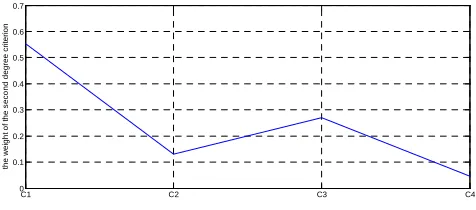
Tw= can be shown by Fig. 2. From Fig. 2, we can directly find that the sort order
of the relative importance among C1, C2, C3 and C4 is “C1»C3»C2»C4”, where “»” implies that the former is more important than the later.
C1 C2 C3 C4
0 0.1 0.2 0.3 0.4 0.5 0.6 0.7
th
e
we
ig
h
t
o
f
th
e
s
e
c
o
n
d
d
e
g
re
e
c
ri
te
ri
o
[image:6.595.195.433.323.428.2]n
Fig. 2: The relative importance among C1, C2, C3 and C4
From the result for the relative importance among C1, C2, C3 and C4, we can know that the importance of scouting and detecting ability C1 is 0.553. Thus we can know that in order to improve the effectiveness of EWCC systems under complex electromagnetic environment, the scouting and detecting ability C1 is first considered, and the other performances are simultaneously considered. In the scouting and detecting ability C1, the relative importance of scouting and detecting range C12 is 0.6667.
Based on the above results of AHP algorithm, we continue to consider the effectiveness evaluation of three EWCC systems under complex electromagnetic environment by using the grey algorithm.
Assume that the scores of the above specifications for three EWCC systems under complex electromagnetic environment S1, S2, and S3, are given in Table 7 and the scores after undimensionalized by the maximum value are given in Table 8.
Table 7: The scores of specifications in the scheme herichacy
C1 C2 C3 C4
C11 C12 C21 C22 C31 C32 C41 C42
S1 70 65 80 75 89 92 65 74
S2 83 74 60 87 78 90 68 58
[image:6.595.164.449.692.746.2]S3 90 87 95 69 85 76 87 60
Table 8: The scores after undimensionalized by the maximum value
C1 C2 C3 C4
C11 C12 C21 C22 C31 C32 C41 C42
S1 0.7778 0.7471 0.8421 0.8621 1 1 0.7471 1 S2 0.9222 0.8506 0.6316 1 0.8764 0.9783 0.7816 0.7838
1
0.7778 0.9222 1 0.7471 0.8506 1
D =
, 2
0.8421 0.6316 1 0.8621 1 0.7931
D =
3
1 0.8764 0.9551 1 0.9783 0.8261
D =
, 4
0.7471 0.7816 1 1 0.7838 0.8108
D =
For C11 of S1, from (2)-(5) we can obtain the whitenized weight value of the grey species as
1
e= , c111= f1(0.778)=0.39,e=2, c112 = f2(0.778)=0.61 3
e= , c113 = f3(0.778)=0,e=4, c114= f4(0.778)=0
Thus the total grey evaluating weight vector for C11 is r11=
[
0.39 0.61 0 0]
.For C12 of S1, from (2)-(5) we can obtain the whitenized weight value of the grey species as1
e= , c121= f1(0.7471)=0.2355,e=2, c122= f2(0.7471)=0.7645, 3
e= , c123= f3(0.7471)=0,e=4, c124= f4(0.7471)=0
Thus from (6) we can obtain the total grey evaluating weight vector for C12 of S1 as
[
]
12 0.2355 0.7645 0 0 r =
Thus from (7) we can obtain the grey evaluating matrix for C1 of S1 as
1
0.39 0.61 0 0
0.2355 0.7645 0 0
R =
Similarly, we can obtain the grey evaluating matrices R , 2 R and 3 R for C2, C3, and C4 of S1, respectively, as 4 follows
2
0.7105 0.2895 0 0
0.8105 0.1895 0 0
R =
, 3
0 0 0 0
0 0 0 0
R =
, 4
0.2355 0.7645 0 0
0 0 0 0
R =
From (8), we can obtain the comprehensive evaluation for the specification C1, C2, C3 and C4 of S1, respectively, as
[
]
1 0.287 0.713 0 0
B = , B2 =
[
0.7855 0.2145 0 0]
,B3 =[
0 0 0 0]
,B4 =[
0.1962 0.6371 0 0]
From (9), we can obtian the grey evaluated matrix for the total specification A of S1 as 0.287 0.713 0 0
0.7855 0.2145 0 0
0 0 0 0
0.1962 0.6371 0 0 B
=
Finally, from (10) we can obtain the value for the grey comprehensive evaluation of S1 as E1=55.9643.Similarly,
we can obtain the values for the grey comprehensive evaluation of S2 and S3, respectively, asE2 =77.4825,
3 32.0936
Table 9: The comprehensive evaluation results by the grey AHP method
Parameters Three EWCC systems
S1 S2 S3
Value for the grey comprehensive evaluation 55.9643 77.4825 32.0936 Grade for the grey comprehensive evaluation common good bad
CONCLUSION
In this paper we consider the grey AHP effectiveness evaluation problem of EWCCS under complex electromagnetic environment is investigated. By using the grey AHP method, an effectiveness evaluation example of three EWCC systems under complex electromagnetic environment is considered, and the grey comprehensive evaluations and their grades of the grey comprehensive evaluation are proposed. In the next research, we will investigate grey synthetically associated analysis method to evaluate the effectiveness evaluation problem of EWCCS with insufficient information.
Acknowledgments
This work was financially supported by the Open Project Foundation of the State Key Laboratory of CEMEE (CEMEE2014K0305B).
REFERENCES
[1]Cai Y. J., Fire Control & Command Control, vol. 37, pp. 106-108, 2012.
[2]Cui J. G., Fu K. Y., Chen X. C., QI Y. W., Jiang L. Y., Acta Aeronautica et Astronautica Sinica, vol. 34, pp. 1-9, 2013.
[3]Tang Z.,Sun C.,Liu Z. W., Meng D., Acta Armamentarii, vol. 33, pp. 432-436, 2012.
[4]Yin H. T.,Wang X. Y.,Gu X. J.,Wu J. B., Journal of Northwestern Polytechnical University, vol. 30, pp. 350-355, 2012.
[5]Shi R., Han C. J.,Huang J., Command Control & Simulation, vol. 28, pp. 59-64, 2006. [6]Yu H., Lu G. X., Chen Y., Zhou L., Radio Engineering, vol. 39, pp. 61-64, 2009. [7]Chen G. Z., Xue Y. F., Electronic Warfare, vol. 106, pp. 26-34, 2006.
[8]Liu Z. Y., Ping D. F., Wang L., Ship Electronic Engineering, vol. 32, pp. 68-71, 2012.
[9]Evangelos T., Stuart H. M., International Journal of Industrial Engineering, Applications and Practice, vol. 2, pp. 35-44, 1995.