The Development of control system via Brain Computer
Interface (BCI) - Functional Electrical Stimulation (FES) for
paraplegic subject
K. A. A. Rahman
1, 3, B. S. K. K. Ibrahim
1, 3, M. M.A. Jamil
2, 3, A.M. Leman
41 Department of Mechatronic and Robotic Engineering, 2Department of Electronic Engineering, 3Modeling and Simulation Research Laboratory, Faculty of Electrical and Electronic Engineering, 4Department of Plan and
Automotive, Faculty of Mechanical and Manufacturing Engineering, Universiti Tun Hussein Onn Malaysia, Parit Raja, Batu Pahat, 86400 Johor, Malaysia.
Received 1 October 2012; accepted 1 December 2012, available online 20 December 2012
1.
Introduction
In human body, brain is the most vital organ and the most valuable asset due to its functioning and its relationship to the whole body. It gives rise to human perception and memory and also it shape human speech, skill, thought and feeling. However, in order to archive great outcomes or results from the nature, human need to keep and teach the brain with knowledge, experiences and any information that suitable for human being. However, when one individual has spinal cord injury means he cannot restore normal motor behavior. Many neurological conditions, such as stroke, spinal cord injury (SCI), and traumatic brain injury (TBI), can leave the affected individual with severe or complete paralysis [1]. But to improve or restore of lost-sensory motor functionalities is one of the major issues in the rehabilitation of subjects with neurological disorders. Brain-computer interface (BCI) has been proved to be a potential method to link the brain and the outward environment directly [2, 6]. It showed the great perspective to help especially the “lock-in” people to regain or recover their ability to communicate and control [3, 6]. Brain signal will be recorded by using electroencephalography (EEG) system. Many researches use EEG as a probable signal source because of the
noninvasiveness and simplicity. EEG features are classified into 2 classes. One is exogenous EEG like Visual Evoked Potential (VEP) and P300 which need external trigger signal. Another is endogenous EEG like Event Related Desynchronization (ERD) and Bereitschaftspotential (BP) [4]. ERD is used as a control signal which can be extracted before and during motor imagery/execution around motor area [7, 8]. It is because ERD has a voluntary aspect which can reflect subject’s intention, therefore, require typically a period of training before they can be used reliably [5].
Functional electrical stimulation (FES) controller is a device that has solves problems of sensorimotor coordination similar to those normally handled by the brain and spinal cord. In the past, most of the practical FES controllers have been designed by trial and error in the patient [20]. FES impresses electrical pulses to muscles, then contract muscle fibers [4]. The FES frequency of stimulation of peripheral nerves was determined by fusion of muscle twitches to the steady and strong movement [11]. Therefore, FES can assist the individual with stroke to produce, practice, and teach a movement that is more normally coordinated.
Using one’s brain signal in a BCI requires intense concentration on the brain signal control task, satisfying a
Abstract: Brain is known to be one of the powerful systems in human body because of its ability to give command and communicate throughout the body. The spinal cord is the pathway for impulses from the brain to the body as well as from the body to the brain. However, the bounty of this pathway could be lost due to spinal cord injury (SCI) and that results in a loss of function especially mobility. A combination of Brain Computer Interface (BCI) and Functional Electrical Stimulation (FES) is among one of the technique to regain the mobility function of human body which will be the focused area of this research. In this study, Electroencephalography (EEG) system will be used to capture the brain signal which will then drive the FES. A paraplegic subject will be involved in this study. The subject will be required to move the knee joint with involvement few muscle contraction. Overall, in this paper the combination of BCI-FES methods for development of rehabilitation system will be proposed. From this preliminary study, it can be summarized that the combination between BCI and FES potentially would provide a better rehabilitation system for SCI patient in comparison to the conventional FES system.
second critical motor learning principle, focused attention. In combination of BCI and FES system, the brain signal activates the FES movement-assist device during practice of the coordinated movement [12]. Therefore, in this paper will be discussed about the combination between BCI system and FES for paraplegic subject in their rehabilitation method.
2. BCI-FES System
FES and motor imagery have been extensively applied in the rehabilitation training of stroke patients [6-10]. However, the passive FES is lacking of the patients’ intention to recover which has been thought to be the important factor of motor relearning theory [13]. The pure motion imagery always has problem about performance variability due to the absence of feedback indication. BCI has been proved to be a potential method to link the brain and the outward environment directly [14]. In spite of encouraging results achieved with previous BCI and FES systems, the integration of these two systems hopefully will give good feedback to the rehabilitation engineering [1].
Recently, BCI-FES systems are increasingly being explored as potential neuro-rehabilitation tools for improving partially impaired upper extremity function in individuals with stroke [15], thereby vastly broadening the potential target population. Given that an estimated 36% of stroke patients [16], 68% of SCI patients [17, 18], and 61% of TBI patients [19] are affected by significant chronic gait impairment, there is a compelling need for the development of BCI-FES system for the lower extremities. Therefore the integration of a noninvasive EEG-based BCI system with a noninvasive FES system for the lower extremities will more feasible.
[image:2.595.305.534.240.609.2]3. Methodology
Figure 1a: Illustration for BCI-FES system
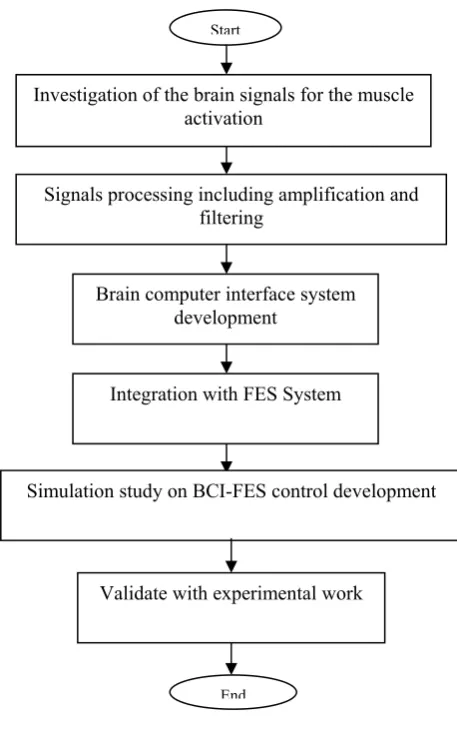
Based on the Figure 1a and the flowchart of Figure 1b, the development of this research starting with investigating of the brain signals and notice which signal that use for the knee joint movement. Brain signal
[image:2.595.62.295.495.665.2]neuroelectrical signals type captured by EEG normally in theta, gamma and alpha neuro-cellular wave which is need to process by the system principle. Band pass filter will be used to separate this raw data signal and just take the needed signal like the alpha and beta signal. Commonly, brain neuroelectrical signal based on its characteristic is really low amplitude gain with non-stable output and in order to gain better output with high amplitude gain response, the data or signal need to amplify and diagnose by developer system with standard quality. Referred to SCI problem, pulse signals from brain cannot go through the human body system because of the signal from brain to muscle has blocked and human’s intention can’t be translated.
Figure 1b: Proposed Flowchart of the system
In order to translate the human’s intention to other devices, BCI system development is needed which is a kind of communication tool that communicate between human and devices. The entire signals that produced by brain will be recorded and filtered by using this BCI system. Therefore, in this stage to make the brain signal can arrive to the muscle, integration BCI system with the FES is needed so in these research, the Hasomed FES will be used. The limitation of this research only on lower
Start
Investigation of the brain signals for the muscle activation
Simulation study on BCI-FES control development Integration with FES System
Brain computer interface system development
Signals processing including amplification and filtering
End
BCI and FES is one of the requirements to make sure this combination will give the effective way in SCI rehabilitation. Finally the BCI-FES control system will be verified in the experimental work in order to achieve the aim of this research work.
Figure 2: Effects of SCI
Referred to SCI problem that illustrated in Fig 2, shows the difference between normal person who has normal spinal cord and a person who has SCI problem. As mention before when person has SCI problem, the information or signal from brain cannot been sent to human muscle due to the breakdown of the pathway. In this condition, known that the brain and muscle still function so what is needed here is the alternative pathway or a bridge which can connect between brain and human muscle. That why hybrid BCI - FES system is suitable to use in this research.
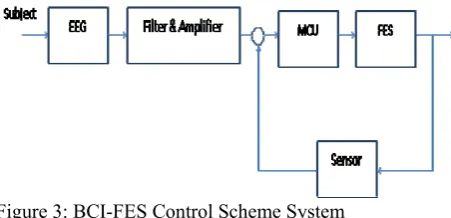
Figure 3: BCI-FES Control Scheme System
Therefore, in order to develop control strategy of BCI-FES system in this study, the architecture of the system in Figure 3 were reviewed. According to this architecture, the SCI patient (paraplegic) will be a subject to this research. EEG method for BCI technique will be used because this research focuses to capture and record the brain signal. Signal from subject will be record by using EEG cap. This EEG cap recordings of neuronal activity in the brain, identified as the EEG, allow measurement of potential changes over time in basic electric circuit conducting between signal (active) electrode and reference electrode. The raw signal from
EEG will be filtered by low band pass filter due to the signal needed are alpha (α) and low-beta (β) signal about 8Hzz to 30Hz. Amplifiers the filtered signal and then bring the microvolt signals into the range where they can be digitalized accurately, converter changes signals from analog to digital form in MCU, and personal computer (or other relevant device) stores then trigger the FES to generate the electric pulse to make the knee joint move, the goniometer sensor will give the feedback to the MCU to compare either what the input(patient thinking) is match with the output (knee joint movement) and will make the correction.
Due to the large of the equation of brains signal and FES equation, the hybrid fuzzy controller will be used. There are also needs another supporting equipments during this study which is to achieve the goal in this project. Some kind of measuring meter such as Digital Multimeter and oscilloscope will be used with signal generator to generate pulse in order to compare pulses with FES (Hasomed GmbH).
4. Preliminary Result
There are some preliminary experiment must done for the beginning. All the experiments have their own propose. The propose of these preliminary experiment is to identify the basic element in this research. so there have two preliminary experiment have been done:
i. Brain wave experiment ii. FES experiment
4.1 Brain wave experiment
The purpose of this simple experiment is to investigate how the human brain signal reflects to the human activities and thinking. This is important to support the fundamental concept of the research that will be carried out in new future.
[image:3.595.60.286.480.589.2](a)
[image:4.595.51.559.56.485.2](b)
(c)
(d)
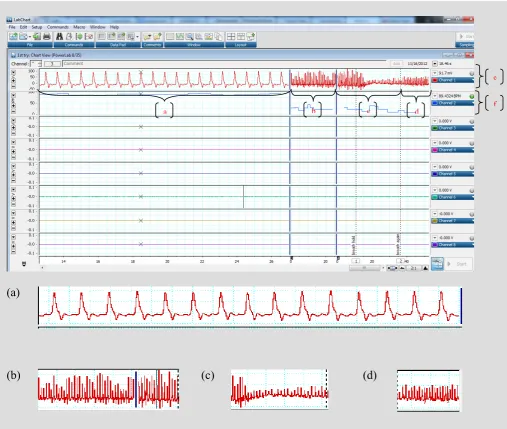
Figure 4 is about the brain signal recorded by Power Lab device according to the activity done by the subject: a) signal in zoom in mode b) signal for normal breathing c) signal when holding breath d) signal when breathing again e) raw data rate f) calculation data rate
Figure 4 above is about the brain signal experiment. Subject has done the experiment in three condition; normal breathing, holding breath and breathing again. The recorded data is in two types, first type is raw data rate and second type is in calculation data rate. In the three condition of experiment, there has some changes on the signal due to the activities done by subject. So can be considered that brain will give the different signal according to the type of activities that done by human.
4.2 FES experiment
This FES simple experiment has uses normal person as the subject and the FES Hasomade as the main device.
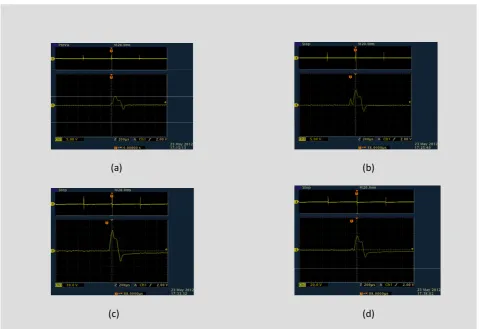
The purpose of this experiment is to investigate the signal change due to the changes of current supply to the electrode which is paste on the subject skin. The experiment has done in four different current input; 10mA, 30mA, 60mA and 90 mA. The main devices are used in this experiment as shown below:
(a) Hasomade FES device (b) Oscilloscope
(c) Surface electrode
a b c d f
Figure 5 above is shown the output waveform from the surface electrode which is pasted on subject muscle. For this experiment two surface electrode were used and have been pasted on subjects thighs muscle. From the output, noticed that the more input current supplied to the electrode so the more changes on the output waveform. So from this can be conclude that if want the paralyze patient move their knee join or some muscle, a lot and variety of input current are needed.
[image:5.595.349.534.77.394.2]Based on the data collected from this two simple experiment, it proves that all of the action will give impact to the brain signal. Also from the second experiment it also prove that the current given to the muscle can produce the muscle contractions. So from here known that human muscle will has contractions by supplied some amount of current and also known that human brain can produce brain signal according to the brain activity either by doing some action or by thinking something. Therefore can be conclude that there have some relation between brain signal and muscle contraction. Figure 6 is the illustration for the combination of BCI and FES.
Figure 6: Illustration of combination BCI and FES system So this fundamental study will be applied in the BCI and FES system development that enables the direct brain control of knee joint movement for SCI patient.
5. Summary
SCI or stroke is the main cause of disability of human. The SCI has created function deficits in motor control that will disturb the people daily activities. Many researchers have proved that motor recovery in the acute stages can reduce the effect of SCI. Therefore most SCI survivors need training and exercise to improve their recovery and reduce the spinal cord disability.
(a) (b)
(c) (d)
[image:5.595.306.533.466.565.2]Regarding the SCI or paralyze patients, it appear that paralyze patient cannot do nothing and need to do the simple activity or exercise to avoid serious health problem due to passive activities Therefore, from the study, BCI-FES control system by using EEG signals to control the knee movement as the rehabilitation method is expected to help the paraplegic to have a better life style.
References
1] An H Do, Po T Wang, Christine E King, Ahmad Abiri and Zoran Nenadic: Brain-Computer Interface Controlled Functional Electrical Stimulation System for Ankle Movement, Journal of NeuroEngineering and Rehabilitation 2011, 8:49.
[2] J. R. Wolpaw, N. Birbaumer, W. J. Heetderks, D. J. McFarland, P. H. Peckham, G. Schalk, E. Donchin, L.
A. Quatrano, C. J. Robinson and T. M. Vaughan, “Brain-computer interface technology: A review of the first international meeting”, IEEE Trans. Rehabil. Eng., vol. 8, pp.164-173, 2000.
[3] N. Birbaumer and L. G. Cohen, “Brain-computer interfaces: communication and restoration of
movement in paralysis”, J. Physiol.,vol. 579, pp. 621-636, 2007.
[4] Mitsuru Takahashi, Manabu Gouko, Koji Ito:
Fundamental Research about Electroencephalogram (EEG) – Functional Electrical Stimulation (FES) Rehabilitation System: IEEE 11th International Conference on Rehabilitation Robotics, Japan, 9781-4244-3789-4/09, 2009.
[5] Henrik Gollee, Member, IEEE, Ivan Volosyak, Member, IEEE, Angus J. McLachlan, Kenneth J.
Hunt, and Axel Gr¨aser: An SSVEP-Based Brain– Computer Interface for the Control of Functional Electrical Stimulation: IEEE Transactions On Biomedical Engineering, Vol. 57, No. 8, 2010
[6] Fei Meng, Kai-yu Tong, Member, IEEE, Suk-tak Chan, Wan-wa Wong, Ka-him Lui, Kwok-wing Tang
Xiaorong Gao, Member, IEEE and Shangkai Gao, Fellow, IEEE: BCI-FES training system design and implementation for rehabilitation of stroke patients: IJCNN, 978-1-4244-1821-3/08 2008
[7] G.Pfurtscheller, F.H.Lopes da Silva: Event-related Desynchronization and related oscillatory phenomena
of the brain, Handbook of electroencephalography and clinical neurophysiology, vol. 6, revised edition. Amsterdam, Elsevier, 1999.
[8] G.Pfurtscheller, F.H.Lopes da Silva: Event-related EEG/MEG synchronization and desynchronization:
basic principles, Clinical Neurophysiology, 110, 1842-1857, 1999.
[9] J. Powell, A. D. Pandyan, M. Granat, M. Cameron
and D. J. Stott, “Electrical stimulation of wrist extensors in poststroke hemiplegia”, Stroke, vol. 30, pp. 1384-1389, 1999.
[10] K. P. Liu, C. C. Chan, T. M. Lee, C. W. Hui-Chan, “Mental imagery for promoting relearning for people
after stroke: A randomized controlled trial”, Arch. Phys. Med. Rehabil., vol. 85, 1403-1408, 2004. [11] Winfried Mayr, Christian Hofer, Karen Minassian, Ursula Hofstötter, Helmut Kern, Manfred Bijak,
Ewald Unger, Frank Rattay and Milan Dimitrijevic: Modulation of stimulation frequency of spinal cord afferents with unchanged intensity and electrode site can induce a variety of movements: IFMBE Proceedings, Volume 25/9, 543-545, 2009.
[12] Daly, Janis J. MSPT, Cheng, Roger, Rogers, Jean PT; Litinas, Krisanne MS, Hrovat, Kenneth MS,
Dohring: Feasibility of a New Application of Noninvasive Brain Computer Interface (BCI): A Case Study of Training for Recovery of Volitional Motor Control After Stroke: Journal of Neurologic Physical Therapy:Volume 33 - Issue 4 - pp 203-211, 2009.
[13] J. H. Carr and R. B. Shepherd, A motor relearning programme. London: William Heinemann, 1987. [14] J. R. Wolpaw, N. Birbaumer, W. J. Heetderks, D. J. McFarland, P. H. Peckham, G. Schalk, E. Donchin,
L. A. Quatrano, C. J. Robinson and T. M. Vaughan, “Brain-computer interface technology: A review of the first international meeting”, IEEE Trans. Rehabil. Eng., vol. 8, pp.164-173, 2000.
[15] Daly JJ, Cheng R, Rogers J, Litinas K, Hrovat K, Dohring M: Feasibility of a new application of
noninvasive Brain Computer Interface (BCI): a case study of training for recovery of volitional motor control after stroke. J Neurol Phys Ther 2009, 33(4):203-211.
[16] Jorgensen HS, Nakayama H, Raaschou HO, Olsen TS: Recovery of walking function in stroke patients:
the Copenhagen Stroke Study. Arch Phys Med Rehabil 1995, 76:27-32.
[17] Waters RL, Adkins RH, Yakura JS, Sie I: Motor and sensory recovery following incomplete tetraplegia.
Arch Phys Med Rehabil 1994, 75(3):306-311. [18] Krawetz P, Nance P: Gait analysis of spinal cord injured subjects: effects of injury level and
spasticity. Arch Phys Med Rehabil 1996, 77(7):635-638.
[19] Williams G, Morris ME, Schache A, McCrory PR: Incidence of gait abnormalities after traumatic brain injury. Arch Phys Med Rehabil 2009, 90(4):587-593. [20] R. Davoodi , I.E. Brown, G.E. Loeb, “Advanced modeling environment for developing and testing
FES control systems” , 2002 IPEM. Published by
Elsevier Science Ltd,