Copyright © 2018 (Deborah Lupton, Sarah Pink, and Christine Heyes LaBond). Licensed under the Creative Commons Attribution Non-commercial No Derivatives (by-nc-nd). Available at http://ijoc.org.
Personal Data Contexts, Data Sense,
and Self-Tracking Cycling
DEBORAH LUPTON
1University of Canberra, Australia
SARAH PINK
RMIT University, Australia
CHRISTINE HEYES LABOND
University of Canberra, Australia
SHANTI SUMARTOJO
RMIT University, Australia
Few studies thus far have focused on how the sensory and embodied aspects of digitized self-tracking are entangled with its technological and spatial dimensions. To address these issues, we draw on the findings of a project that involved the use of digital sensory ethnography to identify the data practices of commuting cyclists in two Australian cities who monitor their rides using digital self-tracking devices. We focus on four key contexts in which our participants collected and interpreted their personal data: (1) affordances (the capacities of the technologies they used and the data thus generated), (2) spaces (the physical environments in which the participants prepared for, undertook, and completed their cycle trips), (3) senses (the embodied sensations involved in cycling, self-tracking, and responses to digital data), and (4) affects (the participants’ emotional responses to and about self-tracking and personal data). As we show, these contexts are intertwined, working together to contribute to people’s personal data collection practices and how they engage in data sense making.
Keywords: self-tracking, senses, embodiment, affects, digital data, cycling
Deborah Lupton: [email protected] Sarah Pink: [email protected]
Christine Heyes LaBond: [email protected] Date submitted: 2016–06–05
Lively Data, Data Sense, and Data Contexts
In many contexts these days, humans are configured as data subjects. Via their encounters and interactions with digital technologies, people constantly generate digital data about their habits, preferences, activities, and bodies. These details constitute one element of the multitude of digital traces that record people’s interactions with digital media and devices. They can be aggregated, sometimes with other digital traces from other activities, to configure digital data assemblages that can often provide fine-grained insights into people’s habits, preferences, body functions, and social encounters. There are now numerous dimensions of everyday life in which people decide to generate data about themselves using digital devices and to use these data for their own purposes. Self-tracking involves creating and then disciplining, managing, and interpreting such information about the self and the body. In some situations people may be encouraged or even coerced into self-tracking (Lupton, 2016c), but in many instances they do so voluntarily. People who engage in this kind of self-tracking do so for many different reasons, but it is often taken up as an ethical practice of the self in attempts to optimize the tracker’s life in various ways: improving health, sleep, and fitness; understanding moods; managing time better; becoming more productive; and so on (Fotopoulou & O’Riordan, 2017; Lupton, 2016c; Nafus & Sherman, 2014; Smith & Vonthethoff, 2017).
We know little about what people actually do with the data they generate from their self-tracking practices: how they interpret these data and incorporate them into their mundane routines and concepts of selfhood and embodiment. Few studies thus far have focused on how the sensory and embodied aspects of self-tracking are entangled with its technological and spatial dimensions. To address these issues, we draw on the findings of a project that involved the use of digital sensory ethnography to identify the data practices of commuting cyclists in two Australian cities who monitor their rides using self-tracking devices.
The experience of cycling has attracted the recent interest of scholars, working principally within mobility studies and cultural geography (Larsen, 2016; Lee, 2015; Lloyd, 2015; McIlvenny, 2015). They have drawn attention to the importance of physical space, embodied-technological assemblages of movement, and the affective and sensory dimensions and strategies integral to propelling a bicycle through physical spaces. This work has demonstrated the heightened body awareness that cyclists experience during their rides compared with other forms of commuting or travelling that involve less direct interaction with the physical environment. Little such research has focused specifically on the intersections between self-tracking, the use of digital devices, and cycling. Yet, when cyclists are using digital devices for self-tracking, they become datafied assemblages that are moving through space. Bodies, space, and place are simultaneously digital-material.
data, and physical spaces (Sumartojo, Pink, Lupton, & LaBond, 2016). These perspectives highlight the embodied experiences, emotions, and sensations generated via these entanglements (Fors, Bäckström, & Pink, 2013; Lupton, 2016b; Pink, 2015a).
The idea of lively data also underpins our research. There are four main elements to the concept of lively data (Lupton, 2016b, 2016c). First, personal digital data are lively because they are about (human) life itself. Second, they are lively because they are constantly emergent and contingent, entering into a digital data economy in which they are repurposed by potentially many different actors. As such, personal data possess their own social lives, taking on new meanings and uses as they are combined and recombined with other data sets. Compared with former types of data, the affordances of cloud computing and the expansion of the digital data economy mean that personal digital data can be circulated and used in an unending proliferation of ways, well beyond the intentions of the original generators of these data. Third, these data are associated with livelihoods, contributing to many forms of employment and profit making, including the new industries of data harvesting and profiling as well as for the Internet empires of Facebook, Google, Amazon, and lesser companies. Finally, personal data influence people’s lives, shaping everyday practices and contributing to digital profiles constructed on people that may influence their access to opportunities such as employment, travel, or credit, and even their choice of dating partners. This again is an unprecedented means of configuring detailed information about people. These are novel forms and uses of personal data that potentially have implications for people’s lives in ways about which they are still learning.
In response to the proliferation of digital data traces and the big data phenomenon, there is a growing emphasis on data literacy, in which it is contended that the public’s understandings and use of digital data need to be enhanced (Frank, Walker, Attard, & Tygel, 2016; Pybus, Coté, & Blanke, 2015). Most of this research, drawing on educational concepts of literacy and on the field of information literacy as well, uses terms such as skills, competencies, and problem solving in discussing how people come to terms with digital data (Wolff, Gooch, Montaner, Rashid, & Kortuem, 2016). This literature often tends to represent humans as disembodied, disaffective actors, using their cognitive processes to engage with information exclusive of their senses and feelings. It reflects a tradition in Western belief systems about the generation and use of knowledge to progressively ignore or discount its sensory dimensions (Classen, 1999; Howes, 2015; Howes & Classen, 2013).
when people are tracking aspects of their bodies using digital technologies, using these details to inform them about their bodies’ functions, feelings, moods, and health, well-being, or fitness levels. Data sense is future-oriented as well as involving reflection on past activities and functions. Self-trackers make decisions about how best to use this information to bestow self-knowledge and potentially change aspects of their routine activities in response.
Part of the embodied and sensory nature of self-tracking are its emotional dimensions. The decision to take up self-tracking can be an affective response, as can engagements with the data that are generated. Previous research has identified the affective intensities of tracking. In their study of self-trackers, Lomborg and Frandsen (2016) noted the playful, pleasurable, and communicative dimensions of self-tracking. Ruckenstein’s (2014) research with people monitoring their heart rates and physical activity levels highlighted the emotional dimensions of this practice. Her participants reported feeling reassured and motivated by collecting and reviewing their biometrics, particularly those who were already predisposed to self-tracking or regular exercise.
However, some people who use self-tracking apps also resent or find irritating their nagging tendencies when providing reminders or notifications. They may be reluctant to let others know about their self-tracking app use, for fear that they may be considered weak or vulnerable in requiring a digital device to discipline their bodies (Dennison, Morrison, Conway, & Yardley, 2013). People can find the technical deficiencies of the devices and software they use to be frustrating and annoying. They may become overwhelmed when faced with dealing with the amount of data they have produced about themselves (Choe, Lee, Lee, Pratt, & Kientz, 2014; Li, Dey, & Forlizzi, 2011; Oh & Lee, 2015). Others can feel disappointed when their data fail to meet their expectations (Fotopoulou & O’Riordan, 2017) or appear to have no value because they are confusing or mysterious (Nafus, 2014). Self-trackers can also be challenged by discrepancies between what the data tell them about their bodies and selves and their own sensory perceptions. In coming to terms with these discrepancies, they need to work hard at sense making, finding explanations for them and making decisions about which form of data to trust (Pantzar, Ruckenstein, & Mustonen, 2017).
Our Cycling Self-Tracking Study
We chose to use digital sensory ethnography as our research method. This method, developed by Pink (2014, 2015b), brings together digital and sensory ethnography. Digital ethnography, influenced primarily by digital anthropological methods, involves close observation of research participants as they engage with digital technologies. It often includes talking to participants as well as watching what they do. It may also involve viewing the digital data that participants generate, and observing how they collect and use those data (Pink et al., 2016). Sensory ethnography devotes attention to the ways in which the senses are employed in human experience, perception, knowing, and practice, including how researchers use their own senses when conducting ethnographies and developing their insights into the practices under investigation (Pink, 2015b).
recognizes that people’s encounters with their digital devices and data are profoundly and inevitably embodied, emplaced, and multisensory (Pink, 2015b; Pink, Sinanan, Hjorth, & Horst, 2015). Like other forms of ethnography that involve close observations of people’s practices in the usual settings in which they carry out these practices, digital sensory ethnography is a form of research able to uncover elements of people’s experiences that are often unspoken or unrecognized by the participants themselves. Because people’s practices are observed and recorded in this ethnographic approach, elements about which research participants may not be fully aware because they are routine and taken for granted can be identified by the researchers as part of their observations. Sensory ethnography is therefore open to multiple ways of knowing. Given that we were interested in the sensory and embodied dimensions of data encounters (how data feel), this approach was important to our investigations.
In our research, we explored how cyclists use their senses in the act of riding the technology of the bicycle, and also how the self-tracking technologies they use as they cycle, and the data that these technologies generate, are drawn into their sensory experience. When cyclists are producing digital data about their rides using these kinds of digital technologies, they are contributing to a spatial–technological environment in which their movements through space as well as aspects of their bodies’ responses are digitally monitored. The actions generate biometrics such as heart rate, energy expended, and even, in the case of a metric generated by the Strava platform, their “suffer score,” which calculates the user’s exercise intensity level. Our study was designed to achieve insights into the entanglements of these elements of self-tracking practices with the contexts in which they are undertaken.
Two members of our research team were located in Canberra and two in Melbourne, with each pair responsible for conducting the fieldwork in their home city. The research protocol was developed collaboratively by all members of the research team. Ethics approval was granted by both of the universities with which the team members are affiliated. Using a combination of personal networks, snowball sampling, and a call for participants in a university’s online staff newsletter, we recruited a total of 18 participants for the study: eight people in Canberra (four women and four men) and 10 in Melbourne (four women and six men). The participants ranged in age from their late 20s to their mid-50s. All of them were in managerial or professional positions, working in occupations such as academia, public service, engineering, and IT.
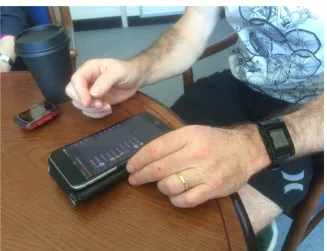
(see an example in Figure 1), and we talked to them about the various forms of information they collected during rides, including the digital data from the devices and their embodied sensations. All the ethnographic work occurred over a period of several months between late 2015 and early 2016.
Figure 1. A participant shows his cycling data on his self-tracking app.
The members of the research team worked together in analyzing the project materials. The set of videos for each participant generated by the project provided records of the interviews and cycle trips that, as a research team, we could share and view as often as we needed to in our analyses. Detailed case studies were written about each participant based on field notes from the face-to-face encounters as well as material derived from the videos. All participants were given pseudonyms for the purposes of the study.
Contexts of Personal Data Practices and Data Sense
bicycle, and data into everyday practices was an essential part of continuing self-tracking as a regular and meaningful activity.
We present our research material arranged under four key contexts framing the ways in which our participants collected and interpreted their personal data: (1) affordances (the capacities of the technologies they used and the data thus generated); (2) spaces (the physical environments in which the participants prepared for, undertook, and completed their cycle trips); (3) senses (the embodied sensations involved in cycling, self-tracking, and responses to digital data); and (4) affects (the participants’ emotional responses to and about self-tracking and personal data). Although, for simplicity of presentation, these contexts are identified and discussed separately, we emphasize that they are intertwined, working together to contribute to people’s personal data collection practices and how they make sense of their data.
Affordances
All participants had chosen to track their commuting rides because of personal reasons: mostly to see how many kilometers they were covering, how fast they travelled, and how their bodies were responding to the cycling exercise. Several participants were keen leisure or competitive cyclists as well as cycle commuters. Their self-tracking cycling practices often involved generating details about all of their cycling trips. The bicycles and monitoring devices they used, the details they collected, and how they used and interpreted their data often varied depending on whether they were riding to work or as part of their recreational or training rides. For example, some people used heart-rate-monitoring devices only on their noncommuting rides; some reviewed their commuting ride data after completing the ride rather in real time, but kept a close eye on their numbers during competitive or leisure rides, or vice versa.
Our participants used a range of different devices to track their cycle commutes. The most commonly used technologies were Garmin bike computers or watches and their associated app and platform Garmin Connect, heart rate monitors, and the Strava platform (often via the Strava app uploaded to a smartphone). Many of these devices and software are interoperable and have cross-platform and cross-activity capabilities. For example, some heart rate monitors and Garmin devices can sync to the Strava platform, incorporating different kinds of data sets to generate a detailed profile of a cycle trip. People may use their devices to track other types of physical activities, such as running, also uploading the data from these activities into their tracking apps or platforms. Details collected from cycling were sometimes aggregated with data from other self-tracking activities, generating detailed profiles of a range of practices, habits, and biometrics. Self-tracked data can be shared across some platforms, so that some people chose to broadcast their physical activity details on Facebook, for example.
observed that people who were training for events in cycling once used stopwatches and paper logs. Apps and bike computers now allow this kind of logging to take place with less effort and in far more detail.
The way in which personal data are materialized on people’s devices is an important affordance. For example, the data visualization properties that Strava offered Tony were important to his desire to compare all of the details he collected about his rides and to easily see whether he had improved or how well he was riding compared with other users. Tony observed that he enjoyed reviewing the details that Strava gives him about his rides, including gradient graphs, speed graphs, heart rate fluctuation graphs, and “power zones,” which provide a calculation based on combined data on heart rate, gradient, and speed. He also enjoyed looking at the dashboard on his Garmin bike computer during his trips so that he could monitor his data in real time. Tony only had a short commuting ride, but engaged in much longer trips on his leisure cycles. He paid particular attention to his heart rate readings during recreational rides (but not on his short commuting trip) to determine how much load he was putting on his body and to “see if I am struggling.” On his commutes, Tony focused mainly on the ride time information.
Tony told us that the digital data he collected do shape how he feels about his body, “because you are trying to use metrics to change something about it.” However, he was also aware that the data from his devices could only tell him so much. His devices, for example, could not determine that he was feeling tired from a bad night’s sleep or because he had already completed a long ride that week, or that he was feeling unwell, had too many drinks the previous night, or that a knee injury was playing up. The algorithms on his software did not incorporate such elements of place as the air temperature or wind strength into their calculations of how far or fast he had ridden. The devices themselves may fail to work accurately. Robert noted several ways in which the Strava visualizations of the data he had collected on his cycle trips using his Garmin have been inaccurate. He has particularly noticed this when using his mountain bike on bush tracks. He found that his GPS often failed to properly track his route, observing that the route-mapping feature of Strava had placed him on a completely different track. Because his road rides are less complex and on well-marked roads, Strava is more accurate when monitoring these routes.
Spaces
digital devices and data and when it was not, and to what the participants were paying attention immediately before or after they reviewed their data.
[image:9.612.103.509.294.548.2]By viewing the GoPro videos and discussing with the participants what they were focusing on and thinking about during their rides, we identified the multitude of phenomena other than the digital devices and the data that these cyclists needed to pay attention to, and how they incorporated their data into the knowledges that were emergent from their sensory responses to those phenomena. The cyclists may have been looking at their devices and data at one point, and judging what the data meant in the context of the road and weather conditions. They were noticing other road or path users (including pedestrians and other cyclists), nonhuman animals, vehicles, potholes or other obstructions in the road surface, and many other aspects of their trips. All of these phenomena contributed to the spatial contexts in which their data were produced and interpreted.
Figure 2. A still from a participant’s GoPro film of a commuting trip.
Like on the weekend, on Saturday, there was a bit of an easterly coming up in the afternoon when I headed out for a ride . . . and I structured my ride around being able to take advantage of that, and went after a few Strava segments that I hadn’t done so well on in the past.
These elements of space and place (weather or climatic conditions, other users of the spaces, both human and nonhuman) are rarely considered in self-tracking or data literacy research. As we found, however, they were key to the choices our participants made about when and how to cycle and self-track their rides. Traffic, road, and weather conditions, for example, have significant effects on how fast cyclists can ride, how their bodies feel as they cycle, and subsequently for the data that they generate about their rides. There are synergistic relationships among these elements of the physical environment through which these self-tracking cyclists move. Cyclists can respond to the conditions by choosing which of their rides to track, and thus manipulate their data performances accordingly. So, too, they interpret their data using their embodied knowledge of what the conditions were like as they gathered the data.
Senses
Most of the participants also talked about how the data their devices collected helped them “to know” phenomena about their rides and their bodies. This knowledge was used to assess changes in their fitness levels, how hard their bodies were working, how fast a particular bicycle was compared with another in their collection, how steep a section of the ride was, and several other assessments of the ride. Dave said that when he rode to work, he looked at his Garmin bike computer only occasionally as he cycled. He sometimes used this information to modify his cycling practices as he rode, noting that the data
might give me a few clues as to when to change gears, for instance [based on the speed that is showing]. Sometimes it can be useful to see where it’s going [the speed] and anticipate those gear changes a little bit.
Other than this, Dave preferred to review his data when he had finished his ride, either on his office computer when he arrived at work, or at home if he was making the return trip. He noted that reviewing his data in this way, after the event, helped him to remember how his body felt during his ride.
For his part, Ernie said that he recognized the sensation of when he was travelling quickly on his bicycle, but he liked to be “accurate” by using the bike computer. He used the computer to “confirm” how he was feeling: If he thought he was going slowly or quickly, the computer let him know if this was correct. Damon preferred not to check his Garmin watch during his trips, wanting to ascertain by “feel” how the ride was progressing. He observed that accumulated bodily experience of cycling helped him to make this kind of assessment:
other times, you’re putting in a lot of effort, but you’re actually quite fatigued and you’re actually not going that quick. I found it’s good having the watch as well to validate that feeling versus reality.
Damon’s strategy of waiting until later to check his data was also part of his desire to ensure that he cycled safely in dangerous conditions rather than trying to beat his times and therefore taking risks. Damon made the decision to rely on his senses rather than the information provided by his digital sensors during cycle trips, including using previous experience to interpret how his body was responding to the conditions of the ride. His desire to exercise caution and avoid risk-taking also contributed to this decision. Yet, once he was able to review his digital data, his sensory and experiential embodied knowledges were mediated by what the data revealed to him about the trip.
Here again, the continual interactions between choices cyclists make about generating data and the sense they make of these data are evident in these accounts. The entanglements of the contexts of affordances, space, senses, and affect were particularly evident when the participants dealt with ambiguities or discrepancies between what their digital data were telling them about their bodies and their cycle trips and what their bodily sensations conveyed to them. Tony noted, “[The] quantitative things are easy. They’re black and white.” However, the “internal battles” (e.g., his mood, level of fatigue, or preoccupation with other issues) were not measurable by digital devices. Sometimes his digital data told him that he had had a “good ride,” but his body felt otherwise during the trip. In these cases, the digital data “are just data,” whereas his body told him more about the ride. Tony needed to assess the digital data against his previous data readings and his knowledge of his body when engaging in sense making.
Robert also observed that the data and devices were blind to how his body felt, as well as failing to incorporate such elements of the conditions of his ride as the prevailing weather. When he did check his self-tracking device on his commute, it was primarily to gauge this discrepancy. For example, he might check his perception of how fast he was riding against the speed shown on his Garmin, and would do so especially if he was encountering a headwind. For Robert, the segment feature of Strava (as well as its leader boards) is one of its main benefits. He said that using this feature repeatedly provided him with better insights into how his body works and responds to cycling:
Affects
Affective responses were evident in many participants’ accounts of reviewing their data. It was common for participants to discuss the motivation that reviewing their data (and developing knowledge about their bodies and their rides) encouraged for them. Tony told us that he sometimes pushed himself harder than he wanted to on commuting rides when he looked at his data and realized that he was not going as fast as in previous trips. He then arrived at work more “hot and sweaty” than he had planned. Tony and most of the other participants gained great satisfaction from winning segments on Strava, receiving support from other users of this platform (“kudos” in Strava jargon), other platforms such as Fitbit, or from social media friends, surging ahead in accumulated monthly distance challenges or achieving personal bests.
The social interactions that were part of some participants’ use of software such as Strava, Garmin, or Fitbit also engendered strong emotions. Although not all our participants chose to share their cycling data with others, for several this feature was very important to how they used and interpreted their data. Some people had adopted an extremely competitive approach to their cycling self-tracking. For example, Tony told us that he tried to accumulate as many kilometers as he could with his self-tracking efforts to participate in the Strava monthly challenge, in which the monthly totals of kilometers that participants have covered are listed in rank order. This was why he tracked his short work commutes: He did not want any of the kilometers that he cycled each month to be omitted from this tally.
The possibilities offered by self-tracking and the potential for sharing this information in a public space/platform could be experienced emotionally in several ways, shaping people’s decisions about how long to track and what to do with their data. Participants often took pride in showing us these types of data on the apps or platforms they used. Michael, who monitored his cycle trips and his running and swimming activities (he is training for triathlon competitions), told us that he can hardly wait to arrive home before rushing to download his data and compare the details with other users: “The first thing I do is download that data and see if I’ve got any course records or things like that. I’m kind of obsessed with going for local course records or testing myself on certain courses.”
commenting on each other’s achievements and experiences, commiserating on the weather conditions or tired bodies and injuries with each other, and so on. Rebecca told us that even when she was cycling alone (as she does on her commutes), her Strava membership made her feel that she was involved in a communal pursuit.
For Simon, tracking his rides helps him increase his speed and, therefore, his fitness. If he did not track, he would take his cycle trips more slowly and be more relaxed about the time they took. He told us he found that when he was using self-tracking devices, he worked much harder on his ride: “Then you start to rush because you want to beat your time. There’s a little graph that they draw [on the Garmin website] and you never want to go slow.” Like Simon, Denise said that although she used Strava and Fitbit and sometimes shared her data with her friends, this was not to compete with them, but rather to attempt to achieve personal bests, measure improvement, and receive support from her friends in doing so: “For me, it’s really motivating. When I first cycled to work, it took me 37 minutes, and I’ve got it down to 27 minutes. So that’s what I’m seeing: myself getting fitter.” Denise observed that the opportunity to use her data to verify that she is becoming physically fitter contributed significantly to her feelings of confidence about cycling to work. She said that she was “very cautious” when she first took up cycling commuting. Over time as she has monitored her cycling achievements, this caution has been tempered. Denise found that measuring the time she took to complete her trips provided her with a good indicator of her improving fitness, as did noting the gradient of her trips and using this to assess how well she did.
On the less positive side, our participants articulated their sometimes quite heart-felt frustration, disappointment, or annoyance when devices or bicycles failed to work as usual: when satellites do not connect quickly or different digital devices do not sync easily, when the GPS system goes wrong and does not accurately record a route, or when devices lose their charge and stop working (see also Sumartojo et al., 2016). Being part of a community of cyclists on a self-tracking platform can also lead to bad feelings. We noted earlier that Rebecca enjoyed this community, but only when she felt she was performing well and competing successfully against others on the platform she used. She at first said that she “didn’t care so much” about being a competitive community member. But when we asked her whether she planned to continue tracking her rides, she hesitated before saying yes. She explained that last year, she felt “burnt out,” and considered “abandoning the whole thing” because she felt pressure to display data revealing “impressive and interesting things” about her rides. She also felt less fit than she used to, and she found this “embarrassing” when other people could view her data.
Discussion
interpreting and making judgments about how the details generated by digital sensors, including those about their own bodily senses and perceptions (how their bodies move, function, feel, recover, perform, rest, respond to weather conditions, and so on), can be trusted and incorporated into their lives. When people are interacting with their personal data, they are seeking to understand the meaning of their data and the implications for their lives.
Our analysis identifies details of contextual dimensions of the digital traces that self-tracking cyclists generate about their rides. The findings from the sensory digital ethnographies that we have outlined above represent the beginning of an approach bringing together the theoretical perspectives introduced at the beginning of this article with empirical findings focusing on the everyday practices and meaning making that contribute to data sense. The interviews revealed the negotiations in which self-trackers engage in response to their data, including drawing on their past experiences and the knowledges of their bodies that these experiences provide, and weighing the relative insights offered by digital data sensors compared with the fleshly senses of the human body. They highlighted the sensory interactions that take place through the interactions of digital sensors and embodied sensing in contributing to data sense.
Such encounters we describe as interactions with mundane data (Pink, Sumartojo, Lupton, & LaBond, 2017). The term mundane as we use it is not meant to suggest that these practices are unimportant or lack meaning. On the contrary, we contend that a focus on ordinary practices is essential to understanding how digital self-tracking practices and the digital traces they generate have become routinized and taken for granted as part of everyday lives. Bringing the concept of lively data into this emergent human subject allows a theorization of data sense and data practices in which change and movement are ever present. As we emphasized in the introduction, the lives of humans are intertwined with the lives of their data. Moreover, they have relationships with their data that can be intimate, compelling, and challenging, suffused with emotion. The nature of these relationships emphasizes, yet again, the entanglements between humans and nonhumans. Here, the nonhuman actors with which humans are coexisting and coevolving (Lupton, 2015a, 2016a) are not only the digital devices they carry or wear to track their activities but also the digital data these devices generate.
For cyclists who choose to digitally self-track their commutes or leisure rides, the affective intensities and demands of cycling can expand to incorporate their engagements with their digital sensors and digital data. Data sense practices have interactive capacities, drawing on embodied capacities to capture certain metrics but also feeding into these capacities and potentially changing them. Data sense operates in a constantly mobile environment. Reviewing ride data is a practice that may take place in real time as these data are collected, or at various time points following the ride: immediately after the ride has finished, or hours, days, or even months later. When people are using self-tracking devices at the same time as they move through spaces, they are engaging in mobile sensory strategies (Jungnickel & Aldred, 2013). When digital data are generated and reviewed, they are incorporated into these strategies. Once digital data are materialized into two-dimensional or even three-dimensional objects (Lupton, 2015b), they become available to sensory engagements and become part of sensory environments.
People cycling and noting their data during their rides are making sense of these data “on the move,” and are incorporating the data into the ride as they progress along their route. They may be thinking about previous rides and making judgments about the data they are viewing on their devices accordingly, and asking themselves questions such as the following: Are the data accurate? Do they concord with what I have learned from other rides? How is my body feeling, and how is that affecting the data? What are the data telling me about my body and the ride? They may be looking at their data as they ride and making judgments about how they should cycle: moderating their speed, for example, or anticipating gear changes based on the speed data that they review as they go. When cyclists wait until after their rides to review their data, they are engaging in reflective practices that engage their embodied memories of their rides as they interpret their data. What were the road and weather conditions like during this ride? How was my body feeling? How did these affect these data? For some self-tracking cyclists, these processes of reviewing and responding to their data happen during the ride as well as afterward, when they view their data again. For others, the interpretation of what the data mean to them happens when they have a chance to look at their app or website to see what their data revealed about a ride.
For self-tracking cyclists, therefore, data sense is a way of knowing about their bodies, the spaces through which they move as they cycle, and the interactions and intersections between the two. It was evident from our study that data sense involves ambivalence about the data that people are collecting about their cycle rides and an acknowledgment from many (particularly the most technically proficient or experienced in monitoring their rides) that modes of data collection are inevitably imperfect. Although people recognize data’s imperfection, these details are valuable in various ways to the participants; otherwise, they would relinquish the effort involved with incorporating mundane data practices into their everyday lives.
Their data also worked to “sensitize” them, making them more aware of aspects of their rides (e.g., particular segments of the trip, other cyclists’ performances on the same platform, or preparing them for gear changes and the impact of weather conditions).
Conclusion
In conclusion, we contend that, in the context of self-tracking data such as that generated by our cyclists, body work and knowledge work come together. Our research goes some way to demonstrating the connections among bodies, knowledge, and technologies such as digital devices and digital data. Emphasizing again that the body is an assemblage of human and nonhuman elements located in specific spaces and place, we note the importance of such aspects as the weather and technologies such as bicycles and self-tracking devices in contributing to this specific type of body work and knowledge work, and the multiple sensory ways in which people engage with their data. This is a type of distributed work (Goodwin, 2010), involving human and nonhuman actors.
Data practices, such as using self-tracking devices as part of everyday routines and engaging in data sense in response to digitized information about one’s body, involve awareness of one’s body and the spaces it is occupying; attention to the devices one is using to monitor one’s body and interpretation of the data these devices generate are a form of labor. They require the work of habituation to become successfully incorporated into mundane routines but also that of continual reflection on their value and use for the project of selfhood. In response to their lively data, self-trackers must work to maintain their data practices and to make decisions about how valid their data are for the purposes they are trying to achieve. This is where the contexts of affordances, spaces, affects, and senses interrelate in complex and constantly changing ways.
References
Choe, E. K., Lee, N. B., Lee, B., Pratt, W., & Kientz, J. A. (2014). Understanding quantified-selfers’ practices in collecting and exploring personal data. In Proceedings of the 32nd Annual ACM Conference on Human Factors in Computing Systems (pp. 1143–1152). New York, NY: Association for Computing Machinery.
Classen, C. (1999). Other ways to wisdom: Learning through the senses across cultures. International Review of Education, 45(3/4), 269–280. doi:10.1023/A:1003894610869
Dennison, L., Morrison, L., Conway, G., & Yardley, L. (2013). Opportunities and challenges for smartphone applications in supporting health behavior change: A qualitative study. Journal of Medical Internet Research, 15(4), e86. Retrieved from http://www.jmir.org/2013/4/e86/
Fors, V., Bäckström, Å., & Pink, S. (2013). Multisensory emplaced learning: Resituating situated learning in a moving world. Mind, Culture, and Activity, 20(2), 170–183.
Fotopoulou, A., & O’Riordan, K. (2017). Training to self-care: Fitness tracking, biopedagogy and the healthy consumer. Health Sociology Review, 26(1), 54–68.
doi:10.1080/14461242.2016.1184582
Frank, M., Walker, J., Attard, J., & Tygel, A. (2016). Data literacy—What is it and how can we make it happen? The Journal of Community Informatics, 12(3). Retrieved from http://www.ci-journal.net/index.php/ciej/article/view/1347
Goodwin, D. (2010). Sensing the way: Embodied dimensions of diagnostic work. In M. Büscher, D. Goodwin, & J. Mesman (Eds.), Ethnographies of diagnostic work: Dimensions of transformative practice (pp. 73–92). London, UK: Palgrave Macmillan.
Howes, D. (2015). Anthropology of the senses. In J. D. Wright (Ed.), International encyclopedia of the social and behavioral sciences (2nd ed., pp. 615–620). Amsterdam, Netherlands: Elsevier.
Howes, D., & Classen, C. (2013). Ways of sensing: Understanding the senses in society. London, UK: Routledge.
Ingold, T. (2000). The perception of the environment: Essays on livelihood, dwelling and skill. London, UK: Routledge.
Jungnickel, K., & Aldred, R. (2013). Cycling’s sensory strategies: How cyclists mediate their exposure to the urban environment. Mobilities, 9(2), 238–255. doi:10.1080/17450101.2013.796772
Larsen, J. (2016). Commuting, exercise and sport: An ethnography of long-distance bike commuting. Social & Cultural Geography. Advance online publication. doi:10.1080/14649365.2016.1249399
Lee, D. J. (2015). Embodied bicycle commuters in a car world. Social & Cultural Geography, 17(3), 412– 422. doi:10.1080/14649365.2015.1077265
Li, I., Dey, A. K., & Forlizzi, J. (2011). Understanding my data, myself: Supporting self-reflection with ubicomp technologies. In Proceedings of the 13th International Conference on Ubiquitous Computing (pp. 405–414). New York, NY: Association for Computing Machinery.
Lloyd, M. (2015). On the way to cycle rage: Disputed mobile formations. Mobilities. Advance online publication. doi:10.1080/17450101.2015.1096031
Lomborg, S., & Frandsen, K. (2016). Self-tracking as communication. Information, Communication & Society, 19(7), 1015–1027. doi:10.1080/1369118X.2015.1067710
Lupton, D. (2015b). Fabricated data bodies: Reflections on 3D printed digital body objects in medical and health domains. Social Theory & Health, 13(2), 99–115. doi:10.1057/sth.2015
Lupton, D. (2016a). Digital companion species and eating data: Implications for theorising digital data– human assemblages. Big Data & Society, 3(1). Retrieved from
http://journals.sagepub.com/doi/pdf/10.1177/2053951715619947
Lupton, D. (2016b). Foreword: Lively devices, lively data and lively leisure studies. Leisure Studies, 35(6), 709–711. doi:10.1080/02614367.2016.1216582
Lupton, D. (2016c). The quantified self: A sociology of self-tracking. Cambridge, UK: Polity.
McIlvenny, P. (2015). The joy of biking together: Sharing everyday experiences of vélomobility. Mobilities, 10(1), 55–82. doi:10.1080/17450101.2013.844950
Nafus, D. (2014). Stuck data, dead data, and disloyal data: The stops and starts in making numbers into social practices. Distinktion, 15(2), 208–222. doi:10.1080/1600910X.2014.920266
Nafus, D., & Sherman, J. (2014). This one does not go up to 11: The quantified self movement as an alternative big data practice. International Journal of Communication, 8. Retrieved from http://ijoc.org/index.php/ijoc/article/view/2170
Oh, J., & Lee, U. (2015, January). Exploring UX issues in quantified self technologies. Paper presented at the Eighth International Conference on Mobile Computing and Ubiquitous Networking, Hakodate, Japan.
Pantzar, M., Ruckenstein, M., & Mustonen, V. (2017). Social rhythms of the heart. Health Sociology Review, 26(1), 22–37. doi:10.1080/14461242.2016.1184580
Pink, S. (2014). Digital–visual–sensory-design anthropology: Ethnography, imagination and intervention. Arts and Humanities in Higher Education, 13(4), 412–427. doi:10.1177/1474022214542353
Pink, S. (2015a). Approaching media through the senses: Between experience and representation. Media International Australia, 154, 5–14. doi:10.1177/1329878X1515400103
Pink, S. (2015b). Doing sensory ethnography (2nd ed.). London, UK: SAGE Publications.
Pink, S., Horst, H., Postill, J., Hjorth, L., Lewis, T., & Tacchi, J. (2016). Digital ethnography: Principles and practice. London, UK: SAGE Publications.
Pink, S., Sinanan, J., Hjorth, L., & Horst, H. (2015). Tactile digital ethnography: Researching mobile media through the hand. Mobile Media & Communication, 4(2), 237–251.
Pink, S., Sumartojo, S., Lupton, D., & LaBond, C. H. (2017). Mundane data: The routines, contingencies and accomplishments of digital living. Big Data & Society, 4(1). Retrieved from
http://journals.sagepub.com/doi/full/10.1177/2053951717700924
Pybus, J., Coté, M., & Blanke, T. (2015). Hacking the social life of big data. Big Data & Society, 2(2). Retrieved from http://bds.sagepub.com/content/2/2/2053951715616649.abstract
Ruckenstein, M. (2014). Visualized and interacted life: Personal analytics and engagements with data doubles. Societies, 4(1), 68–84. doi:10.3390/soc4010068
Smith, G. J. D., & Vonthethoff, B. (2017). Health by numbers? Exploring the practice and experience of datafied health. Health Sociology Review, 26(1), 6–21. doi:10.1080/14461242.2016.1196600
Sumartojo, S., Pink, S., Lupton, D., & LaBond, C. H. (2016). The affective intensities of datafied space. Emotion, Space and Society, 21, 33–40. doi:10.1016/j.emospa.2016.10.004
Whatmore, S. (2006). Materialist returns: Practising cultural geography in and for a more-than-human world. Cultural Geographies, 13(4), 600–609. doi:10.1191/1474474006cgj377oa