Open Access
Research article
Development and evaluation of a quality score for abstracts
Antje Timmer*
2
, Lloyd R Sutherland
1
and Robert J Hilsden
1
Address: 1Department of Community Health Sciences, University of Calgary, Calgary, AB, Canada and 2Department of Internal Medicine I,
University of Regensburg, 93042 Regensburg, Germany
Email: Antje Timmer* - [email protected]; Lloyd R Sutherland - [email protected]; Robert J Hilsden - [email protected]
* Corresponding author
Abstract
Background: The evaluation of abstracts for scientific meetings has been shown to suffer from poor inter observer reliability. A measure was developed to assess the formal quality of abstract submissions in a standardized way.
Methods: Item selection was based on scoring systems for full reports, taking into account published guidelines for structured abstracts. Interrater agreement was examined using a random sample of submissions to the American Gastroenterological Association, stratified for research type (n = 100, 1992–1995). For construct validity, the association of formal quality with acceptance for presentation was examined. A questionnaire to expert reviewers evaluated sensibility items, such as ease of use and comprehensiveness.
Results: The index comprised 19 items. The summary quality scores showed good interrater agreement (intra class coefficient 0.60 – 0.81). Good abstract quality was associated with abstract acceptance for presentation at the meeting. The instrument was found to be acceptable by expert reviewers.
Conclusion: A quality index was developed for the evaluation of scientific meeting abstracts which was shown to be reliable, valid and useful.
Background
The presentation of research at scientific meetings is an es-sential part of scientific communication. The choice of which research will be presented at a meeting is usually based on peer-review of abstracts submitted by interested investigators. Only about 50% of the research projects in-itially submitted as conference abstracts will eventually be published as full articles in peer-reviewed journals and full publication may not occur for several years [1,2]. As a result, a published abstract from a scientific meeting is of-ten the only permanent source of information available on the methodology and results of a research project.
When writing an abstract, investigators are limited on the amount of detail on the study's methodology and results that they can include. This may partly explain the poor ob-server-agreement and several kinds of bias that have been demonstrated in the abstract selection procedures for var-ious medical specialty meetings [3–9]. However, there is evidence that the quality of the presentation of informa-tion in an abstract is associated with the scientific quality of the research [10]. Therefore, standardized methods for assessing formal abstract quality may help improve the liability of abstract selection and, if used as a checklist, re-sult in more informative and useful abstracts.
Published: 11 February 2003
BMC Medical Research Methodology 2003, 3:2
Received: 26 July 2002 Accepted: 11 February 2003
This article is available from: http://www.biomedcentral.com/1471-2288/3/2
Quality checklists and scoring instruments have been published for use with full reports of clinical research [11,12]. No such score is available for the evaluation of abstracts. Also, there is little information addressing the reporting of the methodology and results in basic science research. The objective of this study was to develop a reli-able instrument to assess the quality of meeting abstracts that would be applicable to a wide variety of research types, including both clinical and basic science.
Methods
Material
We used abstracts submitted to the 1992 to 1995 annual meetings of the American Gastroenterological Association (AGA) to develop and test a quality scoring instrument for abstracts. Each year several thousands of abstracts on all aspects of research in gastroenterology are submitted to this meeting. All submitted abstracts were published in a yearly supplement to the journal Gastroenterology whether or not they were accepted for presentation at the meeting. Abstracts selected for oral or poster presentation were marked, however, the mode of presentation was not spec-ified. Abstracts were submitted on a standard form that limited the length to between 200 to 350 words, depend-ing on font size and inclusion of graphs. A structured for-mat (Background & Aims, Methods, Results, Conclusion) was not mandatory but was commonly used.
For the purpose of this study, we divided the abstracts into different research types. Basic science studies (BSS) com-prise all studies, done in a laboratory setting, where the unit of analysis was not an intact human. Controlled clin-ical trials (CCT) included prospective studies on the ef-fects of diagnostic tests or therapeutic interventions, using parallel or cross over controls. All other studies using hu-mans were categorized as "other clinical research" (OCR) and included human physiology experiments, epidemio-logical studies and uncontrolled therapeutic studies.
A large sample (n = 1000) was selected for use in a follow up study on publication bias using computer generated random numbers based on a database containing all ab-stracts submitted (17 205). This sampling was stratified by research type to increase the proportion of RCT's. For the test development and testing, a random subsample (n = 100) was collected from this sample. The eventual sample included 42 CCT's, 39 OCR, and 19 BSS. The abstracts were assessed in a prespecified order.
Item generation and reduction
Formal abstract quality was conceptualized as the combi-nation of the methodological strength of the research as well as the clarity of the presentation. The methodological strength of the research included those methods used to
improve the internal validity of the study as reported in the abstract.
Item selection and instrument structure were based on previously published instruments used to assess the qual-ity of full manuscripts in therapeutic trials and epidemio-logical research [11,13–15]. A measure developed by Cho and Bero was particularly influential because of its appli-cability to different types of clinical research [16]. We could not identify any work on quality scoring in basic sci-ence reports.
When adapting this scale for use with abstracts, we took into account published guidelines for the composition of structured abstracts for original research for publication in biomedical journals [17,18]. Similar guidelines for meet-ing abstracts and basic science reports had not been pub-lished. For content validity, the list of items was discussed face to face and repeatedly with one researcher each in lab based medicine (J. Wallace, Calgary), health care research (RJ Hilsden), and clinical trials (LR Sutherland). The in-strument was further modified following a pilot study of 80 abstracts that were scored by two raters and subse-quently discussed in detail. Items were simplified or dropped if consensus decisions were difficult or if suffi-cient information was absent in the majority of abstracts, unless the item was considered essential for the evalua-tion of study validity by at least one of the reviewers. Input on the final instrument was sought from researchers in the three fields from across Canada by sending them the in-strument and a questionnaire on the appropriateness of the items included (Table 2). No further items were sug-gested to be added or dropped by those surveyed.
The resulting instrument allowed for the calculation of a summary score with a range from 0 to 1. Summary scores are reported as mean scores with standard errors of the mean (SEM).
Interrater and test-retest reliability
between abstract variance to overall variance. A ratio (Ri)
close to 1 is found when the variance is almost exclusively due to differences between the abstracts, while low ratios represent a strong influence of random error and/or ob-server variance on the overall variance. There is no univer-sally accepted cut off of Ri for good agreement, as it is appreciated that this depends on the number of subjects studied and the context in which the decisions based on the instrument will be made [21]. For this study, moder-ate agreement was defined as Ri > 0.6 and good agreement as Ri > 0.8.
Construct validity
To examine construct validity, we hypothesized that high-er abstract quality scores should correlate with abstract ac-ceptance by the AGA. To test this hypothesis, the mean quality scores of rejected and accepted abstracts were com-pared using Student t-tests for independent samples.
Sensibility
The sensibility of an instrument, as defined by Feinstein, comprises different aspects of usability, such as compre-hensibility, ease of use, face and content validity, and suit-ability for the purpose at hand [22]. A sensibility questionnaire was adapted from Oxman [23,24] to assess the usefulness of the newly developed score (see appen-dix). This questionnaire was sent to 24 Canadian research-ers in gastroenterology and epidemiology. The researchresearch-ers rated each item based on a seven-point scale (1= unac-ceptable, 7 = criterion fully met). We considered a mean rating of >5 to indicate general satisfaction with and ac-ceptability of an item.
Results
The review of the literature and expert opinion resulted in the generation of 24 quality assessment items pertaining to the study purpose, methods, reporting of results and conclusions. Following the pilot-study, the instrument was reduced to 19 items. Two items on research methods were discarded because they were never applicable to the abstracts evaluated (1. whether random selection from the study population was performed; 2. if yes, which method of random selection was used). A priori sample size con-siderations were also never reported. Instead, for use in abstracts, the reporting of posteriori sample size
considera-tions or power calculaconsidera-tions for negative results was con-sidered sufficient. Two pairs of items were combined into single items. First, "control for confounding by the study design" and "control for confounding by the analysis" were combined into "confounding controlled for?". Sec-ond, because it was too difficult to discern between the in-clusion/exclusion criteria and the baseline characteristics of the subjects, it was considered sufficient if either were included in the abstract. Although the method of rand-omization in randomized trials was never described, an item on this was retained because it was considered essen-tial for the assessment of study quality. Following the pi-lot testing, several items were reworded for simplification and clarity. A detailed manual was written that provided the definitions used for each item (manual available from the authors). Using the instrument and manual, the aver-age time required to score an abstract was 3:45 minutes (range 2:30 to 6:00 minutes). The final 19-item instru-ment is shown in the appendix.
Reliability
For the 100 abstracts independently assessed by two raters, quality scores ranged from 0.28 to 0.95, and were approximately normally distributed. As shown in table 1, the inter-observer agreement was highest for controlled clinical trials and lowest for basic science abstracts. Indi-vidual item analysis showed substantial agreement for the description of random allocation, investigator and subject blinding, appropriateness of sample size, reporting of at-trition, and reporting of statistical tests. Moderate agree-ment was achieved for the appropriateness of the controls and the appropriateness of the statistical methods. The agreement was low for the remaining items (description of study objective, description and appropriateness of the design, method of subject selection, definition of out-come measure, control for confounding, exact p-values or confidence intervals, reporting of results, and conclusions supported by the results).
Test-retest reliability was good independent of the re-search type, with identical mean scores for first and sec-ond evaluations (0.57) and an intra-class coefficient of 0.85. Individual items also had good test-retest reliability (range of kappa coefficients, 0.54 to 0.85).
Table 1: Interrater reliability.
Type of research n mean summary score observer
1 (SEM)
mean summary score observer 2 (SEM)
intra class correlation coefficient (Ri)
Clinical trials only 42 .63 (.02) .63 (.02) .81
Other clinical research 39 .57 (.02) .59 (.02) .67
Basic science 19 .50 (.02) .61 (.03) .60
Construct Validity
In total, 67 of the 100 abstracts were accepted for presen-tation at the AGA meeting. These abstracts had significant-ly higher quality scores compared with the rejected abstracts (0.61 vs. 0.54, p = 0.001). The quality scores were higher for accepted abstracts compared with rejected abstracts for all research types, but this was only statistical-ly significant for clinical trials (n = 42, 0.67 vs. 0.52, p < 0.001).
Sensibility
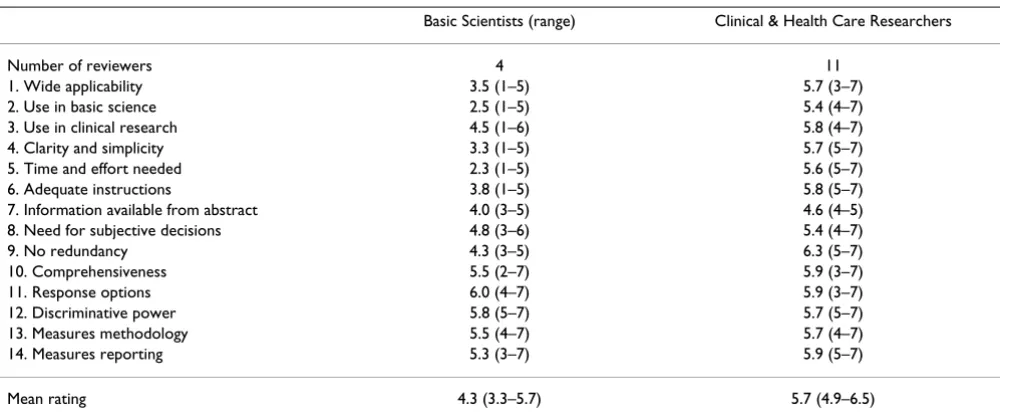
Sensibility ratings were available from 15 reviewers (sur-vey response rate 62.5%). As shown in Table 2, clinical and health care researchers found the instrument useful and acceptable for the purpose described. The reviewers felt that both the research methodology and quality of the report were adequately assessed by our instrument (Table 2). In general, basic scientists found the instrument less useful, largely because of the time and effort required. Both groups of reviewers considered the applicability to basic science abstracts to be a problem. The issue of the limited amount of information available from abstracts was also raised.
Discussion
We have developed a reliable instrument for assessing the quality of an abstract submitted to a scientific meeting. The instrument rates both the quality of the reporting and the quality of the research methods. While a variety of scales are available for the assessment of full reports of clinical trials, abstract evaluation has usually involved in-formal ad hoc scales or checklists [4,18,25,26] or has been
restricted to the quality of reporting only [18,27,28]. Fur-thermore, most abstract evaluation studies were based on summaries of published research.
The limited amount of information available from ab-stracts was the greatest challenge in the development of this instrument. The methodological quality of research can only be assessed to the extent that pertinent informa-tion is available in the report. There is controversy over how well the quality of research is reflected in a short re-port [25,29,30]. Furthermore, the quality of the rere-port and the quality of the research are often intertwined. The experts in our sensibility survey felt that our instrument adequately assessed both the research methodology and the quality of the report. However, we appreciate that the lack of a clear distinction between these two concepts of quality in our instrument may be unsatisfactory to some users, as may the restriction to formal aspects of scientific quality. Our instrument avoids any judgment of content, such as, originality, ethics or scientific relevance. It is rec-ommended that these factors be assessed separately, as suggested by other authors [16,28,31]. However, there is evidence that the formal quality of a research report reflects the content or overall quality of the research [28,32]. This view is supported by the association of high-er quality scores with abstract acceptance by the AGA.
A few important items seem to be missing in our instru-ment. These are characteristics which were never reported in any of the abstracts, although they have been shown to be essential to the validity of study results. Most promi-nently, this concerns concealment of allocation in RCT's.
Table 2: Sensibility ratings
Basic Scientists (range) Clinical & Health Care Researchers
Number of reviewers 4 11
1. Wide applicability 3.5 (1–5) 5.7 (3–7)
2. Use in basic science 2.5 (1–5) 5.4 (4–7)
3. Use in clinical research 4.5 (1–6) 5.8 (4–7)
4. Clarity and simplicity 3.3 (1–5) 5.7 (5–7)
5. Time and effort needed 2.3 (1–5) 5.6 (5–7)
6. Adequate instructions 3.8 (1–5) 5.8 (5–7)
7. Information available from abstract 4.0 (3–5) 4.6 (4–5)
8. Need for subjective decisions 4.8 (3–6) 5.4 (4–7)
9. No redundancy 4.3 (3–5) 6.3 (5–7)
10. Comprehensiveness 5.5 (2–7) 5.9 (3–7)
11. Response options 6.0 (4–7) 5.9 (3–7)
12. Discriminative power 5.8 (5–7) 5.7 (5–7)
13. Measures methodology 5.5 (4–7) 5.7 (4–7)
14. Measures reporting 5.3 (3–7) 5.9 (5–7)
Mean rating 4.3 (3.3–5.7) 5.7 (4.9–6.5)
Possibly, the importance of this item was not appreciated by abstract authors because the paper by Schulz, demon-strating the bias introduced by open allocation was only published in 1995, i.e. after conclusion of our abstract submission period studied [33].
Generally, the use of summary scores should be viewed with caution. In the context of meta-analysis, the individ-ual assessment of the various methodological aspects has been shown to be more informative with respect to their effect on effect size. The excellent meta-analysis by Jüni et al. on quality scoring of clinical trials was not published when we developed our instrument [12]. In contrast, the use of a summary score rather than components is more helpful if a range of diverse designs and topics is evaluat-ed, as the number of shared components is rare.
One of the objections raised in the sensibility survey was the time and effort needed to complete a checklist of 19 items. It is appreciated that this list may seem daunting, especially as previous instruments on full reports were re-stricted to as few as three items. However, instruments such as the checklist used by Chalmers, the Delphi list, or the short instrument by Jadad were developed to assess full reports of randomized clinical trials in the context of meta-analysis [13,14,34]. This entails the possibility (in some cases: necessity) to tailor the instrument to the study subject at hand. In contrast, it was our aim to develop an instrument that would be applicable to a wider variety of research types and subjects. Furthermore, even for rand-omized controlled trials, the use of a three item score was shown to be not useful in the evaluation of abstract qual-ity in a follow up study on scientific abstracts by I. Chalm-ers [26]. This may be due to insufficient information provided in abstracts. A more sensitive instrument is needed for abstracts. Also, other items are required for the evaluation of other types of research, such as adequate control for confounding in observational studies. Conse-quently, depending on the study design, only a limited number of items are applicable for each individual ab-stract. The average time of less than 4 minutes per abstract seemed a reasonable effort. However, this time does not include an evaluation of the scientific background of the study question nor the appreciation of the importance of its conclusions for the scientific community.
Problems were encountered when we tried to tailor the in-strument to basic science research reports. In fact, the re-sults of both the reliability testing and the sensibility survey indicate that the instrument may be less suitable for this type of research. We are not aware of any literature on the formal assessment of quality in the design and re-porting of basic science research. Therefore, some of the problems encountered were due to a lack of generally agreed upon criteria for the evaluation of this type of
re-search. However, the main difficulty when reading basic science abstracts related to the omission of basic informa-tion such as the formulainforma-tion of the research objective and clarification of the research design. Lower quality scores, an increased need for subjective judgments because of limited information, and lack of scale acceptance by basic science reviewers may be interrelated and may reflect, in general, a lesser interest in structured reporting in basic science abstracts.
The score was subsequently successfully used in a study examining the determinants of abstract acceptance and publication in gastroenterological research [35,36]. High abstract quality scores were associated with higher chanc-es for acceptance for prchanc-esentation at a meeting, and were also associated with higher impact factors, if abstracts were followed by full publications.
Conclusions
In summary, we have developed a reliable, valid and ap-plicable instrument for the evaluation of the quality of sci-entific abstracts. While most useful in the clinical research setting, particularly for clinical trials, limitations may ap-ply for its use in basic science. It may also be helpful as a checklist for the preparation of scientific abstracts or serve as an instrument to compare abstract quality between meetings or over time. Other possible applications in-clude the adjunct use in abstract peer review. More work is needed to improve the instrument for use in basic sci-ence research and to assess the applicability to other med-ical specialties. Also, further research should test the hypothesis that this instrument will reduce bias in the se-lection of abstracts for presentation.
Competing interests
None declared.
Authors' contributions
A. Timmer and RJ Hilsden developed the instrument, evaluated abstracts and jointly wrote the manuscript. The statistical analyses were performed by A. Timmer. LR Sutherland conceived and supervised the study, and con-tributed to the instrument modifications and to the writ-ing of the manuscript.
Tables and Appendix
Tables and appendices are added at the end of the manu-script as follows:
Table 1: Interrater reliability
Table 2: Sensibility ratings
Appendix B: Sensibility questionnaire for reviewer survey (see additional file 2)
Additional material
Acknowledgements
We wish to thank Dr. MK Cho for providing information and instructions on the instruments developed by her and L. Bero [16]. We would also like to thank J. Wallace and all other expert raters for participation in the sen-sibility survey. Special thanks to C. Macarthur who contributed to the de-velopment and validation of the instrument, as well as to the writing of the manuscript. A. Timmer was a fellow of the German Academic Exchange Service (DAAD). The study was supported by a grant from the Calgary Re-gional Health Authority (CRHA R&D) and by Searle Canada.
References
1. Scherer RW and Langenberg P Full publication of results initally presented in abstracts (Cochrane Methodology Review).The Cochrane Library 2001, Oxford: Update Softw (4):
2. Scherer RW, Dickersin K and Langenberg P Full publication of re-sults initially presented in abstracts. A meta-analysis.JAMA
1994, 272:158-162
3. Sacks JJ and Peterson DE Improving conference abstract selec-tion [letter].Epidemiology 1994, 5:636-637
4. Conn HO An experiment in blind program selection.Clin Res
1974, 22:128-134
5. Appleton DR and Kerr DN Choosing the programme for an in-ternational congress.Br Med J 1978, 1:421-423
6. Kemper KJ, McCarthy PL and Cicchetti DV Improving participa-tion and interrater agreement in scoring Ambulatory Pedi-atric Association abstracts. How well have we succeeded? Arch Pediatr Adolesc Med 1996, 150:380-383
7. Vilstrup H and Sorensen HT A comparative study of scientific evaluation of abstracts submitted to the 1995 European As-sociation for the Study of the Liver Copenhagen meeting. Dan Med Bull 1998, 45:317-319
8. Rubin HR, Redelmeier DA, Wu AW and Steinberg EP How reliable is peer review of scientific abstracts? Looking back at the 1991 Annual Meeting of the Society of General Internal Medicine.J Gen Intern Med 1993, 8:255-258
9. Koren G, Graham K, Shear H and Einarson T Bias against the null hypothesis: the reproductive hazards of cocaine.Lancet 1989, 1140-1142
10. McIntosh N Abstract information and structure at scientific meetings [letter].Lancet 1996, 347:544-545
11. Moher D, Jadad AR, Nichol G, Penman M, Tugwell P and Walsh S As-sessing the quality of randomized controlled trials: an anno-tated bibliography of scales and checklists.Control Clin Trials
1995, 16:62-73
12. Juni P, Witschi A, Bloch R and Egger M The hazards of scoring the quality of clinical trials for meta-analysis.JAMA 1999, 282: 1054-1060
13. Chalmers TC, Smith H Jr, Blackburn B, Silverman B, Schroeder B, Re-itman D and Ambroz A A method for assessing the quality of a randomized controlled trial.Control Clin Trials 1981, 2:31-49 14. Jadad AR, Moore RA, Carroll D, Jenkinson C, Reynolds DJ, Gavaghan
DJ and McQuay HJ Assessing the quality of reports of rand-omized clinical trials: is blinding necessary?Control Clin Trials
1996, 17:1-12
15. Friedenreich CM Methods for pooled analyses of epidemiologic studies.Epidemiology 1993, 4:295-302
16. Cho MK and Bero LA Instruments for assessing the quality of drug studies published in the medical literature.JAMA 1994,
272:101-104
17. Haynes RB More informative abstracts: current status and evaluation.J Clin Epidemiol 1993, 46:595-597
18. Froom P and Froom J Deficiencies in structured medical abstracts.J Clin Epidemiol 1993, 46:591-594
19. Landis JR and Koch GG The measurement of observer agree-ment for categorical data.Biometrics 1977, 33:159-174 20. Seigel DG, Podgor MJ and Remaley NA Acceptable values of
kap-pa for comkap-parison of two groups.Am J Epidemiol 1992, 135: 571-578
21. Streiner DL and Norman GR Health measurement scales. A practical guide to their development and use.Oxford, New York, Tokyo: Oxford Uni-versity Press 1989,
22. Feinstein AR The theory and evaluation of sensibility. In ClinimetricsNew Haven, London: Yale University Press 1987, 141-166 23. Oxman AD, Guyatt GH, Cook DJ, Jaeschke R, Heddle N and Keller J
An index of scientific quality for health reports in the lay press.J Clin Epidemiol 1993, 46:987-1001
24. Oxman AD, Guyatt G and Guyatt GH Validation of an index of the quality of review articles.J Clin Epidemiol 1991, 11:1271-1278 25. Panush RS, Delafuente JC, Connelly CS, Edwards NL, Greer JM, Long-ley S and Bennett F Profile of a meeting: how abstracts are writ-ten and reviewed.J Rheumatol 1989, 16:145-147
26. Chalmers I, Adams M, Dickersin K, Hetherington J, Tarnow-Mordi W, Meinert C, Tonascia s and Chalmers TC A cohort study of summary reports of controlled trials.JAMA 1990, 263: 1401-1405
27. Narine L, Yee DS, Einarson TR and Ilersich AL Quality of abstracts of original research articles in CMAJ in 1989. CMAJ 1991,
144:449-453
28. Scherer RW and Crawley B Reporting of randomized clinical trial descriptors and use of structured abstracts.JAMA 1998,
280:269-272
29. Deeks JJ and Altman DG Inadequate reporting of controlled tri-als as short reports.Lancet 1998, 352:1908-1909
30. Weintraub WH Are published manuscripts representative of the surgical meeting abstracts? An objective appraisal.J Ped Surg 1987, 22:11-13
31. Weber EJ, Callaham ML, Wears RL, Barton C and Young G Unpub-lished research from a medical specialty meeting. Why in-vestigators fail to publish.JAMA 1998, 280:257-259
32. Moher D, Jadad AR and Tugwell P Assessing the quality of rand-omized controlled trials. Current issues and future direc-tions.International Journal of Technology Assessment in Health Care
1996, 12:195-208
33. Schulz KF, Chalmers I and Hayes RJ Empirical evidence of bias: di-mensions of methodological quality associated with esti-mates of treatment in controlled trials.JAMA 1995, 273: 408-412
34. Verhagen AP, de Vet HC, de Bie RA, Kessels AG, Boers M, Bouter LM and Knipschild PG The Delphi list: a criteria list for quality assessment of randomized clinical trials for conducting sys-tematic reviews developed by Delphi consensus. J Clin Epidemiol 1998, 51:1235-1241
35. Timmer A, Hilsden RJ and Sutherland LR Determinants of ab-stract acceptance for the Digestive Diseases Week – a cross sectional study.BMC Med Res Methodol 2001, 1:13
36. Timmer A, Hilsden RJ, Cole J, Hailey D and Sutherland LR Publica-tion bias in gastroenterological research. BMC Med Res Methodol 2002, 2:7
Additional file 1
Quality scoring instrument. Click here for file
[http://www.biomedcentral.com/content/supplementary/1471-2288-3-2-S1.doc]
Additional file 2
Quality scoring instrument. Click here for file
Publish with BioMed Central and every scientist can read your work free of charge "BioMed Central will be the most significant development for disseminating the results of biomedical researc h in our lifetime."
Sir Paul Nurse, Cancer Research UK
Your research papers will be:
available free of charge to the entire biomedical community
peer reviewed and published immediately upon acceptance
cited in PubMed and archived on PubMed Central
yours — you keep the copyright
Submit your manuscript here:
http://www.biomedcentral.com/info/publishing_adv.asp
BioMedcentral
Pre-publication history
The pre-publication history for this paper can be accessed here: