290 Copyright © 2011-15. Vandana Publications. All Rights Reserved.
Volume-5, Issue-1, February-2015
International Journal of Engineering and Management Research
Page Number: 290-294
The Small Scale Industries and Finance: New Approaches
Mr. Partha.T1, Dr. N. Nagaraja2
1
Research Scholar, DoS in Commerce, University of Mysore, Manasagangotri, Mysore, INDIA
2
Associate Professor, DoS in Commerce, University of Mysore, Manasagangotri, Mysore, INDIA
ABSTRACT
Small scale industries are facing innumerable problems in different areas of operation such as marketing, production, human resource and mainly in the area of finance; obtaining credit from financial institutions is a complex one. When conventional (institutional finance) credit markets get tight, an entrepreneur provoked to find unconventional (informal) ways and means to obtain finance, such as, peer lending, personal savings, friends, family,, credit card etc., to obtain finance for overcome financial problems and for bring the business into the path of success. Here, Researcher has been made an attempt to examine empirically; with the objectives mentioned bellow.
Objective: 1. To review the challenges for SSI’s to access finance from conventional financial sources.
2. To investigate factors stimulating SSI’s towards unconventional financial sources.
Findings: Small Scale Industries are extensively depending on unconventional sources of finance for fulfilling their financial needs, because, the institutional financial sources limitations, such as documentation, red-tapism, procedure, collateral security, government employee security, corruption and so on. And motivated towards unconventional financial sources to obtain finance by motives such as, know each other, Convenience, Only option, Quick service, and low interest.
Suggestion: conventional financial sources have to liberalize their lending norms and they have to sanction loans to SSIs very quickly, very importantly they have to rectify their lacunas and try to correct them.
Keywords--- Conventional finance, Unconventional
Finance, Small Scale Industries.
I.
INTRODUCTION
Every minute a business man affirms the financial requirements, available financial sources, cost of finance and policy framework of lenders. There are plenty of sources of finance are available to raise finance by small scale industries, these can be mainly classified in to
conventional financial source and unconventional financial sources, there are several unique advantages and disadvantages are imbibe in every source of finance whether the conventional source or unconventional source. But, the degree of enjoying the benefits and the degree of bearing risk differ among these. This is an attempt to study the behavior of fund seekers (SSI’s) towards different sources of finance and their perception towards conventional and unconventional financial source. Hence this study has been selected ninety representative samples randomly, consisting micro, small, and medium scale enterprises producing thirty unique products. With well structured questionnaire and through formal discussion with the entrepreneurs primary data has been derived, the study result depicts that successful small scale enterprises are extensively depends on unconventional financial sources, because, these are the sources fulfilling the financial needs of small scale industries with understanding their problems, on the other side conventional financial sources are working like machines with rigid rules, documentation process, and inappropriate co-operation. To overcome with these problems to obtain finance small scale industries were innovate and following unconventional financial sources extensively to fulfill their financial needs.
II.
DEFINITION
Some of the important terms used in this article were defined as follows.
Conventional financial source
Conventional sources of finance are formally
established institutions which includes industrial
291 Copyright © 2011-15. Vandana Publications. All Rights Reserved. Unconventional financial source
Unconventional sources of finance are averse of conventional financial sources, they are not formally established institution, it includes financial sources such as, friends, family, relatives, subordinates, and other informal financial sources.
Small Scale Industries
Micro Small and Medium enterprises Act 2006 defined enterprises as Micro, Small and Medium based on the investment of an enterprise in fixed assets as follows,
Operational Definition of Small Scale Industries
For the study purpose the researcher had frame operational definition for Small Scale Industries. SSIs are defined as, “Small Scale Industry includes Micro, Small, and Medium enterprises which are involving in manufacture, service and trading activity”.
III.
REVIEW OF LITERATURE
Unconventional financing channels play an important role in both developed and developing countries. In fast-growing emerging economies, the unconventional financial system can be the most important source of external finance for Small Scale Industries. Thus,
Coasian view (1937), found and argued that
unconventional finance and institutions arise in an environment with weak formal institutions and become a vital engine to fund economic growth. We also find substantial variations across Small Scale Industries in the same country and across countries in the use of different forms of unconventional finance. Among these, the use of trade credit has been studied extensively in both developing and developed countries, in part given its prominence as a financing source.
Murfin and Njoroge (2012), found that the Small Scale Industries in the US are also net receivers of trade credits. Research based on trade credit contracts also shows that, even in developed countries such as the US, while the initial fixed costs of trade credit are high, once a network
of Small Scale Industries (e.g., along the product chain) is forged, the average costs over an extended period can be lower than the costs of market and bank finance, and the access to trade credit can improve Small Scale Industries’ Allen, Qian, and Qian (2005), demonstrate that china— currently the second largest economy in the world provides a significant counter example to most of the existing research in law, institutions, finance, and growth. During china’s transformation (1980-2010), neither its legal institutions nor its traditional financial systems were well developed, and the government was regarded as autocratic and corrupt. Yet, its economy grew at the fastest pace in the world. Moreover, the most dynamic corporate sector, with various forms of private ownerships (including joint ownership with local governments), relies mostly on unconventional finance and provides the engine for growth in the economy.
Allen, Chakrabarti, et al (2012), find that, despite the English common-law origin and a British-style judicial system, formal legal and financial institutions are of limited use in India, now the fourth largest economy in the world (in purchasing power parity, or ppp terms). They also find that unconventional finance is the most important form of external finance and that those Small Scale Industries with access to bank or market finance are not associated with higher growth rates over Small Scale Industries relying on unconventional finance.
Giannetti (2007); Kim and Shin (2007), these results challenge the conventional wisdom that trade credit is an inferior (and more costly) source of financing as compared to bank- or market-finance
IV.
OBJECTIVES OF STUDY
1. To review the challenges for SSI’s to access finance from conventional financial sources.
2. To investigate factors stimulating SSI’s towards unconventional financial sources.
V.
PROBLEMS
1. Are the conventional financial sources providing
access to finance small scale industries and if no, why are they not?
2. Can the unconventional financial sources be an
alternative source of financing for SSIs?
VI.
RESEARCH HYPOTHESES
The two hypotheses formulated for the study are stated below:
292 Copyright © 2011-15. Vandana Publications. All Rights Reserved.
VII.
SOURCES OF DATA
This article is based on the primary and secondary data which have been collected as follows.
Primary data
The primary data has been collated with the help of structured questionnaire imbibing multidimensional statement to extract information from 100 respondents classified as Micro small and medium enterprises.
Secondary Data
Secondary data has been collected from published sources like journals, magazines, reports, and websites and so on.
Sample Size
This study has been selected, reviewed, and drawn inference based on the information extracted from 90 sample units which were selected as a representation of thirty types of micro, small, and medium enterprises working as manufactures, service provider, trader and other nature of operations.
VIII.
DATA ANALYSIS AND
INTERPRETATION
The researcher chooses a sample size of ninety. Due to the distance and the limited time available, primary data had been collected by the structured questionnaire. However, this was rather challenging as well, because the responses were not coming as promptly as they should, constant follow-up was done to get the response. In addition, responses on some questions were not given as the respondents did not want to disclose those information and some lacked understanding of the questions. The study is focused some SSI’s in Mysore district and availability of physical and financial infrastructure as economic resources.
Since there was no comprehensive listing of the
SSI’s in the district, a random selection of some SSI’s was done with the guide that these SSI’s meet the required criteria for selection, in addition, a listing of firms that have requested one form of service or the other from a recognized bank used.
Sample units (respondent) demographic information:
PROFILE OF SSIs
Data from this section describes the characteristic of the sampled SSIs which is a reflection of most SSIs within the district.
Age of SSIs
This is to describe the age of SSIs.
This table depicts the characteristic of the sampled SSIs in terms of their duration of existence. This shows that Most of the SSIs have been in operation for less than four years and only a few get past the age mark of five years. An indication that majority of them go out of operations due to several challenges especially financial challenges that they encounter, so survival is very difficult.
Number of Employees
This is to describe the range of employees working in SSIs .
293 Copyright © 2011-15. Vandana Publications. All Rights Reserved. Business Involvement
This is to describe the nature of business involvement.
Above table depicts that 48 units are manufacturing sector, 26 are service sector and 16 are traders. Hence, Majority of SSIs are involved in manufacture and service sector few among sample involved in trading .
Awareness of SSIs:
This section describes the SSIs awareness about the policies and procedures support their growth.
Only four 28 respondents from the total 90 are aware of the existence of government-implemented policies to support SSIs.
Requests for Access to Finance Support:
Above table shows that, the vast majority of the SSIs surveyed had not recently made a request for a service and financial support for their SSIs’s activities i.e. 53 out of 90, indicating a cautious attitude due to experiences of refusal from the banks.
Major sources of finance for SSIs:
Above table shows that, out of ninety samples, the majority of the SSIs are obtaining finance from unconventional financial sources. 43 of them are depending on KSFC, 39 of sample units made request to commercial banks, 36 of sample depends on SIDBI, 34 of for a service and financial support for their SSIs activities
i.e. 53 out of 90 indicating cautious attitude due to experiences of refusal from the banks.
Motives to choose unconventional financial sources:
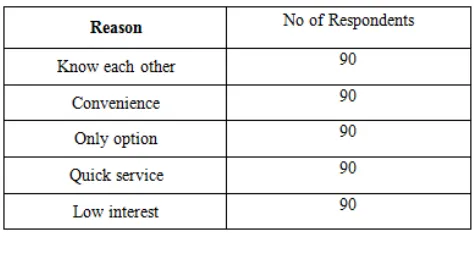
The sample units were motivated towards the
unconventional financial sources to obtain finance by motives such as, Know each other, Convenience, Only option, Quick service, Low interest. Out of ninety samples all respondents were mentioned these reasons.
Barriers experienced for obtain finance from
conventional financial sources:
All respondents express their hard experience
with conventional financial sources regretfully, that the obstacles they were experienced in conventional financial sources were,rigid rules and regulations, documentation, redtapism, procedure, collateral security, government employee security, corruption and so on.
Hypothesis 1 testing:
The analysis showed that small scale industries are facing challenging problems to access finance from conventional financial sources, hence, first hypothesis is acceptable.
Hypothesis 2 testing:
The analysis showed that unconventional
financial sources are playing very vital role as lender to SSIs, so second hypothesis is acceptable.
IX.
FINDINGS OF THE STUDY
The analysis of demographic information of sampled units showed that majority of small scale enterprises are involving in manufacturing activities, leading by men entrepreneurs, and the age of an entrepreneur is above 35years, they are professionals and married, also the majority of entrepreneurs are degree holders.
The analysis of awareness towards policies and procedures to obtain finance from conventional financial sources showed that majority of respondents had not well known the policies and procedures to obtain finance from conventional financial sources.
It is identified while analyzing that
294 Copyright © 2011-15. Vandana Publications. All Rights Reserved.
unconventional sources of finance to overcome from financial problem and limitations of conventional financial sources.
SSIs are hesitating to approach conventional sources of finance to obtain finance; instead they are depending on unconventional financial sources to the maximum extent to get finance. It seems SSIs are more comfortable with unconventional financial sources. Because of conventional financial sources indeed limitations.
In total government is completely forgot the industrial growth, especially the growth of Small Scale Industries in Karnataka.
X.
CONCLUSION
Main purpose of any business entity is to make profit, but the profitability of business entity relays on their level of competency in satisfying customers, timely supply of goods and services, post sale service, quality management, effective promotional strategies and so on, to undertake all above mentioned activities Small Scale Industries require timely supply of financial resources from financial sources. The analysis showed that financial sources are classified as conventional and unconventional; in this regard conventional financial sources are having plenty limitations to access finance to SSIs, so unconventional financial sources are playing significant role in facilitating timely finance, hence SSIs are extensively depending on unconventional financial sources. Small Scale Industries are playing a vital role in Indian economy in terms of industrial production, employment, export, and supply of daily essential goods and services. It seems SSIs are neglected by government and conventional financial sources. So I strongly suggest government to frame rigid rules to conventional financial sources to lend SSIs timely with trim down their lending policies.
Finally, unconventional finance and institutions arise in an environment with weak formal institutions and become a vital engine to fund economic growth.
REFERENCES
[1] Allen, franklin, rajesh chakrabarti, sankar de, jun qian, meijun qian, 2012, financing Small Scale Industries in india, journal of financial intermediation 21, 409-445. [2] Allen, franklin, jun qian, and meijun qian, 2005, law, finance, and economic growth in china. Journal of financial economics 77, 57–116.
[3] Giannetti, mariassunta and xiaoyun yu, 2007, connections and information acquisition in capital allocation, ecgi finance working paper 153.