http://dx.doi.org/10.22161/ijeab/3.1.11 ISSN: 2456-1878
Impact of elevated Carbon Dioxide on two
groundnut genotypes (Arachis hypogaea L.)
under Open Top Chamber facility
Manjula.O
1*, M.Srimurali
2, M.Vanaja
31Deapartment of Civil Engineering, Sri Venkateswara University, Tirupati 517 502, Andhra Pradesh, India.
2Deapartment of Civil Engineering, Sri Venkateswara University, Tirupati 517 502, Andhra Pradesh, India.
3Central Research Institute for Dryland Agriculture, Santoshnagar, Hyderabad 500 059, India.
*Corresponding author: [email protected], +917729904598
Abstract— The impact of enhanced atmospheric CO2
concentration (550ppm) was assessed in Open Top Chambers (OTCs) facility to identify the growth and yield parameters at different growth stages of two popular groundnut (Arachis hypogaea L.) genotypes- Dharani, K-9. The results showed significant differences between genotypes, CO2 levels and time intervals for all the
characters studied. The experiments revealed that the genotype Dharani recorded higher response for seed weight, harvest index at eCO2 while K-9 recorded higher
response for total biomass.This study is necessary if we are to realize the potential genotype for maximum yield in the future climate change scenario.
Keywords— Arachis hypogaea L., Elevated CO2,Yield,
Biomass,Open Top Chamber.
I. INTRODUCTION
The carbon dioxide (CO2) concentration in the atmosphere is increasing due to human activities, fossil fuel combustion and energy use scenario [1]. The increased levels of CO2 have led to an increased threat of global warming and climate change. Changes in climate factors such as increasing CO2 concentration, increased temperature and changed precipitation pattern may have significant impacts on plant development and metabolism. The concentration of atmospheric CO2 has been progressively increasing from 280 ppm (pre-industrial era) in the year 1850 to 407 ppm in 2017 [2]. This created an attention towards the crop responses to enhanced CO2 levels and also to identify the responsive high yielding genotypes in order to enhance the productivity and production.
The agricultural productivity need to be increased to meet the demand for protein-rich diets due to rising global population. The pre-historic records shows legumes are the oldest cultivated crops and at present they are considered as the major nutrient supplying crops for a balanced human diet [3]. Groundnut seed is chiefly used
for edible oil and contains nearly half of the essential vitamins and one-third of the essential minerals. So, for
the resource poor farmer’s groundnut play an important
role in nutritional security [4]. Furthermore it is an excellent fodder for livestock. The productivity of groundnut in Andhra Pradesh is very low against Indian productivity (1615 kg ha-1) and world productivity (1676 kg ha-1). The low productivity can be due to erratic rainfall, incidence of pests and diseases in addition to cultivation of low yielding varieties etc. [5].
Keeping in view the climate change scenario and high yielding groundnut crop varieties, an experiment was conducted in Open Top Chamber facility. The present study was conducted:
To realize the potential genotype of groundnut for maximum yield to elevated/enhanced Carbon Dioxide concentration (550ppm) when compare with ambient CO2 (400ppm) in Andhra Pradesh.
To conduct the experimentin Open Top Chambers (OTCs) facility for evaluating the best groundnut genotype.
To identify the growth and yield parameters at different growth stages of two popular groundnut (Arachis hypogaea L.) genotypes- Dharani and K-9.
II. MATERIALS AND METHODS
2.1 Materials: The field investigations were carried
http://dx.doi.org/10.22161/ijeab/3.1.11 ISSN: 2456-1878
directly in the soil and the observations were recorded atregular intervals from sowing to harvest.
2.2 Open Top Chamber facility: The OTCs are
lined with transparent (90% transmittance of light) PVC (polyvinyl chloride) sheet having 3m x 3m x 3m dimensions. Six OTCs were used for the experimental purpose. Four OTCs were maintained with eCO2 of 550ppm and the other two OTCs served as an ambient control without any additional CO2 supply. Throughout the day within the OTCs, eCO2 concentration was maintained and monitored continuously during the experimental period. Continuous injecting of 100% CO2 from a compressed CO2 cylinder into plenum of OTCs was done to maintain the eCO2 in OTCs at crop canopy level, where it was mixed with air from air compressor before entering into the chamber. From the centre point of OTCs the air sample from each chamber was drawn at three-minute interval into non-dispersive infrared (NDIR) CO2 analyzer (California Analytical) and the CO2 concentration was maintained with an automatic switching solenoid, rotameters, Program Logic Control (PLC) and Supervisory Control and Data Acquisition (SCADA) software [6].But gentle washing was frequently done to maintain the transparency of polythene cover.
Inside the OTCs, the maximum temperatures were 1 to 1.5°C higher than outside except for few days following rainfall while the minimum temperatures remained nearly the same. However, there was no significant difference in their maximum temperatures among the aCO2 and eCO2. Likewise, inside the chambers relative humidity (RH) was higher as compared to outside. The light intensity in chambers was 80-95% of outside environment. Continuous growth measurements were made at 30, 60, 75, 90 and 110 days i.e. flowering, pegging, poding and at harvest respectively. The recommended agricultural practices were followed during the crop growth period in the OTCs and also the crop was maintained free from moisture stress, pests and diseases.
The characteristics of the test field includes sandy loam in texture, neutral in pH (6.8), low in available nitrogen (225 kg ha-1), medium to high in available potassium (300 kg K2O ha-1) and phosphorus (10 kg ha-1). The crop received 662.8 mm rainfall during the crop growth period. Relative humidity and temperature was
continuously measured using the sensors fitted inside the chambers throughout the experimental period.
Destructive samples of two groundnut genotypes were drawn from both CO2 levels at 30, 60, 75, 90, DAS and at harvest (110 DAS) in order to record plant height, leaf area, root length, root volume, pod number and biomass of leaf, stem and root.
The plant height was measured from base of the plant to the tip of main shoot and root length was recorded on main root of plant and expressed in centimetres. The root volume was quantified by water displacement method and expressed as ml. The leaf area at different intervals was measured with photo-electronic leaf area meter (LI-3100, LI-COR) and expressed as cm2/plant. The dry weights of stem, root and leaf were recorded after thorough drying of plant material in hot air oven at 65°C and expressed as g/plant.
The groundnut crop was harvested at 110 days. Three replications with five plants for each replication in each CO2 concentration were harvested and used for recording final biomass, fodder yield, seed yield and its components viz., pod number, pod weight, seed number and 100 seed weight. The HI (%) was calculated as (seed yield)/ (total above ground dry mass) * 100.
The data were statistically analyzed using a three way analysis of variance (ANOVA) to test the significance of variability between the genotypes, CO2 concentrations, time intervals and their interactions using star software.
III. RESULTS & DISCUSSION
http://dx.doi.org/10.22161/ijeab/3.1.11 ISSN: 2456-1878
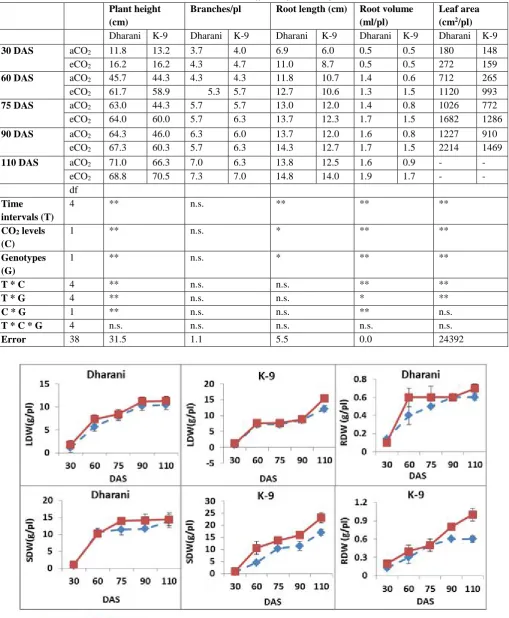
Table 1: The mean per se values and analysis of variance of morphological parameters of groundnut genotypes (Dharani & K-9) under aCO2 and eCO2 conditions at different growth stagesPlant height
(cm)
Branches/pl Root length (cm) Root volume
(ml/pl)
Leaf area (cm2/pl) Dharani K-9 Dharani K-9 Dharani K-9 Dharani K-9 Dharani K-9
30 DAS aCO2 11.8 13.2 3.7 4.0 6.9 6.0 0.5 0.5 180 148
eCO2 16.2 16.2 4.3 4.7 11.0 8.7 0.5 0.5 272 159
60 DAS aCO2 45.7 44.3 4.3 4.3 11.8 10.7 1.4 0.6 712 265
eCO2 61.7 58.9 5.3 5.7 12.7 10.6 1.3 1.5 1120 993 75 DAS
aCO2 63.0 44.3 5.7 5.7 13.0 12.0 1.4 0.8 1026 772 eCO2 64.0 60.0 5.7 6.3 13.7 12.3 1.7 1.5 1682 1286
90 DAS aCO2 64.3 46.0 6.3 6.0 13.7 12.0 1.6 0.8 1227 910
eCO2 67.3 60.3 5.7 6.3 14.3 12.7 1.7 1.5 2214 1469
110 DAS aCO2 71.0 66.3 7.0 6.3 13.8 12.5 1.6 0.9 - -
eCO2 68.8 70.5 7.3 7.0 14.8 14.0 1.9 1.7 - -
df
Time intervals (T)
4 ** n.s. ** ** **
CO2 levels (C)
1 ** n.s. * ** **
Genotypes (G)
1 ** n.s. * ** **
T * C 4 ** n.s. n.s. ** **
T * G 4 ** n.s. n.s. * **
C * G 1 ** n.s. n.s. ** n.s.
T * C * G 4 n.s. n.s. n.s. n.s. n.s.
Error 38 31.5 1.1 5.5 0.0 24392
http://dx.doi.org/10.22161/ijeab/3.1.11 ISSN: 2456-1878
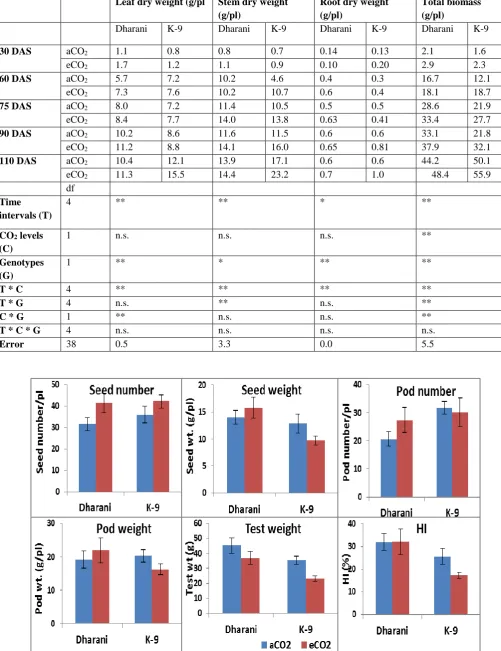
Table 2: The mean per se values and analysis of variance of biomass parameters of groundnut genotypes (Dharani &K-9)under aCO2and eCO2conditions atdifferentgrowth stages
Leaf dry weight (g/pl Stem dry weight
(g/pl)
Root dry weight (g/pl)
Total biomass (g/pl)
Dharani K-9 Dharani K-9 Dharani K-9 Dharani K-9
30 DAS aCO2 1.1 0.8 0.8 0.7 0.14 0.13 2.1 1.6
eCO2 1.7 1.2 1.1 0.9 0.10 0.20 2.9 2.3
60 DAS aCO2 5.7 7.2 10.2 4.6 0.4 0.3 16.7 12.1
eCO2 7.3 7.6 10.2 10.7 0.6 0.4 18.1 18.7
75 DAS aCO2 8.0 7.2 11.4 10.5 0.5 0.5 28.6 21.9
eCO2 8.4 7.7 14.0 13.8 0.63 0.41 33.4 27.7
90 DAS aCO2 10.2 8.6 11.6 11.5 0.6 0.6 33.1 21.8
eCO2 11.2 8.8 14.1 16.0 0.65 0.81 37.9 32.1
110 DAS aCO2 10.4 12.1 13.9 17.1 0.6 0.6 44.2 50.1
eCO2 11.3 15.5 14.4 23.2 0.7 1.0 48.4 55.9
df
Time intervals (T)
4 ** ** * **
CO2 levels (C)
1 n.s. n.s. n.s. **
Genotypes (G)
1 ** * ** **
T * C 4 ** ** ** **
T * G 4 n.s. ** n.s. **
C * G 1 ** n.s. n.s. **
T * C * G 4 n.s. n.s. n.s. n.s.
Error 38 0.5 3.3 0.0 5.5
http://dx.doi.org/10.22161/ijeab/3.1.11 ISSN: 2456-1878
3.1 Shoot parameters: The maximum plant height
of both the genotypes recorded at the harvest stage. The maximum plant height in Dharani was 71cm at aCO2 and 68.8cm at eCO2, whereas it was 66.25cm and 70.5cmrespectively with K-9. The maximum increment in plant height with eCO2 was at 30 DAS in Dharani (37%), at 75 DAS in K-9 (35%) when compared with aCO2. A significant increase in plant height, leaf expansion in sweet potato and cowpea was reported by Bhattacharya et al. under eCO2 [7].
At harvest, the mean stem dry weight was 13.9g/plant and 14.4g/plant in Dharani while 17.1g/plant and 23.2g/plant in K-9 at aCO2 and eCO2 respectively. The maximum percentage increment in stem dry weight with eCO2 was observed as 44.6% at 30DAS in Dharani while 131.9% at 60 DAS in K-9. The genotype K-9 showed better response of stem dry weight than Dharani at eCO2. Similar increase in stem dry weight throughout the crop growth period with eCO2 in castor was reported by Vanaja et al.[8].
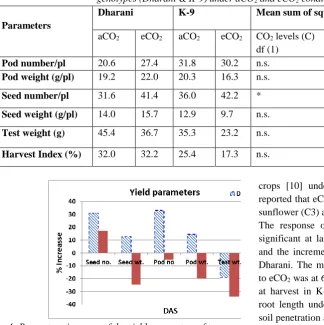
Table 3: The mean per se values and analysis of variance of yield parameters of groundnut genotypes (Dharani & K-9) under aCO2 and eCO2 conditions at harvest
Parameters
Dharani K-9 Mean sum of square
aCO2 eCO2 aCO2 eCO2 CO2 levels (C) df (1)
Genotypes (G) df (1)
C * G df (1)
Error df (6)
Pod number/pl 20.6 27.4 31.8 30.2 n.s. n.s. n.s. 58.1
Pod weight (g/pl) 19.2 22.0 20.3 16.3 n.s. n.s. n.s. 8.5
Seed number/pl 31.6 41.4 36.0 42.2 * n.s. n.s. 37.9
Seed weight (g/pl) 14.0 15.7 12.9 9.7 n.s. * * 5.4
Test weight (g) 45.4 36.7 35.3 23.2 n.s. n.s. n.s. 80.5
Harvest Index (%) 32.0 32.2 25.4 17.3 n.s. ** * 18.6
Fig.4: Percentage increase of the yield parameters of two groundnut genotypes due to eCO2 over aCO2
3.2 Root parameters: The percentage increment of
root length varied from 4 to 59% in Dharani, 3 to 44% in K-9 with eCO2 and the highest increment in root length was noticed at 30DAS. The root length was 13.8cm and 14.8cm in Dharani whereas 12.5cm and 14cm in K-9 at aCO2 and eCO2.The CO2 enrichment enhances the root growth much more by increasing its length, volume and weight. Increased root length was observed by Madhu et al. with increased CO2 conditions in groundnut crop [9]. The improved response due to eCO2 was more significant at initial growth stages of K-9 while a linear increase recorded with Dharani. Higher increment in root volume than root length was observed by Vanaja et al. in rainfed
crops [10] under eCO2. Vanaja et al. observed and reported that eCO2 significantly increased root volume in sunflower (C3) and maize (C4) crops [11].
The response of root dry weight to eCO2 was more significant at later growth stages in both the genotypes and the increment was higher in K-9 as compared with Dharani. The maximum increase in root dry weight due to eCO2 was at 60 DAS in Dharani (50%), whereas it was at harvest in K-9 (66.7%). The increased root volume, root length under eCO2 infers the possibility of deeper soil penetration and spread to more volume of soil, which would be an advantage in a drier climate. In general enhanced CO2 strongly enhanced the root growth by increasing its length, volume and weight. Vaidya et al. [12]testified that the biomass of stem, root, leaf and total biomass of groundnut genotypes recorded significant increase at eCO2.
3.3 Leaf parameters: The maximum incrementin
leaf area with eCO2was 80.4% in Dharani while it was 274.5% in K-9. Increased CO2 tends to accelerate the growth and leaf area per plant, which may increase the total biomass. Leaf area was increased by 46% at eCO2 compared to ambient grown by Jyothilakshmi et al. in Vigna mungo L.[13].
http://dx.doi.org/10.22161/ijeab/3.1.11 ISSN: 2456-1878
groundnut. Increased leaf area and leaf biomass areexpected to improve total biomass as well as yield of a crop as it can improve the photo assimilation of the plant.
3.4 Total Biomass: Among the two genotypes,
Dharani recorded higher total biomass at all growth stages as well as under both aCO2 and eCO2 than K-9 while K-9 recorded higher response to eCO2. It is interesting to observe that the eCO2 impact on total biomass was more at initial growth stages as total biomass increased by 42.4% in Dharani at 30DAS whereas 53% in K-9 at 60 DAS. The increased total biomass at eCO2 in both the genotypes was mainly contributed by enhanced stem and leaf biomass at initial growth stages. An increased above ground biomass in pigeon pea under elevated CO2 conditions wasdetectedby Saha et al. [14].
3.5 Yield parameters: Higher numbers of pods
were observed at eCO2 in Dharani while at aCO2 in K-9. Similar trend was recorded for pod weight and seed weight. It is excited to perceive that among the yield parameters, eCO2 improved only seed number with K-9 and this response could not improve seed weight as the seed filling in this genotype was poor which reflected in reduced test weight. It is also noted that in both the genotypes the test weight decreased under eCO2 and it could be due to the prolonged peg initiation and pod formation with poor seed filling.
Among all the yield parameters, Dharani recorded improved performance for pod number, pod weight, seed number, seed weight with eCO2 while only seed number improved with K-9. Under aCO2 more number of pods per plant was recorded with K-9 while higher improvement with eCO2 was registered with Dharani. The increased pod number in Dharani contributed to increased pod weight and seed weight at eCO2 while no response was recorded with K-9. The reduced test weight in K-9 indicating poor seed filling at eCO2 though higher seed number was recorded. It clearly indicating the response of vegetative and reproductive biomass at eCO2 differed with selected genotypes, as higher improvement in vegetative biomass with K-9 and reproductive biomass with Dharani was observed.
3.6 Harvest index (%) (H): The genotype Dharani
maintained similar HI at both aCO2 and eCO2 as this genotype was able to proportionate the increased biomass to reproductive components. However the response of K-9 was entirely different and the increased total biomass at eCO2 was mainly due to improved performance of vegetative components specially leaf and stem biomass and the yield components failed to respond to the eCO2. This resulted in decreased HI of K-9 at eCO2 revealing that this genotype was not able to take the advantage of enhanced CO2 environment in terms of yield. The results
which are in tune with previously reported findings revealed a significant increase in the HI in black gram due to their improved partitioning efficiency under eCO2 conditionby Vanaja et al. [15].
The results obtained from the present study showed an increase in the dry matter production as well as economic yield at eCO2 level. The seed yield improved by 12.59% in Dharani, whereas the harvest index (HI) increased only by 0.7%. This clearly shows that the eCO2 improved both biomass and economic yield. Thus it may be concluded that the groundnut genotype Dharani is positively responding to increasing CO2 not only for biomass but also for seed yield.It was also conveyed by Krishna Reddy et al. that Dharani produced significantly higher pod yield than other genotypes on sandy loam soils of Tirupati, Andhra Pradesh, during early kharif under irrigated conditions [16].
To conclude, the present study reveals that the importance of legume crops which are protein rich could also sustain under climate change to meet the demand. Overall results revealed that the highest response to eCO2 in terms of seed weight, harvest index was shown by Dharani, biomass in K-9. Hence identification of traits and genotypes to fit in the future predicted climatic conditions is required to sustain and improve the yield.
ACKNOWLEDGMENT
The authors acknowledge the encouragement and support of CoE (Centre of Excellence, SVUCE, S.V. University, Tirupati), Director-CRIDA (Central Research Institute for Dryland Agriculture), Hyderabad.
REFERENCES
[1] Black C.K., Davis S.C., Hudiburg T.W., Bernacchi
C.J., DeLucia E.H. (2017): “Elevated CO2 and
temperature increase soil C losses from a soybean–
maize ecosystem”. Global Change Biology, 23 (1): 435-445.
[2] Asha H.N., Jones N.P., Madhura A.S., Venkatesh H.
(2017): “Impact of elevated CO2 and/or temperature
on the AM fungal diversity in groundnut rhizosphere
under Open Top Chamber facility”. International Journal of Current Microbiology and Applied Sciences, 6(1): 882-895.
[3] International Crops Research Institute for Semi-Arid Tropics. 2012. Jewels of ICRISAT. Patancheru, Telangana, India.
[4] Murugan P., Nisha P.R. (2016): “Evaluation of high yielding groundnut varieties for north eastern zone of
Tamil Nadu”. Journal of Krishi Vigyan, 5 (1): 64-66. [5] Niveditha P.D., Sudharani M., Rajesh A.P., Nirmala
P.J. (2015): “Studies on genetic variability,
http://dx.doi.org/10.22161/ijeab/3.1.11 ISSN: 2456-1878
components and quality traits in peanut stem necrosistolerant groundnut genotypes (Arachis hypogaea
L.)”. Journal of Research ANGRAU, 43 (3/4): 29-33. [6] Vanaja M., Maheswari M., Ratnakumar P.,
Ramakrishna Y.S. (2006a): “Monitoring and
controlling of CO2 concentrations in open top chambers for better understanding of plants response
to elevated CO2 levels”. Indian Journal of Radio and
Space Physics, 35: 193–197.
[7] Bhattacharya, N. C., Biswas P.K., Battacharya S.,
Sionit N., Strain B.R. (1985): “Growth and yield
response of sweet potato to atmospheric CO2 enrichment”. Crop Science, 25 (6): 975-981.
[8] Vanaja M., Jyothi M., Ratnakumar P., Vagheera P., Raghuram Reddy P., Jyothi Lakshmi N., Yadav S.K.,
Maheshwari M., Venkateswarlu B. (2008): “Growth
and yield responses of castor bean (Ricinus communis L.) at two enhanced CO2 levels”. Plant, Soil and Environment. Plant Soil and Environment, 54: 38-46.
[9] Madhu M., Hatfield J.L. (2013): “Dynamics of plant root growth under increased atmospheric carbon
dioxide”. Agronomy Journal, 105 (3): 657-669. [10] Vanaja M., Vagheera P., Ratnakumar P., Jyothi
Lakshmi N., Raghuram Reddy P., Yadav S.K., Maheswari M., Venkateswarlu B. (2006b): Evaluation of certain rainfed food and oil seed crops for their response to elevated CO2 at vegetative stage. Plant Soil and Environment, 52 (4): 164-170. [11] Vanaja M., Yadav SK., Archana G., Jyothi Lakshmi
N., Raghu Ram Reddy P., Vagheera P., Abdul Razak SK., Maheswari M., Venkateswarlu B. (2011):
“Response of C4 (Maize) and C3 (Sunflower) crop
plants to drought stress and enhanced carbon dioxide concentration”. Plant Soil and Environment, 57 (5): 207-215.
[12] Vaidya Sunitha, Vanaja M., Sathish P., Vagheera P., Anitha Y., Sowmya P., Jainender, Jyothi Lakshmi N.
(2014): “Impact of elevated CO2 on growth and
physiological parameters of groundnut (Arachis hypogaea L.) genotypes”. Journal of Plant Physiology & Pathology, 3 (1): (doi:10.4172/2329-955X.1000138).
[13] Jyothilakshmi N., Vanaja M., Yadav S.K., Maheswari M., Vagheera P., Venkateswarlu B.
(2013): “Genotypic variation in growth and yield of
blackgram (Vigna mungo) genotypes in response to
increased carbon dioxide concentration”. Indian Journal of Agricultural Sciences, 83 (2): 184-188. [14] Saha S., Sehgal V.K., Nagarajan S., Madan Pal
(2012): “Impact of elevated atmospheric CO2 on
radiation utilization and related plant biophysical properties in pigeon pea (Cajanus cajan
L.)”. Agricultural and Forest Meteorology, 158: 63-70.
[15] Vanaja M., Raghu Ram Reddy P., Jyothi Lakshmi N., Maheswari M., Vagheera P., Ratnakumar P., Jyothi M., Yadav S.K., Venkateswarlu B. (2007): “Effect of elevated atmospheric CO2 concentrations on growth and yield of blackgram (Vigna mungo L. Hepper)- a rainfed pulse crop”. Plant Soil and Environment, 53: 81-88.
[16] Krishna Reddy G., Muneendra Babu A., Maheswara Reddy P., Giridhara Krishna T. (2013): “Effect of time of sowing and groundnut cultivars under irrigated conditions of Southern Agro-climatic Zone
of Andhra Pradesh, during early Kharif”. Green