The Thirty-Third AAAI Conference on Artificial Intelligence (AAAI-19)
Semantic Proposal for Activity Localization in Videos via Sentence Query
Shaoxiang Chen, Yu-Gang Jiang
∗Shanghai Key Lab of Intelligent Information Processing, School of Computer Science, Fudan University Shanghai Institute of Intelligent Electronics & Systems
{sxchen13, ygj}@fudan.edu.cn
Abstract
This paper presents an efficient algorithm to tackle temporal localization of activities in videos via sentence queries. The task differs from traditional action localization in three as-pects: (1) Activities are combinations of various kinds of ac-tions and may span a long period of time. (2) Sentence queries are not limited to a predefined list of classes. (3) The videos usually contain multiple different activity instances. Tradi-tional proposal-based approaches for action localization that only consider the class-agnostic “actionness” of video snip-pets are insufficient to tackle this task. We propose a novel Semantic Activity Proposal (SAP) which integrates the se-mantic information of sentence queries into the proposal gen-eration process to get discriminative activity proposals. Vi-sual and semantic information are jointly utilized for proposal ranking and refinement. We evaluate our algorithm on the TACoS dataset and the Charades-STA dataset. Experimental results show that our algorithm outperforms existing methods on both datasets, and at the same time reduces the number of proposals by a factor of at least 10.
1
Introduction
Recognizing “what’s happening” in videos is a crucial task of visual understanding. Recent success of deep learning and computer vision has advanced this task from action classifi-cation (Simonyan and Zisserman 2014; Karpathy et al. 2014; Ng et al. 2015; Tran et al. 2015) to detection (Zhao et al. 2017; Yuan et al. 2017; Lin et al. 2018) i.e. temporal lo-calization of actions in videos. Traditional action detection approaches makes one important assumption: the actions to be detected are atomic and in a predefined list (Karpathy et al. 2014; Heilbron et al. 2015; Monfort et al. 2018). Thus these approaches are insufficient to describe and detect the combination of a series of actions.
In this paper, we aim to tackle temporal localization of ac-tivitiesin videos viasentencequeries, which is a more desir-able setting. It has three major differences compared to tra-ditional action localization: (1) Activities are more complex than atomic actions like boxing or drinking. The definition of activity we adopt here is actually the same as “high-level event” defined in (Jiang et al. 2013): an activity is composed
∗
Corresponding author.
Copyright c2019, Association for the Advancement of Artificial Intelligence (www.aaai.org). All rights reserved.
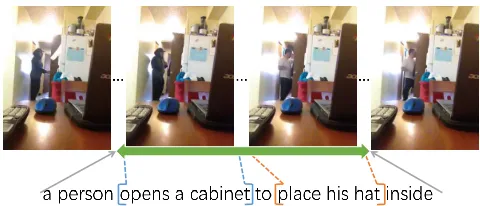
Figure 1: Sample of temporal activity localization via sen-tence query.
by several actions or interactions. The latter is more com-mon and is the process of a subject interacting with an ob-ject. They may happen in order or co-occur. (2) Sentences are not constrained to a predefined list. They are variable re-garding both structure and content, thus can describe various activities. (3) The videos usually contain multiple different activity instances and each may span a long duration. Fig-ure 1 shows an example in which the query sentence is “a person opens a cabinet to place his hat inside ”, which de-scribes an activity composed by two interactions involving two objects: cabinet and hat.
activ-ities, the absence of proper activity proposals will lead to a large number of candidates, and result in inefficient algo-rithms.
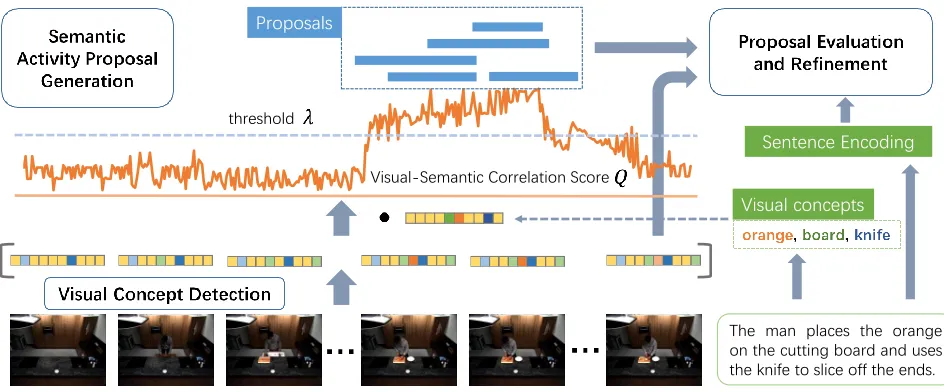
To tackle the challenge of activity proposal generation for sentence query, we propose a novel Semantic Activity Pro-posal (SAP) framework to integrate the semantic informa-tion in sentences into the activity proposal generainforma-tion pro-cess. We first train a visual concept detection CNN with paired sentence-clip training data. The visual concepts are selected from training sentence according to their frequen-cies. For proposal generation, the visual concepts extracted from the query sentence and video frames are used to com-pute visual-semantic correlation score for every frame. Ac-tivity proposals are generated by grouping frames with high visual-semantic correlation score. Finally, the visual features of video frames, the visual concept vectors and the textual features of sentence queries are utilized to compute a visual-textual alignment score and a refinement of the temporal boundaries for proposals.
Our contributions in this work are as follows:
(1) We propose a novel proposal generation algorithm and framework for temporal activity localization via sentence queries. The proposed Semantic Activity Proposal (SAP), to the best of our knowledge, is the first work to integrate semantic information of sentences into proposal generation. (2) The proposed framework not only achieves supe-rior localization performance over the state-of-the-art on the TACoS dataset and the Charades-STA dataset, but also re-duced the average number of proposals by a factor of at least 10, which is a significant improvement of efficiency.
2
Related Work
Action Classification. There has been a large number of studies about action classification using deep convolutional neural networks (CNNs). (Tran et al. 2015) extend the 2D CNN architecture used in image classification tasks to 3D, which includes temporal dimension and can model short-term motion in video clips. (Simonyan and Zisserman 2014) combine two 2D CNNs which model RGB image and opti-cal flow image to predict the actions in videos. 3D convo-lution and optical flow are not enough to model long-term motion information in untrimmed videos, thus later works focused on aggregating temporal information. (Karpathy et al. 2014) propose various kinds of temporal information fu-sion strategies for CNN inputs. (Ng et al. 2015) use the Long Short Term Memory (LSTM) as a feature aggregation technique. (Wang et al. 2017) integrate non-local operation (which can be viewed as a form of attention) into 3D CNN to model relations between consecutive frames. However, these methods deal with trimmed videos or untrimmed videos which contain single action instance. Hence they don’t con-sider the temporal localization of actions.
Action Proposal and Temporal Localization. Temporal action localization methods are based on action proposals, which generates a limited number of candidate temporal re-gions. A major group of action proposal methods are based on “actionness grouping”. (Zhao et al. 2017) train an
ac-tionness classifier to evaluate the binary acac-tionness proba-bilities for individual snippets and then use the proposed temporal actionness grouping (TAG) the generate propos-als. Such strategy is also adopted by later works: (Lin, Zhao, and Shou 2017b; Shou et al. 2017; Gao, Chen, and Neva-tia 2018). (Yuan et al. 2017; Lin et al. 2018) devise algo-rithms to compose action proposals based on the probabil-ities of starting, course, and ending of every time point if the videos. Another group of works first generate anchors of variable length at every temporal position and then evaluate them by predicting 0/1 actionness label or action class la-bel. DAP (Escorcia et al. 2016) and SST (Buch et al. 2017) use an LSTM or GRU unit to process the feature sequence of a video to produce K proposals at each time step. (Gao et al. 2017b) propose to generate and evaluate a clip pyra-mid at every anchor unit in the frame sequence. (Lin, Zhao, and Shou 2017a) also use convolutional layer to produce an-chors hierarchically with different granularities. (Xu, Das, and Saenko 2017) design 3D convolutional network to map a video snippet to predictions of anchor segments.
Video/Image Retrieval with Sentence. Our work is also closely related to video retrieval with sentence, which re-quires retrieving the videos/images from a set of candi-dates that match the given sentence query. In (Wang, Li, and Lazebnik 2016), image and text are embedded into the same space via the proposed deep structure-preserving image-text embeddings. In (Karpathy and Li 2015), they embed object regions and words into the same multi-modal space, then region-word pairwise similarities are computed and reduced to image-sentence score for retrieval. To retrieve videos via complex textual queries, (Lin et al. 2014) parse the sentences into semantic graphs and match them to visual concepts in the videos. But the retrieval of whole videos is different from temporal localization in our settings.
im-Visual-Semantic Correlation Score
The man places the orange on the cutting board and uses the knife to slice off the ends.
Sentence Encoding Proposals
Visual concepts
threshold
Figure 2: The proposed framework for temporal activity localization via sentence query. There are three main components: (1) Visual Concept Detection produces vectors of probabilities of containing common visual concepts for sampled frames. These visual concept vectors dot-product with the one extracted from query sentence, results are the visual-semantic correlation score. (2) Semantic Activity Proposals are generated by temporally grouping frames with high correlation score. (3) Proposal Evaluation and Refinement takes the proposals, visual concept vectors and query sentences as input, and outputs alignment scores and refined boundaries for the proposals.
portance of generating activity proposals, let alone integrat-ing textual information into proposal generation.
3
Approach
3.1
Problem Formulation
A videoV is denoted as a sequence of frames:V ={ft}T t=1. Each video is associated with a set of temporal annotations A = {(dj, sj, ej)Nj=1}, whereN is the number of annota-tions,dj is the sentence description, the corresponding clip of videoV starts at framesjand ends at frameej. The task is to predict the start and end time for a given sentence query.
3.2
Framework
Visual Concept Detection. In this work, we define vi-sual conceptas the visible object and actions in the videos. They are described by the sentences, thus the words in the sentences correspond to visual concepts in the video frames, such as orange, cup, and wash. While there are no spatial bounding box annotations for the words, a visual concept detector can be trained using Multiple In-stance Learning (MIL) (Maron and Lozano-P´erez 1997; Viola, Platt, and Zhang 2005; Fang et al. 2015). We first select K most common words (visual concepts) in all the training sentences. Each sentence descriptiondjcan then be converted to a one-hot vectorcj, whereck
jequals to1means wordkis in the sentence, and0otherwise. Meanwhile, we assume that every frame of the corresponding clip will con-tain the visual concepts indj. Thus we randomly sample a framefjfrom the clip(sj, ej)as the input to visual concept detector. We define the visual concept detector as a func-tionFvcd(fj)that maps an image to a visual concept vector
pj. Inside Fvcd, a CNN Fcnn is utilized as visual feature extractor, whose input is an image fj and output is a fea-ture mapMj.Mh,wj is the feature vector of lengthm for image region indexed by h, w, which is transformed by a fully-connected layer:
Pjh,w=sigmoid(Mh,wj W+b), (1)
whereW ∈Rm×Kandb∈ RK are trainable parameters.
Pjh,wis then the word probability vector of image region in-dexed byh, w. We use the noisy-OR version of MIL (Viola, Platt, and Zhang 2005) to compute the final probability for the whole image:
pj= 1− Y
h,w
(1− Pjh,w), (2)
wherepjis a vector of lengthKandpkj stands for the prob-ability of wordkappearing in framefj. We denotepjas the visual concept vector for frame fj. Equation 1 and 2 con-clude the details of the visual concept detectorFvcd. To learn the parameters ofFvcd, we adopt the cross-entropy loss:
Lossvcd=− K X
k=1 ckjlogp
k
j. (3)
Algorithm 1Semantic Activity Proposal Generation 1: functionSEMANTICACTIVITYPROPOSAL(Q,λ,τ) 2: R← ∅ .Grouped temporal regions
3: G← ∅ .Generated proposals
4: end←True 5: fort=1toTdo
6: ifendthen
7: ifQi≥λthen .Start a new temporal group
8: s←t
9: end←False 10: else
11: r←ratio ofQi≥λin[s, t] .Get positive ratio 12: ifr < τthen .Positive ratio under tolerance
13: end←True
14: add[s, t]toR .End current temporal group 15: fors, tinRdo
16: forLin proposalLengthsdo .List of lengths 17: propL←sliding windows ofLin[s, t]
18: add propL toG
19: returnG
sentencedjand frames can be represented asQj ={qtj}Tt=1, where
qjt=pt·cj. (4)
qtj stands for the total probabilities of frame t containing all the visual concepts in queryj.Qjis then normalized to [0,1]. As shown in Figure 2, frames with more visual con-cepts described indj tend to get higher correlation score. Frames with score above a thresholdλare considered pos-itive, i.e. related to the sentence query. We use a binary-search algorithm to determineλ, such that the ratio of pos-itive frames does not exceed0.06. This value is chosen to make a balance between the number of generated proposals and the recall, and is decided on the validation set. When the positive frames are selected, we adopt an algorithm sim-ilar to (Zhao et al. 2017) to group the positive frames into consecutive temporal regions. To account for false negative frames, an extra parameterτ is introduced as the tolerance ratio, which controls the ratio of negative frames allowed in a temporal region. The activity proposals are finally gener-ated with a predefined length inside the grouped temporal regions using sliding window. Algorithm 1 shows the details of the temporal grouping process.
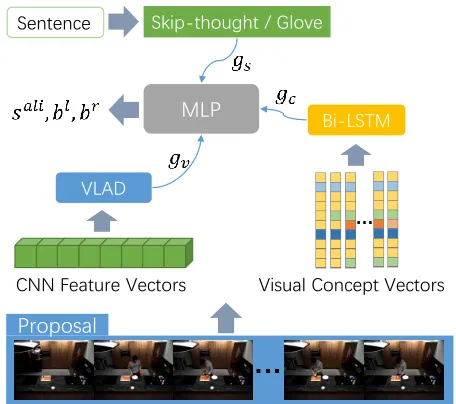
Proposal Evaluation and Refinement. The details of proposal evaluation and refinement are shown in Figure 3. For a specific query (dj, sj, ej), we denote the generated proposals byGj ={(ln, rn)}
Nj
n=1, whereNjis the number of proposals andln, rnare the temporal boundaries.Gjwill be evaluated to produce alignment scores, which are then used to rank the proposals. Since the generated proposals have fixed lengths, their boundaries will be further refined to localize the activities more precisely. First, the visual fea-ture vectors and concept vectors of the frames inside pro-posal region are extracted from a pre-trained CNN, denoted byfvandfc, respectively. Next, these vectors are aggregated as a single feature vector. For visual features, we adopt the trainable VLAD encoding (Miech, Laptev, and Sivic 2017).
CNN Feature Vectors
Bi-LSTM
VLAD
Visual Concept Vectors Skip-thought / Glove
Proposal Sentence
MLP
Figure 3: The proposal evaluation and refinement process.
For visual concept vectors, since the order of the sequence is important, we use a bi-directional LSTM to encode the sequence and concatenate the final state vectors of both di-rections. The feature aggregation is summarized as follows:
gv=VLAD(fv), gc= [LSTMfw(fc),LSTMbw(fc)].
(5)
For the query sentence, we experiment with two kinds of off-the-shelf sentence encoding method: Skip-thought (Kiros et al. 2015) and Glove (Pennington, Socher, and Manning 2014). Details can be found in Sec. 4.2. The encoded sen-tence feature vector is denoted asgs.
Then the alignment score and boundary refinement is computed as:
sali=MLP(gs⊗gv,1),
bl, br=MLP(gs⊗gc,2),
(6)
where⊗is element-wise product, andMLP(, u)is a multi-layer perceptron whose final multi-layer hasuoutputs.bsandbe are the predicted offset for the start and end points of the proposal. During training, we compute alignment scores be-tween all the sentence-proposal pairs in a mini-batch, and encourage our model to output low scores for negative pairs and high scores for positive pairs. Thus the alignment loss is defined as:
Lossali= 1 B
B X
i=1
[log(1 + exp(−salii,i))+
B X
j=1,j6=i
αlog(1 + exp(salii,j))],
(7)
as:
Lossref = B X
i=1
[H(bli−(li−si))+
H(bri −(ri−ei))],
(8)
where li and si are the proposal and annotated starting points, likewise forriandei.H()is the Huber loss function. The final loss for training the proposal evaluation module is:
Loss=Lossali+βLossref, (9)
whereβ is a hyper-parameter to balance the alignment and refinement loss.
4
Experiments
4.1
Datasets
TACoS (Regneri et al. 2013). The TACoS dataset is built on the MPII Cooking Composite Activities (Rohrbach et al. 2012b; 2012a), which contains fine-grained temporal anno-tations of cooking activities. There are 127 videos in the dataset. Following previous work, we split the dataset into training, validation and test sets with 75, 27 and 25 videos, respectively. Each annotation contains one sentence and the start and end time of the activity it describes in the video. The numbers of annotations in training, validation and test sets are 10146, 4589 and 4083, respectively. The average length of the sentences is 6.2 words, the average duration of the videos is 287.1 seconds, and the average number of activities per video is 21.4.
Charades-STA (Gao et al. 2017a). The Charades-STA dataset is built on the Charades (Sigurdsson et al. 2016) dataset, which contains 9848 videos of daily indoors ac-tivities collected through Amazon Mechanical Turk. There are 16128 clip-sentence pairs in the released Charades-STA dataset, which are split into training and test sets of 12408 and 3720 clip-sentence pairs, respectively. The aver-age length of the sentences is 8.6 words, the averaver-age dura-tion of the videos is 29.8 seconds, and the average number of activities per video is 2.3.
4.2
Implementation
For training the visual concept detector, we collect common visual concepts on both datasets. Concretely, we count the words of training sentences, discard stop words and keep words whose occurrence are at least 2 as the visual concepts. This results in 912 and 566 visual concepts on the TACoS dataset and Charades-STA dataset, respectively. We use the VGG16 network pre-trained on ImageNet as the backbone of our visual concept detector. We discard its layers after
fc6and use the rest as the feature extractor. For each an-notated temporal region, we uniformly sample one frame and resize it to 512x512 pixels as the input at every train-ing step. We use the Momentum algorithm with a learntrain-ing rate of10−5and batch size of 16 to train the visual concept detector.
In the proposal evaluation module, the visual feature is extracted from the visual concept detector’sfc6layer. The
number of clusters for VLAD is 64 and the number of units for LSTM is 1024. The Skip-thought encoding produces one vector of length 4800 for each sentence. The Glove encod-ing maps each word to a vector of length 300, and we further encode the sequence using an LSTM with 1024 units. The hyper-parameters in the losses,αandβare0.015and0.01, respectively. During training, the proposals are generated by dense sliding window method. For each annotation, we gen-erate sliding windows of length [64,128,256,512]frames for the video to cover the annotated temporal region. Only windows having temporal IoU≥ 0.5 are used for training. Each mini-batch is sampled such that there does not exist any pair of sentences that describes the same clip, this en-sures there is only one positive sentence for each proposal in the batch andLossaliis correctly computed. The final loss is optimized by the Adam algorithm with a learning rate of 10−4and batch size of 64. For evaluation, the generated pro-posal lengths are in[128,256](decided based on the statis-tics of the datasets).
4.3
Evaluation Metrics
As in previous work (Gao et al. 2017a), we measure the performance of temporal localization by average recall rate of top-n results at certain temporal IoU (Intersection over Union), which is the “R@n, IoU=m” in Table 1 and 2, shown in percentage. The recall of one sentence querydj, r(n, m, dj), is1if the top-nreturned results contains at least one that has a temporal IoU≥m, otherwise0. The average recall rate is the average over all the queries: R(n, m) =
1 N
PN
j=1r(n, m, dj).
4.4
Compared Methods
• Random.We generate activity proposals by sparse slid-ing windows with [128, 256] frames and 20% stride, then randomly select temporal regions from proposals. • SST.(Buch et al. 2017) as mentioned in Sec. 2. The
orig-inal SST method generates dense proposals with various lengths as each time step. In our experiments, we train SST with dense proposal lengths. For evaluation, the pro-posals are [128, 256] frames and post-processed by non-maximum suppression.
• CTRL.(Gao et al. 2017a) as mentioned in Sec. 2. • MCN.(Hendricks et al. 2017) as mentioned in Sec. 2. The
original MCN enumerates all possible temporal regions as candidates, but this is impractical for our settings. We use the same proposal generation algorithm as CTRL for MCN.
• ABLR. (Yuan, Mei, and Zhu 2018) as mentioned in Sec. 2. We implemented ABLR and tested on the datasets. Note that this method can’t produce Recall@5 results.
4.5
Results
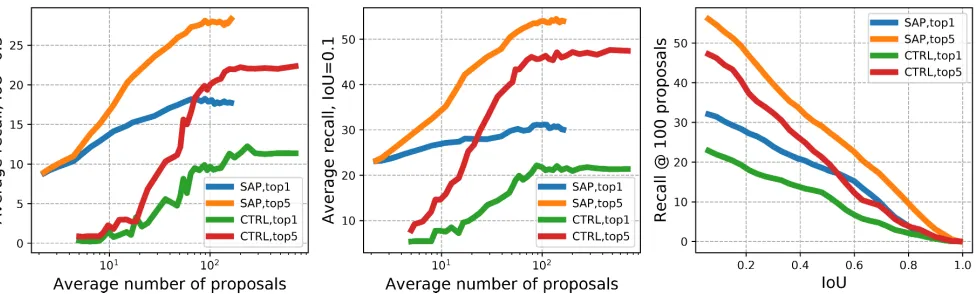
activ-Figure 4: Comparison of our SAP with existing methods on the TACoS dataset. (left & center) SAP outperforms other methods on every metric and requires much less proposals. And SAP reaches peak performance at around 100 proposals. (right) When the number of proposals is fixed to 100, SAP also consistently has the highest recall.
Method R@1 R@1 R@5 R@5
IoU=0.5 IoU=0.1 IoU=0.5 IoU=0.1
Random 0.71 3.28 3.72 15.47
SST 0.97 3.46 4.57 14.54
CTRL 13.30 24.32 25.42 48.73
MCN 5.58 14.42 10.33 37.35
ABLR 9.4 31.4 -
-SAPglove 16.62 29.24 27.01 52.50 SAPnoref 14.45 29.51 23.78 52.09
SAPsv 18.24 31.15 28.11 53.51
Table 1: Comparison of different methods on TACoS.
Method R@1 R@1 R@5 R@5
IoU=0.5 IoU=0.7 IoU=0.5 IoU=0.7
Random 8.51 3.03 37.12 14.06
SST 15.98 8.31 40.68 27.24
CTRL 23.63 8.89 58.92 29.52
MCN 17.46 8.01 48.22 26.73
ABLR 24.36 9.01 -
-SAPglove 26.96 12.36 63.20 35.83
SAPsv 27.42 13.36 66.37 38.15
Table 2: Comparison of different methods on Charades-STA.
ity described in the query sentence; (2) the proposals are not ranked according to their correlation to the query sen-tence. Since the videos in the TACoS dataset have long du-rations and contain multiple activities, methods that do not consider sentence information in proposal generation will suffer from a large number of proposals. CTRL and MCN use naive proposal generation algorithm, and also have this problem. They integrate sentence information only in the proposal evaluation and ranking process, which still leads to inferior performance. ABLR discards proposal generation. However, the attention based approach may suffer from low accuracy at the boundaries, which we conjecture is the rea-son why ABLR gets lower recall at higher IoU threshold. The effectiveness of proposal refinement is demonstrated
by ablation (SAPnoref), it is clear that adding proposal re-finement leads to better localization performance. We also found that Skip-thought vectors (SAPsv) performs consis-tently better than Glove embeddings (SAPglove). We hy-pothesize the reason is that the number of training sentences is not large enough to train the encoding LSTM for Glove embeddings. Overall, the proposed method outperforms oth-ers by a significant margin. Notably, on the most important metric “R@1,IoU=0.5”, SAP outperforms the best competi-tor CTRL by 37%.
Results on the Charades-STA dataset. Table 2 shows the recall of top {1, 5} results at IoU threshold{0.5, 0.7} of different methods on the Charades-STA dataset. We choose a higher IoU threshold on this dataset because the videos are shorter and the number of activities per video is less compared to TACoS. For this reason, SST achieves higher performance on this dataset, which in turn indicates the importance of discriminative proposals on datasets of long videos. And it is also observed that there isn’t a large dif-ference between SAP and other methods regarding the num-ber of generated proposals. Thus the advantage of SAP can be attributed to the proposal evaluation and refinement pro-cess. Overall, the proposed SAP consistently outperforms other methods on this dataset. On the most important met-ric “R@1,IoU=0.7”, SAP outperforms the best competitor ABLR by 48.3%.
4.6
Efficiency of Proposal Generation
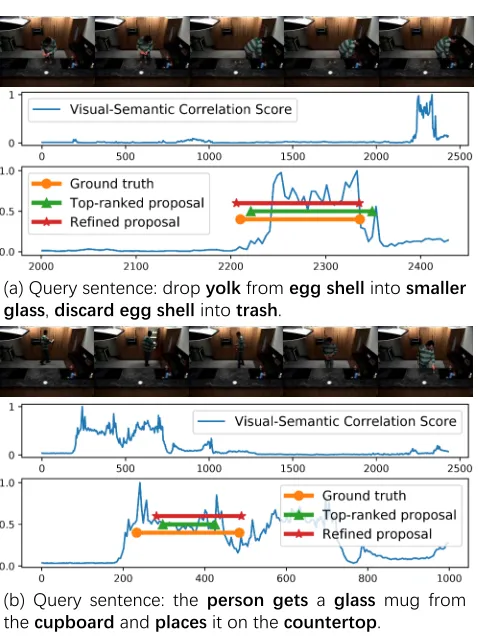
Drop yolkfrom egg shellinto smaller glass, discard egg shellinto trash.
(a) Query sentence: dropyolkfromegg shellintosmaller glass,discard egg shellintotrash.
The person getsa glassmug from the cupboardand placesit on the countertop.
(b) Query sentence: the person gets a glass mug from thecupboardandplacesit on thecountertop.
Figure 5: Qualitative results. The words shown in bold are defined as visual concepts. It can be observed that the visual-semantic correlation score is a good indication of the tempo-ral region of the activity even in a long video.
for IoU=0.1. This demonstrates the high efficiency of SAP. Figure 4(right) plots the average recall rate for 100 pro-posals for SAP and CTRL. The advantage of SAP is again significant, it outperforms CTRL at every IoU region. Ta-ble 3 shows the comparison of time consumption for pro-posal generation and evaluation per query. Note that SST doesnt do proposal evaluation and ABLR generates single prediction without proposals, thus they are faster. The ad-vantage of having less proposals can be seen from the com-parison among SAP(ours), CTRL and MCN. Overall, these show that by integrating semantic information for activity proposal generation, SAP can produce a small number of discriminative proposals for faster evaluation and achieve high localization accuracy.
4.7
Effect of Visual Concepts
To demonstrate the effect of visual concepts, we conduct ex-periments on the TACoS dataset with various numbers of vi-sual concepts. Table 4 shows the results. It can be observed that with a small number of concepts, the model is likely to lose some semantic information during proposal generation. Thus, as the number of concepts increase (from 93 to 912), the performance will continue to improve. But an even larger
Method SAP(ours) CTRL MCN SST ABLR Time 0.35s 1.76s 0.88s 0.33s 0.01s
Table 3: Comparison of time consumption for proposal gen-eration and evaluation per query.
#Concepts R@1 R@1 R@5 R@5
IoU=0.5 IoU=0.7 IoU=0.5 IoU=0.7
1413 18.13 30.14 27.28 52.09
912 18.24 31.15 28.11 53.51
397 18.05 31.66 27.50 54.17
233 17.31 29.83 27.09 53.09
93 16.60 27.50 25.12 49.74
Table 4: Performances with different number of visual con-cepts on TACoS.
number of concepts (e.g. 1413) will introduce noise into the model and hurt the performance.
4.8
Qualitative Results
To gain an intuition about the effectiveness of the Seman-tic Activity Proposal, we present some qualitative results in Figure 5. On the TACoS dataset, each video contains over 20 different activities which could span the duration of the whole video. It can be observed that the visual-semantic cor-relation scores are high around the ground truth regions and low for other regions. Thus our SAP can generate a small number of proposals for a long video while having high lo-calization accuracy. Furthermore, the boundaries of the pro-posals can be refined to more accurately localize the activi-ties as shown in the bottom of Figure 5(a,b).
5
Conclusions
We have introduced a novel framework for activity local-ization in videos via sentence query, including an efficient activity proposal generation algorithm named Semantic Ac-tivity Proposal (SAP). We evaluate both the localization ac-curacy and number of proposals of our framework on the TACoS and Charades-STA dataset. Experiments show that our proposed framework outperforms existing methods with a significant margin, and at the same time reduces the num-ber of needed proposals by a factor of at least 10. Our future work will consider analyzing the sentence structure to dis-cover more discriminative visual concepts.
Acknowledgements. This work was supported in part by two projects from NSF China (61622204, 61572134) and one project from STCSM, China (16QA1400500).
References
Buch, S.; Escorcia, V.; Shen, C.; Ghanem, B.; and Niebles, J. C. 2017. SST: single-stream temporal action proposals. InCVPR, 6373–6382.
Fang, H.; Gupta, S.; Iandola, F. N.; Srivastava, R. K.; Deng, L.; Doll´ar, P.; Gao, J.; He, X.; Mitchell, M.; Platt, J. C.; Zit-nick, C. L.; and Zweig, G. 2015. From captions to visual concepts and back. InCVPR, 1473–1482.
Gao, J.; Sun, C.; Yang, Z.; and Nevatia, R. 2017a. TALL: temporal activity localization via language query. InICCV, 5277–5285.
Gao, J.; Yang, Z.; Sun, C.; Chen, K.; and Nevatia, R. 2017b. TURN TAP: temporal unit regression network for temporal action proposals. InICCV, 3648–3656.
Gao, J.; Chen, K.; and Nevatia, R. 2018. CTAP: complemen-tary temporal action proposal generation. InECCV, 70–85. Heilbron, F. C.; Escorcia, V.; Ghanem, B.; and Niebles, J. C. 2015. Activitynet: A large-scale video benchmark for hu-man activity understanding. InCVPR, 961–970.
Hendricks, L. A.; Wang, O.; Shechtman, E.; Sivic, J.; Dar-rell, T.; and Russell, B. 2017. Localizing moments in video with natural language. InICCV, 5804–5813.
Jiang, Y.; Bhattacharya, S.; Chang, S.; and Shah, M. 2013. High-level event recognition in unconstrained videos.IJMIR 2(2):73–101.
Karpathy, A., and Li, F. 2015. Deep visual-semantic align-ments for generating image descriptions. InCVPR, 3128– 3137.
Karpathy, A.; Toderici, G.; Shetty, S.; Leung, T.; Suk-thankar, R.; and Li, F. 2014. Large-scale video classification with convolutional neural networks. InCVPR, 1725–1732. Kiros, R.; Zhu, Y.; Salakhutdinov, R.; Zemel, R. S.; Urtasun, R.; Torralba, A.; and Fidler, S. 2015. Skip-thought vectors. InNIPS, 3294–3302.
Lin, D.; Fidler, S.; Kong, C.; and Urtasun, R. 2014. Vi-sual semantic search: Retrieving videos via complex textual queries. InCVPR, 2657–2664.
Lin, T.; Zhao, X.; Su, H.; Wang, C.; and Yang, M. 2018. BSN: boundary sensitive network for temporal action pro-posal generation. InECCV, 3–21.
Lin, T.; Zhao, X.; and Shou, Z. 2017a. Single shot temporal action detection. InACM MM, 988–996.
Lin, T.; Zhao, X.; and Shou, Z. 2017b. Temporal convolu-tion based acconvolu-tion proposal: Submission to activitynet 2017. CoRRabs/1707.06750.
Maron, O., and Lozano-P´erez, T. 1997. A framework for multiple-instance learning. InNIPS, 570–576.
Miech, A.; Laptev, I.; and Sivic, J. 2017. Learnable pool-ing with context gatpool-ing for video classification. CoRR abs/1706.06905.
Monfort, M.; Zhou, B.; Bargal, S. A.; Andonian, A.; Yan, T.; Ramakrishnan, K.; Brown, L. M.; Fan, Q.; Gutfreund, D.; Vondrick, C.; and Oliva, A. 2018. Moments in time dataset: one million videos for event understanding. CoRR abs/1801.03150.
Ng, J. Y.; Hausknecht, M. J.; Vijayanarasimhan, S.; Vinyals, O.; Monga, R.; and Toderici, G. 2015. Beyond short snip-pets: Deep networks for video classification. In CVPR, 4694–4702.
Pennington, J.; Socher, R.; and Manning, C. D. 2014. Glove: Global vectors for word representation. InEMNLP, 1532– 1543.
Regneri, M.; Rohrbach, M.; Wetzel, D.; Thater, S.; Schiele, B.; and Pinkal, M. 2013. Grounding action descriptions in videos.TACL1:25–36.
Rohrbach, M.; Amin, S.; Andriluka, M.; and Schiele, B. 2012a. A database for fine grained activity detection of cooking activities. InCVPR, 1194–1201.
Rohrbach, M.; Regneri, M.; Andriluka, M.; Amin, S.; Pinkal, M.; and Schiele, B. 2012b. Script data for attribute-based recognition of composite activities. InECCV, 144– 157.
Shou, Z.; Chan, J.; Zareian, A.; Miyazawa, K.; and Chang, S. 2017. CDC: convolutional-de-convolutional networks for precise temporal action localization in untrimmed videos. In CVPR, 1417–1426.
Sigurdsson, G. A.; Varol, G.; Wang, X.; Farhadi, A.; Laptev, I.; and Gupta, A. 2016. Hollywood in homes: Crowdsourc-ing data collection for activity understandCrowdsourc-ing. In ECCV, 510–526.
Simonyan, K., and Zisserman, A. 2014. Two-stream convo-lutional networks for action recognition in videos. InNIPS, 568–576.
Tran, D.; Bourdev, L. D.; Fergus, R.; Torresani, L.; and Paluri, M. 2015. Learning spatiotemporal features with 3d convolutional networks. InICCV, 4489–4497.
Viola, P. A.; Platt, J. C.; and Zhang, C. 2005. Multiple instance boosting for object detection. InNIPS, 1417–1424. Wang, L.; Qiao, Y.; Tang, X.; and Gool, L. J. V. 2016. Actionness estimation using hybrid fully convolutional net-works. InCVPR, 2708–2717.
Wang, X.; Girshick, R. B.; Gupta, A.; and He, K. 2017. Non-local neural networks. CoRRabs/1711.07971.
Wang, L.; Li, Y.; and Lazebnik, S. 2016. Learning deep structure-preserving image-text embeddings. InCVPR, 5005–5013.
Xu, H.; Das, A.; and Saenko, K. 2017. R-C3D: region con-volutional 3d network for temporal activity detection. In ICCV, 5794–5803.
Yuan, Z.; Stroud, J. C.; Lu, T.; and Deng, J. 2017. Temporal action localization by structured maximal sums. InCVPR, 3215–3223.
Yuan, Y.; Mei, T.; and Zhu, W. 2018. To find where you talk: Temporal sentence localization in video with attention based location regression.CoRRabs/1804.07014.