JIEM, 2015 – 8(2): 476-490 – Online ISSN: 2013-0953 – Print ISSN: 2013-8423 http://dx.doi.org/10.3926/jiem.1321
The Propagation Effect of Paper Version and the iPad Version for Periodicals
Zhang Cong, Sun Yidan, Li Zhongke
School of Journalism and Publication, Beijing Institute of Graphic Communication (China)
[email protected], [email protected], [email protected]
Received: November 2014 Accepted: January 2015
Abstract:
Purpose:
Digital journal created a new development pattern. We use journal APP as an
example to analyze how to migrate the journal content to Internet and other kind of media. Ba
sed on the case study of GQ and other fashion magazines, through text analysis, control
experiments, in-depth interviews and other research methods, the authors analyzed the differen
ces and connections between the iPad App and print edition of magazines, discussed the appro
aches towards operation of new media, offered the tendency of mobile device platform develo
pment for China’s periodical publications.
Design/methodology/approach:
Control experiment.
Findings:
The authors give a stance that the print edition of periodical publication will being
alive still, and conclude that journal APP and printed version can be mutually beneficial and
achieve a win-win state. And we believe that the journal APP is good at advertising
propagation, which will accelerate the development of journal APP in such the information
age, and such kind of media can integrate many information with variety of media forms.
Practical implications:
According to the conclusion of a series of experiments, we can imply
the future of the media, and give the suggestion of both paper version and ipad version of the
journal.
Social implications
: Since people can not live without media and media has to develope with
the help of public, we have to give the new way of both sunrise media and sunset media.
Originality/value:
Based on the case study of GQ and other fashion magazines, through text
analysis, control experiments, in-depth interviews and other research methods, the authors
analyzed the differences and connections between the iPad App and print edition of
magazines, discussed the approaches towards operation of new media, offered the tendency of
mobile device platform development for China’s periodical publications.
Keywords:
journal, iPad, App, GQ
1. Introduction
Journal APP refers to the extension from the traditional paper magazine to a mobile device, so it can be suitable for iPad, other electronic media play and new reading media magazine form. Some Journal APPs are free of charge at first to provide fresh reading magazines and absorb more readers during the promotion period. But more Journal APPs’ downloading charges for fees, which belongs to the internal pay business model. Generally speaking, the traditional magazine industry there are two types of profit pattern, one issue oriented, one is the leading type of advertising. Distribution of income more than advertising revenue, is the issue of leadership; conversely, is advertising led. But for the Journal APP, in addition to the above two kind of profit pattern, through some value-added services or brand extension can also achieve the purpose of profit.
management concept, optimizing the reading environment, strengthening the propaganda, improving librarians' professional quality, realizing humanized service concept, we can expand the paper journal market (Zhuoran, 2007). And if we want to achieve the win-win state between Journal APP and paper periodical, we must make the two play their respective advantages, and achieve mutual benefit and coexistence. As a young but pioneering fashion magazine, GQ offers important insights into periodicals’ digitalization in China.
Fashion journal’s APP is one of the most rapid developed magazine in recent years. Some mainstream fashion journal’ APPs, such as Vogue fashion and beauty, ELLE world fashion, and Rayli have made good achievements already. Fashion journals are in great quantity, big scale, development early, and propagation fast. In addition, from the proportion of view, at present, there are 28 different categories in the apple store’s "newspapers and magazines" family. Removing the news, science, vocational skills and other categories, the rest such as "fashion", "Ms. interest", "the bride and the wedding", "home and garden" and other categories can be attributed to the fashion magazine journals. if we can class those categories according to this division, the number of fashion journals in newspapers and magazines category is 17, accounted for 60% of the total. And analyzing deeper from the number, "fashion", "Ms. interest" and other categories of the free list has 200 Journal APP. If we can estimate the total number according to an average of each category has 200 Journal APP, we can calculate the total number of fashion journals of APP can reach 3,400. And besides, this number is not including the bestsellers’ data and the APP which are not included in the bestsellers chart. Plusing the associated application software, the number and size of fashion journals APP should be far more than that. The fashion journal APP gains high attention and achieves great market share. At the Apple store free top 100 journal APP, the number of fashion journals accounted for 58%, which is nearly the same proportion of consistent statistical categories. More interestingly, in the top 10 journal apps, 5 of them are fashion journals, which means the fashion journals are the prior in the journal APP’s development. In the bestseller ranking in the top 100, fashion journal has the proportion of 48%, slightly lower than the free list. And in the top 10 ranking, there are only 2 of them belongs to fashion journals, but most of them are economical journals, which is accounting for 60%. So we choose one of the most weighty fashion journal GQ as the research model.
editors. Through a series of experiments and interviews, we analysis the similarities and differences between the paper version and the iPad version on the effect of communication, and conclude that there are "degree" and "information receiving selective" differences for the audience on the two forms of media.
2. Description of the Model
With around 2 million readers in the world, the well-known men’s fashion magazine, GQ, has been introduced to China in October, 2009, by China News Press and Condé Nast Publications Inc. Living up to its slogan “look sharp, live smart”, GQ quickly won the Chinese market after its first introduction with top quality and wide circulation, and has become a rising star in the fashion magazine business. Its sales index topped 0.76 in March in Shanghai, China, in 2013, ranking the 2th in its category, following For Him Magazine (Linbo, 2012).
GQ launched its iPad App on September 15, 2011, and has reached a cumulative downloads of 171,000. Then it also introduced the iOS App, GQ Daily, and GQ Mobile for Android users. Those three Apps established a complete Chinese mobile device system of GQ. And in particular, the user-friendly up-to-date iPad App has gained wide acclaim among readers.
3. Comparative Research on iPad Edition and Print Edition
The introduction of Apps will inevitably incur competition to the original print editions. Further development of Apps might even put the magazines in danger of losing readers and profits. However, GQ has found a win-win solution to the dilemma by using differentiated strategies. Therefore, the authors tend to analyze the features of both iPad App and print editions by examining the case of GQ’s October, 2013 Volume, which is selected by casual.
3.1 Differentiated Pricing, Complementary Advantages
3.2 Differentiated Content Designs, iPad Version Focusing on Interactiveness (Linbo, 2012)
Though GQ’s iPad version still costs a lot, it can attract readers’ eyeballs by adding huge amount of pictures and multimedia embedding.
3.2.1 Focusing on the Quality of Pictures
Fashion magazines make the pictures as main content. The iPad version can greatly improve the picture quality. Compared to its print counterparts, GQ’s iPad version has premium graphic quality. Pictures are no longer supportive visual evidences. They stand out with full screen quality photos, some of which can be zoomed in to show readers every tiny detail. For example, GQ uses “big frame plus small button” structure to present the fashion item, so that readers can easily tap and focus on the items that attract them the most. Such special design also makes the whole screen neat and clear, without compromising visual impact. For image processing, there are many features which have great originality, such as dynamic picture, 360 degree rotating image, interactive switching, fitting effect and so on. By these means the interactive functions and the picture quality can be improved greatly.
3.2.2 Adding Video, Audio and other Interactive Elements
besides reading their featured articles, which will be highlighted at the end of the same article on the print edition.
3.2.3 Focusing on User Experience, Making Page Layout More Flexible (Li, 2013)
The iPad version of GQ has more flexibility in page layout. Commercials that would interfere with reading in print editions are mostly cut down on the digital edition and are placed in the front pages. The only few advertisements are shown in videos which increases readers’ interests in watching. Also, each article is designed to be read vertically, which means that readers can read the rest of the contents by scrolling down on the screen, while swiping horizontally means “skip this article”. Such design makes it easier for readers to choose the articles they want to read, and skip the ones they are less interested in by swiping twice, in order to help them focus on reading the things that attract them.
Furthermore, through the comparison can be found, GQ for the version of the iPad have a lot of improvements relative to the print edition in column design, classification processing, advertising, interactive elements and other aspects of the visual change. The concept of its propagation characteristics of GQ for iPad version is different from the traditional journals. It has become a new form of media. Then if we compare the iPad version to the paper version, whether the audience communication effect is better?
4. Controlled Experiment on the Journal App
In order to get the further study of propagation effect, the author made up a control experiment. Experimental respondents are the potential target readers of GQ in both paper version and iPad version, mainly male college students ages from 18 to 26, a small amount of fashionable young women also included. This survey is conducted by the using the questionnaire, 100 questionnaires were sent. The respond controlled experiments were divided into "paper version readers group" and "the iPad version readers group" randomly, each group had 50 people, the proportion of men and women were the same. Respondents were asked to read the paper or iPad version of GQ 2014 3 monthly, followed by a questionnaire. Some respondents were invited for a one-on-one deep interview, and finally returned their feels.
4.1 Data Collection of the Experiment
write down the information they had remembered during the reading. Information could be the title, key words, key points, pictures or data, and the recall order can be different from reading order. The second is the memory degree of all respondents’ information. Two groups were asked to recall the main points of their former five articles in their records, and they have to express information points as more as possible. Respondents who remembered the title get 1 point, and the main content for 3 points, the whole article for 5 points.
4.2 Data Analysis and Experimental Result
According to the content, the author divided GQ into ‘Fashion guide’, ‘Luxury goods’ ‘Talks and Life’ ‘Special reports’ ‘Fashion shoots’ and ‘Advertising’ six parts and asked the respondents to give grade for each part by their interest as ‘Very interested’ ‘Pleased’ ‘Just to kill time’ ‘Bored to read’ or ‘Waste of time’. The author came to a conclusion by the controlled experiment compared with interview.
4.2.1 The iPad Version Readers Group Have More Obtained Information Quantity than the Paper Version Readers Group
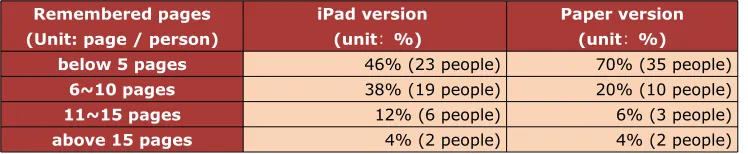
Remembered pages (Unit: page / person)
iPad version (unit:%)
Paper version (unit:%)
below 5 pages 46% (23 people) 70% (35 people)
6~10 pages 38% (19 people) 20% (10 people)
11~15 pages 12% (6 people) 6% (3 people)
above 15 pages 4% (2 people) 4% (2 people)
Table 1. The obtained information comparison of ‘Paper version’ and ‘iPad version readers’
As shown in Table 1, "the paper version readers group" and "the iPad version readers group" didn’t show much differences in remembering a large number of content (more than 15 articles), but in the number of 6~10 and 11-15 articles of memory, "the iPad version readers group was significantly higher than the paper version readers group". It shows that "the iPad version readers group" can obtain more information than the "paper readers group".
4.2.2 Changes in the Layout of the Design Mode
Compared by the paper version, the readers of GQ iPad version can not just read the magazine by its read logic. They can easily skip the passages they don't like, and can continue to choose their interesting articles by browsing through the small maps, without page turning. They will not be hindered by specially thickened advertising page lose the interest of reading on. The unique advantage of iPad makes the reading process always focusing on readers` interesting part and they remembers more and deeper. iPad version has a huge advantages on picture reading, but not on text reading.
Information parts
Option chooser number(Unit: people) Whole marks (Unit: Mark) Very interested (2mark) Pleased (1mark) Just to kill time (0mark) Bored to read (-1mark) Waste of time (-2mark)
Fashion guide 2 40 5 2 1 40
Luxury goods 3 24 21 2 0 28
Life&Talks 1 23 20 5 1 18
Special reports 8 25 10 4 3 27
Fashion shoots 9 26 9 6 0 38
Ads 2 34 10 4 0 24
Table 2. Media information level of ‘iPad version readers’
Information parts
Option chooser number (Unit: people) Whole marks (Unit: Mark) Very interested (2mark) Pleased (1mark) Just to kill time (0mark) Bored to read (-1mark) Waste of time (-2mark)
Fashion guide 0 30 14 4 2 22
Luxury goods 4 10 24 8 4 2
Life &Talks 4 12 29 4 1 14
Special reports 6 28 8 4 4 28
Fashion shoots 0 12 26 7 5 -5
Ads 0 21 15 10 4 3
Table 3. Media information level of ‘Paper version readers’
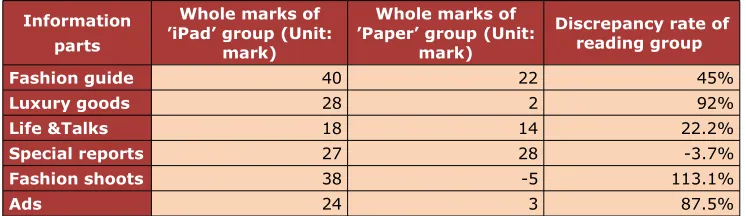
Information parts
Whole marks of ’iPad’ group (Unit:
mark)
Whole marks of ’Paper’ group (Unit:
mark)
Discrepancy rate of reading group
Fashion guide 40 22 45%
Luxury goods 28 2 92%
Life &Talks 18 14 22.2%
Special reports 27 28 -3.7%
Fashion shoots 38 -5 113.1%
Ads 24 3 87.5%
Note: the Discrepancy rate calculation formula: ("Pad group" corresponding value -"paper version using group" corresponding value) / "Pad version using group" reading the corresponding value.
From the comparison of Table 2, Table 3 and Table 4 the author found that, the top-three content on which readers` interest differing most was "Luxury goods" "Fashion shoots" and "Advertising" while "Talks & Life" gap is very small, for "Special report" even the paper version even had a higher interesting level than iPad version. Thus, the interest on picture of iPad version readers was greatly improved, "Luxury goods" "Fashion shoots" and "Advertising" are all pictures. But for depth content such as ‘Special report’ or ‘Life & Talks’, iPad version doesn’t have much advantages, the fragmentation reading characteristics of mobile device may do damage to readers` interest of doing some deep reading.
4.2.3 Advertising Performs Is Better on iPad Version
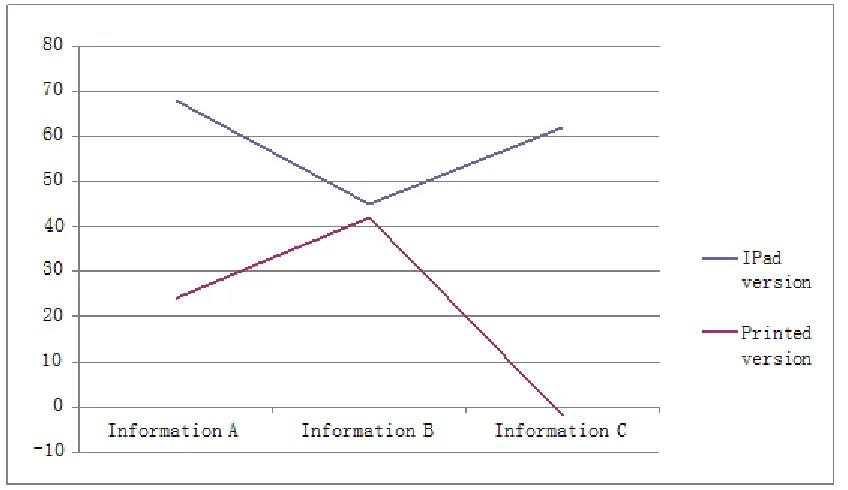
In process of reading comparison and following deep interview, respondents generally out figure out that advertisements affected their reading experience badly. In order to check out and confirm the spread effect of ads on different versions, the author classify the six content of GQ again. ‘Fashion guide’ and ‘Luxury goods’ are the core content of fashion magazines like GQ, we classified them into A group. ’Life & Talks’, ’Special reports’ are the content magazine set in order to extend its connotation, we classified them into B group. ‘Fashion shoots" and "Advertising" are actually the same, just for displaying commodity, which is the most intuitive feeling fashion magazine gives us, we classified them into C group. After classification and counting.
After comparing the reading interest of three types of information, the author found out that the content which has ad properties differs most, especially C class information, followed by the A class information -the image- related information. B class information, which totally is text content, holds the least difference. From this comparison of three types of information we found that: first, the text message, which is the core content of a magazine, doesn’t perform so different on various type of media. Second, ads and images are more expressive on iPad version and are more popular and attractive. Advertising on the iPad version always shows in video form, readers will not suffer from the circumstance under which they read ads then turn papers they meet the ads again when reading the iPad version. A lot of paper version readers` interests are messed up by endless ads. The fragmentation reading of iPad version not only reflected in the fragmentation of reading time (in fact, this experiment completely shield this factor), but also reflected in readers can completely, without interruption, choose anywhere to start reading the magazine, which the author called subjective randomness, and they don’t need to turn pages indeed. This interesting phenomenon makes readers to read any content based on ‘he/she is a little bit interested’. This so-called subjective randomness makes iPad readers turn into the mood of ‘let’s look at this handsome guy’ instead of ‘what bullshit I’m reading’ when they turn to the shoots of male models. For C class information, this phenomenon can significantly reduce the resentment of readers before reading and achieve a better ads effect.
5. The Future of Journal APP
5.1 Differences in the Contents and Independence of Operation
Studying on the ranking of the journal APP, it is not difficult to find that in the form of expression and description, journal APP is more abundant. It is a kind of completely new products relative to the print magazine. Such as ELLE Plus is also called ELLE+, the contents of which is comparative independent to Elle paper magazine. As for the content, the "+" is representative of the enhanced version. As for the function, journal APP is also far beyond paper magazine. Vogue fashion and beauty reassemble the content of paper version to form new journal APP version to satisfy the reading habit of readers, which means the editor should not only continue the same high quality as print magazine such as wonderful content, also have to add new interactive reading experience in the journal editing for iPad users according to there interests and habits (Xiaolian, 2010). So in order to achieve such a level, we should have an independent team who are good at reorganize differences in content and increase the requirements in APP operation. At present, many journal APPs are designed by that paper editing team, such as Vogue; also there are some journal APP are designed by a new media editorial department who are dedicated to create professional journal APP, for example new media magazines such as PCLady. Operational independence is the premise of content differentiation guarantee, but also a basis for APP upgrade.
The iPad version of GQ not only keeps the essence of print editions, but adds more joy to the reading experience. 15 yuan a volume is fairly expensive for a digital magazine, and not that many digital magazines dare to price themselves like that. However, the pricing strategy of GQ proves that quality contents plus joyful readers’ experience makes profits. In first 36 days, the promotion period, APP shows the total flowing number is nearly 300,000,000, and the cumulative downloading number is nearly 100,000 times, has been installed more than 65,000 times, and the activity rate tops to more than 60%. Top quality magazines can target its’ App on the loyal readers by offering them simple but joyful reading experience. The interactiveness of a magazine should go beyond the application of hyper link buttons. As for fashion magazines, a useful way is to add a “dressing room” into the digital publication, which allows readers to take photos of themselves of certain size with their tablets and then strengthen the effects of the fashion items showcased in the magazine by trying out on the photos. Thus, users will not only read the fashion, but also try them out.
5.2 Mature Technology and Experience Quality
Although journal APP are unique in the interactive functions and update aspect, and it also can provide different reading experience. But in the aspect of innovation and technology, Journal APP have many areas to explore and the possibility of ascension. For example, add to cart link function, so that the user can click to buy goods on the promotion of fashion magazine; also, add wearable device identification function, so that the user can take a photo of any cloth that they see in the street and use the Journal APP to link to the corresponding shopping website to buy that cloth. The fashion journal APP can also add shopping price, preferential spike etc to expand other functions and expand the APP user’s polymerization and content integration.
Some traditional journal industry take the content as the king, and some take the channel as the king. But as this journal APP industry, content is transformed from traditional journals; as for channels, we now include electronic reader device manufacturers, telecommunications companies to cooperate, and they are also professional of that, too. Compared to them, we may lack certain specialized technical. It seems fate is not in our own hands, then what is what is the winning way of electronic journals? It is the service. So good content, they must expect large-scale users to acquire it, read it, and can be sold well. The reader is like a large shopping mall, and the media is the business in it. By providing them such a service, such as some forum, the reader let them feel the reader of this platform is useful to them. This time I believe we can aggregate a lot of content in the platform. On the other hand, consumers may have a variety of user terminal, today is PC, tomorrow is iPad, or even mobile phone. Among a variety of the user terminal, screen is not the same, resolutions is different, sizes is different, so how do we let the content get very comfortable in their machines? How can we let the The visual effect be good as well? They can get what they want, the press also get them what they want. Like Zaker, some people may like to read the newspaper, but the other will not work on them. So he could only see the news, but have to pay for the entire magazine. Therefore, we can have this service to them. We are to serve more accurate, the press is to find accurate consumer groups, and consumer is to do the precise content extraction. This thought also can realize personalized design magazine.
two have a complementary role. The development of the Internet has several stages. The first stage is the Yahoo! Stage, which show you all the information. The second stage is your search to Google, and finally is the Facebook stage, which is a platform that everybody can share all the informations there. And why APP will show up? It is because of the mobile Internet, including its environment, network environment, hardware environment, and its future consumption pattern which we have been considering all the time. And we infer that the consumption habit can be formed. Why Americans are willing to spend money to buy the things? Because of their culture are like that. But Chinese can hardly pay for the journal APP. However, this habit can be changed. Playing games are free before, but later the child is paid to play the game, slowly as long as you are he can accept the payment scope inside, he will get paid, and this is the future of the change.
As for other existed problems such as slow to update, slow to download, do not able to download, do not display icon after download, flash back etc. Journal APP management department shall timely maintenance and update, in order to improve the user experience constantly. In addition, on the magazine design aspects of the user interface, we should also continue to learn from the popular Flipboard and Zaker personalization reading APP practices. According to the individual needs, we have to make continuous improvement and innovation. And the publication idea of the paper magazine should be completely subverted, and with help of internet, content can be updated quickly. Besides, for the different demand of mobile phones and tablet PC users, we have to create different platforms and different system according to the different characteristics of the Android system and IOS system.
5.3 Brand Extension and Localization
There are a lot of other fun Apps to increase users’ adhesiveness. For example, the content of a magazine can be saved in Evernote, the graphic can be photoshopped by Meitu, and the video can be edited and shared in Instagram, so that users would become more loyal to the magazine by integrated uses of different social networks. A lot of magazines nowadays have embedded sharing button onto Weibo, Wechat, and the like, to increase their own impact on the users.
International vision and group support are two important reasons why some brand periodical APP enables rapid development. As the result of the mature market pattern, powerful operation ability and talent team of high quality, Matthew effect is obvious on APP journals. For example, among the top 100 fashion periodicals, 80% belong to several major international media group. So the future of the fashion journal APP can grow rapidly. But the extension and the internationalization of the brand marketing is the key to succeed. Brand extension is not only refers to a different language journal or a sub-journal on different areas, journal APP should also be expanded to other industries or fields, such as Rayli has become a multimedia group, from powerful fashion content resources to model agency, e-commerce and other fields, whose extension is also reflected in the APP building and content. Extended journal APP brand, at the same time, also should pay more attention to the localization. For example, People, Friends of health and other highly localized name, as well as the designs of local pictures and portraits and so on, have become the most important elements for International Journal APP to develop rapidly in different countries and languages in the environment.
Print edition and digital version of the same magazine need to be differentiated in order not to compete against each other. More importantly, the magazine needs to develop the digital version as a real App instead of a digital print. Apps of periodicals should challenge the existing layout of print magazines, combining fashion news briefing, fashion trends analysis, life style featured articles, special columns, fashion show highlights, and etc, and categorizing them based on the logic of reading, so as to make the reading more user-friendly and more trendy.
References
Li, S. (2013). China’s periodicals’ App development strategy analysis based on study of user adhesiveness—a case study of periodical App in App Store. China Press, 10, 35-38.
Linbo, C. (2012). New media, new models, not just restyling—comparative studies on print edition and iPad version of Sports Illustrated. The Practice of Journalism, 10, 44-45.
Ling, M., & Lin, D. (2010). Based on the theory of innovation diffusion of mobile phone magazines strategy. News Knowledge, 2, 17-20.
Xiaolian, W. (2010). The tradition Publishing Industry's Retriving: Seeing from iPad. Editors monthly, 6, 24-29.
Zhuoran, S. (2007). Paper journal how to attract readers. Library and Information Forum 2007, 2, 50-52.
Journal of Industrial Engineering and Management, 2015 (www.jiem.org)
Article's contents are provided on a Attribution-Non Commercial 3.0 Creative commons license. Readers are allowed to copy, distribute and communicate article's contents, provided the author's and Journal of Industrial Engineering and Management's names are included.