Ames Laboratory Accepted Manuscripts Ames Laboratory
9-18-2018
Development of a semi-empirical potential for
simulation of Ni solute segregation into grain
boundaries in Ag
Zhiliang Pan
University of Vermont
Valery Borovikov
Ames Laboratory, [email protected]
Mikhail I. Mendelev
Ames Laboratory, [email protected]
Frederic Sansoz
University of Vermont
Follow this and additional works at:https://lib.dr.iastate.edu/ameslab_manuscripts Part of theMetallurgy Commons
This Article is brought to you for free and open access by the Ames Laboratory at Iowa State University Digital Repository. It has been accepted for inclusion in Ames Laboratory Accepted Manuscripts by an authorized administrator of Iowa State University Digital Repository. For more information, please [email protected].
Recommended Citation
Pan, Zhiliang; Borovikov, Valery; Mendelev, Mikhail I.; and Sansoz, Frederic, "Development of a semi-empirical potential for simulation of Ni solute segregation into grain boundaries in Ag" (2018).Ames Laboratory Accepted Manuscripts. 400.
Development of a semi-empirical potential for simulation of Ni solute
segregation into grain boundaries in Ag
Abstract
An Ag–Ni semi-empirical potential was developed to simulate the segregation of Ni solutes at Ag grain boundaries (GBs). The potential combines a new Ag potential fitted to correctly reproduce the stable and unstable stacking fault energies in this metal and the existing Ni potential from Mendelevet al(2012Phil. Mag.92 4454–69). The Ag–Ni cross potential functions were fitted toab initiodata on the liquid structure of the Ag80Ni20 alloy to properly incorporate the Ag–Ni interaction at small atomic separations, and to the Ni segregation energies at different sites within a high-energy Σ9 (221) symmetric tilt GB. By deploying this potential with hybrid Monte Carlo/molecular dynamics simulations, it was found that heterogeneous segregation and clustering of Ni atoms at GBs and twin boundary defects occur at low Ni concentrations, 1 and 2 at%. This behavior is profoundly different from the homogeneous interfacial dispersion generally observed for the Cu segregation in Ag. A GB transformation to amorphous intergranular films was found to prevail at higher Ni concentrations (10 at%). The developed potential opens new opportunities for studying the selective segregation behavior of Ni solutes in interface-hardened Ag metals and its effect on plasticity.
Keywords
semi-empirical interatomic potential, stacking fault energy, grain boundary segregation, Ag–Ni alloy
Disciplines
Materials Science and Engineering | Metallurgy
1
Development of a Semi-Empirical Potential for Simulation of
Ni Solute Segregation into Grain Boundaries in Ag
Zhiliang Pana, Valery Borovikovb, Mikhail I. Mendelevb*, and Frederic Sansoza,c*
aDepartment of Mechanical Engineering, The University of Vermont, Burlington, Vermont 05405, USA
bDivision of Materials Science and Engineering, Ames Laboratory, Ames, Iowa 50011, USA
cMaterials Science Program, The University of Vermont, Burlington, Vermont 05405, USA
*To whom correspondence should be addressed:
[email protected], [email protected]
Abstract
An Ag-Ni semi-empirical potential was developed to simulate segregation of Ni solutes at
Ag grain boundaries. The potential combines a new Ag potential fitted to correctly
reproduce the stable and unstable stacking fault energies in this metal and the existing Ni
potential from Mendelev et al. (Philosophical Magazine 92 4454-69 (2012)). The Ag-Ni
cross potential functions were fitted to ab-initio data on the liquid structure of the Ag80Ni20
alloy to properly incorporate the Ag-Ni interaction at small atomic separations, and to the
Ni segregation energies at different sites within a high-energy Σ9 (221) symmetric tilt grain
boundary. By deploying this potential with hybrid Monte-Carlo/molecular-dynamics
simulations, it was found that heterogeneous segregation and clustering of Ni atoms at
grain boundaries and twin boundary defects occur at low Ni concentrations, 1 at.% and 2
at.%. This behavior is profoundly different from the homogeneous interfacial dispersion
generally observed for the Cu segregation in Ag. A grain boundary transformation to
amorphous intergranular films was found to prevail at higher Ni concentrations (10 at. %).
The developed potential opens new opportunities for studying the selective segregation
2
Keywords: Semi-empirical interatomic potential; stacking fault energy; grain boundary
segregation; Ag-Ni alloy.
1. Introduction
Grain-boundary (GB) segregation refers to the local enrichment of solute atoms at
GBs in polycrystalline materials [1]. It has long been observed that solute segregation can
adversely reduce the ductility and fracture toughness of metallic alloys through GB
embrittlement [2-5]. By contrast, it was recently discovered that the GB segregation can
increase the strength of nanocrystalline materials by suppressing the grain growth [6, 7]
and the GB sliding [8], thus offering a new approach to engineer unprecedentedly strong
and tough bulk metallic nanostructures [9]. Also, at high concentrations, solute segregation
can induce structural transitions at GBs [10] leading to the formation of different types of
interfacial phases, such as GB complexions [11], which are considered to be important in
materials design [12, 13].
Grain boundary segregation and its effects on material properties have been
extensively investigated through both experimental [8, 14, 15] and atomistic simulation
methods [16-18]. Atomistic simulations have enabled high-fidelity GB segregation studies
that could provide insight not available even from the most advanced experimental
characterization techniques, such as high-resolution transmission electron microscopy and
atom probe tomography. For example, atomistic simulations revealed that change in a Cu
Σ5 (310) GB from single to split kite structural units is responsible for the abnormal Ag
3
transitions experimentally remains challenging. Ab initio calculations often employed to
describe complex atomic interactions in metals are limited to small systems containing less
than a few thousands of atoms. This makes them not suitable for studying long-range
phenomena in the Monte Carlo (MC), molecular dynamics (MD), or hybrid MC/MD
simulations [10, 20, 21], which can involve several millions of atoms and large numbers
of time steps in order to maintain stable statistics in calculating solute concentrations near
both chemical and structural equilibrium conditions. Therefore, these simulations require
semi-empirical interatomic potentials, and their outcomes heavily depend on the ability of
the employed potential to predict the desired properties.
GB segregation tends to occur in immiscible metallic alloys [22] where solutes have
a very limited solubility in the matrix. Some examples include Cu-Ag [23], Cu-Zr [24],
Cu-Ta [25], Cu-Nb [26], and Ni-W [27], from which promising alloys with extraordinary
mechanical properties have been created by taking advantage of the GB segregation.
Semi-empirical potentials [28-31] have been developed for some of these alloys, and used to
study how segregated solute atoms improve their properties. For example, in atomistic
simulations using an angle-dependent interatomic potential [30] for Cu-Ta alloys, Frolov
et al. [22] showed that Ta atoms segregated into GBs could suppress grain growth in
nanocrystalline Cu and, meanwhile, increase its strength. With a potential developed for
Cu-Zr [29], a common alloy system involved in making bulk metallic glasses, Pan and
Rupert [10] studied the roles of Zr segregation on disordering transitions in Cu GBs, which
resulted in the finding that amorphous intergranular films could potentially enhance the
ductility without sacrificing strength in nanocrystalline materials [32, 33]. Using a slightly
4
amorphous intergranular films have dramatic effects on dislocation nucleation processes
from GBs [34].
The present study focuses on the Ag-Ni alloy because this alloy system is also
immiscible [35] and consists of two important metals. Ag is known to have the highest
room-temperature electrical conductivity, but also exhibits relatively low strength. The
former property makes Ag ideal as conductive material in electronic and optoelectronic
applications, but Ag interconnects can easily fail under extreme load and temperature
conditions. Ni solute segregation could be a viable solution to help improve the strength of
Ag metals, without sacrificing the electrical conductivity. However, while there are a few
experimental studies [36, 37], no atomistic simulations have been conducted to understand
solute segregation in Ag-Ni alloys because of the lack of a reliable and efficient interatomic
potential.
In this article, we present a Finnis-Sinclair (FS) potential for Ag-Ni alloys suitable
for simulations of GB segregation of Ni in Ag. The Ag-Ag interaction is modeled with a
new potential fitted to correctly reproduce the liquid structure and the stable and unstable
stacking fault energies in Ag, with a fitting database gleaned from ab initio calculations,
while an existing potential from Mendelev et al. [38] is used to describe the Ni-Ni
interaction. The cross potential functions used to describe the interaction between Ag and
Ni atoms were also fitted to ab initio data on the Ag80Ni20 liquid structure, segregation
energy of Ni at different sites of the Σ9 (221) symmetric tilt GB in Ag, and dipole formation
energy of Ni in both single crystal and Σ9 (221) GB in Ag. This potential is shown to
reproduce with high precision not only properties at 0 K temperature included in the
5
to the study of Ni solute segregation in three types of Ag GBs at 500 K with different Ni
concentrations using hybrid MC/MD simulations. The developed potential is available in
the supplementary material and in the Interatomic Potentials Repository maintained by the
National Institute of Standards and Technology (NIST) [39].
2. Computational methods
The potential fitting database was obtained from the ab initio calculations performed
using the Vienna Ab initio Simulation Package (VASP) implemented based on the
Kohn-Sham density functional theory [40]. Three types of calculations were performed:
Wavefunction optimization to calculate the total energy of a specific atomic configuration,
geometry optimization to calculate the local minimum potential energy of a system, and
MD to track the trajectory of temporal system evolution, with an integration time step of 2
fs. In all three cases, plane wave basis set was used to expand the Kohn-Sham orbitals with
an energy cutoff of 350 eV. The exchange-correlation functional was developed by Perdew,
Burke, and Ernzerhof (PBE) [41] in a form of generalized gradient approximation (GGA)
[42]. The interaction between ions was described with projector augmented-wave method
(PAW) potentials [43, 44]. Since large simulation cells were used, only Γ point calculation
was performed for wavefunction optimization, which was assumed to converge when the
total energy difference between the last two iterations was less than 1×10⁻⁶ eV.
Convergence for geometry optimization was considered when the maximum force acting
on the atoms reached less than 1×10⁻⁴ eV/Å.
The performance of the developed FS potential was tested using hybrid MC/MD
simulations implemented in the Large-scale Atomic/Molecular Massively Parallel
6
an integration time step of 1 fs for the MD steps. The total energy of each pure Ag system
was first minimized by conjugate gradient method. Then, the system was further relaxed
with a Nose-Hoover thermostat and a Parrinello-Rahman barostat for 10 ps under zero
pressure at 500 K. The doping process was carried out by the MC method in a
variance-constrained semigrand canonical ensemble [46] after every 100 MD steps, with the target
global composition achieved by adjusting the initial chemical potential difference during
the simulation [20]. The convergence was confirmed when the fitted slope of the system
potential energy over the last 2000 MC steps was found less than 0.001 eV/step. The
adaptive common neighbor analysis (CNA) [47, 48] was used to identify the structural
environment of each atom. In the following, Ag fcc atoms are colored in green, hexagonal
close-packed (hcp) ones are colored in red, and all other atoms are colored in white, unless
otherwise specified. All Ni atoms are colored in dark blue. Atomistic snapshots were made
using the Open-source Visualization Tool (OVITO) [49].
3. Semi-empirical potential development
The FS formalism [50] was used to describe the atomic interactions. The total
potential energy U of a system containing N atoms is given by
( )
∑
( )
∑ ∑
= − = =+Φ
+
=
N i i N i N i j ij i j ir
U
1 1 1 1ρ
ϕ
αα α. (1)
Here, the subscripts i and
j
are atom indices,rij is the separation distance between atoms7
( )
∑
Ψ
=
j ij ir
j iα αρ
, (2)andαiis the element type of atom i. For the Ag-Ni binary alloy,αiis either Ag or Ni. A
total of eight functions are needed for this potential:ϕAgAg,
Φ
AgandΨ
AgAg obtained byfitting to the properties of pure Ag, ϕNiNi,
Φ
NiandΨ
NiNi obtained by fitting those of pureNi, and two cross functions, ϕAgNiand
Ψ
AgNi should be fitted to Ag-Ni alloy properties.3.1 Pure Ag potential
Semi-empirical potentials cannot perfectly reproduce all materials properties with
accuracy. However, they can be optimized to reproduce main properties of interest. In this
work, special focus was on developing a potential to simulate Ni segregation in Ag GBs,
as well as, the dislocation processes and plastic deformation behavior in Ag affected by Ni
solute segregation. For the latter, the stable and unstable stacking fault energies were
considered important parameters to match. Specifically, it has been established that the
stresses required for partial dislocation nucleation in fcc metals are linearly related to the
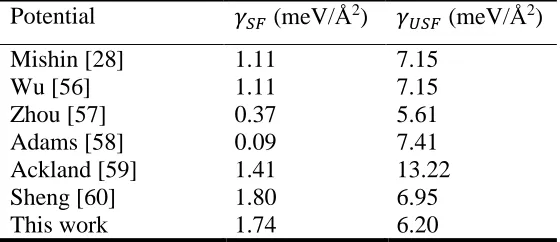
unstable stacking fault energy [51-55]. For pure Ag, Table 1 lists the stacking fault energies
predicted using several potentials from the existing literature [28, 56-60]. This table reveals
clear inconsistency across these potentials. Table 2 summarizes literature values of
stacking fault energy either predicted from ab initio calculations or measured from
experiments [61-71]. This table also shows that the maximum predicted value is more than
three times larger than the minimum one, suggesting a large discrepancy for the reference
values in Ag as well. The conflicting predictions from ab initio might be attributed to the
8
were used to perform the calculations. The atomic configurations used in the calculations
included slab model formed by numbers of (111) atomic layers plus two (111) free surfaces
[62, 68], supercell model containing two twins in order to produce two identical stacking
faults under periodic boundary conditions [63], and supercell model to produce only one
stacking fault by removing one (111) atomic layer [64, 67, 70]. The implementations of
density functional theory used in the calculations differed in the exchange-correlation
functional, whether full-potential method or frozen-core approximation were used, the
types of pseudopotentials used in the frozen-core approximation, etc. Therefore, the
calculation errors might come from various sources. For example, calculation error will
be introduced if insufficient number of the atomic layers is used in the slab model [62].
The linear-muffin-tin-orbital method within atomic-sphere approximation can
overestimate the stacking fault energy by a factor of 2 when compared with the result by a
pseudopotential approach within the local density approximation [70]. Early ab initio
calculations used small supercells and calculated the stacking fault energy based on the
assumption “that the stacking fault energy is determined by covalent bonds between the
hexagonal planes produced by s-d hybridization” [70] and that fault interactions are short
ranged [68] since free electrons will be localized around the stacking fault by forming
covalent bonds. However, Ag has less s–d hybridization, meaning that some free electrons
will not localize, but rather tend to interact with free electrons within a longer range [68,
70]. This breaks the short-range assumption and leads to smaller accuracy when the
simulation cell is too small, which is usually the case for these early ab initio calculations.
To address this issue, we have performed ab initio calculations using a slab model in
9
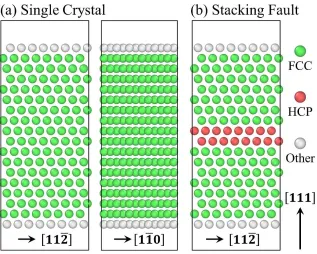
layers and 864 atoms. The configurations of unstable and stable stacking faults were
created by shifting the upper part of the single crystal by a distance of 𝑎𝑎0/2√6 and 𝑎𝑎0/√6
in the [112�] direction, respectively, where 𝑎𝑎0 is the lattice constant of Ag. The stacking
fault energy was calculated as the energy difference per cross-section area between the
single crystal and faulted configurations after geometry relaxation. The values obtained in
this work are given in Table 2. To test if this supercell is large enough, we also calculated
the stacking fault energy using a smaller cell containing 12 (111) atomic layers and 576
Ag atoms. The result is consistent with the large cell, with a relative error of only about
0.06%, indicating that the number of the atomic layers and atoms in the supercell is
sufficient to reliably calculate the stacking fault energy.
The comparison of data presented in Tables 1 and 2 shows that no existing
semi-empirical potential is capable of reproducing the values of both stable and unstable stacking
fault energies obtained in the present study from ab initio calculations. This warranted the
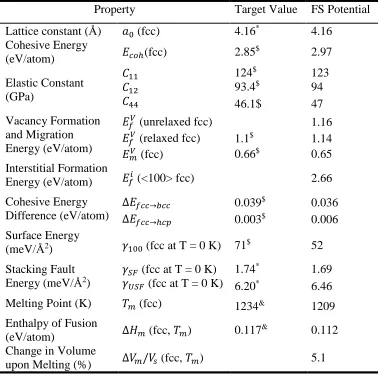
need for developing a new potential for pure Ag. The target property values used for the
fitting of the new Ag potential were obtained from either our ab initio calculations or the
literature [28, 72] ( see Table 3).
It should be mentioned that the ab initio calculations with PBE functional
overestimate the lattice parameter for the fcc Ag, giving a0 = 4.1608 Å, in contrast to the
well-accepted value of a0 = 4.09 Å. To take this effect into account, it has been suggested
that interatomic distances from ab initio calculations should be re-scaled by a factor of
4.09/4.1608 before the fitting process [28]. This approach may work pretty well for a
10
it may actually introduce an additional challenge for using the ab initio data on the liquid
structure. The point is that the ab initio calculations with PBE functional do give a good
prediction for fcc Ni lattice parameter (a0 = 3.5165 Å). Since the same rescalling factor
should be applied to the entire simulation cell it may fix the problem with the Ag-Ag
separations but make unrealistic the Ag-Ni and Ni-Ni separations. Therefore, in order to
use the ab initio data on the liquid structure (see below) we preferred to develop a potential
which is completely consistent with the ab initio data and therefore, used the ab initio Ag
lattice parameter which is quoted in Table 3 as the target value.
It is worth noting that the atomic separations within crystalline interfaces may vary
from those in single crystals. To accurately reproduce the interactions at all atomic
separations, we included a liquid structure in the fitting process by adjusting the potential
parameters so that the pair correlation function of a liquid structure described with this
potential is consistent with that of an input liquid structure. For pure Ag, the latter was
generated by running ab initio MD in a cubic simulation cell containing 250 Ag atoms at
1100 K in a canonical (NVT) ensemble. The volume of the simulation cell was chosen as
to achieve an average pressure close to zero after a duration of 20 ps. The pair correlation
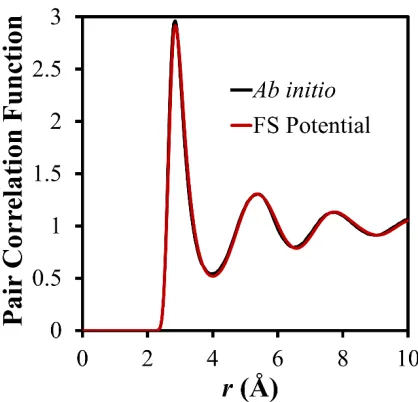
function of the liquid structure resulting from a 20 ps simulation is shown in Figure 2.
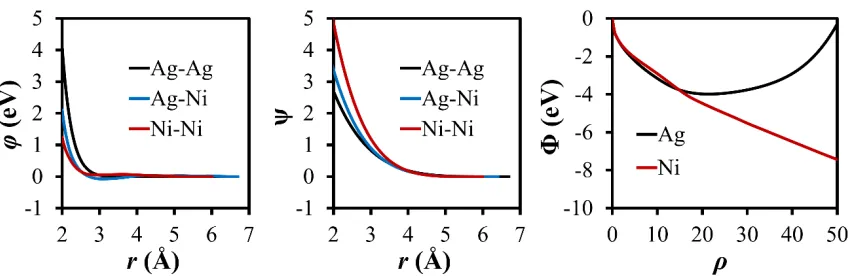
The newly developed pair function ϕAgAg, embedded function
Φ
Ag, and electrondensity function
Ψ
AgAg are shown in Figure 3. Table 3 indicates that this potential reproduces most bulk properties and stacking fault energies included in the fitting processwith a good accuracy. In addition, the liquid structure predicted from the potential is
11
2. To test the potential, we calculated the generalized stacking fault (GSF) energy curve,
which is important for dislocation-assisted plastic deformation mechanisms [73].
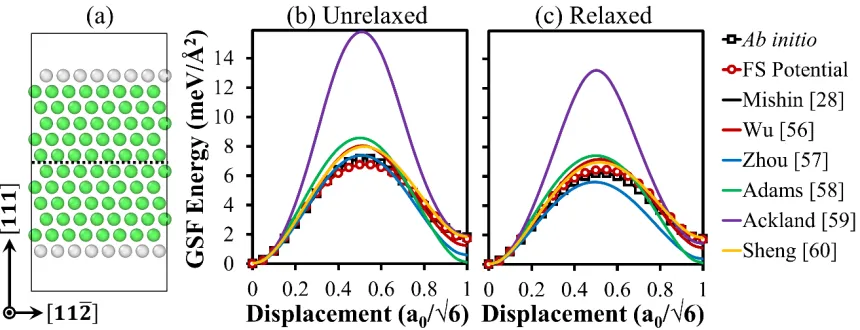
Following the methodology in the literature [74], Figure 4 presents the unrelaxed
generalized stacking fault energy curve calculated as the energy cost of rigidly shifting the
upper part of the single crystal slab in [112�] direction, and the relaxed one obtained by
relaxing all atoms in the [111] direction. It is shown that the results with the developed FS
potential agree very well with the ab initio data, whereas the potentials from the literature
lead to significant differences.
Furthermore, Σ9 GBs have been found to represent the highest fraction of all GBs in
nanotwinned Cu, playing an important role in plastic deformation mechanisms [75].
Similar to Cu, Ag can also form abundant nanotwins easily due to its low stacking fault
energy [76-78], suggesting that Σ9 GBs may also be important for nanotwinned Ag. Past
theoretical studies have shown a correlation between the equilibrium structure of the Σ9
symmetric tilt GBs and the metal type: fcc metals with low stacking fault energy such as
Cu tend to favor pure E structural units, whereas those with high stacking fault energy such
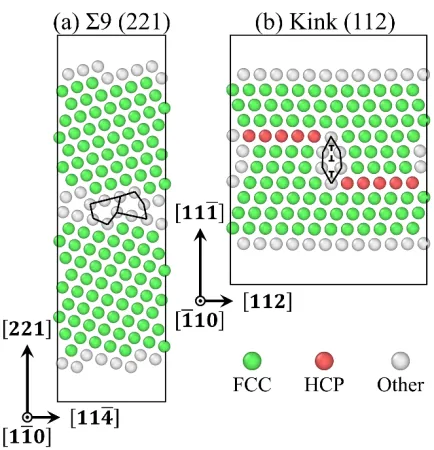
as Al, favor CB structural units [79]. Figure 5(a) shows the equilibrium structure of a Σ9
(221) symmetric <110>-tilt GB predicted in pure Ag from ab initio calculations. Consistent
to the literature findings [80], only E structural units are present in this type of boundary.
Likewise, our new potential, as well as six other potentials, predicts the same E structural
units in this interface, although this structure was not directly included in the potential
fitting process.
Moreover, the kink step defects attached to coherent twin boundaries are found to be
12
understanding the plastic deformation mechanisms of nanotwinned fcc metals [81, 82].
Figure 5(b) shows the relaxed structure of a twin-boundary kink defect from ab initio
calculations. The minimum kink height is equal to one periodic length in the [111]
direction. Kink steps can be viewed as one small segment of an incoherent Σ3 (112) twin
boundary, containing three pure partial dislocations, as described in past atomistic studies
[82]. Again, our new potential, as well as six other potentials, predicts the same structure
in this kink despite the fact that it was not included in the potential fitting procedure.
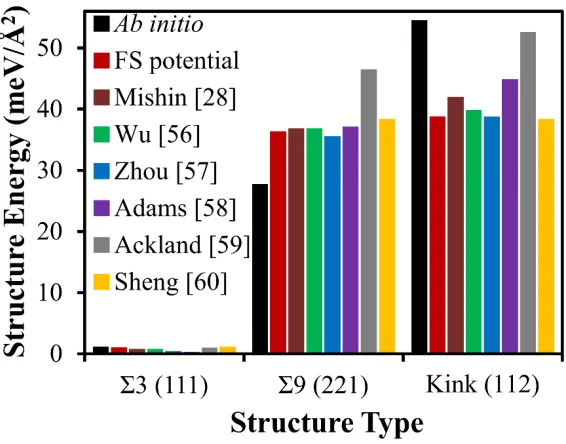
Figure 6 displays the calculated energies for the Σ3 (111) coherent twin boundary,
Σ9 (221) GB, and kink (112) defect. In our calculations, the kink energy is defined as the
energy difference per unit kink area between the model with the kink (see Figure 5(b)) and
a similar model without kink, i.e. containing a perfect twin boundary. Because the stable
stacking fault energy is included in the potential fitting, the twin boundary energy (0.90
meV/Å2) is found very close to the ab initio value, which is about half of the stable stacking
fault energy (1.69 meV/Å2). The Σ9 (221) GB and kink (112) energies were not included
in the potential fitting. Nonetheless, the former still agrees well with the ab initio data, with
somewhat better results than most predictions from other potentials. All potentials,
however, underestimate the kink (112) defect energy predicted by ab initio. It is worth
noting that these calculations used a larger simulation cell to ensure the stability of the
kinks. In fact, four of the seven potentials tested could not achieve a stable kink structure
when the simulation cell was as small as that used in the ab initio calculations. We attribute
this discrepancy to local strains generated in the small simulation cell after relaxation to
reduce excessive surface forces, as evidenced by the slightly curved top and bottom atomic
13
3.2 Ag-Ni cross potential
To fit the cross density function, we determined the difference between the cohesive
and unrelaxed bi-vacancy formation energies for the AgNi B2 crystal phase from ab initio
calculations. In the FS formalism, this quantity does not depend on pair potentials and can
be used to normalize the cross density function. First, we determined the equilibrium lattice
parameter and cohesive energy of the B2 phase (3.058 Å and 3.360 eV, respectively). Then
we constructed a 5×5×5 𝑎𝑎03 B2 crystal configuration containing 125 Ag atoms and 125 Ni
atoms and removed one Ag atom and one Ni atom located far away from each other. The
bi-vacancy formation energy was calculated as (𝐸𝐸 −248𝐸𝐸0/250)/2 = 1.218 eV/atom,
where E and E0 are the total energies for the perfect crystal and bi-vacancy configurations,
respectively. The difference between cohesive energy and bi-vacancy formation energy for
AgNi B2 structure is thus 3.360 – 1.218 = 2.142 eV. The compound formation energy of
AgNi B2 phase (0.302 eV/atom) was also used in the potential development procedure to
provide a reasonable solution thermodynamics.
To properly incorporate the Ag-Ni interaction at small separations in transition states,
the potential was fitted to the ab initio data on the liquid structure of the Ag80Ni20 alloy.
The liquid structure was generated by running ab initio MD in a cubic simulation cell
containing 200 Ag atoms and 50 Ni atoms at a temperature of 1100 K in a canonical (NVT)
ensemble, with a cell volume chosen to reach near-zero average pressure during the
simulations. The actual Ag-Ni alloy has positive deviations from ideality and decomposes
into two liquid solutions at this temperature. However, the simulation cell was too small
14
partial pair correlation function clearly indicates the tendency to the formation of Ni-rich
clusters (see Fig. 7 (a)).
In order to reproduce the liquid structure obtained from the ab initio MD simulation
we used the method based on the Born-Green-Bogoliubov equation described in [83]. This
equation, however, is derived for a homogeneous liquid, and thus the tendency for liquid
decomposition poses a challenge. To overcome this issue, we always started from the first
snapshot obtained from the ab initio MD simulation and run the classical MD simulation
only 20 ps saving snapshots every 0.2 ps. These snapshots were used to produce a new
version of the potential (along with the equations for other target properties used in the
potential development procedure). Figure 7(b) shows that the developed FS potential
provides a reasonable agreement with the liquid structure obtained from the ab initio MD
simulation, although it somewhat underestimates the tendency for the Ni cluster formation.
This does not necessarily mean that this potential will also provide the correct predictions
for the decomposition in solid solutions; so, special caution should be exercised about this
(see below). However, it should work well for dilute solutions because it does provide an
excellent agreement with the Ag-Ni partial pair correlation function.
To fit the Ni segregation energy in Ag, segregation energies at different GB sites
were obtained from the ab initio calculations. We chose the Σ9 (221) symmetric tilt GB
with a <110> tilt axis. Six possible segregation sites were considered within this GB, as
shown in Figure 8(a). Figure 8(b) shows the Ni segregation energies at these sites from
first-principle calculations. The segregation energy at each site was calculated as the
difference in substitutional energy between a GB and a perfect crystal of equivalent size.
15
between the pure GB and the same boundary with one Ag atom at this site replaced by a
Ni atom. Likewise, the single crystal substitutional energy was defined as the total energy
difference between the pure single crystal and the single crystal with one Ag atom is
replaced by a Ni atom.
When segregated into a crystalline interface, solute atoms may either distribute
uniformly inside the boundary, leading to homogeneous segregation, or cluster, leading to
heterogeneous segregation [84]. To correctly reproduce the situation for the Ni solutes in
the chosen Ag GB, we included the Ni dipole formation energy in the potential
development procedure. Figure 9 shows a close-up view on the two Σ9 (221) GB
configurations used for this calculation. One boundary contained two separated Ni atoms
and the other one has a Ni dipole. The dipole formation energy was calculated as the total
energy difference between the two configurations, with a positive value indicating a
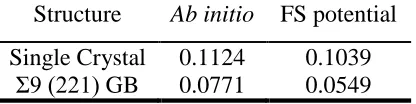
preference for dipole formation. The calculated dipole formation energy is provided in
Table 4. Since Ag and Ni are immiscible at low temperature, Ni atoms remain
preferentially clustered inside Ag single crystals. Therefore, we have also included the Ni
dipole formation energy in Ag single crystal, with the ab initio results provided in Table 4
as well.
The final fitting for the cross potential functions of Ag-Ni are shown in Figure 3,
together with the functions for pure Ag and Ni. With this potential, the calculated
difference between cohesive energy and bi-vacancy formation energy for AgNi B2
structure is equal to 1.984 eV/atom. The compound formation energy is found equal to
0.328 eV/atom. Both predictions agree with our ab initio data. The segregation energies of
16
together with the ab initio data, demonstrating that this potential reproduces the segregation
energy very well. It is worth noting that the site with high segregation energy does not
always reside inside the GB, but could also be a neighboring lattice site, e.g. site 2 in Figure
8(b). This is consistent with past experimental observations that Ni atoms could be found
to segregate into bulk planes adjacent to a GB [85]. The dipole formation energies of Ni in
this GB and single crystal are also in agreement with our ab initio calculations (see Table
4).
Furthermore, it was verified that the predicted Ni segregation energy at the kink (112)
twin boundary structure shown in Figure 5(b) agreed reasonably with ab initio data. An
MD simulation study by Ke and Sansoz [16] showed that twin-boundary kink steps were
preferential sites for segregation of Cu impurities in nanotwinned Ag. Substitutional Ni
segregation energies at six different sites of a kink (112) structure are presented in Figure
10. The segregation energy predicted with the developed FS potential agrees well with the
ab initio data for sites 1 and 2 that have highest segregation energies over other sites,
despite not being included in the potential development procedure. It thus indicates that
this potential could be suitable for simulation of the Ni segregation behavior at kink defects
inside twin boundaries, in addition to GB segregation, making this potential ideal for the
study of Ni segregation in nanotwinned Ag.
4. Applications of the new potential
4.1 Clustering segregation behavior with low Ni contents
Figure 11 shows the equilibrated 1 at. % Ni atom distribution in Ag single crystal
17
temperature of 500 K. Only Ni atoms are shown. This figure shows that most of the Ni
atoms are segregated into one single cluster, consistent with the fact that Ag and Ni are
immiscible at this temperature, where the estimated Ni solubility is much less than 0.2 at. %
at 500 K [35].
Figure 12(a) shows the same type of simulation starting with a pure fcc Ag bicrystal
containing two Σ9 (221) symmetric tilt GBs and doped by hybrid MC/MD technique with
the target Ni concentration of 1 at. % at 500 K. In this case, most Ni atoms segregate into
only one of the two GBs, covering the boundary heterogeneously. This heterogeneous
segregation behavior is characterized by the formation of two interfacial phases, with one
phase rich of Ni atoms and the other almost Ni-free. When increasing the global
composition to 2 at. %, as shown in Figure 12(b), one GB is fully covered with Ni atoms,
while the other GB transforms into two interfacial phases. This heterogeneous segregation
behavior is very similar to that of Au in Pt [84], but different from that of Cu in Ag. Figure
12(c) and Figure 12(d) show the Cu segregation in this boundary simulated using the
potential developed by Wu and Trinkle [56]. Cu atoms always distribute uniformly inside
the two GBs, indicative of a typical homogeneous segregation.
Figure 13(a) demonstrates the Ni segregation in a Ag bicrystal containing two Σ11
(113) symmetric <110>-tilt GBs. Contrary to the Σ9 (221) GB, this type of GB has a low
interface energy. Of all <110> symmetric tilt GBs, it only has higher energy than Σ3 (111)
coherent twin boundaries [79]. It is shown in this figure that Ni segregation behavior in
this special boundary is different from its behavior in the Σ9 (221) GB. Instead of forming
two interfacial phases, Ni atoms tend to cluster inside one boundary. Increasing the global
18
cluster size, as shown in Figure 13(b). In contrast, Cu in this GB type still shows a
homogeneous segregation behavior, regardless of global composition, as shown in Figure
13(c) and Figure 13(d). Similarly, with 1 at. % Ni segregation, our simulations predict that
Ni atoms could form a cluster in an Ag bicrystal containing two coherent twin boundaries,
each of which is attached with two (112) kink steps, as shown in Figure 14(a). Interestingly,
however, most Ni atoms tend to selectively cluster along only one of the four kink steps.
In sharp contrast, when the same structure is doped with 1 at. % Cu, Cu atoms are uniformly
segregated into all kink steps, as shown in Figure 14(b).
With the Ag-Cu potential developed by Wu et al [56], atomistic simulations have
shown that the segregation of Cu into nanotwinned Ag can change the incipient plasticity
mechanism, resulting in a pronounced rise in yield strength [16]. The present simulations
strongly suggest that Ni segregation into interface-strengthened Ag materials should
substantially affect interface stability and mechanical behavior under stress and
temperature, but through different mechanisms than Cu solutes, because Ni solute atoms
have a distinctive segregation behavior, compared to that of Cu solutes, in both GBs and
twin-boundary kink defects. Clearly, the new potential developed in this work could pave
the way for such interesting studies.
4.2 GB amorphization behavior with high Ni contents
Figure 15 shows the equilibrium structure of a bicrystal model containing two Σ9
(221) GBs when doped with a high Ni content, 10 at. %. At high Ni concentration, the two
interfaces become significantly disordered, transforming into two amorphous intergranular
19
perfectly uniform. Ni atoms do not distribute randomly inside the film, as it should be for
ideal amorphous phases, but rather preferentially form chain-like or cluster-like structures.
This heterogeneous amorphous structure is consistent with the structure of an amorphous
Ag-Ni alloy fabricated experimentally by a vapor-quenching method [86]. This finding is
important for several aspects. First, it proves that the new potential can successfully
reproduce pervasive segregation-induced disordering transitions, and the complex phase
transformations observed experimentally in the Ag GBs. Second, the formation of Ni-rich
amorphous intergranular films could have direct ramifications for enhancing mechanical
properties in crystalline Ag material. For example, it has been shown in the past that
Cu-Zr amorphous films can efficiently reduce the damage induced by dislocation absorption
at Cu GBs, holding great promise as fracture toughening mechanism for nanocrystalline
Cu [32]. Likewise, Ni segregation induced amorphous films in Ag interfaces could offer
new opportunities for designing tough materials, in addition to GB segregation
strengthening mechanisms.
5. Conclusion
A semi-empirical FS potential suitable for the simulation of Ni solute segregation
into Ag crystalline interfaces has been developed by fitting to a database derived from the
ab initio calculations. The Ag-Ag interaction was optimized to correctly reproduce the
stable and unstable stacking fault energies and liquid structure of pure Ag. The Ag-Ni cross
potential was optimized to accurately predict the site-dependent Ni segregation energies in
an Ag Σ9 (221) GB, and the liquid structure of Ag80Ni20 alloys. This potential is shown to
replicate with high fidelity not only properties at 0 K temperature included in the potential
20
interfaces. Hybrid MC/MD simulations with this potential show rich predictions leading to
new understandings of atom segregation behavior at GBs. Using the new Ag-Ni potential
with low Ni concentrations, our preliminary atomistic results on two different GB types, a
high-energy Σ9(221) GB and a low-energy Σ11(113) GB, suggest that Ni segregation
shows an interesting clustering phenomenon that is strongly dependent on the GB structure.
This finding differs markedly from Cu-impurity segregation that is uniformly distributed
along the interfaces. This selective Ni clustering behavior is also predicted for segregation
to twin-boundary kink step imperfections. At higher Ni concentrations (10 at. %), a grain
boundary transformation to amorphous intergranular films is found to prevail, which
confirms experimental observations made in the past. Selective Ni segregation is
potentially attractive as a fundamentally new mechanism of strengthening for
interface-hardened Ag metals. It is therefore important that this segregation behavior can now be
studied with this new Ag-Ni potential.
Acknowledgements
ZP and FS were supported for this work by U.S. Department of Energy (DOE) under
Grant No. DE-SC0016270. VB and MIM’s research was supported by the U.S. Department
of Energy (DOE), Office of Science, Basic Energy Sciences, Materials Science and
Engineering Division and was performed at Ames Laboratory, which is operated for the
U.S. DOE by Iowa State University under contract # DE-AC02-07CH11358. This research
used resources of the National Energy Research Scientific Computing Center (NERSC), a
U.S. DOE Office of Science User Facility operated under Contract No.
21
References
[1] Seah M P and Hondros E D 1973 Grain Boundary Segregation Proceedings of the Royal Society of London. A. Mathematical and Physical Sciences335 191
[2] Westbrook J H and Wood D L 1961 Embrittlement of Grain Boundaries by Equilibrium Segregation Nature192 1280-1
[3] Rice J R and Wang J-S 1989 Embrittlement of interfaces by solute segregation Materials Science and Engineering: A107 23-40
[4] Luo J, Cheng H, Asl K M, Kiely C J and Harmer M P 2011 The Role of a Bilayer Interfacial Phase on Liquid Metal Embrittlement Science333 1730-3
[5] Song J and Curtin W A 2013 Atomic mechanism and prediction of hydrogen embrittlement in iron Nat. Mater.12 145-51
[6] Chookajorn T, Murdoch H A and Schuh C A 2012 Design of Stable Nanocrystalline Alloys Science337 951-4
[7] Murdoch H A and Schuh C A 2013 Stability of binary nanocrystalline alloys against grain growth and phase separation Acta Mater.61 2121-32
[8] Hu J, Shi Y N, Sauvage X, Sha G and Lu K 2017 Grain boundary stability governs hardening and softening in extremely fine nanograined metals Science355 1292-6
[9] Raabe D, Herbig M, Sandlöbes S, Li Y, Tytko D, Kuzmina M, Ponge D and Choi P P 2014 Grain boundary segregation engineering in metallic alloys: A pathway to the design of interfaces Current Opinion in Solid State and Materials Science 18
253-61
[10] Pan Z and Rupert T J 2016 Effect of grain boundary character on segregation-induced structural transitions Phys. Rev. B93 134113
[11] Cantwell P R, Tang M, Dillon S J, Luo J, Rohrer G S and Harmer M P 2014 Grain boundary complexions Acta Mater.62 1-48
[12] Rupert T J 2016 The role of complexions in metallic nano-grain stability and deformation Current Opinion in Solid State and Materials Science20 257-67
[13] Dillon S J, Tai K and Chen S 2016 The importance of grain boundary complexions in affecting physical properties of polycrystals Current Opinion in Solid State and Materials Science20 324-35
22
[15] Kameda J and McMahon C 1983 Solute segregation and hydrogen-induced intergranular fracture in an alloy steel Metall. Mater. Trans. A14 903-11
[16] Ke X and Sansoz F 2017 Segregation-affected yielding and stability in nanotwinned silver by microalloying Physical Review Materials1 063604
[17] Babicheva R I, Dmitriev S V, Bachurin D V, Srikanth N, Zhang Y, Kok S W and Zhou K 2017 Effect of grain boundary segregation of Co or Ti on cyclic deformation of aluminium bi-crystals International Journal of Fatigue102 270-81
[18] Detor A J and Schuh C A 2007 Grain boundary segregation, chemical ordering and stability of nanocrystalline alloys: Atomistic computer simulations in the Ni-W system Acta Mater.55 4221-32
[19] Frolov T, Divinski S V, Asta M and Mishin Y 2013 Effect of Interface Phase Transformations on Diffusion and Segregation in High-Angle Grain Boundaries Phys. Rev. Lett.110 255502
[20] Pan Z and Rupert T J 2017 Formation of ordered and disordered interfacial films in immiscible metal alloys Scripta Mater.130 91-5
[21] Mendelev M I, Srolovitz D J, Ackland G J and Han S 2005 Effect of Fe Segregation on the Migration of a Non-Symmetric Σ5 Tilt Grain Boundary in Al J. Mater. Res.
20 208-18
[22] Frolov T, Darling K A, Kecskes L J and Mishin Y 2012 Stabilization and strengthening of nanocrystalline copper by alloying with tantalum Acta Mater.60
2158-68
[23] Subramanian P R and Perepezko J H 1993 The ag-cu (silver-copper) system Journal of Phase Equilibria14 62-75
[24] Arias D and Abriata J P 1990 Cu-Zr (Copper-Zirconium) Bulletin of Alloy Phase Diagrams11 452-9
[25] Subramanian P R and Laughlin D E 1989 The Cu-Ta (Copper-Tantalum) system Bulletin of Alloy Phase Diagrams10 652-5
[26] Chakrabarti D J and Laughlin D E 1982 The Cu−Nb (Copper-Niobium) system Journal of Phase Equilibria2 455-60
23
[28] Williams P L, Mishin Y and Hamilton J C 2006 An embedded-atom potential for the Cu–Ag system Modelling and Simulation in Materials Science and Engineering
14 817
[29] Mendelev M I, Kramer M J, Ott R T, Sordelet D J, Yagodin D and Popel P 2009 Development of suitable interatomic potentials for simulation of liquid and amorphous Cu–Zr alloys Philosophical Magazine89 967-87
[30] Hashibon A, Lozovoi A Y, Mishin Y, Elsässer C and Gumbsch P 2008 Interatomic potential for the Cu-Ta system and its application to surface wetting and dewetting Phys. Rev. B77 094131
[31] Zhang L, Martinez E, Caro A, Liu X-Y and Demkowicz M J 2013 Liquid-phase thermodynamics and structures in the Cu–Nb binary system Modelling and Simulation in Materials Science and Engineering21 025005
[32] Pan Z and Rupert T J 2015 Amorphous intergranular films as toughening structural features Acta Mater.89 205-14
[33] Khalajhedayati A, Pan Z and Rupert T J 2016 Manipulating the interfacial structure of nanomaterials to achieve a unique combination of strength and ductility Nature Communications7 10802
[34] Borovikov V, Mendelev M I and King A H 2018 Effects of Ag and Zr solutes on dislocation emission from Σ11(332)[110] symmetric tilt grain boundaries in Cu: Bigger is not always better International Journal of Plasticity
[35] Liu X J, Gao F, Wang C P and Ishida K 2008 Thermodynamic Assessments of the Ag-Ni Binary and Ag-Cu-Ni Ternary Systems Journal of Electronic Materials37
210-7
[36] Gas P, Poize S, Bernardini J and Cabane F 1989 A new approach to correlate grain boundary diffusion and segregation deduced from experimental measurements Acta Metall.37 17-24
[37] Surholt T, Minkwitz C and Herzig C 1998 Nickel and selenium grain boundary solute diffusion and segregation in silver Acta Mater.46 1849-59
[38] Mendelev M I, Kramer M J, Hao S G, Ho K M and Wang C Z 2012 Development of interatomic potentials appropriate for simulation of liquid and glass properties of NiZr2 alloy Philosophical Magazine92 4454-69
[39] https://www.ctcms.nist.gov/potentials/
24
[41] Perdew J P, Burke K and Ernzerhof M 1996 Generalized Gradient Approximation Made Simple Phys. Rev. Lett.77 3865-8
[42] Perdew J P, Chevary J A, Vosko S H, Jackson K A, Pederson M R, Singh D J and Fiolhais C 1992 Atoms, molecules, solids, and surfaces: Applications of the generalized gradient approximation for exchange and correlation Phys. Rev. B46
6671-87
[43] Blöchl P E 1994 Projector augmented-wave method Phys. Rev. B50 17953-79
[44] Kresse G and Joubert D 1999 From ultrasoft pseudopotentials to the projector augmented-wave method Phys. Rev. B59 1758-75
[45] Plimpton S 1995 Fast Parallel Algorithms for Short-Range Molecular Dynamics Journal of Computational Physics117 1-19
[46] Sadigh B, Erhart P, Stukowski A, Caro A, Martinez E and Zepeda-Ruiz L 2012 Scalable parallel Monte Carlo algorithm for atomistic simulations of precipitation in alloys Phys. Rev. B85 184203
[47] Honeycutt J D and Andersen H C 1987 Molecular dynamics study of melting and freezing of small Lennard-Jones clusters J. Phys. Chem.91 4950-63
[48] Stukowski A 2012 Structure identification methods for atomistic simulations of crystalline materials Modelling and Simulation in Materials Science and Engineering20 045021
[49] Stukowski A 2010 Visualization and analysis of atomistic simulation data with OVITO–the Open Visualization Tool Modelling and Simulation in Materials Science and Engineering18 015012
[50] Finnis M W and Sinclair J E 1984 A simple empirical N-body potential for transition metals Philosophical Magazine A50 45-55
[51] Deng C and Sansoz F 2009 Fundamental differences in the plasticity of periodically twinned nanowires in Au, Ag, Al, Cu, Pb and Ni Acta Mater.57 6090-101
[52] Jin Z H, Gumbsch P, Ma E, Albe K, Lu K, Hahn H and Gleiter H 2006 The interaction mechanism of screw dislocations with coherent twin boundaries in different face-centred cubic metals Scripta Mater.54 1163-8
[53] Smith L and Farkas D 2018 Connecting interatomic potential characteristics with deformation response in FCC materials Computational Materials Science147 18-27
25
[55] Borovikov V, Mendelev M I and King A H 2016 Effects of stable and unstable stacking fault energy on dislocation nucleation in nano-crystalline metals Modelling and Simulation in Materials Science and Engineering24 085017
[56] Wu H H and Trinkle D R 2009 Cu/Ag EAM potential optimized for heteroepitaxial diffusion from ab initio data Computational Materials Science47 577-83
[57] Zhou X W, Johnson R A and Wadley H N G 2004 Misfit-energy-increasing dislocations in vapor-deposited CoFe/NiFe multilayers Phys. Rev. B69 144113
[58] Adams J B, Foiles S M and Wolfer W G 1989 Self-diffusion and impurity diffusion of fee metals using the five-frequency model and the Embedded Atom Method J. Mater. Res.4 102-12
[59] Ackland G J, Tichy G, Vitek V and Finnis M W 1987 Simple N-body potentials for the noble metals and nickel Philosophical Magazine A56 735-56
[60] Sheng H W, Kramer M J, Cadien A, Fujita T and Chen M W 2011 Highly optimized embedded-atom-method potentials for fourteen fcc metals Phys. Rev. B83 134118
[61] Jin Z H, Dunham S T, Gleiter H, Hahn H and Gumbsch P 2011 A universal scaling of planar fault energy barriers in face-centered cubic metals Scripta Mater.64 605-8
[62] Wu X-Z, Wang R, Wang S-F and Wei Q-Y 2010 Ab initio calculations of generalized-stacking-fault energy surfaces and surface energies for FCC metals Applied Surface Science256 6345-9
[63] Li W, Lu S, Hu Q-M, Kwon S K, Johansson B and Vitos L 2014 Generalized stacking fault energies of alloys Journal of Physics: Condensed Matter26 265005
[64] Li R, Lu S, Kim D, Schönecker S, Zhao J, Kwon S K and Vitos L 2016 Stacking fault energy of face-centered cubic metals: thermodynamic and ab initio approaches Journal of Physics: Condensed Matter28 395001
[65] Kibey S, Liu J B, Johnson D D and Sehitoglu H 2007 Predicting twinning stress in fcc metals: Linking twin-energy pathways to twin nucleation Acta Mater.55 6843-51
[66] Suzuki H and Barrett C S 1958 Deformation twinning in silver-gold alloys Acta Metall.6 156-65
[67] Tian F-Y, Chen N-X, Shen J and Vitos L 2012 A novel potential: the interlayer potential for the fcc (111) plane family Journal of Physics: Condensed Matter24
26
[68] Hartford J, von Sydow B, Wahnström G and Lundqvist B I 1998 Peierls barriers and stresses for edge dislocations in Pd and Al calculated from first principles Phys. Rev. B58 2487-96
[69] Rosengaard N M and Skriver H L 1993 Calculated stacking-fault energies of elemental metals Phys. Rev. B47 12865-73
[70] Schweizer S, Elsässer C, Hummler K and Fähnle M 1992 Ab initio calculation of stacking-fault energies in noble metals Phys. Rev. B46 14270-3
[71] Kioussis N, Herbranson M, Collins E and Eberhart M E 2002 Topology of Electronic Charge Density and Energetics of Planar Faults in fcc Metals Phys. Rev. Lett.88 125501
[72] Efimov A I, Belorukova L P, Vasilkova I V and Chechev V P 1983 Svoistva neorganicheskikh soedinenii. Spravochnik (Himija, Leningrad
[73] Van Swygenhoven H, Derlet P M and Frøseth A G 2004 Stacking fault energies and slip in nanocrystalline metals Nat. Mater.3 399-403
[74] Zimmerman J A, Gao H J and Abraham F F 2000 Generalized stacking fault energies for embedded atom FCC metals Modelling and Simulation in Materials Science and Engineering8 103-15
[75] Lu N, Du K, Lu L and Ye H Q 2015 Transition of dislocation nucleation induced by local stress concentration in nanotwinned copper Nat Commun6
[76] Bufford D, Wang H and Zhang X 2011 High strength, epitaxial nanotwinned Ag films Acta Mater.59 93-101
[77] Furnish T A and Hodge A M 2014 On the mechanical performance and deformation of nanotwinned Ag APL Materials2 046112
[78] Ott R T, Geng J, Besser M F, Kramer M J, Wang Y M, Park E S, LeSar R and King A H 2015 Optimization of strength and ductility in nanotwinned ultra-fine grained Ag: Twin density and grain orientations Acta Mater.96 378-89
[79] Sansoz F and Molinari J F 2005 Mechanical behavior of Sigma tilt grain boundaries in nanoscale Cu and Al: A quasicontinuum study Acta Mater.53 1931-44
[80] Sansoz F and Molinari J F 2004 Incidence of atom shuffling on the shear and decohesion behavior of a symmetric tilt grain boundary in copper Scripta Mater.
50 1283-8
27
[82] Fang Q and Sansoz F 2017 Influence of intrinsic kink-like defects on screw dislocation – coherent twin boundary interactions in copper Acta Mater.123 383-93
[83] Mendelev M I and Srolovitz D J 2002 Determination of alloy interatomic potentials from liquid-state diffraction data Phys. Rev. B66 014205
[84] O’Brien C J, Barr C M, Price P M, Hattar K and Foiles S M 2018 Grain boundary phase transformations in PtAu and relevance to thermal stabilization of bulk nanocrystalline metals J. Mater. Sci.53 2911-27
[85] Minkwitz C, Herzig C, Straumal B B and Gust W 1998 Radiotracer Diffusion of Ni and Ag in Ag and Ni Grain Boundaries and Oriented Ag/Ni Interphase Boundaries Materials Science Forum294-296 541-4
28
[image:30.612.167.447.158.279.2]Tables and Captions
Table 1. Stable and unstable stacking fault energies of pure Ag calculated with different interatomic potentials
Potential 𝛾𝛾𝑆𝑆𝑆𝑆 (meV/Å2) 𝛾𝛾𝑈𝑈𝑆𝑆𝑆𝑆 (meV/Å2)
Mishin [28] 1.11 7.15
Wu [56] 1.11 7.15
Zhou [57] 0.37 5.61
Adams [58] 0.09 7.41
Ackland [59] 1.41 13.22
Sheng [60] 1.80 6.95
29
Table 1. Stable and unstable stacking fault energies of pure Ag predicted from ab initio calculations or measured from experimental work in the literature
Reference 𝛾𝛾𝑆𝑆𝑆𝑆 (meV/Å2) 𝛾𝛾𝑈𝑈𝑆𝑆𝑆𝑆 (meV/Å2) Remark
Jin et al [61] 1.00 5.68 Ab initio
Wu et al [62] 1.06 6.93 Ab initio
Li et al [63] 1.06 7.49 Ab initio
Li et al [64] 1.08 Ab initio
Kibey et al [65] 1.12 8.30 Ab initio
Suzuki et al [66] 1.31 Experiment
Tian et al [67] 1.37 Ab initio
Hartford et al [68] 1.81 Ab initio
Rosengaard et al [69] 2.12 Ab initio
Schweizer et al [70] 2.37 Ab initio
Kioussis et al [71] 3.12 11.86 Ab initio
30
Table 2. Target values of bulk properties of pure Ag obtained with ab initio calculations and the values reproduced with this potential.
Property Target Value FS Potential
Lattice constant (Å) 𝑎𝑎0 (fcc) 4.16* 4.16 Cohesive Energy
(eV/atom) 𝐸𝐸𝑐𝑐𝑐𝑐ℎ(fcc) 2.85
$ 2.97
Elastic Constant (GPa)
𝐶𝐶11 124$ 123
𝐶𝐶12 93.4$ 94
𝐶𝐶44 46.1$ 47
Vacancy Formation and Migration Energy (eV/atom)
𝐸𝐸𝑓𝑓𝑉𝑉 (unrelaxed fcc) 1.16
𝐸𝐸𝑓𝑓𝑉𝑉 (relaxed fcc) 1.1$ 1.14
𝐸𝐸𝑚𝑚𝑉𝑉 (fcc) 0.66$ 0.65
Interstitial Formation
Energy (eV/atom) 𝐸𝐸𝑓𝑓𝑖𝑖 (<100> fcc) 2.66
Cohesive Energy Difference (eV/atom)
∆𝐸𝐸𝑓𝑓𝑐𝑐𝑐𝑐→𝑏𝑏𝑐𝑐𝑐𝑐 0.039$ 0.036
∆𝐸𝐸𝑓𝑓𝑐𝑐𝑐𝑐→ℎ𝑐𝑐𝑐𝑐 0.003$ 0.006
Surface Energy
(meV/Å2) 𝛾𝛾100 (fcc at T = 0 K) 71$ 52
Stacking Fault Energy (meV/Å2)
𝛾𝛾𝑆𝑆𝑆𝑆 (fcc at T = 0 K) 1.74* 1.69
𝛾𝛾𝑈𝑈𝑆𝑆𝑆𝑆 (fcc at T = 0 K) 6.20* 6.46
Melting Point (K) 𝑇𝑇𝑚𝑚 (fcc) 1234& 1209
Enthalpy of Fusion
(eV/atom) ∆𝐻𝐻𝑚𝑚 (fcc, 𝑇𝑇𝑚𝑚) 0.117
& 0.112
Change in Volume
31
Table 3. Dipole formation energy (eV) of Ni in Ag predicted from ab initio and this potential.
Structure Ab initio FS potential
Single Crystal 0.1124 0.1039
[image:33.612.204.412.114.166.2]32
Figures and Captions
33
34
35
36
37
38
Figure 7. Ag80Ni20 liquid structure. (a) Atomic snapshot of Ag80Ni20 liquid at 1100 K
39
40
41
[image:43.612.162.450.72.271.2]42
43
44
Figure 13. Ni clustering behavior versus homogeneous Cu segregation in low-energy
45
46