Defining Distance Learning and Distance Education
Frederick B. King, Michael F. Young, Kelly Drivere-Richmond, P. G. Schrader The University of Connecticut
Neag School of Education
Submitted to: Educational Technology Review Frederick King: [email protected] Michael Young: [email protected]
Correspondence about this article should be addressed to Frederick B. King, Unit 2004, 249 Glenbrook Rd. Storrs, CT 06269-2004, [email protected]
Abstract
Defining Distance Learning and Distance Education
It is usual in most academic and scientific fields to have a common, yet distinct, vocabulary. Precise definitions are essential for communication within specific domains for instructors, students and, particularly, researchers who must construct operational definitions. It is strange that in a field as old as distance learning that such a distinct, shared vocabulary does not yet exist. Many authors have used the same terms to mean different things. Often, key distance learning terms are used without defining them, thus either assuming that the meaning is universal or simply ignoring the issue. Phipps & Merisotis (1999) stated, “It is important to understand what is meant by ‘distance
learning.’ Because the technology is evolving, the definition of what distance learning is continues to change (p. 11).” In the same report, they illustrated the fact that much of the research in distance learning since 1990 has serious, methodological flaws and there is “a relative paucity of true, original research dedicated to explaining or predicting
phenomena related to distance learning (p. 2).” We agree and believe that to conduct original, meaningful research, a foundation of operational definitions is required. Terms and definitions must be consistent. Even in their report, Phipps and Merisotis used the terms distance education and distance learning interchangeably. For significant, research-driven progress to be made concerning distance learning, definitions have to be
semantically, as well as operationally, consistent within and across articles. Our
better form a common basis for the exchange of ideas and information, particularly for research and development. By defining the terms and conditions, we acknowledge that meaning is constantly and dynamically constructed, and that definitions change as new knowledge is discovered. Yet, we hope our proposal and its associated dialog can reduce confusion and enhance the clarity of a common language for ongoing research in the field of distance learning.
To emphasize the current state of affairs, consider two definitions of distance learning that are representative of our observations across the field of distance learning. The United States Distance Learning Association defined distance learning in 1998 (Roblyer & Edwards, 2000) as "the acquisition of knowledge and skills through mediated
information and instruction, encompassing all technologies and other forms of learning at a distance (p. 192).” This is a definition that does not distinguish formal and informal learning, or different types of distance (temporal and physical). Newby, Stepich, Lehman and Russell (2000) define distance learning as "an organized instructional program in which teacher and learners are physically separated (p. 210).” This definition is even less specific in that it does not posit any effects on the learner and merely describes the existence of a program in which, presumably, no learning at all might occur.
We begin our proposal concerning "distance learning" beginning with the second word, "learning." Every general psychology and educational psychology textbook has at least one definition of learning. Most of these definitions are similar in many aspects, but different enough in their details to confuse. Some assume one knows what learning is and offer no concrete definition (Pressley & McCormick, 1995). Others use imprecise
Brophy, 1995; Woolfolk, 1995). Some definitions seem to deal only with behavior (Schunk, 2000), some only with knowledge (Mayer, 1987) and some deal with both knowledge and observable behavior (Slavin, 1994). Some authors pose two or more definitions and show no preference. Most of the authors cited also point out the
differences between behavioristic definitions and cognitive definitions. Few authors have dealt with the definition of learning as situated (Brown, Collins, & Duguid, 1989; Greeno & Middle School Mathematics Through Applications Project Group, 1998). So for distance learning to be adequately defined, some common stance on learning in general must first be taken. Taking into account these multiple perspectives and synthesizing these points, our proposed starting point definition of learning is: learning is improved capabilities in knowledge and/or behaviors as a result of experience.
We find this definition is parsimonious, yet inclusive of behavioral and cognitive psychological perspectives. It defines learning as positive change over time, improved capabilities to cognition, actions or both as a result of personal observation or interaction with the lived- in world. It is a dynamic process: learning does not take place in isolation. It is not time restricted. It is permanent. The organism is changed. Once something is learned, nothing will ever be exactly as it was before, no matter how small or trivial the lesson learned. Yet, we find this definition is incomplete for our purposes. It represents a reasonable synthesis of those definitions referred to from textbooks, but there is
something missing from this definition—specifically, there is no account of what limits learning, such as the social or environmental context.
changing dynamic between the situation and the learner. The situational effects (on the learner) are as varied as the number of individuals, and as specific as the individual is unique in their own right. The individual also changes as a result of experiences with the situation, and the learner can take actions that affect and modify the situation. Thus, the complexities of learning lie not solely within an individual, but in the complex dynamics of the learner-situation interaction.
Each situation places limitations on learning by the very fact that one situation cannot offer—to a particular individual—the unique experiences another situation can offer, and vice-versa. These limitations shall be termed constraints. The situation that individuals encounter constrains their potential for action in that situation. Constraints can be viewed in two ways. The first is that constraints are restrictions on action. This view of
constraints has a negative connotation. The individual cannot do something because the situation they are in will not allow them to take that action. For example, an individual cannot go swimming at 30,000 feet while flying on a 747.
The second way to view constraints—as boundary conditions for goal-directed
action—has a more positive outlook. This second view is consistent with Gibson’s (1986) notion of affordances (Greeno, 1994). In this sense, each situation proposes possibilities. Gibson's term, affordances, were described as possibilities for action, given a learner with the capability to act. Each situation allows an individual to do something in that situation that could not be done in another. Again, in the 747 example, one is afforded spectacular views over a wide area that one would not have when swimming, earth bound. In
learning can be crafted. Learning is improved capabilities in knowledge and/or behavior as a result of mediated experiences that are constrained by interactions with the
situation.
With this definition of LEARNING we are half- way to our goal of defining distance learning. Now consider that there is more than one purpose for learning. Recognizing that learning is a constant process that takes place wherever and whenever the individual is receptive, there must be accommodation made for the different purposes for learning (different learning intentions). After all, learning situations may be formal (contrived) or be self-directed in everyday settings (naturalistic). Learning may occur by design, or it might occur by chance. Therefore, with these possibilities in mind, the authors propose three major subcategories of learning: 1) instruction: objectives-driven learning; 2) exploration: without objectives; and 3) serendipity: unintended learning.
Instruction: Objectives-Driven
The first category is the one that most readily comes to mind when we talk about learning in schools. It is the instructional/educational model. In this type of learning, which we call Instruction, there is a student and an instructor. Instruction is
Exploration without Objectives
The next category of learning is much less formal than the first. It can be termed Exploration. This type of learning is self/internally directed by personal goals and interests. It is much more informal and not normally associated with instructor and student interaction. However, it is still goal oriented. The goals in this category are all personal learning goals, not performance goals. This learning takes place outside of the formal educational situation. Mainly, it takes place in naturalistic contexts during everyday circumstances such as shopping efficiently, experimenting with learning to cook at home, seeking advice from friends and other intention-driven experiences that result in learning informally.
Serendipity
Serendipity is our acknowledgement that sometimes there is chance learning. There are no goals associated with this type of learning. This is learning something simply because the individual “stumbled across" the information. Meeting new friends unexpectedly, passively viewing TV and overhearing a piece of gossip are good examples. Web surfing provides daily examples of this type of learning—when an individual is surfing, reading nonlinearly and gets sucked in by a “seductive detail” presented on a page irrelevant to the individual's initial purpose for browsing. The
Instruction—A Piece of the Learning Puzzle with Multiple Parts
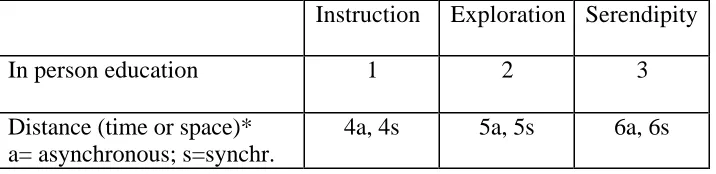
As can be seen from our proposal of these categories, the authors feel that "learning" is the encompassing concept and that there are three subcategories that derive from that overarching principle. Instruction is but one subcategory. For that reason, and for clarity of definition, instruction is further divided into two main categories: in-person education and distance education. We propose that in-person education be defined as a situation in which the instructor and the student share the same time and geographic space. That is, the student and instructor are constrained by time and geographic location (Barker & Dickson, 1996). Examples would be most traditional college lectures, high school and elementary classroom situations. This brings us to a definition of "distance education." Figure 1. Three Purposes for Learning
Instruction Exploration Serendipity
In person education 1 2 3
Distance (time or space)* a= asynchronous; s=synchr.
4a, 4s 5a, 5s 6a, 6s
broadcaster is in another—under the hot lights in a TV studio. And the newsmaker, video taped earlier, is in yet another—the middle of the wind and rain. The situations are different and are being mediated by the television. In this case, the viewer is separated geographically from both the newsmaker and broadcaster, but separated by time only from the newsmaker. The learning context would dictate whether the broadcast was being used as instruction, i.e., a parent informing a child about disasters (Figure 1, Cell 1); as intentional distance exploration, i.e., sitting down to get updated on the storm (Cell 5) or distance serendipity, i.e., intending to watch a ball game and pausing while flipping through the channels (Cell 6).
Our definition of distance learning is this: distance learning is improved capabilities in knowledge and/or behaviors as a result of mediated experiences that are constrained by time and/or distance such that the learner does not share the same situation with what is being learned. From this definition of distance learning flows our definition of distance education. Distance education is formalized instructional learning where the
time/geographic situation constrains learning by not affording in-person contact between student and instructor. In person education is formalized instructional learning where the time/geographic situation constrains learning by requiring synchronous person-to-person interaction.
should be enumerated by research. Our belief runs counter to the prevailing concept that distance education is the weak stepchild of in-person education. A focus on constraints may release us from repeatedly proving the null hypothesis, that distance education is not different from in-person education. Clearly, there may even be times when distance education proves superior. Distance education has clear affordances that in-person education does not, permitting, for example, extended time for reflection before answering, use of distributed resources without interrupting the flow of discussion or class presentations, permanent recording of many interactions (listservs, bulletin boards, and e- mail) for research and evaluation purposes. Thus, we propose that the affordances of distance education be compared to the affordances of in-person education and the constraints of distance education be compared to the constraints of in-person education, providing a level playing field for research.
Synchrony as a Variable Characteristic of Distance Learning
Distance education (Cells 4a and 4s), according to the definition we have established, encompasses a vast array of possible situations. However, these situations can be grouped within two major categories, each with its own constraints. The two categories are
synchronous and asynchronous distance education.
Synchronous situations provide affordances that allow “real-time” interaction between student and instructor. Synchronous situations are time sensitive but
geographically insensitive. Examples of such situations would be teleconferencing, video teleconferencing, online chat and CUSeeME.
and geographically insensitive. Examples of these situations are correspondence courses, e-mail and web/server-based instruction.
These two basic categories of learning situations can be applied to another
subcategory of learning. Distance exploration and distance serendipity can also take place synchronously or asynchronously. The definitions are the same as above, the situation is the same, but a time scale difference exists (possibly days or weeks). Thus, a web surfer can be involved in a personal, goal-directed online chat—synchronous distance
exploration (Cell 5s)—and later communicate by e- mail with a domain expert—
asynchronous distance exploration, (Cell 5a). Or, this surfer may run across an interesting piece of trivia and explore it through hypertext—synchronous distance serendipity (Cell 6s)—or by mistakenly posting a message to a listserv and receiving unexpected input from list member—asynchronous distance serendipity (Cell 6a).
References
Barker, B. O., & Dickson, M. W. (1996). Distance learning technologies in K-12 schools: Past, present, and future practice. Techtrends, 41(6), 19-22.
Brown, J. S., Collins, A., & Duguid, P. (1989, January-February). ‘Situated cognition and the culture of learning’, Educational Researcher, 32-42.
Cognition and Technology Group at Vanderbilt (CTGV) (1990). Anchored instruction and its relationship to situated cognition. Educational Researcher, 19, 2-10.
Cognition and Technology Group at Vanderbilt (CTGV) (1993, March). Anchored Instruction and situated cognition revisited. Educational Technology, 52-70.
Dweck, C. S. (1990). Self-theories and goals: Their role in motivation, personality, and development. Paper presented at the Nebraska Symposium on Motivation, Lincoln.
Gibson, J. J. (1986). The ecological approach to visual perception. Hillsdale, NJ: Erlbaum.
Good, T. L., & Brophy, J. (1995). Contemporary educational psychology (5th ed.). White Plains, NY: Longman.
Greeno, J. G., & Middle School Mathematics Through Applications Project Group (1998). The situativity of knowing, learning, and research. American Psychologist, 53(1), 5-26.
Greeno, J. G. (1994). Gibson's affordances. Psychological Review, 101(2), 236-342. Lave, J., & Wenger, E. (1991). Situated learning: Legitimate peripheral
participation. Cambridge, UK: Cambridge University Press.
Moore, M. G., & Kearsley, G. (1996). Distance education: A systems view. Albany, NY: Wadsworth.
Newby, T. J., Stepich, D. A., Lehman, J. D., & Russell, J. D. (2000). Instruction technology for teaching and learning. Upper Saddle River, NJ: Merrill.
Ormrod, J. E. (1995). Human learning (2nd ed.). Englewood Cliffs, NJ: Prentice Hall. Phipps, R., & Merisotis, J. P. (1999, April). What’s the Difference? A review of contemporary research on the effectiveness of distance learning in higher education. Washington, DC: The Institute for Higher Education Policy.
Pressley, M., & McCormick, C. B. (1995). Advanced education psychology for educators, researchers, and policymakers. New York: HaperCollins.
Roblyer, M. D., & Edwards, J. (2000). Integrating educational technology into teaching (2nd ed.). Upper Saddle River, NJ: Merrill.
Schunk, D. H. (2000). Learning Theories (3rd Ed.). Englewood Cliff, NJ: Prentice-Hall.
Slavin, R. E. (1994). Educational psychology: Theory and practice (5th ed.). Boston: Allyn and Bacon.
Woolfolk, A. E. (1995). Educational Psychology (6th ed.). Needham Heights, MA: Simon & Schuster.