The Thirty-Third AAAI Conference on Artificial Intelligence (AAAI-19)
RGBD Based Gaze Estimation via Multi-Task CNN
Dongze Lian,
1∗Ziheng Zhang,
1∗Weixin Luo,
1Lina Hu,
1Minye Wu,
1Zechao Li,
2Jingyi Yu,
1Shenghua Gao
1†1ShanghaiTech University,2Nanjing University of Science and Technology
{liandz, zhangzh, luowx, huln, wumy}@shanghaitech.edu.cn,
{zechao.li}@njust.edu.cn,{yujingyi, gaoshh}@shanghaitech.edu.cn
Abstract
This paper tackles RGBD based gaze estimation with Convo-lutional Neural Networks (CNNs). Specifically, we propose to decompose gaze point estimation into eyeball pose, head pose, and 3D eye position estimation. Compared with RGB image-based gaze tracking, having depth modality helps to facilitate head pose estimation and 3D eye position estima-tion. The captured depth image, however, usually contains noise and black holes which noticeably hamper gaze tracking. Thus we propose a CNN-based multi-task learning frame-work to simultaneously refine depth images and predict gaze points. We utilize a generator network for depth image gen-eration with a Generative Neural Network (GAN), where the generator network is partially shared by both the gaze track-ing network and GAN-based depth synthesiztrack-ing. By optimiz-ing the whole network simultaneously, depth image synthesis improves gaze point estimation and vice versa. Since the only existing RGBD dataset (EYEDIAP) is too small, we build a large-scale RGBD gaze tracking dataset for performance evaluation. As far as we know, it is the largest RGBD gaze dataset in terms of the number of participants. Comprehen-sive experiments demonstrate that our method outperforms existing methods by a large margin on both our dataset and the EYEDIAP dataset.
Introduction
Gaze estimation is an important task and has wide applica-tions in human-computer interaction (Majaranta and Bulling 2014), visual behavior analysis (Morimoto and Mimica 2005) and psychological studies (Rayner 1998). More re-cent studies have focused on appearance-based estimation (Zhang et al. 2015; Krafka et al. 2016; Zhang et al. 2017; Zhu and Deng 2017) as a vehicle for general gaze estima-tion. Unlike model-based methods, appearance-based meth-ods achieve satisfactory performance and at the same time maintain a user-friendly data acquisition procedure, i.e., without imposing additional priors on face poses or con-ducting elaborate system calibrations. Despite being a de-sirable gaze estimator, existing solutions are still sensitive to head pose, illumination inconsistencies, occlusions, low
∗
The authors contribute equally. †
Corresponding author.
Copyright c2019, Association for the Advancement of Artificial Intelligence (www.aaai.org). All rights reserved.
image quality,etc. In particular, accuracy in gaze estimation still varies significantly across subjects.
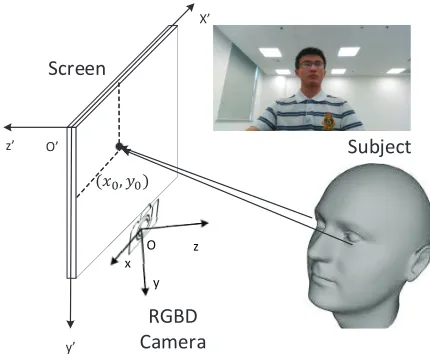
In light of the recent success of Convolutional Neural Networks (CNNs) in various computer vision tasks, a num-ber of approaches have been proposed to leverage CNNs for appearance-based gaze estimation (Krafka et al. 2016; Zhang et al. 2017). They observe that the gaze point of a per-son depends on 3D eye position centered at the camera and gaze direction whereas the gaze direction further depends on the head and eyeball poses (Zhang et al. 2017)1. The 3D eye position imposes significance because even with the same gaze direction, a change of distance between the eye and the screen would change the gaze point on the screen target, as shown in Figure 1. To obtain 3D eye positions, (Krafka et al. 2016; Zhang et al. 2017) employed face grid to indicate the face region in the image. In reality, faces of different sub-jects can vary greatly in size and shape that a uniform grid is insufficient to describe.
Another challenge lies in head pose representations. A number of previous approaches (Krafka et al. 2016; Zhu and Deng 2017; Ranjan, De Mello, and Kautz 2018) attempt to encode head pose information by analyzing the RGB color image, e.g., to introduce gaze transform layers or to use branched head pose models. Improvements brought by these approaches are still limited due to the lack of depth infor-mation. In this paper, we introduce depth-based approach to simultaneously address the 3D eye positions and head pose representation problems.
Using RGBD images for gaze tracking is not completely new (Mora and Odobez 2013; Xiong et al. 2014). However, the latest approaches only use a sparse set of points with depth information due to the limitations of the depth sensor. These points, although useful, are not sufficiently robust to reconstruct the head pose. Ideally, data-driven methods can more robustly infer the pose by leveraging learning-based approaches. However, so far only a single RGBD dataset is readily available to the public and the dataset itself only con-tains a very small number of participants - 16 with 12 males and 4 females. The study by Krafkaet al.shows that more participants can clearly improve gaze tracking performance (Krafka et al. 2016). On the dataset front, we first present a
1
X’
y’
z’ O’
Screen
( !, "!)
RGBD Camera
Subject
x y
z O
xx y
z O
Figure 1: Our data acquisition system.
much larger RGBD gaze tracking dataset. Our dataset con-sists of 218 participants with a total over 165K images, prob-ably the largest RGBD gaze dataset readily available to the research community.
On the algorithm front, we observe that (Zhu and Deng 2017) has demonstrated the effectiveness of estimating eye-ball pose and head pose using separate CNNs. (Krafka et al. 2016) has further shown the benefits of separately extracting features from eye and face images. When combined with 3D eye positions features extracted using face grid, (Krafka et al. 2016) achieves the state-of-the-art performance. In a similar vein, we propose to decompose gaze point estima-tion into four separate modules: eyeball pose estimaestima-tion, head pose estimation, 3D eye positions estimation, and gaze point estimation. Both head pose and 3D eye positions es-timation exploit depth information. We notice that the cap-tured raw depth images are of high noise and contain holes caused by occlusions, specularity of eyeglasses, depth range limitations,etc. We hence build a network to simultaneously remove noises and compensate for holes.
The contributions of this paper can be summarized as fol-lows: 1) We build a large-scale RGBD gaze tracking dataset, to facilitate the exploration of data-driven approaches for gaze tracking; 2) We propose to decompose gaze point es-timation into eyeball pose, head pose, and 3D eye position estimation and design a CNN based multi-task learning net-work to simultaneously refine depth maps and predict gaze point. Specifically, we present a generator network for both depth image refinement and head pose feature extraction. The generator is partially shared across multiple modules and can extract the effective head pose information; and 3) We conduct extensive experiments to show that our new technique outperforms existing state-of-the-art methods by a large margin in gaze tracking.
Related Work
RGB Image Based Gaze Tracking
Generally, gaze estimation can be categorized into model-based and appearance-model-based methods (Hansen and Ji 2010). Model-based methods (Zhu, Ji, and Bennett 2006) utilize geometric eyeball models and features for gaze estimation. Appearance-based methods (Lu et al. 2014b; 2014a) directly extract eye or face image information as feature vectors and learn a mapping from the feature vectors to gaze points. Pre-vious research has mainly relied on hand-crafted features. Due to their success, CNNs have also been introduced to gaze tracking. In (Zhang et al. 2015), head poses were en-coded as extra information used for gaze tracking. Krafkaet al. (Krafka et al. 2016) proposed the implicit extraction of eyeball pose, head pose and eye coordinates from eye im-ages, face images and a face grid. Zhang et al.(Zhang et al. 2017) proposed a spatial weights CNN for gaze point es-timation directly from single RGB face images. It is worth noting that even though both head pose and eyeball pose can be inferred from face images, the input resolution of these faces is fixed because of computational costs, therefore eye areas are small, in addition to which CNN pooling opera-tions cause information loss. Thus, such global face input solutions may not be a good choice for gaze point estima-tion. Recently, Zhu et al.(Zhu and Deng 2017) explained the within-subject and cross-subject ambiguity of extract-ing head pose based on facial landmarks, and proposed the encoding of head pose and eyeball pose with two separate CNNs. Ranjanet al.(Ranjan, De Mello, and Kautz 2018) designed a branched gaze network with different head poses.
RGBD Image Based Gaze Tracking
To recover a 3D model of head pose more accurately, RGBD cameras have been used in some works (Mora and Odobez 2013; Xiong et al. 2014). Previous works (Xiong et al. 2014) used eye or facial landmark locations in 3D space as seen by RGBD cameras, and predicted the gaze point through a map-ping function learned from a personal calibration step. Al-though depth cameras were utilized to collect data and head poses were obtained (Sugano, Matsushita, and Sato 2014; Zhang et al. 2015), only six points on the face were used to establish the head coordinate system, insufficient to recover a 3D model of the face. Our method strengthens the impor-tance of the facial 3D model and instead inputs the overall head depth into the network architecture to enhance perfor-mance.
Gaze Tracking Dataset
Table 1: Statistics of our dataset with some publicly available datasets. Abbreviations:cont.for continuous,illum. for illumina-tion.
Dataset #Participants #Poses #Targets Illum. #Images #Views Modality
UT-Multiview 50 8 + synth. 160 1 64,000 8 RGB
OMEG 50 3 + cont. 10 1 45,000 1 RGB
MPIIGaze 15 cont. cont. cont. 213,659 1 RGB
TabletGaze 51 cont. 35 cont. videos 1 RGB
iTracker 1474 cont. cont. cont. 2,445,504 1 RGB
Free-head 200 cont. cont. cont. 240,000 12 RGB
ShanghaiTechGaze 137 cont. cont. cont. 233,796 3 RGB
EYEDIAP 16 cont. cont. 2 videos 1 RGBD
ShanghaiTechGaze+ (ours) 218 cont. cont. cont. 165,231 pairs 1 RGBD
ܴܩܤ ݅݉ܽ݃݁
ܦ݁ݐ݄ ݉ܽ
Figure 2: Some images captured by our system.
Depth distribution of left eye
0 2 4 6 8
Number of images 104
0 1-500 501-600 601-700 701-800 801-900 901-1000
Depth value
Depth distribution of right eye
0 2 4 6 8
Number of images 104
0 1-500 501-600 601-700 701-800 801-900 901-1000
Depth value
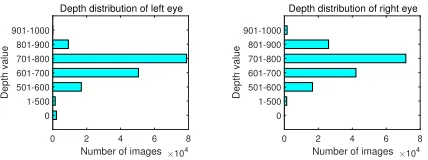
Figure 3: Depth distribution of left and right eyes in our dataset.
eye coordinates. In (Sugano, Matsushita, and Sato 2014; Lian et al. 2018), multi-view cameras were proposed to cap-ture eye images, and the UT Multiview dataset and Shang-haiTechGaze dataset was built. Depth information was im-plied by the multi-view data, but this information was not obvious. Moraet al.(Mora, Monay, and Odobez 2014) have built a dataset based on RGBD by using a Kinect camera, but the participants were too few (only 16 participants). Krafka
et al. (Krafka et al. 2016) showed that more participants
would boost the performance of person-independent gaze tracking. Thus we build a large RGBD gaze dataset with 218 participants and 165,231 images. Our dataset will facilitate the study of data-driven-based approaches for gaze tracking, and we will release our dataset to the community in the fu-ture.
Our Proposed RGBD Dataset
Data Collection System
Our data collection system is depicted in Figure 1. Specifi-cally, we use a 27-inch Apple iMac machine as a display. We
use an Intel RealSense SR300 as our RGBD camera, which is placed under the iMac. We use the RGB images and their associated depth images captured by the RealSense SR300 to build our dataset. We fix the system on a desk in a room with normal lighting conditions. A chair is placed in front of the system, and all participants can move this chair to any comfortable position.
Data Acquisition Procedure
In the data acquisition phase, the participant is required to click a white dot displayed randomly on the screen. This clicking action makes the participant concentrate on the dot. After clicking, a blue dot will be generated in the posi-tion of the click. The distance between the white dot and the blue dot helps us to judge the reliability of the cor-responding sample, because it is possible that the partici-pant was distracted while clicking, causing an inaccurately placed blue dot. Finally, we drop incorrect dots exceeding a certain threshold. After which we then use the coordinates of the white dots as the ground-truth. When clicked, RGB and depth images of the participant are recorded together through the Intel RealSense SR300; the depth image is then resampled to be the same size as the RGB image (1920×
1080 pixels) through a built-in program. The procedure is divided into 16 sessions and each session contains 50 dots.
There are 218 participants in our experiments (141 males, 77 females, aged between 19 and 37 years old). All par-ticipants have normal or corrected-to-normal vision. There are about 600-800 RGB and depth image pairs for each par-ticipant and their associated gaze point coordinates on the screen. In total, our dataset consists of 165,231 RGB/depth image pairs. We further use the images corresponding to 159 participants (119,318 RGB/depth image pairs) as training data and use the data corresponding to the remaining 59 par-ticipants as test data (45,913 RGB/depth image pairs). We list the statistics about the RGBD gaze tracking dataset and other gaze tracking datasets in Table 1.
Dataset Analysis
2. The distribution of eyes at different distances is shown in Figure 3 (The statistics are calculated by averaging the depth values around eye areas, excluding invalid values). The vari-able distances increase the complexity of the gaze point re-gression model, which makes gaze tracking in our dataset more challenging.
Method
As mentioned previously, gaze point estimation can be de-composed into eyeball pose, head pose, and 3D eye position estimation. Depth images provide head pose and 3D eye po-sition information, which facilitates gaze tracking. The orig-inal depth images, however, sometimes contain considerable noise and black holes, limiting gaze tracking performance. In this section, we propose a CNN-based multi-task learn-ing framework to simultaneously refine depth images and predict gaze points.
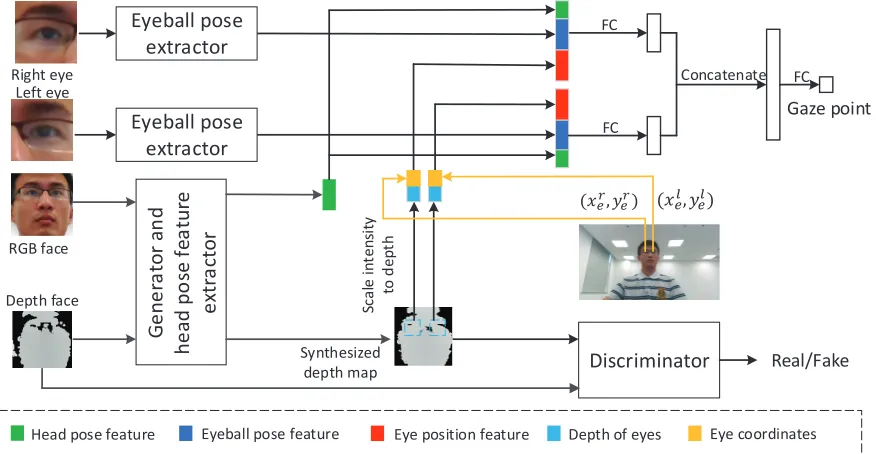
Figure 4 shows the overall network architecture. Our net-work predicts gaze points with the following steps: 1) We first extract eyeball pose features from two single-eye im-ages. 2) We extract head pose features from RGB and depth images. In order to obtain more accurate head poses, we re-fine the depth map with a GAN. Here we utilize a generator network architecture which uses both RGB and depth im-ages for depth image refinement, where the feature maps in the generator are also used to generate head pose features2. 3) We use the depth values of eye regions in the refined depth maps and eye coordinates in the original image to encode the 3D eye position. 4) We concatenate eyeball pose features, head pose features, as well as the 3D eye position features together and feed them into a network containing some fully connected layers for gaze point estimation.
Depth Image Refinement Based on GAN
Previous research has shown the practicability of single RGB image-based depth image generation (Eigen, Puhrsch, and Fergus 2014), which suggests that RGB images con-tain some depth information. In our setting, we have ob-served depth images with noise, as well as their correspond-ing RGB images. Since we do not have an accurate ground-truth depth for RGB images, we cannot directly learn a map-ping with CNNs, as has been done in (Eigen, Puhrsch, and Fergus 2014). Thus we propose to use RGB and depth im-ages together to synthesize a better depth map within a GAN (Goodfellow et al. 2014) framework.
Generator. In the generator, we feed RGB images and
depth images into two separate CNNs to extract features, then we combine both features and use a decoder to gener-ate a refined depth image. The detailed network architecture of the generator is shown in Figure 5. Since the depth map contains noise and black holes, we restrict the intensity of the synthesized depth to be consistent with its ground-truth
2
Since the generator takes face and depth images as inputs, which contain eyeballs and the depths of eyeballs/faces, the fea-tures used for head poses contain some eyeball pose information and eye coordinate information. To maintain consistency with (Zhu and Deng 2017), we also refer to this feature as the head pose.
for the non-black-hole areas. Because the measurement error of depth camera is different among all depth maps, we hope that CNNs would automatically fill the black holes. The RGB image contains content information and the depth im-age contains structure information. It is reasonable to infer partial structure from the content of RGB face. The CNN ar-chitecture itself seems to be a strong prior to regress more re-alistic images from non-rere-alistic ones with reasonable super-vision, which is similar to (Ulyanov, Vedaldi, and Lempitsky 2017). In addition, the middle feature will also be consid-ered as the head pose information to regress the gaze point because the synthesized depth map information is from it to-tally. We denoteΩ ={(x, y)|Id
i(x, y)6= 0}, andIid, IiRGB
as theithRGBD image pair (i = 1, . . . , M), whereM is the total number of RGB/depth image pairs. Then the adver-sarial loss is given by
`g=E[log(D(G(Id, IRGB)))]∼G (1) HereGis the generator andDis the discriminator. Except for adversarial loss, we also use an additional L1 loss as the reconstruction loss to guide the training process, given by
`l1=
1
M
X
i
kG(Iid(Ω), IRGB)−Iid(Ω)k1 (2)
Discriminator. The discriminator module in Figure 4
con-sists of simple convolution layers. It takes the synthesized depth maps and real depth images as its input to make them indistinguishable. The loss function of the discriminatorD is
`d=E[log(D(Id))] +E[log(1−D(G(Id, IRGB)))]∼D (3) Such synthesized depth maps help to obtain more accurate depth values from eye regions, which promotes the perfor-mance of gaze point estimation. In addition, when the syn-thesized depth maps are of a high-quality, the head pose fea-tures can help to predict gaze points more accurately.
Gaze Point Estimation Network
When a person stares at a point on the target screen, the po-sition of the gaze point is geometrically determined by three factors: eyeball pose, head pose, as well as 3D eye posi-tions, as shown in Figure 1. Instead of directly regressing gaze points from RGBD face images, following the work of (Krafka et al. 2016; Zhang et al. 2017), we propose that these factors be predicted separately, after which they can be combined together for gaze point estimation.
Eyeball pose estimation. Although a single eye contains
eyeball pose information, two single-eye images can en-hance estimation performance (Krafka et al. 2016) because two eyes are expected to stare at the same gaze point on the screen target. In this paper, we employ the shared ResNet-34 (He et al. 2016) as the eyeball pose extractor and take two single-eye images as inputs of it.
Head pose estimation.RGB images contain head pose
esti-Gaze point Right eye Left eye Synthesized depth map RGB face Depth face FC FC Concatenate
Eyeball pose
extractor
Eyeball pose
extractor
G
e
ne
ra
to
r
an
d
he
ad
po
se
f
e
a
tur
e
e
xtr
a
cto
r
Discriminator
Real/Fake FC( !", #!") ( !$, #!$) Sc a le in ten si ty to d e p th
Head pose feature Eyeball pose feature Eye position feature Depth of eyes Eye coordinates
Figure 4: The network architecture for gaze point prediction. Eyeball pose features are extracted from two single-eye images. Head pose features are obtained from RGB and depth images. 3D eye positions are determined by eye coordinates and depth of eyes. Finally, all features are combined to predict gaze point (Best viewed in color).
3 64 128 256 512
1 1024 1024 512 256 128 64 1024 1024
澦澦
澨
×
!
澥
"
×
"
"
澩
#
×
$
#
澦
%
×
%
澦
%
×
%
澦
%
×
%
澫
×
&
Conv & Pooling
澥
× " Deconv Concatenation Conv RGB image Depth image Synthesized depth map Head pose feature
澦澦
澨
×
!
1 64 128 256
512
澥
"
×
"
"
澩
#
×
$
#
澦
%
×
%
澦澦
澨
×
!
澦澦
澨
×
!
澥
"
×
"
"
澩
#
×
$
#
澦澦
澨
×
!
澦澦
澨
×
!
澦澦
澨
×
!
Figure 5: The network architecture of generator and head pose feature extractor.
mate head poses. Since the features at the bottom of the gen-erator already contain the content information and the struc-ture information (from RGB and depth image), we reuse them to generate head pose features with an additional two convolutional layers, thereby helping to reduce the dimen-sionality of head pose features.
3D eye position extraction.In order to get 3D eye positions, we first use facial landmark detection methods to locate eye positions in RGB face images. We denote the coordinates of the left and right eye centers as(xle, ylr)and (xre, yer), respec-tively, and denote the depth of these eyes aszl
eandzer, which can be obtained from the synthesized depth image. We can directly feed these coordinates to a neural network for gaze point estimation. It is based on the fact that the 3D eye posi-tion in the camera-centered world coordinate system can be derived based on the eye coordinates of images captured by the camera as well as their distances to the camera since the
data acquisition system is fixed.
Gaze point estimation. Given eyeball pose features, head
pose features, and 3D eye position features, we concatenate all of this information and feed it to a neural network with two fully connected layers to conduct gaze point estimation. The loss function is as follows:
`gp=
1
M
M X
i
kpˆi−pik2
2 (4)
wherepˆi denotes the predicted gaze point, and its ground-truth ispifor theithtraining image pair (i= 1, . . . , M).
Remarks. Since the generator is shared by both the gaze
point prediction network and the depth image refinement network, the optimization of gaze point prediction enforces the depth of refined images and pose features to be cor-rect, thus facilitating GAN training; in addition, the GAN discriminator also helps to generate better depth images for more accurate gaze tracking.
Implementation Details
Experiments
Experimental Setup
Training setup. We implement our method with the
Py-Torch (Paszke et al. 2017) framework. The batch size for all of our experiments is 100 for training and 200 for testing. We use 8 NVIDIA Tesla k40m GPUs to train our network. Stochastic Gradient Descent (SGD) optimization algorithm is adopted to train our network.
Datasets. We evaluate our method on both our RGBD
gaze dataset and EYEDIAP. Our RGBD gaze dataset is used for gaze point prediction, and we choose images correspond-ing 159 subjects from the total of 218 subjects as a traincorrespond-ing set, with the remaining used as a test set. The EYEDIAP dataset is used for gaze direction prediction. Since depth im-ages also facilitate estimation of gaze direction, we also use them for performance evaluation. We follow the same strat-egy as (Zhang et al. 2017) to choose frame images and gaze points. After that, we divide the 14 participants into 5 groups and perform cross-validation.
Evaluation metrics. For gaze point estimation on our
RGBD gaze dataset, we use the Euclidean distance metric to measure the distance between the prediction of our gaze point and its ground-truth.
de=
1
M
M X
i
kpi−pˆik2 (5)
whereM is the total number of images in our dataset,piis
the ground-truth for theithimage, and its prediction ispˆi. For gaze direction estimation on the EYEDIAP dataset, the angle deviation between our estimation and its ground-truth is used for performance measurement, i.e.,
ae=
1
N
N X
i
arccosha i,aˆii
|ai||aˆi| (6)
whereN is the total number of images in EYEDIAP.aiis
the ground-truth of theithimage, and its prediction isˆai.
hai,ˆaiirefers to the inner product betweenaiandˆai. To
be consistent with (Zhang et al. 2017), Equation (5) is in millimeters (mm), and Equation (6) is in degrees.
Table 2: Performance comparison of gaze point estimation on our dataset. (unit: mm)
Methods de
Multimodal CNN (Zhang et al. 2015) 67.2
iTracker (Krafka et al. 2016) 55.5
iTracker* (Krafka et al. 2016) 47.5 Spatial weights CNN (Zhang et al. 2017) 60.6
Our method 38.7
Table 3: Performance comparison of gaze direction estima-tion on EYEDIAP. (unit: degree)
Methods ae
Multimodal CNN (Zhang et al. 2015) 10.2 (2.9)
iTracker (Krafka et al. 2016) 8.3 (1.7)
iTracker* (Krafka et al. 2016) 5.7 (1.1)
Spatial weights CNN (Zhang et al. 2017) 6.0 (1.2) Ghiasset al.(Ghiass and Arandjelovic 2016) 7.2 (1.3)
Our method 4.8 (0.7)
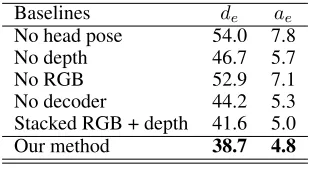
Table 4: Network architecture evaluation on our dataset and EYEDIAP.
Baselines de ae
No head pose 54.0 7.8
No depth 46.7 5.7
No RGB 52.9 7.1
No decoder 44.2 5.3
Stacked RGB + depth 41.6 5.0
Our method 38.7 4.8
Performance Comparison
We compare our proposed method with state-of-the-art deep learning based methods for gaze point estimation on our dataset and gaze direction estimation on EYEDIAP, includ-ing:
• Multimodal CNN (Zhang et al. 2015): Normalized eye images and 3D head poses are fed into a CNN consist-ing of a LeNet feature extractor and a few fully connected layers to predict gaze direction.
• iTracker (Krafka et al. 2016): Eye images, faces, and face grids are fed into a multi-region CNN architecture. In the fully connected layer, all features are combined to predict gaze points.
• iTracker* (Krafka et al. 2016): We substitute the origi-nal feature extractor in iTracker with ResNet-34. All other parts are the same as with iTracker (Krafka et al. 2016).
• Spatial weights CNN (Zhang et al. 2017): It makes use of the full-face image as its input to learn the spatial weights CNN for gaze point and gaze direction prediction.
Original depth map
Synthesized depth map
ܴܩܤ ݅݉ܽ݃݁
Figure 6: Visualization of original and synthesized face depth map.
apply GAN to refine the depth maps and predict gaze points. Although we do not geometrically model 3D faces, the depth data provide sufficient information, necessary head poses and 3D eye positions for improving gaze estimation.
In Table 3, we apply our methods to gaze direction esti-mation. The results on the EYEDIAP dataset are the average results based on 5-fold cross-validation, and the numbers in parentheses indicate the standard deviations of angles. Dif-ferent from gaze point estimation, gaze direction estimation does not depend on the 3D eye positions, but the depth maps still provide the head pose information and help head pose estimation. Thus, with synthesized depths, our method still achieves state-of-the-art results for gaze direction estimation on EYEDIAP. The t-test3shows that the improvements are statistically significant.
Ablation Studies
In order to explore the effectiveness of different modules for gaze tracking, we report the performance after removing dif-ferent components from our network. We conduct these ex-periments on our dataset and the EYEDIAP dataset. The re-sults of all baseline methods are listed in Table 4. For gaze point estimation, our network combines head pose features, eyeball pose features and 3D eye position features. For gaze direction estimation, we only concatenate the head pose fea-tures and eyeball pose feafea-tures.
First, we remove the head pose information, which means that the network only takes two single-eye images and 3D eye positions as inputs, which leads to the worst recorded performance. As mentioned before, head poses are neces-sary for gaze estimation, otherwise, the network will be over-fitting. Both RGB image and depth map provide head pose information. Next, we remove the RGB image and depth map, respectively. Removing depth input results in better performance over removing RGB input, which shows that RGB face data makes for better representation than fa-cial depth data. It is also worth noting that the difference between removing depth and iTracker* (Krafka et al. 2016) lies in the 3D eye position encoding method. To obtain 3D eye position information, in (Krafka et al. 2016), a binary map (referred to as a face grid) is used to indicate face
re-3
https://www.graphpad.com/quickcalcs/ttest1/?Format=SD
gions in the images, and the sizes of the faces and their po-sitions in the images captured by the camera roughly en-codes the 3D eye coordinates. Our accurate 3D eye positions slightly enhance the performance (46.7 mmvs.47.5 mm), as shown in Table 4.
In addition, we also remove the decoder module during depth reconstruction, obtaining a worse performance than the depth reconstruction, which validates the effectiveness of depth refinement in our network. The network can learn a better representation of head pose feature due to the super-vision of depth reconstruction. Finally, since we introduce the depth map to extract head pose feature, we also conduct the experiment about how to combine RGB image and depth map. We stack both together to extract the head pose feature and denoted it as Stacked RGB + depth, but this leads to a poorer performance than our method.
Evaluating the Quality of Synthesized Depth Maps
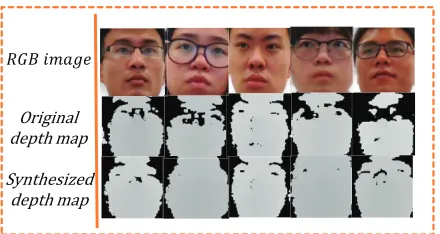
Due to the raw depth images directly obtained from depth sensor contain noises, it is hard to evaluate how accurate the generated depth map is. Alternatively, we evaluate the qual-ity of synthesized depth maps through the performance of gaze point estimation indirectly. In this experiment, we use the same network architecture. In the testing phase, how-ever, rather than using depth data from the refined depth map, we use the depth value of the original depth image as 3D eye positions for gaze tracking. The gaze point es-timation error of this baseline on our dataset is 40.4 mm, which is worse than that when using the refined depth map (38.7 mm). The improvement of our method over this base-line quantitatively validates the better quality of synthesized depth maps over original maps. We also qualitatively show the improvement from original depth images to refined ones in Figure 6. Our synthesized depth map can complement the black holes caused by occlusion, the specularity of eye-glasses, and out-of-valid ranges of the depth camera partly.
Conclusion
In this paper, we decompose gaze point estimation into eye-ball pose, head pose, and 3D eye position estimation. Depth is important to predict gaze because it complements head pose and 3D eye position information. Raw depth images di-rectly obtained from depth sensors, however, contain noises, so we utilize a generator network and apply GAN to re-fine the depth maps and predict gaze points simultaneously. The entire network is combined via a multi-task learning framework. In addition, we build a large-scale RGBD gaze dataset. As far as we know, this is the largest dataset in terms of its number of subjects. Extensive experiments on our dataset and the EYEDIAP dataset show that our gaze track-ing method outperforms all existtrack-ing state-of-the-art methods by a large margin.
Acknowledgment
References
Eigen, D.; Puhrsch, C.; and Fergus, R. 2014. Depth map prediction from a single image using a multi-scale deep net-work. In Advances in neural information processing sys-tems, 2366–2374.
Ghiass, R. S., and Arandjelovic, O. 2016. Highly accurate gaze estimation using a consumer rgb-d sensor. In Proceed-ings of the Twenty-Fifth International Joint Conference on
Artificial Intelligence, 3368–3374. AAAI Press.
Goodfellow, I.; Pouget-Abadie, J.; Mirza, M.; Xu, B.; Warde-Farley, D.; Ozair, S.; Courville, A.; and Bengio, Y. 2014. Generative adversarial nets. InAdvances in neural
information processing systems, 2672–2680.
Hansen, D. W., and Ji, Q. 2010. In the eye of the beholder: A survey of models for eyes and gaze.IEEE transactions on
pattern analysis and machine intelligence32(3):478–500.
He, Q.; Hong, X.; Chai, X.; Holappa, J.; Zhao, G.; Chen, X.; and Pietik¨ainen, M. 2015. Omeg: Oulu multi-pose eye gaze dataset. InScandinavian Conference on Image Analy-sis, 418–427. Springer.
He, K.; Zhang, X.; Ren, S.; and Sun, J. 2016. Deep residual learning for image recognition. InCVPR.
Huang, Q.; Veeraraghavan, A.; and Sabharwal, A. 2015. Tabletgaze: unconstrained appearance-based gaze estima-tion in mobile tablets. arXiv preprint arXiv:1508.01244.
Krafka, K.; Khosla, A.; Kellnhofer, P.; Kannan, H.; Bhan-darkar, S.; Matusik, W.; and Torralba, A. 2016. Eye tracking for everyone. InCVPR, 2176–2184.
Lian, D.; Hu, L.; Luo, W.; Xu, Y.; Duan, L.; Yu, J.; and Gao, S. 2018. Multiview multitask gaze estimation with deep convolutional neural networks. IEEE Transactions on
Neu-ral Networks and Learning Systems1–14.
Lu, F.; Okabe, T.; Sugano, Y.; and Sato, Y. 2014a. Learn-ing gaze biases with head motion for head pose-free gaze estimation.Image and Vision Computing32(3):169–179.
Lu, F.; Sugano, Y.; Okabe, T.; and Sato, Y. 2014b. Adap-tive linear regression for appearance-based gaze estimation.
IEEE Transactions on Pattern Analysis and Machine
Intelli-gence36(10):2033–2046.
Majaranta, P., and Bulling, A. 2014. Eye tracking and eye-based human–computer interaction. InAdvances in
physio-logical computing. Springer. 39–65.
Mora, K. A. F., and Odobez, J.-M. 2013. Person independent 3d gaze estimation from remote rgb-d cameras. In ICIP, 2787–2791. IEEE.
Mora, K. A. F.; Monay, F.; and Odobez, J.-M. 2014. Eye-diap: A database for the development and evaluation of gaze estimation algorithms from rgb and rgb-d cameras. In Pro-ceedings of the Symposium on Eye Tracking Research and
Applications, 255–258. ACM.
Morimoto, C. H., and Mimica, M. R. 2005. Eye gaze track-ing techniques for interactive applications. Computer vision
and image understanding98(1):4–24.
Paszke, A.; Gross, S.; Chintala, S.; Chanan, G.; Yang, E.;
DeVito, Z.; Lin, Z.; Desmaison, A.; Antiga, L.; and Lerer, A. 2017. Automatic differentiation in pytorch.
Ranjan, R.; De Mello, S.; and Kautz, J. 2018. Light-weight head pose invariant gaze tracking. arXiv preprint
arXiv:1804.08572.
Rayner, K. 1998. Eye movements in reading and informa-tion processing: 20 years of research.Psychological bulletin
124(3):372.
Sugano, Y.; Matsushita, Y.; and Sato, Y. 2014. Learning-by-synthesis for appearance-based 3d gaze estimation. In
CVPR, 1821–1828.
Ulyanov, D.; Vedaldi, A.; and Lempitsky, V. S. 2017. Deep image prior. CoRRabs/1711.10925.
Xiong, X.; Liu, Z.; Cai, Q.; and Zhang, Z. 2014. Eye gaze tracking using an rgbd camera: a comparison with a rgb so-lution. InProceedings of the 2014 ACM International Joint Conference on Pervasive and Ubiquitous Computing:
Ad-junct Publication, 1113–1121. ACM.
Zhang, X.; Sugano, Y.; Fritz, M.; and Bulling, A. 2015. Appearance-based gaze estimation in the wild. In Proceed-ings of the IEEE Conference on Computer Vision and
Pat-tern Recognition, 4511–4520.
Zhang, X.; Sugano, Y.; Fritz, M.; and Bulling, A. 2017. It’s written all over your face: Full-face appearance-based gaze estimation. InCVPRW.
Zhu, W., and Deng, H. 2017. Monocular free-head 3d gaze tracking with deep learning and geometry constraints. In
Proceedings of the IEEE Conference on Computer Vision
and Pattern Recognition, 3143–3152.
Zhu, Z.; Ji, Q.; and Bennett, K. P. 2006. Nonlinear eye gaze mapping function estimation via support vector regression.
InPattern Recognition, 2006. ICPR 2006. 18th International