Second language teachers’ sense of self-efficacy: A
construct validation
Ramin Akbari
Assistant Professor, Tarbiat Modares University
Arman Abednia
Ph.D., Alameh Tabataba'i University
Abstract
While teacher efficacy is a well-researched concept in mainstream teacher education, it is relatively unexplored in second language (L2) teaching contexts. Part of the problem stems from lack of a specific instrument for measuring teacher efficacy in L2 settings. The present study was conducted, therefore, to develop such an instrument. “Teachers’ Sense of Efficacy scale” (TSES) formed the basis for the development of the new instrument. 35 L2 teachers with more than 3 years of experience were interviewed on the specifics of efficient foreign language teaching. After the content analysis of the interviews, ten items were developed and added to TSES. The resultant 33-item questionnaire, “Second Language Teacher Efficacy Scale”, SLTES, was administered to 272 English language teachers for construct validation. Factor analysis of the collected data with principal axis factoring yielded the same factor structure of
TSES, that is, efficacy in instructional strategies, efficacy in
student engagement, efficacy in classroom management which were redefined in light of the items added to each.
1. Introduction
The history of language teaching is a narrative of rise and fall of methods; up to 1990s most textbooks dealing with language teaching methodology (see for example Richards & Rogers, 2001; Larsen-Freeman, 2000) presented a neat chronology of methods coming into existence and going out of fashion in response to changing trends in linguistics and psychology or students' needs.
The perceived impracticality of methods, however, resulted in the rise of what is called the post method era in language teaching (Kumaravadivelu, 1994, 2001, 2003). The post method debate rejects the artificial framework laid down by methods for teacher performance as well as qualification, and, instead, emphasizes practitioners' sense of competence and confidence.
Post method views teachers as the focal point of the teaching process; giving teachers such a priority entails a more serious consideration of teachers' beliefs and characteristics (Gencer & Cakiroglu, 2007). As indicated by a growing body of research, teachers’ behaviors and instructional decisions are closely linked to their assumptions and the way they define their roles (Chacon, 2005). Teachers’ beliefs, for example, have been associated with the use of multimedia instructional tools (Antonietti & Giorgetti, 2006), learners’ and teachers’ autonomy (Warfield, Wood & Lehman, 2005), teachers’ lesson planning (Pajares, 1992) and teachers’ conceptualization of how children learn (Rimm-Kaufman, Storm, Sawyer, Pianta & LaParo, 2006). Williams and Burden (1997) point out that more than any particular methodology, teachers’ deep-rooted beliefs about learners, language learning, and themselves have noticeable effects on their classroom actions.
Vacha-Haase, 2001). Efficacy beliefs have been associated with teachers’ perseverance in unsupportive environments (Milner & Woolfolk Hoy, 2003), less likelihood of referring students to special education (Poddell & Soodak, 1993) and student achievement in mathematics (Ross & Causin, 1993), to name a few. Teachers’ sense of efficacy, however, has not received its due share in language teacher education, and only a few studies have been done on its contributions to language teacher behavior and other variables related to language teaching and learning (e.g. Chacon, 2005; Goker, 2006). The dearth of research in this area partly stems from the fact that there is not any specific language teacher efficacy instrument available to language teaching professionals. Taking into account the context-specific nature of efficacy beliefs (Bandura, 1986), the present study was conducted to fill this gap by developing and validating an L2 teacher efficacy instrument and, as a result, to further draw the attention of L2 teacher education professional community to the significance of teachers’ perceptions about their capabilities.
The first part of the paper presents a brief discussion of the theoretical underpinnings of teacher efficacy, followed by a description of some of the available instruments for the measurement of the construct as well as a survey of some of the variables that are shown to be related to teachers' sense of efficacy. The second part of the paper deals with the design and validation process of an L2 teacher efficacy instrument.
1.1 Teacher Efficacy Beliefs: Two Conceptual Strands
The construct of teacher self-efficacy has been developed within two theoretical frameworks, namely Rotter's (1966) "Locus of control" and Bandura's (1977) "Social cognitive theory". Each of these strands has made great contributions to conceptualization and measurement of the concept. Rotter's "Locus of control" gave birth to the idea of teacher efficacy, and Bandura's theory helped the concept mature to its adulthood.
1.1.1 Rotter's Locus of Control
expectations exert significant influences over achievement behavior (Schunk, 2004). Teachers with an internal tendency believe they can control or, at least, affect student achievement more than those teachers with an external tendency. Locus of control theory generated extensive research on teacher self-efficacy assessment and the construct's relation with other educational variables.
1.1.2 Bandura's Social Cognitive Theory
Although locus of control paved the way for the emergence of teacher efficacy and fostered its development to a great extent, the term "teacher efficacy" mainly originated from the concept of self-efficacy introduced by Bandura (1977) within the framework of his “Social Cognitive Theory”. Bandura defines self-efficacy as “people’s judgments of their capabilities to organize and execute courses of action required to attain designated types of performance” (p. 174). Generally, efficacy judgments are considered the main mediator for behavior and behavioral change (Henson, 2001).
Efficacy expectations are different from outcome expectations, i.e., the focus of locus of control. While outcome expectations relate to people's estimate of the likely outcomes of carrying out a task at the expected level of competence, efficacy expectations reflect people's beliefs about their own abilities in performing courses of action (Bandura, 1977). In other words, while the efficacy question is, “Do I have the ability to organize and execute the actions required to accomplish a specific task at a desired level?", the outcome question is, “If I manage to accomplish the task at that level, what are the likely consequences?" (Tschannen-Moran et al., 1998, p. 6) Temporally, efficacy expectations are aroused prior to outcome expectations and contribute to their formation (Tschannen-Moran et al., 1998).
With regard to the sources of efficacy beliefs, Bandura (1997) identifies four forms of influence which develop people's beliefs about
their efficacy: mastery experiences, i.e. people's experience of success and
failure in performing different tasks, vicarious experiencesgained through
people's observation of accomplishments and failures on the part of similar
others, social persuasion, i.e. significant others' verbal encouragement of
certain courses of action, and emotional and physiological states which include both negative emotional and physiological reactions like tension and stress and positive moods such as excitement and happiness and desirable emotional and physiological states.
As it was pointed out, teacher efficacy established its identity in light of the way self-efficacy was conceptualized in social cognitive theory. Therefore, it can be defined as teachers’ belief in their ability to affect valued student outcomes even when confronted with difficult and unmotivated students (Tschannen-Moran & Woolfolk Hoy, 2001; Wheatly, 2005). However, due to the contextual and task-specific nature of self-efficacy, teacher efficacy can be more precisely defined as "the teacher’s belief in his or her capability to organize and execute courses of action required to successfully accomplish a specific teaching task in a particular context" (Tschannen-Moran et al., 1998, p. 22).
As mentioned above, teacher efficacy has been extensively researched in mainstream teacher education and, therefore, its meaning and measure are among current topics of debate in teacher education literature (see Wheatly, 2005, for example). We now turn to measurement instruments designed to tap into teachers' sense of self efficacy.
1.2 Measuring Teacher Efficacy Beliefs
A considerable number of measurement instruments were developed based on the two theoretical strands explained above. Temporally, the instruments based on Bandura's theory followed the ones grounded in Rotter's theory.
1.2.1 Efficacy Measures Growing out of Rotter's Locus of Control
1. When it comes right down to it, a teacher can’t do much because most of a student’s motivation and performance depend on his or her home environment.
2. If I really try hard, I can get through to even the most difficult or unmotivated students.
If a teacher agrees with the first one, then it shows the teacher’s external locus of control. Since this assessment shows a teacher’s perception of abilities of teachers in general (Tschannen-Moran & Woolfolk Hoy, 2001), as opposed to those of a particular teacher, this item has been labeled “general teaching efficacy” (GTE) (Ashton, Olejnik, Crocker & McAuliffe, 1982). Agreeing with the second item shows a teacher’s internal locus of control. Also, this item is believed to refer to a particular teacher’s beliefs and, therefore, is labeled “personal teaching efficacy” (PTE) (Tschannen-Moran & Woolfolk Hoy, 2001).
RAND researchers’ concern about the reliability of this two-item scale resulted in developing longer and more comprehensive instruments like “Teacher Locus of Control” (Rose & Medway, 1981). Half of the items of this 28-item scale describe a situation of student failure and half success. “Responsibility for student achievement” (Guskey, 1981) was another scale developed the same year. The scale has two subscales of 'Responsibility for student success' and 'Responsibility for student failure'. Respondents are required to give a percentage or weight to either of the choices in every item.
Finally, “Webb Scale” (Ashton et al., 1982) developed subsequently includes 7 items each comprised of two statements. Respondents are asked to show if they agree most strongly with the first or the second statement.
1.2.2 Efficacy Measures Growing out of Bandura's Social Cognitive Theory
teachers are to judge their effectiveness in handling them on a 7-point scale from “extremely ineffective” to “extremely effective”.
Another measure based on this conceptual strand was Gibson and Dembo’s (1984) “Teacher Efficacy Scale” (TES). The factor analysis of this instrument yielded the two subscales of general and personal teaching efficacy.
Due to some conceptual and statistical problems of this instrument (Tschannen-Moran & Woolfolk Hoy, 2001), Riggs and Enochs (1990) modified it and developed the 25-item “Science Teaching Efficacy Belief Instrument” (STEBI) which was subject-matter specific.
Bandura (1997) also developed his own 30-item scale based on the assumption that teacher efficacy is not necessarily a uniform concept across different tasks and subject matters. While most of the other measures had used a 5/6-point Likert scale ranging from 'Disagree' to 'Agree', Bandura developed a 9-point one ranging from 'nothing' to 'a great deal'. Putting forward a multi-faceted picture of teacher efficacy, Bandura included different subscales such as efficacy to enlist parental involvement and efficacy to enlist community involvement.
More recently, Tschannen-Moran and Woolfolk Hoy (2001), dissatisfied with the currently used instruments in finding the balance between specificity and generality, developed their own “Teacher sense of efficacy scale” (TSES) with its three factors of “efficacy for classroom management”, “efficacy for student engagement”, and “efficacy for instructional strategies” which are measured by 24 items designed on a 9-point Likert scale proposed by Bandura. The following are examples of each factor in order:
-How much can you do to control disruptive behavior in the classroom? -How much can you do to get through to the most difficult students? -How well can you implement alternative strategies in your classroom?
TSES served as the basis for the development of L2 teachers’ efficacy instrument in the present study. The adoption of TSES for this purpose was due to a number of flaws observed in other available instruments and certain advantages of TSES over them.
there are some conceptual problems with the interpretation of their factor structures (Tschannen-Moran & Woolfolk Hoy, 2001). Moreover, the scales based on the two-factor model of GTE and PTE encounter some serious problems. For example, in TES (Gibson & Dembo, 1984) and STEBI (Riggs & Enochs, 1990), the GTE subscale seems to have measurement error problems and its construct validity is open to question (Henson et al., 2001; Tschannen-Moran et al., 1998). In addition, TES has the most variable reliability coefficient (Henson et al., 2001).
On the contrary, in addition to its reasonable length, TSES can capture the multidimensionality and specificity of teacher efficacy (Fives, Hamman & Olivarez, 2007) and also “a wider range of teaching tasks” (Tschannen-Moran & Woolfolk Hoy, 2001, p. 801). Its factors are more interpretable, and they are more specific to teaching tasks (Woolfolk Hoy & Spero, 2005). Theoretically, TSES is based on an integrated model of teacher efficacy (Tschannen-Moran et al., 1998) which includes two
dimensions of “task analysis” and “perceptions of teaching competence”.
These dimensions have certain advantages over GTE and PTE. Compared to GTE which considers only the constraints and not the useful means, task analysis is more specific and includes both elements that can facilitate and those which can hinder the process of teaching. Also, compared to PTE which involves “futuristic evaluations”, personal teaching competence “deals directly with perceptions of current functioning or abilities” (Henson, 2001, p.7). For a more detailed and thorough explanation of the characteristics and flaws of other scales and advantages of TSES, interested readers may refer to Moran et al. (1998), Tschannen-Moran and Woolfolk Hoy (2001), and Henson (2001).
1.3 The Role of Teacher Efficacy in Educational Settings
Strong links have been found between teachers' level of aspiration and their sense of efficacy. For example, extra-role behavior toward the team and the organization tends to relate to high levels of teacher efficacy (Somech & Drach-Zahavy, 2000). Also, Cousins and Walker (2000) found that highly efficacious teachers show a tendency toward educational innovations and changes. In terms of classroom management, high personal teacher efficacy has been found to be correlated with more humanistic approaches toward pupil control (Woolfolk Hoy & Hoy, 1990) and the ability in developing positive relationships among students (Rich, Lev & Fisher, 1996). Teacher efficacy is also related to students’ learning outcomes. Tcshannen-Moran et al. (1998), for example, found that positive personal teacher efficacy has positive effects on students’ performance on language achievement tests. Furthermore, Ross and Causin (1993) found a positive correlation between high general teaching efficacy and students’ high achievement in mathematics.
All the studies surveyed here are indicative of the significant contribution of teacher efficacy to positive teacher behavior and desireble student performance. All these studies indirectly highlight the need for teacher efficacy construct to be invesitaged in L2 teacher education due to its relation with many positive teaching/learning outcomes in the classroom. To this end, the present study was carried out to specify, in its exploratory phase, the components of teacher efficacy in language teaching contexts, and as a result, in its quantitative phase, develop and validate an L2 teacher efficacy instrument.
responses to items (Wheatley, 2005). Seeking to remedy these shortcomings, some researchers have developed instruments at more specific levels like Riggs and Enochs (1990) who developed STEBI (Science Teaching Efficacy Belief Instrument) and Rubecks and Enochs (1991) who tried to account for a higher level of specificity by differentiating chemistry teaching efficacy from science teaching efficacy. Bandura’s Teacher Self-Efficacy Scale can also be considered as a step toward task-specificity. Nevertheless, no measure has been specifically designed for an L2 teaching context. The only attempt in this regard was made by Chacon (2005) who changed the wording of items in the short form of TSES to tailor the scale to the context of L2 teaching. For example, the phrase "in your English class" had been added to the end of the item "How much can you do to calm a student who is disruptive or noisy?" A similar change was made by Atay (2007 in “Teacher Self-Efficacy Scale” (TSES) (Tschannen-Moran & Woolfolk Hoy, 2001) when he tried to investigate the effects of practicum courses on the efficacy perceptions of pre-service teachers in Turkey. But, we believe that mere rephrasing of items does not address the need since it by no means captures particulars of language education context and fails to provide any adequate componential definition of L2 teacher efficacy. Such conditions render the design of an instrument to evaluate L2 teacher efficacy beliefs necessary.
2. Method
The present study was conducted in two phases; the first phase, which was the exploratory one, was carried out to develop a definition of teacher efficacy from a second language instruction perspective. The second purpose of this stage was the development of a questionnaire which would measure the construct of teacher efficay in L2 teaching situations; the second phase was devoted to the confirmatory construct validation of the instrument developed during the first phase of the study.
2.1 The Qualitative Phase
meant to provide a componential definition of teacher sense of efficacy in the second language education context so that such components can be, later, incorporated into the selected measurement instrument.
2.1.1 Participants
19 male and 16 female language teachers volunteered to participate in the first phase of the study, i.e. interview on the characteristics of an efficacious language teacher. All the participants had at least three years of uninterrupted teaching experience and had degrees or were studying for a degree in TEFL (Teaching English as a Foreign Language). They also had the experience of teaching English to different proficiency levels at different language education institutes in Tehran.
2.1.2 Instrumentation
35 semi structured interviews were conducted to establish a concpetual framework for defining the qualities of effective language teachers during the exploratory phase of the study. Each interviewee was presented with the following three questions on different characteristics of an ideal second language teacher:
1. Describe to me one or two ideal language teachers you have ever had. What were their outstanding features that made them ideal?
2. Please list and explain different characteristics that a language teacher needs to have to be successful in his/her language teaching profession.
3. What are the extra qualities that a teacher needs to have, in addition to
those of a typical teacher, to be an ideal language teacher?
question did so based on what the interviewees had theorized about effective teaching of L2. The third question was asked in order to draw the interviewees’ attention to the distinctive qualities of an L2 teacher rather than those of teachers in general terms. The language of the interview was English due to the high proficiency level of the respondents and their preference in responding in English.
It should be noted that in this phase we asked interviewees about characteristics of an ideal teacher, hoping it will give us clues about efficacy as well. Hence, the two were not assumed the same, but very closely related, and, therefore, those characteristics which would be referred to by the interviewees and found to be related to teacher efficacy would be selected for instrument development purposes.
2.1.3 Procedures
In the qualitative phase of the study we relied on interviews as its data collection instrument. As it was pointed out, the main purpose of the interview was to find out how efficacy is defined and viewed by L2 practitioners. The interviews lasted between 25 and 40 minutes and were tape-recorded and transcribed. To analyze the content of the interviews, both code and thematic analyses were used. Code analysis was used in order to extract the most frequently mentioned points which were then categorized into common themes through thematic analysis.
Based on the frequency of the qualities mentioned by the interviewees, 10 statements with the highest frequencies, ranging from 12 to 15, were extracted and categorized based on their common themes, and 4 categories
were obtained namely student engagement, instructional strategies,
concern for individual differences, and teacher's proficiency(see Table 1). However, since three of the items (items 3, 4, and 5) seemed to belong to both categories A and B (i.e. Student engagement and instructional strategies), they were included under both. It was assumed that Principal Factor Analysis at the next stage would show which category they belong to more clearly.
It is worth mentioning that the extracted items and themes, except for
data. Thus, these items and themes are what teachers have most referred to as pivotal in the context of language instruction.
Table 1: The results of thematic analysis of interview scripts in the form of statements
A. Student engagement
1. A successful teacher should develop friendly relationship with
students.
2. A successful teacher should provide a friendly environment in the
classroom.
3. A successful teacher should teach learners how to learn.
4. A successful teacher should enhance learners’ autonomy.
5. A successful teacher should motivate and encourage learners to learn
more and better.
B. Instructional strategies
1. A successful teacher should prepare a lesson plan for his teaching.
2. A successful teacher should know how to conduct pair and group
activities in the classroom.
3. A successful teacher should motivate and encourage learners to learn
more and better.
4. A successful teacher should teach learners how to learn.
5. A successful teacher should enhance learners’ autonomy.
C. Concern for individual differences
1. A successful teacher should pay attention to individual learners.
2. A successful teacher should be familiar with learners’ personality
traits.
D. Teacher's proficiency
1. A successful teacher should be proficient in different skills and
components of English.
Woolfolk Hoy, 2001) to develop the new questionnaire, “Second Language Teaching Efficacy Scale”. The items are as follows:
1. How well can you conduct pair and group activities well in the classroom?
2. How much can you do to motivate and encourage learners to learn more and better?
3. How well do you prepare a lesson plan for your teaching? 4. To what extent are you familiar with learners’ personality traits? 5. How much do you pay attention to individual learners?
6. To what extent can you enhance learners’ autonomy? 7. How well can you teach learners how to learn?
8. How well can you provide a friendly environment in the classroom? 9. How much can you do to develop friendly relationship with learners? 10. How proficient are you in different aspects of English?
As mentioned before, due to the advantages of TSES mentioned in the previous section of the paper, it seemed to make an adequate measure of efficacy of teachers, in general terms, and, therefore, adding these items to it would result in an adequate measure of L2 teachers’ efficacy. A few minor changes, however, were made in TSES, following the examples of
Atay (2007) and Chacon (2005) in replacing words such as school with
classroom and students with learners. For example, the item "How much can you do to motivate students who show low interest in schoolwork?"
was changed into "How much can you do to motivate learners who show
low interest in classroom work?"
2.2 The Quantitative Phase
In this section, construct validation of the developed instrument is explained.
2.2.1 Participants
levels. Both male and female teachers participated in this study, representing different urban/rural teaching contexts. The participants’ ages ranged from 19 to 60. The inclusion of this relatively diverse group of respondents was with the objective of having a heterogeneous sample for the factor analysis of data, as recommended by Kline (1994). Out of the 415 questionnaires collected, however, only 272 could be used since the rest were either carelessly filled or had some of their items not responded to. Out of these 272 questionnaires 117 were filled by male teachers and 155 by female respondents.
2.2.2 Instrumentation
The new questionnaire “Second Language Teaching Efficacy Scale” (SLTES), consisted of 34 items, a combination of the 24 items of TSES (its long form) and the 10 added items related to langauge teachers. In this questionnarie the 9-point Likert Scale of the original questionanire was kept intact. Bandura's model and his advice in establishing an expanded, unidirectional response scale was followed as the rational for the use of a 9-point Likert scale (Tschannen-Moran & Woolfolk Hoy, 2001). In addition, it was assumed that any change in the scale would negatively affect its measurement precision (Tschannen-Moran, personal communication, April 20, 2007).
2.2.3 Procedures
The first draft of the questionnaire was reviewed by two questionnaire development experts. Based on their feedback, certain modifications were made in the structure of the instrument and some of its items, and the revised developed version was administered to the respondents. As it was pointed out earlier, 143 questionnaires were rejected by the researchers due to missing data or apparent carelessness on the part of respondents in selecting responses (manifested, for example, in consistent selection of one option across all items). The remaining data were fed into SPSS and analyzed.
extraction method used for the original questionnaire (Tschannen-Moran & Woolfolk Hoy, 2001).
To check for the factorability of data, the determinant, KMO (Kaisor-Mayor-Olkin) Measure of Sampling Adequacy and Bartlett Test of Sphericity were used. With regard to the rotation procedure, Varimax, the most common orthogonal rotational criterion, which was used in the development of TSES, was drawn upon.
3. Results and Discussion
3.1 Construct Validation3.1.1 Descriptive Statistics
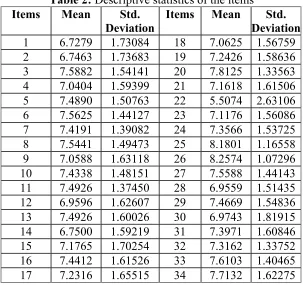
Table 2: Descriptive statistics of the items
Items Mean Std.
Deviation Items Mean DeviationStd.
1 6.7279 1.73084 18 7.0625 1.56759
2 6.7463 1.73683 19 7.2426 1.58636
3 7.5882 1.54141 20 7.8125 1.33563
4 7.0404 1.59399 21 7.1618 1.61506
5 7.4890 1.50763 22 5.5074 2.63106
6 7.5625 1.44127 23 7.1176 1.56086
7 7.4191 1.39082 24 7.3566 1.53725
8 7.5441 1.49473 25 8.1801 1.16558
9 7.0588 1.63118 26 8.2574 1.07296
10 7.4338 1.48151 27 7.5588 1.44143
11 7.4926 1.37450 28 6.9559 1.51435
12 6.9596 1.62607 29 7.4669 1.54836
13 7.4926 1.60026 30 6.9743 1.81915
14 6.7500 1.59219 31 7.3971 1.60846
15 7.1765 1.70254 32 7.3162 1.33752
16 7.4412 1.61526 33 7.6103 1.40465
17 7.2316 1.65515 34 7.7132 1.62275
3.1.2 Factor Analysis
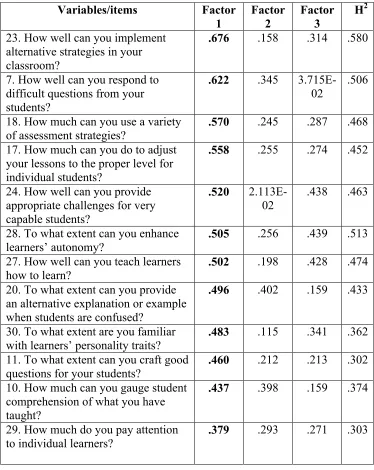
In order to check the construct validity of the developed 34-item questionnaire, the gathered data was subjected to Principal axis factoring with Varimax Rotation and Kaiser Normalization. To account for any computational problem with factor analysis and multicolinearity, the determinant was checked and it was found to be higher than 0.00001. KMO (Kaisor-Mayor-Olkin) measure of sampling adequacy was considerably greater than .5 (.92). Also, Bartlett’s test of sphericity was significant (.0) and showed that the correlation matrix was not an identity matrix. The conclusion was that the data were factorable.
Criterion overestimated the number of factors. More precisely, the researchers could not impute factor labels from factor loadings of the variables grouped in those factors. For example, in some cases the label assigned to a particular group of items happened to fit another group too. Therefore, the Scree test was also employed, but it also did not help because the curve started to flatten after the second factor. Therefore, it underestimated the number of factors and produced an unrealistically condensed picture of the factor structure.
Therefore, we chose to check different factor solutions and found the 3-factor solution as the most interpretable one. The original 3-factor structure, “efficacy in student engagement”, “efficacy in instructional strategies”, and “efficacy in classroom management”, was retained except for two items. Item 8, “How well can you establish routines to keep activities running smoothly?” had originally loaded on “efficacy in classroom management”, while in the proposed measure it loaded on “efficacy in instructional strategies”. Also, item 14, “How much can you do to improve the understanding of a student who is failing?” had originally loaded on “efficacy in student engagement”, while it loaded on “efficacy in classroom management” in our analysis. The loading of item 8 on “efficacy in instructional strategies” made sense to the researchers since establishing routines to keep activities running smoothly could be thought of as an instructional strategy as well. However, the content of item 14 did not seem to match the related factor.
The last problem with this factor structure was that item 32, “How proficient are you in different aspects of English?”, loaded on “efficacy in instructional strategies”. But the researchers concluded that the content of this item corresponds neither with this factor nor with the other two. So, this item was omitted and another 3-factor analysis was run.
Table 3: The 3-factor model (communalities, loadings sorted by size, and eigenvalues)
Variables/items Factor
1
Factor 2
Factor 3
H2
23. How well can you implement alternative strategies in your classroom?
.676 .158 .314 .580
7. How well can you respond to difficult questions from your students?
.622 .345
3.715E-02 .506
18. How much can you use a variety
of assessment strategies? .570 .245 .287 .468
17. How much can you do to adjust your lessons to the proper level for individual students?
.558 .255 .274 .452
24. How well can you provide appropriate challenges for very capable students?
.520
2.113E-02 .438 .463
28. To what extent can you enhance
learners’ autonomy? .505
.256 .439 .513
27. How well can you teach learners
how to learn? .502
.198 .428 .474
20. To what extent can you provide an alternative explanation or example when students are confused?
.496 .402 .159 .433
30. To what extent are you familiar
with learners’ personality traits? .483 .115 .341 .362
11. To what extent can you craft good
questions for your students? .460 .212 .213 .302
10. How much can you gauge student comprehension of what you have taught?
.437 .398 .159 .374
29. How much do you pay attention
15. How much can you do to calm a
student who is disruptive or noisy? 5.037E-02 .648 .338 .536
16. How well can you establish a classroom management system with each group of students?
.224 .581 .255 .453
19. How well can you keep a few problem students from ruining an entire lesson?
.337 .565 .231 .486
3. How much can you do to control disruptive behavior in the classroom?
.111 .505 .171 .296
8. How well can you establish routines to keep activities running smoothly?
.457 .479
1.720E-02
.439
13. How much can you do to get learners to follow classroom rules?
9.651E-02 .478
.136 .256
5. To what extent can you make your expectations clear about student behavior?
.380 .466
8.109E-02
.368
31. How well do you prepare a lesson plan for your teaching?
.369 .462 .219 .398
21. How well can you respond to defiant students?
.365 .446 .294 .418
14. How much can you do to improve the understanding of a student who is failing?
.240 .428 .414 .412
34. How well can you conduct pair and group activities well in the classroom?
.301 .401 .254 .316
4. How much can you do to motivate students who show low interest in classroom work?
.185 .243 .514 .358
9. How much can you do to help your students value learning?
33. How much can you do to motivate and encourage learners to learn more and better?
.302 .249 .498 .401
12. How much can you do to foster
student creativity? .352 .157 .487 .386
26. How well can you provide a friendly environment in the classroom?
6.274E-02 .155 .482 .260
25. How much can you do to develop friendly relationship with students?
7.812E-02
8.142E-02 .467
.231
2. How much can you do to help your students think critically?
.308 .203 .439 .329
6. How much can you do to get students to believe they can do well in classroom?
.261 .280 .420 .323
22. How much can you assist families in helping their children do well in classroom?
.165 .202 .412 .238
1. How much can you do to get through to the most difficult students?
.251 .329 .386 .320
Eigenvalue 15.11 12.36 11.85
Cumulative % 15.11 27.47 39.33
With regard to the theory of how the proposed instrument should be structured, the factor structure of the original questionnaire is as follows (Table 4).
Table 4: The factor structure of TSES (Tschannen-Moran & Woolfolk Hoy, 2001)
Factors Items
Efficacy in Student Engagement 1, 2, 4, 6, 9, 14, 22
Efficacy in Instructional Strategies 7, 10, 11, 17, 18, 20, 23, 24
Efficacy in Classroom Management 3, 5, 8, 13, 15, 16, 19, 21
The items added to the original questionnaire (TSES), except for the deleted item 32 about teacher’s English proficiency, corresponded well with the other items in their factor as well as with the theme of the factor itself. Accordingly, it was not necessary to change the labels given to the factors in TSES. Table 5 shows the added items under each factor.
Table 5: The added items in the factor structure
Factor 1: Efficacy in instructional strategies
27. How well can you teach learners how to learn? 28. To what extent can you enhance learners’ autonomy? 29. How much do you pay attention to individual learners?
30. To what extent are you familiar with learners’ personality traits?
Factor 2: Efficacy in student engagement
25. How much can you do to develop friendly relationship with students? 26. How well can you provide a friendly environment in the classroom? 33. How much can you do to motivate and encourage learners to learn more and better?
Factor 3: Efficacy in classroom management
31. How well do you prepare a lesson plan for your teaching?
34. How well can you conduct pair and group activities well in the classroom?
instructional strategies”, “efficacy in classroom management”, and “efficacy in student engagement” each accounted for 15.11%, 12.36%, and 11.85% of the variance, respectively. Therefore, the variance accounted for by all the factors was estimated to be 39.33%.
As many as 12, 11 and 10 items constituted factors “efficacy in instructional strategies”, “efficacy in student engagement”, and “efficacy in classroom management” respectively. Table 6 illustrates the factor structure of “Second Language Teaching Efficacy Scale”, (SLTES).
Table 6: The factor structure of SLTES
Factor 1: Efficacy in Instructional Strategies Loadings
1. How well can you implement alternative strategies in your classroom?
.676
2. How well can you respond to difficult questions from your learners?
.622
3. How much can you use a variety of assessment strategies?
.570
4. How much can you do to adjust your lessons to the
proper level for individual learners? .558
5. How well can you provide appropriate challenges
for very capable learners? .520
6. To what extent can you enhance learners’
autonomy? .505
7. How well can you teach learners how to learn? .502
8. To what extent can you provide an alternative
explanation or example when learners are confused? .496
9. To what extent are you familiar with learners’
personality traits? .483
10. To what extent can you craft good questions for
your learners? .460
11. How much can you gauge learner comprehension
of what you have taught? .437
12. How much do you pay attention to individual
Factor 2: Efficacy in Classroom Management
1. How much can you do to calm a learner who is
disruptive or noisy? .648
2. How well can you establish a classroom
management system with each group of learners? .581
3. How well can you keep a few problem learners from
ruining an entire lesson? .565
4. How much can you do to control disruptive
behavior in the classroom? .505
5. How well can you establish routines to keep
activities running smoothly? .479
6. How much can you do to get learners to follow
classroom rules? .478
7. To what extent can you make your expectations clear about learner behavior?
.466
8. How well do you prepare a lesson plan for your
teaching? .462
9. How well can you respond to defiant learners? .446
10. How well can you conduct pair and group
activities well in the classroom? .401
Factor 3: Efficacy in Learner Engagement
1. How much can you do to motivate learners who show low interest in classroom work?
.514
2. How much can you do to help your learners value learning?
.504
3. How much can you do to motivate and encourage
learners to learn more and better? .498
4. How much can you do to foster learner creativity? .487
5. How well can you provide a friendly environment in the classroom?
.482
6. How much can you do to develop friendly relationship with learners?
.467
7. How much can you do to help your learners think
8. How much can you do to get learners to believe they
can do well in classroom? .420
9. How much can you do to improve the understanding of a learner who is failing?
.414
10. How much can you assist families in helping their children do well in classroom?
.412
11. How much can you do to get through to the most difficult learners?
.386
As shown in the table, no change has been made in the original factor structure of TSES which endorses the observation that this questionnaire has a consistent factor structure..
With regard to the way the added items have been grouped, there seems to be no unreasonable grouping pattern. The items which have been
classified into Efficacy in Instructional Strategies are "To what extent can
you enhance learners’ autonomy?", "How well can you teach learners how to learn?", "To what extent are you familiar with learners’ personality traits?", and "How much do you pay attention to individual learners?" The first two items show that language teachers sound more concerned about learners' autonomy which is a direct result of learning how to learn. This observation has been widely endorsed in the literature on language teaching through emphasizing the significant role of language learning strategies which can help learners gain more control over their learning process and develop the necessary skills to solve their language problems on their own (e.g., Cohen, 1998; Oxford, 1990). The last two items shed light on the importance language teachers attach to learners' individual characteristics and the way personality traits render learners different enough to be treated differently by language teachers. This issue has again been seriously attended to in language teaching under different titles like "individual differences" and "individualization" (e.g., Brown, 2001)
The items which have been grouped with the items under Efficacy in
such activities can help teachers manage the classroom process, esp. in communicative classes, very efficiently (Richards & Farrell, 2005).
Finally, the items loading on Efficacy in Learner Engagementare "How
much can you do to motivate and encourage learners to learn more and better?", "How well can you provide a friendly environment in the classroom?", and "How much can you do to develop friendly relationship with learners?" No doubt, appropriate encouragement of language learners to learn results in their deeper involvement in the process of learning a second language (Williams & Burden, 1997). Furthermore, a friendly atmosphere in the classroom, the focus of the second item, and close rapport between a language teacher and learners, the focus of the third item, can help language learners to achieve their desirable learning outcomes as they make learners more engaged in their language learning practice (Brown, 2001).
All in all, given the logical conceptual correspondence observed between the foci of the items added to each factor and the foci of the other items existing in that factor, on the one hand, and our perception that none of the added items would enjoy more go-togetherness with the items in the same factor if classified differently, we tend to think of the present factor structure as the most meaningful and coherent factor solution. These observations coupled with the almost high obtained factor loadings of all of the items (.379-.676) show that the developed questionnaire enjoys a high degree of construct validity, while some caution must be exercised with regard to the interpretation of responses to item 14 which had mainly loaded on “efficacy in classroom management". The instrument SLTES is found in the Appendix; the first 24 items are those of the original TSES and the rest were added in this study.
3.2 Reliability of the instrument
For the sake of comparison, the reliability estimates of TSES and its factors, i.e. “efficacy in instructional strategies”, “efficacy in classroom management”, and “efficacy in student engagement” were reported .94, .91, .90, and .87 respectively (Tschannen-Moran & Woolfolk Hoy, 2001). The reliability of the newly developed instrument, using Cronbach Alpha, was found to be 0.93, and the reliability estimates of its different factors were .89, .85, .83, for “efficacy in instructional strategies”, “efficacy in classroom management”, and “efficacy in student engagement” respectively. This shows that the questionnaire enjoys an acceptable level of reliability.
4. Concluding Remarks
The development of “Second Language Teaching Efficacy Scale" (SLTES) is viewed as the first step toward a wider and more comprehensive exploitation of this construct in L2 teaching settings. Such a scale, provided that its validity is established in different contexts, can be used in projects dealing with the relationship of language teacher efficacy and variables such as student achievement, teacher personality, and types of instructional strategies that teachers use, to just name a few.
References
Antonietti, A., & Giorgetti, M. (2006). Teachers’ beliefs about learning
from multimedia. Computers in human behavior 22, 267-282.
Armor, D., Conroy-Oseguera, P., Cox M., King, N., McDonnell, L.,
Pascal, A. Pauly, E., & Zellman, G. (1976). Analysis of the school
preferred reading programs in selected Los Angeles minority schools. (REPORT NO. R-2007-LAUSD). Santa Monica, CA: Rand Corporation. (ERIC Document Reproduction Service No. 130 243).
Ashton, P. T., Olejnik, S., Crocker, L., & McAuliffe, M. (1982).
Measurement problems in the study of teachers’ sense of efficacy. Paper presented at the annual meeting of the American Educational Research Association, New York.
Ashton, P., Buhr, D., & Crocker, L. (1984). Teachers’ sense of efficacy: A
self- or norm-referenced construct? Florida Journal of Educational
Research, 26, 29-41.
Ashton, P.T., & Webb, R. B. (1986). Making a difference: Teachers’ sense
of efficacy and student achievement. New York: Longman.
Atay, D. (2007). Beginning teacher efficacy and the practicum in an EFL
context. Teacher Development, 11, 203-219.
Bandura, A. (1977). Social Learning Theory. New Jersey: Prentice Hall,
Inc.
Bandura, A. (1986). Social foundations of thought and action: A social
cognitive theory. New Jersey: Prentice-Hall, Inc.
Bandura, A. (1997). Self-efficacy: The exercise of control. New York:
Freeman.
Brown, D. (2001). Teaching by principles. An interactive approach to
language pedagogy.New York: Addison Wesley Longman, Inc. Chacon, C. T. (2005). Teachers’ perceived efficacy among English as a
foreign language teachers in middle schools in Venezuela.
Teaching and Teacher Education, 21, 257-272.
Cohen, A. D. (1998). Strategies in learning and using a second language.
London and New York: Addison Wesley Longman Limited.
Cousins, J. B., & Walker, C. A. (2000). Predictors of educators’ valuing of
systematic inquiry in schools. Canadian Journal of Program
Fives, H., Hamman, D., & Olivarez, A. (2007). Does burnout begin with student-teaching? Analyzing efficacy, burnout, and support during
the student-teaching semester. Teaching and Teacher Education,
23, 916-934.
Gencer, A. S., & Cakiroglu, J. (2007). Turkish preservice science teachers’ efficacy beliefs regarding science teaching and their beliefs about
classroom management.Teaching and Teacher Education, 23,
664-675.
Gibson, S., & Dembo, M. (1984). Teacher efficacy: A construct validation.
Journal of Educational Psychology, 76, 569-582.
Goker, S. D. (2006). Impact of peer coaching on self-efficacy and
instructional skills in TEFL teacher education. System, 34, 239-254.
Guskey, T. R. (1981). Measurement of responsibility teachers assume for
academic successes and failures in the classroom. Journal of
Teacher Education, 32, 44-51.
Hatch, E., & Lazaraton, E. (1991). The research manual: Design and
statistics for applied linguistics. New York: HarperCollins.
Henson, R. K. (2001). Teacher Self-efficacy: Substantive Implications and
Measurement Dilemmas. Keynote address presented at the annual meeting of the Educational Research Exchange, January 26.
Henson, R. K., Kogan, L. R., & Vacha-Haase, T. (2001). A reliability generalization study of the teacher efficacy scale and related
instruments. Educational and Psychological Measurement, 61,
404-420.
Kline, P. (1994). An easy guide to factor analysis. London and New York:
Routledge.
Kumaravadivelu, B. (1994). The post-method condition: Emerging
strategies for second/foreign language teaching. TESOL Quarterly,
28, 27-48.
Kumaravadivelu, B. (2001). Toward a post-method pedagogy. TESOL
Quarterly, 35, 537-560.
Kumaravadivelu, B. (2003). Critical language pedagogy, a post method
perspective on English language teaching. World Englishes, 22,
539-550.
Larsen-Freeman, D. (2000). Techniques and principles in language
Milner, H. R., & Woolfolk Hoy, A. (2003). A case study of an African American Teacher’s self-efficacy, stereotype threat, and
persistence. Teaching and Teacher Education, 19, 263-276.
Oxford, R. (1990). Language learning strategies: what every teacher
should know. New York: Newbury House.
Pajares, M. F. (1992). Teachers’ beliefs and educational research: clearing
up the messy construct. Review of Educational Research, 62,
307-332.
Pajares, M. F. (1996). Self-efficacy beliefs in academic settings. Review of
Educational Research, 66, 533-578.
Poddell, D., & Soodak, L. (1993). Teacher efficacy and bias in special
education referrals. Journal of Educational Research, 86, 247-253.
Rich, Y., Lev, S., & Fisher, S. (1996). Extending the concept and
assessment of teacher efficacy. Educational and Psychological
Measurement, 56, 1015-1025.
Richards J. C., & Farrell, T. S. C. (2005). Professional development for language teachers. Strategies for teacher learning. New York: Cambridge University Press.
Richards, J. C., & Rogers, T. S. (2001). Approaches and methods in
language teaching. Cambridge: Cambridge University Press
Rimm-Kaufman, S. E. Storm, M. D. Sawyer, B. E., Pianta, R. C., & LaParo, K. M. (2006). The teacher belief Q-sort: A measure of teachers’ priorities in relation to disciplinary practices and beliefs
about children. Journal of School Psychology, 44, 141-165.
Riggs, I., & Enochs, L. (1990). Toward the development of an elementary
teacher’s science teaching efficacy belief instrument. Science
Education, 74, 625-638.
Rose, J. S., & Medway, F. J. (1981). Measurement of teachers’ beliefs in
their control over student outcome. Journal of Educational
Research, 74, 185-190.
Ross, J.A., & Cousins, J. B. (1993). Enhancing secondary school students’
acquisition of correlational reasoning skills. Research in Science &
Technological Education, 11, 191-205.
Rotter, J. B. (1966). Generalized expectancies for internal versus external
Rubeck, M., & Enochs, L. (1991). A path analytic model of the variables that influence science and chemistry teaching self-efficacy and outcome expectancy in middle school science teachers. Paper presented at the annual meeting of the National Association of Research in Science Teaching, Lake Geneva, WI.
Schunk, D. H. (2004). Learning theories: An educational perspective. New
Jersey: Pearson Education, Inc.
Somech, A., & Drach-Zahavy, A. (2000). Understanding extra-role behavior in schools: the relationships between job satisfaction,
sense of efficacy, and teachers’ extra-role behavior. Teaching and
Teacher Education, 16, 649-659.
Tschannen-Moran, M., & Woolfolk Hoy, A. (2001). Teacher efficacy:
capturing an elusive construct. Teaching and Teacher Education,
17, 783-805.
Tschannen-Moran, M., Woolfolk Hoy, A., & Hoy, W. K. (1998). Teacher
Efficacy: Its Meaning and Measure. Review of Educational
Research, 68, 202-248.
Warfield, J., Wood, T., & Lehman, J. D. (2005). Autonomy, beliefs and
the learning of elementary mathematics teachers. Teaching and
Teacher Education, 21, 439-456.
Wheatly, K. F. (2005). The case for reconceptualizing teacher efficacy
research.Teaching and Teacher Education, 21, 747-766.
Williams, M., & Burden, R. L. (1997). Psychology for language teachers:
a social constructivist approach. Cambridge: Cambridge University Press.
Woolfolk Hoy, A. , & Hoy, W. K. (1990). Prospective teachers’ sense of
efficacy and beliefs about control, Journal of Educational
Psychology, 82, 81-91.
Woolfolk Hoy, A., & Spero, R. B. (2005). Changes in teacher efficacy during the early years of teaching: A comparison of four measures.
Appendix
"Second Language Teaching Efficacy Scale” (SLTES)
Teachers beliefs How much can you do?
Directions: This questionnaire is designed to help us gain a better understanding of the kinds of things that create difficulties for English teachers in their school activities. Please indicate your opinion about each of the statements below. Your answers are confidential.
N ot h in g V er y L itt le S om e I n flu en ce Q u ite a b it A g re at d ea l
(1) (2) (3) (4) (5) (6) (7) (8) (9)
1. How much can you do to get through to the most difficult students?
(1) (2) (3) (4) (5) (6) (7) (8) (9)
2. How much can you do to help your students think critically?
(1) (2) (3) (4) (5) (6) (7) (8) (9)
3. How much can you do to control disruptive behavior in the classroom?
(1) (2) (3) (4) (5) (6) (7) (8) (9)
4. How much can you do to motivate students who show low interest in classroom work?
(1) (2) (3) (4) (5) (6) (7) (8) (9)
5. To what extent can you make your expectations clear about student behavior?
(1) (2) (3) (4) (5) (6) (7) (8) (9)
6. How much can you do to get students to believe they can do well in classroom?
(1) (2) (3) (4) (5) (6) (7) (8) (9)
7. How well can you respond to difficult questions from your students?
(1) (2) (3) (4) (5) (6) (7) (8) (9)
8. How well can you establish routines to keep activities running smoothly?
(1) (2) (3) (4) (5) (6) (7) (8) (9)
9. How much can you do to help your students value learning?
(1) (2) (3) (4) (5) (6) (7) (8) (9)
10. How much can you gauge student comprehension of what you have taught?
(1) (2) (3) (4) (5) (6) (7) (8) (9)
11. To what extent can you craft good questions for your students?
(1) (2) (3) (4) (5) (6) (7) (8) (9)
12. How much can you do to foster student creativity?
(1) (2) (3) (4) (5) (6) (7) (8) (9)
13. How much can you do to get children to follow classroom rules?
(1) (2) (3) (4) (5) (6) (7) (8) (9)
14. How much can you do to improve the understanding of a student who is failing?
(1) (2) (3) (4) (5) (6) (7) (8) (9)
student who is disruptive or noisy?
16. How well can you establish a classroom management system with each group of students?
(1) (2) (3) (4) (5) (6) (7) (8) (9)
17. How much can you do to adjust your lessons to the proper level for individual students?
(1) (2) (3) (4) (5) (6) (7) (8) (9)
18. How much can you use a variety of assessment strategies?
(1) (2) (3) (4) (5) (6) (7) (8) (9)
19. How well can you keep a few problem students from ruining an entire lesson?
(1) (2) (3) (4) (5) (6) (7) (8) (9)
20. To what extent can you provide an alternative explanation or example when students are confused?
(1) (2) (3) (4) (5) (6) (7) (8) (9)
21. How well can you respond to defiant students?
(1) (2) (3) (4) (5) (6) (7) (8) (9)
22. How much can you assist families in helping their children do well in classroom?
(1) (2) (3) (4) (5) (6) (7) (8) (9)
23. How well can you implement alternative strategies in your classroom?
(1) (2) (3) (4) (5) (6) (7) (8) (9)
24. How well can you provide appropriate challenges for very capable students?
(1) (2) (3) (4) (5) (6) (7) (8) (9)
25. How much can you do to develop friendly relationship with students?
(1) (2) (3) (4) (5) (6) (7) (8) (9)
26. How well can you provide a friendly environment in the classroom?
(1) (2) (3) (4) (5) (6) (7) (8) (9)
27. How well can you teach learners how to learn?
(1) (2) (3) (4) (5) (6) (7) (8) (9)
28. To what extent can you enhance learners’ autonomy?
(1) (2) (3) (4) (5) (6) (7) (8) (9)
29. How much do you pay attention to individual learners?
(1) (2) (3) (4) (5) (6) (7) (8) (9)
30. To what extent are you familiar with learners’ personality traits?
(1) (2) (3) (4) (5) (6) (7) (8) (9)
31. How well do you prepare a lesson plan for your teaching?
(1) (2) (3) (4) (5) (6) (7) (8) (9)
32. How much can you do to motivate and encourage learners to learn more and better?
(1) (2) (3) (4) (5) (6) (7) (8) (9)
33. How well can you conduct pair and group activities well in the classroom?