Applied Research on English Language
V. 7 N. 2 2018 pp: 215-236
http://uijs.ui.ac.ir/are
DOI: http://dx.doi.org/10.22108/are.2018.108465.1209
___________________________________________ *
Corresponding Author. Authors’ Email Address:
Citation Behaviours of Applied Linguists in Discussion Sections of
Research Articles
Leila Dobakhti
1*and Mohammad Zohrabi
21
Assistant Professor, Tabriz Islamic Art University
2
Assistant Professor, University of Tabriz,
Received: 2017/12/09 Accepted: 2018/03/03
Abstract: It is now generally accepted that academic writing is a social activity by which the authors negotiate with their audience to gain community acceptance for their findings. One of
the ways to achieve such an acceptance is by establishing intertextual links to prior research
using citation. Despite a vast research on the topic and suggestion of typologies for the form
and function of citation in academic writing, few studies have focused on the rhetorical
functions of citations. Using Swales' (1990) and Samraj‟s (2013) typologies and analyzing 45
research articles from five high impact factor journals in the field of Applied Linguistics, this
paper aims to identity the forms and rhetorical functions of citations in the Discussion sections
of these articles. The analysis of the forms shows an overwhelming tendency towards using
non-integral citations. Studying the functions of citations indicates that citations are used with
various rhetorical functions: to compare the findings; support the explanations; to support the
interpretations; and to support the recommendations. It is concluded that by referring to
literature, applied linguists contextualize their propositions and try to use it as a support for
their research claims in order to persuade their audience of their research outcomes soundness.
The findings can enhance our understanding of the reasons behind choosing citations in various
parts of discussion section and can be turned into pedagogical materials and raise rhetorical
consciousness through teaching those choices explicitly to ESL students.
216 Applied Research on English Language, V. 7 N. 2 2018
AREL
IntroductionAcademic writing is an interaction where knowledge is made based on previous established
ideas. Research articles (RAs) are a central and preferred genre in exchanging and
disseminating knowledge among academic community members and “an indicator of
academic achievement” (Azirah, 2005, p. 4).An academic work is considered successful if it
is read and cited by other scientists in the field (Slyder et al., 2011). With the explosion of
online international journals and the ease of access to these sources around the globe and
considering the importance of citation counts as an indicator of the quality and impact of
academic writing and a basis for promotion, citations have become even more vital in the
career of those who are cited (Hyland & Jiang, 2017)
While RAs have become the currency of science (Figa`-Talamanca 2007), citations are
now "the currency of the scholarly economy" (Hyland & Jiang, 2017, p.1). Referring to the
works of the authorities has become a key feature of academic writing since the late medieval
period (Taavitsainen, 2002). To become a successful academic work it needs to meet the
criteria: the author must demonstrate the novelty of his/her work and situate the work in
her/his discourse community (Hyland, 2015). By showing the work's dependence on a
disciplinary context, writers demonstrate their familiarity with the discipline and create an
intertextual framework for their work. In other words, writers "gradually integrate" their new
claims by offering "propositional warrants" and "establishing a context through citation"
(Hyland, 2010, p. 118).
Due to its importance in academic discourse and scholarly publications, citation has
attracted several scholars in applied linguistics. Citation analysts in Applied Linguistics have
focused on several aspects of citations. One aspect is citation count which is concerned with
frequency of citations in academic texts (Coffin, 2009; Hyland, 2004; Thompson, 2005).
Another line of studies have focused on linguistic features of citations such as reporting verbs
and tense (Hyland, 1999; Jallilifar, 2012; Shooshtari & Jalilifar, 2010; Thompson & Ye, 1991).
Citation integration (integrative, non-integrative) has also been the focus of some other studies
(Hewings, Lillis, & Vladimirou, 2010; Hyland, 2000; Swales, 1990; Thompson, 2005). The
other aspect of citation which has been investigated is functions of citations (Fazel & Shi, 2015;
Harwood, 2009; Hu & Wang, 2014; Loan, 2016; Mansourizahed & Ahmad, 2011; Samraj,
2013). Regardless of which aspect of citation has been studied, citation analyses have focused
on comparing the use of citations in different disciplines and different languages as well as the
Citation Behaviours of Applied Linguists in Discussion Sections of Research Articles 217
Whereas a wealth number of studies on citations on different disciplines have found
that citation plays an important role in academic writing (Charles, 2006), differences in
citation practices across different disciplines have been observed. Hyland‟s (2000, 2004)
study on 240 RAs from eight disciplines showed variations in the discourse features,
including citations, of these disciplines. His analysis showed that among the eight
disciplines, which included both „soft‟ and „hard‟ disciplines (see Becher, 1989), sociologists
used the most number and physicists the least number of citations. Hyland concluded that
citations in soft disciplines are more frequent than hard disciplines as, because of their nature,
they need to situate their studies more firmly in the literature. Hyland (1999) argues that “the
imperatives that motivate citation are contextually variable and are related to community
norms of effective argument” (p. 362). In this line, other studies have shown Applied
Linguistic RA writers (as a soft discipline) overuse citations compared to their counterparts in
disciplines such as Computer Science (Posteguillo, 1999) and Medicine (Nwogu, 1997) (as
hard disciplines).
Studies on citations have mainly focused on citation practices in published writing,
particularly RAs, (Hewings et al., 2010; Hu & Wang, 2014; Martines, 2008), as well as
novice writing in the form of doctoral theses (Thompson, 2005; Thompson & Tribble, 2001),
master‟s dissertations (Jalilifar & Dabbi, 2010; Loan, 2016; Samraj, 2013), articles written by
expert and novice writers (Mansourizadeh & Ahmad, 2011), doctoral grant proposals (Fazel
& Shi, 2015) and undergraduate students‟ writing (Lee, Hitchcock & Casal, 2018). Studies
have also focused on comparing citations in the expert writings (research articles) with the
writing of novice writers (master dissertations and doctoral theses). Jalilifar (2012) compared
citations in the introduction of master‟s dissertations and RAs and found differences between
the two sets of his corpora. He concluded that the higher use of citation, especially in the
integral form, was an indication of the familiarity of the students with the form of citations
but a lack of their knowledge of their functions.
The line of inquiry focused on citation from a cross-linguistics aspect (Hewings et al.,
2010; Hu & Wang, 2014; Shooshtari & Jalilifar; 2010) have showed that cultural
backgrounds can also affect the citation practices of writers. For example, Hu and Wang
(2014), in a cross-disciplinary, cross-linguistics study of citation practices in published
articles in Chinese and English medium journals in Applied Linguistics and General
Medicine found differences in the type and level of citations between these four groups of
218 Applied Research on English Language, V. 7 N. 2 2018
AREL
linguists. They concluded that citation practices can be influenced by the types of information
which are communicated, disciplinary and culturally epistemologies and norms of
communications. In another study, Shooshtari and Jalilifar (2010) looked at the citation
practice of applied linguists in the discussion section of English articles published in local
(Iranian) and international journals. Their findings showed an overuse of integral citations by
local published articles. They concluded that while local writers were aware of the forms of
citations, they „underestimated‟ the functional aspects of them.
In a more precise recent genre based study, Samraj (2013) looked at the forms and
functions of citations used in the discussion section/chapter of ecology, a sub-discipline of
biology RAs/master dissertations. Adopting move-step approach (see Swales, 1990), she
investigated the rhetorical functions of citations in discussion sections of 16 RAs and 8
master‟s dissertations. Previous genre studies on rhetorical structure of discussion sections
have identified Reference to Previous Research as one move (communicative segment) which
is used to support and/or compare the study with literature in discussion sections. Swales
(1990) uses the move of Reference to Previous Research to compare the findings with
previous research and/or support the present study. Dudley-Evans‟ (1994) model also
includes the same move which can be used to compare the findings with literature and/or
support the claims and explanations they make. Several other studies (e.g., Holmes, 1997,
2000; Posteguillo, 1999; Peacock, 2002), which have adopted Swales‟ or Dudley-Evans‟
model, have identified Reference to Previous Research as one of the common
communicational purposes in their data to compare the findings with literature. Samraj
(2013) identified more precise and detailed functions (eight) for citations in her two corpora
among which comparison of results, comprising around two fifth of the whole citations, and
interpretation of results, comprising over a quarter of the whole citations, were the most
frequent functions in RAs‟ discussion section.
Academic discourse is an interactive practice where the writer‟s main aim is to persuade the readers and gain discourse community‟s acceptance (Hyland, 2010) and
discussion section enjoys a crucial role in establishing its importance and creating persuasion.
In this section writers go beyond merely presenting their findings objectively and present and
argue their own points of view about them in a way that “readers are likely to find persuasive” (Hyland, 2005, p. 176). Besides, a well-written discussion section needs to relate
the findings of the study to the relevant literature (Bloomberg & Volpe, 2008; Dörnyei, 2007;
Citation Behaviours of Applied Linguists in Discussion Sections of Research Articles 219
stating findings and commenting on them, it is also an important stage that writers make
connections between existing knowledge and their own study and demonstrate a clear
connection between present study and previous theory and research and show how their work
“is important in the 'bigger picture'” (Cargill & O'Connor, 2009, p. 10). By critically
engaging with literature, the writers contextualize their study and help their audience to
understand how the findings are connected to previous work and how they support or
challenge earlier studies (Mackey & Gass, 2016). As Petric (2007, p. 246) states, by citing
other researchers‟ work and indicating similarities and differences of one‟s own work and the
cited ones, writers foreground their own research and position it in relation to other works
and show their contribution to the field. Discussion is also the section that students find the
most problematic to write and understand (Bitchener & Basturkmen, 2006; Dudley-Evans,
1994). Citation, a common strategy for situating a work within the disciplinary community,
has been identified as one of the important elements of persuasion in academic writing
(Hyland, 2004) which has a high density in discussion section (next to introduction section)
(Mansourizadeh & Ahmad, 2011).
Genre studies have shown Referring to Literature as an important communicative move
in discussion sections in various fields, including applied linguistics. Genre studies,
attempting to identify the generic structure of discussion sections of RAs in various fields,
have acknowledged reference to literature as an important communicative move. However,
they have either limited it to just one move, „to compare the findings with literature‟ (Swales,
1990; Dudley-Evans, 1994; Peacock, 2002) or even a step under the move of „commenting
on findings‟ (Kanoksilapatham, 2005; Lim, 2010; Yang & Allison, 2003). In spite that, previous research on citation used in discussion sections of master‟s dissertations (Samraj,
2008, 2013) and RAs (Samraj, 2013; Kwan & Chan, 2014) have shown that reference to
literature is not used only for comparing findings, but serves other functions.
Given the importance of discussion sections, the vital role of citation in academic
discourse, particularly discussion section, and students difficulty in writing this section as
well their problems in proper use of citations in their writings, studying the rhetorical
functions of citations to find out what functions they serve in this sub-genre would yield
important information about citation practice of this important sub-genre which can assist
EAP developers and newcomers to the discourse community. In order to explore intertextual
220 Applied Research on English Language, V. 7 N. 2 2018
AREL
(integral, non-integral) and rhetorical functions of citations. In particular the paper plans on
answering two questions:
1-What are the forms of the citations used in the discussion section of Applied
Linguistics research articles?
2-What are the rhetorical functions of the citations used in the discussion section of
Applied Linguistics research articles?
Method
This study is a small scale mixed-method genre-based study and consists of two main parts.
Forty-five RAs‟ discussions, selected randomly from five high impact journals, are analyzed
in terms of formal characteristics of citations (integral, non-integral) and their rhetorical
functions.
Data Collection
The corpus consisted of 45 RAs' Discussion sections including nine articles selected
randomly from five high impact factor journals in the field of Applied Linguistics published
from 2003-2013. The corpus was selected from among a database of over 600 articles which
was compiled as part of a large scale project during 2008 to 2015. In selection of the journals
it was tried to select the ones that both published qualitative and quantitative articles.
Previous research has shown that research design (qualitative/quantitative) might have
“rhetorical effects which are reflected in preferred patterns of persuasion” (Hyland, 1999, p. 81). Hyland‟s study on soft and hard disciplines has shown that the differences in
epistemology and how these disciplines see the world and what they consider as knowledge
influences the way the academics write in them. In Applied Linguistics, research is both done
in qualitative and quantitative designs. While quantitative research is more close to the hard
side of the continuum, qualitative research is more close to the soft side. In order to prevent
any possible influence of the research design, journals such as Modern Language Journal and
Language Learning which dealt mostly with quantitative studies were excluded.
The selected journals, based on their accessibility in electronic version for the
researchers, included: Applied Linguistics (APP), English for Specific Purposes (ESP),
Studies in Second Language Acquisition (SSLA), Language Teaching Research (LTR) and
TESOL Quarterly (TESOL). After selecting the journals, two empirical articles (qualitative,
Citation Behaviours of Applied Linguists in Discussion Sections of Research Articles 221
journals were selected randomly which gave a total of 100 articles. The focus of this study
was on Discussion sections of the articles, therefore all the 100 articles were checked for
meeting this criterion. The papers which combined Discussion section with Conclusion,
Summary, Findings and Analysis were excluded. This yielded a total of 84 articles which
included from 9 to 15 articles from each journal. In order to select equal number of articles
from each journal, 9 were selected randomly from each of the five journals which gave a total
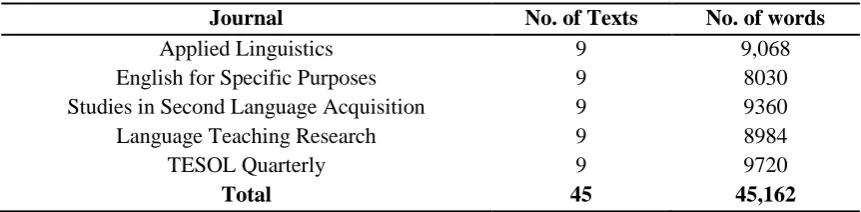
of 45 articles (45,162 words)
Table 1. Corpus characteristics
Journal No. of Texts No. of words
Applied Linguistics 9 9,068
English for Specific Purposes 9 8030
Studies in Second Language Acquisition 9 9360
Language Teaching Research 9 8984
TESOL Quarterly 9 9720
Total 45 45,162
Data Analysis
Although the study is mainly a small scale qualitative study, it also adopts some quantitative
analysis as well. Data analysis was conducted in two phases: first the forms of the citations
were identified and then the rhetorical functions that they served were investigated.
Citation forms. Swales' (1990) categorization of integral and non-integral citations
was used to identify the forms of the citations. In integral citations, the name of the cited
author is included in the cited sentence which has a grammatical role (as in example 1); in
non-integral citations, the name of the cited author appears within parentheses or footnote
and plays no grammatical role in the cited sentence (as in example 2).
1)Swales (1990) states that it is the expert or active members of a discourse
community that give a specific generic name to a particular communicative event.
2)Based on this definition, genres are not merely types of texts, rather, they are
communicative events which are identifiable based on their communicative purposes
(Swales, 2004).
In order to identify the forms of the citations, at first all instances of another author‟s
name regardless of whether it was followed by a year or not as well as third person pronouns
whenever referred to a cited author were counted. Following Hyland (2000) and Samraj‟s
(2013) method, counting the frequency of the citations and assigning a function to them was
222 Applied Research on English Language, V. 7 N. 2 2018
AREL
criterion, the number of references was recorded first. Next, the frequency of integral and
non-integral types and their ration to the whole citations were calculated. Then, the
percentages of integral and non-integral were calculated. Finally, the counted citations were
normalized at 1,000 words in order to be able to compare with the findings from other
studies.
Citation functions. In order to identify the functions of the citations, Samraj‟s (2013)
typology was used. Her study is one of the few and recent studies that have employed
genre-based approach to identifying rhetorical functions of citations in the discussion sections.
Thus, it was found a suitable typology to use, given the purpose of the present study and the
sub-genre it focused on. Using a genre analysis approach and studying the discussion section
of 8 RAs and 8 master‟s dissertation‟s discussion sections from biology (ecology), Samraj
have proposed a typology of citation functions in this sub-genre. The typology includes eight
functions of which seven was identified in her RAs corpus:
Comparison of results
Interpretation of results
Explanation of results
Evaluation of the study
Evaluation of the field
Research recommendations
Applied Recommendations (identified only in the dissertations)
Background
Using a genre analysis approach (Swales, 1990), after identifying the citations, they
were studied in their context to find out what purposes they served. A genre (e.g., research
articles) and sub-genre (e.g., discussion section of RA) is organized based on a set of
communicative purposes which are realized by communicative units. These communicative
units are called Move which carry the specific communicative purpose of a particular part of
a text. A Move might be realized by one or more subsidiary elements called Step. Thus,
Moves and Steps constitute the generic structure of a particular genre.
In order to identify the rhetorical functions of the citations, after they were identified in
the first phase, the citations were studied in the context that they were used. It was tried to
identify the communicative purpose of the segment that the citation was used in. The
identification was not done only based on the sentence that the citations appeared in. In many
Citation Behaviours of Applied Linguists in Discussion Sections of Research Articles 223
Adapting Samraj's (2013) framework, only four functions were identified in the corpus of the
present study. In her framework, she differentiated between research recommendations and
applied recommendations and her analysis showed no use of citation in applied
recommendation. As the communicative purpose of both of these is the same, similar to other
genre analysis studies, it was decided to label both as Recommendation. After identifying the
cases, all of them were examined and double checked carefully to ensure that they all
represented the identified function. In the next stage, the overall frequency of each function
was counted manually and the percentage of each of the functions was calculated. The overall
frequency and percentage of the forms and functions of the citations and preference of some
types might provide preliminary understanding of the relative importance of certain forms
and functions in this sub-genre.
Findings and Discussion
Citation Forms
As Table 2 shows, a total of 330 citations were identified in the corpus which is an average
frequency of about 7.31 citations in each article. The frequencies of the citations ranged from
6 to 12. The density of citations per 1,000 words was 7.31 which was lower than the
frequency Jallilifar (2012) identified in introduction sections of Applied Linguistics RAs.
This can be explained by findings of other studies (Mansourizadeh & Ahmad, 2011; Hu, et
al. 2013) which have shown that citations are densely used in the introduction sections in
order to catch the attention of the readers when scanning the papers.
The relative percentage of the two forms of citations, integral and non-integral, showed
an overuse of non-integral form (comprising 60.91% of the whole citations) by applied
linguists. This indicates that applied linguists, in their discussion section, prefer to focus on
the propositions, research actions and findings of other researchers in order to argue and
support their findings rather than on the cited authors. Previous studies have also shown a
preference for non-integral citations in various disciplines (Hewings et al., 2010; Hyland,
2004; Hyland & Jiang, 2017; Thompson, 2012; Samraj, 2013). The preference of the use of
integral and non-integral forms of citations can be related to attribution (transferring the
responsibility of statements that are being said by writers). As Thompson (2012) argues,
non-integral citations allow writers to concentrate on the proposition and avoid explicitly bringing
other researchers in their work. Non-integral citations also help the authors to keep the flow
224 Applied Research on English Language, V. 7 N. 2 2018
AREL
preference of non-integration citation over the fifty years in several disciplines, including
Applied Linguistics, Hyland and Jiang (2017) conclude that authors "are moving towards a
rhetorical style which gives less prominence to other authors [and allow them to use citations
that]… support their ideas but does not foreground the originator" (p.11).
Table 2. Occurrences of Integral and Non-Integral Citations in the Corpus
Raw No. Percentage Frequency Per 1000 words Frequency Per Paper
Integral 129 39.09% 2.86 2.87
Non-integral 201 60.91% 4.45 4.46
Total 330 100% 7.31 7.33
Citation Functions
Adapting Samraj's (2013) framework, four functions were identified which were used to
varying levels in the corpus (see Table 3).
Table 3.Frequency of the Functions of Citations in the Corpus
Raw No. Percentage Frequency Per 1000 words
Comparison of results 139 42.12% 3.07
Explanation of results 106 32.12% 2.35
Research recommendations 44 13.34% 0.97
Interpretation of results 41 12.42% 0.91
Total 330 100% 7.30
As Table 3 indicates, the functions varied in frequency with the comparison of the
findings and explanation of results as being the most frequent and interpretation of the results
and research recommendations being the least frequent functions.
Comparison of results. Comparison of results with literature is the most dominant
function of citations in discussion sections of RAs, the communicative purpose of which is to
compare and contrast the findings with relevant studies in literature and connect the findings
to the field. Similar observations were also reported in Samraj (2013) and Kwan and Chan
(2014). In the data of this study, 42 percent of the whole citations (139 out of 330 instances)
were employed for the purpose of comparing the results with literature. The comparisons
were made either with a specific or general claim/finding. Connecting the findings to the field
and showing the contribution of their studies to the literature was done by showing
consistency and inconsistency of the findings with literature. Citation was used to show the
ways in which the findings were similar to findings in literature (excerpt 1) and/or a claim or
Citation Behaviours of Applied Linguists in Discussion Sections of Research Articles 225
1) There was evidence that repeating a task with well-defined parameters and
similar content (i.e. switching roles during a role play) increased the likelihood of
its completion, a finding that is consistent with studies that attest to improved
proficiency ... (e.g., Gass, Mackey, Alvarez-Torres & Fernandez-Garcia, 1999).
[Referring to literature to compare the findings]
2) Our data thus supports Metge and Kinloch‟s (1978) contention that for at least
some Maori people in large Pakeha organizations ... (see also Metge, 2001).
Excerpt 3, below, illustrate instances that the writers showed the inconsistency of their
findings with findings of other studies in literature. In excerpt 4, the writers refer to a model
in literature and indicate the conflict between their findings and the model.
3) It is interesting that, in contrast to the study reported in this article, Bitchener et
al. did not find any statistically significant effect for direct corrective feedback
alone (i.e. without metalinguistic comments).
4) According to Bialystok‟s (1993) model, more proficient learners are able to
executive attention to target pragmatic features more accurately than less
proficient learners because ... However, this was not the case in the context of the
present study, suggesting that ...
Comparing findings with literature is a common move in discussion sections that
writers use to compare and contrast their findings with relevant studies in literature and
connect the findings to the field. It has been emphasized widely in the literature that a
well-written Discussion section needs to relate the findings of the study to the relevant literature
(e.g., Bloomberg & Volpe, 2008; Dörnyei, 2007; Mackey & Gass, 2016; Paltridge &
Starfield, 2007). This has been identified in the generic structure of discussions in various
disciplines including applied linguistics (Yang & Allison, 2003). The main purpose of
referring to literature is to put the findings of the study in the context of previous research and
compare and contrast them with existing findings, claims, assumptions, or theories in
literature.
Therefore, in addition to stating findings and commenting on them, it is also an
important stage that writers make connections between existing knowledge and their own
study and demonstrate a clear relation between present study and previous theory and
research, and show how their work is important in the „bigger picture‟ (Cargill & O'Connor,
2009, p. 10). By critically engaging with literature, the writers contextualize their study and
226 Applied Research on English Language, V. 7 N. 2 2018
AREL
they support or challenge earlier studies (Mackey & Gass, 2016). By citing other researchers‟
work and indicating similarities and differences of one‟s own work and the cited ones, writers
foreground their own research and position it in relation to the other works and show their
contribution to the field (Petric, 2007). Therefore, by employing this strategy, writers position
new findings within the body of existing knowledge and connect it to the wider field.
The analysis showed that referring to literature to show the inconsistency of the
findings to literature was infrequent in the corpus compared to indicating consistency. While
consistency/inconsistency of findings was shown by referring to assumption, claim, or
contention in literature and/or with findings of studies in literature, when showing
inconsistency, the writers indicated inconsistency of their findings with a statement or claim
in the literature rather than a specific finding.
Investigating the intentions of writers in citing specific resources, Case and Higgins
(2000, pp. 640-1) found “negative citation”, such as reference that “illustrates a perspective
or finding that contradicts a perspective or finding” quite rarely in writers‟ own study. They
suggested that writers apparently prefer citing documents that support their own findings and
knowledge claims. However, showing consistency or inconsistency of findings can also be
unintentional and can be decided based on the findings. For instance, findings can also be
interesting if they are different from literature and challenge it.
Explanation of results. The analysis shows that using source texts to support the
writers‟ explanations of the findings is the second most frequent rhetorical function of
citations (comprising around 32% of the whole citations) in discussion section. In these
instances, after the writers went beyond the objective presentation of their findings and
presented their own understanding of the results, they referred to literature to support their
comments. The references to literature were either in the form of direct or indirect quotations.
In Excerpt 5, the findings are presented first. Then, the writer(s) go on and add their
explanation of findings. They try to persuade the audience of their explanations' soundness by
providing evidence from literature.
5) Many of the distance learners in this sample found the time and created the
opportunities to engage in functional practice beyond their course work. During
this activity, their main focus was on meaning, with some Incidental Focus on
Form.... [Stating Findings]. For intermediate and advanced distance learners, this
activity appears to be crucial in providing exposure to ... [Explaining]. White
Citation Behaviours of Applied Linguists in Discussion Sections of Research Articles 227
learning to maintaining motivation as a significant factor in learners‟ involvement
and persistence in their distance-learning experiences. It was ranked as the most
significant factor for success by distance language learners in a study that she
carried out (White, 1999) [Referring to Literature to Support the Explanation].
In excerpt 6, the first sentence is the writers‟ interpretation of the findings and is
followed by a direct quotation from literature to support it.
6) This implies that it is difficult for learners to apply the Japanese rule, even if
they have the necessary knowledge [Explaining]. The following quotation
supports this view:
In fact, I was warned before I came to Japan to be cautious of hai, that it didn‟t necessarily mean „„yes, I will do that.‟‟ It meant „„yes, I understand that.‟‟ And
even with knowing that, I still found difficulties at first in understanding between
the people in my company that speak very good English. (JETRO, 1980 cited
from Miller, 1991:125) [Referring to Literature to Support the Explanation]
Commenting on findings and providing explanations for them is one of the main
functions of discussion section and has been identified in several genre studies (e.g., Yang &
Alison, 2003). One of the common ways for writers to comment on their findings is to draw
on other studies and „borrow‟ ideas, concepts, and explanations from literature (Ritchie, Spencer & O‟Connor, 2003; White et al., 2003). Therefore, apart from providing their own
interpretations and explanations of their findings, writers use interpretations, explanations,
and concepts in literature to support the comments they make on their findings. This is a
rhetorical function of citation which helps the writers to justify their knowledge claims based
on the existing knowledge in the field and promote acceptance from their peers.
Recommendation. Citations were also used to support the recommendations the
writers made for further research and practice. Comprising around 13% of the whole
instances of citations, it appeared less frequent compared to the other two rhetorical functions
discussed above. Referring to literature, either to a research or a theoretical claim, was used
to provide evidence for the suggestions that the writers made. In other words, after making
suggestions for practice and further research, the writers tried to back them up and provide
evidence that justified their statements. In excerpt 7, the writers make a suggestion for further
research while positioning a reference to literature at the end of the sentence to support the
228 Applied Research on English Language, V. 7 N. 2 2018
AREL
7)Further research is needed to explore task types that encourage a focus on
fluency and meaning, such as interactive tasks and information transfer, as
suggested by Robinson (2001). [Making Suggestions for further research and
Referring to Literature to Support the Suggestion].
As can be seen in excerpt 8, in the first sentence the writers make a suggestion for
practice and then continue with a suggestion for further research which is followed by a
quotation by Kramer-Dahl to support and justify these suggestions:
8) Clearly, a closer connection between top-down implemented language policies
and the realities of the classroom in which such policies must be implemented
needs to be made and a research priority undertaken concerning the reality of the
Singapore classroom [Making Suggestions for Practice]. As Kramer-Dahl
(2003: 164) has observed: What has remained grossly under researched and
poorly understood, as a result, is the... [Referring to Literature to Support the
Suggestion].
By recommendation for practice, writers show the contribution of their study to the
contemporary issues in the field and how it can solve the problems. In this sense, the writers
promote their works by showing the valuable contribution that they make to the language
issues in the real world. Recommending further research not only suggests new lines of
inquiry in the field but also “demonstrates to the reader that the author has concluded one phase of the research and has carefully thought about the next phase” (Mackey & Gass, 2016,
p. 351). Citations were used as a source to back up the recommendations that the authors
suggested. As was mentioned earlier, this was a less frequent rhetorical function of citations.
It should also be stated that recommendations were not observed frequently in the corpus and
was only present in 18 RAs (40% of the corpus). One of the reasons might be that making
recommendations is a move that can be present either in discussion or conclusion sections. This has also been observed by genre studies that have investigated the generic structure of
Applied Linguistics RAs (Yang, 2001). This might explain the lesser frequency of this
rhetorical function of citations.
Interpretation of results. In the data of this study reference to previous studies in
literature was also used to support the deductions that the authors had made, although with
much less frequency (identified only 41 times in 45 RAs). The reference to literature was
either in the form of direct or indirect quotation. The writers referred to literature to support
Citation Behaviours of Applied Linguists in Discussion Sections of Research Articles 229
conclusions they are making are based on and supported by literature. In excerpt 9 below, the
writers interpret their findings in the first sentence which is followed by several references to
literature to back them up and provide evidence that justifies and supports their statements.
9) Our study also suggests reconsideration of the role of oral participation versus
the role of silence in both EAP and mainstream education [Interpreting
Findings]. For example, Jaworski and Sachdev (1998) report that Western
secondary school students associated silence with productive learning, and Rowe
(1974, 1987) and Tobin (1987) demonstrate that ... In addition, as Valdés (1998)
demonstrates in a study of an ESL class in the United States, silence may also be
used as an important tool for classroom management. Finally, as Zhou et al.
(2005, p. 303) point out in their discussion of ... [Referring to Literature to
Support the Interpretation].
In excerpt 10, the writers make a deduction in the last sentence while positioning a
reference to literature in the first sentence to support the deduction.
10) Goodwin and Goodwin (1992) claim that an important aspect of collaboration
and negotiation in constructing and developing an emergent topic involves
reaction to the content of the preceding utterances [Referring to Literature to
Support the Interpretation]. Such instances of either „marked‟ topic shift or
„stepwise‟ topic movement described in our analyses thus display characteristics
of emergent topical development in conversation [Interpreting the findings].
Interpretations are inferences and logical conclusions which are based on the findings
and discussions that are presented previously in the discussion section. Interpreting has been
identified in several genre studies as an important element of discussion section, though
under different labels such as Generalization, Deduction and Hypothesis, and Claim
(Dudley-Evans, 1994; Holmes, 2000; Kanoksilapatham, 2005; Peacock, 2002; Swales, 1990).
Conclusion
Form and rhetorical functions of citations in Discussion sections of applied linguistics RAs
were studies in this paper. Studying the form of the citations showed a preference for
non-integral forms of citations compared to non-integral ones which indicates that applied linguists
tend to foreground the propositions rather than the authors by using more non-integral
citations. Similar results are also observed in previous research on RAs from various
230 Applied Research on English Language, V. 7 N. 2 2018
AREL
words in the corpus of the present study and those in literature confirmed that while citation
has a vital role in academic writing, it seems that it is used far more in Applied Linguistics
than hard disciplines such as Computer Science (Posteguillo, 1999) and Medicine (Nwogu,
1999). This is in line with Hyland‟s (1999) finding that writers in soft disciplines, overall, use
more citation than their counterparts in hard disciplines. This might suggest that citation
practices are discipline-specific and can be ruled by discourse community norms and
conventions of proper and effective argument (ibid.).
Several genre studies (e.g., Holmes, 1997, 2000; Lim, 2010; Posteguillo, 1999;
Peacock, 2000; Swales, 1990; Yang and Allison, 2003) have identified Reference to Previous
Research as one of the common moves in discussion section of various disciplines. Studying
the rhetorical functions of citations indicates similarities and differences with these studies.
While the findings of this study are in line with those studies in that reference to previous
research is mainly used for comparing findings, it challenges them in that reference to
previous research in not solely used for comparison purposes but is used with various
rhetorical functions throughout the discussion section in order to contextualize the current
study within the previous studies. Reference to literature does not simply serve the function
of comparison but is employed to support the writers‟ explanations, interpretations, as well as
their recommendations. While the predominant rhetorical function of citations was to
compare and contrast the findings with literature in order to contextualize and relate them to
the field, a substantial number of citations were also used to help the writers to support the
arguments when making a deduction and/or suggestion, and to back up the comments made
on findings. This is in agreement with the observations of several other studies (Kwan &
Chan, 2014, Mansourizadeh & Ahmad, 2011; Samraj, 2013).
Academic writers use various types of evidence to back up their claims and arguments
and “what counts as suitable evidence to support an argument is governed by the epistemic
conventions of a discipline. Epistemic conventions refer to the means of establishing „truth‟ as based on accepted forms of evidence” (Coffin et al., 2003, p. 27). Citations or „Quotative‟
mode of knowing (Palmer, 1986, p. 51 cited in Hyland & Jiang, 2017) are one of the
important tools in academic argument which are used to achieve persuasion (Gillbert, 1977).
While part of persuasion can be achieved through logical argument, “much support for the
results and the argument necessarily arises from work already performed and presented to the
scientific community” (Gilbert, 1977, p. 116). Therefore, citation as an important element in
Citation Behaviours of Applied Linguists in Discussion Sections of Research Articles 231
support their claims by “synthesizing past research and presenting evidence to back up claims or points of view” (Coffin et al., 2003, p. 27). Referring to earlier work not only incorporates the previous research into the new paper but also “provide[s] a measure of persuasive support
for the newly announced findings” as referenced work “has already been accepted as 'valid
science'” (Gilbert, 1977, p. 116). In his interview-based study of the functions of citation,
Harwood (2009) found justifying claims as one of the purposes that computer scientists and
socialists used citation for. In fact, citation is and remains "more important than ever as an
element of the scholar's rhetorical armoury" and as "part of epistemological and social
framework for the acceptance of argument" (Hyland & Jiang, 2017, p. 2).
Writing a research report is a challenging task for novice writers as they need to be
familiar with the norms of their discourse community to establish the importance of their
research and to show that their study is worthy of attention. In order to be able to negotiate
with their discourse community and persuade them to accept their knowledge claims, they
need to be able to apply the knowledge of norms and conventions of their discourse
community, including citation practices, in their writing. Some of these norms can be
acquired by observing the writing of senior members by reading RAs. Studies (e.g., Loan,
2016; Mansourizadeh & Ahmad, 2011) have shown that citation practices cannot be evident
from merely reading expert written texts and some of their rhetorical functions are so
complex that they can only be acquired by years of experience in the field. Studies on the
texts written by graduate students (e.g., Jalilifar, 2012) have also shown that these novice
writers are familiar with forms of citations and ignorant of their functions. Besides, students
find the function and use of citations difficult to understand (Thompson & Tribble, 2001).
The findings of the present study provide some information on the citation behavior of
applied linguists particularly in discussion section of RAs. The knowledge on the rhetorical
functions and forms of citations can enhance our understanding of the reasons behind
choosing citations in various parts of our discussion and can be turned into pedagogical
materials and raise rhetorical consciousness through teaching those choices explicitly to ESL
232 Applied Research on English Language, V. 7 N. 2 2018
AREL
ReferencesAzirah H. (2005). Linguistic approaches to academic discourse [Electronic Version]. Bulletin,
5, 4–5. Retrieved from http://www.ippp.um.edu.my/download/files/0004A.pdf.
Bitchener, J., & Basturkmen, H. (2006). Perceptions of the difficulties of postgraduate L2
thesis students writing the discussion section. Journal of English for Academic Purposes, 5, 4–18.
Bloomberg, L. D., & Volpe, M. (2008). Completing your qualitative dissertation: A roadmap
from beginning to end. London, UK: Sage Publications.
Cargill, M., & O'Connor, P. (2009). Writing scientific research articles: Strategy and steps. Oxford, UK: Wiley–Blackwell.
Case, D. O., & Higgins, G. M. (2000). How can we investigate citation behaviour? A study
of reasons for citing literature in communication. Journal of the American Society for Information Science, 51, 635–645.
Charles, M. (2006). The construction of stance in reporting clauses: A cross–disciplinary
study of theses. Applied Linguistics, 27(3), 492–518.
Coffin, C. (2009). Incorporating and evaluating voices in a film studies thesis. Writing & Pedagogy, 1(2), 163–193.
Coffin, C., Curry, M. J., Goodman, S., Hewings, A., Lillis, T. M., & Swann, J. (2003).
Teaching academic writing: A toolkit for higher education. London, UK: Routledge. Dörnyei, Z. (2007). Research methods in applied linguistics: Quantitative, qualitative and
mixed methodologies. Oxford, UK: Oxford University Press.
Dudley–Evans, T. (1994). Genre analysis: An approach to text analysis for ESP. In M.
Coulthard (Ed.), Advances in written text analysis (pp. 219–228). London, UK:
Routledge.
Fazel, E. & Shi, L. (2015). Citation behaviours of graduate students in grant proposal writing.
Journal of English for Academic Purposes, 20, 203–214.
Figà-Talamanca, A. (2007). Are citations the currency of science? Journal of European Psychoanalysis,24(1), 155–164.
Gilbert, G. N. (1977). Referencing as persuasion. Social Studies of Science,7(1), 113–122. Harwood, N. (2009). An interview-based study of the functions of citations in academic
writing across two disciplines. Journal of Pragmatics, 41(3), 497–518.
Hewings, A., Lillis, T., & Vladimirou, D. (2010). Who‟s citing whose writings? A corpus
Citation Behaviours of Applied Linguists in Discussion Sections of Research Articles 233
English medium international journals. Journal of English for Academic Purposes, 9,
102–115.
Holmes, R. (1997). Genre analysis, and the social sciences: An investigation of the structure
of research article discussion sections in three disciplines. English for Specific Purposes, 16(4), 321–337.
Holmes, R. (2000). Variation and text structure: The discussion section in economics
research articles. ITL: Review of Applied Linguistics, 131–132, 107–135.
Hu, G. & Wang, G. (2014). Disciplinary and ethnolinguistic influences on citation in research
articles. Journal of English for Academic Purposes, 14(1), 14–28.
Hu, Z., Chen, C. & Liu, Z. (2013). Where are citations located in the body of scientific
articles? A study of the distributions of citation locations. Journal of Informetrics, 7, 887–96.
Hyland, K. (1999). Academic attribution: Citation and the construction of disciplinary
knowledge. Applied Linguistics, 20 (3), 341–367.
Hyland, K. (2000). Academic attribution: Interaction through citation. In K. Hyland (Ed.),
Disciplinary discourses: Social interactions in academic writing (pp. 20–40). New York, NY: Longman.
Hyland, K. (2004). A convincing argument: Corpus analysis and academic persuasion. In U.
Connor & T. A. Upton (Eds.), Discourse in the professions (pp. 87–112). Amsterdam:
John Benjamins.
Hyland, K. (2005). Metadiscourse. London: Continuum.
Hyland, K. (2010). Constructing proximity: Relating to readers in popular and professional
science. English for Academic Purposes, 9(2), 116–127.
Hyland, K. (2015). Academic Publishing: Issues and challenges in the construction of knowledge. Oxford: Oxford University Press.
Hyland, K. & Jiang, F. (2017). Points of reference: Changing patterns of academic citation.
Applied Linguistics, Advance access, 1–23.
Jalilifar, A. R. (2012). Academic attribution: Citation analysis in master‟s theses and research
articles in applied linguistics. International Journal of Applied Linguistics, 22(1), 23– 41.
Jalilifar, A. R., & Dabbi, R. (2012). Citation in applied linguistics: Analysis of introduction
234 Applied Research on English Language, V. 7 N. 2 2018
AREL
Kanoksilapatham, B. (2005). Rhetorical structure of biochemistry research articles. English for Specific Purposes, 24 (3), 269–292.
Kwan, B. S. C. & Chan, H. (2014). An investigation of source use in the results and the
closing sections of empirical articles in Information Systems: In search of a
functional-semantic citation typology for pedagogical purposes. Journal of English for Academic
Purposes, 14, 29– 47.
Lee, J. J., Hitchcock, C., & Casal, J. E. (2018). Citation practices of L2 university students in
first-year writing: Form, function, and state. English for Academic Purposes, 33, 1–11.
Lim, J. M. H. (2010). Commenting on research results in applied linguistics and education: A
comparative genre-based investigation. Journal of English for Academic Purposes, 9
(4), 280–294.
Loan, N. T. T. (2016). Citation practice in the whole TESOL master‟s theses by Vietnamese
postgraduates. 3L: Language, Linguistics, Literature, 22 (3), 79–92.
Mackey, A., & Gass, S. (2016). Second language research: Methodology and design (2nd
ed.).New York, NY: Routledge.
Mansourizadeh, K., & Ahmad, U. K. (2011). Citation practices among non-native expert and
novice scientific writers. Journal of English for Academic Purposes, 10(3), 152–161. Martínez, I. A. (2008). Building consensus in science: Resources for intertextual dialog in
biology research articles. Journal of English for Academic Purposes, 7(4), 268–276. Nwogu, K. N. (1997). The medical research paper: Structure and functions. English for
Specific Purposes, 16 (2), 119–138.
Paltridge, B., & Starfield, S. (2007). Thesis and dissertation writing in a second language. London: Routledge.
Peacock, M. (2002). Communicative moves in the discussion section of research articles.
System, 30 (4), 479–497.
Perry, L. F., Jr. (2005). Research in applied linguistics: Becoming a discerning consumer. Mahwah, NJ: Lawrence Erlbaum Associates.
Petric, B. (2007). Rhetorical functions of citations in high- and low-rated master's theses.
Journal of English for Academic Purposes, 6 (3), 238–253.
Citation Behaviours of Applied Linguists in Discussion Sections of Research Articles 235
Ritchie, J., Spencer, L., & O'Connor, W. (2003). Carrying out qualitative analysis. In J.
Ritchie & J. Lewis (Eds.), Qualitative research practice: A guide for social science students and researchers (pp. 219–262). London: SAGE Publications.
Samraj, B. (2008). A discourse analysis of master‟s theses across disciplines with a focus on
introductions. English for Academic Purposes, 7(1), 55–67.
Samraj, B. (2013). Form and function of citations in discussion sections of master‟s theses
and research articles. Journal ofEnglish for Academic Purposes, 12(4), 299–310. Shooshtari, Z. G., & Jalilifar, A. R. (2010) Citation patterns of research article discussions
across subdisciplines of applied linguistics. Journal of Teaching Language Skills, 2 (1), 45–66.
Slyder, J. B., Stein B. R., Sams B. S., Walker D. M., Jacob Beale B., Feldhaus J. J., &
Copenheaver C. A. (2011). Citation pattern and lifespan: A comparison of discipline,
institution, and individual. Scientometrics, 89, 955–66.
Swales, J., M. (1990). Genre analysis: English in academic and research settings. New York,
NY: Cambridge University Press.
Swales, J. (2004). Research genres: Explorations and applications. Cambridge: Cambridge
University Press.
Taavitsainen, I. (2002). Historical discourse analysis: Scientific language and changing
thought-styles. In T. Fanego , B. Méndez–Naya, & E. Seoane (Eds.), Sounds, words, texts and change (pp. 201–206). Amsterdam: John Benjamins.
Thompson, G., & Ye, Y. (1991). Evaluation in the reporting verbs used in academic papers.
Applied Linguistics, 12 (4), 365–382.
Thompson, P. (2005). Points of focus and position: Intertextual reference in PhD theses.
Journal of English for Academic Purposes, 4(4), 307–323.
Thompson, P. (2012). Achieving a voice of authority in PhD theses. In K. Hyland & C.
Sancho Guinda (Eds.). Stance and voice in written academic genres (pp. 119–133). London: Palgrave Macmillan.
Thompson, P., & Tribble, C. (2001). Looking at citations: Using corpora in English for
academic purposes. Language Learning and Technology, 5 (3), 91–105.
White, C., Woodfield, K., & Ritchie, J. (2003). Reporting and presenting qualitative data. In
236 Applied Research on English Language, V. 7 N. 2 2018
AREL
Yang, R., & Allison, D. (2003). Research articles in applied linguistics: Moving from results