Rukundo Exode
Researcher And Business Analyst, Msc In Economics,
Kigali, Rwanda.
Mugemana Hugues
BSc with Hons in Chemistry, University of Rwanda.
Modelling The
Optimal Harvest Of
The Ecosystem. A
Case Of The
Exode Rukundo is the Sales Operations and Enterprise Business Analyst in MTN Rwanda with
a rich experience in business, research, analytics and operational management. He has been
working on different research projects in spheres of economics, migration, business, agriculture
and environment. He published a book; Binary Logistic Model Of Rural-Urban Migration
Determinants In Rwanda, 2013, and a paper; Sectoral View of The Importance of Agriculture
in The Growth of States, 2019. He holds a BSc with Honors in Applied Statistics as well as a
Mini MBA (Telecom). He’s currently undertaking a MSc in Economics at the University of
Rwanda.
Hugues Mugemana is a level 4 varsity student, currently doing Chemistry with Environmental
Chemistry as option. His fields of interest are environmental impact assessments, climate
change, recycling, upcycling and nuclear chemistry. His hobbies are reading, writing and
music.
ABSTRACT
The world evolves, the people change, the future calls. The decades of economic endeavors to lift humankind in terms of wellbeing and commitment to a so-called “greater tomorrow” resulted into new and future alarming tendencies. The fight to stabilize the trends or reverse them has been of the key focus for the last 2 decades, but efforts seem to not capture the minds of all the strates of the societies, and the community engagement to enjoy the current yields of the environment and inherit the future premises of this planet are not well understood by both the policy makers and the mobilisers (researchers, leaders, etc.). The call for action requires a clear focus on the optimization of a single aspect of the ecosystem lay that is highly integrated into the cultural change and adaptation vis-à-vis the millennial demand to pave a consensus that incorporate a common understanding between optimistic and pessimistic scholars, and leave it as a legacy to humanity. This paper slashes a light into a dark ocean of the need to position the emphasis and awareness on the key matters of the climate change, by drawing all internalities and externalities into play.
Keywords: humankind, trends, community, environment, planet, optimization, ecosystem, climate
1. INTRODUCTION
journey may seem smooth, but it requires a core, sometimes forgotten, aspect of the awareness of the historical impact and trends of the matter. Optimization that is modelled to reflect a decentralized participation would seem unrealistic, but it is revealed to be effective and efficient as far as the optimal strategies are understood. The climate change – that serves as the case for this study - occurs when changes in Earth's climate system result in new weather patterns that remain in place for an extended period of time. These changes bring about abnormal variations to the climate, and the effects of these variations on other parts of the Earth. It goes way far to reflect a reciprocal relationship between itself and the economic growth/decline and is already having an impact on human rights. And this impact is projected to only intensify in coming years.
The issue, though explained globally, has to be narrowed, contextualized and conceptualized into each country’s experiences. Rwanda knows that the cost of inaction is greater than the cost of action. Any untendered risk is thought to impact negatively the long-term vision of the country (Vision 2050). Though the equilibrium economic growth is of a high choice, threats like a startling growth in energy use, poor land use and forest management, and climate change vulnerabilities have been thought about in the country’s policies to sustain its annual economic growth of around 8.4%. In the National Environment and Climate Change Policy adopted in June 2019, Rwanda opted for a more inclusive and decentralized approach to confirm its obligation to address climate change and resolve to lessen the potential hardships that climate change may pose to the sustainable development of the country. This policy, however, sets the first step into this big ocean, since the optimum is still of a concern. Thus, a further call to holistically map the ongoing journey, with a hand of private-public partnerships in all possible linkages and integrations.
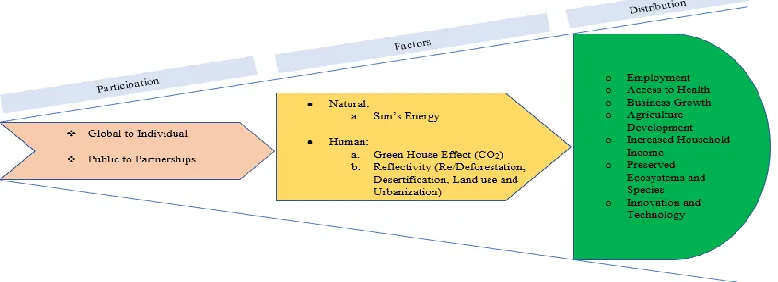
The rounded move requires a clear model of how interactions and interventions are monitors, the factors are identified and controlled, and the outcome is distributed locally, regionally and globally. The mapping stages into 3 outlets that summarize the model: participation, factors and distribution.
Participation: It explains a shift from the old view of the climate issues and focuses mainly on individual participation and values more the cross sectoral partnerships
Factors: Any model scrutinizes the explanatory variables that serves to explain and predict the behavior. Any climate change factor falls under 2 segments (natural and human), but the human contribution (Green House Effect and Reflectivity) seems to prevail over the sun’s energy that is low since the orbit and tilt of the sun variates rarely.
ecosystems and species in waters, on land and in space, and the advancement of innovation and technology.
Figure 1: The Optimal Model of the Rwandan Climate Change
Source: Author
It’s of a prerequisite that variables and constraints, against which the measurement of the relevance of the model, be quantified objectively and cleaned to avoid multicollinearity over time. The measure of the intrinsic values and unavailability of some of the data on major factors restricts the analytics on the available information and sets opportunities for further studies.
Employment Rate
Access to Health
Business Growth
Increase of Household Income
Agriculture Development
Innovation & Technology
Required Optimum
Individual a b c d e f g
Partnerships h i j k l m n
CO2 o p q r s t u
Land Use v w x y z aa ab
Mathematically, we can represent the problem as
Optimize Participation=Individuala…f+Partnershipsh…m A.1
Where a…f and h…m stand for the distribution outcome
subject to { CO2;𝑜…𝑡(Individuala…f+Partnershipsh…m) ≷ 𝑜𝑟 = 𝑢 𝐿𝑎𝑛𝑑 𝑈𝑠𝑒𝑣…𝑎𝑎(Individuala…f+Partnershipsh…m) ≷ 𝑜𝑟 = 𝑎𝑏
A.2
Depending on the nature of the problem, the term optimize means either maximize or minimize the value of the objective function. As indicated in Equation A.2, each constraint can take the form of an equality (=) or an inequality (>or <) relationship.
2. STRATEGIZING THE OPTIMAL CLIMATE HARVEST MODEL
in long run, yet the call requires an immediate action. The studied constraint reveals itself impactful and exigent when it portrays the importance of individuality in managing the land resources, but it sees a great resonance in as much as the CO2 gas is kept at its minimal level when set against the required optimum.
The evaluation places the costs of the climate degradation at the center of the transition of the behavioral change and the global commitment to address the different organismal features. Whoever wants to throw a quick climate “Save Our Planet” campaign is to be inspired in the protocols that draw from the individual trace from the time of participation to the harvest (distribution).
The echo emitted by the crave for innovation and technology to digitize the soft process and have a new era of climate rebirth the hard way is of no limit as to when and how to have it realized. The collinearity of the distribution factors springs a clear indication that all social strates are to comply by embracing cross-cuttingly the shared prosperity (agriculture, behavior change), and the development green economies (by reversing the business models with the introduction of BEE “Brand Environmental Economy” placing climate resource efficiency at its worth corner).
3. CONSIDERING CONSTRAINTS FOR THE NATIONAL ACTION PLANS
The relationship “Land-Air” is of eternity and necessitates a combined focus for a proper mitigation plan. The current carbon dioxide (CO2) storage discrepancy between the atmosphere stock and the ground storage stock
is an imminent and immediate threat to our world’s economies and ways of lives. Looking into the prominence of the issue, one sees an emergency as to when to start driving the economies of soils and carbon sequestration. The integrated approaches suggest two options by increasing the repossession potential of forests and land use mainly to recompense the amplified demission in industrial zones from fossil energy use, and by the holding of atmospheric carbon through photosynthesis and through calcification. Acting so would bring back to the soil both organic carbon and inorganic carbon in the form of calcium carbonate as a short time (20 to 25 years) response while waiting for a more sustained go-to-front gateway.
Several insights deliberate on a grounded education of generations for the relevancy of the ecosystem supply chain as to narrow the gap in the increased land use and unstable CO2 concentration. The synergies in this
reconciliation keep producing priorities for nations by handing over the main climate items to the private-public umbrella and leave the externalities to the government agendas. Thus, the efficiency and equity in the adapting the change will only be realized at the expense of a little cost for both human and ecological systems.
4. CONCLUSION
maximally or delayed, the study calls us all to a pressing mitigation of the climate deteriorating factors and minimization of the polarization of the current economic and political scenes with a much more collaboration between world leaders, businesses and policy-makers that are pushed to the decentralization of the action plans to stop severe threats to climate, environment, public health and technology systems.
5. REFERENCES
A. Bonen, P. Loungani, W. Semmler and S. Koch. (2016). Investing to Mitigate and Adapt to Climate Change: A Framework Model.
IMF Working Paper. WP/16/164.
E. Jochem and R. Madlener. (2003). The Forgotten Benefits of Climate Change Mitigation: Innovation, Technological Leapfrogging,
Employment, and Sustainable Development. OECD Workshop on the Benefits of Climate Policy: Improving Information for Policy
Makers. ENV/EPOC/GSP(2003)16/FINAL. Paris, France.
FAO. (2017). FAO Strategy on Climate Change. Rome, Italy.
I. El Ouadi1, D. Ouazar, M.R. Doukkali and M.D. Hasnaoui. (2017). Economic-Engineering Optimization to Assess Climate Change
Impacts on Agriculture in Morocco. International Journal of Applied Engineering Research. ISSN 0973-4562. Volume 12, Number 5
(2017) pp. 648-655. Research India Publications.
J.A. Filar, P.S. Gaertner and M.A. Janssen. (1996). An Application of Optimization to the Problem of Climate Change. in: State of the
Art in Global Optimisation: Computational Methods and Applications, eds. P.M. Pardalos and C.A. Floudas, Nonconvex Optimization
and its Applications, Vol. 7 (Kluwer, Boston, MA, 1996) pp. 475–499.
Ministry of Environement. (2019). National Environment and Climate Change Policy. Kigali, Rwanda.
S. Fankhausera and N. Sternab. (2016). Climate Change, Development, Poverty and Economics. Grantham Research Institute on Climate
Change and the Environment and Centre for Climate Change Economics and Policy (CCCEP), London School of Economics and