ISSN: 2251-6204
Vol. 5, Issue 1, March 2015 |
1ISSN: 2251-6204
Vol. 5, Issue 1, March 2015 |
2Modern Journal of Language Teaching Methods
(MJLTM)
ISSN: 2251 - 6204
www.mjltm.com
Editor – in – Chief
Hamed Ghaemi, PhD in TEFL, Islamic Azad University, Iran
Editorial Board
Abednia Arman, PhD in TEFL, Allameh Tabataba’i University, Tehran, Iran
Azizi Masoud, PhD in Applied Linguisitcs, University of Tehran, Iran
Basiroo Reza, PhD in TEFL, University of Tehran, International Campus, Iran
Elahi Shirvan Majid, PhD in TEFL, Ferdowsi University of Mashhad, Iran
Fernández Miguel, PhD, Chicago State University, USA
Ghaemi Hamide, PhD in Speech and Language Pathology, Mashhad University of Medical
Sciences, Iran
Grim Frédérique M. A., Associate Professor of French, Colorado State University, USA
Izadi Dariush,
PhD candidate in Applied Linguistics, Macquarie University, Sydney,
Australia
Kargozari Hamid Reza, PhD Candidate in TEFL, Payame Noor University of Tehran,
Iran
Kaviani Amir, Assistant Professor at Zayed University, UAE
Kirkpatrick Robert, Assistant Professor of Applied Linguistics, Shinawatra International
University, Thailand
Morady Moghaddam Mostafa, PhD Candidate in TEFL, University of Tabriz, Iran
Ndhlovu Finex, PhD, Linguistics Programme, University of New England, Australia
Raddaoui
Ali Hechemi, PhD, Associate Professor of Applied Linguistics, University of
Wyoming in Laramie, USA
Rezaei Saeed, PhD in TEFL, Sharif University of Technology, Tehran, Iran
Rolstad Kellie, PhD, Associate Professor of Education, University of Maryland, USA
Shahbazirad Mohammad, PhD in English language and Literature, Yerevan State
University, Armenia
Weir George R. S., PhD in Philosophy of Psychology, University of Strathclyde, Glasgow,
UK
Zegarac Vladimir, PhD, University of Bedfordshire, UK
ISSN: 2251-6204
Vol. 5, Issue 1, March 2015 |
3Abstracting and Indexing
ISSN: 2251-6204
Vol. 5, Issue 1, March 2015 |
4ISSN: 2251-6204
Vol. 5, Issue 1, March 2015 |
5ISSN: 2251-6204
Vol. 5, Issue 1, March 2015 |
6ISSN: 2251-6204
Vol. 5, Issue 1, March 2015 |
7TABLE OF CONTENTS
THE IMPACT OF FORM FOCUSED DISCOVERY APPROACH ON EFL LEARNERS ‘SPEAKING ABILITY………...10 Touran Ahour
Leila Mostafaee
A CRITICAL EVALUATION OF INTER- AND INTRA-CULTURAL ENCOUNTERS OF TEXTBOOKS: INSIGHTS FROM IRAN………...20 Zahra Alimorad
THE EFFECT OF WRITTEN CORRECTIVE FEEDBACK ON THE WRITING PERFORMANCE OF IRANIAN EFL LEARNERS………..…28 Sara Amiramini
Batoul Ghanbari
Mohammad Reza Shamsoddini
CHILD LANGUAGE DEVELOPMENT FROM SOCIOCULTURAL THEORY POINT OF VIEW………36 Zahra Asvad
Firooz Sadighi
CROSS-LINGUISTIC INVESTIGATION OF REQUEST SPEECH ACTS AMONG NATIVE PERSIAN AND ENGLISH SPEAKERS……….43 Shiler Yazdanfar
Alireza Bonyadi
SOME TENTATIVE SUGGESTIONS FOR LOCALIZING EFL TEXTBOOKS IN CONTEXT OF IRAN……….55 Sepeedeh Hanifehzadeh
Sara Ebrahimi Arezu Haji maghsudi
A COMPARATIVE STUDY OF LANGUAGE FUNCTIONS AND ELEMENTS OF SOCIAL CONTEXT IN FOUR CORNERS SERIES, TOP NOTCH SERIES, INTERCHANGE SERIES, AND ILI TEXTBOOKS FROM A PRAGMATIC POINT OF VIEW………...63 Vida Ezatzadegan
Seyed Jamal Abdorrahimzadeh Mohammad Amin Sorahi
TEST FORM AND ESP: A STUDY OF IRANIAN UNDERGRADUATE BUSINESS MANAGEMENT STUDENT’S TRANSLATION SCORES……….82 Masoomeh Fathi
Ramin Rahimi
COMPARING THE USE OF PERSUASIVE SPEECH ACT BY IRANIAN EFL LEARNERS' AT TWO DIFFERENT LEVELS OF LANGUAGE PROFICIENCY……….…89 Hadis Fendereski
Fateme Behjat Arash Zareiaan
THE EFFECT OF TEACHER CREATIVITY ON SELF-ESTEEM OF BEGINNER EFL LEARNERS………100 Khadijeh Ghaffari
CONCEPTUALIZING WILLINGNESS TO COMMUNICATE: A QUANTITATIVE
INVESTIGATION OF ENGLISH-LANGUAGE MAJOR STUDENTS………103 Ali Asghar Ghasemi
Faezeh Vahedi Kermanshahi Mehdi Moharami
THE EFFECTS OF BRAINSTORMING STRATEGY ON WRITING SKILL OF IRANIAN EFL LEARNERS………111 Masoud Khalilii
Abdoreza Tahriri
ISSN: 2251-6204
Vol. 5, Issue 1, March 2015 |
8Elham Ghorbanpour
THE EFFECT OF ORAL VERSUS WRITTEN ERROR FEEDBACK ON PARAGRAPH WRITING ABILITY OF IRANIAN LOW-INTERMEDIATE EFL LEARNERS………...125 Besat Hamtaei
Ramin Rahimy
ITEM RESPONSE THEORY (IRT): STATE OF THE ART ………..…134 Pooneh Heydari
THE IMPACT OF SELF-ASSESSMENT ON EFL LEARNERS' CRITICAL
THINKING………...145 Zahra Jafari
Samira Yavari S. Dariush Ahmadi
ATTITUDES OF IRANIAN ADMINISTARAORS, STUDENTS AND TEACHERS TOWARDS THE USE OF INTERACTIVE WHITEBOARDS IN EFL CLASSROOMS, A CASE STUDY IN ANDIMSHK HIGH SCHOOLS………....150 Gholam-Ali Kalanzadeh
Gholam Valizadeh
THE EFFECT OF TEACHING STANDARD PERSIAN-ENGLISH COGNATE WORDS ON INCREASING LEXICAL KNOWLEDGE IN IRANIAN EFL LEARNERS ………..170 Amirsaleh Kamali
THE EFFECT OF EMPLOYING LEXICAL MODIFICATION TECHNIQUES ON INCIDENTAL VOCABULARY LEARNING IN IRANIAN EFL CONTEXT……….179 Mohammad Saber Khaghaninejad
Elham Teymoori
THE IMPACT OF CODE SWITCHING ON ELEMENTARY EFL STUDENTS’ SPEAKING SKILL……….190 Mohammad Reza Khodashenas
Mahnaz Shahroody
A GENRE ANALYSIS OF PUBLIC DEATH ANNOUNCEMENTS IN TABRIZ………..195 Biook Behnam
Khodaverdi Alizadeh
ATTITUDE OF IRANIAN EFL LEARNERS AND TEACHERS TOWARDS USING MOVIE CLIPS IN TEACHING IDIOMS………202 Masoud Mahmoodi-Shahrebabaki
Zeynab Mahmoodi
THE RELATIONSHIP BETWEEN EFL TEACHERS’ IDEALITY AND EFL LEARNERS’ ACHIEVEMENT………..…211 Ataollah Maleki
Tahmine Ahmadlou
THE EFFECT OF GLOSSING TECHNIQUE ON INCIDENTAL VOCABULARY RETENTION, A
COMPARISON BETWEEN TEXTUAL AND MULTI-MEDIA
GLOSSES………..222 Zhaleh Moazzeni
Mohammad Sadegh Bagheri Firooz Sadighi
Mostafa Zamanian
INVESTIGATING EFL LEARNERS’ PERCEPTION OF NEEDS: NECESSITIES, WANTS, AND LACKS IN DIFFERENT LANGUAGE SKILLS TAUGHT IN GENERAL ENGLISH COURSES………..………236 Touran Ahour
Fatemeh Mohseni
A COMPARATIVE STUDY OF METADISCOURSE MARKERS IN SOME SELECTED NEWS PROGRAMS ON VOA: THE CASE OF REGULAR ENGLISH PROGRAMS VS. SPECIAL ENGLISH PROGRAMS……….242 Biook Behnam
Nasrin Mollanaghizadeh
ISSN: 2251-6204
Vol. 5, Issue 1, March 2015 |
9TECHNOLOGY AND ENGLISH LANGUAGE TEACHING (ELT)……….…256 Akram Kazemi
Mehry Haddad Narafshan
THE RELATIONSHIP BETWEEN SECOND LANGUAGE(L2) LEARNERS’ MOTIVATION AND LANGUAGE LEARNING STRATEGIES WITH L2 WRITING ABILITY OF THE STUDENTS OF
MEDICINE AND DENTISTRY AT SHIRAZ UNIVERSITY OF MEDICAL
SCIENCES………..…266 Sepideh Nourinezhad
Ali Asghar Kargar Mohammad Rostampour
THE STUDY OF READING STRATEGIES BY EXTROVERT AND INTROVERT INTERMEDIATE EFL LEARNERS IN CHALOUS CITY, IRAN………...283 Mansoure Roudgarsaffari
LEARNING IN HIGHER EDUCATION; MISCELLANEOUS
APPROACHES……….….295 Mohammad Reza Sadeghi
The EFFECTS OF PERSONALITY TYPE ON TRANSLATION QUALITY BASED ON THE FIVE FACTOR MODEL………301 Elham Sahebi Poor
Ehsan Rasaee
INVESTIGATING THE RELATIONSHIP BETWEEN IRANIAN ESP TEACHERS' SELF-EFFICACY AND THEIR EXPERTISE………..…319 Seyedeh Sara Jafari
Ali Asghar Kargar Mohammad Rostampour
USE OF METACOGNITIVE READING STRATEGIES BY IRANIAN EFL
STUDENTS………330 Batool ShamsiNejad
Jahanbakhsh Langroudi RezaPasha Moghimizadeh
ON THE CORRELATION BETWEEN IRANIAN EFL LEARNERS ' SELF-REGULATION CAPACITY AND THEIR SELF EFFICACY………342 Moharram Sharifi
Saeedeh Ahangary
MIND MAP SOFTWARE: A NOTE-TAKING STRATEGY FOR LEARNING COMMON MEDICAL PREFIXES……….….…351 Akbar Solati
THE RELATIONSHIP BETWEEN LANGUAGE LEARNING AND CRITICAL THINKING OF EFL LEARNERS………357 Samira Yavari
Hamid Gholami
EXPLICIT TEACHING AND FORM-MEANING CONNECTIONS IN SLA: THE CASE OF ENGLISH PREPOSITIONS IN AND INTO………...362 Morteza Saraee
Behzad Nazari
TEACH-TO-TEST INSTRUCTION OF DYNAMIC ASSESSMENT: A CRITICAL MOVEMENT TO RAISE GRAMMAR………..369 Mohammad Reza Khodabakhsh
Behzad Nazari
EFL LEARNERS’ WRITING ACCURACY: THE EFFECTS OF GUIDED VS. UNGUIDED PRESSURED PLANNING………..…385 Zhila Mohammadnia
Parisa Ayaz
ISSN: 2251-6204
Vol. 5, Issue 1, March 2015 |
10THE IMPACT OF FORM FOCUSED DISCOVERY APPROACH
ON EFL LEARNERS ‘SPEAKING ABILITY
Touran Ahour (PhD)
Department of English, Tabriz Branch, Islamic Azad University, Tabriz, Iran [email protected]; [email protected]
Leila Mostafaee
Department of English, Tabriz Branch, Islamic Azad University, Tabriz, Iran
ABSTRACT
Since discovery learning is a major feature of the ways in which learners become autonomous and contribute to the development of cognitive skills such as connecting, generalizing, and hypothesizing in different settings, many researchers (Bolitho ,2003;Tomilinson,1994;Wright,1993) have conducted researches on the notion of this knowledge from different perspectives. Following such studies, the present study was designed to investigate the impact of Form Focused Discovery
Learning on the Iranian EFL learners’ Speaking ability. To this end, 60 advanced EFL learners at
Hekmat Institute were selected by means of a proficiency test and were randomly assigned to control and experimental groups of this quasi-experimental study. The two groups were subjected to exactly the same procedures except that the control group did not receive any treatment which was practicing Discovery Learning alongside Form Focused Learning. At the end of the instructions, T test was run on the obtained means of the experimental and control groups on both pretest and posttest in IEILTS tests to determine whether there was any significant difference between the speaking performances of the two groups. The result showed that there was a significant difference between the mean scores of the experimental and control groups on the posttest meaning that Form Focused Discovery approach enhances performance of EFL learners’ Speaking ability. Form Focused
Discovery Approach enhances student autonomy by developing built –in strategy.
Keywords: Discovery Learning, Form Focused, speaking ability
Introduction
Recent approaches to foreign language education emphasize the significance of the students’ own contribution to their language learning through initiative-taking and active involvement. Students need to take charge of their learning in order to enhance their autonomy as students and language users. This shift in the research has brought an increased interest to the students themselves as learners in general and as language learners in particular. Students need to be facilitated to develop a basic reflective orientation by working on their experiences, beliefs and assumptions of language and learning (Breen, 2001).
Discovery learning techniques include a rich variety of interactive practices whereby the
participants have opportunities to learn from their own and each other’s experiences, being actively and personally engaged in the process. Using form focused discovery approaches to discover how a particular language form functions, discovering the way the form is used in native language and discovering the features of a given form provide a growing insight into the way language works to convey meaning (Hawkin, 1984).
Discovery learning is dynamic and intuitive and is gradually developed internally by the learner (Tomlinson, 1994). It develops a healthy spirit of enquiry (Bolitho & Tomilson, 1994). The main objective of discovery approach is to promote noticing of how language item are used so that learners become aware of the gap between their use of target forms and the typical use of highly proficient
ISSN: 2251-6204
Vol. 5, Issue 1, March 2015 |
11Speakers (Swain, 1994). Discovery Learning Contributes to the development of such cognitive skills such as connecting, generalizing, and hypothesizing, helping learners to become better monitors of their own and other peoples output, helping learners to become independent and autonomous, helping learners to develop positive attitudes towards the TL, and equipping the learners with the means to gain more from their language exposure outside of classroom and after language course is of paramount important to discovery learning (Tomilson, 1994).
When it comes to discovery learning, deep processing of intake is necessary for effective and durable learning to take place (Craik & Lockhart, 1972). Deep processing centers on meaningful learning in that the attention of the learner is primarily on the meaning and significance of the intake .However , narrowly controlled activities can only achieve shallow processing and can only be an aid to short term learning .This research sets out to investigate the effect of Form Focused Discovery approach on speaking ability of EFL learners, combining elements of both discovery approach and form focused instruction. Form focused discovery approach was used to figure out its effect on EFL learners speaking ability .While substantial evidence exists to support the empirical foundations of this approach, very little, if any, systematic research has been conducted on its impact on human speaking ability.
Statement of the Problem
Institutions encourage learning environments that foster deep approaches to learning to enhance
students’ academic achievement and cognitive development. The importance of a deep approach to
learning has been validated by a growing body of studies designed to measure various academic outcomes, including academic achievement (Biggs, 1987; Diseth, 2002, 2003, 2007b; Diseth, Pallesen, Hovland, & Larsen, 2006; Diseth, Pallesen, Brunborg, & Larsen, 2010; Duncan & Mckeachie, 2005; Entwistle & Ramsden, 1983; Furnham, Monsen, & Ahmetoglu, 2009; Marton & Säljö,, 1976a; Prosser & Millar, 1989; Ramsden, 1992; Rowell, Dawson, & Pollard, 1993).
In attempts to promote a higher level of learner autonomy, it is important for the instructor to encourage and organize team activities and homework assignments that will force students to explore realms and means that could ultimately pique a greater interest in autonomous learning. As English instructors, it becomes teacher responsibility to not only teach a language, but also inform and instruct how to study outside the classroom. This will be accomplished by presenting tasks that inspire the learner to take learning into their own hands. Autonomy in learning is a process and not a product that many EFL students seek today. (Breen, 1989).
Autonomy requires understanding one’s own strengths and weaknesses and accumulating
a diverse set of resources that will maximize exposure and improvements in speaking, listening, reading, and writing (Tomilson, 1998).
Unfortunately, most of the teachers consider students as a jug to be filled with knowledge.
Piaget (1973) was the first to show that children were not “empty vessels” to be filled with
knowledge, but active builders of knowledge. In this regard, the present study aimed find out the
effect of Form Focused Discovery Learning on EFL learners’ speaking ability. Therefore, the following
research question and null hypothesis were stated:
RQ: Does Form Focused Discovery approach have any effect on EFL learners’ speaking ability?
H0: Form Focused Discovery learning doesn’t have any effect on EFL learners’ speaking
ability.
Significant of the Study
To understand is to Invent, Piaget (1973) maintain that understanding comes from discovery and that without understanding production and creativity are lost and the individual is caught in only repetition. A significant advantage of the discovery learning method is its capacity to motivate students. Discovery learning allows learners to seek information that satisfies their natural curiosity. It provides the opportunity for students to explore their desires and consequently creates a more engaging learning environment.
Simply put, discovery learning makes learning fun (Schank & Cleary, 1994). In a study conducted by Hardy (1967), Discovery learning increased student achievement when the students were learning skills rather than facts. Skills developed through a discovery learning process seem to be more in
ISSN: 2251-6204
Vol. 5, Issue 1, March 2015 |
12line with the changing economy of today than more traditional, non-contextual, lecture methods of teaching (Paper, 2001).
As McCain maintain that Discovery learning focuses on learning within context and using experiences as a guide which are more closely related to the needs of learners and they are preparing their students to assume careers upon graduation. Therefore, education must find ways to adapt teaching and learning so that students become more independent, active learners (McCain, 2000). Theoretical principles underlying Form Focused Discovery approach facilitate experiential learning, deep processing, self-investment, noticing that are beneficial for language learning (Tomilson ,1994)..
Review of the Literature
Discovery learning encompasses an instructional model and strategies that focus on active, hands-on learning opportunities for students (Dewey, 1916/1997; Piaget, 1954, 1973). Bicknell-Holmes and Hoffman (2000) describe the three main attributes of discovery learning as:
1) Exploring and problem solving to create, integrate, and generalize knowledge,
2) Student driven, interest-based activities in which the student determines the sequence and frequency,
3) Activities to encourage integration of new knowledge into the learner’s existing knowledge base. The first attribute of discovery learning is a very important one. Through exploring and problem solving, students take on an active role to create, integrate, and generalize knowledge. Instead of engaging in passively accepting information through lecture or drill and practice, students establish broader applications for skills through activities that encourage risk-taking, problem solving, and an examination of unique experiences (Bicknell-Holmes & Hoffman, 2000). In this attribute, students rather than the teacher drive the learning. Expression of this attribute of discovery learning essentially changes the roles of students and teachers and is a radical change that is difficult for many teachers to accept (Hooks, 1994). A second attribute of discovery learning, according to Bicknell-Holmes and Hoffman, is that it encourages students to learn at their own pace. Through discovery learning, some degree of flexibility in sequencing and frequency with learning activities can be achieved. Learning is not a static progression of lessons and activities. This attribute contributes greatly to student motivation and ownership of their learning. A third major attribute of discovery learning is that it is based on the principle of using existing knowledge as a basis to build new knowledge (Bicknell-Holmes & Hoffman, 2000). Scenarios with which the students are familiar allow the students to build on their existing knowledge by extending what they already know to invent new ideas.
How do these three attributes combine to make discovery learning different from traditional forms of Learning? Some researchers (e.g., Bonwell, 1998; Mosca & Howard, 1997; Papert, 2000; Schank & Cleary, 1994) have stated the most fundamental principles of discovery learning as follows: 1) Learning is active rather than passive
2) Learning is process-oriented rather than content-oriented 3) Failure is important
4) Feedback is necessary 5) Understanding is deeper
First, in discovery learning, students are active. Learning is not defined as simply absorbing what is being said or read, but actively seeking new knowledge. Students are engaged in hands-on activities that are real problems needing solutions. The students have a purpose for finding answers and learning more (Mosca & Howard, 1997).
Second, the focus shifts from the end product, learning content, to the process, how the content is learned. The focus in discovery learning is learning how to analyze and interpret information to understand what is being learned rather than just giving the correct answer from rote memorization. Bonwell (1998) maintain that Process-oriented learning can be applied to many different topics instead of producing one correct answer to match one question that is typically found in content-oriented learning. Discovery learning pushes students to a deeper level of understanding. The emphasis is placed on a mastery and application of overarching skills (Tomilson, 1994).
Third, failure in discovery learning is seen as a positive circumstance (Bonwell, 1998). Discovery learning does not stress getting the right answer. Cognitive psychologists have shown that failure is central to learning (Schank & Cleary, 1994). The focus is learning and just as much learning can be
ISSN: 2251-6204
Vol. 5, Issue 1, March 2015 |
13done through failure as success. In fact, if a student does not fail while learning, the student probably has not learned something new (Schank & Cleary, 1994).
Fourth, an essential part of discovery learning is the opportunity for feedback in the learning process (Bonwell, 1998). Student learning is enhanced, deepened, and made more permanent by discussion of the topic with other learners (Schank & Cleary, 1994). Without the opportunity for feedback, learning is left incomplete. Instead of students learning in isolation, as is typical in the traditional classroom where silence is expected, students are encouraged to discuss their ideas to deepen their understanding. Lastly, incorporating all of these differences, discovery learning provides for deeper learning opportunities.
Methodology 3.1. Participants
This research was conducted in an institute of foreign languages in Tehran Hekmat, Iran. The institute had multiple levels of language proficiency; the upper intermediate level was selected for this study. Two intact classes with 30 female students in each group aged between 16 and 28 were selected and then they were randomly assigned into the control and experimental groups. The participants in the control group received traditional learning syllabus, whereas those in the experimental group received form focused discovery approach.
3. 2. Instruments and Materials Proficiency Test of English
In order to homogenize learners regarding language proficiency and to take into account learner’s
level of language proficiency , The English language proficiency test used. In this study, the test is a sample of the TOEFL written by Capel and Ireland (1994), Oxford university press. It consists of 45 multiple choice questions covering listening, reading and, writing skills. The reliability and also item facility of the test were checked in the piloting phase of the study and the test was thus determined to be reliable for the actual purpose of homogenization.
Pretest and posttest
IELTS speaking test was used both as a pretest and posttest .in this research, learners voices were recorded by interviewers who were familiar with IELTS test .when it comes to learners IELTS speaking ability learners were classified in a scal
Speaking ability band score used in this research consisted of Fluency and Coherence, Pronunciation, Word Choice, and Grammar .likewise, speed of speech, length of answer, pause correctly, and expand answer played a role in learners IELTS speaking score.
English Texts
The following texts were employed in this study:
(a) The researcher used the book “Summit”, written by Allen Ascher, Joan Saslow (2004) which was a main source in the Hekmat institute. The book consists of four skills namely listening, writing, speaking, and reading. The researcher placed a high premium on speaking skill while considering reading and listening as a source of input to be discovered by the learners. Two units of Summit were covered in this study.
(b) “Speak English Like American” developed and written by Babaee(1994) was also used in this study. Each unit consists of one short text enriched with input that was presented to the both groups. The experimental group was supposed to discover how a particular form functions in a given language by discovering features of the forms and their functions while overall focus is on meaning. However, the control group did not receive any Form Focused discovery approach. In this research, three units of the given book were covered.
(c) “Three English Pod” is a short listening text, which was downloaded through the internet.it
has some idiomatic expression that learners were supposed to discover their function in target language.
(d) “Chicken Soup for Soul” was downloaded through the internet. It contains short stories
that were used to meet the strategy of case based learning which has to do with short stories containing problems and ethical content to be discovered in discovery learning approach by discussion among student.
ISSN: 2251-6204
Vol. 5, Issue 1, March 2015 |
143.3. Procedure
This study was conducted in 19 sessions and each session was 120 minutes. In order to meet the requirement of discovery learning, the researcher manipulated case based learning, learning by conversing, learning by exploring, learning by reflection, and stimulation based learning in the research. The researcher was the teacher of both groups in Hekmat institute.
Each session started with a warm-up and recycling of the material the participants had learned in the last session. Then the teacher went through the main book “Summit” and asked the
students to discover the features and functions of different forms by exposing to a text enriched by grammatical features. As an example, as far as grammatical rules are concerned, the teacher guided the learners to discover the answer by posing challenging questions. The learners interacted with each other and the internet to find the answer either individually or in groups. Then Learners engaged in simulation mentioned in Summit so as to meet the requirement of simulation- based learning that is one technique of discovery learning, learners engage in role-playing.
Some cases have to do with stores containing problem to be discovered by learners, “chicken soup for soul” were downloaded and participant discussed the problem stated by the case while worked in groups they found the answer to the questions posed by the teacher. Every session followed the same procedure except sessions 3, 6,9,12 15, 19 in that students listened to “English Pod” and found the functions for different forms stated in the listening text and read “Speak English like American” “developed and written by Babaee (1994), each unit consists of a text enriched by a set of idiom and prefabricated structures used in a special context and learners were supposed to discover the function of form by themselves. In this study, three units of the Speak English like American and three English Pod were covered. Technology were integral part of such a research, students used internet as a source of information either to answer the questions posed by the teacher and to make new questions and communicate through mailing and video conferencing
outside the classroom.
The researcher took advantage of web-quest program as a kind of learning by discovery through posing some questions. The learners tried to find the answers to the questions by surfing the internet and by introducing some websites as sources of input and some websites to engage in speaking with other learners. The websites exploited in this research were Babelize, Live Mochal, Voice Thread, and Voxpop.
3.4. Design
The pretest-posttest control group design as one of the quasi-experimental research designs was employed in this study. The independent variable of this study was Form Focused Discovery learning and the dependent variable was speaking ability. The level of the participants (upper intermediate) and their gender (female) were the control variables of this study.
3.5. Data Analysis
The data analysis in this study comprised two series of calculations: descriptive statistics and inferential statistics. For the first part, the data gathered from the proficiency test of homogenization of both groups were analyzed. In order to standardize the TOEFL test.
As for the inferential statistics employed to verify the null hypothesis of this study, a T test used in order to estimate the probability that an observed difference between the means of two groups were statistically significant.
The test included 45 listening, reading and writing items to be answered in 45 minutes. The format of reading, writing, and listening items was multiple choice.
Results
The TOEFL test was used in order to homogenize the participants in the target sample with respect to their general English proficiency that comprised reading, listening, and writing abilities. A sample of 120 students was selected for the test from Hekmat institute following the administration of the test; the mean and standard deviation were calculated to be 29.14, 7.59 respectively. Table 1 demonstrates the descriptive statistics of the test.
ISSN: 2251-6204
Vol. 5, Issue 1, March 2015 |
15Table 1.Descriptive Statistics of TOEFL TEST
N Minimum Maximum Mean Std. Deviation
TOTAL
Valid N
(listwise)
120 17 43 29.1417 7.59400
Those 60 participants whose scores fell one standard deviation above and below the mean were selected and randomly assigned into the experimental and control groups each with 30 participants. Pretest and Posttest
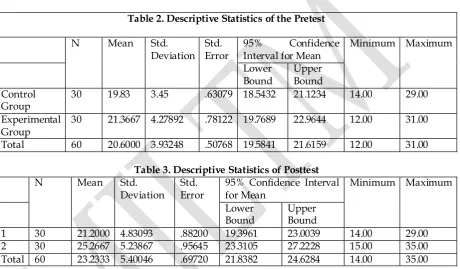
A pretest was administered among the participants of the two groups before the treatment. The results of the pretest are presented in table 2 the details of descriptive and inferential statistics are presented respectively.
Table 3. Descriptive Statistics of Posttest
N Mean Std.
Deviation Std. Error
95% Confidence Interval for Mean
Minimum Maximum
Lower
Bound Upper Bound
1 30 21.2000 4.83093 .88200 19.3961 23.0039 14.00 29.00 2 30 25.2667 5.23867 .95645 23.3105 27.2228 15.00 35.00 Total 60 23.2333 5.40046 .69720 21.8382 24.6284 14.00 35.00
The mean were selected and randomly assigned into the experimental and control groups each with 30 participants.
Pretest and Posttest
A pretest was administered among the participants of the two groups before the treatment. The results of the pretest are presented in table 2. The details of both descriptive and inferential statistics are presented respectively.
Table 4. Independent Sample test Levene's Test for Equality of
Variances t-test for Equality of Means
F Sig. t df Sig. (2-tailed)
Equal variances assumed .078 .780 -3.126 58 .003
Equal variances not assumed
-3.126 57.623 .003 Table 2. Descriptive Statistics of the Pretest
N Mean Std.
Deviation Std. Error 95% Interval for Mean Confidence Minimum Maximum Lower
Bound
Upper Bound Control
Group 30 19.83 3.45 .63079 18.5432 21.1234 14.00 29.00 Experimental
Group
30 21.3667 4.27892 .78122 19.7689 22.9644 12.00 31.00
Total 60 20.6000 3.93248 .50768 19.5841 21.6159 12.00 31.00
ISSN: 2251-6204
Vol. 5, Issue 1, March 2015 |
16As shown in table above the result of the Leven's test reveals that the two groups had homogeneous variances (F=.078, p=.780 >.05), hence the second condition for running a t-test is met.
Table 3.4 also shows that the difference between the means of the two groups was significant (t=-3.126, p=.780<.05), and by virtue of the mean values shown in table 2 (control = 21.20, experimental= 25.26), it was concluded that the experimental group outperformed the control group significantly. And this shows the significant effect of the Form Focused Discovery Learning on the Speaking Ability of the learners.
Based on the results of the data analysis, the null hypothesis of the study which stated that "Form Focused Discovery does not have significant effect on Speaking ability of EFL learners " was rejected and the researcher came up with the result that embellishing a class with Form Focused Discovery Learning has significant effect on the reading Speaking ability of EFL learner .
The above-mentioned research increasingly supports the idea that adorning a class with Form
Focused Discovery Learning enriches students’ learning in unique ways. The presence of Discovery Learning approach in today’s teaching and learning leads to learner’s autonomy and deep processing
(Tomilson, 1994).
Discussion
Researcher suggests that traditional instruction on isolated grammar forms is insufficient to promote their acquisition (long1991; Long and Robbinson 1998), yet purely communicative approaches have been found inadequate for developing high levels of target language accuracy (Harley and Swain 1984; Swain1985, 1998; Swain and Lapkin 1998). two general solution have been proposed in the research literature : one is to encourage learners to attend to target forms by noticing them in input (Schmidt 199o,1993;Doughty and William 1998a;R.Ellis 1994a,2000a) .thus assisting in their processing to produce output containing target forms, again enable learners to notice the gap between their current TL ability and the correct use of the target form (Swain 1985,2005).it has been shown that attention and noticing interact with the learner task and context ,as well as with various cognitive processing variables (Robinson 1995,2001,2005;skehen1996b,1998,N .Ellis 2002a,2002b).
Some studies have found that explicit instruction may be more effective than implicit instruction when learning involves simple rules (for example, Dekayser 1995; Robinson 1996; de graaff1997). The researches have addressed various issues related to the role of formal instruction including that of student –student or student –teacher interaction ,errors correction ,comprehension and production practices ,communicative and instructional activities ,and output and input, including learner revision ,and has led to important finding(for example ,Lightbown and Spada 1990 ;VanPattern 1990;Fotos and Ellis 1991;Fotos 1993,1994,1998,2002;VanPattern and Cardiero 1993;William 1995, 2005a ; Dekayser and Sokalski1996;Lyster and Ranta1997;Doughty and Varela 1998;Lyster 1998b;Swain 1998,2000,2005 ;white 1998 ; R,Ellis Basturkmen ,and Loewen 2001a;Swain and Lapkin 2001 Pennington 2003). form focused learning involves drawing learner’s attention to linguistic forms
as they arise incidentally in the text whose overriding focus is on meaning to communication(Long,1991).
Form Focused Discovery activities is regarded as a way to encourage learners to discover language for themselves while overall focus is on meaning (Bolitho and Tomilson 1980:1)Theoretical principles underlying Form Focused Discovery approach facilitate experiential learning, deep processing, self-investment, noticing that are beneficial for language learning (Tomilson ,1994). The outcome of the posttest administration and analysis was the rejection of the null hypothesis
which stated that “ Form Focused Discovery Learning does have significant effect on speaking
ability of EFL learners". The results of data analysis demonstrated the significant superiority of the experimental group over the control group on their posttest performance. Since the learners in both groups were homogenized with respect to their English listening , reading and writing proficiency and then randomly assigned to the two groups prior to the treatment, the final significant difference between their mean scores on the posttest could be attributed to effect of the speaking ability . Therefore, it can be claimed that Form Focused Discovery Learning has significant effect on EFL
learners’ Speaking ability.
ISSN: 2251-6204
Vol. 5, Issue 1, March 2015 |
17REFRENCES
Andrews, J. D. W. (1984). Discovery and expository learning compared: Their effects on independent and dependent students. Journal of Educational Research, 78, 80–89.
Ausubel, D. P. (1964). Some psychological and educational limitations of Learning by discovery. The Arithmetic Teacher, 11, 290–302.
Bolitho ,R,1988.’Language awareness on teacher training courses’in T.Duff(ed) Exploratiop in teacher
training Problems and Issues, Harlow;Longman .
Bolithmo, R.2003.Material for language awareness in B.Tomilson (ed) Developing Material for Language Teaching London;Continuum.
Bolithno,R,and B.Tomilson ,1980,1995,2005,Discover English.Oxford.
Breen, M.,CBarrati-Pugh,B,Derewlanka,H.House,C.Hudson,T,Lumley,andM,,Rohl.1997.How teachers interpret and use national and state assessment Framework.Volumes 1-3 Canbera Department of Employment, Education ,Training and Youth Affairs.
Bielaczyc, K., Pirolli, P. L., & Brown, A. L. (1995). Training in self-explanationand self-regulation strategies: Investigating the effects of knowledge acquisition activities on problem solving. Cognition andInstruction, 13, 221–252. doi:10.1207/s1532690xci1302_3
Brant, G., Hooper, E., & Sugrue, B. (1991). Which comes first the simulation or the lecture? Journal of Educational Computing Research, 7, 469–481.
Bruner, J. T. (1993). Schools for thought: A science of learning in the classroom. Cambridge, MA: MIT Press. Bruner, J. S. (1961). The act of discovery. Harvard Educational Review, 31, 21–32.
Cantor, G. N., Dunlap, L. L., & Rettie, C. S. (1982). Effects of reception And discovery instruction on
kindergarteners’ performance on probability Tasks. American Educational Research Journal, 19, 453–463. Chandler, P., & Sweller, J. (1991). Cognitive load theory and the format of Instruction. Cognition and Instruction, 8, 293–332. Doi: 10.1207/s1532690xci0804_2
Chi, M. T. H., de Leeuw, N., Chiu, M., & LaVancher, C. (1994). Eliciting Self-explanations improves understanding. Cognitive Science, 18, 439–477.
Clark, R. E. (2009). How much and what type of guidance is optimal for Learning from instruction? In S. Tobias & T. M. Duffy (Eds.), Constructivist Theory applied to instruction: Success or failure? (pp. 158–
183). New York, NY: Taylor & Francis.
Craig, R. C. (1965). Discovery, task completion, and the assignment as factors in motivation. American Educational Research Journal, 2, 217–222.
Danner, F. W., & Day, M. C. (1977). Eliciting formal operations. Child Development, 48, 1600–1606. doi:10.2307/1128524
Debowski, S., Wood, R. E., & Bandura, A. (2001). Impact of guided exploration and enactive exploration on self-regulatory mechanisms and information acquisition through electronic search.
Journal of Applied Psychology, 86, 1129–1141. doi:10.1037/0021-9010.86.6.1129
Denson, D. W. (1986). The relationships between cognitive styles, method of instruction, knowledge, and process skills of college chemistry students (Unpublished doctoral dissertation, University Microfilms No. 87–05059). University of Southern Mississippi, Hattiesburg, MS.
Destrebecqz, A. (2004). The effect of explicit knowledge on sequence learning: A graded account.
Psychologica Belgica, 44, 217–247. Dewey, J. (1910). How we think. Boston, MA: D. C. Heath. doi:10.1037/10903-000
Fletcher, J. D. (2009). From behaviorism to constructivism. In S. Tobias & T. M. Duffy (Eds.),
Constructivist theory applied to instruction: Success or failure? (pp. 242–263). New York, NY: Taylor & Francis.
Gagne´, R. M., & Brown, L. T. (1961). Some factors in the programming of conceptual learning. Journal of Experimental Psychology, 62, 313–321. doi:10.1037/h0049210
Grandgenett, N., & Thompson, A. (1991). Effects of guided programming instruction on the transfer of analogical reasoning. Journal of Educational Computing Research, 7, 293–308.
Greenockle, K. M., & Lee, A. (1991). Comparison of guided and discovery learning strategies.
Perceptual and Motor Skills, 72, 1127–1130.doi:10.2466/PMS.72.4.1127-1130
Guthrie, J. T. (1967). Expository instruction versus a discovery method. Journal of Educational Psychology, 58, 45–49. doi:10.1037/h0024112
Herman, P., & Gomez, L. M. (2009). Taking guided learning theory to school. In S. Tobias & T. M. Duffy (Eds.), Constructivist theory applied to instruction: Success or failure? (pp. 62–81). New York, NY: Taylor & Francis.
ISSN: 2251-6204
Vol. 5, Issue 1, March 2015 |
18Hmelo-Silver, C. E., Duncan, R. G., & Chinn, C. A. (2007). Scaffolding and achievement in problem-based and inquiry learning: A response to Kirschner, Sweller, and Clark (2006). Educational Psychologist, 42, 99–107.
Kagan, J. (1966). Learning, attention, and the issue of discovery. In L. S. Shulman & E. R. Keislar (Eds.), Learning by discovery: A critical appraisal (pp. 151–161). Chicago, IL: Rand McNally.
Kalyuga, S., Chandler, P., & Sweller, J. (2001). Learner experience and efficiency of instructional guidance. Educational Psychology, 21, 5–23. doi:10.1080/01443410124681.
Kalyuga, S., Chandler, P., Tuovinen, J., & Sweller, J. (2001). When problem solving is superior to studying worked examples. Journal of Educational Psychology, 93, 579–588. doi:10.1037/0022-0663.93.3.579.
Karpov, Y. V., & Haywood, H. C. (1998). Two ways to elaborate Vygotsky’s concept of mediation: Implications for instruction. American Psychologist, 53, 27–36. doi:10.1037/0003-066X.53.1.27.
Kersh, B. Y. (1958). The adequacy of “meaning” as an explanation for the superiority of learning by independent discovery. Journal of Educational Psychology, 49, 282–292. doi:10.1037/h0044500.
Kersh, B. Y. (1962). The motivating effect of learning by directed discovery. Journal of Educational Psychology, 53, 65–71. doi:10.1037/h0044269
Kintsch, W. (2009). Learning and constructivism. In S. Tobias & T. M. Duffy (Eds.), Constructivist theory applied to instruction: Success or failure? (pp. 223–241). New York, NY: Taylor & Francis.
Klahr, D., & Nigam, M. (2004). The equivalence of learning paths in early science instruction: Effects of direct instruction and discovery learning. Psychological Science, 15, 661– 667. doi:10.1111/j.0956- 7976.2004.00737.x
Kozulin, A. (1995). The learning process: Vygotsky’s theory in the mirror of its interpretations. School Psychology International, 16, 117–129. doi:10.1177/0143034395162003.
Kuhn, D., Black, J., Keselman, A., & Kaplan, D. (2000). The development of cognitive skills to support inquiry learning. Cognition and Instruction, 18, 495–523. doi:10.1207/S1532690XCI1804_3.
Long , M , 2000, Focus on Form in task –based Language teaching in R.Lambert and E Shohamy Language Policy and Pedagogy Essay in Honor of A.Ronald Walton Philadelphia:John Benjamins. Long,M,1991 ,Focus on Form :a design feature in language teaching methodology ‘in k,de bot ,R
Ginsberg and C Kramsch (eds,)Foreign Language Research in Cross -cultural Prespective ,Amesterdom;John Benjamin
Mayer, R. E. (2004). Should there be a three-strike rule against pure discovery learning? The case for guided methods of instruction. American Psychologist, 59, 14–19. doi:10.1037/0003-066X.59.1.14
Mayer, R. E. (2009). Constructivism as a theory of learning versus constructivism as a prescription for instruction. In S. Tobias & T. M. Duffy (Eds.), Constructivist theory applied to instruction: Success or failure?(pp. 184–200). New York, NY: Taylor & Francis.
McDaniel, M. A., & Schlager, M. S. (1990). Discovery learning and transfer of problem-solving skills.
Cognition and Instruction, 7, 129–159. doi:10.1207/s1532690xci0702_3.
Murphy, N., & Messer, D. (2000). Differential benefits from scaffolding and children working alone.
Educational Psychology, 20, 17–31. doi: 10.1080/014434100110353.
Nassaji, H, 1999.Toward integrating Form –Focused Instruction and communicative interaction in the
second language classroom; some pedagogical possibilities’. Canadian Modern Language
Review55/3; 385-402.
Nassaji,H..and J,.Tian ,2005,Octobor,Co-production of language forms in task based work .paper
presented at Second Language Research Forum(SLRF)Teacher’ ,Columbia College University, New
York City.
O’Brien, T. C., & Shapiro, B. J. (1977). Number patterns: Discovery versus reception learning. Journal for Research in Mathematics Education, 8, 83–87. doi:10.2307/748536
Olander, H. T., & Robertson, H. C. (1973). The effectiveness of discovery and expository methods in the teaching of fourth-grade mathematics. Journal for Research in Mathematics Education, 4, 33–44. doi:10.2307/749022
Paas, F. G. W. C., Renkl, A., & Sweller, J. (2003). Cognitive load theory and instructional design: Recent developments. Educational Psychologist, 38, 1–4. doi:10.1207/S15326985EP3801_1
Piaget, J. (1952). The origins of intelligence in children (M. Cook, Trans.). New York, NY: International Universities Press. doi:10.1037/11494-000
Piaget, J. (1965). Science of education and the psychology of the child. In H. E. Gruber & J. J. Voneche (Eds.), The essential Piaget (pp. 695–725). New York, NY: Basic Books.
ISSN: 2251-6204
Vol. 5, Issue 1, March 2015 |
19Ray, W. E. (1961). Pupil discovery vs. direct instruction. Journal of Experimental Education, 29, 271–280. Reid, D. J., Zhang, J., & Chen, Q. (2003). Supporting scientific discovery learning in a simulation environment. Journal of Computer Assisted Learning, 19, 9–20. doi:10.1046/j.0266-4909.2003.00002.x. Rogoff, B. (1990). Apprenticeship in thinking: Cognitive development in social context. New York, NY: Random.
Rosenshine, B. (2009). The empirical support for direct instruction. In S. Tobias & T. M. Duffy (Eds.),
Constructivist theory applied to instruction: Success or failure? (pp. 201–220). New York, NY: Taylor & Francis.
Scandura, J. M. (1964). An analysis of exposition and discovery modes of problem solving instruction. Journal of Experimental Education, 33,149–159.
Schmidt, H. G., Loyens, S. M. M., van Gog, T., & Paas, F. (2007). Problem-based learning is compatible with human cognitive architecture: Commentary on Kirschner, Sweller, and Clark (2006). Educational Psychologist, 42, 91–97.
Skinner, B. and R ,Austain ,1999.Computer conferencing-does it motivate EFL student ?ELT journal 53/4;270-80.
Singer, R. N., & Pease, D. (1978). Effect of guided vs. discovery learning strategies on initial motor task learning, transfer, and retention. Research Quarterly, 49, 206–217.
Tobias, S., & Duffy, T. M. (Eds.). (2009). Constructivist theory applied to instruction: Success or failure?
New York, NY: Taylor & Francis.
Tomilson ,B,1981,O-Level Summery and Composition .Harlow;Longman.
Tomilson ,B.1990,Managing change in Indonesian high school .ELT Journal44/1;25-37
Tuovinen, J. E., & Sweller, J. (1999). A comparison of cognitive load associated with discovery learning and worked examples. Journal of Educational Psychology, 91, 334–341. doi:10.1037/0022-0663.91.2.334.
ISSN: 2251-6204
Vol. 5, Issue 1, March 2015 |
20A CRITICAL EVALUATION OF INTER- AND
INTRA-CULTURAL ENCOUNTERS OF TEXTBOOKS: INSIGHTS
FROM IRAN
Zahra Alimorad
Department of Foreign Languages and Linguistics Shiraz University, Shiraz, Iran
Corresponding Author's Email: [email protected]
ABSTRACT
Focusing on the vital role textbook evaluation plays in any educational system, the present study evaluated two textbook series in terms of the inter- and intra-cultural encounters they offer to Iranian EFL learners. Data for this study were gathered based on dialogues of Right Path to English 1 & 2
(RPE) and Prospect 1 & 2. Pennycook’s (2004) distinction between consensual and conflictual dialogues and Long’s (1996) notion of meaning negotiation constituted the theoretical frameworks of
the study. Findings indicated that RPE provided its readers with consensual, inauthentic and highly cooperative dialogues which lacked any instances of meaning negotiation. Prospect, on the other hand, presented both consensual and conflictual dialogues which are also devoid of meaning negotiation. Implications of these findings for Iranian textbook writers are also discussed.
Key words: Consensual vs. conflictual dialogues, Critical discourse analysis, Meaning negotiation, Textbook evaluation.
1. Introduction
Education as an important system dealing with language is constructed by the society; hence, the prejudices, values and traditions of the society which are also reflected in textbooks can influence the educational system of a country. Textbooks as a part of each school and the educational system are of great significance in this regard since they may pave the way for such prejudices in the educational environment and in the society at large (Söylemez, 2010). Hence, practitioners must attempt to examine the contents of textbooks closely and to choose the best available textbook for use in instructional settings.
Evaluating different textbooks, some researchers have identified different characteristics for effective and good textbooks (e.g., Crawford, 2002). However, more recently, other researchers have adopted a newer perspective based on poststructuralist theory and critical discourse analysis. Based on studies of Second Language Acquisition (SLA), L2 learners and users experience identity conflicts while they try to participate in target language use contexts (Shradakova & Pavlenko, 2004). They might also experience denial or misunderstanding of their identities (Norton, 2000). Sometimes, L2 learners might feel that they lack the necessary linguistic resources needed for communication in situations involving gender, ethnicity, race or social class (Ehrlich, 2001; Polanyi, 1995; Talburt & Stewart, 1999). In such situations, textbooks can serve as a useful tool providing learners with the linguistic skills necessary to overcome such problems. They can introduce a variety of identity options to learners to make them more familiar with the social, ethnic and cultural norms of the target language community. If learners are unaware of these norms, they may feel vulnerable and powerless in real-life encounters with native speakers of the target language and this feeling might decrease their investment in the target language (Norton Peirce, 1995) and might even lead to their resistance to a particular language (Ehrlich, 2001; Ohara, 2001).
Textbooks can even be considered more crucial in EFL (English as a Foreign Language) contexts where students have little or no access to native speakers of English. In a country such as Iran, the
ISSN: 2251-6204
Vol. 5, Issue 1, March 2015 |
21situation is even worse since in addition to being an EFL context, Iran has little contact with other countries of the world, especially English speaking ones, because of the sanctions imposed on it. Therefore, Iranian students are highly deprived of getting in touch with native speakers of English as role models. In such a situation, it is textbook writers' mission to compensate for this shortage by providing Iranian EFL learners with adequate and sufficient content.
Since textbooks play a pivotal role in making learners familiar with native speakers’ norms, it is
crucial for textbook writers to pay more attention to the information offered to the learners by their books. In this study, we will examine inter- and intra-cultural encounters offered to Iranian EFL students by four different textbooks; that is, Prospect 1 & 2 which are two recently published textbooks and are currently taught to first and second graders of junior secondary schools and RPE 1 & 2 which were previously taught to the students of the same levels at those schools. The aim is to find out whether the new textbook has made any progress in comparison to its former counterpart. To do this, characters in the texts are viewed as representative of two sets of identity options: learners and target language speakers. Therefore, this study seeks to answer the following research questions: 1. Did RPE 1 & 2 provide their learners with the linguistic skills needed to overcome difficulties in inter- and intra- cultural real-life encounters?
2. Do Prospect 1 & 2 offer their learners the linguistic tools necessary for participating in inter- and intra- cultural real-life encounters?
3. How do these two textbook series depict the imaginary world of native speakers for their learners?
2. Literature review
Many researchers all over the world have tried to examine and evaluate the published textbooks from different perspectives in order to inform teachers and practitioners of the merits and demerits of those books and to help them make informed decisions. For example, Sahragard and Davatgarzadeh (2010) investigated the linguistic representation of male and female social actors and construction of gender identities in the Interchange Third Edition. Results of their study revealed a differential representation of social actors in that females were portrayed as more prominent, successful, active, independent, expressive and assertive in comparison with males. They concluded apparently attempts have been made to bring women from margin to the foreground because females were associated with high status activities in this series. This kind of representation of female social actors challenges traditional values that exclude and demean the value of women in society implying that women are as crucial as men to the functions of the communities.
Söylemez (2010) tried to find out how social gender identity is constructed in the reading passages in two sets of textbooks, Face 2 Face and English File, elementary, pre-intermediate, intermediate and upper-intermediate. To collect the data, the reading texts in these textbooks were scanned and the adjectives used to describe both genders were identified and categorized to determine what kind of characteristics have been attributed to males and females and how their social identities have been constructed. Results indicated that although the adjectives seemed to have been chosen randomly, writers of the books reflected the general outlook on females and males; that is, deliberately or not, textbook writers had a tendency to use some adjectives with one gender rather than with the other. Some other researchers expanded the focus of inquiry and took into account a range of social
identities and the students’ perceptions of identity options offered to them. As an example,
Canagarajah (1993) examined a US-published ESL textbook in a Sri Lankan classroom and its “hidden curriculum”, that is, implicit ideological values covered by the text. His results indicated that
dialogues and narratives in the text presented racial and gender biases as well as implicit Western middle-class values like consumerism, thrift, delayed gratification and social mobility. In addition, he
investigated the students’ reactions to the text. Results showed that rural Tamil students employed a
range of discursive strategies to deal with ideological conflicts posed to them by the texts. For instance, in some situations, they exhibited direct hostility while in others they opted for parody, exaggeration or mockery. Canagarajah (1993) recommended textbook authors to make use of discourses that are relevant to the students’ lives and social and political realities in order to prevent students’ resistance to the texts and even to English.
In Iran, Amalsaleh (2004) studied the representation of social actors (in terms of social class, gender,
…) in EFL textbooks. She found that all the books, irrespective of their goals and audience, mostly seemed to follow an almost similar trend. For example, all of them showed males and females
ISSN: 2251-6204
Vol. 5, Issue 1, March 2015 |
22differently portraying the female social actors as belonging to home context or having limited job opportunities in the society.
Even though many textbook evaluation studies have been conducted in Iran (e.g., Bahrami, 2011; Darali, 2007; Gordani, 2010; Hajizadeh, 2008; Iraji, 2007; Jahangard, 2007; Kazempourfard, 2011; Ketabi, 2006; Mirza-Suzani, 2006; Rahimi Alagha, 2007; Rastegar, 1992; Razmjoo, 2007; Riazi & Aryasholouh, 2007; Riazi & Mosallanejad, 2010; Sahragard & Davatgarzadeh, 2010; Souzandehfar, 2011; Tajeddin, 2006; Zare Moayedi, 2007), to name a few, none of them has examined the types of dialogues offered to Iranian EFL learners in the textbooks taught to them. Therefore, in order to fill this lacuna, the present study intends to examine and compare the dialogue types offered to Iranian EFL students by the four textbooks: Prospect 1 & 2 and RPE 1 & 2.
3. Theoretical underpinning of the study
In this study, an attempt is made to explore the vital role textbooks play in the potential empowerment or disempowerment of language learners. In EFL contexts such as Iran where learners have few opportunities to encounter native speakers, textbooks can create “imaginary worlds” for the
learners and sometimes misrepresentation, oversimplification or stereotyping of these worlds might lead to cross-cultural miscommunication, demotivation, frustration, conflict or even resistance on the part of language learners when they feel their own identities and values conflict with those values and identities imposed on them by the texts (Shardakova & Pavlenko, 2004).
To analyze dialogues and instances of inter- and intra-cultural encounters, Pennycook’s (2004) distinction between conflictual and consensual dialogues and Long’s (1996) notion of meaning
negotiation were employed. According to Pennycook (2004, p. 338), consensual dialogues are cooperative without any power relations while conflictual ones “reproduce relations of power and may be seen as ideologically normalized” the assumption being that “there are no relations without power”. He believes that consensual dialogues are not only inauthentic but also “they provide passively cooperative subject positions for language learners”.
Long (1996) defines meaning negotiation as a process that speakers go through to reach a clear understanding of each other. It occurs when there is a breakdown in communication which interlocutors attempt to overcome. For instance, one of the participants in a conversation might say something that the other one does not understand. In such a situation, the participants will use various communicative strategies to help the interaction progress. These strategies may include slowing down speech, speaking more deliberately, requests for clarification, or paraphrases.
The role of imagination in the language learning process will be clarified based on Anderson (1991). Anderson (1991, p. 6) viewed nation-states as imagined communities “because the members of
even the smallest nation will never know most of their fellow-members, meet them, or even hear of
them, yet in the minds of each lives the image of their communion”. Using these frameworks, the researcher examined the dialogues offered to Iranian EFL learners by two textbook series and tried to find out whether any progress has been made by publishing and teaching a new book in the junior secondary schools of Iran.
4. Method
4.1. Materials for the study
This study analyzes two textbook series of RPE 1 & 2 and Prospect 1 & 2 taught in Iran. Previously, RPE 1 and 2 were obligatory in all Iranian junior secondary schools. However, recently, two new textbooks have been introduced to Iranian junior secondary schools. Although both these two textbook series are written by a group of Iranian teachers under the auspices of the Ministry of Education, the former ones are no longer taught in the junior secondary schools of Iran and have been replaced by Prospect 1 & 2. In fact, the latter two textbooks are recently published and are currently taught to first- and second-graders.
4.2. Data analysis procedures
Adopting the above-mentioned theoretical frameworks, imaginary worlds created for Iranian EFL learners by the two textbook series were investigated. Therefore, to answer the research questions, the researcher examined the textbooks closely to find out whether any interaction between native English speakers and non-native speakers was depicted and also to study the way they were depicted. To this end, dialogues of the two textbooks were analyzed.
ISSN: 2251-6204
Vol. 5, Issue 1, March 2015 |
23The reliability of ratings is usually increased by having two trained raters make independent ratings. These independent ratings are averaged to obtain a final score. Researchers may also correlate the ratings of the two separate raters to obtain a coefficient of inter-rater reliability (Ary, Jacobs, Sorensen, & Razavieh, 2010). Therefore, to confirm the validity of the coding procedure, inter- and intra-rater reliabilities were checked. To this aim, the researcher asked one of her colleagues who was proficient enough in English and also an expert in critical discourse analysis studies to independently categorize inter- and intra-cultural encounters in the two textbook series once more. They agreed on labels for 87% of the cases. Differences for the remaining cases were resolved through discussion. "The size of the coefficient indicates the extent to which the raters agree. An inter-rater reliability coefficient of .70 or higher is considered acceptable for rating scales" (Ary et al., 2010, p. 215). Intra -rater reliability was also checked. The researcher herself rated the inter- and intra-cultural encounters of the two textbook series once and then after a few days, she rated them for the second time. The overlap between the two ratings was 90.4% which was quite acceptable.
5. Results and discussion
5.1. Inter- and intra-cultural encounters in RPE 1 & 2
Native and non-native identities were determined based on characters' names and the pictures accompanying them. Actually, no instances of inter-cultural communication between native and non-native speakers of English in the RPE series were observed. Therefore, it seems that Iranian EFL learners are seriously deprived of becoming familiar with how to overcome communication problems while interacting with native speakers. In addition, they are not taught how to negotiate meaning which is a vital condition for successful communication in order to compensate for communication breakdowns (Long, 1996). According to Long (1996), it is useful and beneficial for learners to encounter situations in which communication problems are negotiated between participants and this negotiation promotes production and comprehension and it will ultimately facilitate L2 development. The absence of native speakers and the lack of meaning negotiation instances are two major
drawbacks of this series. Portraying the miscommunication exchanges is “extremely beneficial for the
learners who need to learn how to negotiate meaning in less than friendly environments”
(Shardakova & Pavlenko, 2004, p. 41). Almost all of the dialogues are consensual inauthentic ones which are not challenging for the learners and create a view of the “imaginary world” of English use
as highly cooperative without any power relations. As an example, the dialogue on page 54 of Book 1 will be presented here:
Amin: Hello, Ali. How are you today? Ali: Just fine. Thank you.
Amin: How is school? Ali: It is OK.
Amin: Have you English today? Ali: Yes, we have. What about you?
Amin: No, we haven’t.
And another dialogue from Book 2 page 50: Mansoor: Hi, Akbar.
Akbar: Hi.
Mansoor: This is my school. Akbar: I go to Farabi School.
Mansoor: I walk to school every day. Akbar: But I go by bus.
Mansoor: Nice to meet you.
Akbar: Goodbye. See you tomorrow.
In each of the above-mentioned contexts, two students are talking to each other very gently, cooperatively and kindly; hence, there are no challenges, disagreements and rejections. Such conversations are not, of course, characteristic of real-life encounters in which power relations lead to the use of different discursive strategies to persuade the people or to challenge their ideas. In addition
to being inauthentic, such dialogues “provide passively cooperative subject positions for language learners” (Pennycook, 2004, p. 33). Practicing such conversations does not empower or enable learners to participate in real world challenging situations involving ethnic, racial, social and gender conflicts.
ISSN: 2251-6204
Vol. 5, Issue 1, March 2015 |
245.2. Inter- and intra-cultural encounters in Prospect 1 & 2
Like RPE series, Prospect series also portrays all encounters as intra-cultural ones; that is, interactions between non-native speakers of English who are mostly Iranian. However, all learners depicted in the texts are not highly proficient in the standard variety of English and their pronunciation is problematic in some instances. For instance, on page 34 of Prospect 1, Fatemeh is talking to her teacher:
Teacher: Fatemeh, look at this picture. What’s the man doing? Fatemeh: He’s working*.
Teacher: Say it again.
Fatemeh: He’s working*.
Teacher: He’s working. It’s the /w/, not /v/.
As is evident from the above conversation, Fatemeh does not make a distinction between /w/ and /v/ sounds in English and her teacher is drawing her attention to the difference in these two consonants' pronunciation in English. The reason for this mispronunciation is that in Persian, there is only one sound corresponding to these two sounds in English, namely, /v/. This kind of conversation helps Persian native speaker students distinguish between these two sounds consciously. In addition to depicting English learners' mispronunciations, Prospect 1 also portrays slightly conflictual dialogues between non-native speakers of English. As an example, on page 38 of Prospect 1, two students are talking about going to a friend's house in this way:
Omid: Ali’s not well. I’m going to visit him today. Are you coming with me?
Hossein: What time are you going? Omid: Around 5 in the afternoon.
Hossein: I’m not sure I can, but I’ll try. What’s his address? Omid: 5 Azadi Street.
Hossein: Call me before you go. My phone number is 586-2144. Omid: OK, bye.
Despite its simplicity, this conversation seems to be slightly conflictual and non-cooperative since Hossein does not readily accept Omid's suggestion of going to their friend's house. In fact, such a conversation is challenging for participants putting them in situations needing rejections, disagreements and noncooperation. This is the way we interact with other people in real-life situations. Hence, it seems to be a more authentic conversation which helps English learners empower themselves in order to be able to face the challenges of real world encounters with (non)native speakers. On page 10 of the same book, we can also see an instance of a consensual dialogue between three students who are talking in the school yard.
Ali: Who is that boy?
Parham: That’s Erfan. He’s our new classmate. Ali: Let’s talk to him.
Parham: Hi, Erfan. This is Ali. Ali: Nice to meet you, Erfan. Erfan: Nice to meet you, too. Ali: Welcome to our school. Erfan: Thank you.
As another example, on Page 26 of Prospect 2, two students are talking about their abilities in this way:
Elham: Wow! Your drawing is very good. Sara: Thanks. Can you draw?
Elham: No, I’m not good at drawing. But I can take good photos. Sara: Really? Can I see your photos?
Elham: Why not? Come to my house this afternoon.
Sara: Oh, I can’t make it today. How about Thursday afternoon? Elham: That’s fine. You can bring your drawing book, too.
Sara: Sure.
In the above-mentioned conversation too, it can be seen that Sara declines her friend’s invitation to
her house. This is another instance of rejection and non-cooperative interaction which is more natural than those presented in RPE 1 & 2.
ISSN: 2251-6204
Vol. 5, Issue 1, March 2015 |
25Based on the above analyses, it is possible to answer the three research questions of this study. In response to the first research question, it was found that RPE gives its learners an over-simplified
picture of the target language use by depicting Iranian learners’ interactions with each other in the
context of their own native language and culture. RPE, it can be argued, portrays “imaginary worlds”
which offer oversimpl