ISSN (E): 2305-9249 ISSN (P): 2305-9494
Publisher: Centre of Excellence for Scientific & Research Journalism, COES&RJ LLC Online Publication Date: 1st April 2017
Online Issue: Volume 6, Number 2 Special, April 2017 http://centreofexcellence.net/J/JSS/JSS%20Mainpage.htm
Language of the TIMSS – like test and student
performance in general science
Anabelie Villa Valdez Mindanao State University Abstract :
Learning is the process of accumulating bits of information and isolated skills. However, language barrier could hinder efficient and effective teaching-learning process. Language is a written code for systematic science learning, and as a vehicle for constructive and creative thinking in which teachers’ primary responsibility is to transfer knowledge directly to students; and the process of learning and teaching process primarily on the interactions between the teacher and individual students.This study aimed to identify the effect of language used in the TIMSS-Like test and the science vocabulary test towards the students’ performance in General Science. Two research instruments were used in this experimental research namely; the TIMSS-Like Test and vocabulary test which was translated into Filipino and Meranao (Students Native Dialect) or chosen language. Control group was exposed to English language test while experimental group was exposed to Filipino language test and Meranao or chosen language in the test. With the use of Analysis of Variance and Correlations, results revealed that the group exposed to Filipino language test obtained highest mean gain followed by the group exposed to their own choice of language. More so, vocabulary knowledge has positive significant relationship to the students’ performance in General Science TIMSS-Like Test. Thus, it is very important for teachers’ that the language used as medium of instruction must be the language to be used in the test. Furthermore, teachers should incorporate science vocabulary in teaching scientific concepts so as to provide effective learning and understanding among learners.
Keywords:
Language used in the test, student performance in science, vocabulary knowledge Citation:
Introduction
Language is a spoken code that enables human beings to communicate with each other. In the Philippines, Filipino people are typically multilingual which is now creolized among small elite. Language development and communication are integral components of science learning, and in turn science experiences provide a meaningful experience base that children want to write, talk, read, and construct new meanings [1].One of the major issues facing policy makers and the implementations of education in general and science education in particular is the low performance of Filipino students at the basic level of education. In the IEA preliminary report, which presented data for seventeen (17) countries, the Philippines ranked 15th and 17th for grades 5 and 9(third year high school) respectively. This ranking did not improved in the Philippines participation in the TIMSS conducted in 1994. TIMSS-R in 1998 features the translation of the English version of the test items in Filipino language for Filipino participants, for which only 15 schools or 10% of the total schools sampled chose to take the Filipino version of the test [2]. In their study, two questions remained unanswered; does the language of the test make significant difference in performance? Would Filipino students perform better if the students themselves were made to choose the language of the test? In this connection, this research were materialized for the purpose of looking into, whether the languages use in the TIMSS-like test affects student performance in general science. Specifically it investigated the extent of the students’ performance I the TIMSS –like test using English language test, Filipino language test and their preferred or choice language in the test which are either Filipino, English or Meranao language.
Methodology
Participants and Procedure
A total of 72 grade seven students at MSU-Balindong High School participated and randomly distributed into three groups: control group (group1) took the English version test, experimental group A (Filipino version test) and experimental group B took their choice language version of the test. In the experimental group B, the students were free to choose what test version they wanted to take. In this group, 3 or 12.5% chose English version, 5 or 20.83% chose Filipino version and 16 or 66.67% chose Meranao version test. Each group consisted of 24 students which were matching paired based on their previous grades in General Science.
A. Instruments
B. Statistical Treatment
The data gathered were analysed using SPSS software computed by the statistician. The statistical tools used were Pearson r to established relationship between variables, the one way ANOVA to determine the significant differences of variables and the descriptive statistics such as mean, frequency and percentage distribution.
Results and discussion
Analysis and comparison of the mean scores in General Science obtained by the students using English language, Filipino language and their own chosen language for the test are presented in Table 1.
Table 1 Mean Scores and Standard Deviation
Groups N Mean Standard deviation
Control group 24 15.958 4.339
Experimental (Filipino version test) Group A
24 16.792 3.999
Experimental (own choice version) Group B
24 16.177 5. 939
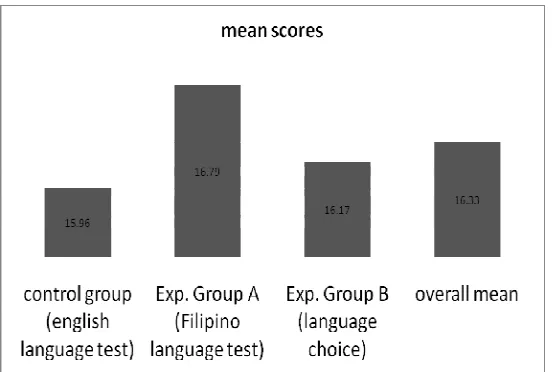
Experimental group A obtained highest means scores followed by experimental group B and control group respectively. Students who chose Filipino version test (group A) showed homogeneity in answering the test, indicating that there is uniformity in their understanding of the concept being tested. The semblance of heterogeneity manifested by experimental group B implied that this student varries in their understanding due to the fact that they are taking different version of test.
Mean score in General Science Test
The comparison of overall mean score in General Science Test among groups shown in Figure 1, indicate that if the students are exposed on Filipino language, they performed better on the Filipino language test. Research findings of Acuna and de Guzman supported the findings of this study that students did better in Filipino language test in Science than in English language test.The relational terms in the test is better understood in Filipino than in English language. It is also contends that one component of Filipino language is easier to understand if the vocabulary is based on its usage.
Using Pearson r, results showed that there is positive correlation (r = 0.241, α = 0.041) of the overall mean scores of the TIMSS-like and vocabulary test at 0.05 level of significant. This means that if the students have a wide range in vocabulary, then, they can perform better and understand deeper the concepts on higher order thinking skills. One reason why the Philippines has a very low performance in Science is due to the difficulty of students in identifying the concepts and skills, that is probably because of poor vocabulary knowledge.The size of a person’s vocabulary is directly associated with the level of his intelligence. This means that if the students have wide range in vocabulary they can perform better and understand deeper the concepts on higher order thinking skills on the TIMSS-like test items. The limited effect on the language used and the performance of the respondents in this study may indicate that the respondents are not familiar and not used to answer TIMSS –like test items. Furthermore, the respondents may not understand the terms used in the questions, probably due to limited knowledge in vocabulary.
Table 2 Relationship between Overall Mean Score and the Vocabulary Test
Score Mean SD Correlation Sig. Decision
General Science
16.306 4.776
0.241 0.041 Ho rejected
Vocabulary 19.542 4.645
Analysis of variance revealed that the mean scores obtained by the three groups did not differ significantly, probably due to limited number of respondents and or the number of items in the test. This result is consistent with the findings of Castillo (1999), which claimed that language use has limited effect on academic performance.The dilemma on what language to use for science and mathematics instruction has remained for some time. However, based on the results of the study, the Filipino students’ respondent performed better in the Filipino version test.
Although English is the official medium of instruction in teaching science in the Philippines, but, in reality teacher use Filipino or their dialect in the teaching-learning process. Thus, it can be inferred that the language use in the instructions must be the language to be used in the test. Moreover, the positive correlation between the students’ performance in the TIMSS-like test and vocabulary test implied that vocabulary knowledge is a tool for the students to perform better in their academic subjects. Therefore, teachers should be encouraged to incorporate science vocabulary in the science subjects. Findings on the Language and Science Achievement in the PhilippineContext (2000) claims flexible implementation of the bilingual policy is needed for the fact that there is no clear position on the relationship of language to thought and concept of the students. Until now, it is still unclear which language situation is best suited for the students to have a better academic performance [6].
Table 2 One way ANOVA of the Mean Scores and the Overall Mean Score of the TIMSS-like Test
Source of variation
SS Df MS F Sig. Decision
Between groups
9.06 3 3.019
0.131 0.941 Ho
accepted Within
groups
3218.3 140 22.987
Total 3227.36 143 26.006
Conclusions
The dilemma on what language to use for Science and Mathematics instruction has remained for some time. It seems this would remain as it is today. Policy makers, teachers, administrators and others that conforming the uniformity of language may find that there is a need for flexibility in the language to be used in instruction in general and assessment in particular. The results in this study could conclude that vocabulary knowledge is significant for student’s comprehension and understanding the language in the test and in the instructions. It can also be concluded that the more frequent used language in the class and by the students has a positive bearing that could enhance students’ performance if the same language is use I the test. One has to realize however, that there are three aspects of communication namely; scene setting, intention, and meaning. As science educators, the task is one that calls for total commitment to improving the Filipino learners.
Recommendations
knowledge. Further study related on this study can be conducted in other areas order to triangulate results and for updates.
References
Grough, R.L. & Griffiths, A.K. (1993).Science for Life.Harcourt Brace 7 Company.NINSMED (201). 100 years of Science and Math Education in the Philippines. NINSMED and PundasyonsaPagpapaunladngKaalamansaPagtuturongAgham,
Diliman Quezon City.
TIMSS – R (2000).Philippine Report Volume 1: Science Department of Education Culture and Sports: DOST, Science Education Institute & UP National Institute for Science and Mathematics Education development.
UP Science Education Center (1983).Words in Elementary School Science and Mathematics. Foundation for the Advancement of Science Education Inc. Science Education Center UP Quezon City.
Acuna, J. E. and de Guzman F.S (1987). Language and Science Achievement in the Philippine Context. Journal of Science and Math Education is S.E. Asia SEAMEO – RECSAM Vol.X No. 1
Acuna, J.E. (1987)NINSMED (2001). 100 Years of Science and Math Education in the Philippines. NINSMED and PundasyonsaPagpapaunladngKaalamansaPagtuturongAgham, Diliman Quezon City
Castillo, E.H.S.t al (1999). Educating via Language.Language Education Council of the Philippines and Language Study and Research CenteIncorporated.