Chapter 2
Water and
Carbon: The
Chemical Basis
of Life
Key Concepts
• Molecules form when atoms bond to each other. Chemical bonds
are based on electron sharing. The degree of electron sharing
varies from nonpolar covalent bonds, to polar covalent bonds, to ionic bonds.
• Of all small molecules, water is the most important for life.
• Chemical reactions tend to be spontaneous if they lead to lower
potential energy and higher entropy.
The Building Blocks of Chemical Evolution
• Each element has a unique atomic number and contains a
characteristic number of protons, called the atomic number.
• The mass number (indicated in superscript) is the number of
protons + neutrons of the most common isotope.
• Elements commonly found in organisms have at least one
Chemical Bonding
• Unfilled electron orbitals allow formation of chemical bonds,
and atoms are most stable when each electron orbital is filled.
Covalent bond: Each atom’s unpaired electrons are shared by
both nuclei to fill their orbitals
Nonpolar covalent bond: Electrons are evenly shared between
two atoms and the bond is symmetrical.
Covalent Bonds
Covalent bond
Hydrogen atoms each have
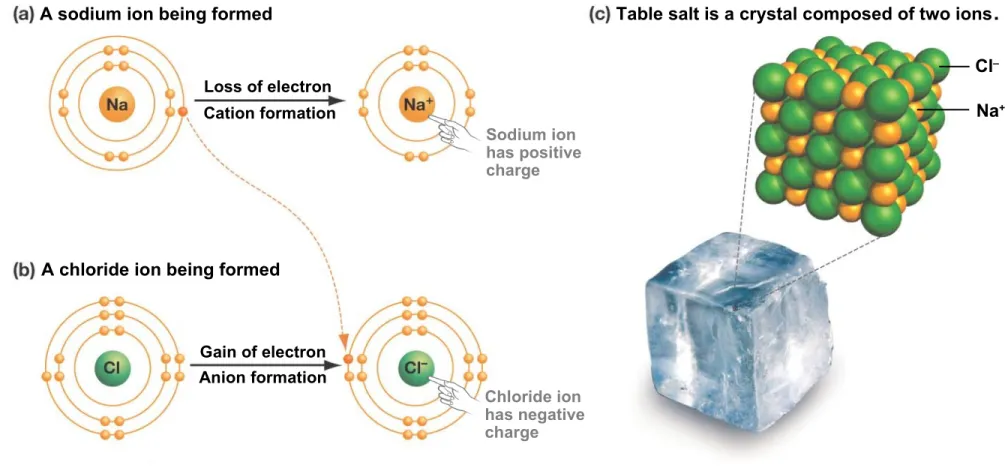
Ionic Bonds
A sodium ion being formed
A chloride ion being formed
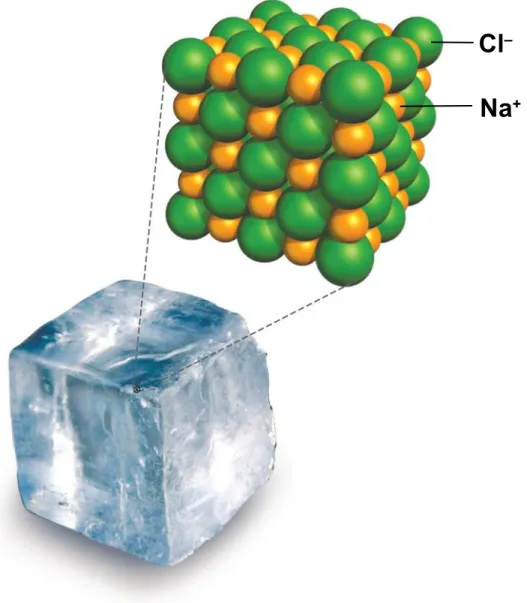
Table salt is a crystal composed of two ions. Cl–
Na+
Loss of electron Cation formation
Anion formation Gain of electron
Ionic Bonds
A sodium ion being formed
A chloride ion being formed
Loss of electron Cation formation
Anion formation Gain of electron
Ionic Bonds
Table salt is a crystal composed of two ions.
Cl–
Electronegativity of Atoms
• An atom in a molecule with a high electronegativity will hold the
electrons more tightly and have a partial negative charge (δ–),
whereas the other atom will have a partial positive charge (δ+).
• Cation: An atom that loses an electron and becomes positively
charged.
• Anion: An atom that gains an electron and becomes negatively
How Many Bonds Can an Atom Have?
• The number of unpaired electrons determines the number of
bonds an atom can make.
• Atoms with more than one unpaired electron can form multiple
Representing Molecules
• The shape of a simple molecule is governed by the geometry of
its bonds.
• The molecular formula indicates the numbers and types of atoms
in a molecule (e.g., H2O, CH4).
• Structural formulas indicate which atoms are bonded together
and whether the bonds are single, double, or triple bonds.
Molecular Representations
Methane Ammonia Water Oxygen
Molecular formulas:
Structural formulas:
Quantifying Molecules
• The molecular weight of a molecule is the sum of the mass
numbers of all the atoms in the molecule.
• One mole, or 6.022 1023 molecules, has a mass equal to the
molecular weight expressed in grams.
• The concentration of a substance in a solution is typically
The Properties of Water
• Life is based on water because water is a great solvent.
• The covalent bonds in water are polar because oxygen and
hydrogen differ in their electronegativity: oxygen has a partial negative charge and hydrogen has a partial positive charge.
• Ions and polar molecules stay in solution because of their
Interaction between Hydrogen Bonds and Water
• Hydrogen bonds form between H2O and other polar molecules or
ions. Ions and polar molecules stay in solution because of their interactions with water’s partial charges.
• Hydrogen bonding makes it possible for almost any charged or polar molecule to dissolve in water and hydrogen bonds are
Water Molecules and Hydrogen Bonding
Water is polar. Hydrogen bonds form between water molecules.
The Structure of Water
• The structure of water is unique—its small size, bent shape,
highly polar covalent bonds, and overall polarity.
• Water also has several striking physical properties:
(1) It expands as it changes from a liquid to a solid.
The Properties of Water
• Water is cohesive and has high surface tension
(1) Binding between like molecules is called cohesion. (2) Binding between unlike molecules is called adhesion.
• Water is denser as a liquid than as a solid:
(1) Ice: Hydrogen bonds connect water molecules in an open crystal pattern.
Structure of Water: Liquid and Ice
In ice, water molecules form a crystal lattice. In liquid water, no
Acid–Base Reactions and pH
• In acid–base reactions, a proton donor (acid) transfers a proton
to a proton acceptor (base).
• The pH scale is logarithmic:
pH = −log [H+].
pH Scale
Neutral
Oven cleaner
Household bleach Household ammonia
Milk of magnesia
Baking soda Seawater Human blood Pure water Milk Urine Black coffee Tomatoes Wine
Vinegar, soft drinks, beer Lemon juice