Solution of Unit Commitment Problem by using
Artificial Intelligence Method
Ashutosh Parmar Dipesh Doshi
ME Student Assistant Professor
Department of Electrical Engineering Department of Electrical Engineering Noble Group of Institution, Junagadh, India Noble Group of Institution, Junagadh, India
Abstract
An important criterion in power system is to meet the power demand at minimum fuel cost using an optimal mix of different power plants. Moreover, in order to supply electric power to customers in a secured and economic manner, unit commitment is considered to be one of the best available options. It is thus recognize that the optimal unit commitment results in a great saving for electric utilities. Unit Commitment is the problem of determining the schedule of generating units subject to device and operating constraints. The unit commitment has been identified for the thesis work. The formulation of unit commitment has been discussed and the solution is obtained by classic Dynamic Programming method, Ant Colony Optimization technique and or by Particle Swarm Optimization method. MATLAB codes have been generated for all the three methods to solve the unit commitment problem. The effectiveness of these methods has been tested on two systems comprising three units and six units and total operating cost is obtained. The results of unit commitment problem by all the three methods are compared for total operating cost and for computation time.
Keywords: Unit Commitment Problem, Artificial Intelligence Techniques, Comparison with Conventional Techniques _______________________________________________________________________________________________________
I. INTRODUCTION
The unit commitment problem is a hard combinatorial mixed integer optimization problem to determine the optimum schedule of generating units while satisfying a set of system and unit constraints [I]. Unit Commitment involves the selection of units that will supply the anticipated load of the system at minimum cost over a period of time. It is an operation scheduling function. To ‘commit’ a generating unit is to ‘turn it on’ that is to bring the unit up to speed, synchronize it to the system, and connect it so it can deliver power to the network. Solving the UC problem for large power systems is computationally expensive. The complexity of the UC problems grows exponentially to the number of generating units. A great deal of money can be saved by
II. CONSIDERATION USED IN UNIT COMMITMENT PROGRAMMING METHOD
Economic Consideration of Unit Commitment
A fundamental principle in developing a preliminary commitment is that the most economic operation tends to result when the fewest number of units are online. Having illustrated that commitment with a minimum number of units tends to be most economical, we must now decide which units are the best ones to commit for each hour. As a preliminary step, a commitment priority list is developed that ranks the units’ full- load hourly fuel cost per megawatt. For a given hour the priority list is reviewed, in order from lowest to highest $/MWh, committing enough units to serve the load. Refinement to this preliminary commitment will make it more economical.
Reliability Considerations of Unit Commitment
1) Several hours in advance:- the several hour projection is useful for trimming an established unit commitment schedule 2) 1-2 days in advance: 1 or 2 day projection aids in establishing unit start up and shut down cost schedule.
3) 1 week Advance - the load projection one week in advance is useful in scheduling any hydro unit on the syste turning units off (decommiting them) when they are not needed.
Constraints in Unit Commitment
1) Production Cost:- Pci = ai + bi pi + ci pi2 2) Start Up Cost :- Sci = σ + δi {1 – e(Toff/Ti) }
3) Total Operating Cost :- 𝑂𝑐𝑡 = ∑ Pci, t Ui, t + Sci, t (1 − Ui, t − 1)U
𝑇,𝑁
𝑇=1,𝑖=1
All rights reserved by www.ijirst.org 39 7) Minimum Down time :- Ti,t(Off) ≥ MDTi
8) Spinning Reserve Contstaints :- Σ P max i,t Ui,j ≥ Pdi + Rt
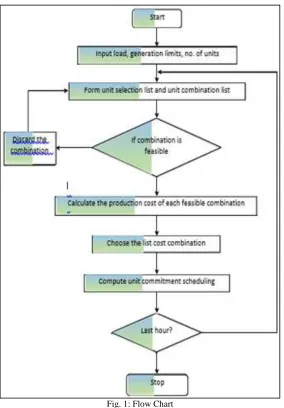
Flow Chart
Fig. 1: Flow Chart
Dynamic Programming Method
Dynamic programming [I] can be used to compute the UC table, if the load is assumed to increase in small but finite steps. The total number of units available, their individual cost characteristics and the load cycle on the station are assumed to be known priori. Also it shall be assumed that the load on each unit or combination of unit changes in suitably small but uniform steps of size ΔMW (e.g., 1MW).
FN (x) = the minimum cost in Rs/hr of generating MW by N units FN (y) = the minimum cost in Rs/hr of generating MW by N units
FN-1 (x-y) = the minimum cost in Rs/hr of generating (x-y) MW by N units FN (x) = min FN (y) + FN-1 (x-y)}
Ant Colony Method (ACO)
Ant colony optimization (ACO) [II] is based on the cooperative behaviour of real ant colonies, which are able to find the shortest path from their nest to a food source. The method was developed by Dorigo and his associates in the early 1990’s.
Pheromone trail evaporation:
When an ant k moves to the next node, the pheromone evaporates from all the arcs I jaccording to the relation, 𝜏𝑖𝑗 = (1 − 𝑝) ∗ 𝜏𝑖𝑗 ; ∀ (i, j) ∈A
𝜏𝑖𝑗 = (1 −ρ) ∗ 𝜏𝑖𝑗+ ∑ 𝛥𝜏𝑖𝑗 (𝑘) 𝑁
𝑘=1
Where ρ∈ (0, 1] is the evaporation rate (or the pheromone decay factor) and 𝛥𝜏𝑖𝑗(𝑘)is the amount of pheromone deposited on arc ijby the best ant k.
𝛥𝜏𝑖𝑗(𝑘)Can be computed as,
𝛥𝜏𝑖𝑗(𝑘) = { Ϛ𝑓𝑏𝑒𝑠𝑡
𝑓𝑤𝑜𝑟𝑠𝑡
; if (i, j ) ∈ global best tour
𝑜; otherwise
Particle Swarm Optimization
A swarm consists of a set of particles, where each particle represents a potential solution. Particles are then flown through the space, where the position of every particle is changed according to its own experience and that of its neighbours.
The position of pi is then changed by adding a velocity VI (t) to the current position the velocity vector drives the optimization process and reflects the socially exchanged information. Three different phases are differing in the extent of the social information exchange, which are detailed below. Form the basis of initial PSO algorithm. The phases are individual best, global best, local best.
III. RESULTS & COMPARISON
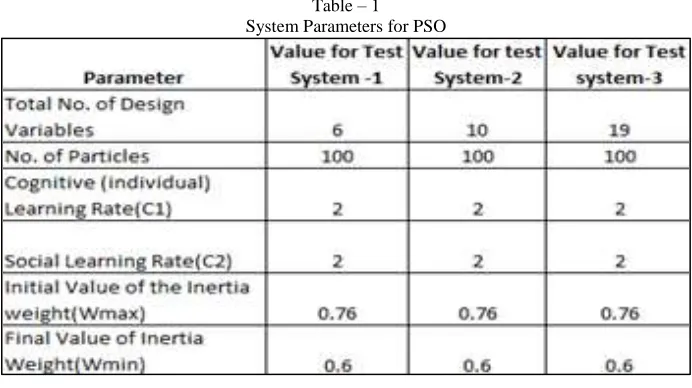
System Parameters for PSO
Table – 1 System Parameters for PSO
Result by PSO Table for Test System - 1
Table – 2
All rights reserved by www.ijirst.org 41
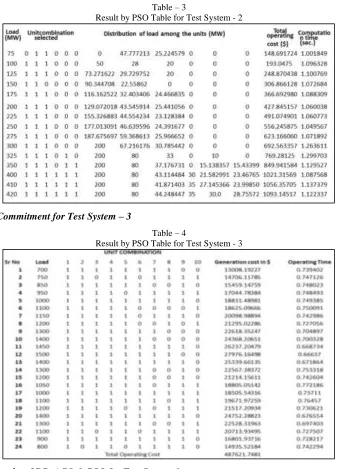
Solution of Unit Commitment for Test System - 2
Table – 3
Result by PSO Table for Test System - 2
Solution of Unit Commitment for Test System – 3
Table – 4
Result by PSO Table for Test System - 3
Comparison of Results of DP, ACO & PSO for Test System-1 Table – 5
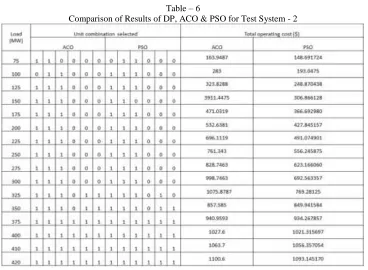
Comparison of results of DP, ACO & PSO for Test System - 2 Table – 6
Comparison of Results of DP, ACO & PSO for Test System - 2
Comparison of ACO & PSO for Test System - 3
Table – 7
All rights reserved by www.ijirst.org 43
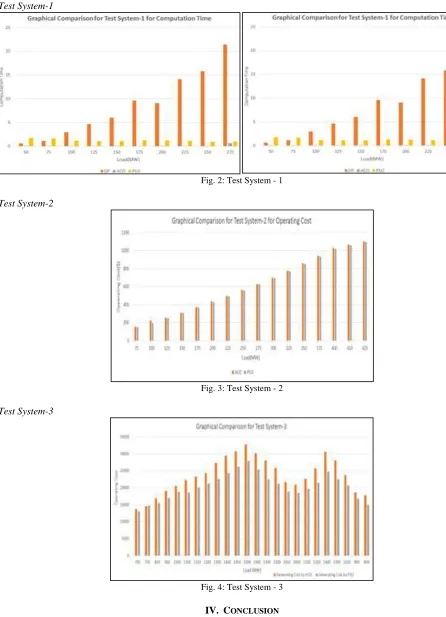
Graphical Comparison
Test System-1
Fig. 2: Test System - 1
Test System-2
Fig. 3: Test System - 2
Test System-3
Fig. 4: Test System - 3
IV. CONCLUSION
solution in terms of operating cost , computation time we can get the optimal solution by using Particle Swarm Optimization Technique. Dynamic Programming method gives the optimal solution for only lower number of units (Test System-1) but in case of large number of units it consumes more time compare to ACO & PSO Techniques. By comparing Ant Colony Technique and Particle Swarm Optimization there is a vast difference in the operating cost for selected unit combination. PSO is more economical than ACO for particular Test system-3.Solution of the Unit Commitment problem by using PSO & ACO is carried out and come to know that for lighter load in both the cases there will be a lower operating time but in case of heavier load the operating time will be decreasing.
REFERENCES
[1] P. G. LOWERY, “Generating Unit Commitment by Dynamic Programming”, IEEE transactions on power apparatus and systems, vol. pas-85, no. 5, may1966.
[2] Walter L. Snyder, Jr., H. David Powell, Jr., and John C. Rayburn, “DYNAMIC PROGRAMMING APPROACH TO UNIT COMMITMENT”, IEEE
Transactions on Power Systems, Vol. PWRS-2, No. 2, May 1987.
[3] N. S. Sisworahardjo and A. A. El-Keib, “Unit Commitment Using the Ant Colony Search Algorithm,” Proceedings of the IEEE/LESCOPE 2002, Halifax,
Nova Scotia, June 2002.
[4] S. P. Simon, N. P. Padhy, R. S. Anand, “An Ant Colony System Approach for Unit Commitment Problem”, Journal of Electrical Power and Energy Systems,
vol. 28, pp. 315-323, 2006.