Differential Privacy for Functions and Functional Data
Rob Hall [email protected]
Machine Learning Department Carnegie Mellon University Pittsburgh, PA 15289, USA
Alessandro Rinaldo [email protected]
Larry Wasserman [email protected]
Department of Statistics Carnegie Mellon University Pittsburgh, PA 15289, USA
Editor:Charles Elkan
Abstract
Differential privacy is a rigorous cryptographically-motivated characterization of data privacy which may be applied when releasing summaries of a database. Previous work has focused mainly on methods for which the output is a finite dimensional vector, or an element of some discrete set. We develop methods for releasing functions while preserving differential privacy. Specifically, we show that adding an appropriate Gaussian process to the function of interest yields differential pri-vacy. When the functions lie in the reproducing kernel Hilbert space (RKHS) generated by the covariance kernel of the Gaussian process, then the correct noise level is established by measur-ing the “sensitivity” of the function in the RKHS norm. As examples we consider kernel density estimation, kernel support vector machines, and functions in RKHSs.
Keywords: differential privacy, density estimation, Gaussian processes, reproducing kernel Hilbert space
1. Introduction
Suppose we have databaseDwhich consists of measurements of a set of individuals. We want to
release a summary of D without compromising the privacy of those individuals in the database.
One framework for defining privacy rigorously in such problems is differential privacy (Dwork
et al., 2006b; Dwork, 2006). The basic idea is to produce an output via random noise addition.
An algorithm which does this may be thought of as inducing a distributionPDon the output space
(where the randomness is due to internal “coin flips” of the algorithm), for every input data setD.
Differential privacy, defined in Section 2, requires that PD not depend too strongly on any single
element of the databaseD.
A concept that has been important in differential privacy is the “sensitivity” of the output (Dwork et al., 2006b). In the case of vector valued output the sensitivity is typically measured in the
Eu-clidean norm or the ℓ1-norm. We find that when the output is a function the sensitivity may be
measured in terms of an RKHS norm. To establish privacy a Gaussian process may be added to the function with noise level calibrated to the “RKHS sensitivity” of the output.
The motivation for considering function valued data is two-fold. First, in some problems the data are naturally function valued, that is, each data point is a function. For example, growth curves, temperature profiles, and economic indicators are often of this form. This has given rise to a subfield of statistics known as functional data analysis (see, for instance, Ramsay and Silverman, 1997). Second, even if the data are not functions, we may want to release a data summary that is a function. For example, if the datad1, . . . ,dn∈Rd are a sample from a distribution with density f then we can estimate the density with the kernel density estimator
b
f(x) =1
n n
∑
i=1 W
||x−di|| h
, x∈Rd,
whereWis a kernel (see, for instance, Wasserman, 2006) andh>0 is the bandwidth parameter. The
density estimator is useful for may tasks such as clustering and classification. We may then want to release a “version” of the density estimator bf in a way which fulfills the criteria of differential privacy. The utility of such a procedure goes beyond merely estimating the underlying density. In fact, suppose the goal is to release a privatized database. With a differentially private density estimator in hand, a large sample of data may be drawn from that density. The release of such a sample would inherit the differential privacy properties of the density estimator: see, in particular, Wasserman and Zhou (2010) and Machanavajjhala et al. (2008). This is a very attractive proposition, since a differentially private sample of data could be used as the basis for any number of statistical analyses which may have been brought to bear against the original data (for instance, exploratory data analysis, model fitting, etc).
Histograms are an example of a density estimator that has been “privatized” in previous litera-ture (Wasserman and Zhou, 2010; Chawla et al., 2005). However, as density estimators, histograms are suboptimal because they are not smooth. Specifically, they do converge at the minimax rate un-der the assumption that the true density is smooth. The preferred method for density estimation in statistics is kernel density estimation. The methods developed in this paper lead to a private kernel density estimator.
In addition to kernel density estimation, there are a myriad of other scenarios in which the result of a statistical analysis is a function. For example, the regression function or classification function from a supervised learning task. We demonstrate how the theory we develop may be applied in these contexts as well.
Outline. After putting our contribution in the context of some related work, we introduce some notation and review the definition of differential privacy in Section 2. We also give a demonstra-tion of a technique to achieve the differential privacy for a vector valued output. The theory for demonstrating differentially privacy of functions is established in Section 3. In Section 4 we apply the theory to the problems of kernel density estimation and kernel SVM learning. We also demon-strate how the theory may apply to a broad class of functions (a Sobolev space). Section 5 discusses possible algorithms for outputting functions.
1.1 Related Work
There are a few lines of research in the differential privacy literature that are related to this work. In addition to the foundational papers mentioned above there has already been interest in the differen-tially private release of functions such as support vector machines. Independently Rubinstein et al. (2010) and Chaudhuri and Monteleoni (2011) demonstrated that a private approximation to a non-private kernel support vector machine could be made by considering a certain finite dimensional projection of the original function. In essence they construct a finite dimensional feature space so that the classification function may be characterized by a finite dimensional vector of coefficients, at which point standard techniques may be brought to bear to ensure privacy. Here we give an alter-nate method for the release of the classification function (or regression function) which avoids this approximation, although we do so by employing a weaker type of differential privacy. Our method in essence results in an infinite dimensional private function which is not necessarily characterized by any finite dimensional vector. Rather we can permit the user to query the value of the function at any arbitrary number of input points.
There has also been research in the literature regarding the generation of synthetic data sets. For example, Barak et al. (2007) and more recently Hardt et al. (2010) give techniques which output a differentially private contingency table. A recent summary of related methods is in Charest (2012). These contingency tables may be subjected to whatever statistical analysis is required, while still maintaining privacy. In the case that the original data is not categorical (for example, containing real valued measurements) there are two immediate options, the first is to divide the range of the vari-ables up into bins and to essentially make the data categorical then to apply these techniques. This is conceptually simple however the resulting density estimator fails to achieve the correct convergence rate under the usual regularity conditions Wasserman (2006) (namely the histogram density estima-tor achieves the rate ofn−2/(2+d)whereas the kernel density estimate achieves the raten−4/(4+d)in
d dimensions). The second approach is to perform some other kind of density estimation on the
input data in a way which admits the differential privacy, and then to sample that density to generate synthetic data. So far differentially private density estimation is considered in Smith (2011) for parametric models and Wasserman and Zhou (2010) for non-parametric estimation. In this work we give a technique which is useful for the differentially private estimation of a density in arbi-trary dimension, and which achieves the same convergence rate (up to constants) as the non-private estimator.
otherwise) and so the quality of the released data (which will ultimately dictate the quality of the learned function) depends on the convergence rate of these estimators—which are typically slow in high dimensions. On the other hand a kernel support vector machine learned on the original data may converge to a good classifier with a relatively small number of samples, and so building a private version of that directly may lead to better classification performance. Therefore although private synthetic data may be seen as a panacea for differential privacy, it is important to remember that it in essence taints all analyses with the curse of dimensionality.
2. Differential Privacy
Here we recall the definition of differential privacy and introduce some notation.
LetD= (d1, . . . ,dn)∈
D
be an input database in whichdi represents a row or an individual, andwhere
D
is the space of all such databases ofnelements. For two databasesD,D′, we say they are“adjacent” or “neighboring” and writeD∼D′ whenever both have the same number of elements,
but differ in one element. In other words, there exists a permutation ofDhaving Hamming distance
of 2 toD′. In some other works databases are called “adjacent” whenever one database contains the
other together with exactly one additional element.
We may characterize a non-private algorithm in terms of the function it outputs, for example
by, θ:
D
→Rd. Thus we write θD =θ(D) to mean the output when the input database is D.Thus, a computer program which outputs a vector may be characterized as a family of vectors
{θD:D∈
D
}, one for every possible input database. Likewise a randomized computer programmay be characterized by the distributions{PD:D∈
D
}it induces on the output space (for example,Rd) when the input is D. In the literature such a set of distributions is sometimes referred to as a
“mechanism.” We consider randomized algorithms where the input is a database in
D
and the outputtakes values in a measurable spaceΩendowed with the σ-field
A
. Thus, to each such algorithmthere correspond the set of distributions{PD: D∈
D
}on(Ω,A
)indexed by databases. We phrasethe definition of differential privacy using this characterization of randomized algorithms.
Definition 1 (Differential Privacy) A set of distributions{PD:D∈
D
}is called(α,β)-differentially private, or said to “achieve(α,β)-DP” whenever for all D∼D′∈D
we have:PD(A)≤eαPD′(A) +β, ∀A∈
A
, (1)whereα,β≥0are parameters, and
A
is the finestσ-field on which all PDare defined.Typically the above definition is called “approximate differential privacy” wheneverβ>0, and
“(α,0)-differential privacy” is shortened to “α-differential privacy.” It is important to note that
the relation D∼D′ is symmetric, and so the inequality (1) is required to hold when D and D′
are swapped. Throughout this paper we takeα≤1, since this simplifies some proofs. We note
that an alternate notion of adjacency for databases also appears in some of the differential privacy literature. There databases are called adjacent whenever one is a strict subset of the other and contains exactly one less entry. We remark that the techniques we present can be reformulated under this definition, but we use the above definition of adjacency since it leads to slightly simpler forms for the sensitivity.
The σ-field
A
is rarely mentioned in the literature on differential privacy but is actually quiteany randomized algorithm. To make the definition as strong as possible we insist that
A
be the finestavailableσ-field on which the PDare defined. Therefore whenΩis discrete the typicalσ-field is
A
=2Ω(the class of all subsets ofΩ), and whenΩis a space with a topology it is typical to use thecompletion of the Borelσ-field (the smallestσ-field containing all open sets). We raise this point
since whenΩis a space of functions, the choice ofσ-field is more delicate.
2.1 Differential Privacy of Finite Dimensional Vectors
Dwork et al. (2006a) give a technique to achieve approximate differential privacy for general vector valued outputs in which the “sensitivity” may be bounded. We review this below, since the result is important in the demonstration of the privacy of our methods which output functions. What follows in this section is a mild alteration to the technique developed by Dwork et al. (2006a) and McSherry and Mironov (2009), in that the “sensitivity” of the class of vectors is measured in the Mahalanobis distance rather than the usual Euclidean distance.
In demonstrating the differential privacy, we make use of the following lemma which is simply an explicit statement of an argument used in a proof by Dwork et al. (2006a).
Lemma 2 Suppose that, for all D∼D′, there exists a set A⋆D,D′ ∈
A
such that, for all S∈A
,S⊆A⋆D,D′⇒PD(S)≤eαPD′(S) (2)
and
PD(A⋆D,D′)≥1−β. (3)
Then the family{PD}achieves the(α,β)-DP.
Proof LetS∈
A
. Then,PD(S) = PD(S∩A⋆) +PD(S∩A⋆C)≤PD(S∩A⋆) +β
≤ eαPD′(S∩A⋆) +β≤eαPD′(S) +β.
The first inequality is due to (3), the second is due to (2) and the third is due to the subadditivity of measures.
The above result shows that, so long as there is a large enough (in terms of the measurePD) set on
which the(α,0)-DP condition holds, then the approximate(α,β)-DP is achieved.
Remark 1 If(Ω,
A
)has aσ-finite dominating measureλ, then for (2) to hold a sufficient condition is that the ratio of the densities be bounded on some set A⋆D,D′:∀a∈A⋆D,D′ :
dPD dλ (a)≤e
αdPD′
dλ (a). (4)
This follows from the inequality
PD(S) =
Z
S dPD
dλ (a)dλ(a)≤ Z
S eαdPD′
dλ (a)dλ(a) =e
αP
In our next result we show that approximate differential privacy is achieved via (4) when the
output is a real vector, sayvD=v(D)∈Rd, whose dimension does not depend on the databaseD. An
example is when the database elementsdi∈Rdand the output is the mean vectorv(D) =n−1∑ni=1di. We note that this is basically a re-statement of the well-known fact that the addition of appropriate Gaussian noise to a vector valued output will lead to approximate differential privacy.
Proposition 3 Suppose that, for a positive definite symmetric matrix M∈Rd×d, the family of vec-tors{vD:D∈
D
} ⊂Rd satisfiessup D∼D′kM
−1/2(vD
−vD′)k2≤∆. (5)
Then the randomized algorithm which, for input database D outputs
e
vD=vD+c(β)∆
α Z, Z∼
N
d(0,M)achieves(α,β)-DP whenever
c(β)≥ s
2 log2
β. (6)
Proof Since the Gaussian measure onRdadmits the Lebesgue measureλas aσ-finite dominating measure we consider the ratio of the densities
dPD(x)/dλ dPD′(x)/dλ=exp
α2 2c(β)2∆2
(x−vD′)M−1(x−vD′)−(x−vD)TM−1(x−vD)
.
This ratio exceedseαonly when
2xTM−1(vD−vD′) +vTD′M−1vD′−vTDM−1vD≥2c(β)
2∆2
α .
We consider the probability of this set underPD, in which case we havex=vD+c(βα)∆M1/2z, where
zis an isotropic normal with unit variance. We have
c(β)∆ α z
TM−1/2(vD
−vD′)≥c(β)
2∆2
α2 − 1
2(vD−vD′)
TM−1(vD
−vD′).
Multiplying by c(βα)∆ and using (5) gives
zTM−1/2(vD−vD′)≥ c(β)∆
α − α∆
2c(β).
Note that the left side is a normal random variable with mean zero and variance smaller than∆2.
The probability of this set is increasing with the variance of said variable, and so we examine the probability when the variance equals∆2. We also restrict toα≤1, and lety∼
N
(0,1), yieldingP zTM−1/2(vD−vD′)≥c(β)∆
α − α∆
2c(β) !
≤ P
∆y≥c(β)∆
α − α∆
2c(β)
≤ P
y≥c(β)− 1
2c(β)
wherec(β) is as defined in (6) and the final inequality is proved in Dwork (2006). Thus lemma 2 gives the differential privacy.
Remark 2 The quantity (5) is a mild modification of the usual notion of “sensitivity” or “global sensitivity” (Dwork et al., 2006b). It is nothing more than the sensitivity measured in the Maha-lanobis distance corresponding to the matrix M. The case M=I corresponds to the usual Euclidean distance, a setting that has been studied previously by McSherry and Mironov (2009), among others. The use of this matrix allows for smaller noise magnitudes in the case when the difference of vectors on neighboring data sets are elements of some ellipsoid rather than a sphere. A simple case when this is advantageous is when the released function is an affine transformation of a sample mean of input vectors.
2.2 The Implications of Approximate Differential Privacy
The above definitions provide a strong privacy guarantee in the sense that they aim to protect against an adversary having almost complete knowledge of the private database. Specifically, an adversary knowing all but one of the data elements and having observed the output of a private procedure, will remain unable to determine the identity of the data element which is unknown to him. To see this, we provide an analog of theorem 2.4 of Wasserman and Zhou (2010), who consider the case of
α-differential privacy.
Let the adversary’s database be denoted by DA = (d1, . . . ,dn−1), and the private database by D= (d1, . . . ,dn). First note that before observing the output of the private algorithm, the adversary could determine that the private databaseDlay in the set{(d1, . . . ,dn−1,d)∈
D
}.Thus, the private database comprises his data with one more element. Since all other databases may be excluded from consideration by the adversary we concentrate on those in the above set. In particular, we obtain the following analog of theorem 2.4 of Wasserman and Zhou (2010).Proposition 4 Let X∼PDwhere the family PDachieves the(α,β)-approximate DP. Any levelγtest of: H:D=D0vs V :D=6 D0has power bounded above byγeα+β.
The above result follows immediately from noting that the rejection region of the test is a measurable set in the space and so obeys the constraint of the differential privacy. The implication of the above
proposition is that the power of the test will be bounded close to its size. Whenα,βare small, this
means that the test is close to being “trivial” in the sense that it is no more likely to correctly reject a false hypothesis than it is to incorrectly reject the true one.
3. Approximate Differential Privacy for Functions
The goal of the release a function raises a number of questions. First what does it mean for a computer program to output a function? Second, how can the differential privacy be demonstrated? In this section we continue to treat randomized algorithms as measures, however now they are measures over function spaces. In section 5 we demonstrate concrete algorithms, which in essence output the function on any arbitrary countable set of points.
We cannot expect the techniques for finite dimensional vectors to apply directly when dealing
exist, and, therefore, neither do densities. However, there exist probability measures on the spaces of functions. Below, we demonstrate the approximate differential privacy of measures on function spaces, by considering random variables which correspond to evaluating the random function on a finite set of points.
We consider the family of functions overT =Rd(where appropriate we may restrict to a
com-pact subset such as the unit cube ind-dimensions):
{fD:D∈
D
} ⊂RT.A before, we consider randomized algorithms which on inputD, output some efD∼PDwhere
PDis a measure onRTcorresponding toD. The nature of theσ-field on this space will be described
below.
3.1 Differential Privacy on the Field of Cylinders
We define the “cylinder sets” of functions (see Billingsley, 1995) for all finite subsetsS= (x1, . . . ,xn)
ofT, and Borel setsBofRn
CS,B=
f ∈RT :(f(x1), . . . ,f(xn))∈B .
These are just those functions which take values in prescribed sets, at those points inS. The family
of sets:
C
S={CS,B:B∈B
(Rn)}forms aσ-field for each fixedS, since it is the preimage ofB
(Rn)under the operation of evaluation on the fixed finite set S. Taking the union over all finite sets S
yields the collection
F
0=[
S:|S|<∞
C
S.This is a field (see Billingsley, 1995 page 508) although not a σ-field, since it does not have the
requisite closure under countable intersections (namely it does not contain cylinder sets for which
Sis countably infinite). We focus on the creation of algorithms for which the differential privacy
holds over the field of cylinder sets, in the sense that, for allD∼D′∈
D
,P(efD∈A)≤eαP(fDe′∈A) +β, ∀A∈
F
0. (7)This statement appears to be prima facie unlike the definition (1), since
F
0 is not aσ-field onRT. However, we give a limiting argument which demonstrates that to satisfy (7) is to achieve the
approximate(α,β)-DP throughout the generated σ-field. First we note that satisfying (7) implies
that the release of any finite evaluation of the function achieves the differential privacy. Since for any finiteS⊂T, we have that
C
S⊂F
0, we readily obtain the following result.Proposition 5 Let x1, . . . ,xn be any finite set of points in T chosen a-priori. Then whenever (7) holds, the release of the vector
e
fD(x1), . . . ,efD(xn)
satisfies the(α,β)-DP.
Proof We have that
PD
e
The claimed privacy guarantee follows from (7).
We now give a limiting argument to extend (7) to the generated σ-field (or, equivalently, the
σ-field generated by the cylinders of dimension 1)
F
def=σ(F
0) =[
S
C
Swhere the union extends over all the countable subsetsSofT. The second equality above is due to
Billingsley (1995) theorem 36.3 part ii.
Note that, for countableS, the cylinder sets take the form
CS,B=
f∈RT: f(xi)∈Bi,i=1,2, . . . = ∞
\
i=1
C{xi},Bi,
whereBi’s are Borel sets ofR.
Proposition 6 Let (7) hold. Then, the family{PD:D∈
D
}on(RT,F
)satisfies for all D∼D′∈D
:PD(A)≤eαPD′(A) +β, ∀A∈
F
.Proof DefineCS,B,n=Tni=1C{ti},Bi.Then, the setsCS,B,n form a sequence of sets which decreases
towardsCS,BandCS,B=limn→∞CS,B,n.Since the sequence of sets is decreasing and the measure in question is a probability (hence bounded above by 1), we have
PD(CS,B) =PD(lim
n→∞CS,B,n) =nlim→∞PD(CS,B,n).
Therefore, for each pairD∼D′and for everyε>0, there exists ann0so that for alln≥n0
|PD(CS,B)−PD(CS,B,n)| ≤ε, |PD′(CS,B)−PD′(CS,B,n)| ≤ε.
The numbern0depends on whichever is the slowest sequence to converge. Finally we obtain
PD(CS,B)≤PD(CS,B,n0) +ε
≤eαPD′(CS,B,n0) +β+ε
≤eαPD′(CS,B) +β+ (1+eα)ε ≤eαPD′(CS,B) +β+3ε.
Since this holds for allε>0 we conclude thatPD(CS,B)≤eαPD′(CS,B) +β.
In principle, if it were possible for a computer to release a complete description of the function
e
fDthen this result would demonstrate the privacy guarantee achieved by our algorithm. In practice
a computer algorithm which runs in a finite amount of time may only output a finite set of points, hence this result is mainly of theoretical interest. However, in the case in which the functions to be output are continuous, and the restriction is made thatPDare measures overC[0,1](the continuous
restriction of
F
to the elements ofC[0,1]corresponds to the Borel σ-field overC[0,1]with the topology induced by the uniform norm (kfk∞=supt|f(t)|). Therefore in the case of continuousfunctions, differential privacy over
F
0 hence leads to differential privacy throughout the Borelσ-field.
In summary, we find that if every finite dimensional projection of the released function sat-isfies differential privacy, then so does every countable-dimensional projection. We now explore
techniques which achieve the differential privacy over theseσ-fields.
3.2 Differential Privacy via the Exponential Mechanism
A straightforward means to output a function in a way which achieves the differential privacy is to make use of the so-called “exponential mechanism” of McSherry and Talwar (2007). This approach entails the construction of a suitable finite set of functionsG={gi, . . . ,gm} ∈RT, in which every
fD has a reasonable approximation, under some distance functiond. Then, when the input isD, a
function is chosen to output by sampling the set ofGwith probabilities given by
PD(gi)∝exp
−α
2s d(gi,fD)
, sdef= sup D∼D′
d(fD,fD′).
McSherry and Talwar (2007) demonstrate that such a technique achieves theα-differential privacy,
which is strictly stronger than the(α,β)-differential privacy we consider here. Although this tech-nique is conceptually appealing for its simplicity, it remains challenging to use in practice since the
set of functionsGmay need to be very large in order to ensure the utility of the released function
(in the sense of expected error). Since the algorithm which outputs fromPDmust obtain the
nor-malization constant to the distribution above, it must evidently compute the probabilities for each gi, which may be extremely time consuming. Note that techniques such as importance sampling are also difficult to bring to bear against this problem when it is important to maintain utility.
The technique given above can be interpreted as outputting a discrete random variable, and fulfilling privacy definition with respect to theσ-field consisting of the powerset ofG. This implies the privacy with respect to the cylinder sets, since the restriction of each cylinder set to the elements
ofGcorresponds some subset ofG.
We note that the exponential mechanism above essentially corresponded to a discretization of
the function space RT. An alternative is to discretize the input space T, and to approximate the
function by a piecewise constant function where the pieces correspond to the discretization of T.
Thereupon the approximation may be regarded as a real valued vector, with one entry for the value of each piece of the function. This is conceptually appealing but it remains to be seen whether the sensitivity of such a vector valued output could be bounded. In the next section we describe a method which may be regarded as similar to the above, and which has the nice property that the choice of discretization is immaterial to the method and to the determination of sensitivity.
3.3 Differential Privacy via Gaussian Process Noise
We propose to use measuresPDover functions, which are Gaussian processes. The reason is that
A Gaussian process indexed by T is a collection of random variables{Xt :t∈T}, for which each finite subset is distributed as a multivariate Gaussian (see, for instance, Adler, 1990; Adler
and Taylor, 2007). A sample from a Gaussian process may be considered as a functionT →R, by
examining the so-called “sample path”t→Xt. The Gaussian process is determined by the mean
and covariance functions, defined onT andT2respectively, as
m(t) =EXt, K(s,t) =Cov(Xs,Xt).
For any finite subsetS⊂T, the random vector{Xt:t∈S}has a normal distribution with the means, variances, and covariances given by the above functions. Such a “finite dimensional distribution” may be regarded as a projection of the Gaussian process. Below we propose particular mean and covariance functions for which Proposition 3 will hold for all finite dimensional distributions. These
will require some smoothness properties of the family of functions{fD}. We first demonstrate the
technical machinery which allows us to move from finite dimensional distributions to distributions on the function space, and then we give differentially private measures on function spaces of one dimension. Finally, we extend our results to multiple dimensions.
Proposition 7 Let G be a sample path of a Gaussian process having mean zero and covariance function K. Let M denote the Gram matrix
M(x1, . . . ,xn) =
K(x1,x1) ··· K(x1,xn)
..
. . .. ... K(xn,x1) ··· K(xn,xn)
.
Let{fD:D∈
D
}be a family of functions indexed by databases. Then the release ofe
fD= fD+
∆c(β)
α G
is(α,β)-differentially private (with respect to the cylinderσ-field
F
) wheneversup D∼D′
sup n<∞
sup
(x1,...,xn)∈Tn
M−1/2(x1, . . . ,xn)
fD(x1)−fD′(x1)
.. .
fD(xn)−fD′(xn)
2
≤∆. (8)
Proof For any finite set(x1, . . . ,xn)∈Tn, the vector(G(x1), . . . ,G(xn))follows a multivariate nor-mal distribution having mean zero and covariance matrix specified by Cov(G(xi),G(xj)) =K(xi,xj).
Thus for the vector obtained by evaluation of ef at those points, differential privacy is
demon-strated by Proposition 3 since (8) implies the sensitivity bound (5). Thus, for anyn<∞and any
(x1, . . . ,xn)∈Tnwe haveB∈
B
(Rn) PDe
f(x1), . . . ,ef(xn)∈B
≤eαPD′
e
f(x1), . . . ,ef(xn)∈B
+β
Finally note that for anyA∈
F
0, we may writeA=CXn,B for some finiten, some vectorXn=(x1, . . . ,xn)∈Tnand some Borel setB. Then
PD(ef ∈A) =PD
e
f(x1), . . . ,ef(xn)
∈B.
Combining this with the above gives the requisite privacy statement for allA∈
F
0. Proposition 63.4 Functions in a Reproducing Kernel Hilbert Space
When the family of functions lies in the reproducing kernel Hilbert space (RKHS) which corre-sponds to the covariance kernel of the Gaussian process, then establishing upper bounds of the form (8) is simple. Below, we give some basic definitions for RKHSs, and refer the reader to Bertinet and Agnan (2004) for a more detailed account. We first recall that the RKHS is generated from the closure of those functions which can be represented as finite linear combinations of the kernel,
H
0=( n
∑
i=1
ξiKxi
)
for some finite n and sequence ξi∈R, xi ∈T, and where Kx =K(x,·). For two functions f =
∑ni=1θiKxi andg=∑
m
j=1ξjKyj the inner product is given by
hf,giH =
n
∑
i=1j
∑
=1mθiξjK(xi,yj),
and the corresponding norm of f iskfkH =phf,fiH.This gives rise to the “reproducing” nature of the Hilbert space, namely,hKx,KyiH =K(x,y). Furthermore, the functionalshKx,·iH correspond
to point evaluation,
hKx,fiH =
n
∑
i=1
θiK(xi,x) = f(x).
The RKHS
H
is then the closure ofH
0 with respect to the RKHS norm. We now present the maintheorem which suggests an upper bound of the form required in Proposition 7.
Proposition 8 For f ∈
H
, whereH
is the RKHS corresponding to the kernel K, and for any finite sequence x1, . . . ,xnof distinct points in T , we have:
K(x1,x1) ··· K(x1,xn) ..
. . .. ... K(xn,x1) ··· K(xn,xn)
−1/2
f(x1) .. . f(xn)
2
≤ kfkH.
The proof is in the appendix. Together with Proposition 7, this result implies the following.
Corollary 9 For{fD:D∈
D
} ⊆H
, the release ofe
fD= fD+
∆c(β)
α G
is(α,β)-differentially private (with respect to the cylinderσ-field) whenever
∆≥ sup D∼D′k
fD−fD′kH.
4. Examples
We now give some examples in which the above technique may be used to construct private versions of functions in an RKHS.
4.1 Kernel Density Estimation
Let fD be the kernel density estimator, where D is regarded as a sequence of points xi ∈T as
i=1, . . . ,n drawn from a distribution with density f. Let hdenote the bandwidth. Assuming a Gaussian kernel, the estimator is
fD(x) = 1 n(2πh2)d/2
n
∑
i=1 exp
−kx−xik22 2h2
, x∈T.
LetD∼D′so thatD′=x1, . . . ,xn−1,x′n(no loss of generality is incurred by demanding that the data sequences differ in their last element). Then,
(fD−fD′)(x) = 1
n(2πh2)d/2
exp
−kx−xnk
2 2 2h2 −exp
−kx−x′nk
2 2 2h2
.
If we use the Gaussian kernel as the covariance function for the Gaussian process then upper bounding the RKHS norm of this function is trivial. Thus, let K(x,y) =expn−kx−yk22
2h2
o
. Then
fD−fD′ = 1
n(2πh2)d/2 Kxn−Kxn′
and
kfD−fD′k2H =
1 n(2πh2)d/2
2
K(xn,xn) +K(x′n,x′n)−2K(xn,x′n)
≤2
1 n(2πh2)d/2
2 .
If we release
e
fD= fD+
c(β)√2
αn(2πh2)d/2G
whereGis a sample path of a Gaussian process having mean zero and covarianceK, then differential
privacy is demonstrated by corollary 9. We may compare the utility of the released estimator to that
of the non-private version. Under standard smoothness assumptions on f, it is well-known (see
Wasserman, 2006) that the risk is
R=E
Z
(fD(x)−f(x))2dx=c1h4+ c2 nhd,
for some constants c1 and c2. The optimal bandwidth is h≍(1/n)1/(4+d) in which case R=
O(n−4+4d).
For the differentially private function it is easy to see that
E
Z
(efD(x)−f(x))2dx=O
h4+ c2
nhd
.
0.0 0.2 0.4 0.6 0.8 1.0
0.5
1.0
1.5
x
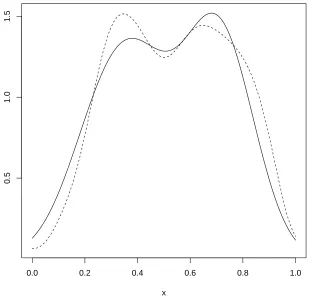
Figure 1: An example of a kernel density estimator (the solid curve) and the released version (the
dashed curve). This uses the method developed in Section 4.1. Here we sampledn=100
points from a mixture of two normals centered at 0.3 and 0.7 respectively. We useh=0.1
and haveα=1 andβ=0.1. The Gaussian Process is evaluated on an evenly spaced grid
of 1000 points between 0 and 1. Note that gross features of the original kernel density estimator remain, namely the two peaks.
4.1.1 NON-ISOTROPICKERNELS
The above demonstration of privacy also holds when the kernel is replaced by a non-isotropic Gaus-sian kernel. In this case the kernel density estimate may take the form
fD(x) =
1 n(2π)d/2|H|1/2
n
∑
i=1 exp
−1
2(x−xi)
TH−1(x−x i)
, x∈T,
whereHis a positive definite matrix and|H|is the determinant. For example it may be required to
a diagonal matrix having non-equal entries on the diagonal. So long asH is fixed a-priori, privacy may be established by adding a Gaussian process having mean zero and covariance given by
K(x,y) =exp
−1
2(x−y)
TH−1(x−y)
.
As above, the sensitivity is upper bounded, as
kfD−fD′k2H ≤2
1 n(2π)d/2|H|1/2
2 .
Therefore it satisfies the(α,β)-DP to release
e
fD= fD+
c(β)√2
αn(2π)d/2|H|1/2G,
whereGis a sample path of a Gaussian process having mean zero and covarianceK.
4.1.2 PRIVATECHOICE OFBANDWIDTH
Note that the above assumed thath(orH) was fixed a-priori by the user. In usual statistical settings
his a parameter that is tuned depending on the data (not simply set to the correct order of growth
as a function ofn). Thus rather than fixedhthe user would usebhwhich depends on the data itself.
In order to do this it is necessary to find a differentially private version ofbhand then to employ the composition property of differential privacy.
The typical way that the bandwidth is selected is by employing the leave-one-out cross
valida-tion. This consists of choosing a grid of candidate values forh, evaluating the leave one out log
likelihood for each value, and then choosing whichever is the maximizer. This technique may be amenable to private analysis via the “exponential mechanism,” however it would evidently require
thatT be a compact set which is known a-priori. An alternative is to use a “rule of thumb” (see
Scott, 1992) for determining the bandwidth which is given by
b
hj=
4
(d+1)n
1
d+4 IQR j 1.34
In whichIQRj is the observed interquartile range of the data along the jth coordinate. Thus this
method gives a diagonal matrixHas in the above section. To make a private versionehjwe may use
the technique of Dwork and Lei (2009) in which a differentially private algorithm for the interquar-tile range was developed.
4.2 Functions in a Sobolev Space
The above technique worked easily since we chose a particular RKHS in which we knew the kernel density estimator to live. What’s more, since the functions themselves lay in the generating set of
functions for that space, the determination of the norm of the difference fD−fD′ was extremely
simple. In general we may not be so lucky that the family of functions is amenable to such analysis. In this section we demonstrate a more broadly applicable technique which may be used whenever the functions are sufficiently smooth. Consider the Sobolev space
H1[0,1] =
f ∈C[0,1]:
Z 1 0
(∂f(x))2dλ(x)<∞
This is a RKHS with the kernelK(x,y) =exp{−γ|x−y|}for positive constantγ. The norm in this space is given by
kfk2H =1
2 f(0)
2+f(1))2+ 1 2γ
Z 1 0
(∂f(x))2+γ2f(t)2dλ(t). (9)
See Bertinet and Agnan (2004) (p. 316) and Parzen (1961) for details. Thus for a family of functions
in one dimension which lay in the Sobolev spaceH1, we may determine a noise level necessary to
achieve the differential privacy by bounding the above quantity for the difference of two functions.
For functions over higher dimensional domains (as[0,1]d for some d >1) we may construct an
RKHS by taking the d-fold tensor product of the above RKHS (see, in particular, Parzen, 1963;
Aronszajn, 1950, for details of the construction). The resulting space has the reproducing kernel
K(x,y) =exp{−γkx−yk1}, and is the completion of the set of functions
G
0=n
f:[0,1]d→R:f(x
1, . . . ,xd) = f1(x1)···fd(xd),fi∈H1[0,1]
o
.
The norm over this set of functions is given by:
kfk2G0 =
d
∏
j=1
kfik2H. (10)
The norm over the completed space agrees with the above on
G
0. The explicit form is obtainedby substituting (9) into the right hand side of (10) and replacing all instances of∏dj=1fj(xj)with f(x1, . . . ,xj). Thus the norm in the completed space is defined for all f possessing all first partial derivatives which are all in
L
2.We revisit the example of a kernel density estimator (with an isotropic Gaussian kernel). We note that this isotropic kernel function is in the setG0defined above, as
φµ,h(x) = 1
(2πh2)d/2exp
−kx−µk
2 2 2h2 = d
∏
j=1 1
√
2πhexp
−(xj−µj)
2 2h2 = d
∏
j=1
φµj,h(xj).
Whereφµ,h is the isotropic Gaussian kernel on Rd with mean vectorµ andφµj,h is the Gaussian
kernel in one dimension with meanµj. We obtain the norm of the latter one dimensional function
by bounding the elements of the sum in (9) ad follows:
Z 1 0
(∂φµj,h(x))
2dλ(x)
≤
Z ∞
−∞
∂√1
2πhe
−(x−µj)2/2h2
2
dλ(x) = 1
4√πh3, and
Z 1 0
φµj,h(x)
2dλ(x)
≤
Z ∞
−∞
1 2πh2e−
(x−µj)2/h2
dλ(x) = 1
where we have used the fact that
φµj,h(x)
2
≤21πh, ∀x∈Rd.
Therefore, choosingγ=1/hleads to
kφµj,hk
2
H ≤
1 2πh2+
1 8√πh2+
1 4√2πh2 ≤
1
√
2πh2, and
kφµ,hk2H ≤ 1
(2π)d/2h2d. Finally,
kfD−fD′kH =n−1kφxn,h−φx′
n,hkH ≤
2
(2π)d/4nhd
Therefore, we observe a technique which attains higher generality than the ad-hoc analysis of the preceding section. However this is at the expense of the noise level, which grows at a higher rate
asdincreases. An example of the technique applied to the same kernel density estimation problem
as above is given in Figure 2.
4.3 Minimizers of Regularized Functionals in an RKHS
The construction of the following section is due to Bousquet and Elisseeff (2002), who were inter-ested in determining the sensitivity of certain kernel machines (among other algorithms) with the aim of bounding the generalization error of the output classifiers. Rubinstein et al. (2010) noted that these bounds are useful for establishing the noise level required for differential privacy of support vector machines. They are also useful for our approach to privacy in a function space.
We consider classification and regression schemes in which the data setsD={z1, . . . ,zn}with zi= (xi,yi), wherexi∈[0,1]d are some covariates, andyiis some kind of label, either taking values
on {−1,+1} in the case of classification or some taking values in some interval when the goal
is regression. Thus the output functions are from[0,1]d to a subset of R. The functions we are
interested in take the form
fD=arg min g∈H
1 nz
∑
i∈D
ℓ(g,zi) +λkgk2H (11)
where
H
is some RKHS to be determined, andℓis the so-called “loss function.” We now recall adefinition from Bousquet and Elisseeff (2002) (usingMin place of theirσto prevent confusion):
Definition 10 (M-admissible loss function: see Bousquet and Elisseeff, 2002) A loss function: ℓ(g,z) =c(g(x),y) is called M-admissible whenever c it is convex in its first argument and Lips-chitz with constant M in its first argument.
We will now demonstrate that for (11), whenever the loss function is admissible, the minimiz-ers on adjacent data sets may be bounded close together in RKHS norm. Denote the part of the optimization due to the loss function:
LD(f) = 1 nz
∑
i∈D
0.0 0.2 0.4 0.6 0.8 1.0
0.0
0.5
1.0
1.5
x
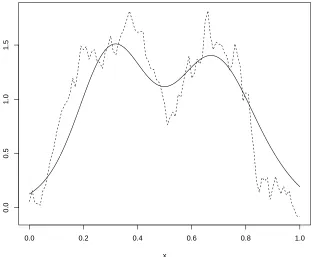
Figure 2: An example of a kernel density estimator (the solid curve) and the released version (the dashed curve). The setup is the same as in Figure 1, but the privacy mechanism devel-oped in Section 4.2 was used instead. Note that the released function does not have the desirable smoothness of released function from Figure 1.
Using the technique from the proof of lemma 20 of Bousquet and Elisseeff (2002) we find that since
ℓis convex in its first argument we have
LD(fD+ηδD′,D)−LD(fD)≤η(LD(fD′)−LD(fD)),
whereη∈[0,1]and we useδD′,D= fD′−fD. This also holds when fDand fD′ swap places.
Sum-ming the resulting inequality with the above and rearranging yields
LD(fD′−ηδD′,D)−LD(fD′)≤LD(fD)−LD(fD+ηδD′,D).
Due to the definition of fD,fD′ as the minimizers of their respective functionals we have
LD(fD) +λkfDk2H ≤LD(fD+ηδD′,D) +λkfD+ηδD′,Dk2H
This leads to the inequalities
0≥λ kfDk2H − kfD+ηδD′,Dk2H +kfD′k2H − kfD′−ηδD′,Dk2H +LD(fD)−LD(fD+ηδD′,D+LD′(fD′)−LD′(fD′−ηδD′,D)
≥2λkηδD′,Dk2H−LD(fD′) +LD(fD′−ηδD′,D) +LD′(fD′)−LD′(fD′−ηδD′,D) =2λkηδD′,Dk2H+1
n ℓ(z,fD′)−ℓ(z,fD′−ηδD′,D) +ℓ(z ′,f
D′)−ℓ(z′,fD′−ηδD′,D).
Moving the loss function term to the other side and using the Lipschitz property we finally obtain that
kfD−fD′k2H ≤ M
λnkfD−fD′k∞.
What’s more, the reproducing property together with Cauchy-Schwarz inequality yields
|fD(x)−fD′(x)|=|hfD−fD′,KxiH | ≤ kfD−fD′kH p
K(x,x).
Combining with the previous result gives
kfD−fD′k2H ≤ M
λnkfD−fD′kH
r
sup x
K(x,x),
which, in turn, leads to
kfD−fD′kH ≤ M
λn
r
sup x
K(x,x).
For a soft-margin kernel SVM we have the loss function: ℓ(g,z) = (1−yg(x))+, which means the
positive part of the term in parentheses. Since the labelytakes on either plus or minus one, we find
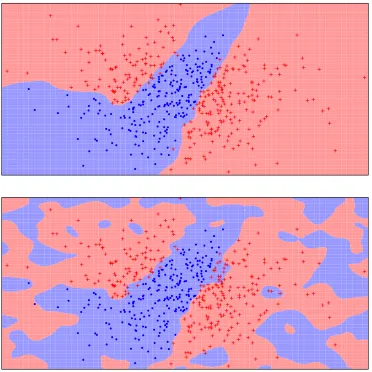
this to be 1-admissible. An example of a kernel SVM inT=R2is shown in Figure 3.
5. Algorithms
There are two main modes in which functions fDcould be released by the holder of the dataDto the
outside parties. The first is a “batch” setting in which the parties designate some finite collection of pointsx1. . . ,xn∈T. The database owner computes efD(xi)for eachiand return the vector of results. At this point the entire transaction would end with only the collection of pairs (xi,efD(xi)) being known to the outsiders. An alternative is the “online” setting in which outside users repeatedly specify points inxi∈T, the database owner replies with efD(xi), but unlike the former setting he remains available to respond to more requests for function evaluations. We name these settings “batch” and “online” for their resemblance of the batch and online settings typically considered in machine learning algorithms.
The batch method is nothing more than sampling a multivariate Gaussian, since the set x1, . . . ,xn∈T specifies the finite dimensional distribution of the Gaussian process from which to sample. The released vector is simply
e
fD(x1)
.. .
e
fD(xn)
∼
N
fD(x1)
.. . fD(xn)
, c(β)∆
α
K(x1,x1) ··· K(x1,xn)
..
. . .. ...
Figure 3: An example of a kernel support vector machine. In the top image are the data points, with the colors representing the two class labels (also points are used for one class and crosses for the other). The background color corresponds to the class predicted by the learned kernel svm. In the bottom image are the same data points, with the predictions of the private kernel svm. This example uses the Gaussian kernel for classification.
In the online setting, the data owner upon receiving a request for evaluation atxiwould sample the
Gaussian process conditioned on the samples already produced atx1, . . . ,xi−1. Let
Ci=
K(x1,x1) ··· K(x1,xi−1) ..
. . .. ...
K(xi−1,x1) ··· K(xi−1,xi−1)
Gi=
e
fD(x1)
.. .
e
fD(xi−1)
, Vi=
K(x1,xi)
.. . K(xi−1,xi)
.
Then,
e
fD(xi)∼
N
ViTCi−1Gi,K(xi,xi)−ViTCi−1Vi
.
The database owner may track the inverse matrixCi−1and after each request update it intoCi−+11by making use of Schurs Complements combined with the matrix inversion lemma. Nevertheless we
note that asiincreases the computational complexity of answering the request will in general grow.
In the very least, the construction ofVi takes time proportional toi. This may make this approach
problematic to implement in practice. However we note that when using the covariance kernel
K(x,y) =exp{−γ|x−y|1}
that a more efficient algorithm presents itself. This is the kernel considered in section 4.2. Due to the above form ofK, we find that for x<y<z we have: K(x,z) =K(x,y)K(y,z). Therefore in
using the above algorithm we would find thatViis always contained in the span of at most two rows
ofCi. This is most evident when, for instance, xi<minj<ixj. In this case let m=arg minj<ixj Vi =K(xi,xm)Ci(m), in whichCi(m) means the mth row ofCi. ThereforeCi−1Vi will be a sparse vector with exactly one non-zero entry (taking valueK(x,xm)) in themth position. Similar algebra
applies wheneverxi falls between two previous points, in which caseVilays in the span of the two
rows corresponding to the closest point on the left and the closest on the right. Using the above
kernel with some choice ofγlet
ρ(x,y) =eγ|x−y|−e−γ|x−y|.
Letξ(xi) = efD(xi)−fD(xi)represent the noise process. We find that the conditional distribution of
ξ(xi)to be Normal with mean and variance given by:
Eξ(xi) =
K(xi,x(1))ξ(x(1)) xi<x(1)
K(xi,x(i−1))ξ(x(i−1)) xi>x(i−1)
ρ(x(j+1),xi)
ρ(x(j),x(j+1))ξ(x(j)) +
ρ(x(j),xi)
ρ(x(j),x(j+1))ξ(x(j+1)) x(j)<xi<x(j+1),
and
Var[efD(xi)] =
1−K(x,x(1))2 xi<x(1)
1−K(x,x(i−1))2 x
i>x(i−1)
1−K(x,x(j)) ρ(x(j+1),xi)
ρ(x(j),x(j+1))−K(x,x(j+1))
ρ(x(j),xi)
ρ(x(j),x(j+1)) x(j)<xi<x(j+1),
wherex(1)<x(2)<···<x(i−1)are the pointsx1, . . . ,xi−1after being sorted into increasing order. In using the above algorithm it is only necessary for the data owner to store the valuesxi and efD(xi). When using the proper data structures, for example a sorted doubly linked list for thexiit is possible
to determine the mean and variance using the above technique in time proportional to log(i)which
6. Conclusion
We have shown how to add random noise to a function in such a way that differential privacy is preserved. It would be interesting to study this method in the many applications of functional data analysis (Ramsay and Silverman, 1997).
Interesting future work will be to address the issue of lower bounds for private functions. Specif-ically, we can ask: Given that we want to release a differentially private function, what is the least amount of noise that must necessarily be added in order to preserve differential privacy? This question has been addressed in detail for real-valued, count-valued and vector-valued data (see, for
example, Hardt and Talwar, 2010). However, those techniques apply to the case ofβ=0
where-upon the family{PD}are all mutually absolutely continuous. In the case ofβ>0 which we consider this no longer applies and so the determination of lower bounds is complicated (for example, since quantities such as the KL divergence are no longer bounded). Some work in this direction is in McGregor et al. (2010) and Chaudhuri and Hsu (2012).
Acknowledgments
We thank the anonymous reviewers for constructive comments. This research was partially sup-ported by Army contract DAAD19-02-1-3-0389 to Cylab, and NSF Grants BCS0941518 and SES1130706 to the Department of Statistics, both at Carnegie Mellon University.
Appendix A.
Proof of Proposition 8. Note that invertibility of the matrix is safely assumed due to Mercer’s
theorem. Denote the matrix byM−1. Denote byPthe operator
H
→H
defined byP=
n
∑
i=1 Kxi
n
∑
j=1
(M−1)i,j
Kxj,·
H
We find this operator to be idempotent in the sense thatP=P2:
P2=
n
∑
i=1 Kxi
n
∑
j=1
(M−1)i,j
*
Kxj,
n
∑
k=1 Kxk
n
∑
l=1
(M−1)k,lhKxl,·iH
+
H
=
n
∑
i=1 Kxi
n
∑
j=1
(M−1)i,j n
∑
k=1
Kxj,Kxk
H
n
∑
l=1
(M−1)k,lhKxl,·iH
=
n
∑
i=1 Kxi
n
∑
j=1
(M−1)i,j n
∑
k=1 Mj,k
n
∑
l=1
(M−1)k,lhKxl,·iH
=
n
∑
i=1 Kxi
n
∑
l=1
(M−1)i,lhKxl,·iH
Pis also self-adjoint due to the symmetry ofM,
hP f,giH = *
n
∑
i=1 Kxi
n
∑
j=1
(M−1)i,jKxj,f
H ,g
+
H
= *
n
∑
i=1
hKxi,giH
n
∑
j=1
(M−1)i,jKxj,f
+
H
= * n
∑
j=1 Kxj
n
∑
i=1
(M−1)i,jhKxi,giH ,f
+
H
= * n
∑
j=1 Kxj
n
∑
i=1
(M−1)j,ihKxi,giH ,f
+
H
=hPg,fiH.
Therefore,
kfk2H =hf,fiH
=hP f+ (f−P f),P f+ (f−P f)iH
=hP f,P fiH+2hP f,f−P fiH+hf−P f,f−P fiH
=hP f,P fiH+2f,P f−P2fH +hf−P f,f−P fiH
=hP f,P fiH+hf−P f,f−P fiH
≥ hP f,P fiH
=hf,P fiH.
The latter term is nothing more than the left hand side in the statement. In summary the quantity in
the statement of the theorem is just the square RKHS norm in the restriction of
H
to the subspacespanned by the functionsKxi.
References
R.J. Adler. An Introduction to Continuity, Extrema, and Related Topics for General Gaussian
Pro-cesses, volume 12 ofLecture Notes–Monograph series. Institute of Mathematical Statistics, 1990.
R.J. Adler and J.E. Taylor. Random Fields and Geometry (Springer Monographs in Mathematics).
Springer, 1 edition, June 2007. ISBN 0387481125.
N. Aronszajn. Theory of reproducing kernels.Transactions of the American Mathematical Society,
68, 1950.
B. Barak, K. Chaudhuri, C. Dwork, S. Kale, F. McSherry, and K. Talwar. Privacy, accuracy, and
consistency too: a holistic solution to contingency table release. Proceedings of the
A. Bertinet and Thomas C. Agnan.Reproducing Kernel Hilbert Spaces in Probability and Statistics. Kluwer Academic Publishers, 2004.
P. Billingsley. Probability and Measure. Wiley-Interscience, 3 edition, 1995.
O. Bousquet and A. Elisseeff. Stability and generalization.Journal of Machine Learning Research,
2:499–526, 2002.
A. Charest.Creation and Analysis of Differentially-Private Synthetic Datasets. PhD thesis, Carnegie
Mellon University, 2012.
K. Chaudhuri and D. Hsu. Convergence rates for differentially private statistical estimation. In ICML’12, 2012.
K. Chaudhuri and C. Monteleoni. Privacy preserving logistic regression. NIPS 2008, 2008.
K. Chaudhuri and C. Monteleoni. Differentially private empirical risk minimization. Journal of
Machine Learning Research, 12:1069–1109, 2011.
S. Chawla, C. Dwork, F. McSherry, and K. Talwar. On the utility of privacy-preserving histograms. UAI, 2005.
C. Dwork. Differential privacy. 33rd International Colloquium on Automata, Languages and
Pro-gramming, pages 1–12, 2006.
C. Dwork and J. Lei. Differential privacy and robust statistics. Proceedings of the 41st ACM
Symposium on Theory of Computing, pages 371–380, May–June 2009.
C. Dwork, K. Kenthapadi, F. McSherry, I. Mironov, and M. Naor. Our data, ourselves: Privacy via
distributed noise generation. EUROCRYPT, pages 486–503, 2006a.
C. Dwork, F. McSherry, K. Nissim, and A. Smith. Calibrating noise to sensitivity in private data
analysis. Proceedings of the 3rd Theory of Cryptography Conference, pages 265–284, 2006b.
C. Dwork, G.N. Rothblum, and S. Vadhan. Boosting and differential privacy. Foundations of
Computer Science (FOCS), 2010 51st Annual IEEE Symposium, pages 51–60, 2010.
M. Hardt and K. Talwar. On the geometry of differential privacy. STOC ’10 Proceedings of the
42nd ACM Symposium on Theory of computing, pages 705–714, 2010.
M. Hardt, K. Ligett, and F. McSherry. A simple and practical algorithm for differentially private
data release. Technical Report, 2010.
S. Kasiviswanathan, H. Lee, K. Nissim, S. Raskhodnikova, and A. Smith. What can we learn
pri-vately? Proceedings of the 49th Annual IEEE Symposium on Foundations of Computer Science,
pages 531–540, 2008.
A. Machanavajjhala, D. Kifer, J. Abowd, J. Gehrke, and L. Vilhuber. Privacy: Theory meets Practice
on the Map. Proceedings of the 24th International Conference on Data Engineering, pages 277–
A. McGregor, I. Mironov, T. Pitassi, O. Reingold, K. Talwar, and S. Vadhan. The limits of two-party
differential privacy. InFOCS’10, pages 81–90, 2010.
F. McSherry and I. Mironov. Differentially private recommender systems: building privacy into the
net. InProceedings of the 15th ACM SIGKDD International Conference on Knowledge Discovery
and Data Mining, pages 627–636, New York, NY, USA, 2009. ACM.
F. McSherry and K. Talwar. Mechanism design via differential privacy. Proceedings of the 48th
Annual IEEE Symposium on Foundations of Computer Science, pages 94–103, 2007.
K. Nissim, S. Raskhodnikova, and A. Smith. Smooth sensitivity and sampling in private data analy-sis. Proceedings of the 39th Annual ACM Symposium on the Theory of Computing, pages 75–84, 2007.
E. Parzen. An approach to time series analysis. The Annals of Mathematical Statistics, 32(4):
951–989, 1961.
E. Parzen. Probability density functionals and reproducing kernel hilbert spaces.Proceedings of the
Symposium on Time Series Analysis, 196:155–169, 1963.
J. Ramsay and B. Silverman. Functional Data Analysis. Springer, 1997.
B.I.P. Rubinstein, P.L. Bartlett, L. Huang, and N. Taft. Learning in a large function space:
Privacy-preserving mechanisms for svm learning. Journal of Privacy and Confidentiality, 2010.
D.W. Scott. Multivariate Density Estimation: Theory, Practice, and Visualization (Wiley Series in
Probability and Statistics). Wiley, 1992.
A. Smith. Privacy-preserving statistical estimation with optimal convergence rates. InProceedings
of the 43rd Annual ACM Symposium on the Theory of Computing, STOC ’11, pages 813–822, New York, NY, USA, 2011. ACM.
L. Wasserman. All of Nonparametric Statistics. Springer, 2006.
L. Wasserman and S. Zhou. A statistical framework for differential privacy. The Journal of the