
A new method for estimating atorvastin in tablet with its stability studies by using RP-HPLC
7
0
0
Full text
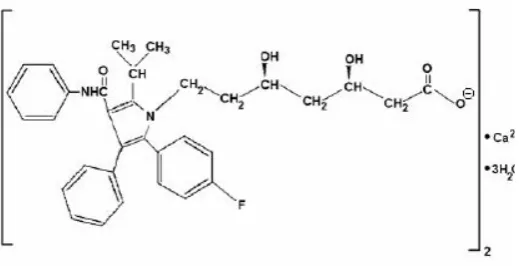
(2) 28. Vijya Gopal M. et al., Int. J. Pharm & Ind. Res., Vol.–03 (01) 2013 [27 - 33]. pharmaceutical dosage forms & it’s stability indicative studies. Atorvastatin is a synthetic lipid – lowering agent. It is chemically designed as [R – (R*, R*)] – 2- (4- flurophenyl) β-dihydroxy – 5 (1-methyl ethyl) – 3-phenyl-4-[(phenylamino) carbonyl] -1H-pyrole – 1-heptanoic acid, calcium salt (2:1) trihydrate. Atorvastatin is a synthetic lipid-lowering agent. It is an inhibitor of 3hydroxy-3-methyl-glutaryl-coenzyme A (HMGCoA) reductase enzyme. This enzyme catalyzes the. conversion of HMG-CoA to mevalonate, an early and rate limiting step in the synthesis of cholesterol. The primary site of action of HMGCoA reductase inhibitors is the liver. Inhibition of cholesterol synthesis in the liver leads to up regulation of LDL-receptors and an increase in LDL-catabolism. There is also some reduction of LDL-production as a result of inhibition of hepatic synthesis of very low density lipoprotein (VLDL), the precursor of LDL-cholesterol.. Fig. 01: Structure of atorvastatin calcium. Materials and method Instruments and Reagents The chromatographic separation was performed on SCHIMADZU LC2010c HT (Autosampler) with class-10vp Software with Isocratic--Gradient with UV-Visible Detector (SPD-IOA), PDA Detector (PDA-10A), PUMP (LC-IOAT). Waters C8, 5µm, 25cmx4.6mm i.d. column was used as a stationary phase. PH Analyzer (ELICO), Electronic Balance (AFCOSET), Ultra Sonicator (ENERTECH) has been used in the work. Atorvastatin. Active Pharmaceutical Ingredient (API) was provided by Startech labs pvt ltd, Madinaguda, Hyderabad. Acetonitrile, Methanol, & water of HPLC grade were from Standard reagents, Hyderabad. Orthophosphoric acid (S.D Fine chemicals, Mumbai), Commercial formulations of Atorva-20, 40 (Wexford pharmaceuticals) Optimised Chromatographic conditions The mobile phase of ACN: buffer= 6:4, diluents of water: ACN (50: 50) were used in this study. The conditions optimized were: flow rate (1 ml/minute), wavelength (246 nm, monitored by PDA detector) and run time was 25 min, column temperature was maintained at 500C. Retention time was found to be. 6.975 min. Waters C8, 5µm, 25cmx4.6mm i.d. column was used as stationary phase in the study. Preparation of mobile phase Acetonitrile and buffer were mixed in the ratio of 60:40 and filtered through membrane filter and degassed in a sonicator for 10 minutes. The final pH of the mobile phase was adjusted to 4. Preparation of buffer (0.01M) 1.3609 gm of Potassium di-hydrogen phosphate in sufficient water to produce 1000ml, pH adjusted to 4.0 with orthophosphoric acid. Preparation of Standard Drug Solutions Standard stock solution of a concentration of 100 μg/ml of Atorvastatin was prepared by using diluents (Acetonitrile and water were mixed in the ratio of 50:50) Preparation of Sample Solutions Sample solution of a concentration of 100 μg/ml of Atorvastatin was prepared by using diluents. The procedure for preparing the solution is as per the guideline. The graph obtained is shown in fig. 02.. www.ijpir.com.
(3) 29. Vijya Gopal M. et al., Int. J. Pharm & Ind. Res., Vol.–03 (01) 2013 [27 - 33]. (ATORVASTATIN). mAU. 6.975. 0.4. 0.2. 0.0 0. 2. 4. 6. 8. 10. 12. 14. 16. 18. 20. 22. 24. Minutes. Fig. 02: Chromatogram of atorvastatin (100 ppm) in optimized conditions (RT 6.975 min) Estimation of Atorvastatin in tablet The performance test of the method has been conducted on market sample, manufactured by Wexford Laboratories Pvt., Ltd., Brand Name: ATORVA-20, 40 and As per the label claim, the tablets contain 20, 40 of atorvastatin. To estimate these 20 tablets were taken & an equivalent powder weight has been taken which contains 20 mg of atorvastatin (each of these has been taken in separate volumetric flask), than the powders has been dissolved in methanol & made 20ml with the. diluents. Further dilution was done by taking 1ml of this solution in 10ml volumetric flask, dissolve and make up with the diluents. To extract the drug in the solution, it has been sonicated for 5 minutes followed by cyclo-mixing for 5 minutes. Resulting solution was filtered by using Millipore syringe filter (0.42 micron). Resulting clear solution was injected in HPLC in duplicate as per the above mentioned HPLC method. The assay results have been mentioned in table-01.. Table No. 01: Assay of atorvastatin tablets Mean (SD) amount (mg). Brand name of tablets. Labeled amount of Drug (mg). Atorva. 20. 20.363(0.03). 101.81% (0.4). Atorva. 40. 40.8(0.09). 102.05% (0.01). found by the proposed method (n=6). Fig. 03: Calibration curve for atorvastatin. www.ijpir.com. Mean ( SD) Assay (n = 6).
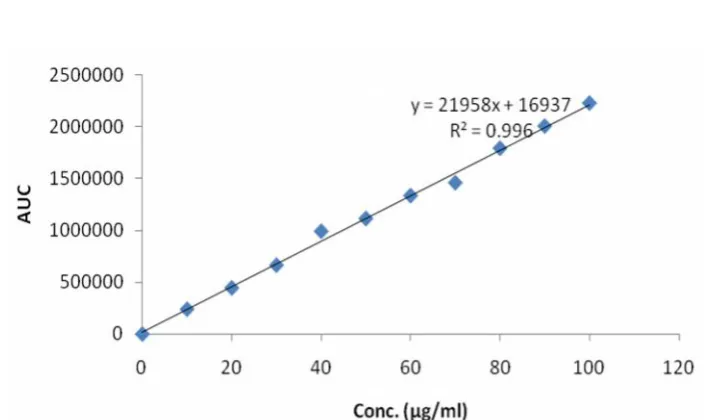
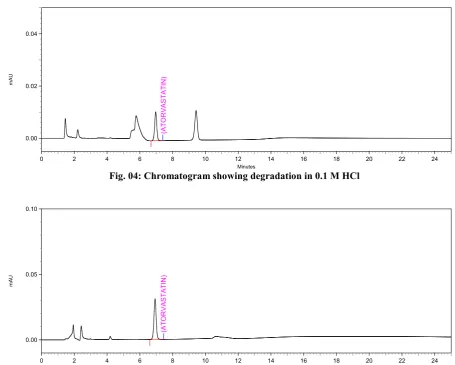
(4) 30. Vijya Gopal M. et al., Int. J. Pharm & Ind. Res., Vol.–03 (01) 2013 [27 - 33]. administration to body. This is one type of accelerated stability studies that helps us determining the fate of the drug that is likely to happen after long time storage, within a very short time as compare to the real time or long term stability testing. The various degradation pathways studied are acid hydrolysis, basic hydrolysis and oxidative degradation.. Method Validation As per the ICH8 guidelines, the method validation parameters checked were linearity, accuracy, precision, limit of detection, limit of quantisation. Preparation of Calibration Curves Calibration curve was prepared by taking appropriate aliquots of standard Atorvastatin stock solution in different 10 ml volumetric flask and diluted up to the mark with diluents to obtain the final concentrations of 10, 20, 30, 40, 50, 60, 70 ,80, 90, 100 μg/ml of Atorvastatin. Standard solutions (n=6) were injected, the sample volume was 20 μl with a flow rate of 1.0 ml/min., the results shown in fig. 03.. Mother Sample Before carry out the degradation studies the mother sample was prepared to find out the % degradation. It is prepared as the same method followed in sample or standard preparation. Acid Hydrolysis An accurately weighed 20 mg. of pure drug was transferred to a clean & dry 20 ml volumetric flask. To which 1 M HCl was added & make up to the mark & kept for 8 hrs. from that 2 ml was taken in to a 20 ml volumetric flask & make up to the mark with diluent, then injected for HPLC analysis. The chromatogram obtained has been shown in fig. 04.. Forced degradation studies: The protocol was strictly adhered to for forced degradation of atorvastatin Active Pharmaceutical Ingredient (API). The API (atorvastatin) was subjected to stress conditions in various ways to observe the rate and extent of degradation that is likely to occur in the course of storage and/or after. (ATORVASTATIN). mAU. 0.04. 0.02. 0.00 0. 2. 4. 6. 8. 10. 12. 14. 16. 18. 20. 22. 24. 20. 22. 24. Minutes. Fig. 04: Chromatogram showing degradation in 0.1 M HCl. 0.05. (ATORVASTATIN). mAU. 0.10. 0.00 0. 2. 4. 6. 8. 10. 12 Minutes. 14. 16. 18. Fig. 05: Chromatogram showing degradation in 0.1 M NaOH. www.ijpir.com.
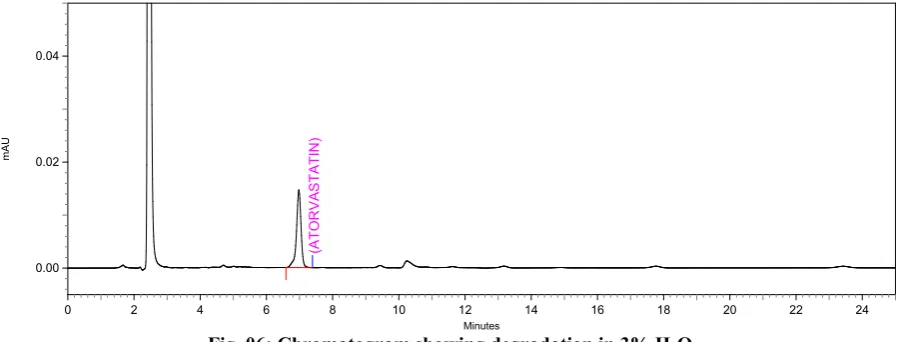
(5) 31. Vijya Gopal M. et al., Int. J. Pharm & Ind. Res., Vol.–03 (01) 2013 [27 - 33]. Basic Hydrolysis An accurately weighed 20 mg. of pure drug was transferred to a clean & dry 20 ml volumetric flask. To which 1 M NaOH was added & make up to the mark & kept for 8 hrs. from that 2 ml was taken in to a 20 ml volumetric flask & make up to the mark with diluent, then injected for HPLC analysis. The chromatogram obtained has been shown in fig. 05.. Oxidation with (30%) H2O2 An accurately weighed 20 mg. of pure drug was transferred to a clean & dry 20 ml volumetric flask. To which 30% H2O2 was added & make up to the mark & kept for 8 hrs. from that 2 ml was taken in to a 20 ml volumetric flask & make up to the mark with diluent then injected for HPLC analysis. The chromatogram obtained has been shown in fig. 06.. (ATORVASTATIN). mAU. 0.04. 0.02. 0.00 0. 2. 4. 6. 8. 10. 12. 14. 16. 18. 20. 22. 24. Minutes. Fig. 06: Chromatogram showing degradation in 3% H2O2. Results & discussion Results of degradation studies The results of the stress studies indicated the specificity of the method that has been developed. Atorvastatin was degraded only in 3% H2O2 & temperature stress conditions. The result of forced degradation studies are given in the table-02. Method Validation Linearity and Range The linearity of the method was determined at ten concentration levels ranging from 10-100 µg/ml for atorvastatin. The calibration curve showed good linearity in the range of 10 – 100 µg/ml, for atorvastatin (API) with correlation coefficient (r2) of 0.995 (Fig. 03). A typical calibration curve has the regression equation of y = 21845x + 24841 for atorvastatin. Accuracy The accuracy of the method was determined by recovery experiments. The recovery study was carried out by the standard addition method at three levels of 80, 100 and 120%. Each solution was injected in triplicate and the percentage recovery was calculated (Table-03). Recovery was within the range of 100 ± 2% which indicates accuracy of the method.. Precision The precision of each method was ascertained separately from the peak areas & retention times obtained by actual determination of six replicates of a fixed amount of drug. atorvastatin. (API) The percent relative standard deviations were calculated for atorvastatin (Table-03). The intra & inter day variation of the method was carried out & the high values of mean assay & low values of standard deviation & % RSD (% RSD < 2%) within a day & day to day variations for atorvastatin (Table-03). Limit of Detection and Limit of Quantification The LOD was found to be 0.377 g/ml and LOQ was found to be 1.143 g/ml for atorvastatin which represents that sensitivity of the method is high. Method Robustness Influence of small changes in chromatographic conditions such as change in flow rate ( 0.1ml/min), Temperature (20C), Wavelength of detection (2nm) & acetonitrile content in mobile phase (2%) studied to determine the robustness of the method are also in favour of (% RSD < 2%) the developed RP-HPLC method for the analysis of atorvastatin (API).. www.ijpir.com.
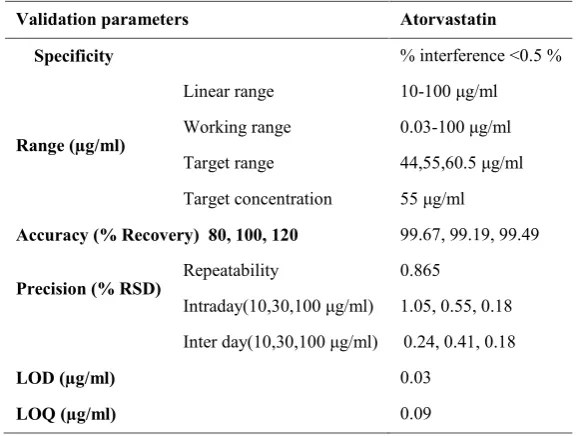
(6) 32. Vijya Gopal M. et al., Int. J. Pharm & Ind. Res., Vol.–03 (01) 2013 [27 - 33]. Table No. 02: Results of Force Degradation Studies of Atorvastatin Api. Stress condition Acid Hydrolysis (0.1 M HCl) Basic Hydrolysis (0.I M NaOH) Oxidation (3% H2O2). Time (Hrs). Assay of active substance. Assay of degraded products. Mass Balance (%). 08. 58.36. 41.13. 99.49. 08. 88.32. 10.42. 98.72. 08. 97.15. 02.05. 99.20. Table No. 03: Summary Of Validation Parameters by RP-HPLC Method Validation parameters. Atorvastatin % interference <0.5 %. Specificity. Range (µg/ml). Linear range. 10-100 μg/ml. Working range. 0.03-100 μg/ml. Target range. 44,55,60.5 μg/ml. Target concentration. 55 μg/ml 99.67, 99.19, 99.49. Accuracy (% Recovery) 80, 100, 120 Precision (% RSD). Repeatability. 0.865. Intraday(10,30,100 μg/ml). 1.05, 0.55, 0.18. Inter day(10,30,100 μg/ml). 0.24, 0.41, 0.18. LOD (µg/ml). 0.03. LOQ (µg/ml). 0.09. Conclusion To develop a precise, linear, specific & suitable stability indicating RP-HPLC method for analysis of atorvastatin different chromatographic conditions were applied & the results observed are presented. Isocratic elution is simple, requires only one pump & flat baseline separation for easy and reproducible results. So, it was preferred for the current study over gradient elution. In case of RPHPLC various columns are available, but here waters C18, 5µm, 25cm x 4.6 mm i.d. column was preferred because using this column peak shape, resolution and absorbance were good. Mobile phase & diluents for preparation of various samples were finalized after studying the solubility of API in different solvents of our disposal (methanol, acetonitrile, water, 1M NaOH, IM HCl). The drug was found to be highly soluble in methanol. Drug was sparingly soluble in acetonitrile. Using these solvents with appropriate composition newer methods can be developed and validated. The result shows the developed method is yet another suitable method for assay and stability studies which can help in the analysis of atorvastatin in different formulations.. The precision of the method was demonstrated by intra-day and inter-day variation studies. For intraday studies the drug having concentration value 80%, 100 % & 120% of the target concentration (n 3), were injected in triplicate into the HPLC system and for inter-day studies the drug at above three concentrations were injected in triplicate into the HPLC system for three days. Data were subjected to statistical treatment for the calculation of SD and %RSD. The value of %RSD for atorvastatin was found to be 1.05, 0.55, and 0.18 for intra-day studies. The values for inter-day studies were 0.24, 0.41, and 0.18 respectively. This shows that values are not more than 2%, indicates that the developed method is precise. The proposed method is simple, sensitive and reproducible and hence can be used in routine for determination of Atorvastatin in bulk as well as in pharmaceutical preparations. Statistical analysis of the results has been carried out revealing high accuracy and good precision.. www.ijpir.com.
(7) Vijya Gopal M. et al., Int. J. Pharm & Ind. Res., Vol.–03 (01) 2013 [27 - 33]. Acknowledgement. 5.. The authors are thankful to the Director of Comprime Labs Pvt Ltd, Hyderabad for providing the necessary facilities to carry out this work.. References 1.. 2.. 3.. 4.. Rockville M D, United States Pharmacopoeia; United States Pharmacopoeial Convention Inc, 25th Edn., 2002 ; 1 : 2150. Jain N, Raghuwanshi R, Jain D. Development and Validation of RP-HPLC Method for Simultaneous Estimation of Atorvastatin Calcium and Fenofibrate in Tablet Dosage Forms. Indian J Pharm Sci. Vol. 70, Issue. 02, Mar-Apr 2008. Manzoor Ahmed, Manohara Y.N, Ravi M.C RP-HPLC method development and validation for simultaneous estimation of Atorvastatin calcium and Amlodipine besylate. International Journal of ChemTech Research. Vol. 04, Issue. 01, Jan-Mar 2012, Pages 337345. R. Vijayamirtharaj, J. Ramesh, B. Jayalakshmi and Hanas Bin Hashim Development And Validation Of Rp-Hplc Method For The Simultaneous Estimation Of Telmisartan And Atorvastatin Calcium In Tablet Dosage Forms. Pharmacie Globale International Journal of Comprehensive Pharmacy. Pharmacie Globale. Vol. 01, Issue 04, Year 2010.. 6.. 7.. 8.. www.ijpir.com. 33. Rajesh Sharma, Sunil Khanna, and Ganesh P. Mishra Development and Validation of RPHPLC Method for Simultaneous Estimation of Ramipril, Aspirin and Atorvastatin in Pharmaceutical Preparations E-Journal of Chemistry Volume 9, Issue 4, Year 2012 Pages 2177-2184. Ray Chaudhury Dipanjan, Basu Arindam, Chakraborty Mithun, Chakraborty Susant Analytical Method Development and Validation of Simultaneous Determination of Atorvastatin Calcium and Aspirin in Capsule Dosage form by RP-HPLC International Journal Of Pharmaceutical Innovations Volume 1, Issue 5, November-December 2011. D A Shah, K K Bhatt, R S Mehta, M B Shankar, SL Baldania, T R Gandhi Development and validation of a RP-HPLC method for determination of atorvastatin calcium and aspirin in a capsule dosage form Volume 69, Issue 4, Year 2007, Pages 546549. ICH, International Conference on Harmonization of Technical Requirements for Registration of Pharmaceuticals for Human Use, Validation of analytical procedure: Text and Methodology Q2 (R1), 2005..
(8)
Figure
+2
Related documents
Methadone adverse reaction presenting with large increase in plasma methadone binding: a case series
While it is clear that the increased concentration of unbound methadone contributed to this symptomatic overexposure, the large change in bound methadone may also have contributed
In conclusion, dogs that were vaccinated with full doses of primary vaccination against canine distemper had more protective antibody titre and also, those that received booster
Th e goal of the paper is to fi nd out whether the collusive oligopolies are created in the food-products market, in what range the cartel agreements appear in the given sector
The agreed plans that are used for the management of the case studies represent the fifth aspect that was adopted to explore the influences of the Global Strategy on
4. Wing kindly supplied the writer with scores for his tests made by five groups viz, a) a highly talented group of 41 professional music students; b) a group of 100 training
Another measure of assay variation was the comparison of the CVs from the between-laboratory mean antibody levels of 16 unknown serum samples (Table 2). Although the present
Using recombinant fusion proteins encompassing the entire human topo I amino acid sequence, a topo I-specific proliferative response was detected in PBMC cultures from 25
Gen- erally, serum 25-hydroxy vitamin D levels define vitamin D status, and vitamin D deficiency (defined by the Institute of Medicine to be at < 12 ng/mL of serum
