By J. Eian Harm
A dissertation
submitted in partial fulfillment of the requirements for the degree of
Doctor of Education in Curriculum and Instruction Boise State University
© 2013 J. Eian Harm
DEFENSE COMMITTEE AND FINAL READING APPROVALS
of the dissertation submitted by
J. Eian Harm
Dissertation Title: Promoting Authentic Instruction Through Second-Career Educators Date of Final Oral Examination: 22 April 2013
The following individuals read and discussed the dissertation submitted by student J. Eian Harm, and they evaluated his presentation and response to questions during the final oral examination. They found that the student passed the final oral examination. Jonathan L. Brendefur, Ph.D. Co-Chair, Supervisory Committee Kathleen M. Budge, Ed.D. Co-Chair, Supervisory Committee Keith W. Thiede, Ph.D. Member, Supervisory Committee William H. Parrett, Ph.D. Member, Supervisory Committee
v
DEDICATION
vi
ACKNOWLEDGEMENTS
vii ABSTRACT
Promoting Authentic Instruction through Second-Career Educators
Newmann, Secada, and Wehlage (1995) has shown that student achievement can be gained through the use of what is described as authentic instructional styles. These types of pedagogy maintain a focus on building knowledge through real-world
application of subject matter and discussion of topics that are relevant to students’ lives. Studies have shown that an ongoing process of socialization into the school system occurs throughout a teacher’s career leading them into the use of more objectivist methods of teacher-centered instruction and rote learning of information (Hoy & Woolfolk, 1990; Staton & Hunt, 1992; Wattenburg, 2001; Zeichner, 1980). This study sought to measure whether second-career teachers, through their experience within non-teaching careers, have developed a theory of action (set of rules used to design and implement behavior) that is more aligned toward authenticity as compared to that of first-career teachers (Argyris, 1991). The analysis attempted to focus on a teacher’s theory of action because this will guide how a person perceives the world and therefore how she or he will act within it. To accomplish this, a survey was sent to secondary teachers (n=217) in a large suburban school district. Data were evaluated using a variety of analyses to determine both reliability (Chronbach’s Alpha), differences between means (t-test and ANOVA), and correlations between variables (Pearson’s correlations). Results
viii
ix
TABLE OF CONTENTS
DEDICATION ... v
ACKNOWLEDGEMENTS ... vi
ABSTRACT ... vii
LIST OF TABLES ... xiii
LIST OF FIGURES ... xiv
CHAPTER 1: INTRODUCTION ... 1
Problem Statement ... 1
Research Question and Purpose ... 4
Question ... 5
Hypothesis... 6
CHAPTER 2: REVIEW OF LITERATURE ... 8
Teaching as a Second Career ... 8
Reasons for a Change... 9
Making the Switch ... 11
Beliefs Held by Second Career Educators ... 12
Barriers to Authentic Instruction in Second Career Teachers ... 16
Second Career Teacher Education Programs—What Is Needed for Effective Change ... 18
Aspects of Successful Programs ... 19
x
The Behaviorist Approach in Today’s Schools ... 24
Piaget’s Active Cognition and Learning Theory ... 25
Cognitive Information Processing Theory (CIP) ... 26
Vygotsky, Bruner, and a Move Toward Constructivism ... 29
Social Learning Theory... 30
The Social Constructivist Approach ... 31
Social-Constructivist Pedagogy ... 33
Authenticity... 34
Creating an Authentic Environment ... 40
Socialization and Enculturation ... 48
Socialization ... 50
Previous Experiences ... 52
Ongoing Factors of Socialization... 61
Leadership as a Solution ... 75
CHAPTER 3: METHODS ... 82
Research Design... 82
Defining First and Second-Career Educators ... 82
Participants ... 84
Instrumentation ... 85
Initial Pilot Test of Survey and Factor Analysis ... 88
Survey of Participants ... 89
Data reliability, Recording, and Analysis ... 90
xi
CHAPTER 4: RESULTS ... 98
Statistical Analysis of Theory of Authentic Action Score between First, Second, and Encore Career Educators ... 98
Total Theory of Authentic Action Score ... 98
Analyses Among Authenticity Factors ... 102
Individual Question Analysis ... 107
Age and Years of Experience Correlations ... 109
CHAPTER 5: DISCUSSION ... 111
Discussion of Demographics ... 111
Differences Between Entrances into Education ... 113
Perception of the Value Beyond Instruction ... 113
Depth of Knowledge Analysis ... 115
Construction of Knowledge Analysis ... 117
Implications... 120
Implications for Schools and Districts ... 121
Teacher Preparation Programs ... 122
State and Federal Level ... 123
Final Thoughts and Further Research ... 124
REFERENCES ... 128
APPENDIX A ... 142
Theory of Authentic Action Survey ... 142
APPENDIX B ... 145
xii
xiii
LIST OF TABLES
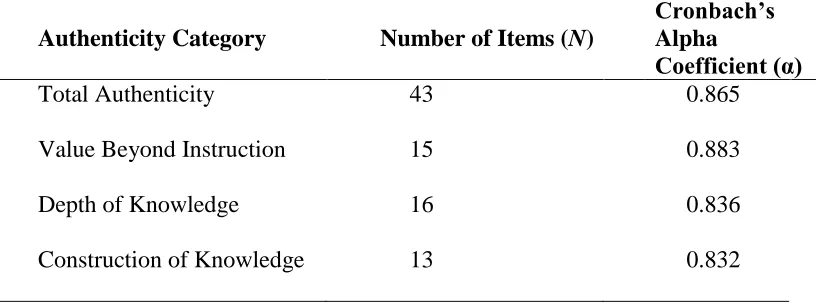
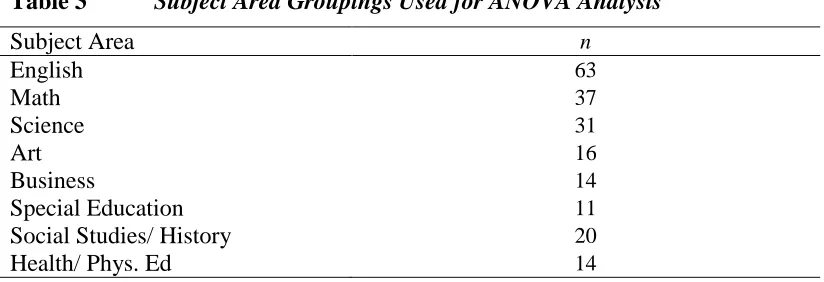
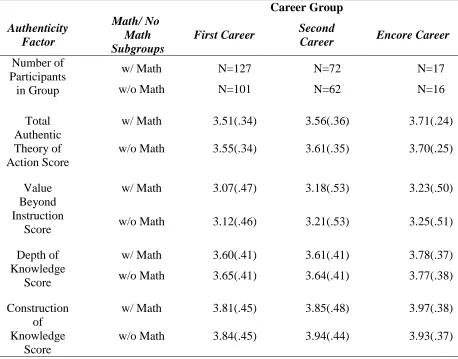
Table 1 Demographic Findings: Age and Years of Experience of First, Second, and Encore Career Teachers ... 85 Table 2 Cronbach’s Alpha Coefficients for Theory of Authentic Action Survey ... 91 Table 3 Subject Area Groupings Used for ANOVA Analysis... 93 Table 4 Second and Encore Career "Fit” Participant Numbers to Career
Groupings ... 94 Table 5 Comparison of Career Group Theory of Authentic Action Mean Scores by
Authenticity Factor ... 99 Table 6 Descriptive Statistics for Total Theory of Authentic Action Between
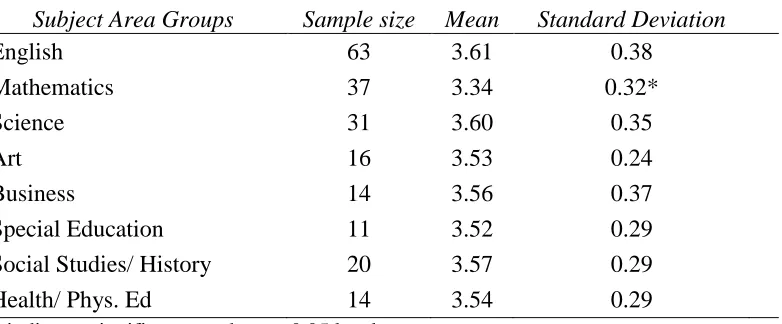
Subject Matter Groups ... 100 Table 7 Summary of ANOVA: Subject Matter Taught by Total Theory of Authentic
Action Score ... 101 Table 8 Descriptive Statistics for Total Theory of Authentic Action Between “Fit”
Categories to Previous Career ... 102 Table 9 Summary of ANOVA- Subject Area Fit to Previous Career by Total
Authentic Theory of Action Score- Mathematics Teachers Excluded ... 102 Table 10 Comparison Between First, Second, and Encore Career Teachers with
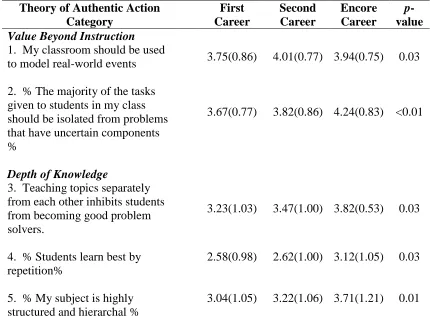
Statistically Significant Differences on Individual Questions in Theory of Authentic Action Survey ... 108 Table 11 Pearson Correlation Coefficients for Factors of Authenticity ... 109 Table C1 Descriptions of career, subject area, and subject matter fit to previous
xiv
LIST OF FIGURES
Figure 1. The onion model. This figure depicts the layers of experience and their interactions. Layers toward center of model indicate more deeply
CHAPTER 1: INTRODUCTION
Problem Statement
The importance of finding techniques that ensure that students learn to high levels should be obvious in its importance for the prosperity of our country. Previous research has positively linked effective teaching to student achievement (Chenoweth, 2007; Fullan, 2007; Goodlad, 1991). This evidence indicates that it is indeed possible to increase learning within our classrooms and it is the teachers who play the greatest role. In order for teachers to be effective, they need to have the tools to be successful—they need pedagogy that has been proven to increase motivation and learning for students. Newmann, Secada, and Wehlage (1995) have shown that student achievement can be gained through the use of what is described as authentic instructional styles. These types of pedagogy maintain a focus on real-world skills and discussion of topics that are relevant to students’ lives. Though this type of teaching has been shown to increase learning, its implementation within our classrooms has been very slow to develop. This typically leads students into classrooms that are built upon the objectivist methods of teacher-centered instruction and rote learning of information. Studies have shown that an ongoing process of socialization into the school system occurs throughout a teacher’s career, leading them into the use of more objectivist methods of teacher-centered
being creative and attempting to employ authentic techniques, most of these teachers end up teaching in objectivist ways (Feiman-Nemser, 2001; Hoy & Woolfolk, 1990; Staton & Hunt, 1992; Wattenburg, 2001; Zeichner, 1980.) Additionally, many other teachers having little working knowledge of cognitive research simply begin to teach as they were once taught. The result is the use of methods that are not grounded in cognitive research and are typically much less effectual in achieving positive results in student learning.
build upon previous student knowledge. Authentic instruction provides this methodology.
Though in many cases teachers and educational leaders desire to use these types of pedagogy within their classrooms or schools, it seems that these research-based
methods have never been implemented to a wide degree. Instead, the more behaviorist or objectivist approaches toward teaching and learning are the norm. These methods
typically involve the student as the passive recipient of information provided by the teacher, followed by an assessment typically in the form of an exam. Many studies have been performed attempting to analyze why it is so difficult for educators to move away from the implementation of this type of teaching in light of the fact that it is, by and large, unsuccessful in achieving high levels of learning for students (Zeichner, 1980; Feiman-Nemser, 2001). These studies have shown that an ongoing process of socialization into the school system occurs throughout a teacher’s career. This socialization, also described as enculturation, is especially prevalent within novice teachers who are attempting to fit into the profession. Though much research maintains a focus on new teachers who tend to use role models from their previous experiences or within their current schools as a template, this process is evident throughout the entirety of one’s career in education.
recruit and hire teachers who have been involved in previous careers. These individuals should be able to pass the knowledge and skills that are used within a particular subject and show the subject’s relevance within the greater world. If authentic instruction leads students to greater motivation and subsequent understanding of a subject through
relevance of material, then who better to provide this instruction than individuals who have participated in that subject’s implementation within the real world. Second-career teachers may hold the capacity to increase relevance and therefore authenticity within a classroom and possibly a school.
Research Question and Purpose
This study seeks to discover if second-career teachers do indeed teach with more authentic methods as compared to those used by first-career teachers. If second-career educators do teach more authentically, using skills employed by individuals who work within their particular subject, employment of these individuals could be a successful way to install these techniques within schools and districts to increase relevance,
effectiveness of teachers, and subsequent success by students. What this study intends to do is find out if second career teachers are inherently more authentic in their teaching styles despite the challenges of being socialized by and into the school system. Much of the literature implies that these second-career teachers feel they have abilities that will enable them to be successful within the typical school environment. Prior research speaks to those abilities of problem solving, implementing new techniques, and working past school bureaucracy as some of the attributes that differentiate second-career
Most was performed through interviews of mainly pre-service career-switching teachers in asking what they felt they brought to the profession, what were the reasons for
switching careers, and what teacher induction program characteristics they felt would make them most successful in their transition. Where this study differs is that it seeks to quantify actual differences between these groups (first and second-career teachers). This study also seeks to look at the influence of time within the school system and the effect that this has on both first and second career teachers alike.
If second-career educators are found to be more authentic as the result of their previous careers, educational leaders could use this information to recruit these
individuals as a means of increasing authentic instruction within their schools. If they are not more authentic, however, the questions arise: why are these teachers not
demonstrating the knowledge and skills that are needed by students to successfully enter today’s workforce? What can be done to increase the degree of authentic instruction that second-career teachers should be able to provide? And where in teacher education and certification programs could interventions take place to ensure that these second-career teachers find the confidence and competence to implement authentic pedagogy that has already been shown to be successful at increasing student achievement?
Question
This study was conducted to determine if career switching teachers, those who were educated for and employed in jobs prior to teaching, taught in a more authentic manner than individuals who began their working careers as educators. Authenticity, defined by Newmann et al. (1995) consists of five components: construction of
the inclusion of all students in the learning process. For the purpose of this paper, an analysis will be made comparing the authenticity of these two groups within their own personal Theory of Action. This theory of action, as described by Argyris (1991) is the set of personal rules under which their teaching is guided. This theory of action will give some sense of how the teacher views teaching and learning and, therefore, will give a sense of actions taken within their classroom.
Hypothesis
It has been proposed by Tigchelaar, Brouwer, and Vermunt (2010) and others that having had a previous career before entering the teaching profession can result in
profound changes in the way educators view teaching and learning. It therefore can be argued that these individuals may bring real-world skills into the classroom, resulting in higher levels of authenticity. Conversely, however, much research has shown that in fact the opposite can happen as well. Second-career teachers having successfully navigated their way through the “system” of schooling may end up becoming conservative forces within a school building. Additionally, the socialization influences of a school described by Lortie (1975) and Zeichner (1980) can lead a would-be authentic teacher into the conservative methodology of objectivist teaching.
For this study, a null hypothesis has been developed stating that the level of authenticity of instruction within a particular classroom will be unrelated to whether or not an individual had a previous career in her or his particular field of study or whether they worked for a substantial length of time prior to teaching at all. What I hope to glean, however, is that second-career educators have a more authentic alignment toward
become so. Since a survey was created to measure this authenticity, this alignment would manifest itself in higher overall scores. Additionally, it is hypothesized that, if there is no difference found in the levels of authenticity between first and second-career educators, the reason for this could in large part be due to the socialization influences placed upon the individual. These influences possibly arise from both past and present experiences within the classroom (Zeichner, 1980). Examples of this socialization will include the influence of previous teachers and/or college professors within the subject that they are teaching, as well as the socialization influences found within the school building once they have begun their teaching careers. This study will determine if first and career-switching educators differ in how they view student learning (construction of
CHAPTER 2: REVIEW OF LITERATURE
Teaching as a Second Career
Changing careers is a decision that typically is not taken lightly. These “career switchers” choose to enter into the teaching profession based upon decisions that are highly personal (Wilcox & Samaras, 2009). Though the reasons for a change in careers are individual in nature, there are some generalizations that can be made regarding the reasons behind people’s motivations. These generalizations can be analyzed and used as important pieces of the puzzle for implementing successful programs for the recruitment, education, induction, and retention of second-career teachers. Additionally, knowing the motivations behind why an individual switches a career allows educational leaders to develop targeted approaches toward creating an affective and authentic teacher. Resta, Huling, and Rainwater (2001) indicate a projected shortage of 18 million teachers worldwide and a need to hire 200,000 teachers annually within the United States alone. Successfully incorporating second-career teachers into the profession will play an integral role in filling this gap. These shortages are typically seen to be the result of an aging and retiring workforce coupled with the excessive attrition rates associated with teaching in many countries (Brindley & Parker, 2010; Elmore, 2008; Haggard, Slostad, & Winterton, 2006; Tigchelaar et al., 2010). The potential and therefore importance of enlisting
experience of some individual.” Dewey (1940) states later that a “school must represent life—life as real and vital to the child.” Who among our teachers is more capable of bringing this vitality of realism into the classroom than those who have experienced it? Second-career teachers can offer knowledge and skills rich in authenticity and based upon the real world use of the subject they teach. It is these features, when implemented, that stand the greatest chance of creating the active and interested students that research shows leads to increased learning (Driscoll, 2000).
Reasons for a Change
Lortie (1975) spoke of the aspects of teaching that attracted people into the career. Some of these features were seen to be interacting with children, caring for others,
compared with traditional first-career candidates at the same point in their program. In accord with previous research on this subject, these authors presented findings that indicated a strong desire by these individuals to use their expertise to pass subject matter knowledge, help young people, and contribute to society. Upon analysis of many second-career teacher interviews, Dietrich and Panton (1996) found that their decision to make this change could be categorized into two major factors: internal and external motives. Dietrich and Panton articulate this transition theory by showing that the internal factors that are associated with switching careers are those that align themselves with perceptions of making a difference and seeking enjoyment and fulfillment. The external factors were determined to be associated with compensation and career advancement. Dietrich and Panton came to the conclusion that the internal factors played a more influential part in the decision to become a teacher as compared with the external.
Salyer (2003) highlights that second-career, pre-service educators maintain the “ability to incorporate very specialized, practical, and real-world knowledge into their instruction.” Additionally, Salyer indicates that they can provide “interpersonal skills such as patience…teaming, management and organizational skills” (pp. 20-21). Haggard et al. (2006) cite other research in discussing career switchers as possessing strong work ethics, analytical thinking skills, expert knowledge, a willingness to try new techniques, and, overall, the ability to think outside of the norms of the typical school culture.
2010). Though these competencies are evident due to the previous relevant experiences of these individuals, their implementation within the classroom setting is not certain.
Making the Switch
Castro and Bauml (2009) performed a qualitative study attempting to determine what factors affected the decisions of alternative pathway students entrance into
education. As stated previously, they mentioned that these factors consist of both internal and external motivations. They focused their study only on the determinants for actual entrance into the teaching career. They concentrated these findings into four generalized categories: resource availability, latitude, commitment readiness, and program
accessibility. All of the participants mentioned that they had access to knowledge about the teaching field either through some degree of experience within the field or knowledge of someone who was a teacher. This resource availability tended to provide the support and information necessary for transition into this career. Another integral factor in the change to become an educator found these individuals having the latitude to make the change. Castro and Bauml define this latitude as having the financial and temporal means to pursue this change. Weighing the “opportunity costs” and having the ability to make this conversion obviously plays a large part in peoples’ decision to enter into a new profession (p. 119).
The third concept proposed by Castro and Bauml (2009) indicating why second-career educators enter into the field is commitment readiness. The authors describe commitment readiness as the individual possessing the confidence to endure the
risk. Tigchelaar et al. (2010) performed an analysis of 36 studies examining various aspects of the career choices of second-career teachers. The results of these studies show that there is no typical age category (ages ranged from 22-57 for participants) for second-career teachers to possess the commitment readiness to make this change, though it certainly can be argued that both younger individuals as well as older, possibly
previously retired individuals, could be more ready to make this commitment. Finally, Castro and Bauml (2009) talk of the importance of a teacher education program’s accessibility. Most of the participants within the studies spoke of the need to make the transition “quickly and easily” (p. 122). They discussed the need for immediate
information about program offerings and alternate routes into the teaching profession. The use of the internet and discussions with others who possess expertise to provide access to information was a prevalent concept among those being researched in the studies.
Beliefs Held by Second Career Educators
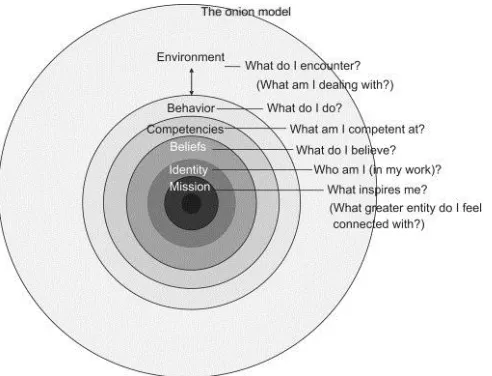
Figure 1. The onion model. This figure depicts the layers of experience and their interactions. Layers toward center of model indicate more deeply ingrained
experiences (Korthagen, 2004).
The deeper into the model the experience lays, the more deeply rooted and persistent the experience will be. It is clear from this model that the beliefs about
education. Unfortunately, if authentic teaching is not fostered within these teachers, this stronger sense of identity can lead toward the promotion of outdated and conservative practice passed to them through previous experience.
Freidus and Krasnow (1991) show that many second-career teachers appreciate that they have valuable skills to offer but they do not, however, have the abilities yet in which to impart them upon their students. They continue by showing that these
into the conceptions of teaching among second-career science teachers. In this research, they found that there was a strong resistance to change among the participants and their perceptions about the teaching of science. It is argued that this is due, in large part, to these learners having been taught through the typical “passive recipient” method of teaching certainly common to most fields of science, but also prevalent in many other aspects of education. These beliefs are strongly held and deeply ingrained (as evidenced by the onion model of experience) and therefore are highly resistant to change. The more recent concept of students having to construct their own knowledge (construction of knowledge) argues against the majority use of this pedagogy. Koballa et al. (2005) discuss the need for teacher education programs to consider the process of conceptual change about learning among their participants as a primary goal of their programs. By comparing the views of these individuals both before and after teacher training,
educational leaders can develop programs that accurately develop teachers who
implement pedagogy grounded in research. Furthermore, by comparing these findings with those of more traditional methods of teacher education for first-career teachers, it is possible to highlight the difficulties in developing and employing more authentic
teaching techniques.
Barriers to Authentic Instruction in Second Career Teachers
previous careers and now struggled as teachers” (p. 185). This statement clearly indicates that, even with the benefit of additional experience and expertise of second-career educators, there are indeed difficulties to be faced. Wilcox and Samaras draw attention to and generalize the typical difficulties faced by these novices as issues of: time, discipline, getting to know students and families, and working within the
bureaucracy of the school. These issues were reported in addition to the balance between the teachers’ personal lives and their “very demanding professional life” (p. 186).
Many of the skills that career-changing teachers bring with them into the
classroom are not necessarily the skills needed to become successful teachers (Tigchelaar et al., 2008; Trent and Xuesong, 2009). In fact, Trent and Xuesong (2009) talk about the mismatch between the content and pedagogy that these teachers want to teach with and how they actually end up teaching. This “mismatch” reduces the potential for creativity and more authentic instruction that second-career teachers could inherently bring to the classroom (p. 254). Work by Gonzales, Rodriguez, and Sjostrom (1998) in which a sample of 25 traditional and 18 non-traditional (second-career) students were observed at the beginning of their careers found that second-career teachers tended to be more
student-centered in their approach to teaching. The traditional route students were heavily reliant upon curriculum in both content and time management. This study
revealed that second-career teachers were more adept at navigating the political culture of the school, and were able to modify their behaviors to accomplish goals within it.
to determine where roadblocks lie in the development and implementation of relevant and authentic teaching techniques that they could bring to the classroom. Once these
stumbling points are determined, teacher training programs and school-based educational leaders can then enact appropriate pedagogy to harness and develop skills. Through this process, the growth of creative and authentic second-career teachers and teaching will become the norm.
Second Career Teacher Education Programs—What Is Needed for Effective Change Teacher education programs play an integral role in moving an individual toward or away from the use of research-based pedagogy within their classroom. The use of effective pedagogy within the novice’s classroom plays a large role in teacher retention during the first few traumatic years. The type of teacher, created through a teacher education program, could even determine if these induction years are traumatic at all. It could therefore be argued that teacher training is on the front line of educational change and may possibly decide the success or failure of our schools by giving good teachers the skills to be successful from the beginning. For this reason, it is essential to have an understanding of the characteristics that make teacher education successful. Of the 36 studies in which Tigchelaar et al. (2010) analyzed aspects of second-career entrants into teaching, only 4 touched upon characteristics of successful education programs for these career switchers. If career-switching teachers indeed bring knowledge, skills, and real-world relevance into the classroom, then it is vital that programs are developed to harness these qualities. In order to successfully integrate second-career teachers into the
Aspects of Successful Programs
There are a wide variety of preparation programs as alternatives to the traditional bachelor’s degree method of many first-career teachers entrance into the field. These range from fast-track programs that place teachers in front of students in as little as a few weeks to graduate programs earning the scholar a teaching credential as part of a
indicated six areas of importance for an effective program: a) an integrated system of resource support; b) scaffolded mentorship; c) situated learning experiences; d) alternative new teacher networks; e) active coordination; and f) university support (p. 178). Sandoval-Lucero et al. (2011) corroborate these finding by showing that how teachers teach is indeed affected by the type of program in which they were involved. Within the aspects of resource and support, mentorship, and situated learning, teachers who learned how to teach through “in residence” methods (no formal pedagogical training involved, simply entering into the classroom) were less likely to develop into master teachers and teacher leaders. It is argued by Sandoval-Lucero et al. that these individuals tended to view good teaching as emanating from a passion or calling that was innate and unlearned. They showed, on the other hand, that teachers who went through formal training such as those of traditional methods or entrance into an alternative program based upon professional development were more likely to see teaching as something that could be learned and therefore improved. These educators viewed knowledge of pedagogy, cognition, and experience through mentorship as a means for this improvement. Sandoval-Lucero et al. also showed that the teacher education programs highly focused upon professional development and mentorship produced teachers with a greater theoretical knowledge base with which to fall back upon. This is in comparison to both the traditional and teacher-in-residence methods of teacher
immediate colleagues, or gravitate toward structured packages (Sandoval-Lucero et al., 2011). These methods all play a part in the move of the teacher toward the application of the conservative routines of objectivism within their classroom.
Knowledge that teachers become more effective when given varied experiences, mentors, and resources for support argues for the decrease in fast-track programs aimed at placing a teacher at the front of the classroom as quickly as possible. Though
experience is certainly part of the teacher-training equation, it must be coupled with a large amount of theory, pedagogy, and reflection upon practice. All of which must be accomplished to the highest standards in order to ensure both the success of the individual within the classroom, but also that students are provided access to the best teachers. Another aspect highlighted by Wilcox and Samaras (2009) is the necessity of continuous collaboration between individual teacher-learners, the university, and the schools with which they are involved. In order to build reflective practitioners, successful programs find ways for new and learning teachers to collaborate among themselves. An example of this process can be seen in the cohort method, which
attempts to reduce the isolation typically felt by beginning teachers. Wilcox and Samaras highlight that this collaboration must extend beyond the individual teachers to
communication between teacher educators and the schools in which their teachers are involved. This communication with schools is necessary in order to meet the needs of the student teachers as well as the schools and to adjust to issues as they arise. The
indicate a necessity for their programs to be flexible, easy to enter, and provide quick results. The sense of security that is lost during the process of switching careers is not something these individuals wish to prolong. For this reason, how seamlessly an individual can make this change counts as a major factor in their decision. This is in accordance with Castro and Bauml’s (2009) program accessibility. They found that career-switching candidates appreciated having instant access to information concerning pathways into teaching. Through the use of the internet, these students gathered relevant information and made the decisions most accommodating to their needs. Along with instant access, career-switchers were shown to value programs that have varied entry points and schedules. Due to the necessity of full-time employment while pursuing their credentials, most of these individuals could not attend the typically scheduled classes of traditional students. Classes on evenings and weekends were seen as valuable and offered a chance for these learners to develop schedules that allowed them to both go to work and to school.
The transition from a previous career into teaching can be made much less
Authentic Instruction
In today’s modern and technological society with competition for jobs becoming international, the need to develop and impart students with relevant and necessary skills is essential. In order to accomplish this, educators need to enact techniques that are based upon real-world concepts, focused upon developing thinking and problem-solving
for the school or district to accomplish this through the development of professional learning communities (PLCs). It is by enacting the capacity for teachers to develop authentic lessons, connect to the community, and engage in relevant teaching that student achievement is increased and success can thereby by claimed (Choo, 2007; Gambrell, Hughes, Calvert, Malloy, & Igo, 2011; Kemker, Barron, & Harmes, 2007; Yonezawa, Jones, & Joselowsky, 2009).
The Behaviorist Approach in Today’s Schools
Piaget’s Active Cognition and Learning Theory
Beginning with Piaget’s research on learning, the idea of students needing to be active participants in the learning process was developed. Siegler (1998) describes Piaget’s belief likening “children’s thinking to that of scientists solving problems about the fundamental nature of the world.” He continues by stating how “Piaget emphasized cognitive activity as the means through which development occurs” (pp. 29-31). In fact, he sometimes described his theory as “interactionism,” the combination of heredity and environment leading to one’s cognition (Driscoll, 2000). Piaget suggested three
a greater variety of instructional techniques” (as cited in Siegler, 1998, p. 58). However, Piaget’s role of active cognition—learners forming their own interpretations about the world through experience—was to be a foundational point in educational psychology. How students develop these interpretations, how they process the information, and how they recall this knowledge was the next query. The Cognitive Information Processing Theory (CIP) attempted to do just this.
Cognitive Information Processing Theory (CIP)
The Cognitive Information Processing Theory (CIP) attempts to determine how information gets from outside (the environment), is processed, and becomes part of one’s memory. This theory states that information moves linearly from sensory memory (associated with the senses and holding information briefly), to short-term memory (likened to consciousness where one “thinks” about input), and finally to long-term memory, which is the permanent storehouse for information. This seemingly simple representation of how information is processed is frequently compared to computer modeling. In fact, Siegler illustrates the creation of connectionist theories, which are computer simulations attempting to depict the workings of the brain. The most
the encoding of information (mnemonics, imagery, rehearsal, chunking to name a few), it seems that relevance of the information to the learner, while providing a connection of ideas and concepts to previously learned information, is the most effective.
Driscoll (2000) informs us of Ausubel’s belief that “meaning occurs when learners actively interpret their experiences using certain internal cognitive operations” (p. 116). It is this internalization of information that allows it to be encoded within the learner. While most school learning seems to be of the reception type, what Ausubel described as “the entire content of what is to be learned is presented to the learner in its final form,” meaningful learning can only be accomplished through relevant and stimulating material. Driscoll continues with “in discovery learning, on the other hand, learners are required to ‘rearrange a given array of information, integrate it with existing cognitive structure, and reorganize or transform the integrated combination in such a way as to create a desired end product or discover a missing means-end relationship’” (p. 117). Learners thereby begin to create their own meaning.
Ausubel suggested that an anchoring idea was needed for a learner to begin to connect new information. This anchoring idea must be something that is relevant to the learner and provides a context for which further learning can be related. Ausubel
proposed that “retention involves maintaining the availability of acquired information so that it may be accessed for use at a later time” (as cited in Driscoll, 2000, p. 125). Initially, meaningful learning promotes easy recall of concepts due to the need for
remember only the “gist” of what was presented, creating yet another anchoring concept for further learning. Though over time the details of what was learned would fade, Ausubel argued that a net gain would be achieved as a result of meaningful learning when compared to that of rote learning. Ausubel notes that there is “memorial residue of ideational experience,” which enables the concept or proposition to be “more functional for future learning and problem solving occasions” (as cited in Driscoll, 2000, p. 125). This notion of the linkage and organization between previously learned and new information was further enhanced through what was to be first described by Bartlett (1932) as schema and later integrated into what Anderson, Spiro, and Anderson (1978) called schema theory (as cited in Driscoll, 2000). In either case, the knowledge of exactly how new information is incorporated into one’s existing interpretation of the world is at question.
Schema Theory, as proposed by Anderson et al. (1978), suggested that “what is remembered is largely a function of what was understood to begin with.” Additionally, Driscoll (2000) indicates that further studies concerning schema theory “reveal that both comprehension and memory are driven by meaning, or gist” (p. 129). This theory suggests that learners typically do not remember the fine details about a subject, rather they remember broad generalizations. Within the context of learning, each “gist” or theme can be compared to Ausubel’s anchoring ideas as a point with which to attach new concepts. It therefore makes sense when Driscoll states that “the amount of prior
relate information, making that information relevant and meaningful. Ausubel described this as readiness for learning.
Ausubel indicates that “the most important factor influencing learning is what the learner already knows.” It is therefore essential that, if we are to teach something, we have an understanding of what the learners already know. The concept of a spiraled curriculum is built upon this premise. For students to truly and meaningfully understand a concept, they must continually be exposed to that concept (anchoring idea) while building upon their knowledge of it with further information. Theoretically this process never ends as new information is always incorporated and connected. As one learns more about the world he or she will obtain an ever-closer approximation to the truth about the world, however they can never know the full truth.
Vygotsky, Bruner, and a Move Toward Constructivism
One can see that as relevant and meaningful schemas become more and more interconnected, a learner’s ability to remember and understand information becomes enhanced. This model has been described by the “rhizome metaphor” in which there is no beginning or end. Break the model anywhere and the only effect is that new
learning—learning in context, and the social and political role in education (Driscoll, 2000; Siegler, 1998). Vygotsky (1978) studied the social role in learning. From the very first forms of human communication (cooing, crying, pointing), to the more complex transfer of cultural norms and mores, Vygotsky stressed that neither of these were simply invented nor passed down by adults, rather these were generated after a series of changes within the learner. This statement indicates how a learner creates his or her own
knowledge using both individual thought processes as well as information acquired from others. The learner constructs their own meaning from what they receive from others within the context of the situation in which they are placed.
Social Learning Theory
Siegler (1998) emphasizes how people are profoundly social animals. Siegler alludes to Piaget in signifying that children also greatly influence each other’s
chance that she or he will incorporate the information into their own understanding of the world. The classroom with a teacher passing knowledge to the student provides only one of these connections to information. This method has repeatedly been proven insufficient to supply the necessary connections for student learning. Connecting student to student and student to community offers a powerful research-based approach for an educator to increase the links between the student and information. The social learning theory enables access to varied perspectives associated with topics. Once these perspectives are provided, the student can then begin to construct their own conception of the world.
The Social Constructivist Approach
Driscoll (2000) states, “as experience grows broader and deeper, knowledge is represented in the individual’s mind as an ever-closer approximation of how the world really is” (p. 376). It is argued by the more modern social constructivist theory advocates that this representation must be constructed or built within the learners mind. The social constructivist theory proposes that this can only be done through analysis of the
include students, teachers, administrators, parents, local business, and any other people that can provide a positive impact on students. It is from these social connections that students are provided the opportunity to develop meaning.
Driscoll (2000) specifies the five key recommendations for constructivist learning. These are:
1. Embed learning in complex, realistic, and relevant environments. 2. Provide for social negotiation as an integral part of learning. 3. Support multiple perspectives and the use of multiple modes of
representation.
4. Encourage ownership in learning.
5. Nurture self-awareness of the knowledge construction process. Though the above recommendations were designed from a “pure” constructivist methodology, the importance of the “social” and thus its relation to social constructivist theory is obvious.
Social-Constructivist Pedagogy
The development of the social constructivist theory of learning emphasizes the building of one’s own knowledge through careful and precise pedagogical practices. Enabling the learner to test her or his own conceptions about the world is not equivalent to setting students free to do whatever they desire within the classroom—as discovery learning and constructivist theory has become in many classrooms. Instead, these techniques require precise and well-defined instructional methods and goals. Some of these methods include Problem-Based Learning (PBLs), collaborative learning, role-plays, debates, and the more recently applicable computer and web-based learning—the goal of these techniques being development of reasoning, critical thinking, cognitive flexibility, and reflection (Driscoll, 2000).
The social-constructivist theory is currently growing in popularity among today’s schools and classrooms—though by far, objectivist methods still are emphasized.
issues and based upon skills that practitioners within a particular subject would use. In essence, current brain research shows us that in order for learning to be most affected, teaching needs to be authentic to what students will need as active participants in society. The closer a school can get to becoming a mimic of the world beyond its walls, or better yet, beneficial participants, the more effective it will become.
Authenticity
Newmann, Bryk, and Nagaoka’s (2001) approach to authenticity that has yielded empirical results showing improved learning within the classroom (Avery, 1999;
Gambrell et al., 2011). It is for this reason that this paper will focus upon Newmann and Wehlage’s (1995) definition of authentic instruction.
Additionally, in a world of increasing complexity with ever fewer resources available to education, the more effectively we can develop students who see the connection between school and the “real-world,” are exposed and aware of the careers and opportunities available, and are able to make decisions steeped in knowledge and rationale, the better and more successful schools will be. In essence, if we make schools more authentic, we stand the greatest chance of making schools more useful and therefore more valued by the communities within which they participate.
Standards of Authentic Instruction
environments necessary for young people to become active participants within a classroom, thereby promoting achievement and success (Newmann & Wehlage, 1995; Yonezawa et al., 2009).
Newmann and Wehlage (1993) speak of the development of higher-order thinking (HOT) through the manipulation and combination of information to synthesize,
problems, or 2) students using personal experiences as a framework for constructing knowledge.
The development of higher-order thinking to create a depth of knowledge through connection to the real world has the potential to create students who are able to see the nuance that is inherently present within a topic. Students who are at this level of understanding are therefore able to have substantive conversations about the issues that revolve around the subject, employing their own personal views while being exposed to alternate interpretations within this discussion. This is in accord with the social
constructivist theory. Newmann and Wehlage cite classes with little to no substantive conversation and show how they typically involve one-way conversations of teacher lecture. They describe these lessons as lists of facts and concepts that tend to be choppy and incoherent. They continue by describing the three features of substantive
conversation as: 1) a considerable interaction about ideas within a topic such as raising questions and applying ideas; 2) students sharing ideas in a scripted or
non-controlled way; 3) the dialogue builds on ideas to promote the improved collective understanding of the group (p. 10).
Newmann and Wehlage (1993) and Kemker et al. (2007) acknowledge that achieving all of these qualities within a single lesson is most likely not realistic. These are however, good guidelines to follow in order to create the dynamic learning
environment necessary to achieve success through relevance in today’s schools.
Empirical Evidence for Authentic Pedagogy
Recent research has attempted to provide empirical evidence linking authentic pedagogy and instruction to increased student success within the classroom. Choo (2007) observed a significant difference between lecture-based lessons and the more authentic style associated with activity-based learning. Activity-based learning follows Lave and Wenger’s (1991) situated learning in which an emphasis is placed upon the activities that are germane to application of what is being learned while taking place in a similar setting to those who would use the information of a particular subject. In Choo’s (2007) study, a comparison was made between these two types of pedagogy within a vocational institute in Singapore with the majority of students being between 18 and 19 years of age. Choo found a significant difference between conventional teaching and more authentic instruction—with authentic instruction having mean scores that were higher on evaluations. Interestingly, McLellan (1991) found that similar outcomes could be achieved through “virtual surrogates” of the actual work environment, indicating that authenticity can be achieved through simulations both within the classroom and through use of computers.
that a more engaged student will be more cognitively active, as seen through Piaget’s work, by using authentic teaching styles she or he is likely to learn to a greater extent. Within this same study, Avery found a statistical significance between scores on an authentic task as compared with a traditional multiple-choice test with authentically taught students performing higher. This indicates that students who perform high on authentic tasks also have improved scores when assessed through traditional testing methods. She highlights though that this correlation was small, adding that “teachers may focus on critical thinking and inquiry in their classrooms, but if they give low-level, basic skills tests, their students do not have the opportunity to demonstrate more authentic work” (p. 372). She did show, however, that the authenticity of instruction accounted for 40 percent of the difference between scores on authentic-type assessments—the greater the degree of authentic teaching, the greater the score on performance-based assessment.
Other recent research shows that significant increases in student learning can be achieved as the result of authentic instruction across disciplines, such as literacy
a wide variety of school settings and contexts. It is the responsibility of educators to create and implement techniques based upon sound cognitive science and shown to be successful through empirical analysis. Authentic instruction and pedagogy incorporates both of these characteristics.
Creating an Authentic Environment
Huang (2011) discusses the need to move away from the de-contextualized learning used to acquire skills solely necessary to do well on tests. Huang argues that higher education has long been criticized for teaching in this manner and a move toward more relevant and real-world learning should take place. Examples of this type of teaching and learning include team-based learning and project-based fieldwork that are used in conjunction with higher education professional courses. This concept of including real-world activities, however, should not be limited to professional courses within higher education, but be used to provide access to real-world skills for all students. Since it can be argued that a large part of the purpose of education is to prepare students for careers and the workforce (as well as creating citizens able to participate in a
2007). Kemker et al. (2007) discuss how even within the elementary school setting “students’ work in the classroom should prepare them for the intellectual tasks that will be demanded of them as adults” (p. 307). Huang (2011) presents another, arguably even more authentic, method—peripheral participation. The peripheral participation model of instruction enables students to actually become a part of the community in which they are to be involved. Huang argues that students develop a sense of “self” through this process while the development of skills and identity become meshed in one process. Huang (2011) and Lave and Wenger (1991) talk about the limitations of this model in that involvement within the community will inevitably result in time being spent on
unexpected tasks that are typically not related to the learning curriculum and educational objectives of the class. Additionally, they discuss the limitations of physical space and allotment of time involved in complex educational endeavors such as peripheral
participation learning. Huang (2011) does discuss the need to integrate and find a balance between the classroom-based tasks of a collaborative problem-based learning scenario with the peripheral participation model. The result of this marriage is a student who spends time both inside the classroom as well as at the workplace. Realistically, however, under the current circumstances of most public education environments
Leadership Toward Authentic Instruction
Much of the research emphasizes the importance of developing authentic techniques within the individual classroom. Donaldson (2006), Elmore (2008), and Fullan (2007) highlight the importance of leadership at the school level in order to foster the growth of authentic practice within the classroom. Elmore (2008) talks about the principle of “reciprocity of accountability” (p. 93). This idea emphasizes that leaders, attempting to improve their schools, have an obligation to provide teachers with the capacity to implement demands for increased performance. In essence, it is the leader’s responsibility to ensure that teachers have the time, capability, and knowledge to cultivate authentic practice within their classrooms. The school leader is therefore equally
responsible for the success or failure of such implementations. All too often today’s teachers are expected to produce more with less and yield greater outcomes while never being provided additional resources or even the time to develop them (Fullan, 2007). Donaldson (2006), Elmore (2008), and Fullan (2007) urge educational leaders to take responsibility in becoming the principal teachers that the title so clearly states. In order for an educational leader to promote the highest-quality teaching and learning they must look not only to the students, but to adults as well. It is clear that educational leadership must focus on student success, but this same leadership must also focus on the adults in the school setting (Donaldson, 2006). As Donaldson states, “leaders engage in the issues and decisions of teachers, students, counselors, and parents” (2006, p. 24). This
that they should work together better than seeing that it makes each person more successful” (p. 106). Through a leader’s feedback, each individual can examine the results, share data, and problem solve for questions and challenges that arise within the school. It is as a result of this examination and effort that ownership begins to take place (Heifetz et. al., as cited by Donaldson, 2006). A leader who fosters this ownership is then creating the commitments and the “action-in-common” that is so crucial to creating an organizational culture that supports and promotes authentic, high-quality teaching and student achievement. As a leader begins to move toward a transformational school, reliant upon authentic and research-based methods, she or he will need to successfully foster this culture through targeted and highly effective professional development.
Organizing a School Toward Authenticity
authentic pedagogy. But, at the school wide or even district level, an organizational structure becomes necessary to ensure that students are continually exposed to teachers implementing best practice. Research by Berg (2010) shows that students who are
ever-present change, and able to implement a systematic methodology in response to that change. The first step of this process is giving teachers the ability to work together as teams at all levels (individual, cross-curricular, school-wide, and even district-wide) in order to problem solve and develop skills and techniques necessary and relevant to the contexts within which the teachers are placed. In order to do this the school should be organized to ensure collaboration and a spread of ideas that work. An example of this is a professional learning community.
Using Professional Learning Communities to Promote Authenticity
Research has shown that Professional Learning Communities (PLCs) improve student learning (DuFour et al., 2008). PLCs allow teachers to “pursue a clear shared purpose, engage in collaborative activities, and take collective responsibility for student learning” (Newmann and Wehlage, 1995, p.30). These communities allow for the “fostering of mutual openness, trust, and affirmation” as an essential element to building a successful school for both students as well as teachers (Donaldson, 2006, p. 10). The formation of an “us,” not a “me and you,” mentality encourages participants to work hard to be successful for not only themselves but for the entire group.
Changing the context and effectiveness of schooling is a social endeavor (Comer, Haynes, Joyner, & Ben-Avie, 1996; Donaldson, 2006, Elmore, 2008). Thus, the
through collaboration and reflection is essential to the process of creating the culture of shared vision, goals, and actions associated with highly effective schools. If Lortie’s (1975) assessment of teacher isolation is to be used as a starting point, then the use of the PLC model allows the greatest chance to break from this mold. PLCs provide access to others’ ideas within a school and, in short, create greater degrees of authenticity simply through the use of cross-curricular activities and the building of better lessons. Fullan (2007) stresses the link between professional communities, teacher learning, and student performance as he cites work performed by Newmann and Wehlage (1995). Professional learning communities can provide the structure that enables an increase in teacher
attention toward pedagogical knowledge. This focuses teacher energy on the
enhancement of instruction to increase student achievement (DuFour, 2004; Elmore, 2008; Fullan, 2007). In PLCs, teachers are continually learning from each other while collecting data to know when each student has learned to high levels. This increase in teacher pedagogical knowledge, coupled with the use of data, is anticipated to manifest as increased student learning (DuFour, 2004; DuFour, DuFour, Eaker & Karhanek, 2004). Thus, development of PLCs can be seen as opportunities for teacher professional
development and the spread of authentic pedagogy across an entire school.
of support and a sustained focus on promoting high-quality teaching and learning (Fullan, 2003).
Professionally Developing Authentic Teaching
Fullan (2007) states that much professional development is dedicated to the individual growth of teachers related to their content knowledge, skills and dispositions. He argues that, though this is indeed important, unless it is “connected to collective learning, it fails to influence the culture of the school” (p. 164). He urges leaders to develop school-wide professional communities similar to DuFour et al.’s (2008) PLCs. DiPaola and Hoy (2008) state that “teachers think of professional development
as...single-event activities that are often not directly related to their classroom practice or their ability to help students learn” (p. 129). In order for a leader to develop authentic teaching within a school, she or he should possess experience within the classroom, have good social skills, be knowledgeable of a wide range of subjects, and be able to
are most effectively implemented, it is very important to create a culture that both expects, supports, and promotes high-quality teaching and learning. Unfortunately, this is typically not the culture found in most of our schools. In order to break out of this cycle, we must first analyze the roadblocks that make changing the system difficult.
Socialization and Enculturation
Lortie, 1975; Staton & Hunt, 1992; Zeichner, 1980). It is this state of survival that then leads the novice teacher into isolation and hiding their practice for fear of being
reprimanded or embarrassed in the face of other more experienced teachers and
administrators. They attempt to maintain their professional identity through isolating and insulating themselves from outside observation into their troubled classrooms. Several outcomes become apparent in light of this experience. One, new teachers become disillusioned, eventually “burn-out” and become another statistic in the nation’s teacher attrition rate. Or two, they develop techniques that have been deemed successful in controlling student discipline and transferring information in the past. Additionally, the fact that most of his or her peers are teaching using the same behaviorist methods allows the novice teacher to blend in with the crowd and thereby decrease the chance for
reprimand and public shame (Driscoll, 2000; Elmore, 2008; Fullan, 2007). The idea here is that if the administrator walked into the room at least he or she would see students working on something—and typically this is exactly what most pre-reform administrators want to see.
teacher decides to leave the profession—typically after 3 to 5 years (Cherubini, 2009; Fenwick & Weir, 2010). If the new teacher is going to persist through the hectic first years of the profession, they need to find a methodology that will sustain their limited time and energy. They look to others around them in order to determine how they are able to survive within the system. They begin to adopt the techniques and practices of those who surround and came before them. This is done with little to no thought about how this matches with theory or good practice.
Socialization
Socialization can be defined as the adjustment of one’s actions to the demands placed upon them within a workplace (Hargreaves, 1995). Parsons (1951) describes the socialization process as finding an orientation satisfactory to function within a role, while Staton and Hunt (1992) simply describe this as the process of acquiring the attitudes, knowledge, and skills of a group in which an individual is trying to become a member. This coping process is the inevitable outcome of attempting to make sense of a situation. Though this paper focuses on the novice teacher, much of the literature indicates that this process is ongoing throughout the course of one’s career (Staton & Hunt, 1992; Zeichner, 1980). In either case, as a novice teacher moves through their career from student, to pre-service teacher, from professional to veteran, he or she will be confronted with many socializing agents. Lortie (1973) emphasizes four key processes that are involved in teacher socialization; some beginning long before the pursuit of a teaching career even begins. Lortie describes these as the socializing effects caused by:
3) Persons with evaluative power (i.e., principals, vice-principals) 4) Pupils within the classroom
Zeichner’s (1980) review of the literature exposes additional processes. He continues this list of socialization agents by adding:
5) Lateral roles and non-professional influences 6) Ecology of the classroom
7) Teacher subculture and the bureaucratic structure of schools
Though these factors affect both the novice as well as the veteran teacher, the process of socialization is more likely to influence those who are at the earliest stages of their career. It is the novice teacher in the first few years of practice that stands the greatest chance of not only being socialized to the norms within the school but also being overloaded, overwhelmed, and subsequently at risk of burnout and resignation. The focus of these studies has implications that concern both the improved education of students, as well as teacher retention. The squandering of resources both monetary and human inevitably becomes part of the equation when districts acquire, train, and then lose novice teachers. For this reason, I will attempt to limit my discussion to those aspects that readily involve the novice teacher—though it can certainly be said that all of these forces play a role throughout one’s career.
In Allen’s (2006) literature review on teacher socialization, three major groupings can be ascertained to guide this discussion. These are the influences of students; the ecology of the classroom; and the institutional characteristics of schools, which include colleagues, evaluators, and the various levels of bureaucracy in which they are
environments on the novice teacher. These influences can be described as those
characteristics, traits, and practices learned from other teachers, educators, and mentors throughout one’s student and work careers prior to entrance into the school system.
Previous Experiences
Before a discussion about aspects of enculturation and socialization within the school can be accomplished, we must first discuss how previous experiences of the teacher affect her or his conception of learning and education within a school system. These experiences most notably come from parents, former teachers, and college professors. This period of time is when a student is less likely to critique and challenge the teacher or pedagogy used and more likely to construct their vision of teachers and teaching based upon what they observe.
Effects of Previous Teachers
findings about learning theories and emphasized the student’s participation in and
contributions to exploring strategies for learning and interpreting” (p. 46). Since teaching styles and pedagogy of the pre-constructivist era dominate among older teachers, this tended to be the normal routine and practice that was passed from teacher to student. When the former student decided to enter into the education profession, she or he brings with them the pedagogy from previous experience with former teachers (Fullan, 2007; Staton & Hunt, 1992). In order to instill pedagogy based upon the newer constructivist theories, there will need to be targeted influence stemming from teacher education classes at the university level, a focus on development of reflective practice in the pre-service and in-service teacher, and the allowance for creativity and experimentation within the classroom—all without the risk of reprimand from administrators and parents who see these techniques as differing from the “norm” (Goodlad, 1991; Zeichner, 1980). Indeed, if the typical vision of a properly functioning classroom, one with students in rows, quietly sitting and listening to the teacher with little to no interaction can be broken, post-reform educators stand the greatest chance of creating a new school culture (Elmore, 2008; Fullan, 2007; Goodlad, 1991). This culture would be based upon new brain research and would implement best practice. The next generation of student would probably become accustomed to this methodology and therefore imitate it within their future classrooms.
process and the subsequent deterioration of the new teacher’s idealism has been described by Halford (1998) as the cannibalization of the novice teacher. It is at this point that the novice teacher begins to acquire a more custodial approach to teaching—relying upon maintaining order within the classroom (Allen, 2006; Feiman-Nemser, 2001). The focus for the teacher now becomes fitting into the school setting in which they reside while trying to maintain a professional identity. The result is the employment of techniques engrained from previous experiences with teachers throughout one’s educational career. The theory and pedagogy learned throughout teacher training are surrendered, and along with it the chance for new teachers to develop unique, creative, and effective styles. In fact, it is these very formative early years of a teacher’s career that typically can be some of the most creative times for developing a teacher’s techniques and pedagogy (Kardos et al., 2001; Lortie, 1975). However, Gold (1996) shows that these years and the strategies developed within them become “imprinted” and strongly affect future development of the teacher within the profession. When teachers begin to rely on past experience, they are therefore typically relying on non-constructivist methodology and the pedagogy
this is that the school leaders must make an effort along with more veteran peers to model and continually implement research-based best practices in order to prevent the adoption of custodial techniques. These techniques are typically developed and implemented by struggling teachers. These very supervisory techniques tend to follow the teacher throughout her or his career and will possibly be transferred to the following generation of students and teachers—thus continuing the pattern of ineffective teaching and learning (Kardos et al., 2001; Nasser-Abu Alhija & Fresko, 2010; Staton & Hunt, 1992).
Socialization and Enculturation Through Teacher Education