A MODEL PROPOSAL FOR THE INVESTIGATION OF END USERS’
SATISFACTION OF THE USAGE OF AN E-LEARNING PLATFORM
ABSTRACT
Moodle is an Open Source e-learning platform used by a large and stable community of users and developers for web based education. This paper analyzes the perceived quality of end users of such a platform. The analysis is done by using Partial Least Squares (PLS) regression, a second generation causal modeling statistical technique, and is aimed to provide a model that describes end users’ perception on the platform described in terms of Usability, Functionality, Reliability, Efficiency, Quality in Use, Users Experience, and Usage Intensity. The investigation has been made on a sample of students that have used the Moodle for 6 months. The paper adopts an explorative perspective and aims to study the main factors that affect users’ perception of quality.
The analysis shows that the final users feel themselves satisfied with the platform, but only functionality and quality in use seems to positively affect the perceived quality.
KEY WORDS
End users’ perception, Web based education, e-learning platform, Moodle.
1. Introduction
From 1995 onwards, Web-based education (WBE) has always been a relevant topic of scientific research. A quick search on the ScienceDirect repository, using “web based education” as a search key, produced a result of about 650 papers, 630 of which are published in peer reviewed journals. In most of the cases, such articles belong to medical and clinical journals which discuss the application of web based education techniques. Less than 50 works are published in journals that discuss human computer interaction or information systems related aspects.
Besides application of web-based education techniques, studies on specific tools adopted for e-learning are relevant too. This paper focus in this direction analyzing the final users’ perception on the Moodle e-learning platform.
Moodle is an Open Source e-learning platform frequently used for web based education. Moodle can rely on a large and stable community of users and developers. According to the data publicly available on its website, Moodle is used in 210 countries with 45,504 registered installations, serving a total amount of approximately 30 millions users.
Open Source software in general, are frequently studied by scientific researchers [1] who acknowledge that Open Source
Appendix
Efficiency Function-ality
Qualit y in
Use Reliability
Satisfac
tion Usability Usage_PC
Use_Mo
odle Use_OSS Use_TIAL EFFICIENCY_ResponseTime 1,000 0,435 0,357 0,412 0,344 0,272 0,316 0,252 0,194 -0,135
FUNCTIONALITY_Accuracy 0,283 0,794 0,246 0,485 0,599 0,195 0,436 0,255 0,091 -0,042
FUNCTIONALITY_Security_Level 0,451 0,583 0,262 0,463 0,338 0,391 0,159 0,035 -0,115 -0,095
FUNCTIONALITY_Utility 0,319 0,853 0,378 0,307 0,572 0,457 0,316 0,353 -0,095 -0,153
GLOBAL_SATISFACTION 0,344 0,690 0,643 0,488 1,000 0,593 0,290 0,153 0,207 -0,124
QUALITYINUSE_Effectiveness 0,337 0,360 0,907 0,521 0,585 0,621 0,300 0,207 -0,038 -0,029
QUALITYINUSE_Productivity 0,309 0,346 0,906 0,348 0,581 0,473 0,119 0,108 -0,070 -0,178
RELIABILITY_Absence_of_errors 0,329 0,417 0,335 0,848 0,383 0,320 0,329 0,185 0,115 0,075
RELIABILITY_Recoverability 0,387 0,514 0,491 0,899 0,464 0,548 0,368 0,248 0,034 0,087
USABILITY_Operability 0,274 0,397 0,623 0,488 0,570 0,935 0,131 0,015 -0,028 -0,135
USABILITY_Understendability 0,230 0,422 0,496 0,456 0,531 0,924 0,151 0,084 0,068 -0,038
UsageFrequency_Firefox 0,118 -0,117 -0,110 0,029 -0,011 -0,059 0,086 0,157 0,457 0,316
UsageFrequency_OthersLinux 0,186 -0,032 -0,066 0,111 0,204 0,044 0,148 -0,033 0,914 0,254
UsageFrequency_Thunderbird 0,176 -0,046 0,047 0,053 0,041 -0,078 0,162 0,172 0,445 0,245
UsageFrequency_UbuntuLinux 0,146 -0,029 -0,062 0,024 0,175 0,003 0,092 0,165 0,906 0,357
Usage_Chat 0,250 0,178 0,027 0,189 0,077 -0,066 0,234 0,791 0,096 0,294
Usage_DownloadTeachingMaterial 0,102 0,187 0,155 0,076 0,036 0,078 0,324 0,401 0,001 0,209
Usage_Forum 0,075 0,271 0,213 0,219 0,218 0,161 0,303 0,674 0,023 0,078
Usage_TIALab_Labels -0,131 -0,115 -0,066 0,225 -0,053 -0,031 0,136 0,166 0,205 0,783 Usage_TIALab_Pages -0,031 -0,175 -0,061 0,147 -0,111 -0,139 0,097 0,145 0,267 0,817 Usage_TIALab_Quiz -0,053 -0,080 0,054 0,155 0,008 -0,022 0,228 0,136 0,269 0,797 Usage_TIALab_TeachingMaterial_
Upload -0,154 -0,083 -0,167 -0,031 -0,158 -0,097 0,190 0,418 0,322 0,876 UsePC_Study 0,074 0,229 0,201 0,243 0,198 0,093 0,735 0,118 0,101 0,193
UsePC_WebBrowsing 0,280 0,126 -0,019 0,245 0,101 0,108 0,569 0,138 0,191 0,164
UsePC_Work 0,342 0,463 0,227 0,367 0,278 0,132 0,840 0,546 0,087 0,123
to investigate the adoption of Open Source based solutions in different fields [6, 7]. So far literature focused on the internal perspective of the usage of Open Source software, without taking too much into account the final user. Given the absence of specific studies on the Moodle e-learning platform, we retain these considerations valid for Open Source software in general, therefore they should be valid for Moodle too.
In this paper we therefore analyze end users’ perception of the Moodle e-learning platform. We adopt Partial Least Squares (PLS) regression, a second generation causal modeling statistical technique, to analyze data gathered (with a survey) from a sample of Moodle users. The aim of this study is to identify the main factors that affect users’ perception of its quality (in terms of Usability, Functionality, Reliability, Efficiency, Quality in use, user’s experience, and usage intensity), deepening the understanding of the phenomenon that has been gained in a previous work of ours. In this analysis, the paper adopts an explorative perspective.
The article is structured as follows: after the research design, a brief literature review will describe the theoretical framework. Afterwards the research hypothesis will be described, then the results of the PLS analysis will be introduced, followed by a discussion and a conclusion.
2. Research design
This research paper refers to a group of students (about 80 in total) of the University of l’Aquila. These students were enrolled in the Education Science master degree course, and they attended a course called “Computer Mediated Training”. This course addresses the impact of new media on traditional teaching methodologies. Among media studied, e-learning platforms are taken into account too. In particular, the Moodle e-learning platform has been used during the specific course. All students have had access to the platform for the whole duration of the course (about 6 months). They were able to download/upload contents and to create contents in training courses: as a matter of fact, in the platform, they played the role of students and teachers in two different points of time.
The students used the platform to download the teaching material that the teacher distributed to them. They have, therefore, used the platform mainly as students. Anyhow, besides this, they have also had the chance to play the role of teachers inside the platform even if only in a specific course, created in the platform, called TIA_Lab (in the rest of this paper this course is referred to as TIAL).
A survey, to be administered to these students, has been created using the focus group technique. A small number of users (about 10% of the final sample size) has been interviewed to define the quality-related aspects perceived (according to them) as relevant. These aspects have been compared with those indicated in the ISO 9126 and ISO 25000 international software quality model standards. These two international standards posits that the most relevant quality-related aspects are the following: functionality, reliability, usability, efficiency, maintainability, portability. We therefore referred to these areas to classify the aspects that have been indicated by users as most relevant. Areas covered by the abovementioned standards focusing on structural and internal characteristics of software (ie: Maintainability and Portability) have been excluded from the survey on the basis of the assumption that the end user is not in the right position (for knowledge and stock of information) to judge such aspects.
Data collected with the survey have been analyzed with the Partial Lease Square (PLS), a second-generation causal modelling statistical technique. PLS has been adopted in this paper to describe the behaviour of the individuals included in the sample. Since in this research we aim at testing hypothesis based on multiple variables, the PLS technique has been chosen due to its advantages against other regression techniques. At first, PLS produces meaningful results even in the case of multicollinearity among independent variables, the presence o missing values, and the availability of only a reduced number of observations (compared to the number of x variables). This advantages perfectly suit our situations since the number of our observations is reduced (less than 100), and some of these observations contains missing values.
Secondly, PLS is reported to be well suited for highly complex predictive models [23], and it is more appropriate for testing theories in the early stages of development [24]. Again, this suits our needs since we are studying end-users’ perception of the Moodle e-learning platform for the first times. Our work is therefore in the early stage of theory development.
3. Theoretical framework
Open Source Software development has usually been based on the blurred distinction between users and developers. In traditional Open Source Software development process, users can easily turn into developers, contributing to the project by submitting a patch, writing a piece of code or doing other activities in support of the development. It can therefore be argued that the Open Source Software development process relies on the assumption that users and developers may converge. The diffusion of Open Source Software outside the development community contributes to sharpen the distinction between users and developers. As a result these two groups are no longer equivalent,and have become too different [9]. In the traditional Open Source Software development process, users outside the community are hardly ever taken into consideration during the development. For this reason, a major involvement of HCI (Human Computer Interaction) experts is required in Open Source Software Development projects, as the interface design might not be treated with the same degree of openness that is used for the source code [9].
This set of circumstances has contributed to increase the general interest on Open Source Software adopting an end user perspective. As a consequence, research on FLOSS usability, as seen from the end user perspective, is increasing (see for example [10, 11, 12, 13]). More recently, much attention has been paid to flexibility, efficiency, robustness and effectiveness [10, 14]. Studies on users’ perception on Open Source Software are anyhow quite recent and, at the best of our knowledge, no study seems to be available for the Moodle e-learning platform.
Traditionally, Open Source has been considered as a development process with a great chance to produce a successful piece of software due to the so called “Linus Law” [15] that synthesize the effect of the peer review process: “given enough eyeballs all bugs are shallow”. This anecdotal assumption has been described by a predictive mathematical model [16] which states that OSS can converge to a bug free state even if the average programmers quality is lower than the one available in a traditional environment. Code inspection and statistical analysis of defect density have commonly been used to assess the quality of Open Source projects [17, 18].
time, it is not even granted that this is the only relevant dimension for them. The internal characteristics of the Open Source Software might therefore be of high quality and respect high standards, but they might not be what the user wants, or desires, or, under a different point of view, the user might not be in the position to perceive and evaluate them. This consideration is still valid for the e-learning context, where the end user is defined in our case as the student who used the platform both as a student and as a teacher.
3. 1 Research hypothesis
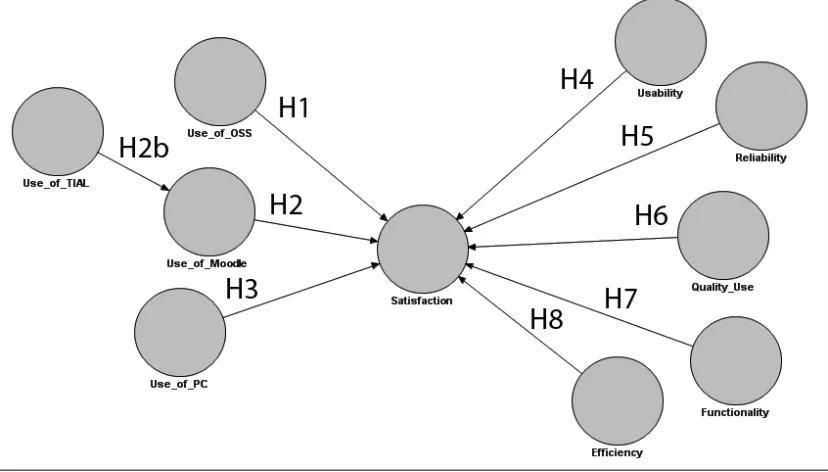
This research is based on a set of hypothesis covering two different aspects. The end users’ satisfaction is investigated as a consequence of specific software quality characteristics and of the past experience of the user.
Many times Open Source software are seen from final users as more difficult to be used (mainly due to the absence of documentation, of specific customer care services, and of the differences in usage paths normally adopted in standard de facto software). We therefore hypothesize that the previous experience of Open Source, intended as its usage intensity, may affect end users’ perception. The following hypothesis is therefore formulated:
H1: The intensity of usage of Open Source software affects end users’ satisfaction.
In our specific context, the Open Source software that has been used is the Moodle e-learning platform (and the TIALab on-line course that was hosted in the platform used by students). Therefore the following two hypothesis are formulated:
H2: The intensity of usage of the Moodle e-learning platform affects end users’ satisfaction.
H2b: The intensity of usage of the TIALab on-line course in the Moodle e-learning platform affects the intensity of usage of the Moodle e-learning platform.
The difficulties that end users find in the usage of Open Source software might be less relevant for expert users. Their specific stock of knowledge, measured by their stated intensity of PC usage, might allow them to more easily use those software, and to have a more fruitful usage experience. Therefore, we formulate the following hypothesis:
H3: The intensity of usage of PC affects end users’ satisfaction.
Finally, the quality perception of the end users can of course be influenced by specific quality characteristics of the software adopted. To refer to quality characteristics of software we adopted the ISO 9126 international standard that describes software quality as composed by several dimensions: Functionality, Reliability, Usability, Efficiency, Maintenability, Portability, Quality in Use. Some of these characteristics are internal, and therefore difficult to be analyzed or assessed from the point of view of the final user. Other characteristics are instead external, since they are pertinent to aspects that the final user can perceive and judge. Focusing only on external characteristics, we therefore formulate the following hypothesis:
H5: The perceived Reliability of the Moodle e-learning platform affects end users’ satisfaction. H6: The perceived Quality in Use of the Moodle e-learning platform affects end users’ satisfaction. H7: The perceived Functionality of the Moodle e-learning platform affects end users’ satisfaction. H8: The perceived Efficiency of the Moodle e-learning platform affects end users’ satisfaction.
A summary and the relationships among all hypothesis are shown in Fig. 1.
4. Results
4.1 Measurement Model
The evaluation of the measurement model has been made adopting the quality criteria produced by PLS. These are shown in tab. 1 and tab. 3 (in the Appendix).
Indicators and their loadings adopted to measure latent variables are shown in tab. 1 (last two columns). The loadings are supposed to be significant if they exceed the 0,707 criterion. Non significant indicators are indicated in boldface in the last column of tab. 1.
Tab. 1 also shows three indexes that contribute to asses the quality of the measurement model: Average Variance Extracted (AVE), composite reliability, and Cronbach’s Alpha. The Average Variance Extracted (AVE) reflects the average communality for each latent factor and is used to establish convergente validity: AVE should be greater than 0.5 [23, 25]. Cronabch’s Alpha is a measure of internal consistent reliability: a value grater than 0.60 is good enough for exploratory purposes. Composite Reliability, is also a measure of reliability (preferred to Cronbach’s Alpha since the latter is biased against short scaled): like the Cronbach’s Alpha, a value grater than 0.60 is good enough for exploratory purposes [23, 25]. Tab. 3 shows the factors cross loadings. In an ideal model, expected loadings (those between indicators and measures) will be strong, while cross-loadings will be weak.
The r square for the model turned out to be 0,74 (strong) for the Satisfaction construct, and 0,11(weak) for the Use_Moodle construct.
4.2 Structural Model
After having assessed the validity of the measurement model, the test of the structural paths in our model has been done using PLS. All the answers to the survey were used to form a sample that has been adopted to test the hypothesis we identified. To estimate signs and significance of the path coefficients we adopted a bootstrapping technique. The test has been done at 5% of significance with one-tailed t-test.
in Use and the previous use of Moodle positively affects the perceived Satisfaction. The direct effect also shows the obvious consideration that the usage of the TIAL course (a special course created in Moodle for the students taking part into this survey) affects the Use of Moodle.
Neverthless, the total effect shows that, excluding the obvious result that has just been discussed, the only hypothesis supported are the one connected to Functionality and Quality in Use.
5. Discussion
This study analyzed perceived customers’ satisfaction of the Moodle e-learning platform adopting a multi-variable model. The model described in the text is capable of explaining 73,73% of the variance of the sample, therefore we consider it as quite good in describing the sample. Some further considerations can be formulated concerning the model.
First of all, it has to be pointed out that not all indicators loadings exceeded the 0,707 criterion. The loadings and the indicators which did not fulfill the criterion are shown in boldface in Tab. 1. Moreover, also the Cronbach’s Alpha and the AVE index were not satisfactory for two measures (again, thei are shown in boldface in tab.q. In particular, Cronbach’s Alpha was not satisfactory for the Usage_PC and Use_Moodle measures, while the AVE was not satisfactory only for the Use_Moodle measure. Cronbach’s Alpha measures the internal consistent reliability of the measure. If it has to be interpreted literally, the two measures Use_Moodle and Usage_PC were, respectively, strongly unreliable and weakly unreliable. Anyhow, as already cited, Cronbach’s alpha is biased against short scale (this is exactly our case, since we adopted a 4 points scale). Therefore, for these measures, we decide not to pay attention to Cronbach’s alpha since the Composite Reliability index (who alos measures reliability and does not suffer from the bias problem) is satisfactory for exploratory purposes. Adopting a “lessons learned” perspective from the analysis that has been made so far, we believe that the indicators that were not satisfactory have to be discarded from the model, and have to be replaced with different ones. We mainly used the ISO 9126 international standard description to derive the indicators for the quality dimensions. In further research this approach has to be withdraw and indicators have to be gathered in a different way.
Regarding the test of the hypothesis, the only supported hypothesis are those that posits a correlation between Functionality and Satisfaction (H7) and between Quality in Use and Satisfaction (H6). In both cases the correlation turned out to be positive. The hypothesis that the usage of the TIALab course affects the usage of the Moodle e-learning platform is of no great relevance since it is an obvious result.
According to the results of our sample, quality perception of final users seems to be affected only by functionality and quality in use. These results can be seen to be intuitive, since final users are most likely to perceive external aspects of the software, and functionality and quality in use are both external aspects. Anyhow, according to us, it is interesting to notice how final users perceive as relevant only a subset of external aspects of the software.
Moreover, our sample shows no relevance in the perceived satisfaction of past experiences with Open Source Software, nor of past experiences with the general PC usage. Further revision of the indicators of the model could help in gaining more understanding on this specific topic, since in the present model 2 out of 4 indicators for the Usage of Open Source software were not satisfactory.
This paper introduced an explorative study on the Moodle e-learning platform seen from the perspective of the final user. In this paper we applied a second-generation causal modeling technique to analyze how end users perceive usability and quality of the specific e-learning platform. We therefore proposed a model that describes antecedents of end-users satisfaction. Our study shows that, among the set of hypothesis that compose the model, only Functionality and Quality in Use result validated in our sample, indicating that there is a positive correlation between satisfaction, on one side, and functionality and quality in use on the other. Translated into practice, these conclusion suggests that final user feel themselves satisfied with the e-learning platform if the platform offers functionalities that are accurate, useful, and show a proper degree of security. At the same time, such features need to allow the final user to reach his objectives in a productive and an effective way.
No useful information are available on whether previous experience with other software (both Open Source and not Open Source) affect end users’ perception. This is mainly due to some limitation of our measurement model, and in particular to the inadequateness of some indicators of our model. Therefore, a revision of the model will be necessary to investigate also this other area.
Since this paper is based only on the Moodle e-learning platform, the results of the research are valid for this platform only. Besides Moodle there are others e-learning platforms, both Open and Closed source. We therefore do not claim to extend the results of this study to every platform. Anyhow, the research model adopted in this paper could be applied to others e-leraning platforms too (no matter whether they would be Open Source or not). In future research, once the measurement model would be improved to overpass the limitations that have been highlighted in this paragraph, we could think to apply it to others e-learning platforms to develop a theory of end users’ perception.
References
[1] Darking, M.L, Whitley, E.A. (2007). Towards an Understanding of FLOSS: Infrasctructures, Materiality and the Digital Business Econosystem. Science Studies, 20(2): 13-33.
[2] von Krogh, G., Spaeth, S. (2007). The Open Source Software Phenomenon: Characteristics that Promote Research.
Journal of Strategic Information systems, 16(3): 236-253.
[3] Mockus, A., Fielding, R.T., Herbsleb, J.D. (2002). Two case Studies of Open Source Soft-ware Development: Apache and Mozilla. ACM Transactions on software engineering methodology, 11(3): 309-346.
[4] Stamelos, I., Angelis, L., Oikonomou, A., Bleris, G.L. (2002). Code quality analysis in Open Source software development. Info Systems Journal, 12(1): 43-60.
[5] Fuggetta, A. (2003). Open Source software – an evaluation. The Journal of Systems and Software, 66(1): 77-90. [6] Stone, A. (2002). Open Source Acceptance Grows. IEEE Software, 19(2): 102.
[7] Gallego, M.D., Luna, P., Bueno, S. (2007). User acceptance model of Open Source Software. Computers in Human
Behaviour, 24(5): 2199-2216.
[8] Crowstone, K., Annabi, H., Howison, J. (2003). Defining Open Source Software Project Success. Proceeding of the Twenty-fourth International Conference on Information Systems (pp. 327-340).
[9] Nichols, D.M. and Twidale, M.B. (2006). Usability processes in open source projects. Software Process: Improvement and Practice, 11(2): 149-162.
[11] Benson, C., Muller-Prove, M., Mzourek, J. (2004). Professional usability in open source projects: GNOME, OpenOffice.org, NetBeans. Extended Abstracts of the Conference on Human Factors and Computing Systems. ACM Press: New York, 1083–1084.
[12] Nichols, D.M., Twidale M.B. (2005). The usability of open source software. First Monday 8(1): http://firstmonday.org/issues/issue8_1/nichols/, 15 September 2005.
[13] Nichols, D.M., McKay, D., Twidale, M.B. (2003). Participatory usability: supporting proactive users, Proceedings of 4th ACM SIGCHI NZ Symposium on Computer-Human Interaction (CHINZ’03), SIGCI: Dunedin, 63–68.
[14] Raymond, E.S. (1999). The revenge of the hackers. In Open Sources: Voices from the Open Source Revolution, StoneM,
Ockman S, DiBona C (eds). O’Reilly and Associates: Sebastopol, CA, 207–219.
[15] Raymond, E.S. (2001) The Cathedral and the Bazaar: Musings on Linux and Open Source by an Accidental Revolutionary, O’Reilly.
[16] Challet, D., Le Du, Y. (2003), Microscopic model of software bug dynamics: Closed Source versus Open Source, International Journal of Reliability, Quality and Safety Engineering, 12(6): 521-534.
[17] Chelf, B. (2006). Measuring software quality – A Study of Open Source Software. http://coverity.com/html/library.php. [18] Coverity Inc. (2008). Open Source Report. http://scan.coverity.com/report.
[19] DeLone, W.H., McLean, E.R (1992). Information systems success: the quest for the dependent variable. Information
Systems Research, 3(1): 60-95.
[20] DeLone, W.H., McLean, E.R (2003). The DeLone and McLean model of information systems success: a ten-year update.
Journal of Management Information Systems, 19(4): 9-30.
[21] Sang-Yong, T.L., Hee-Woong, K., Sumeet, G. (2007). Measuring open source software success. Omega, 37(2): 426-438. [22] Hair, J.F., Anderson, R.E., Tatham, R.L., Black, W.C. (1998). Multivariate data analysis. Fifth ed. Englewood Cliffs, NJ: Prentice-Hall.
[23] Chin, W.W. (1998). The Partial Least Squares Approach to Structural Equation Modeling, in: Modern Methods for
Business Research, G.A. Marcoulides (ed.), London, (pp. 295-336).
[24] Fornell, C., Bookstein, F.L. (1982). Two Structrual Equation Models: LISREL and PLS Applied to Customer Exit-Voice Theory, Journal of Marketing Research 19(11): 440-452.
Fig 1. Model
AVE Composite Reliability Cronbach’s Alpha Indicators Loadings
Efficiency 1,000000 1,000000 1,000000 Response_Time 1,000
Functionality 0,565670 0,792308 0,616468 Accuracy
Utility Security_Level
0,794 0,852 0,583
Quality_Use 0,821093 0,901759 0,782113 Effectiveness
Productivity
0,907 0,905
Reliability 0,763472 0,865773 0,692764 Recoverability
Absence_of_Errors
0,899 0,848
Satisfaction 1,000000 1,000000 1,000000 Global_Satisfaction 1,000
Usability 0,864000 0,927036 0,842777 Operability
Understandability
0,935 0,924
Usage_PC 0,523632 0,763000 0,580351 Study
Work Web_Browsing
0,735 0,569 0,840
Use_Moodle 0,413925 0,664671 0,255122 Chat
Forum
Download_Teaching_Material
0,791 0,674 0,401
Use_OSS 0,515815 0,792785 0,757240 Firefox
Thunderbird Ubuntu_Linux Others_Linux 0,457 0,445 0,905 0,914
Use_TIAL 0,670406 0,890362 0,867739 Labels
Pages Quizzes Teaching_Material_Upload 0,783 0,817 0,797 0,876 Tab. 1. Model’s quality criteria
Total Effect Direct Effect
Cohefficient t Statistics Cohefficient t Statistics H8 - Efficiency -> Satisfaction -0,105281 1,204911 -0,105281 1,414464 H7 - Functionality -> Satisfaction 0,583309 5,561073 0,583309 5,561073 H6 - Quality_Use -> Satisfaction 0,436835 3,873900 0,436835 3,873900 H5 - Reliability -> Satisfaction -0,045140 0,419233 -0,045140 0,648999 H4 - Usability -> Satisfaction 0,128089 1,134556 0,128089 1,428445 H3 - Usage_PC -> Satisfaction -0,033867 0,315560 -0,033867 0,492695 H2 - Use_Moodle -> Satisfaction -0,083068 0,870419 -0,083068 1,204345 H1 - Use_OSS -> Satisfaction 0,284902 1,820716 0,284902 2,287758
H2C - Use_TIAL -> Satisfaction -0,027806 0,672634 - -