Open Access
Research
DNA fingerprinting of Shiga-toxin producing
Escherichia coli
O157
based on Multiple-Locus Variable-Number Tandem-Repeats
Analysis (MLVA)
Bjørn-Arne Lindstedt*
1, Even Heir
1, Elisabet Gjernes
1, Traute Vardund
1and
Georg Kapperud
1,2Address: 1Norwegian Institute of Public Health, Department of Infectious Disease Control, Oslo, Norway and 2Department of Pharmacology,
Microbiology and Food Hygiene, Norwegian School of Veterinary Sciences, Oslo, Norway
Email: Bjørn-Arne Lindstedt* - [email protected]; Even Heir - [email protected];
Elisabet Gjernes - [email protected]; Traute Vardund - [email protected]; Georg Kapperud - [email protected] * Corresponding author
VNTR fingerprintingEscherichia coliSTECcapillary electrophoresisPFGEAFLP
Abstract
Background: The ability to react early to possible outbreaks of Escherichia coli O157:H7 and to trace possible sources relies on the availability of highly discriminatory and reliable techniques. The development of methods that are fast and has the potential for complete automation is needed for this important pathogen.
Methods: In all 73 isolates of shiga-toxin producing E. coli O157 (STEC) were used in this study. The two available fully sequenced STEC genomes were scanned for tandem repeated stretches of DNA, which were evaluated as polymorphic markers for isolate identification.
Results: The 73 E. coli isolates displayed 47 distinct patterns and the MLVA assay was capable of high discrimination between the E. coli O157 strains. The assay was fast and all the steps can be automated.
Conclusion: The findings demonstrate a novel high discriminatory molecular typing method for the important pathogen E. coli O157 that is fast, robust and offers many advantages compared to current methods.
Background
Escherichia coli O157:H7 is a common cause of a variety of illnesses, including bloody diarrhea and the hemolytic uremic syndrome (HUS). The O157:H7 serotype was first described in the literature in 1983 following two out-breaks of hemorrhagic colitis in a fast-food restaurant chain in Oregon and Michigan in 1982 [1,2]. Illness was characterized by watery diarrhea, which progressed to
bloody diarrhea and abdominal cramps [1,2]. E. coli O157:H7 belongs to a group of diarrheagenic E. coli named Shiga toxin-producing E. coli (STEC) [3]. STEC produce several distinct Shiga toxins (Stx) [4] and it is believed that HUS results from the systemic action of Stx on vascular endothelial cells [5]. The most frequent mode of transmission for E. coli O157:H7 infection is through consumption of contaminated food and water, and
Published: 10 December 2003
Annals of Clinical Microbiology and Antimicrobials 2003, 2:12
Received: 07 August 2003 Accepted: 10 December 2003
This article is available from: http://www.ann-clinmicrob.com/content/2/1/12
several outbreaks have been caused by ground beef. Approximately 1% of healthy cattle may have the organ-ism in their intestines.
The ability to react early to possible outbreaks of E. coli O157:H7 and to trace possible sources relies on the avail-ability of highly discriminatory and reliable techniques. Of particular interest are the DNA based molecular typing methods. Previous work in our laboratory has shown that the pulsed-field gel electrophoresis (PFGE) method of XbaI digested whole genomes gave good discrimination and was highly reproducible [6]. We previously compared PFGE with the newer method of Amplified-Fragment Length Polymorphism (AFLP) and found that while AFLP was faster, PFGE offered the best resolution for typing E. coli O157:H7 [6]. Typing E. coli O157:H7 by PFGE is cur-rently the preferred typing method in our laboratory. However, the rapid sequencing of complete bacterial genomes including the sequence of two E. coli O157:H7 strains [7,8]. gave us the opportunity to search the genomes of these two strains in order to look for Variable Number of Tandem Repeats (VNTRs) that could be used as a source of genetic polymorphisms and be used in a typing assay. Polymorphic VNTR regions which can be used for typing purpouses have been identified and tested in Yersinia pestis [9-11], Francisella tularensis [12], Mycobac-terium tuberculosis [13-16], Xylella fastidiosa [17], Haemo-philus influenzae [18-20], Bacillus anthracis [21-24], and we have recently developed a VNTR based typing assay for the important enteropathogen Salmonella Typhimurium [25].
Methods
Bacterial strains
In all 73 isolates of shiga-toxin producing Escherichia coli O157 were used in this study. The isolates included both domestic (32 isolates) strains and strains from Sweden (11 isolates), Finland (6 isolates), UK (5 isolates) and from the USA (19 isolates). The majority, 69, of the iso-lates have previously been typed both by XbaI PFGE and AFLP [6], and the collection included strains from well characterized outbreaks as well as strains designated as sporadic isolates. Table 1 [see Additional file 1] summa-rizes the strain collection.
DNA extraction
Suspensions of bacterial cells were boiled for 15 min and used directly in the PCR reactions after a brief centrifuga-tion at 3500 rpm for 3 min., or genomic DNA was extracted using a commercial kit ("Easy-DNA"; Invitrogen BV, Leek, The Netherlands).
MLVA typing
The genomic sequences of both the E. coli O157 strains that have been fully sequenced (accession numbers AE005174 and NC_002695) were searched for tandem
repeated DNA motifs with the Tandem Repeat Finder [26], GeneQuest (DNASTAR, Madison WI) and Kodon (Applied-Maths, Kortrijk, Belgium) software. Several regions containing tandem repeated motifs were found, of which seven were chosen to constitute a set for high level discrimination of E. coli O157 isolates. Six of the VNTRs were localized on the main chromosome, and one was localized on the E. coli O157 large virulence plasmid (accession no. AF074613). Table 2 [see Additional file 2] gives an overview over the repeat characteristics. The VNTRs were situated in five genes and two intergenic regions and had repeated motifs ranging from 6 to 30 basepairs. Some of the VNTRs displayed size variations between the EDL933 and Sakai strains when their Gen-Bank sequences were examined, and the predicted ampli-cons are shown in table 2 [see Additional file 2]. The actual repeats with leader and tailing sequence of 500 bps were used to design specific PCR primers (Table 3) [see Additional file 3]. Care was taken to match both anneal-ing temperature and sizes of the produced PCR amplicons to make a convenient set for PCR and capillary electro-phoresis separation. The PrimerSelect (DNASTAR) soft-ware automatically calculated the primer annealing temperatures, and analyzed how the different primers could interact in multiplex PCR. The forward primers for all the seven VNTR regions were labelled with 6 FAM (6'-carboxyfluorescein). The different primer-sets were tested against each other in several combinations. A combina-tion of primers with Vhec1 alone annealed at 50°C, Vhec4 and Vhec5 annealed at 53°C, Vhec2 and Vhec3 annealed at 50°C and Vhec6 and Vhec7 annealed at 50°C. The tem-perature profile was: 94°C denaturation for 5 min fol-lowed by 30 cycles of 94°C for 30 s, annealing temperature from above for 60 s and 72°C for 50 s and finally a 10 min extension step at 72°C performed on a GeneAmp PCR system 9700 (Applied-Biosystems, Foster City, CA). Five microliters of each of the PCR products were pooled together into a single tube for each sample and thoroughly mixed. Five microliters of the resus-pended solution mixed with 8 µl formamid and 1 µl of size standard was then used for capillary electrophoresis, after a 2 min denaturation at 94°C, on an ABI-310 Genetic Analyzer (Applied-Biosystems) with POP4-poly-mer and Genescan TAMRA-500 or TAMRA-2500 as inter-nal standard in each sample (Applied-Biosystems). The capillary electrophoresis was run for 50 min at 60°C. The samples were injected into the capillary by applying a 15 kV voltage for 5 s. The run voltage was 15 kV. The size of each VNTR locus was determined by the GeneScan soft-ware (Applied-Biosystems).
Phylogeny calculation
cluster analysis with the unweighted pair group method with arithmetic averages (UPGMA) from the ABI trace files. The constructed phylogeny was based on the result-ing compound band-pattern from all amplified loci for each isolate, thus, the separate VNTR loci were not ana-lysed individually.
Sequencing
The same primers used to amplify the VNTR regions were used for sequencing at 3.2 pmol concentration. The PCR products were cleaned with the Qiaquick PCR purification kit (QIAGEN, Hilden, Germany) and both forward and reverse strands were sequenced two times each using the ABI Cycle-sequencing kit V3.0 (Applied-Biosystems), the sequencing products were cleaned with the DyeEx kit (QIAGEN) to remove unincorporated dyes before applied on an ABI-3100 automated sequencer.
Results
The Tandem Repeat Finder software [26] found 36 repeats when it was set to search for repeated motifs of 6 or more nucleotides repeated in tandem with 3 or more copies, which were more than 60% internally homogenous between repeat units. Both the GeneQuest (DNASTAR) and Kodon software (Applied-Maths) found these repeats and added the possibility of viewing graphics of the loca-tion of each VNTR locus with surrounding area, and infor-mation about melting temperatures and GC content in these genomic areas. The Tandem Repeat Finder offered by far the fastest search routine, however, both GeneQuest and Kodon also searched for other classes of repeated DNA e.g. inverted repeats and dyad repeats.
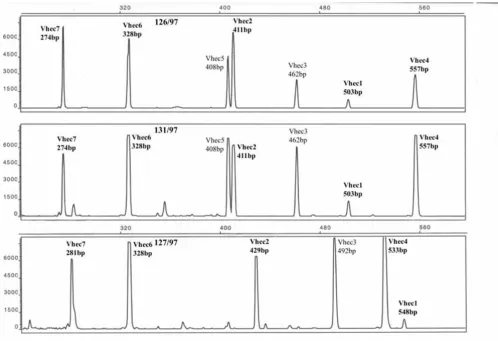
The MLVA assay displayed 47 distinct profiles among the 73 strains analysed. The resulting electropherogram of the pooled amplicons showed a clear and easily interpretable banding patterns (Figure 1). The identification of each peak in the pooled run with the correct VNTR region was done by running each primer-pair separately in every iso-late. This was done primarily for the development of the method, and the resulting phylogeny was based on the resulting banding-pattern without identifying each locus separately. Selected isolates were run repeated times by different individuals, and always displayed identical banding patterns. Some minor variations in signal strength between runs were noted which possibly could be explained by variations in PCR efficiency or in the amount of DNA available as template since the boiling of isolates is likely to produce different amount of DNA. Not all the VNTR loci gave amplification products in all iso-lates or some of the peaks were masked by two VNTRs producing the same sized PCR products. The majority of samples displayed all amplification products, although some of these were masked by two different VNTRs having the same size in the electropherograms. Eight isolates
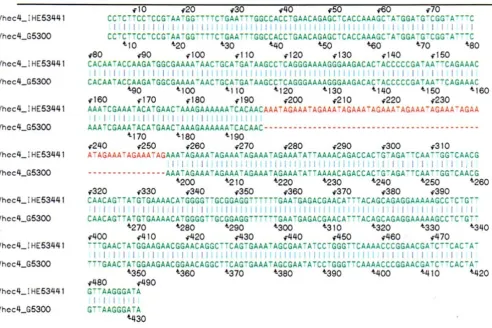
(11%) displayed a loss of one band, and only one isolate had less than 6 bands (Table 4) [see Additional file 4]. All primer-pairs showed loss of amplification products except Vhec2, Vhec6 and Vhec7, which were present in all our isolates. All the VNTR loci displayed heterogeneity in our material. In table 5 [see Additional file 5] the data for allele size ranges in basepairs, number of alleles at each locus and the polymorphism index of each marker is shown. In table 4 [see Additional file 4] the allele distribu-tion among all the distinct MLVA patterns are shown. All unique alleles differing by gain or loss of repeat units were given allele numbers, thus PCR amplicons of a VNTR locus with the same size in different isolates were given the same number in table 4 [see Additional file 4]. Differ-ent allele sizes at the differDiffer-ent VNTR loci were results of loss or gains of repeat unites, which were verified by direct sequencing of the PCR amplicons using the VNTR prim-ers. In figure 2 is an alignment of the Vhec4 primer prod-ucts from isolates G5300 and IHE5344 showing a 10 repeat unit difference of the AAATAG motif.
Discussion
outbreak #7 (USA) displayed a different MLVA profile (V28) than the rest of the outbreak #7 strains (V30). This isolate was also different by PFGE typing indicating that this strain might not be a part of outbreak #7, or that this outbreak had several strains involved. Strain G4919 (V30) of outbreak #7 displayed a different PFGE profile (P17) from the main PFGE pattern of this outbreak (P16), but by MLVA this strain was identical to the main outbreak pattern V30. The P16 and P17 PFGE profiles were, how-ever, quite similar and had a one-band difference [6] mak-ing the MLVA data credible. Outbreak #6 from the USA was also divided into different profiles by MLVAtyping. Strains H0619 and H0620 were identical (V31), while H0617 (V32), H0618 (V34) and H0616 (V35) displayed different profiles. Here only the H0618 isolate was also different by PFGE. The H0617 and H0616 isolates were thus identical with H0619 and H0620 by PFGE while they
had different patterns by MLVA (Table 1) [see Additional file 1]. The outbreak #6 isolates did however cluster together, but strain 174/99 (V33), a Norwegian isolate, was included in this cluster by MLVA. The cattle isolates H90/95, H82/95, H83/95 and H89/95 were isolated from the same herd, and believed to be identical. This was con-firmed by MLVA typing, which gave identical patterns for these isolates (V36). The PFGE typing, however, displayed minor differences between these isolates, giving H90/95 and H83/95 identical patterns (P37) as well as different patterns for H82/95 (P38) and H89/95 (P39). The PFGE profiles for patterns P37, P38 and P39 were, however, highly similar and related [6]. No size variations in the repeated motifs in any of the seven VNTR loci were detected between isolates H82/95 and H90/95. For out-break #14 (V42 profile), the MLVA assay included two iso-lates, one human isolate previously considered unrelated Escherichia coli O157 MLVA Fragment patterns generated from seven VNTR loci showing two identical and one different profile
Figure 1
Escherichia coli O157 MLVA Fragment patterns generated from seven VNTR loci showing two identical and
3108/97 (V42) and one isolate from cattle 127/97 (V42). The suspected outbreak isolate 127/98 (V43) (outbreak #14) was given a different profile from the other outbreak strains by MLVA (Fig. 1). The inclusion of strain 3108/97 into outbreak #14 was confirmed by PFGE, while the exclusion of 127/98 was not indicated neither by PFGE nor AFLP. Figure 1 shows the MLVA patterns for three iso-lates that were identical by PFGE and AFLP. Two of these isolates (131/97 and 126/97) were also identical by MLVA (V1), while strain 127/97 displayed a clearly unrelated profile (V42). Some of the MLVA types in table 1 [see Additional file 1] displayed less than seven VNTR bands. The reason for this was that some primer-pairs did not give an amplification product in all isolates. It can also be viewed in figure 1 where the 127/97 isolate in the lower panel has no amplification product from the Vhec5 primer-pairs.
Conclusions
The main finding was a remarkable high co-clustering of the MLVA and PFGE profiles. This high co-clustering was a bit unexpected given that these methods were based on quite different mechanisms to generate the profile date. The presence of XbaI recognition sites for PFGE and the variability of tandem repeated motifs in MLVA. The good correlation between PFGE and MLVA is important since the majority of E. coli O157 has been typed by PFGE and the clusters generated with MLVA will be familiar. The speed of the MLVA assay combined with its resolution makes it an attractive alternative for typing E. coli O157 isolates which are considered to be the most important pathogens so far among the shiga-toxin producing E. coli serotypes. We thus present here a novel VNTR based typ-ing method for STEC O157 strains, which is both consid-erably faster, less labour intensive and yet offers a slightly higher discriminatory power compared to PFGE. An
addi-Sequence alignment of the Vhec4 VNTR loci from isolates G5300 and IHE5344
Figure 2
tional benefit compared with PFGE is the potential for fully automating the analysis. The main tasks were liquid handling, which can be performed by laboratory robots, and by using multi-dye electrophoresis the analysis of the data can also be automated.
Authors' contributions
B-AL had primary responsibility for study design, collec-tion of data and writing the manuscript. EH performed the comparison with the PFGE and AFLP data and had intellectual contribution, EG and TV verified the results and had intellectual contributions. GK had intellectual contribution.
Additional material
References
1. Riley LW, Remis RS, Helgerson SD, McGee HB, Wells JG, Davis BR, Hebert RJ, Olcott ES, Johnson LM, Hargrett NT, Blake PA, Cohen ML:
Hemorrhagic colitis associated with a rare Escherichia coli
serotype.N Engl J Med 1983, 308:681-685.
2. Wells JG, Davis BR, Wachsmuth IK, Riley LW, Remis RS, Sokolow R, Morris GK: Laboratory investigation of hemorrhagic colitis outbreaks associated with a rare Escherichia coli serotype.J Clin Microbiol 1983, 18:512-520.
3. Paton JC, Paton AW: Pathogenesis and diagnosis of Shiga toxin-producing Escherichia coli infections. Clin Microbiol Rev 1998,
11:450-479.
4. Melton-Celsa AR, Rogers JE, Schmitt CK, Darnell SC, O'Brien AD:
Virulence of Shiga toxin-producing Escherichia coli (STEC) in orally-infected mice correlates with the type of toxin pro-duced by the infecting strain. Jpn J Med Sci Biol 1998,
51(Suppl):S108-S114.
5. Louise CB, Obrig TG: Shiga toxin-associated hemolytic uremic syndrome: combined cytotoxic effects of shiga toxin and lipopolysaccharide (endotoxin) on human vascular endothe-lial cells in vitro.Infect Immun 1992, 60:1536-1543.
6. Heir E, Lindstedt B-A, Vardund T, Wasteson Y, Kapperud G:
Genomic fingerprinting of shigatoxin-producing Escherichia coli (STEC) strains: comparison of pulsed-field gel electro-phoresis (PFGE) and fluorescent amplified-fragment-length polymorphism (FAFLP).Epidemiol Infect 2000, 125:537-548. 7. Hayashi T, Makino K, Ohnishi M, Kurokawa K, Ishii K, Yokoyama K,
Han CG, Ohtsubo E, Nakayama K, Murata T, Tanaka M, Tobe T, Iida T, Takami H, Honda T, Sasakawa C, Ogasawara N, Yasunaga T, Kuhara S, Shiba T, Hattori M, Shinagawa H: Complete genome sequence of enterohemorrhagic Escherichia coli O157:H7 and genomic comparison with a laboratory strain K-12.DNA Res 2001, 8:11-22.
8. Perna NT, Plunkett G, Burland V, Mau B, Glasner JD, Rose DJ, May-hew GF, Evans PS, Gregor J, Kirkpatrick HA, Posfai G, Hackett J, Klink S, Boutin A, Shao Y, Miller L, Grotbeck EJ, Davis NW, Lim A, Dimalanta ET, Potamousis KD, Apodaca J, Anantharaman TS, Lin J, Yen G, Schwartz DC, Welch RA, Blattner FR: Genome sequence of enterohaemorrhagic Escherichia coli O157:H7.Nature 2001,
409:529-533.
9. Adair DM, Worsham PL, Hill KK, Klevytska AM, Jackson PJ, Fried-lander AM, Keim P: Diversity in a variable-number tandem repeat from Yersinia pestis.J Clin Microbiol 2000, 38:1516-1519. 10. Klevytska AM, Price LB, Schupp JM, Worsham PL, Wong J, Keim P:
Identification and characterization of variable-number tan-dem repeats in the Yersinia pestis genome.J Clin Microbiol 2001,
39:3179-3185.
11. Le Fleche P, Hauck Y, Onteniente L, Prieur A, Denoeud F, Ramisse V, Sylvestre P, Benson G, Ramisse F, Vergnaud G: A tandem repeats database for bacterial genomes: application to the genotyp-ing of Yersinia pestis and Bacillus anthracis.BMC Microbiol 2001,
1:2.
12. Johansson A, Göransson I, Larsson P, Sjöstedt A: Extensive allelic variation among Francisella tularensis strains in a short-sequence tandem repeat region. J Clin Microbiol 2001,
39:3140-3146.
13. Frothingham R, Meeker-O'Connell WA: Genetic diversity in the
Mycobacterium tuberculosis complex based on variable num-bers of tandem DNA repeats. Microbiology 1998, 144(Pt 5):1189-1196.
14. Skuce RA, McCorry TP, McCarroll JF, Roring SM, Scott AN, Brittain D, Hughes SL, Hewinson RG, Neill SD: Discrimination of Myco-bacterium tuberculosis complex bacteria using novel VNTR-PCR targets.Microbiology 2002, 148:519-528.
15. Supply P, Mazars E, Lesjean S, Vincent V, Gicquel B, Locht C: Varia-ble human minisatellite-like regions in the Mycobacterium tuberculosis genome.Mol Microbiol 2000, 36:762-771.
16. LeFleche P, Fabre M, Denoeud F, Koeck JL, Vergnaud G: High reso-lution, on-line identification of strains from the Mycobacte-rium tuberculosis complex based on tandem repeat typing.
BMC Microbiol 2002, 2:37.
17. Coletta-Filho HD, Takita MA, de Souza AA, Aguilar-Vildoso CI, Mach-ado MA: Differentiation of strains of Xylella fastidiosa by a var-iable number of tandem repeat analysis.Appl Environ Microbiol
2001, 67:4091-4095.
Additional File 1
Characteristics of the E. coli O157 strains. A) Presence of genes encoding
shigatoxin 1 (stx1) and/or shigatoxin 2 (stx2) is indicated. B) The data
for the PFGE and AFLP analysis is from our previous study (Heir et al.2000). C) Kindly provided by E. Borch, Swedish Meat Research
Insti-tute, Kävlinge, Sweden. D) Kindly provided by F. Thomson-Carter,
Scot-tish Reference Laboratory for Campylobacter and E. coli, Aberdeen, Scotland. E) Kindly provided by T. J. Barrett, Centers for Disease Control
and Prevention, Atlanta, USA. F) Kindly provided by A. Siitonen,
National Public Health Institute, Helsinki, Finland.
Click here for file
[http://www.biomedcentral.com/content/supplementary/1476-0711-2-12-S1.doc]
Additional File 2
Characteristics of the E. coli O157 VNTR regions. A In sequence
NC_002695 B In sequence AE005174 C In sequence AF074613, located
on the pO157 large virulence plasmid.
Click here for file
[http://www.biomedcentral.com/content/supplementary/1476-0711-2-12-S2.doc]
Additional File 3
VNTR primers for MLVA genotyping of E. coli O157.
Click here for file
[http://www.biomedcentral.com/content/supplementary/1476-0711-2-12-S3.doc]
Additional File 4
Distribution of alleles for all seven VNTR loci in each of the 47 distinct MLVA profiles. AEach allele differing by gain or loss of repeat units is
indi-cated by an allele number. np = no PCR product.
Click here for file
[http://www.biomedcentral.com/content/supplementary/1476-0711-2-12-S4.doc]
Additional File 5
Allele ranges in basepairs(bp), total number of alleles and polymorphism index for each locus. APolymorphism index is calculated as 1-Σ (allele
frequency)2 among the isolates where the marker is present.
Click here for file
Publish with BioMed Central and every scientist can read your work free of charge "BioMed Central will be the most significant development for disseminating the results of biomedical researc h in our lifetime."
Sir Paul Nurse, Cancer Research UK
Your research papers will be:
available free of charge to the entire biomedical community
peer reviewed and published immediately upon acceptance
cited in PubMed and archived on PubMed Central
yours — you keep the copyright
Submit your manuscript here:
http://www.biomedcentral.com/info/publishing_adv.asp
BioMedcentral
18. van Belkum A, Melchers WJ, Ijsseldijk C, Nohlmans L, Verbrugh H, Meis JF: Outbreak of amoxicillin-resistant Haemophilus influ-enzae type b: variable number of tandem repeats as novel molecular markers.J Clin Microbiol 1997, 35:1517-1520. 19. van Belkum A, Scherer S, van Leeuwen W, Willemse D, van Alphen
L, Verbrugh H: Variable number of tandem repeats in clinical strains of Haemophilus influenzae. Infect Immun 1997,
65:5017-5027.
20. Weiser JN, Maskell DJ, Butler PD, Lindberg AA, Moxon ER: Charac-terization of repetitive sequences controlling phase varia-tion of Haemophilus influenzae lipopolysaccharide. J Bacteriol
1990, 172:3304-3309.
21. Andersen GL, Simchock JM, Wilson KH: Identification of a region of genetic variability among Bacillus anthracis strains and related species.J Bacteriol 1996, 178:377-384.
22. Keim P, Price LB, Klevytska AM, Smith KL, Schupp JM, Okinaka R, Jackson P, Hugh-Jones ME: Multiple-locus variable-number tan-dem repeat analysis reveals genetic relationships within
Bacillus anthracis.J Bacteriol 2000, 182:2928-2936.
23. Kim W, Hong YP, Yoo JH, Lee WB, Choi CS, Chung SI: Genetic relationships of Bacillus anthracis and closely related species based on variable-number tandem repeat analysis and BOX-PCR genomic fingerprinting. FEMS Microbiol Lett 2002,
207:21-27.
24. Smith KL, DeVos V, Bryden H, Price LB, Hugh-Jones ME, Keim P:
Bacillus anthracis diversity in Kruger National Park. J Clin Microbiol 2000, 38:3780-3784.
25. Lindstedt B-A, Heir E, Gjernes E, Kapperud G: DNA Fingerprint-ing of Salmonella enterica subsp. enterica Serovar Typhimu-rium with Emphasis on Phage Type DT104 Based on Variable Number of Tandem Repeat Loci.J Clin Microbiol 2003,
41:1469-1479.