Evaluating and Implementing learning Environments:
A United Kingdom Experience
BRUCE INGRAHAM University of Teesside, UK [email protected]
BARBARA WATSON University of Durham, UK
LIZ MCDOWELL University of Northumbria, UK
ADRIAN BROCKETT Sunderland University, UK
SIMON FITZPATRICK Newcastle University, UK
This article reports on ongoing work at the five universities in northeastern England, Durham, Newcastle, Northumbria, Sunderland, and Teesside. In common with many universities, all five have been engaged in the process of evaluating and imple-menting online learning environments. During the 1999-2000 academic year the authors organized a series of meetings to share information and experience. From these meetings and other activities the group identified a set of issues and criteria that they felt needed to be addressed to inform the decision making process. This article will report on these. The process is, of course, ongoing with all of the institutions having elaborated implementation strategies. The article will also report briefly on these decisions. However, it is perhaps significant that the four universities that have, at the time of writing, chosen a VLE have independently chosen the same one, Blackboard.
During the latter part of 1999, Barbara Watson of the University of Durham undertook a survey of work going on in the UK with respect to virtual or managed learning environments (VLEs/MLEs). The results of this survey are available at http://www.dur.ac.uk/ITS/ltteam/ under the heading “Learning Environments.” Partly inspired by this survey, the authors, who all act as teaching and learning technology (TLT) officers, recognized that, in common with many others, they were all engaged in the same task of seeking to determine a suitable online learning environment for use at their respective universities. Given the geographical proximity of the five Universities a decision was made to meet and share information and experience. This meeting led to a series of other meetings, workshops, and product demon-strations during the spring of 2000. From these meetings and other activities the group identified a set of issues and criteria that they felt needed to be addressed to inform the decision making process. The group then discussed the process of implementation and integration needed within their respective institutions. These, along with the decisions that have so far been made are detailed in the following article.
One important outcome of the initial meeting was the organisation of workshops to which the group invited colleagues from other universities who were actually using such systems to report on their experiences. The event was organised by Barbara Watson of University of Durham and took place at University of Durham Business School on March 30th, 2000. On the day there were formal presentations from colleagues from other UK Universi-ties who were already using various learning environments. These included Coventry University (WebCT), The University of Huddersfield (Blackboard /CourseInfo), The Sheffield Hallam University (FirstClass) and the TLTP3 CHIC Project (TopClass)1. There was an additional ad hoc presentation of Wolverhampton Univeristy’s WOLF2 environment by Pauline McCormack and Simon Fitzpatrick of Newcastle University. Each of the presentations was followed by discussions and the day ended with a plenary reflection on what had been learned. A report of this event is available from the North East Learning Environments (NELE) site http://www.dur.ac.uk/ITS/ltteam/. The results were also summarised at an Association of Learning Technology (ALT– http://www.alt.ac.uk) event organised by Dr. Brian Boullier at Bradford University on May 11th, 2000. A summary of the event is available in ALT-N Issue No 30.
of reports on these and other systems available under the heading “Learning Environments” at http://www.dur.ac.uk/ITS/ltteam/. Furthermore, such detail might suggest that the evaluation process was more coordinated than perhaps it really was. In reality, each of the five Universities was necessarily working to its own timeframe and pursuing its own agenda with reference to the implementation of a learning environment. What the collaborative process primarily did was to provide a forum for the consideration of a range of issues that arose during the ongoing processes and an opportunity to identify certain criteria or elements that a system should offer. It is our reflections on these issues and criteria that are reported here. Additionally, the article will briefly report on the decisions that have been taken and the state of implementation at each University.
ISSUES
The following are issues that the group believed needed to be addressed when implementing a learning environment. In principle, all of the authors were committed to a single university-wide system on the grounds that a single system would be easier to maintain and support. However, it might be that for some large or greatly devolved universities the implementation of multiple systems might be a viable option. In any case, one would need to address the following issues.
“Do-It-Yourself” or Acquire Commercially Available System(s)
The primary advantage of acquiring a commercial product is that costs of supporting and developing the system will largely be born by a third party. The drawback is that the systems are not tailored to meet the specific needs of the institution. To the degree that the system does what you want it to do, it is likely to be very effective, but tailoring it to your own needs may prove both difficult and costly. For example, at the workshop organised by the authors, the University of Coventry indicated that while they were very satisfied with the system that they now had and that they had been well supported by the WebCT team in making alterations, there had nonetheless been a long, and therefore expensive, development process involved in achieving the system they had implemented.
As reported by Sheffield Hallam University at the workshop, there is a third option that lies somewhere between doing it entirely yourself and buying a complete system from a third party; and that is to combine various existing products into a system that meets your needs. There are, for example, a number of serviceable products freely available to UK higher education that emerged from TLTP that address some aspects of an LE—for example, the CASTLE computer-aided assessment tools, (http://www.le.ac.uk/cc/ltg/ castle/). Similarly, not all commercially available systems are total packages. FirstClass (http://www.softarc.com/), for example, is essentially a tool for supporting online conferencing. And, finally, most Universities already have at least some systems, for example, e-mail, in place.
It is therefore perfectly possible to consider integrating some “pastiche” of systems to achieve at least some of the best of both worlds. Nonetheless, the current received wisdom would suggest that the safest and most economical route to pursue is the acquisition of a third party system. However, considering the full costs of implementing and maintaining any system, the evidence is by no means conclusive. The final decision will probably depend on the particular requirements and existing systems of specific institutions. However, it is perhaps worth noting, that at the time of writing none of the five Universities is planning to implement any of the systems developed locally across their entire campuses.4
Transferability to a New LE
immediately foreseeable future. One implication of this is that LEs should not only make it easy to develop and include materials, but that it should also be easy to extract such information for inclusion in another system. However, even in cases where long-term “upgradability” with backwards compatibility appears assured, one would still need to insure that learning materials were easy to port to other systems. For example, where one institution develops a high quality learning resource, there may be good reasons for making it available to other institutions that may operate other LEs. Indeed the cost of materials development is generally so high that inter-institution collabora-tion seems increasingly likely and developers would not wish to have such collaboration limited by LE compatibility. Similarly, the advent of the proposed UK E-University (http://www.hefce.ac.uk/Pubs/HEFCE/2000/ 00_43.htm) is likely to increase both collaboration and the need for “inter-operability.” In practical terms this means taking care not to overly entangle data and interface, which is always good practice in developing any system. All of which probably argues for adopting some web-based system for the immediately foreseeable future. However, web accessibility does not necessarily mean platform independence. All of the systems examined create web accessible documents, but those documents can only be read by users registered on the system.Further, in some cases the documents can only be retrieved within the system.5
Web-Based or Client-Server
VLE or MLE? Integration with Management Information Systems (MIS)
Some of the functions of many of the available environments are functions that are or should be carried out by an institution’s MIS. These include registering students on courses and modules, producing class lists, recording assessment performance and so forth. It is self-evident that running two record-keeping systems is a recipe for disaster. Accordingly, it is essential that an institution’s LE and its MIS be capable of communicat-ing easily and efficiently. Data should only be entered into the system at a single point and then propagated around the system as needed. One obvious implication of this is that staff from Registries and MIS units will need to be involved in the decision making process. Indeed, at the time of writing, it is evident that for all five universities the integration of VLE and other information systems is key to their implementation strategies. (See “Progress to Date”)
STAFF DEVELOPMENT
It is evident that irrespective of the user-friendliness of a chosen LE there will be significant implications for staff development. Staff will not only need to be trained to use the various features of the learning environment itself, it is likely that they will have to rethink many of their normal activities to exploit the new system—for example, preparing text for electronic distribution is different than preparing printed handouts. Similarly, they may need to acquire quite new skills—moderating an online discussion is not the same as conducting a face-to-face tutorial or seminar (Salmon, 2000). All of these “learning curves,” however shallow, will require the investment of time from both academic and support staff if a system is to be successfully implemented.
Tensions Between Academic and Technical Support Staff System Requirements
of technical support staff to maintain the stability and reliability of the system. To state the issue in its most extreme way, many academic staff appear to believe that they, personally, need to tinker with the system at will, while some technical support staff appear to believe that an ideal system is one that is switched off. If nothing changes, nothing can go wrong. Clearly neither of these extreme positions is tenable and both would appear to arise from a history with too many examples of irresponsibility on the one hand and intransigence on the other. However, this tension masks a genuine problem. As an institution’s activities become increasing entangled in its LE, so that system will become increasing crucial to the institution and the maintenance of its stability and reliability increasing essential. However, by their very nature LEs, perhaps especially in the early years of their adoption, will require continual modification and in ways that cannot always be sensibly undertaken by support staff. Accordingly, systems will need to allow academic staff to update materials in a timely manner without putting the system at risk. This probably means something like developing clear protocols for materials change and development with automated daily updates to the system and immediate cover for emergencies. However, it will also require timely technical support for non-standard modifications.
The Need for 24 Hour a Day Support, 7 Days a Week, 365 Days a Year
Support for Appropriate Pedagogies
One very real risk in adopting an LE, especially a third-party environment, is that it may tend to limit academics to its inherent pedagogical model, rather than empowering them to create models that suit their own demands. There is the risk that academics will find themselves led by rather than leading the technology. This is particularly problematic in the UK because many commercial systems are inspired by training and/or US models of pedagogy. There is nothing intrinsically wrong with these models and they are in many respects well suited to distance learning. However, they are not necessarily terribly compatible with the pedagogic traditions of UK higher education. In Mega-Universities and Knowledge Media, John Daniel (1998) argued that the distinction can be understood as follows: The traditional North Ameri-can model is one in which a tutor presents a body of information to a group of students for their consideration, while the in the UK the tradition is actually one in which a student presents information to a tutor for their mutual consideration. The former model relies heavily on information propagation and testing for its acquisition and the latter on reflective discursive interaction in which assessment is embedded. The former is easily supported by computers and existing learning environments, but computer support for the latter is currently less well developed.
There are some alternative models emerging and there is considerable relevant activity in the area of computer-mediated collaborative working (e.g., S. Shum, Computer Supported Collaborative Work, http://
kmi.open.ac.uk/sbs/). The discussion format of the Journal of Interactive Media in Education (http://www-jime.open.ac.uk) is a particularly useful example of how such discourse can be conducted; and CoMentor (http:// comentor.hud.ac.uk/) and the tool developed by the TELRI project (http:// www.warwick.ac.uk/ETS/TELRI/ ) provide examples of environments (or elements of learning environments) based around a discursive pedagogy. However, none of these currently appear to be as fully featured in other respects as some of the commercial environments. Similarly, where academ-ics are more in tune with pedagogic innovation, other possibilities abound. For example, much has been written on the themes of active, collaborative and resource-based learning; and in such areas the argument for a techno-logical intervention may be very strong6, but existing VLE models may not be entirely appropriate. These are not necessarily arguments against
resource in a selective manner or, at least initially, prioritizing its rollout in areas whose pedagogic practices map well on to the system’s functionality. It is also probably an argument for an open systems/web approach, that is, developing the system so it can access other tools as appropriate.
COSTS—THE FINAL ISSUE
Inevitably, cost will be a major issue and it is not easy to quantify. However, there are a number of areas in which costs are likely to be incurred and that should be considered by institutions in evolving an implementation strate-gy. Where specific costs are cited they are largely based on figures reported by Coventry University at the North East Learning Environments Work-shops on the costs they incurred in moving from having nothing to having a well-developed system in place over a three-year-period. These figures were, in general terms, confirmed by others present at the workshop and by the ongoing experience of the five universities. However, it is perhaps signifi-cant that at the Bradford ALT Workshop the Nathan Boddington team, who had developed their own system at Leeds, indicated that they believed these costs were rather high.
Infra-Structure
Any system will require a robust network infrastructure if it is to be success-ful. To the degree that an institution has such a network in place, costs under this heading are likely to be negligible. To the degree that no such network is in place, it will frankly be needed to for many reasons and the cost will be considerable, but not, perhaps, directly linked to the LE. It is, however, likely that most institutions will need to acquire at least a dedicated server as part of the implementation process.
Software/System
but a figure of between three and a half and fifteen thousand pounds sterling per annum, depending on the product and the scale of the implemen-tation, would seem typical. Client server approaches may prove more costly than web-based ones if there is an end-user license fee. Nonetheless, it is clear that the cost of the environment itself is probably not a key issue.
Development/Implementation
There will certainly be considerable costs associated with developing and implementing and institutional LE. These are likely to include costs incurred in choosing a system and perhaps in customising it for local use. There will be costs for training technical staff to install, support, and maintain it. Coventry reported a cost of 10 person years spread over a three-year period to get their system up and running in the manner they wanted. However, it seems likely that as “early adopters,” their costs may have been unusually high. Nonetheless, it is clear that these are nontrivial costs.
Roll-Out/Staff Development
Similarly, there will be substantial costs incurred in the process of rolling the system out across the institution. These include time for support staff to become familiar with the system and develop appropriate training and support mechanisms to enable staff and students to use the system effec-tively. It will also include support staff delivering this training. Again, Coventry cited an approximate cost of 10 person years over a three-year period to train their staff and establish support mechanisms for students. This figure does not include the time spent by staff being trained, but it would reasonable to assume a figure of at least three hours per staff member for even the most user-friendly of environments.
Ongoing Support
both technical and learning support staff this represents a new element in their job for which time will need to be allocated. With so few systems fully up and running in the UK at this point, it is difficult to estimate what that cost might be, but it would certainly seem wise to allocate at least the equivalent of one person per annum.
Hidden Costs
Finally, the large-scale adoption of electronic learning techniques has significant hidden costs. These have been well articulated by Professor Paul Bacsich (1999) and his team at Sheffield Hallam University. However, one useful example of such costs can be seen with respect to putting “hand-outs” on an intranet. At first glance doing this may seem to incur a cost saving in terms of photocopying, but this not actually true. If the handouts are merely placed on the intranet for the purpose of being printed off, the photocopying charge is not saved, it is merely passed on to the student. Furthermore, it is passed on to the student in an uneconomical way, since for most institutions, distributed printing or photocopying costs are greater than centralised bulk copying. In short, if the cost for a paper handout must be passed on to the student, it would be more economical to bulk copy and charge the student for the photocopying. On the other hand, if the handout is designed only to be read online, it is likely that it will need to be signifi-cantly reconsidered/redesigned to the purpose; and, as such, will incur a cost in staff time. Indeed, however efficient and user-friendly an LE is, there will be considerable staff effort involved in migrating to the system. Nor does it seem likely that that investment will actually be recovered in subse-quent savings. “Most educational technology introduced over the past 50 years has supplemented and often enhanced—but not supplanted— traditional classroom instruction, thus adding to its cost, not reducing it.” (The College Board, 1999)
EVALUATION CRITERIA
In the course of groups’ deliberations, a number of approaches to evaluation were considered (see Learning Environments at http://www.dur.ac.uk/ITS/ ltteam/ and http://www.jtap.ac.uk/reports/htm/jtap-041.html) and developed. A simple list of necessary functions emerged.
Simple list of necessary VLE/MLE functionality:
! support linking to student records and other MIS systems;
! easy to use staff and student user interface;
! provide a secure environment;
! support a full range of multimedia file formats;
! easy access both on and off campus;
! support industry-standard browsers and editors to create material;
! provide student tracking;
! provide assessment tools;
! provide feedback;
! support online student collaboration;
! support online discussion groups;
! flag new changes made since student last visited;
! provide student note taking facility;
! provide a search facility;
! be or support database driven active pages;
! provide good online help for staff and students; and
! support easy printing.
An alternative approach, suggested by Graham Sexton and other colleagues, from The University of Northumbria was to reorganise this simple list in terms of five significant areas of functionality.
Authoring: The author should be able to:
! Define a course structure that can be used to access course modules.
! Upload information in almost any format, but the system should provide a warning if the file type may not be supported by known browser plugins or apps.
! Upload information to a database with minimal expertise. As a process, this should look like mailing a document to a specific location.
! Define a schedule for a course. The schedule may be relative to the starting date of the student and should be customisable to allow for different modes of study.
! Review/track progress of individual and groups of students through report generators.
! Access and update student portfolio for confidential as well as public records.
! Control the progression of students through the material.
! Seed discussion lists.
! Author MCQs—a novice entry level system should be available as well as a more sophisticated approach.
Client end-use: Any system should be able to provide the client with the following:
! Be able to view information directly using the browser or using a supplied helper application.
! Clear navigation, not just relying on the browser navigation buttons.
! Overall navigation should be related to the course of study implying the need for a layered navigation system that is one that is useful at the module level and another at the course level.
! Secure login preferably using the same ID and password for the UNN domain login.
! On line registration with local authentication
! Controlled access to courses registered for.
! Guest login to view sample material.
Online help:
! satisfactory operation with a basic browser;
! bookmark capability;
! review chart for marks and progress;
! schedule information; and
! online testing with feedback to student and tutor.
Integrated conferencing:
! audio, video, keyboard, and
Integrated e-mail:
! access to CVs from others registered on the system,
! ability to complete there own online CV,
! access to mentor support through e-mail,
! access to FAQ list, and
! site search facilities.
Administration: The administrator or author should be able to perform the following tasks:
! clean/purge old data from data bases,
! synchronise databases; this is particularly important from a registration point of view,
! modify student profiles,
! modify group profiles,
! define groups for students,
! define entry points for particular groups of students, and
! upload/download records from any external student database.
Support:
! successful operation is dependent on a prime contractor only; this is particularly important when interfacing to other vendors systems to prevent buck passing;
! long-term support (3 – 5 yrs) guaranteed;
! learning platform should portable across different platforms;
! training is available for developers and authors; and
! documentation is available.
Systems integration:
! Will clients need to register on University admin systems and the learning platform?
! Where will marks be kept?
Finally, the team at Northumbria also rightly argued that it was necessary to place their evaluation very explicitly within their own local context and address issues that are particularly important at Northumbria. There the learning environment must support the university’s learning, teaching, and assessment strategy that, amongst other things, emphasises active learning, a focus on student development, and a holistic student experience. It also states commitment to academic autonomy and a commitment to empower rather than unnecessarily restrict students and staff.
This raised certain key issues. Some of these are features of the approach to course material design or the way systems are managed at Northumbria rather than features of an LE per se. However, it is important to address such issues, because this boundary is not clear. As indicated earlier, LEs may lead users to design materials in certain ways that won’t necessarily be consis-tent with other local needs. This led the Northumbrian team to identify a series of key issues that reflected their local perspective.
1. Ability to operate at a course, in addition to at a unit, (module) level. The majority of Northumbria students are on named programmes where a high proportion of their study time is spent on a common set of units. It might therefore be better for students’ entry into the environment to be at course rather than unit level. Unit “webs” could then hang off the course level pages.
2. Off-campus accessibility is particularly important to Northumbria. This means paying attention to issues such as: no special software required to use the environment; works on different browsers; fast download times. Offline working should be as easy as possible for students off campus. Security features should not exclude any regis-tered students. It should be possible for students to continue to use their own preferred e-mail and still participate fully in the electronic communication activities presented by the environment.
3. Accommodation of a range of uses—from the lecturer who just wants to make PowerPoint presentations available for students to refer to, or one who just wants to use class e-mail—up to a full, online distance learning course (unless one chooses to adopt different systems for different ends of the spectrum).
features such as e-mail, notice boards, calendars, or course resources. However, different subjects and courses will want their pages to look somewhat different and to engage students in different activities. A unit in fashion is unlikely to want its pages to look exactly like pages in law and students will be expected to use the LE in different ways.
5. Materials creation and the management of communication facilities should be conducted easily and efficiently by lecturers themselves. Northumbria is not likely to have a large number of learning develop-ment support staff who can produce course materials for every unit. Ways of producing and presenting content and managing communica-tion must therefore be supportive and not waste staff time.
6. Re-use and adaptation of materials for different groups of learners should be encouraged. Lecturers need to have direct control of their own materials but be assisted by supportive structures and tools for content management.
7. Advanced types of materials must also be supported for delivery through the environment. For those courses (especially online distance learning), which do wish to use sophisticated, interactive, multimedia materials.
8. Use of external materials. It should be easy for lecturers to incorporate materials into their unit other than those they produce for themselves. One obvious link is to electronic library materials. Students should be presented with an integrated set of resources.
9. Holistic student experience. Northumbria particularly values and promotes its student support. The environment should reinforce this and not lead to an unnecessary separation between “teaching and learning” resources and activities and the other resources and facilities that go to make up the student experience.
11. Good course and student management features are needed to make efficient use of staff time. There should be ready access to various forms of management data for example, student information, class lists, and timetables with features such as notifications of timetable changes built in. There should be possibilities for student monitoring for example, flagging nonattenders or nonsubmission of course work (this is particularly important on flexible and distance learning courses). There should be secure assignment handling mechanisms. The system should facilitate appropriate quality assurance procedures.
12. It is important that different kinds of students and “staff” can gain access to and be managed within the environment. Students on flexible programmes may enrol at different times and progress at different rates. Short course students may only be “at Northumbria” for a few days or a few weeks. In some cases external people may also need access. For example, some courses operate with work-based mentors or assessors in external organisations. Other courses involve alumni in various ways.
13. Security and access. The environment should provide a secure environ-ment without presenting barriers to students coming into the system. Apart from the overall security of our IT facilities it is important that students get access to the courses they have paid for and not to others. This means that even a full-time registered student should not automati-cally have access to all units (unless the unit wishes to be “open”).
PROGRESS TO DATE
As a direct consequence of the work undertaken by the group during the 1999-2000 academic year all five universities have made substantial progress in implementing a VLE/MLE. Four of the five have acquired a learning environment and begun the process of “rolling it out.” Interestingly, all four independently chose the same one, Blackboard (http://
www.blackboard.com), and seemingly did so for the same reason. Each viewed it as the most user-friendly, especially staff user-friendly, and consequently as the most likely to be easily taken up and used across their institutions.
direct consequence of their evolving strategy for the integration of a VLE with their other management systems. Indeed, as will be evident from what follows, with the possible exception of Durham University, whose MIS system is out-sourced, the implementation strategies of all the universities are partly governed by the key question of how to integrate VLE functional-ity with other aspects of information generation and record keeping.
Finally, it is interesting to note that cost, at least the cost of the VLE itself, does not appear to have made a significant impact on the decision making process. However, this may be a consequence of decisions that each of the five had already made with respect to such Teaching Quality Fund Enhance-ment (TQFE) funds as they were receiving.
University of Durham
Durham University Online, duo, launched in October, 2000 using Black-board , and originally intended as a small pilot, became swiftly and firmly established across many departments during the Michaelmas (autumn) term. By April 1st, 2001, there were 305 courses in 23 departments with 5,384 students and 493 academic staff. Ease of use for both staff and students is probably the single factor that has led to so many requests for courses. Training sessions have taken place throughout the year, to provide support for academics wishing to use the Blackboard software.
Newcastle University
to provide half-day “Get Started” workshops for academic staff at the Universi-ty. Other ancillary staff at the University are also being trained to provide technical and other routine support to staff and students. Finally, Newcastle University is planning a major upgrade to its MIS systems in September, 2003 and it is likely that Blackboard will also be upgraded at that time.
University of Northumbria
University of Northumbria is currently engaged in process of choosing and implementing a new MIS system. This process began independently of the simultaneous process of adopting a VLE (Blackboard). However, the pressure to insure that these systems interact in an intelligent manner is seen as key to the long-term success of the VLE. Similarly, ease of use by staff at Northumbria is regarded as crucial. While the University acknowl-edges that some support will be required for the creation of particularly sophisticated learning materials, it is, in general, expected that individual members of academic staff will be entirely responsible for the creation and management of their own Blackboard materials. This does, however, have immediate implications for Quality Assurance (QA) and the development of appropriate QA procedures is seen as a key element in Northumbria’s implementation strategy.
University of Sunderland
The University of Sunderland began to procure an LE around the same time as its sibling universities in the NE, but in some ways it has gone about it slightly differently. The University is now about six months into a major two-year restructuring programme with the aim of achieving a hybrid state. Since offcampus delivery will be as important as oncampus, developing its distance-learning provision is a vital part of this programme. For Sunderland a VLE is integral to its overall strategy. Its Learning Environment Acquisi-tion Project (LEAP) is part and parcel of the larger restructuring programme (Project Plus 2 – http://plus2ext.sunderland.ac.uk).
pursued a route of maximum consultation. Learning Environment Groups (LEGs) were set up across the institution in every school and service to meet regularly to discuss and determine their particular future needs. Each LEG comprises representatives from all strata of interests in that school or service: academic, administrative, and technical. Students have one too. Indeed, students have played a central role in the acquisition of Sunder-land’s learning environment at all stages, shortlisting and final choice included.
In tandem with this consultative structure, LDS has engaged in an extensive awareness-raising campaign across the institution:
! a series of open meetings was organised for all members of the Universi-ty, in which LEs were either demonstrated or analysed;
! a website devoted to the topic was set up, including discussion fora;
! trials have been conducted over a period of months; and
! members of LDS have reported back on their visits to other institutions who are using particular products and on various conferences on the subject.
It appears that the acquisition of LEs by many HE and FE institutions is usually product-driven. Typically, a working party assesses the market, draws up a shortlisted number of products, then either sets up a pilot of one or more of them, or purchases one. Sunderland is looking more for a process and a partnership than for a product; and, as such, is seeking an ongoing relationship with a supplier who will provide for their evolving needs, rather than an off-the-shelf product. To this end, Sunderland is adopting a formal tendering process. The University’s needs, communicated by each LEG, were combined into a “request for information” sent out to all suppliers who expressed an interest. The deadline for receipt of tenders was the end of March, 2001. This was followed by visits from shortlisted suppliers to demonstrate to the University as a whole how they will address its needs, current and future.
University of Teesside
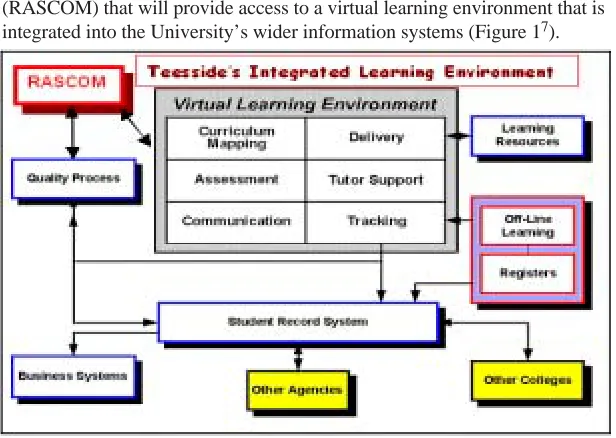
and all other student related information. The proposal calls for the creation of a searchable online catalogue of all the University’s courses and modules (RASCOM) that will provide access to a virtual learning environment that is integrated into the University’s wider information systems (Figure 17).
Figure 1. Online catalogue (RASCOM)
To achieve this goal, a Teesside Integrated Learning Environment (TILE) steering group has been proposed. This group will be composed of a mixture of senior management, technical, and academic staff; and over three years it is expected that this group will be responsible for:
1. the development of a strategy for the implementation of TILE; 2. specifying the integration of a VLE that would be part of TILE; and 3. insure appropriate QA is adopted with respect to all aspects of
imple-mentation.
The University has also begun formal piloting of Blackboard. This will make it possible:
1. to evaluate the problems inherent in integrating a VLE into an MLE; and 2. to give interested staff the opportunity to experiment with and
deter-mine the utility of a fully featured VLE.
References
Bacsich, P. et al (1999), The cost of networked learning, Sheffield Hallam Uni-versity. [Online]. Available: http://www.shu.ac.uk/virtual_campus/cnl/ Blackboard [Computer software]. Retrieved from: http://www.blackboard.com The College Board (1999), The virtual university & educational opportunity:
Is-sues in equity and access for the next generation, [Online]. Available: http:/ /www.collegeboard.org. (quoted in Bacsich, 1999).
CASTLE [Computer software]. Retrieved from: http://www.le.ac.uk/cc/ltg/cas-tle/
CoMentor [Computer software]. Retrieved from: http://comentor.hud.ac.uk/ Cornford, J (2000). The virtual University is... the university made concrete?
Information, Communication and Society, 3(4), 508-525.
Daniel, J.S. (1998). Mega-universities and knowledge media: Technology strate-gies for higher education. London: Kogan Page.
Extended Learning Environment Network (ELEN ). [Computer software]. Re-trieved from: http://home.ulh.ac.uk/Ldu/elen/index.html
FirstClass (Centrinity) [Computer software]. Retrieved from: http:// www.softarc.com
JISC (2000). Circular July 2000, Managed learning environments (MLEs) in further education: Progress report. [Online]. Available: http:// www.jisc.ac.uk/pub00/c07_00.html
Learnwise [Computer software]. Retrieved from: http://www.learnwise.net/ Netskills [Computer software]. Retrieved from: http://www.netskills.ac.uk/ Salmon, G. (2000), Emoderating. London: Kogan Page.
Shum, S. Computer supported collaborative work. [Online]. Available: http:// kmi.open.ac.uk/sbs/.
TekniCAL [Computer software]. Retrieved from: http://www.teknical.com TELRI [Computer software]. Retrieved from: http://www.warwick.ac.uk/ETS/
TELRI/
TopClass [Computer software]. Retrieved from: http://www.wbtsystems.com/ Watson, B. (1999, November). A survey of learning environments. [Online].
Notes
1. The authors would particularly like to thank Frances Deepwell & Andy Sysonof Coventry University, Neil Ringan of the University of Hudder-sfield, Ken Mills of Sheffield Hallam University, and Derek Harding of the TLTP3 Courseware in History Implementation Consortium (CHIC) for making their time and experience available. (Teaching and Learning Technology Programme [TLTP]) is a series of UK Government funded initiatives to encourage the uptake of Learning Technologies in Higher Education.)
2. Shortly after this workshop, WOLF, as it was then known, became available as a commercial product, from Granada Media, and is now known as Learnwise (http://www.learnwise.net/).
3. These included TekniCAL’s (http://www.teknical.com) Virtual Campus (originally developed as ELEN http://home.ulh.ac.uk/Ldu/elen/
index.html), and Leeds University’s Nathan Bodington Building (http:// www.fldu.leeds.ac.uk/bodingtoncommon.html). The group also benefit-ed from the experience of Gabriel Jezierski at University of Wales Institute, Cardiff (UWIC) and Dennis Bates from Napier University who provided advice concerning the ongoing decision-making processes at those institutions.
4. Professor Lockyer of Teesside who developed an experimental system called FOLE is not recommending it for the reasons stated previously and the LE developed by Durham and Newcastle medical schools is not be adopted across campus. Similarly while at the time of the workshop the School of Human and Health Sciences at University of Huddersfield was continuing to use the CoMentor system developed there, it was Huddersfield’s Business School that reported on Blackboard to the North East learning environments Workshop; and, at the time of writing, Huddersfield has apparently to decided to adopt Blackboard level three across the University.
6. Underwood, J.D.M. and Fitzpatrick, S. (1995). Focusing on resource based learning: The STILE Project, Education Library Journal, 37(3), 49-59.