Center
Center
Master's Theses Theses, Dissertations, Capstones and Projects
1998
African American Student Code-Switching in Freshman English
African American Student Code-Switching in Freshman English
Composition
Composition
Melanie A. Lewis
Follow this and additional works at: https://repository.usfca.edu/thes
African American Student Code-Switching
in Freshman English Composition
A Dissertation Presented to
The Faculty ofthe School ofEducation
International and Multicultural Education Program
In Partial Fulfillment
Ofthe Requirements for the Degree Doctor of Education
by
Melanie A Lewis
members of the committee, has been presented to and accepted by the Faculty of the School of Education in partial fulfillment of the requirements for the degree of Doctor of Education. The content and research methodologies presented in this work represent the work of the candidate alone.
Dissertation Committee
I would first like to thank my Heavenly Father for blessing me with the patience, courage, motivation, and strength to pursue my dreams and trust in His Word.
I extend my heartfelt appreciation to my second and third readers, Dr. Mary L. Newling and Dr. Betty Taylor, for their wisdom and encouragement.
Dr. Anita P. DeFrantz: compassionate, nurturing, loving, caring, supportive, spiritual, encouraging, wise, wonderful. Thank you for shining your light on me. You give so much of yourself to your students. I am so thankful for you. Thank you for guiding me through this process, and exemplifYing the meaning of scholar. I believe that I speak for the many students you touch when I say, thank God for you.
I would be remiss if I did not thank my many mends for the ''therapy" sessions. Thank you for sharing the laughs, tears, and overwhelming joy. Thank you for convincing me that the "light at the end of the tunnel" was not a train. I will always love and cherish you all.
I thank my sisters, Robbin, Miriam, and Constance, for loving me, believing in me, and, when I was a little girl, telling me that I would succeed beyond my expectations.
Lastly, lwould like to dedicate this academic work to my parents, James and Dolores Lewis, for believing in me when I did not believe in myself. I thank you, Mom and Daddy, for teaching me courage, confidence, and what love really means. Thank you for teaching me to trust the Lord in everything I do, to put Him first in my life, and to have faith in His promises. Thank you for encouraging me to strive for the highest
educational degree, and for supporting me in becoming the first Doctor in our family. The smiles on your faces and the joy in your hearts are my reward. Thank you for your
APPROV
AI.PAGE ...
.iACKNOWLEDGMENTS ... .ii
TABLE OF CONTENTS ... iii
LIST OF TABLES ... v
CHAPTERS
I.THESTUDY
Statement of the Problem ...
1Purpose of the Study ...
3Research Questions ...
6Definition ofKey Terms ...
6Significance of the Study ... 8
Assumptions and Limitations ...
9Summary ... 10
II. REVIEW OF THE LITERATURE
Historical Background of
African American Linguistic System ... 12
Features and Evidence of Code-Switching ... 19
Features of "Black English" ...
32Phonology ...
36Syntax ... 36
Challenges Facing Black Students in Composition Courses ...
44Composition Teaching Strategies ... , ...
56Summary ... 68
ill. METHODOLOGY
Introduction ...
69Research Design ...
70Variables ...
70Procedures and Instrumentation ...
71Validity and Reliability ... 74
Subjects ... 79
Summary ... 85
IV. THE FINDINGS Answers to the Research Questions ... 87
Answer to Research Question No. 1 ... 87
Answer to Research Question No.2 ... 113
Answer to Research Question No.3 ... 146
Answer to Research Question No. 4 ... 154
V. SUMMARY, CONCLUSIONS, IMPLICATIONS AND RECOMMENDATIONS Summary ... 158
Conclusions ... 159
Implications ... 164
Recommendations ... 170
REFERENCES ... 174
APPENDICES ... 179
A Consent Form-- Instructor ... 180
B. Consent Form-- Administrator ... 185
C. . Lewis Model Syllabus ... 190
D. Lewis Model Timed Essay ... 196
E. Lewis Model Essay Topic ... 197
F. Lewis Model Guidelines for Timed Essay ... 198
G. Chart of Code-Switching Features ... 199
H. Guidelines for Instructors ... 200
I. Sample Sentences for Selection ... 201
J. Selected Sentences ... 205
K. Questionnaire for Students ... 206
L. Symbol Matrix Pretest -- Experiment Group # 1 ... .207
M. Symbol Matrix Pretest-- Experiment Group #2 ... 208
N. Symbol Matrix Pretest -- Control Group ... 209
S. Symbol Matrix Treatment #2 --Experiment Group #2 ... 214
T. Symbol Matrix No Treatment #2 --Control Group ... 215
U. Symbol Matrix Treatment #3 --Experiment Group #I ... 216
V. Symbol Matrix Treatment #3 -- Experiment Group #2 ... 217
W. Symbol Matrix No Treatment #3 -- Control Group ... 218
X. Symbol Matrix Posttest --Experiment Group #1 ... 219
Y. Symbol Matrix Posttest --Experiment Group #2 ... 220
Z. Symbol Matrix Posttest -- Control Group ... 221
AA. Components ofthe SEEW Scale ... 222
BB. Answers to Student Questionnaire ... 232
LIST OF TABLES 1. SEEW Selected Features and Scores Experiment Group #1 Pretest ... 90
2. Experiment Group #1 Pretest Scores ... 91
3. SEEW Selected Features and Scores Experiment Group #2 Pretest ... 92
4. Experiment Group #2 Pretest Scores ... 93
5. SEEW Selected Features and Scores Control Group Pretest ... 94
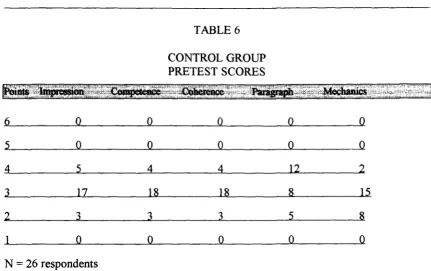
6. Control group Pretest Scores ... 95
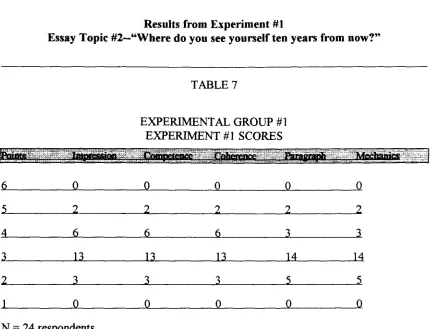
7. Exp~riment Group # 1 Experiment # 1 Scores ... 97
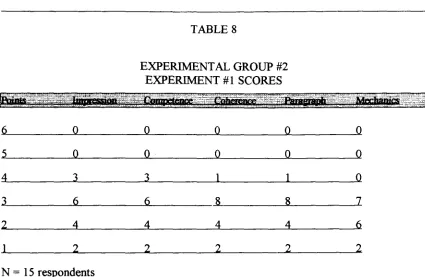
8. Experiment Group #2 Experiment # 1 Scores ... 98
18. Experiment Group #I Posttest Scores ... 1 09 19. Experiment Group #2 Posttest Scores ... 111 20. Control Group Posttest Scores ... 111 21. SEEW Selected Features and Scores Experiment Group # 1
Pretest African American Students ... 114
22. Experiment Group # 1 Results in Mechanics Category ... 115
23. Chart of Code Switching Features (Appendix L) ... 199
24. SEEW Selected Features and Scores Experiment Group #2
Pretest African American Students ... 116
25. Experiment Group #2 Results in Mechanics Category ... 117
26. Chart of Code Switching Features (Appendix M) ... 200
27. SEEW Selected Features and Scores Control Group Pretest
African American Students ... 118
28. Control Group Results in Mechanics Category ... 119
29. Chart of Code Switching Features (Appendix N) ... 201
30. SEEW Selected Features and Scores Experiment Group #1
Experiment # 1 African American Students ... 120
31. Experiment Group # 1 Results in Mechanics Category ... 121
32. Chart of Code Switching Features (Appendix 0) ... 202
33. SEEW Selected Features and Scores Experiment Group #2
Experiment Group #1 African American Students ... 122
34. Experiment Group #2 Results in Mechanics Category ... 122
35. Chart of Code Switching Features (Appendix P) ... 203
38. Chart of Code Switching Features (Appendix Q) ... 204
39. SEEW Selected Features and Scores Experiment Group #1
Experiment #2 African American Students ... 126
40. Experiment Group #1 Results in Mechanics Category ... 126
41. Chart of Code Switching Features (Appendix R) ... 205
42. SEEW Selected Features and Scores Experiment Group #2
Experiment #2 African American Students ... 128
43. Experiment Group #2 Results in Mechanics Category ... 129
44. Chart of Code Switching Features (Appendix S) ... 206
45. SEEW Selected Features and Scores Control \.Jfoup No Treatment #2
African American Students ... 130
46. Control Group Results in Mechanics Category ... 143
47. Chart of Code Switching Features (Appendix T) ... 207
48. SEEW Selected Features and Scores Experiment Group #1
Experiment #3 African American Students ... 132
49. Experiment Group #1 Results in Mechanics Category ... 132
50. Chart of Code Switching Features (Appendix U) ... 208
51. SEEW Selected Features and Scores Experiment Group #2
Experiment #3 African American Students ... 134
52. Experiment Group #2 Results in Mechanics Category ... 134
53. Chart of Code Switching Features (Appendix V) ... 209
54. SEEW Selected Features and Scores Control Group No Treatment #3
African American Students ... 136
Posttest African American Students ... 138
58. Experiment Group #1 Results in Mechanics Category ... 138
59. Chart of Code Switching Features (Appendix X) ... 211
60. SEEW Selected Features and Scores Experiment Group #2 Posttest African American Students ... 140
61. Experiment Group #2 Results in Mechanics Category ... 140
62. Chart ofCode Switching Features (Appendix Y) ... 212
63. SEEW Selected Features and Scores Control Group Posttest African American Students ... 142
64. Control Group Results in Mechanics Category ... 143
65. Chart of Code Switching Features (Appendix Z) ... 213
66. Student Pretest Scores ... 147
67. Student Experiment #1 and No Treatment #1 Scores ... 148
68. Student Experiment #2 and No Treatment #2 Scores ... 148
69. Student Experiment #3 and No Treatment #3 Scores ... 149
CHAPTER I THE STUDY
Statement of the Problem
What is "good" writing? Many researchers (Axelrod & Cooper, 1994; Bruder &
Hayden, 1972; Dietsch, 1998; Freigenbaum, 1975; Hart, Reinkling, Von Der Osten, 1996; Hoffman & Yarbes, 1996; Krapp, 1962; Labov, 1970) would assert that good, or
effective, writing is fluid, grammatically and structurally correct, makes easy transitions from one paragraph to the next, is coherent, concise, strategic in purpose, eloquent in prose, descriptive, focused. ''Bad," or ineffective, writing, is usually associated with the exact opposite ofthe above mentioned characteristics (Chapman & Waller, 1994; DiYanni, 1985; Feigenbaum, 1975; Macrorie, 1984). Bad writing, thus, is unclear, unorganized, lacking in fluidity, focus, and coherence. Unfortunately, second language speakers have been stigmatized as poor writers, but for very unique reasons. When students "change" linguistic patterns, or, rather, when they "code-switch" into their "first" linguistic system, the writing becomes "bad." The writing is discredited; the students' language is lost. Feigenbaum (1975) asserts that "the term 'different' does not mean 'right' or 'wrong.' There is no linguistic criteria by which a given language or dialect of a language c~ be proven 'more wrong' than another" (p. 144). Feigenbaum goes on to state that "no language system can be proven more or less valid than another" (p. 144). The only criteria for selecting "one language or dialect for use in a given situation is
-t
'appropriateness"' (p. 144). All students are in a special position to provide their
What challenges do African American students, in particular, face in freshman English composition courses? Do the challenges result from fear of the college environment, or from an embedded notion that their thoughts and ideas will not be recognized? Or could the issue be culturally based? What role does language play in the success or failure of African American students in composition courses? The real issue seems to be whether or not the student is being equipped with the tools needed to succeed in freshman English composition. All African American students do not need to "add" formal English to their repertoire; many students currently speak and write using formal English; however, African American students will need to add a more formal English register to their written communication in order to write more effectively. The difficulty occurs when students have trouble communicating a particular thought or idea in written work. African American students will "switch" to a more familiar linguistic system to convey their thoughts. Typically, the linguistic system used is not considered formal although many features in Africanized English are recognizable in formal English.
Therefore, the students "add" a different· way to express the same idea, another linguistic system which will add clarity to their meaning. African American students will add to the linguistic skills they already possess, incorporating additional skills to express themselves from a cultural linguistic perspective. African American students will recognize when and why they are switching to their "home" language, and learn to transition those thoughts to formal English, the accepted linguistic form in college composition.
asserts that the linguistic system is noncommunicative is a misrepresentation of fact, that anything nonstandard is deficient is an incorrect notion.
An investigation was conducted on teaching strategies, showing how the use of more effective teaching strategies helped the African American students in this study transition from their linguistic system to formal English. Results of this study not only showed the legitimacy of linguistic systems other than formal English, but also identified code-switching in composition, which aided students in transitioning their writing to formal English when code-switching occurs. The investigation rendered improved written communication systems for students to express themselves in college composition, in other words, saying what the students want to say, using effective writing strategies.
Purpose of the Study
The purpose of this study was to identify that code-switching does occur in the writing of freshman composition students, to identify when it occurs, why it occurs, and to help students transition their writing to formal English without losing their original
meaning. TQi_~-~t~d)' ~dentified code-switching in the composition writing of African American students as having significance in th~ framework of college writing. Of the
- - - · ' ... >,0_.-<.~>"o'•>•" . : . , , , _ ' , • r , A ,
many challenges African American students in the college environment face, perhaps neglect of their linguistic system as a legitimate language is the most troubling; thus, this study attempted to alleviate this problem by identifying code-switching in composition as having linguistic significance, and examined how African American students can be taught to retain their linguistic system while transitioning to formal English. Fromkin and
Rodman (1998) assert the following:
English. The cultural-deprivation myth is as false as the idea that some dialects or languages are inferior (p. 413).
Valdes-Fallis (1978) defines code-switching "as the alternating use oftwo languages on the word, phrase, clause, or sentence level" (p. 1 ). The author asserts that "in essence, code switching involves introducing into the context of one language
stretches of speech that exhibit the other languages' phonological and morphological features" (p. 1 ). When a bilingual speaker of Spanish, for instance, uses "a word, phrase, or clause of a sentence that is recognizably English (in both pronunciation and form)" (p. 1 ), the person has code-switched into English, and vice versa. When a speaker
code-switches into another language, the language and meaning used are exactly the same as in the original language. Nothing is altered when switching from one language to the other.
first language acquired by children" (p. 46); thus, African American students' language should be validated as their first, cultural linguistic system. Code-switching can affirm this fact. Results of the study have implications that acknowledging code-switching as a common occurrence in composition leads to a greater understanding of the difficulties students face in freshman English composition, and determining more effective ways to teach writing to students at the college level.
Research Questions
The specific areas of investigation for this study included: analyzing the speech patterns of African American students evident in the written communication; recognizing the various fonns of code-switching; identifYing code-switching on many levels, including grammatical, meaning, and word choice; and reviewing the effects of teaching
code-switching to the experiment group over a period of time.
Hypothesis: Code-switching is not recognized or utilized in teaching English composition; thus, the treatment the Researcher provides for students demonstrating code-switching behavior can be used to help them produce meaning in fonnal English.
The research questions for this investigation are as follows:
1. How were the types of code-switching in freshmen English composition detected, observed, and identified?
2. What were the features of code-switching in freshman English composition classes demonstrated by African American students?
3. What were the semantic transitions in code-switching identified in the English composition writing of African American students?
A What do African American students accomplish by code-switching in compositions?
B. Does code-switching in English compositions lead to more effective communication, or does code-switching lead to miscommunication? 4. Which features reflected code-switching speech patterns?
Definition of Key Terms
Tenns used in this study were operationally defined. These tenns included:
1. Africanized English:
English," ''Black American English" (BAE), ''Black Dialect," (Dandy, 1991 ), and, most recently, ''Ebonies", which means ''Black Sounds." Linguistic features specifically used by African American peoples, including specific phonologic and morphologic features.
Specific features and usage are discussed in Chapter II, Review of the Literature.
2. Effective Writing:
Effective writing is clear, concise, coherent, fluid, mature, grammatically and structurally correct; clear focus, purpose, intent, strategy. Effective writing is not only consistent with the method, style, and format of formal English, but also expresses what the writer truly intends to say, not a tainted version of what the writer "thinks" the reader wants to read. Effective writing is the voice of the writer.
3. Formal English:
This is the most accepted term to "standard" English. ''Formal" English is by no means the most appropriate term, but the term is more consistent with the true definition of the accepted language in academe and in American society.
4. Standard American English:
The accepted term used to define the appropriate way to speak and write in academe and in American society. Fromkin and Rodman (1998) define Standard English as "An
idealized dialect ofEnglish that is considered by some prescriptive grammarians to be the proper form of English" (p. 537). The language is consistent with European, or "white", notions of what is acceptable linguistic patterns of speech and writing. Standard English is the legislative "official" language of the United States of America, and is recognized around the world as the official language of America. Wardhaugh ( 1993) asserts that "Standard English is codified to the extent that the grammar and vocabulary ofEnglish are much the same everywhere in the world English is used" (p. 32).
5. Nonstandard English:
the accepted term referring to all linguistic systems other than standard English. Such languages include Mricanized English, Asian American English, Mexican American English, Native American English, and so forth. The linguistic systems of people of color are typically labeled as nonstandard. W ardhaugh ( 1993) asserts that nonstandard "can connote various degrees of inferiority, with that connotation of inferiority carried over to those who speak a dialect" (p. 25).
6. The Researcher:
I have chosen to use the term the ''Researcher" capitalized to identify myself Lower case "researcher" is used to identify researchers cited in the Review of the Literature.
NOTE: Fromkin and Rodman (1998) define code-switching as, "The insertion of a word or phrase of a language other than that being spoken into a single sentence, or the
movement back and forth between two languages or dialects" (p. 522). Hymes (1980) asserts that "the changing intellectual context of the human sciences as a whole introduces new questions and courses of diversity" (p. 88). The Researcher's analysis of the
code-switching features and patterns of Africanized English speakers has lead her to the following definition of the term: The alternate use of two legitimate linguistic systems.
Significance of the Study
the distinct linguistic system of African Americans, and the need to help students transition from their linguistic system to formal English. The media backlash on the issue ofEbonics stemmed from misinformation, not from well-informed linguists trained to identify
language systems. This was by no means a mistake. One of the challenges second language speakers face is not having their language validated by the "mainstream." The School Board had all the right intentions, but the conveyance of the information led to confusion.
This research examined what happens when the verbal language is transferred to the written language, and how the negative impressions of African American oral speech also occur in freshman English composition. Although the subject of code-switching in composition has be~n explored in the past, much more research is necessary--the subject has been abandoned, and the time has come to resurrect it. This research attempted to ·validate the language of Mrican American students and showed how these students switch
from one linguistic system to the other. As Holiday (1991) asserts, Africanized English "is a language with its own rlJles, structure, and meaning" (p. 8). If the language system is not considered in the teaching of formal English, students will not learn the similarities and . differences of formal and "non-formal" English, placing these students at a disadvantage in
written communication. This research was significant as it addressed the historical significance of Africanized language, code-switching in composition, and the strategies teachers can use to help students learn formal English for college writing. This research should ultimately assist not only African American students at the college level, but all ·students at every educational level.
Assumptions and Limitations of the Study
The Researcher also assumed that using quasi-experimental methodology would prove beneficial in identifying code-switching in student writing.
Some possible limitations of the study were as follows: 1. Limited number of subjects.
2. Extraneous variables (e.g., students' persistence in courses, motivation, other unforeseen circumstances, illness, etc.).
The major limitation of this study rested in the extraneous variables, those unforeseen circumstances that the Researcher cannot control. One such variable was persistence of the students in both the experimental and control groups. As public colleges are reasonably inexpensive, students, for whatever reason (e.g., personal issues, low grades, employment issues) might drop the class, reducing the sample size. The Researcher had no control over such circumstances, yet with this study, the research could lead to results which could help increase persistence of African American students in freshman English composition. The Researcher was fortunate in that no African American students dropped any of the three courses selected for study.
Therefore, the main concern was sample size. The Researcher chose an institution with a high African American student population as freshman English composition classes are usually not impacted with African American students. The three instructors who participated in the study are: Chairman of the Humanties Department, Dr. Keflyn Reed; English Instructor, Mrs. Dowartha Davis; and English Instructor, Ms. Shiela Hall.
Summary
on which to conduct quasi-experimental methodology. Although the need for this study has been thoroughly explained, much more supporting evidence was needed to reinforce the importance of validating various linguistic systems found in college composition courses and using these systems as learning tools. The research documents that
CHAPTER II
REVIEW OF THE LITERATURE
This study was concerned with exploring the significant implications of code-switching of African American students in freshman composition classes. The investigation covers the historical significance ofBlack American linguistic patterns and how the recognition of the system as a distinctive language can be used to increase the competency of African American students' writing at the college level. This investigation explores several areas in the literature of code-switching: linguistics, bidialectalism, bilingualism, and the teaching of writing; evidence of the link between Africanized English and formal English; the unique characteristics of Africanized English; and teaching
strategies when code-switching occurs in freshman composition writing.
Historical Significance Background of African American Limguistic System
Most educators support the use of formal English in the educational system. In order for a composition·paper to receive a passing grade, the language usage must meet the criteria established by the administration, which is, without question, "standard" English. Although some educators have called for the eradication and dismantling of "nonstandard" English language or "dialect" usage in order to reinforce the importance of fluency in formal English, other educators seek to emphasize the importance and validity of nonstandard English use in the classroom as a learning tool. In order for proponents of code-switching, mixing, or choice of Africanized English to establish legitimacy, a review of the historical background is needed to support the linguistic system, a study Dillard ( 1972) asserts as "irresistible" to some linguists and historians.
Acquire some acquaintance with several languages spoken in those sections of the West Coast of Africa from which the Negroes were brought to the United States as slaves. The Negro dialect known as Gullah or Geechee is spoken by the ex-slaves and their descendants in that part of its region which extends along the Atlantic coast approximately from Georgetown, South Carolina, to the northern boundary ofFlorida. It is heard both on the mainland and on the Sea Islands near by(p. 1).
Turner continues with the following historical perspective:
If one were to give a conservative estimate of the number of slaves imported direct from Africa to South Carolina and Georgia during the one hundred years prior to 1808, it would be at least 100,000. After January 1, 1808, when the Slave Trade Act became operative, slave-traders continued to bring Negroes direct from Africa, though to do so was illegal. As late as 1858, approximately 420 Negroes direct from Africa were landed near Brunswick, Georgia. Information as to how many of these 'new' slaves, i.e., those who had come direct for Africa, remained in coastal South Carolina and Georgia and how many other 'new' slaves from
Virginia and other colonies joined them is not available; but if there is any
correlation between the number who settled there and the extent to which African customs and speech habits have survived in that area, then the 'new' slaves must have constituted a considerable part of the slave population of coastal South Carolina and Georgia" (p. 1 ).
Anderson (1976) asserts that Africanized English is valid, legitimate, has its own linguistic approaches, and could be used to enhance the competency of all students in composition courses. Anderson states that "In America one often feels a definite need to speak and to write in Standard American English which is the acceptable form of
communication in our complex society and which affects one's success in a given social, educational, cultural, and occupational environment" (p. 4). Standard English is the only linguistic system which is recognized throughout the world as the accepted language of the United States. Standard English is also the language accepted by the multitude of American citizens as being the "correct" form of speaking and writing.
Over the past several years, increased immigration, as well as established regional
Black American English which is basically and often called 'Negro Dialect', 'dialect', 'street talk', 'gutter talk', 'ghetto talk', 'Non-standard Negro English', 'ghettoese', or 'bad grammar', is one ofthese dialects that is especially
non-acceptable in many American circles and in many American schools although it is regularly used by most of the people who are in America's largest minority group (p. 4).
The term "Black American English", Anderson asserts, "includes an entire linguistic system--a variety of Standard American English distinguished from Standard American English by features of grammar, phonology, and vocabulary, and used by a group of people who are socially set off from other speakers of Standard American English" (p. 4-5). Black English is not spoken by all members of the ethnic group, but has incorrectly been labeled as the language of"lower-class," "underprivileged," and
"undereducated" African American people in the "inner city" who are too disenfranchised to learn the type of language needed to survive in "mainstream" society. Holiday ( 1991) reinforces this theory by stating "do not expect all Black English speakers to use all these patterns all the time" (p. 7). Use of Africanized English is linked to the inability to adapt to societal norms. If this is the case, why, then, do many educated African American people in middle to high income brackets use Africanized English? Regardless of socioeconomic status, African American people are able to "smoothly shift to Standard English when the need arises or in appropriate environments" (p. 5), as the linguistic system "is not an indicator of their intelligence," but a language embedded in the culture. As DeFrantz ( 1995) mentions, "language and culture are inextricably intertwined," and Bruder (1972) asserts ''that language and culture are inextricably mixed, so that to eradicate one is to negate the other" (p. 5).
positive, cultural attribute, it must be addressed as a respected, positive, cultural attribute" (p. 62). It is important to note that historically, African Americans have had to develop survival skills other ethnic groups have not needed to develop. African Americans' lives have been dictated by hundreds of years of struggle, plight, degradation, oppression, and transgression other groups have not experienced. The resilience of African Americans is evident in folk literary traditions, song, ballads, poetry, and other forms of communication and traditions. Use of these traditions as tools for more effective teaching will be
discussed later in the Review of the Literature ("Teaching Strategies").
Because of the preventative measures taken to prohibit African ancestry people from reading and writing, many cultural traditions, including remnants of original language systems, have been, as Dandy ( 1991) asserts, preserved in oral tradition to assure
communication, both verbal and nonverbal. The communicative practice of Africanized English users has been preserved through "music, stories, folk sayings, jokes, food, and most especially in the ways words are used" (p. 20). Dandy continues with the following assertion:
Black communications, as it exists, today, probably developed through a sort of leveling process as a result of cultural contact and interaction: 1) cultural transmission among the enslaved Africans who, before they came to America, devised bridge-languages to communicate among various tribes; and 2) contact among language different speakers from communities throughout Africa--some of whom were deposited in the West Indies and later brought to this country and European slave traders and settlers from Portugal, Holland, France and England, who colonized parts of Africa, South America, the West Indies, and the New World (p. 20).
The initial language system used by African Americans has been a source of speculation for many years. Most early research is not supported by evidence, leaving many theories unsupported. Anderson notes that more recent research has been supported by more concrete data. He states the following influences as the basis for present-day African American linguistic patterns: West African (language) influences, the United States slave trade influences, enslavement in the United States, isolation of African American people in the United States (on plantations and later in ghettos), and Southern (U.S.) white influences (p. 11). Such influences have been challenged by writers who have stigmatized the language and created negative images of African American language. These writers assume that Black dialect "evolved from 17th and 18th century British dialects spoken by overseers and masters to communicate with slaves" (p. 12). These researchers negate the fact that the languages actually originated from African language influences.
Enslaved Africans brought with them to America their native languages. The countries from which many Africans wete captured were West African countries, as well as countries further inland, the West Indies, and islands in the Caribbean, as supported by Dandy ( 1991). As a component of colonization, one of the first methods of conquering a people is to strip them of their language. The colonizers were interested in "getting work done" (p. 12), not teaching African ancestry people the English language. Anderson (1976) cites many ofthese languages as Twi, Yoruba, Ibo, and Ga. Gullah, spoken today around the Southern Coastal islands and corroborated by Turner (1969), is a language responsible for many of the linguistic patterns of Africanized English. Black American English, Anderson asserts, has also contributed much to various white American dialects.
This Researcher has found evidence of this phenomena in the writing of the respondents in this study, as well.
is needed, however, to study the origins and development of Africanized English. One major component which is not addressed in this study is evidence of other African languages brought to this country by enslaved people. West Africa, to be sure, was not the only region in which Africans were captured. West Africa may have been the region where the first Africans were captured; thus, helping to establish Africanized English--this fact should be noted. What also must be considered are the languages not mentioned in this study. A more conclusive investigating of all languages which contributed to the African American linguistic system is needed.
Burkett ( 1978) discusses the perceived notions of the definition of dialect. Since Africanized, or "Black," English is commonly assigned the label of a dialect of English, Burkett's discussion is applicable here: "To some people dialect means the speech of the uneducated, or the speech of a person from another section whose pronunciation and word choice differ from their own, or the speech of someone who is speaking a language not his native one" (p. 3). If this definition is justified, then there exists several dialects of English, including dialects of British and American English, regional and social dialects, and subdivisions of practically every known dialect. Unfortunately, many people who have historically ascribed the term dialect to language systems do not accredit the "dialects" as legitimate linguistic systems; example, Africanized English.
Bickerton ( 1981 ), in a study establishing the Africanized system of Creole as developed from one of the most technologically and descriptive cultures of the day, and included what the author calls the "horrendous complexity of language and culture" of the "hunting and gathering" cultures, the author contributes the following to the
understanding of racist views of languages other than ''Western":
What linguistics will have to change is not the generative theory, in its essential rather than accidental aspects, but a set of much more widely held beliefs, central to which is the belief that all existing languages are at the same level of
'there are no primitive languages,' arose as a natural and indeed laudable reaction to the claim that thick lips and subhuman minds underlie the characteristics ofboth creole and tribal languages. According to 19th-century racists, languages and people alike were ranged along a scale ofbeing from the primitive Bushman with his clicks, grunts, and shortage of artifacts, to the modern Western European with his high brow and plethora of gadgets. That was when everyone, racist or
anti-racist, did believe that Western man was superior; the only argument was about how nasty this superiority permitted him to be toward 'lesser' breeds. Now that we are rapidly disabusing ourselves of this kind of mental garbage, it becomes possible to uncouple language from 'level of cultural attainment' and look at it developed mentally without any pejorative implication (p. 299).
Bickerton denounces racist theory and supports recognition of complex, rule-governed languages, and reinforces his analysis with historical fact.
Rickford ( 1987) suggests that the first Africanized English speakers who had significant interaction with slave holders learned English gradually. Enslaved Africans' learning process, Rickford asserts, could have initially been comparable to those persons enslaved in the fields who had less contact with English speakers, and their subsequent progression may have been comparable to the language progression of field slaves in latter years. The author acknowledges that "Given that field slaves had less exposure to and interaction with native English speakers than house slaves did, the structural stages by which these groups acquired English probably differed in some respects" (p. 34).
Acknowledging that this progression is tenable, we cannot make drastic assumptions on the actual language learning dynamic in the early years of enslavement.
language patters are communicated and accepted, the "prestige" of language use and imitation becomes the standard. Yet if we are to change perceptions of language usage in our society, especially the language of African Americans, Burling suggests the following:
By our language we define the groups to which we belong. We define certain people inside the group, and we leave others out. Language comes to be an accurate map ofthe sociological divisions of a society ... Once we recognize how readily social divisions come to be marked by linguistic variables, it is natural to wonder whether the deepest and most persistent division in American society, the gulf that has always separated blacks from whites, is not also linguistically marked. One would expect the division to be marked simply because it is so deep. People sometimes hesitate to consider this question for fear that if differences are found, it will imply that the speech ofblacks is inferior; and yet if we shrink from examining this subject, we run the risk of obscuring features that bear upon the education of black children. We may have to take dialect differences very seriously if all Americans are to derive the full benefits of our educational system (p. 27).
Features and Evidence of Code Switching
Myers-Scotton (! 993) asserts the following theory to code-switching:
The dominant view of CS [code-switching] was simply that it did not exist, least of all as a research topic. If they treated CS at all, ealier studies oflanguage in
contact largely considered CS as an interference phenomenon, with 'interference' interpreted in its most literul sense. That is, CS was considered part of the performance of the imperfect bilingual~ motivated by inability to carry on a conversation in the language on the floor at the moment (p. 47-48).
The sample size of the study is crucial in examining its relevance. Lynx Lake, a small, isolated community located in Manitoba, Canada, provided important findings for Valentine. Since the community is isolated, the study of the language yields more
concrete results regarding the social relations and communal interactions oflanguage and culture ofthe Severn people. Within the community of three hundred citizens, "one finds two subdialects of Severn Ojibwe, three dialects of Cree ... , and at least two varieties of English regularly employed as linguistic resources" (p. 115). Again, the sample size may seem small, but the limited population is important as the community is isolated; thus, the use of language is authentic. This study also indicates that people of color, in general, are isolated to certain degrees if their linguistic patterns are not the "accepted" patterns of larger society.
Valentine asserts that ''most code switching research has involved groups living in industrialized societies where two or more speech communities exhibit extensive, daily contact" (p. 115). Most ofthese studies revolve around languages based in the European linguistic system and languages close}y.related, the author asserts. Valentine states that in the small number of studies on nonindustrialized communities, code-switching has been viewed from the perspective of la11guetge shifting from the minority language to the majority language (p. 116). This study examines a completely stable and viable linguistic system in which the community code-switches from one Native American language to the other, and where there is no threat by the European language to the overall linguistic system of the indigenous system. In other words, the native linguistic system remains intact.
Important observations can be made from the data collected for this study. The researcher has collected data which is primarily monologic, or, rather, oral translation which controls for such variables as "participant, role, setting, and even genre" (p. 116).
the use of multiple varieties of these languages, relationships which are consistent with the general pattern oflanguage in Lynx Lake" (p. 116).
Three separate monologues were used for the study: the first, a radio program which provided information regarding situational code-switching; the second, a sermon delivered by a prominent Native Anglican archdeacon; and the third, a monologue delivered via radio by the same archdeacon five years later.
Valentine examined the role English plays as an interface between "bureaucratic agencies" and "those in administrative roles in the land" (p. 117). The author notes that English is an important communication tool, yet within the group, "nonstandard" English is the "primary vehicle" of communication. Thus, the linguistic system is not lost. The author identified situational code-switching ''where the presence of particularly salient aspects of the situation provide motivation for the shifts" (p. 117); in this case, shifting from Severn Ojibwe to English. Gibbons (1987) further identified situational
code-switching as, "choice of code wither the speech repertoire is influenced by such socio-situational factors as physical context. ·what is happening, participants, and topic. Interaction proceeds in a single code until one ofthese factors is changed" (p. 79). The participants in the study seemed to "switch" codes for a few reasons: the caller spoke English, the message was written down in English, or the person lacks a proficiency in English. Second language users often feel uncomfortable using another language when the second language incorporates terms or patterns which are difficult to grasp. For instance, in the Ojibwe language, the numeric system only goes up to twenty; thus, the speaker may have trouble communicating higher numbers in either language. Since many Ojibwe people, in the Lynx Lake community, lack proficiency in English, communication in the switching of languages could be confusing. The result· could be miscommunication between speaker and listener, or writer and reader.
metaphorical code switching requires the speaker (or writer) to switch depending on the topic (Wardhaugh, p. 106). Valentine found that the radio station was treated as a "wholly Native medium", in which the English language, unless intended, does not obscure the use of the native language. Metaphorical code-switching was found useful when topics were difficult to communicate in one language, easier to communicate in the other. The subsequent monologues also used metaphorical code-switching as certain aspects of the linguistic system can only be communicated in the language native to the speakers. Humor?. another component, is also used when speakers attempt to switch to another language. Examples of such use will be discussed in later sections dealing primarily with Afiicanized language speakers.
The author notes the importance of second language acquisition and recognition, because even in the small Lynx Lake community, the English language is important for <l.l;l.!S.ide c~~unication. The people of this community needed English for their jobs both
····---..
inside and outside of the community, but their native tongue remained undisrupted, proving that two or more languages can benefit the speaker --the speaker has the advantage of communicating with at least two groups of people, switching codes when necessary or appropriate, bui: retaining the native language. Valentine states that
''functional bilingualism is becoming more and more a necessity" (p. 124). Knowledge of two or more languages and the ability to switch from one to the other can prove beneficial to the speaker of those languages.
other languages, and that over the course of time, the linguistic system basically remains the same.
Valentine acknowledges that further research is needed on this particular community, but identifies code-switching on many levels. The importance of cross cultural communication is examined as well as the importance of retaining native languages. Although this study focuses on a Native American group, all groups can benefit from the results. A larger sample size could have supplied even better results, as well as similar finding from studies on other ethnic groups. This study, however, reveals many observations which match those to be discussed regarding the language of African ancestry people. This study helped solidify code-switching as a viable resource for speakers, and thus, writers, of more than one linguistic system.
Hispanic Americans have been labeled much the same as African American as "outcast" minorities. Unlike African American people, however, Hispanic people have a recognized linguistic system, Spanish. Although Spanish is a recognized language, the system has been stigmatized in many mediums, from the classroom to the
telecommunications industry. The following study examines code-switching as it relates to Spanish speakers. The implications of the findings provide valid infonnation on the code-switching of Spanish speakers which prove useful in understanding African American code-switching.
English word or phrase, for instance. When a speaker code-switches into another language, the language and meaning used are the same as in the first linguistic system used; nothing is altered when switching from one language system to the other.
Valdes-Fallis states that "all natural bilingual situations have in common the fact that bilingualism will occur at those times when the speakers' first language will not meet all their communication needs" (p. 3). Bilingual speakers sometimes cannot find the appropriate word, phrase or clause to effectively articulate their meaning; thus,
code-switching becomes necessary. Yet in order for survival in a system which dictates the use of formal English in most environments, bilingualism becomes mandatory. Bilingual, as used by the author, means "varying degrees" in the proficiency of two languages, yet it does not mean that the speaker knows both languages exceptionally well, but that they have a working knowledge of two languages, and can "function, to whatever degree, in more than one language" (p. 4).
The author also makes the distinction between the "academic" bilingual and the "natural" bilingual. The "academic" bilingual becomes bilingual by choice, by studying the language in school or learning the language via travel, for instance. The latter is "a product of a specific linguistic community that uses one of its languages for certain functions and the other for other functions or situations" (p. 4). Wardhaugh (1992) defines situational code-switching as occurring "when languages change according to the situations in which the conversants find themselves: they speak one language in one situation and another in a different one" (p. 1 06). Dulay ( 1982) asserts that bilinguals are able to "code switch when the
situation
demandsif'
(p. I 00). Metaphoricalcode-switching occurs when the topic of conversation controls the linguistic system used. Natural bilinguals are products of their environment, meaning the linguistic system used was learned via family, friends, and social interactions. Natural bilinguals usually interact with speakers who use the same language, yet they are also able to converse with
In linguistic systems, certain rules are acknowledged. These "rules" of the
language encompass the groups' belief system. Valdes-Fallis states that "part of belonging to a speech community involves knowing what to say, when to say it, how formal,
friendly, or intimate to be, and under which circumstances to speak or to remain silent" (p. 4). Since language and culture are intertwined, the rules of the culture are also
displayed in the language. These rules are sociolinguistic, or, rather, dictated by the social norms of the culture using the language.
The author also asserts that the language patterns used by a group are learned in childhood. The appropriateness of language usage, the conditions to which certain speech is used, and the tone used when communicating is important. We are raised to know what language is appropriate at home and which is appropriate for school or work. Resistance to the second language is also a factor in this area. Some members of a community are encouraged to "resist" the native language and encouraged to use the second language, negating the original language. However, most bilinguals will retain the first language for communication with other community members, especially elders.
The author mentions a feature of language cited as "language contact," in which ''two languages ... are used alternately by the same speakers" (p. 5). When bilingual speakers use two different languages, a situation called "interference [occurs when there is] a momentary transfer from one language to another of elements from one of the languages spoken by the bilingual" (p. 6). This situation exists regardless of the dominant language.
adequately describe the speaker's meaning, or when the second language term takes on a completely new meaning.
Code-switching, as mentioned earlier, can be advantageous to speakers of two languages, the bilingual. The author examines several questions which cover the area of code-switching:
1. Is code switching random and meaningless?
2. Is social information conveyed by a change in language?
3. Is code switching used stylistically by speakers, that is, to add color to speech or for emphasis?
4. Is code switching related to the relative proficiency ofbilingual speakers in each of their languages?
5. Is code switching rule governed, that is, do syntactic constraints operate on code switching on the word, phrase, and clause levels?
6. How do each of the above factors interact in the use ofthis verbal strategy by individual speakers? (p. 7-8).
The author notes that code-switching is not random or meaningless, and that the social information is conveyed through this medium. Situational and metaphorical
code-switching are important in that "code switching ... can signal the fact that two
bilinguals are shifting their role relationship with regard to one another, are shifting topics, or are responding to the particular characteristics of the setting" (p. 8). For instance, when two people are conversing using one language, one party switches to the second language to convey a certain meaning (e.g., for emphasis or illustration).
Valdes-Fallis' research targets the main characteristics of code-switching by using Spanish as the first language, English as the second. Citing specific experiments on language usage would have been helpful, but with this kind of research, statistical data might prove obsolete. The important definitions are covered and thoroughly explored in this study, establishing a valuable foundation which future researchers can use to examine code-switching in other environments, cultures and languages.
Bidialectalism falls under the same umbrella as code-switching, in a sense, as the phenomenon relates to the alternate use of language; in this case, two dialects. Campbell ( 1994) poses an interesting argument to refute definitions and interpretations of
bidialectalism. Campbell believes that the term is simply another euphemism used to demean and subjugate African American people, their culture, their language. To summarize, bidialectalism is a way for white Americans to acknowledge that African ancestry people have their own speech patterns, that this original linguistic system should remain in place, but that African American students should acquire the more formal standard, known as "standard English." The author believes that the term bidialectalism refers primarily to Africanized .English although the term has been used by and for other groups as well. Ironically, bidialectalism may be a powerful entry point for what the author states as "peaceful cohabitation" between Africanized English and formal English.
Bidialectalism can also serve as a useful tool ifused as an effective strategy. Bruder (1972) conducted a study in which bidialectalism served as a useful teaching tool. Bruder states that "a bidialectal approach recognizes the fact that control of a variety of language styles is a useful tool" (p. 3). This approach recognizes that the student
Auer supports the theory that language usage is not limited to verbal communication, but that physical communication is also used to "switch":
In addition to verbal means, contextualization strategies rely on prosodic cues (intonation, rhythm, accent, etc.), gestural and kinesic cues, eye contact, etc. Code-switching is one of these cues which, for instance, can signal that one topic is terminated and another one about to begin. Generally, it is one way of
contextualizing verbal activities, that is, of informing co-participants about the ever-relevant question 'what are we doing now?' --even though its contribution to answering it may be restricted to the information 'something different than before.' Switching is, in this sense, very similar to other contextualization strategies such as lowering or heightening of pitch level, change of posture (e.g. leaning back,
leaning forward), change of speed ofutterance delivery (Iento vs. allegro speech), and some others (p. 18).
Lipski (1985) confirms that "code-switching is a rule-governed form oflinguistic behavior, and not an unprincipled confusion" (p. 1 ). The challenge, Lipski asserts, in confirming further the use of two alternating linguistic systems is both obtaining actual language-switched utterances congruent with those seen in spontaneous speech, but also the representation of the two linguistic systems with recognizable mechanisms and speech patterns. Lipski asserts the following:
Bilingual code shifting is one of the most striking bits of evidence which may be adduced in favor of the hypothesis that bilingual speakers, at least those who are sufficiently proficient in both languages to engage in spontaneous switching have, in addition to two possibly distinct grammars, a mechanism which fully integrates the two, to the point where it becomes more useful to speak in terms of a bilingual grammar. Precisely the recognition of an internal structure for bilingual language shifting militates in favor of such a systematic integration, since without a
structured basis for language shifting, one is free to simply postulate random interferences resulting for imperfectly learned systems" (p. 2).
Lipski introduces another type of code-switching, intersententiallanguage shifting, which is "shifting languages at sentence boundaries which are frequently principal
categorical shift" (p. 2). Lipski notes the differences between "inter" and "intra" shifting: "Language switching is frequently taken as a sign of ingroup solidarity and monolingual discourse may be triggered by the appearance of a speaker who is unknown to the participants, whose bilingual abilities are either unknown or in doubt, or who is identified with only one ofthe two language domains" (p. 10). Intrasentential shifting is the form of code-switching which the respondents in this study use, and will be discussed in Chapter IV, the Findings.
Lipski further states the following:
Mere bilingualism of the interlocutor may not be sufficient, since code shifting often conveys connotations of ingroup identity, ethnicity and solidarity. In particular, membership in the ethnic group characterized by code switching is frequently a necessary ingredient for code switching to be used. When the listener is not part of the ethnic group, no matter how fluent in Spanish or how functionally bilingual, spontaneous code switching is inhibited or entirely suppressed. If the listener is of Anglo American background and/or identified with a professional domain (teachers, social workers, psychological investigators, etc.), the element of formality may be foremost, while in other less formal situations in dealing with Anglo Americans or non-United States Hispanics, lack of code switching may be due to perceived norms of courtesy (p. 1 0).
Lipski's theory, as will be shown in the Findings, connotes similarities with African American code-switching.
Fishman ( 1971) asserts that speech communities have rules and forms which control language behavior and show the intricate value of the language varieties used by its speakers. Fishman asserts the following regarding speech variation: "Any speech community of even moderate complexity reveals several varieties of language, all of which are fundamentally differentiated from each other" (p. 219), meaning language styles and usage are complex, rule-governed systems. Fishman continues by stating that "The
the following as this form oflanguage relationship: ''Language-contact phenomena such as CS seem best accommodated if one thinks of the grammar of a linguistic variety as a set of lemmas, with the conditions on accessing or modifying members of some subsets more limited than that for others" (p. 239).
Bickerton ( 1975) suggests the theory that code-switching occurs naturally, spontaneously, and situationally. He asserts the following: "The amount of variation in any given language may vary from epoch to epoch, but is always present in some degree, and continually shifts its locus; if the feature that is variable today was often invariant yesterday, it is equally often true that today's invariant was yesterday's variable" (p. 60).
Fishman ( 1991) asserts the following regarding language shift:
It is necessary to add that most cultures reveal the 'domino principle' in operation and when any of their many props, such as language, are lost, most other props are seriously weakened and are far more likely to be altered and lost as well.
Ultimately, therefore, RLS [reverse language shift] and language maintenance are not about language per se; they are about language-in-culture. RLS is an attempt to foster, to fashion, to attain and to assist a particular language-in-culture content and pattern (p. 17)
Although the term "'reverse language shift" sounds threatening, the theory described above connotes an effort to aid in the preservation <;>f threatened linguistic system, such as
Afucanized English.
Dulay ( 1982) asserts the following as the premise of code-switching:
Borrowing and code switching are additional areas where L 1 (language # 1) and L2 (language #2) interact. Borrowing, the incorporation oflinguistic material from one language into another, is an extremely common phenomenon observed in languages throughout much of the world. Code switching refers to alternating between one language and another among bilinguals. It is a normal consequence
of the natural contact oflanguages in multilingual societies (p. 119).
Features of "Black English"
Having established code-switching as a dynamic component in language usage, the features of African American linguistic patterns must be discussed. Like other cultural groups, African Americans possess a specific linguistic system embedded in Black culture. Although not all African American people use their language all of the time, the
characteristics and features are an integral part of the culture. African American people can effectively code-switch from formal English to Africanized English at will, as other bilingual speakers do, on a regular basis. By establishing the known characteristics of Africanized English, the teaching strategies as to how African American students, and all students, in freshman composition can transition to formal English can be reviewed.
Dandy ( 1988) discusses the features of African American language by asserting that the language is a legitimate linguistic system that should be recognized and validated. The author cites Hoover (1985) who labels the language "Black Communication," as it encompasses more than just speech communication. Black communication consists of the following:
1. A speech code with grammar, phonology, lexicon, intonation, and semantics, 2. Speech acts such as testifying, sounding, marking, signifying, and rapping,
which initially was language used for power exchange--Black talk from a Black man to a Black woman for the purpose of winning her emotion and sexual affection,
3. Style that includes call and response, dramatic repetition, as in Martin Luther King's "I Have a Dream" speech,
4. Nonverbal behavior such as silence in response to a ridiculous question, kinesics [nonlinguistic body motions] ... or eyerolling, and,
In other words, the linguistic system, as mentioned before, encompasses the culture of the people. Other important markers of the language include:
1. Not all Blacks speak this dialect all of the time. Many Blacks are bidialectal, for they engage in code switching or code shifting.
2. Black English shares many features with other dialects of English.
3. Black English is rule-governed--it is a legitimate linguistic system that has rules (Dandy, p. 3).
As seen in the study of other linguistic systems, Africanized English has rules which govern the use and appropriateness ofthe language. Labov (1970) reinforces this theory by asserting that "nonstandard" systems are rule-governed, coherent linguistic systems and that they are not inferior to other linguistic systems. These rules are not inherent, but learned within the culture. The term "dialect" is troubling here, however, in that Africanized English language has been and still is stigmatized as a dialect and not as a legitimate language. Therefore, more current research should authenticate that Africanized English shares many features with other linguistic systems.
Dandy addresses the phonological features, or, rather, the "sound," of Africanized English as being distinct from other linguistic forms. Ebonies, or Black Sounds, stems from similar findings. The final consonant ending of words are examples of the sound features such as:
test--- tes desk--- des
wasp--- was (p. 4).
and regardless of whether or not they use the language themselves, can understand the meaning, as well.
Dandy also acknowledges the pronunciation of ask, pronounced ax, which is a common feature of both oral and written Africanized English:
Ax appears clearly in Gullah as well as in Black English. The Oxford English Dictionary, Volume 1, page 488, affirms that until 1600 AD the literary form (appropriate to literature as opposed to everyday speech or writing) was ax. In fact, ax is still used in England today everywhere in midland and southern dialects and also in Ulster, a province of northern Ireland (p. 4).
The author identifies that one of the most identifiable features of Africanized English is the use of the verb
:to...he..
The verb is used "habitually, and it is omitted if the condition is not repeated or recurring" (p. 4):The coffee bees cold. The coffee cold.
Everyday the coffee is cold.
The coffee is cold today. It might not be cold tomorrow (p. 4).
In addition, Holiday ( 1991) asserts that the verb is often deleted in Africanized English (p.2).
Dandy illustrates that Africanized English does have legitimacy, and is related to many other dialects of English. The researcher could have used more illustrations in this particular section to give the reader a clear understanding of the theory behind the linguistic pattern of African ancestry people. And again, the use of the term dialects
should be clarified. The primary points remain convincing and give the reader a platform on which to explore deeper into this area of research.
appropriate. Formal English, the most recognized and accepted language of the United States, is used by those in the "mainstream," e.g. governing bodies, educational systems, and the overall establishment. As with many nonstandard elements in society, myths and facts plague the language argument. Anderson asserts the following myths about Africanized language:
1. Before being brought to the Western hemisphere, blacks spoke "savage gibberish" (Taylor, 1971 ).
2. Increased contact with whites enables blacks to speak in a more "civilized manner" (Taylor, 1971).
3. Due to physical and cognitive deficiencies, blacks could not learn English properly.
4. Black dialect is part of the pathology of cultural deprivation.
5. Children's ability to learn is retarded because of the use of illegitimate linguistic systems such as black English.
6. Black English dialect is an inferior linguistic system. 7. Blacks are nonverbal (p. 21).
Of course, these misconceptions are fueled by racist assumptions about the entire culture of African ancestry people.
The following are facts regarding Africanized English:
1. Black people who use a form ofblack dialect do not use all ofthe black dialect features at
all
times. Use of the features may vary from sentence to sentence.2. The type of black English used is determined by sex, age, socioeconomic status, geographical area in which one spent formative years, the speaker's
purpose, setting, topic, and audience.
The features of Afiicanized English certainly support the theories behind code-switching. It is also important to note here that the literature reviewed uses the term ''Black English" to identify the linguistic patterns of African Americans. Most of the authors do not intend to demean the language at all; instead, most authors, such as Anderson, choose to use this terminology--the term is not derogatory when used by a researcher who knows the importance and relevance of the linguistic system.
Phonology
A distinguishing feature of Afiicanized English is the way it "sounds." Alexander notes that the final letter of many words is dropped in the linguistic system, for example "soft" is pronounced "sof'; ask is "as" or "ax"; adopt is "adop", and so forth. The '1h," which is voiced, is pronounced "d," for example "dis" or "dat." Both phonological features are also found in other dialects, such as in the British Cockney (p. 22).
Dulay (1982) contributes the following to phonological dynamics:
The processes used in children's acquisition ofL2 (the second language)
phonological structures appear to be similar in many respects to those childrens' use in learning their Ll (the primary language), suggesting the existence of a set of natural processes of phonological acquisition. In contrast to the acquisition of grammar, however, the ·learner makes extensive use of first language phonological structures as a communicative strategy in the early stages of L2 acquisition. The new phonology is built up using L 1 phonology as a case. Because the L2 learner already has an L 1 phonology, and uses it as a foundation for further learning, the learner's L2 speech will have a substratum ofL1 sounds (p. 112).
Dulay's theory supports the development of Afiicanized English phonology.
Other examples of voiced distinction in the language considers the use of the letter "e," sounded as "i." For example, "pen" is pronounced "pin," "bet" is pronounced "bit," "yet" is "yit," and so forth. The features can also be found in the "American South and southern Midwest" (p. 22), which shows the similarities in linguistic systems and helps support the origins of Afiicanized languages.