Available Online at www.ijergs.in
Volume - 5, Issue - 4, July – August - 2019, Page No. 01 - 09
Corresponding Author: Bhumika Sharma, Volume - 5, Issue - 4, July- August - 2019, Page No. 01 - 09
Pag
e
1
A new framework for optimizing the cost of the service architecture AWS cloud computing
1
Bhumika Sharma, 2Sonal Saxena
1
Research Scholar, 2Assistant professor
E-mail Id: 1[email protected] , [email protected]
Center for Cloud Infrastructure and Security, Suresh Gyan Vihar University, Jaipur
Abstract
In the recent past Cloud computing and large scale data management has received considerable attention by the internet
users. The small and medium scale enterprises are finding it as an attractive option due to reductions in overheads such as
setting up and maintenance of on-site database systems and other reliable companies in maintaining their hardware.
Though this technology is quiet advantageous but there are some privacy and security hurdles issues which is hindering
the momentum of growth. The essential characteristics of cloud computing-based agents are based on cooperation and
negotiation. Coordination protocols agents adopt the system to automate activities because pooling of resources for
exchanging clouds. Prices remain with considerations to accommodate dynamically changing resource demands. Cloud
resources are autonomously managed by software agents at the appropriate level. The fact that cloud computing is still in
an infant age, but holding its strength and has great potential for growth in the future. User base Cloud Computing is
growing steadily. More and larger players are attracted by the passage of time and are offering better and smoother and
refined services and solutions.
Keywords: Cloud, Data Security, Cost, Data Migration, Resource Utilization, Optimization
Introduction
Cloud Computing is a technology increasingly famous and growth that has led to a new dawn in the field of information
technology. It has created a drastic change in the trend of different digital devices. It is a technique where we have access
to our data and applications worldwide, each and every part of the world that has an Internet connection. Data and
applications are remotely through the central remote server. In other words, it is the methodology to provide online
services. With Cloud Computing, we can reduce operating and capital costs and we can focus on the respective project
rather than keep your eye on the operation of the data center. For example, remember the times when you have Microsoft
Office installed on each of the computers in our organization. Or stop walking with an installation disk to install on all
machines or had a configuration of our servers distributing software to install the application on machines. And when
there is a service package issued by Microsoft, you will need to run and install the package or having to reconfigure our
distribution servers to distribute software accordingly. The license in question is very costly.
The main advantage of the technology of cloud computing is that some other company is organizing our application, ie
who are responsible for the entire cost of the servers, manage software upgrades and modifications, and pay-for-use
authenticity.
Service providers simplify and greatly enjoy the installation and maintenance of software and facilitate centralized control
© IJERGS, All Rights Reserved.
Pag
e
2
Pag
e
2
Pag
e
2
Pag
e
2
Pag
e
2
Pag
e
2
Pag
e
2
Pag
e
2
Pag
e
2
Pag
e
2
Pag
e
2
Pag
e
2
Pag
e
2
Pag
e
2
Pag
e
2
Pag
e
2
Pag
e
2
Pag
e
2
Pag
e
2
Pag
e
2
Pag
e
2
and securely store their data infrastructure. Cloud computing does not change these things, but gives more applications
and service providers the freedom to provide their products without providing a data center as a service: as an increase in
semiconductor foundries, chip design and allow companies sell chips. It is a myth From now on, we will focus on
possible problems related to SaaS (cloud users) and cloud providers that receive less attention.
Figure1: users and providers of Cloud Computing
Both users of SaaS and SaaS providers are well documented and reported, so focus on cloud providers and cloud
computing providers cloud / SaaS users. The upper level can be retroactive, and SaaS providers can be users of SaaS. For
example, a provider of maps mashup for rent can be a user of Google Maps.
Cloud Computing
As a concept, cloud computing is a technology that helps users to use various information services while they are
accessing the Internet. Cloud computing is taken before the techniques of grid computing and utility computing
throughout the 1990s At present, network technologies and related services developed vigorously over time, in parallel to
improve networking skills. Google proposed the concept of cloud computing in 2007, includes several related business as
Infrastructure as a Service (or "IaaS"), platform as a service (or "FCA") and software as a service service (also known as "
SaaS ").
The main advantage of cloud computing is cutting operating costs and capital and allows us to focus on the strategic
project instead of keeping your eye on the operation of the data center. For example, think of a time when Microsoft
Word installed on our machines in the organization. Therefore, if turning everywhere with your disk to install it on each
and every individual machine, or has an option to make a software distribution server configuration necessary to install it
on the respective machines. Whenever Microsoft releases new software service package, which reached each machine
and install the update package, or else we have to modify or restore our software distribution servers for distribution. The
cost of the license in question is very high. We can use the application of the word once or twice a week,
The advantage of the technology of cloud computing is that some other company hosting our application, so they handle
calculating the cost of servers and look over software updates released and depending on the use of payment service for
© IJERGS, All Rights Reserved.
Pag
e
3
Pag
e
3
Pag
e
3
Pag
e
3
Pag
e
3
Pag
e
3
Pag
e
3
Pag
e
3
Pag
e
3
Pag
e
3
Pag
e
3
Pag
e
3
Pag
e
3
Pag
e
3
Pag
e
3
Pag
e
3
Pag
e
3
Pag
e
3
Pag
e
3
Pag
e
3
Pag
e
3
Cloud computing includes applications that will service over the Internet and the hardware and software system residing
in data centres that provide all these services and functions. These services have always been called software as a service
or SaaS. The data centre software is also called "the cloud." Cloud computing is an example of vision, Leonard Klein
rock, the creator of the Internet, had the services available on demand IT. Consumer (Computing Service user) can access
the service related to the equipment if it is a software or hardware or infrastructure, and pay for the duration had access to
services, i.e. "pay per use".
With this technology, consumers do not have to pay for all or who have difficulty configuring and maintaining complex
system hardware and all the infrastructure. The name of the cloud, occurs due to the participation of Internet, which is a
metaphor for the Internet. The benefit of cloud computing is eliminating the cost, complexity of the task and shopping,
hectic billing, configuration and maintenance of software and hardware needed for different applications. Now anyone in
the world who has an Internet connection can make applications and powerful and effective software to services provided
by Cloud Computing. Technology cloud computing allows people to use IT hardware and software in a better way.
Clouds
A cloud is basically a collection of different teams anywhere in the world, with payment functionality for use only for the
clouds are using. Different types of clouds in detail with its architecture are explained below.
Problem Statement
Once the consumer decides to raise a cloud, the next most important decision is to choose the provider of cloud
computing from the number of existing service providers. This is the most complex area is in managing the cloud, as
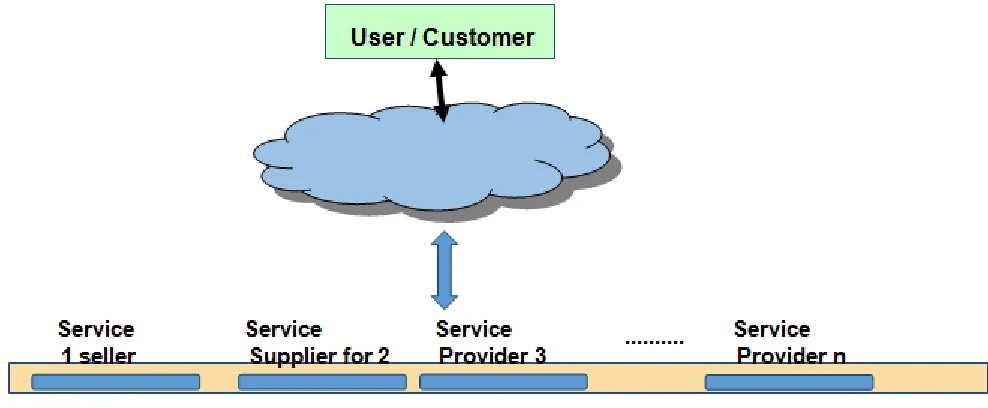
there are many service providers to choose from. The following figure shows the situation more clearly:
Figure 2: The cloud subscription service
In the figure above, n number of service providers that provide services IT (SaaS, PaaS, IaaS). Some of them offer the
© IJERGS, All Rights Reserved.
Pag
e
4
Pag
e
4
Pag
e
4
Pag
e
4
Pag
e
4
Pag
e
4
Pag
e
4
Pag
e
4
Pag
e
4
Pag
e
4
Pag
e
4
Pag
e
4
Pag
e
4
Pag
e
4
Pag
e
4
Pag
e
4
Pag
e
4
Pag
e
4
Pag
e
4
Pag
e
4
Pag
e
4
consumer to choose the service provider from which the consumer can obtain service. Therefore, the problem is to choose
the most appropriate service (in terms of price or time) that the number of service providers that meet consumer needs.
Proposed solution
As mentioned, there are many services available in the cloud that is classified into 3 categories. And we have to find a
platform where all services, regardless of the service provider and regardless of the category (three categories), which is
the membership, which must have access to the services we have requested. For this problem, we can find a ready to use
solution, an integrated platform that will help the user / client to get everything you want in a single integrated
development environment (IDE). This IDE of ours, a user can find everything you need in one, so you do not have to look
for different cloud services, or if you need help finding service providers. Everything has been done Suppose a customer /
user has requested a service. There are many service providers who provide that particular service requested by the
customer and all are working on their own set of rules. So first you have to think of a solution (process) running on a
platform common / common interface. The next problem comes from the recovery of all service providers that offer that
particular service requested. All these tedious tasks have been eliminated by our IDE forever.
When the links require a complex and dynamic engagement and are subject to rapid changes should be considered agents
based approaches. We can think of an automated process, it is assigned an agent between the needs of users and service
providers. The idea of using an agent has been discussed. Our agent all online service providers will recover, choose the
services and optimize services according to time or cost of access.
Methodology
The idea of managing this research is the management of cloud computing with intelligent behaviour. We offer integrated
multi-agent cloud, which translates into a more flexible, autonomous and high operating system. This system is a special
software that allows users to work independently and without interference. The original of this system has two functions:
service providers and customers. The goal is to create a system that allows the client to hide the complexity API and GUI,
and allow customers to choose the best service provider for your needs. The system architecture has two levels: the
application layer and the Internet layer.
The application tier includes all applications provided by the factor generating agent administration, data recovery
organizations and all information on support for recovery and decision. The system provides all services to customers
through a standard interface. Levels of Internet layer, where the necessary information is restored to meet the needs of
users of the cloud.
Proposed Methodology
During the project have created a web-based interface that offers an integrated development environment to implement
the functionality of the market by the basic support cloud server and its plugins to analyse in several languages, offering
users and online functionality.
To this end, we have built a web based tool where users can register themselves and carry out their project work online
© IJERGS, All Rights Reserved.
Pag
e
5
Pag
e
5
Pag
e
5
Pag
e
5
Pag
e
5
Pag
e
5
Pag
e
5
Pag
e
5
Pag
e
5
Pag
e
5
Pag
e
5
Pag
e
5
Pag
e
5
Pag
e
5
Pag
e
5
Pag
e
5
Pag
e
5
Pag
e
5
Pag
e
5
Pag
e
5
Pag
e
5
also charge users additional features and check your subscription time to time. Everything is based on the payment policy
for use of the cloud.
Clone-able agents
When the user decides to take a cloud service, you have to think at all costs, subscription time, and related many other
features. This is not a simple task for the everyday user. You want a simple solution to your problem, you do not have to
go through this gruelling task for fulfilling their needs.
Here on our web tools, we have a readymade Platform integrated development agents operating on Cloneable. It provides
a graphical user interface development platform rich that is easy to use and cheaper than any other software you pay for.
Through clone-able agents, we can use it on multiple computers, and open multiple instances, which is exactly the
number provided by our service provider. On the other hand, if the user tries to use an additional system, say the service
is ten systems, and tries to use it in the system XI, then the threads of the clones will overflow, and the signing of the
eleventh garbage device.
Implementation
As stated earlier, we have a web tool to simulate cloning agents. The following are the steps that will guide you through
all the tools of the Web.
Step 1
Next picture shows the login screen of our web-tool, called "Codiad". Enter your username and password login and click
Continue.
Step 2
Click "New Project" and start programming in any of the available languages, which are integrated into Codiad. There are
a number of languages in which Codiad are integrated and can be compiled.
Step 3
The side panel on the right displays the additional options, including reserves, users, projects, markets, change settings,
etc. this side panel is displayed when the mouse is passed to the right of the screen. In addition, the left side of the
workspace shows your projects and directories.
Step 4
If you want, you can create multiple users for privacy and abstraction of work. Each user is authenticated based on user
ID and password. you can also see different projects created by you, when you get into your space.
Step 5
You can download additional to integrate additional functions for Codiad plug-ins. This tool will be plug-ins on the
market, which is linked to Github.
Step 6
© IJERGS, All Rights Reserved.
Pag
e
6
Pag
e
6
Pag
e
6
Pag
e
6
Pag
e
6
Pag
e
6
Pag
e
6
Pag
e
6
Pag
e
6
Pag
e
6
Pag
e
6
Pag
e
6
Pag
e
6
Pag
e
6
Pag
e
6
Pag
e
6
Pag
e
6
Pag
e
6
Pag
e
6
Pag
e
6
Pag
e
6
Figure 3: Change Password
Here you can find different files created by you. You can plan a search for them in their projects and ongoing projects in
your workspace. It will search through the various files and various projects based on the search term you previously
provided.
Figure 4: File Search
Comparison with existing tools
Codiad, as shown above, is a web-based IDE provides application development environment and shared distribution for
the development of a wide variety of languages, namely: java, asp.net, PHP, Python, Pearl, C , C ++, C #, Android, JSP,
HTML, XML, CSS, JavaScript, vb.net, XHTML, ruby-on-rails, J-query ,, CORBA, COBOL, ADA, SQL, PL / SQL
basic, and many more.
When compared with another IDE on the market, as wix.com, godaddy.com, indiamart.com, based on parameters such as
bandwidth, are some results that are visible in the following decision table:
Table 1: Comparison of different tools and Codiad
Internet-based IDE
bandwidth
provided
SPACE
PROVIDED
LANGUAGE
SUPPORT
subscription
COST OTHER
Codiad Unlimited (as per user)
Almost unlimited
(expandable)
800+ (approx.
Vivo)
It starts from Rs.
600 (used based
cloud)
features unlimited user
interface, frames,
© IJERGS, All Rights Reserved.
Pag
e
7
Pag
e
7
Pag
e
7
Pag
e
7
Pag
e
7
Pag
e
7
Pag
e
7
Pag
e
7
Pag
e
7
Pag
e
7
Pag
e
7
Pag
e
7
Pag
e
7
Pag
e
7
Pag
e
7
Pag
e
7
Pag
e
7
Pag
e
7
Pag
e
7
Pag
e
7
Pag
e
7
Wix 10 GB (with
ads) 10 GB
Python,
Ruby-on-Rails, Java
(frames only)
Rs. 9083.16 PA for
the premium
package
Limited space and
language support
see papi
Unlimited (up
to 25
websites)
Limited to 25
websites
Many languages
and tools
Rs. 8000 PA for the
unlimited package Privacy Issues
Indiamart 1 GB
As needed for
your unique
website
ASP (classic),
ColdFusion
Rs. 14000 + (space)
Rs 26,000 for
marketing
Only internet marketing,
buying and selling
Results
As we mentioned before, that Codiad is an integrated development environment that works through agents and cloning,
and therefore reduces the overall cost normally spend on various commercial and academic versions of the decade of
software available for purchase the market; Here are some results in support of our arguments. On the next page is a table
showing the costs of the various software packages and their different versions in commercial and academic versions, in
tabular form. These costs are compared with the costs we pay in Codiad, and its total comparative, in which it was found
that by using Codiad, we just have to pay only 2-5% of the cost of other programs:
© IJERGS, All Rights Reserved.
Pag
e
8
Pag
e
8
Pag
e
8
Pag
e
8
Pag
e
8
Pag
e
8
Pag
e
8
Pag
e
8
Pag
e
8
Pag
e
8
Pag
e
8
Pag
e
8
Pag
e
8
Pag
e
8
Pag
e
8
Pag
e
8
Pag
e
8
Pag
e
8
Pag
e
8
Pag
e
8
Pag
e
8
Conclusion and future scope
The essential characteristics of cloud computing is the exchange and pooling of resources; in other words, is a cloud
computing platform resources to be shared by several consumers meet their individual needs. Applications and data can be
shared by several companies, individuals and / or cross-platform users. Exchange and sharing of resources means:
To use the resources by combining the resources of various cloud providers; risk that can enter through
cooperation,
To assign, schedule and coordinate resources to share and Establish contracts between service providers and users.
The essential characteristics of cloud computing-based agents is based on cooperation and negotiation. Coordination
protocols agents adopt the system to automate activities because pooling of resources for exchanging clouds. The
requirement for systems management cloud resources is to manage and conserve the process continuously by controlling
the requirements of current service requests. To change to meet the demands of future services. To adjust schedules
autonomously. Prices remain with considerations to accommodate dynamically changing resource demands. Cloud
resources are autonomously managed by software agents at the appropriate level. Every coin has two sides, so is the cloud
computing. However the advantages of using cloud computing with economic advantages of profitability is finding
acceptance worldwide by corporate sectors as well as individuals and progresses at a faster pace. The fact that cloud
computing is still in an infant age, but holding its strength and has great potential for growth in the future. User base
Cloud Computing is growing steadily. More and larger players are attracted by the passage of time and is offering better
and smoother and refined services and solutions.
References
1. AK Srivastava, Vandana Srivastava, Richa Bhargava, "Towards the development of an intelligent agent for Cloud
Computing" International Conference on Cloud, Big Data and Trust 2013, Nov 13-15.
2. Dinesh Kumar RC, Ashwin R. "multi-agent based on cloud services." International Journal of Computer
Applications (IJCA). The procedure of eGovernment and infrastructure services - 2012, vol. EGOV - Issue 1, pp
7-10 ISBN 973-93-80870-67-9.
3. S. Ayshwarya Laxmi, S. Shanmuga vadivu, A. Ramchandran, "Detection and Badsmells programming Java Agent
Development Environment (JADE)", International Journal of Computer Applications (0975-8887), vol. 67-No.10,
April 2013.
4. Aarti Singh, Manisha Malhotra. "Marco agent scalability based on Cloud Computing". International Journal of
Computer Science and Engineering Technology (IJCSET), vol3, No. 4, April 2012, pp 41-45, ISSN 2229-3345.
5. Roman Debski, AleksanderByrski and MarekKisiel-Dorohinicki, "Towards a cloud Augmented Agent-Based".
National Telecommunications Institute, Journal of Telecommunications and Information Technology, January 2012.
6. H.Liu, L.Yang, Z.Niu, Z.Ma and W.Shao, "smell Detection and Resolution Program: A new way to save effort,"
IEEE Trans. Software Eng., Vol. 38, no. 1 February 2012.
© IJERGS, All Rights Reserved.
Pag
e
9
Pag
e
9
Pag
e
9
Pag
e
9
Pag
e
9
Pag
e
9
Pag
e
9
Pag
e
9
Pag
e
9
Pag
e
9
Pag
e
9
Pag
e
9
Pag
e
9
Pag
e
9
Pag
e
9
Pag
e
9
Pag
e
9
Pag
e
9
Pag
e
9
Pag
e
9
Pag
e
9
Workshop 12 on objects and agents (WOA-2011), Renede (CS) Italy, July 4 to 6, 2011, vol 741, pp 2-6.
8. J. Octavio Gutiérrez-Garcia and Kwang-MongSim, "agents of self-organization of the service composition incloud
Computing". In Proceedings of the Second IEEE 2010 International Conference on Cloud Computing Technology
and Science (CLOUDCOM '10), pp 59-66 November 30 --DIC-3, 2010.
9. RajkumarBuyya, Rajiv Ranjan, Rodrigo N. Calheiros, "InterCloud: Federation cloud computing environments
application service scale for profit". In Proceedings of the 10th International Conference on Algorithms and
Architectures for parallel processing (ICA3PP 2010, Busan, South Korea, 21-23 May 2010), LNCS, Springer,
Germany, 2010.
10. Cloud Computing Expert Group, "The future of cloud computing", Report of the European Commission, January
2010.
11. Armbrust M., et al., "A view of cloud computing", Communications of the ACM, vol. 53, no. 4, pp. 50-58 April
2010.
12. Sergiy Nikitin, Vagan Terziyan, Michal Nagy, "intelligent processing services data in the cloud", 2010.
13. M.Nikraz, G.Caire and Parisa A.Bahri "A Methodology for Analysis and Design of Multi-Agent System using
JADE", 2010.