Volume 01, No.4, April 2015
P
age
29
Cloud Computing
Karan Saxena * & Kritika Agarwal**
*Student, Sir M. Visvesvaraya Institute of Technology **Student, Dayananda Sagar College of Engineering
ABSTRACT:
This document contains basic information about cloud technology and services, history which includes details about its key features, architecture, working as well as its advantages and disadvantages and the types of services (security)
Keywords: Cloud, Bandwidth, Infrastructure, Software, Platform.
I. INTRODUCTION
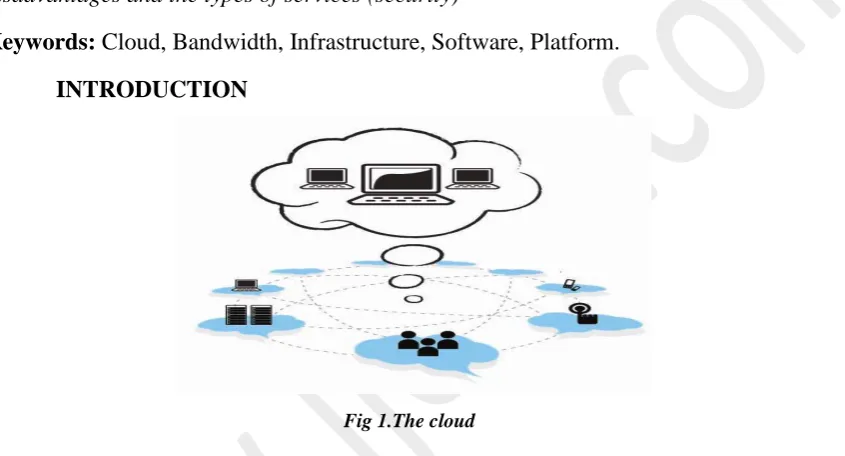
Fig 1.The cloud
Cloud computing is the delivery of computing services over the Internet. Cloud services allow individuals and businesses to use software and hardware that are managed by third parties at remote locations. Examples of cloud services include online file storage, social networking sites, webmail, and online business applications. The cloud computing model allows access to information and computer resources from anywhere that a network connection is available. Cloud computing provides a shared pool of resources, including data storage space, networks, computer processing power, and specialized corporate and user applications.
The following definition of cloud computing has been developed by the U.S. National Institute of Standards and Technology (NIST):
Volume 01, No.4, April 2015
P
age
30
II. HISTORY
The underlying concept of cloud dates back to the 1950’s when large scale mainframe computers were accessible via thin clients or terminal computers.‖Cloud‖ is the newest name for what has been around since the mid 90’s as on-demand infrastructure. In 1995 it was known as ―shared web hosting‖ and had limited features.1997 brought dedicated hosting both managed and unmanaged. In 1998 VPS hosting became available, it provided partial infrastructure demand and resource size flexibility.Amazon.com played a key role in the development of cloud computing. By 2007 Google, IBM started large scale cloud computing. In August 2008 Gartner observed that ―Organizations are switching from company owned hardware and software assets to per-use service based models.” And that the “Projected shift to cloud computing will result in dramatic growth in IT products in some areas and in significant reduction in other areas.”
III. KEY FEATURES OF CLOUD
The characteristics of cloud computing include on-demand self service, broad network access, resource pooling, rapid elasticity and measured service.
On demand self-service:
A client can unilaterally provision computing capabilities, such as server time and network storage, as needed automatically without requiring human interaction with each service provider.
Broad network access:
A client can access software hosted on the cloud using appropriate devices (tablets, laptops) wherever they are located using a simple online access point. Broad network access includes private clouds that operate within a company’s firewall, public clouds, or a hybrid development.
Resource pooling:
It is about assigning computing resources to multiple customers dynamically. It is something that can change from time to time based on user’s demands.
Measured service:
The cloud is affordable, you can pay for what you use. The consumer and the cloud provider can measure storage levels, processing, bandwidth, and the number of user accounts and the consumer is billed appropriately.
IV. ARCHITECTURE
Volume 01, No.4, April 2015
P
age
31
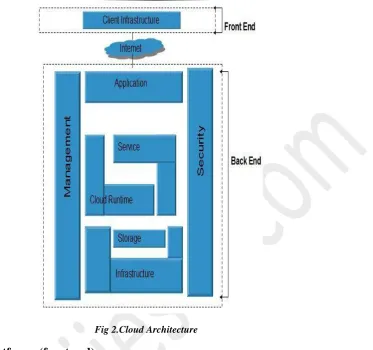
Fig 2.Cloud Architecture
Cloud client platforms (front end):
Front end platforms are called cloud clients comprising of fat clients, thin clients, zero clients. These client platforms interact with the cloud storage via application (middleware) via a web browser or through a virtual session.
Cloud storage (back end):
An online network storage where data is stored and accessible to multiple clients. In order to be effective the cloud storage needs to be agile, flexible, scalable and secure.
Cloud based delivery: It is further categorized as:
• Infrastructure as a service (IaaS) • Software as a service (SaaS) • Platform as a service (PaaS)
Cloud networking:
The cloud network layer should offer:
Volume 01, No.4, April 2015
P
age
32
• Network security for protecting data and information.
V. TYPES OF CLOUDS
Public cloud: A cloud computing model in which services, such as applications and storage
are available for general use over the internet.
Private cloud: It is a virtualized datacenter that operates with a firewall. Private clouds are
highly virtualized, joint together by mass quantities of IT infrastructure into resource pools, and are privately owned and managed.
Hybrid cloud: It is a combination of private and public cloud.
Community cloud: It’s an infrastructure shared by several organizations which supports a
specific community.
I. SERVICES AND ITS TYPES
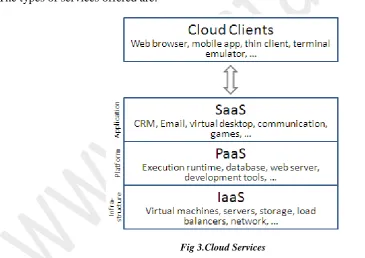
Services made available to users on demand via the Internet from a cloud computing provider's servers as opposed to being provided from a company's own on-premises servers. The types of services offered are:
Fig 3.Cloud Services
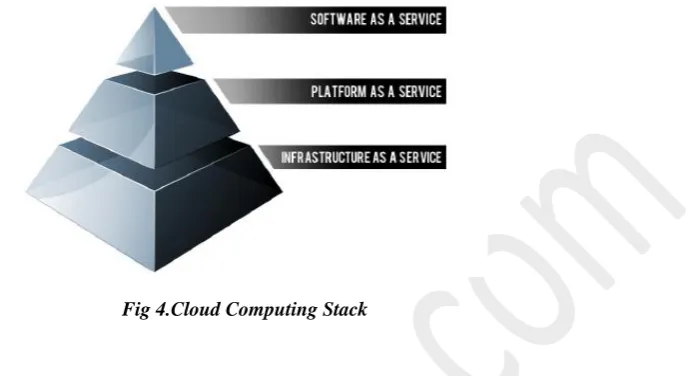
Software as a service (SaaS): The provider licenses an application to customers either as a
service on-demand, through a subscription, in a pay-as-you-go model.
Platform as a service (PaaS): It is a platform for the creation of software delivered over the
Volume 01, No.4, April 2015
P
age
33
Infrastructure as a service (IaaS): Using this service clients buy cloud infrastructure such
as servers, storage, network as a fully outsourced service on demand.
Fig 4.Cloud Computing Stack
VII. WORKING
Cloud technology refers to sharing resources, software and information via a network in this case internet. The information is stored on physical servers maintained and controlled by a cloud computing provider. The client can access the data from any location and download it in to any device such as tablets, laptops. The client can also edit files simultaneously with other users. This technology helps clients to use applications without installation and access their data via any computer with internet access. Cloud technology uses twice the number of storage devices it requires to make a copy of all its client information (backup). Making copies of data on a backup is called redundancy. There are different types of cloud services available to suit different needs.
VIII. ADVANTAGES OF CLOUD TECHNOLOGY
Cost efficient: The clients are billed for only what they use and they spend less on
infrastructure hence the overall cost reduces.
Improve accessibility: Clients will be able to access their applications and data from
anywhere via the internet
Backup and storage: Clients can store large amount of data and a copy is created on the
backup by the host server.
Scalability and performance: This technology is flexible to meet immediate needs of the
clients.
Minimize licensing new software: The clients don't have to buy a set of software or
software licenses for every system. Instead, the client could pay a metered fee to a cloud computing company.
IX. DISADVANTAGES OF CLOUD TECHNOLOGY
Technical issues: A high speed, reliable, broadband internet connection functioning during
Volume 01, No.4, April 2015
P
age
34
High dependency: There is greater dependency on the service providers making the clients
more vulnerable.
Security: There are always potential security and privacy risks especially due to presence of
sensitive data on cloud.
Limited control: Since the clients buy the services often they need to compromise and adopt
solutions which precisely don’t meet their needs.
X. SECURITY ON CLOUD
The idea of handing over important or sensitive data to other companies makes the client vulnerable because the information is no longer kept under lock and key. Moreover, concerns have been raised by many that cloud computing may lead to ―function creep‖—usage of data by cloud providers that were not anticipated when the information was originally collected and for which consent has typically not been obtained. However since the cloud service providers live and die by their reputation, it benefits the company to have reliable safety measures or the service would lose out on their clients.
There is possibility of the client’s privacy being compromised on the cloud. However counter measures are taken to avoid this, like for example:
• Authentication – providing username and passwords to the clients.
• Authorization – User can access only the data and application relevant to their job.
XI. FUTURE OF CLOUD
As per the result of the third annual future of cloud computing survey in 2014 by North Bridge Venture Partners, in conjunction with GigaOM Research and 57 collaborating organizations, Software-as-a-Service (SaaS) leads but fastest growth is in Infrastructure-as-a-Service (IaaS), which will give way to Platform-as-a-Infrastructure-as-a-Service (PaaS) in five years:
• SaaS remains the most popular form of cloud service, used by 63% of organizations, up from 55% in previous year.
• However, the fastest growth today is in IaaS, with usage rising from 35% to 45%, a 29% increase over the prior year.
• Meanwhile, platform-as-a-service (PaaS) is forecast to grow the fastest in the next five years, with 72% of respondents expecting to use PaaS in their organization within that time.
• In five years, more than three-quarters (76%) of respondents expect hybrid clouds to be the core of their cloud strategies overtaking public and private clouds.
According to Steven Martin, General Manager of Windows Azure Marketing & Operations, Microsoft
Volume 01, No.4, April 2015
P
age
35
competition and that, over the next five years, hybrid cloud will become the norm. This echoes what we hear from customers and it’s why comprehensive, hybrid cloud solutions are core to our strategy.”
XII. CONCLUSION
Cloud technology is the fastest growing part of IT. Cloud services are simpler to acquire and scale up or down. Public clouds work great for some but not all applications. Private clouds offer many benefits for internal application.Public and private clouds can be used in combination.Cloud technology holds some strong promises
• Highly available
• Dynamically allocated resource
• Clients pay only for the resources used.
XIII. ACKNOWLEDGEMENT
We hereby thank International Journal of Engineering Studies and Technical Approach (IJESTA) which is a good platform for students to help them grow technically. The open source resources available on the internet have been a boon in helping to find data on the subject in a very fast and efficient manner. Lastly we would like thank our friends who have maintained a tough competition throughout by preparing better paper presentation. Our sincere thanks to those who have motivated us to present this paper.
REFERENCES
i. Computer.howstuffworks.com/cloud-computing/cloud-computing4.htm
ii. www.slideshare.net/himanshuawasthi2109/cloud-computing-ppt-16240131
iii. south.cattelecom.com/rtso/Technologies/CloudComputing/007162948_chap01.pdf
iv. www.rockspace.com/knowledge_center/Whitepaper/understanding-the-cloud-- computing-stack-saas-paas-iaas
v. www.explainthatstuff.com/cloud-computing-introduction.html
vi. http://www.northbridge.com/2013-future-cloud-computing-survey-reveals-business-driving-cloud-adoption-everything-service-era-it