RESEARCH ARTICLE
Development and evaluation of the efficacy of Persian phonemic
synthesis program in children with (central) auditory processing
disorder: a single subject study
Samane Sadat Barootiyan1, Leyla Jalilvand Karimi1*,Shohreh Jalaie2, Ehsan Negin3
1- Department of Audiology, School of Rehabilitation, Shahid Beheshti University of Medical Sciences, Tehran, Iran
2- Biostatistics, School of Rehabilitation, Tehran University of Medical Sciences, Tehran, Iran
3- Department of Audiology, School of Rehabilitation, Tehran University of Medical Sciences, Tehran, Iran
Received: 6 Feb 2018, Revised: 13 Feb 2018, Accepted: 13 Feb 2018, Published: 15 Apr 2018
Abstract
Background and Aim: Central auditory pro-cessing disorder (C)APD can affect academic, social and communicative status of its patients whether children or adults. One of the most important skills involved in these disorders is decoding. The rehabilitation method for the dec-oding deficit in Buffalo auditory processing model is the phonemic synthesis program (PSP). In this study, the Persian version of PSP was developed and then the efficacy of this method in the rehabilitation of Persian children with (C)APD was evaluated.
Methods: This study was conducted in two stages. At first, the Persian version of PSP was prepared in accordance with its English version. Then, a child with (C)APD according to the res-ults of Persian versions of Phonemic Synthesis Test PST) and staggered spondaic words (P-SSW) was rehabilitated with this method. The treatment was given to the patient three sessions a week, each session lasted 30 minutes. Data were analyzed using visual analysis and non-parametric tests.
Results: During the treatment phase, a
significant improvement was seen in P-PST and P-SSW test results (p<0.05).
Conclusion: Based on the study results, the Persian version of PSP improves decoding, tole-rance fading memory, and organization disor-ders.
Keywords: Central auditory processing disorders; decoding; phonemic synthesis program; learning disability
Citation: Barootiyan SS, Jalilvand Karimi L, Jalaie S, Negin E. Development and evaluation of the efficacy of Persian
phonemic synthesis program in children with (central) auditory processing disorder: a single subject study. Aud Vest Res. 2018;27(2):101-10.
Introduction
(Central) auditory processing disorder or (C)APD is a central auditory nervous system disability in using auditory information [1]. ASHA (1996) defined central auditory proce-ssing as a set of mechanisms and proceproce-ssing that contribute in sound localization and latera-lization, auditory discrimination, auditory patt-ern recognition, and auditory temporal proce-ssing such as intelligibility, masking, summ-ation and temporal ordering, as well as auditory function in the presence of competing signals, and auditory function for degraded signal perce-ption. Central auditory processing involves
* Corresponding author: Department of Audiology,
both verbal and non-verbal signals and has neurophysiologic and behavioral bases [2]. ASHA (2005) in its last report on (C)APD stated that it is a disability in processing audi-tory stimuli and although it may occur in asso-ciation with other sensory disorders, it is not the result of involvement in other modalities [1]. The prevalence of (C)APD is reported to be 2% to 5% [3]. Inability in auditory processing can lead to language understanding disorder [1]. (C)APD can be due to central auditory nervous system (CANS) disorder [4] or an executive dysfunction necessary for motor response orga-nization for reception, perception, and interpre-tation of auditory signal [5]. This ailment can be seen in children with speech-language impair-ments, developmental disabilities, attention def-icits, or learning disabilities [6]. It may cause problems in communication, elementary educa-tion, self-confidence, and everyday activities [7]. Auditory processing models were proposed to help (C)APD classification, introducing tests, achieving proper results in determining disorder structure, and finally presenting appropriate treatments. Buffalo model is the most common and popular model. It consists of four catego-ries: decoding, integration, organization, and tolerance fading memory (TFM) [7].
Decoding in Buffalo model is defined as fast and accurate speech perception at the phonemic level [7]. Moreover, it is the most prevalent (C)APD category [8]. Buffalo model mostly mentions evaluations of this category, too [8,9]. Decoding problem is the most common problem in patients who have communication and edu-cation difficulties. These patients have ambigu-ous or inaccurate phonemic information stored in their brains. In Buffalo model, there are six therapies all including phonemic synthesis. Katz introduced phonemic and Phonemic Synthesis Trainings (PST) as the main trainings in his model. The aim of PST is to gradually change patients’ perception of phonemes and increase their ability to blend phonemes into words, so they can improve their decoding skill [7]. In addition to high efficacy, PST is simpler and more cost-effective than other decoding rehabi-litations. Other PST characteristics are its
resistant to peripheral hearing impairment, sim-plicity, and availability of the required equip-ment. It is applicable even in children with pro-found (C)APD, or in hearing-impaired subjects in different age groups with different cognitive status [7].
Although decoding is one of the main (C)APD categories, there has not been a Persian version of PST. The present study develops the Persian version of PST and then evaluate its efficacy in a Persian-speaking child with (C)APD.
Methods
This project conducted in two steps: step 1) developing the Persian version of PST, and step 2) evaluation of PST efficacy in an Iranian child with (C)APD.
PST development in the Persian language
unfamiliar for children so they were substituted by suitable words. Finally, word lists for each lesson were prepared and score sheet for PST was adapted from the original version.
Single-subject study for the evaluation of PST efficacy
This research is a basic and practical inter-ventional single-subject study. A patient was selected and entered into the basic phase of the study (A). Then she was put under the training phase (B) and at the end of each session, her performance was checked. As a definite prog-ram does not exist for screening and diagnosis of (C)APD in Iran, we used available sampling method and our inclusion criteria were as follows: aged 7-9 years, normal peripheral hearing, right-handedness based on Edinburgh questionnaire, (C)APD with decoding difficulty. Exclusion criteria were as follows: not coope-rating in the baseline phase or training phase and parents’ unwilling to continue participation. Hananeh was a 9-year-old girl (third grade of elementary school) living in Tehran, Iran. The chief complaints of her parents were her spell-ing, readspell-ing, memory difficulty, and sensitivity to loud sounds. She had a late response, history of chronic otitis media and communication difficulty. She asked “what?” repeatedly and showed severe speech articulation with nasal speech. She showed many phonemic errors and articulation problems in history taking. She also had low self-confidence, isolation, and verbal communication problem. She had problem with following instructions and late speech emer-gence based on parents’ report.
Hananeh has been under speech therapy due to her academic problems for two years. Her speech therapy continued during PST. She had simultaneous occupational therapy for one year, play therapy for three months when she was five, and cognitive therapy in first six months of her third grade. She was still on the speech and cognitive therapy during PST. She was receiving private teaching after school hours due to her academic problems. She had no progress based on teachers’ report. She showed spelling problems including phonemic omission,
substitution, and poor handwriting.
Hananeh entered into the basic phase after first evaluations and checking the inclusion criteria. In the training phase, PST was used for correc-ting phonemic engrams. Three weeks after com-pletion of training program, the patient was tested again. In general, six evaluations were performed during the study including Persian staggered spondaic words (P-SSW) and P-PST, also phonemic error analysis (PEA) form was completed. Therefore results were analyzed for P-SSW, P-PST, and PEA.
As her performance was good at first lessons, therapy was started from session 5. Words were presented phoneme by phoneme and she had to blend them in her mind and make up that word and say it out loud. Her score in each session was recorded. Each session had two signs. One, dashed line which the area above it is called target area. If her performance was below the target area, it was assumed that her performance is poor and we cannot jump to the next lesson yet. Therefore that lesson must be repeated and if it was necessary, compensation strategies were used. The second sign was two dark line above and below a row. This area is called com-pletion level and when her scores were above completion level, that lesson was completed and the next one would start. When the child had many errors or it took a long time for her to reach a completion level, compensation strate-gies were used.
page was opened and all eight words were presented simultaneously in front of the child and words were spelled randomly. Child had to point to the right word. To make sure that child is not pointing by chance, each word might be presented several times consecutively in a row.
Results
The present study was performed to develop the Persian version of PST and evaluate its efficacy in an Persian-speaking Iranian child with (C)APD. After development, its face and content validity were tested. For testing content validity index (CVI), the chosen words were distributed among 10 experts and they made comments based on a Likert-type qualitative scale (absolutely appropriate, partially appro-priate, and absolutely inappropriate). CVI was found to be 90.56%. Content validity ratio (CVR) based on Lawshe method was 77%-95%. For face validity, participants had to score each word based on a 5-point Likert-type scale. Impact score for all words was higher than 1.5.
1) Comparison of Hananeh’s evaluations before and after training
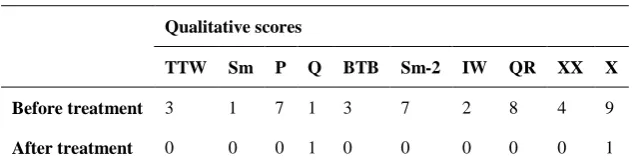
In Tables 1 to 3, the results of the baseline and the last session evaluations were compared. As it is seen in Tables 1 and 2, the results of P-SSW and in Table 3 the results of P-PST show the child’s performance improvement. Table 3 shows phonemic error reduction after training. 2) Single-subject study analysis
a) Analysis based on ascending-descending line The most appropriate aligned line was drawn for left competing (LC), right competing (RC), left noncompeting (LNC), right noncompeting (RNC) conditions from the baseline phase to training phase. In RNC, RC, LNC, and LC con-ditions in the baseline phase, 33% of dots were below the line but after training 100%, 83%, 66%, and 50% of dots were below the line, respectively. In total, right ear, left ear, and condition scores in the baseline phase, 33% of dots were below the line and after training 83%, 100%, 100%, and 83% were below the line. With regard to organization (ORG), decoding
Table 1. The patient’s quantitative scores of the Persian staggered spondaic words test in the first session of baseline phase and the last session of follow-up stage
Quantitative scores
C LE RE Rev Total LNC LC RC RNC
Before treatment 31 22 27.5 7 24.75 25 19 31 24
After treatment 1 0.5 0 0 0.25 0 1 0 0
C; condition, LE; left ear, RE; right ear, Rev; reversal, LNC; left non-competing, LC; left competing, RC; right competing, RNC; right non-competing
Table 2. The patient’s qualitative scores of the Persian staggered spondaic words test in the first session of baseline phase and the last session of follow-up stage
Qualitative scores
TTW Sm P Q BTB Sm-2 IW QR XX X
Before treatment 3 1 7 1 3 7 2 8 4 9
After treatment 0 0 0 1 0 0 0 0 0 1
(DEC) and tolerance fading memory (TFM) indices in the baseline phase (based on P-SSW), 33% of dots were below the line and after training 100%, 66%, and 100% of dots were below it. Regarding the qualitative indices of PST for DEC errors and TFM errors in the base-line phase, 33% and 50% of dots were below the line and after training 100% and 83% of dots were below the line. With regard to the quanti-tative (Quant) and qualiquanti-tative (Qual) scores in the baseline phase, 33% of dots were below the line and after training 100% of dots were below it. Regarding the PEA in the baseline phase, 50% of dots were below the line for substitution (SUB), omission (OMI) and addition (ADD) but after training 100%, 66% and 83% of dots were below the line, respectively. With regard to total errors in the baseline phase, 33% of dots were below the line and after training 83% were below it.
b) C-statistic analysis
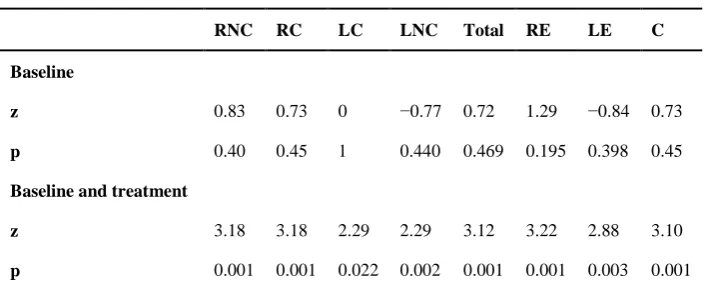
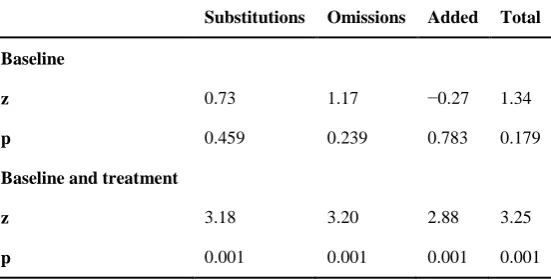
The results of C-statistic are summarized and presented in Tables 4 to 7. P-PST, P-SSW, and PEA showed significant improvement after trai-ning (p<0.05).
c) Efficacy study based on two standard devi-ations band method
Based on the results of P-SSW, P-PST, and PEA, her errors and scores were 2SD out of normal limits, so the training was significant and effective.
d) Efficacy evaluation based on nonoverlapping data
In P-SSW, her best performance (lowest level of error) in the baseline phase was 23, 29, 17, and 22 for RNC, RC, LC and LNC, respectively. The percentages of data under the horizontal line was 83%, 66%, 50% and 66%. For total, right ear (RE), left ear (LE), and condition (C) scores in the baseline phase, there were 23, 26,
Table 4. C-statistics analysis for the patient’s scores of the Persian staggered spondaic words test
RNC RC LC LNC Total RE LE C
Baseline
z 0.83 0.73 0 −0.77 0.72 1.29 −0.84 0.73
p 0.40 0.45 1 0.440 0.469 0.195 0.398 0.45
Baseline and treatment
z 3.18 3.18 2.29 2.29 3.12 3.22 2.88 3.10
p 0.001 0.001 0.022 0.002 0.001 0.001 0.003 0.001
RNC; right competing, RC; right competing, LC; left competing, LNC; left non-competing, RE; right ear, LE; left ear, C; condition
Table 3. The patient’s scores of the Persian Phonemic Synthesis Test and phonemic errors analysis in the first session of baseline phase and the last session of follow-up phase
Phonemic Synthesis Test scores Phonemic errors analysis scores
1st P Rev NF QR Q XX X Qual Quant Total Added Omissions Substitutions
Before treatment 9 11 0 11 8 7 0 0 0 0 112 18 53 41
After treatment 0 0 0 0 0 0 0 1 23 24 3 1 1 1
1st; 1st phoneme omission, P; preservation, Rev; reversal, NF; non fused, QR; quiet rehearsal, Q; quick, XX; extreme delay, X; delay,
20, and 29 errors, respectively. The percentages of the findings under the horizontal line were 66%, 83%, 66% and 83%, respectively. For ORG, DEC and TFM scores in the baseline phase, her best performances were 6, 35, and 5 respectively and the percentages of findings below the horizontal line were 100%, 66%, and 66% respectively. In P-PST, the lowest errors for DEC and TFM in the baseline phase were 29 and 15, respectively and the percentages of findings below the horizontal line was 83 in both. The best Qual and Quant scores in the baseline phase were 1 and 0, respectively, and the percentages of the findings above the hori-zontal line was 66% for both.
The lowest errors for SUB, OMI, ADD, and total in the baseline phase were 40, 48, 17, and 112, respectively and the percentages of find-ings below horizontal line for SUB, OMI, and ADD were 66% and for total was 83%.
e) Efficacy evaluation based on percentages of all nonoverlapping data (PAND)
With regard to P-SSW in RNC, RC, LC, and LNC, the number of nonoverlapping points was 1, 2, 2, and 0, respectively. So all percentages of nonoverlapping data (PND) were 91%, 83%, 83%, and 100%, respectively. For reversal (REV), DEC and TFM errors, the number of nonoverlapping points were the same and the total percentage of nonoverlapping data was
91%. Regarding P-PST, DEC, TFM and Quant and Qual score, the number of nonoverlapping points were 1, 1, 2, and 2 respectively and the total percentage of nonoverlapping data were 91% for DEC and TFM and 83% for Quant and Qual scores.
Regarding the SUB, OMI, ADD and total errors in PEA, the number of nonoverlapping points were 0, 2, 1, and 0 and a total percentage of nonoverlapping data were 100%, 83%, 9%, and 100%, respectively.
f) Visual evaluation of Hananeh’s performance One method for efficacy evaluation in the single-subject study is monitoring patients’ per-formance changes in the baseline, training and follow-up phase. Hananeh’s performances are summarized in Fig. 1A-F. As it is seen, there was a significant decrease in the number of err-ors after training. In addition, there was no ret-urn of indices to the baseline phase in the follow-up phase.
Discussion
This study was conducted to develop P-PST and evaluate its efficacy in Persian-speaking chil-dren with (C)APD. Ascending-descending line, C-statistic, two standard deviation band method, PND, and PAND analysis were used. In the first stage of the study (PST development), face validity and content validity ratio showed that selected words were appropriate to evaluate the central auditory system. For studying CVI,
Table 5. C-statistics analysis for the patient’s scores of the Persian staggered spondaic words test based on Buffalo sub-categories
DEC TFM Rev
Baseline
z −0.52 0.57 −1.21
p 0.603 0.563 0.223
Baseline and treatment
z 3.06 2.74 2.81
p 0.002 0.006 0.004
DEC; decoding, TFM; tolerance fading memory, Rev; reversal
Table 6. C-statistics analysis for the patient’s scores of the Persian-Phonemic Synthesis Test
Quant Qual DEC TFM
Baseline
z −0.59 0 −1.66 −0.36
p 0.554 1 0.961 0.712
Baseline and treatment
z 3.21 3.12 3.25 2.93
p 0.001 0.001 0.001 0.003
Waltz and Bausell method was used [11]. Wor-ds were distributed among 10 experts to have their comments based on a qualitative Likert-type scale (highly relevant, somewhat rlevant, and not relevant). In the end, CVI was 90.56% that means the chosen words had high content validity for PST. Lawshe maintained that CVI larger than 0.62 is an acceptable criterion [12]. CVR in this study based on Lawshe method was 77%-95%. For face validity, the participants were asked to score words on a 5-point Likert-type scale. Impact score above 1.5 was indica-tive of acceptable face validity. Impact score for all words was above 1.5 so the face validity was acceptable.
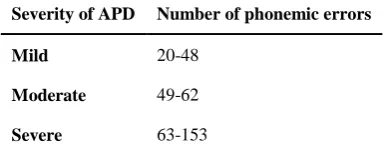
In the present study, disorder severity was eva-luated by a number of phonemic errors. Katz suggested that the number of errors in Buffalo model is a good index for determining disorder severity. Disorder severity based on Katz [7] is presented in Table 8. Based on this table, the subject in the present study had severe (C)APD. Katz after introducing Buffalo model, showed that left posterior middle temporal lobe defect can lead to DEC involvement [13]. The subject in the present study had DEC involvement, so it is assumed that she has a left posterior middle temporal lobe defect. As it is seen in 1 to 3 des-criptive Tables, all indices of P-SSW and P-PST showed improvements after training and in the follow-up phase there was no return of her com-plaints and problems. This shows that training effects were permanent. Olive and Franco
suggested that in addition to visual analysis of the performance change graph, several ana-lytic statistics should be used in the single-subject study [14]. Lenz suggested that in order to decrease error occurrence rate in the single-subject study, several analytic approaches sho-uld be used in training efficacy evaluation [15]. Noorbakhsh and Ottenbacher. commented that to achieve comprehensive conclusion in treat-ment efficacy evaluations, several analytic met-hods have to be used [16]. In this study ascen-ding-descending line, C-statistic, two standard deviation band method, PND and PAND ana-lysis were used.
Scruggs and Mastropieri [17] as well as Lenz mentioned that PND is vulnerable to floor and ceiling effect in the baseline phase and this may lead to underestimation of the training. He added that PAND analysis is more cautious and accurate that PND [15]. So in cases that there is a floor or ceiling effect in PND, we can use PAND instead. PND and PAND are interpreted based on Scruggs and Mastropieri findings that are summarized in Table 9. This table shows the relationship between PND and PAND findings and training efficacy [17,18].
Hananeh showed significant improvement in four scores of P-SSW. In the baseline phase, there was no spontaneous improvement based on C-statistic. With regard to RNC, RC, LC and LNC scores, the percentages of total nonover-lapping data were 91%, 83%, 83%, and 100%, respectively indicating a definite improvement Table 7. C-statistics analysis for the patient’s scores of
the phonemic error analysis form
Substitutions Omissions Added Total
Baseline
z 0.73 1.17 −0.27 1.34
p 0.459 0.239 0.783 0.179
Baseline and treatment
z 3.18 3.20 2.88 3.25
Fig.1. The trend of changes in the patient’s A) scores in four main condition of SSW, B) scores of P-SSW, C) behavioral indices of decoding, tolerance fading memory and organization based on P-SSW scores, D) behavioral indices of decoding, tolerance fading memory and organization based on P-PST scores, E) qualitative and quantitative scores of the P-PST, and F) phonemic errors based on the P-PEA in the baseline, treatment, and follow up sessions. RNC; right non-competing, RC; right competing, LC;
left competing, LNC; left non-competing; S; session, RE.s; right ear score, LE.s; left ear score, C.s;
condition score, TFM; tolerance fading memory, DEC; decoding, Rev; reversal, SSW;staggered spondaic
words, PST; Phonemic Synthesis Test, Quant; quantitative, Qual; qualitative, SUB; substitution, OMI; omission, ADD; addition.
E
rr
or
Baseline Intervention Follow-up 0 10 20 30 40 A S .6 S .5 S .4 S .3 S .2 S
.1 S.1 S.2 S.3 S.4 S.5 .6S S.1 S.2 S.3 S.4 S.5 S.6
RNC RC LC LNC S .6 S .5 S .4 S .3 S. 2 S .1 S .6 S .5 S .4 S .3 S .2 S .1 S .6 S .5 S. 4 S .3 S .2 S .1 B E rr or
Baseline Intervention Follow-up 0 10 20 30 40 Total RE.s LE.s C.s
Baseline Intervention Follow-up
E rr or 40 30 20 0 10 50 S .6 S .5 S .4 S .3 S .2 S
.1 S.1 S.2 S.3 S.4 S.5 .6S S.1 S.2 S.3 S.4 S.5 S.6
TFM.SSW DEC.SSW Rev.SSW
C D
Baseline Intervention Follow-up
E rr or 40 30 20 0 10 S .6 S .5 S. 4 S .3 S .2 S
.1 S.1 S.2 S.3 S.4 S.5 .6S S.1 S.2 S.3 S.4 S.5 S.6
TFM.PST DEC.PST
Baseline Intervention Follow-up
S .6 S .5 S .4 S .3 S .2 S
.1 S.1 S.2 S.3 S.4 S.5 .6S S.1 S.2 S.3 S.4 S.5 S.6
E E rr or 20 15 10 0 5 25 Quant Qual
Baseline Intervention Follow-up F E rr or 120 80 60 0 40 20 100 S .6 S .5 S. 4 S .3 S .2 S
.1 S.1 S.2 S.3 S.4 S.5 .6S S.1 S.2 S.3 S.4 S.5 S.6
in all four conditions. RE, LE and total scores showed strong training effects and condition score showed proper training effects as well. Regarding the qualitative errors in DEC, TFM and ORG subcategories, training had very strong effects. Regarding the P-PST indices, PAND was 83% for quantitative and qualitative scores which is indicative of effective training based on Table 9. In these two scores, her per-formance improvement was not significant in the baseline phase and after training the imp-rovement was significantly based on C-statistic. Training effect for Buffalo subcategories in P-PST was 91% that is very strong and agrees with qualitative P-PST score improvement. Phonemic error analysis (PEA) showed strong training effects in SUB, ADD, and total indices and proper training effects in OMI. After three weeks since the completion of training, all base-line evaluations were done again and the pro-bability of disorder recurrence was tested. In all indices, training effects were permanent so it can be concluded that PST correctly works on the defective area and its effects are maintained
after training. In other words, it can modify ina-ccurate phonemic engrams in the left posterior middle temporal lobe because the central audi-tory system is plastic. The plasticity and flexibi-lity were permanent and howed the durabiflexibi-lity of training effects.
Katz investigated PST efficiency in a field study on 54 children and showed that there was a significant improvement following training. One of his findings was that the number of lessons’ repetition for reaching to the completion level was higher in the first few sessions sessions. The child first shows a peak of errors that incr-ease the length of training but in the second half of training sessions, this peak starts to decline fast. This steep reduction can be seen in a num-ber of errors and increment of lesson comp-letion. This finding is in agreement with the pre-sent study [7].
There has not been any study on both phonemic synthesis program (PSP) and phonemic training efficacy. Katz in 2009 studied a group of chil-dren who were under PSP and phonemic trai-ning program (PTP). He evaluated PST and PEA before and after training. He reported that after an average of 12.8 sessions, the scores ncreased 7 point on average. They pointed that at the end of training, 31% of the patients had no error or only one error. Qualitative score improvement was from 14 errors on average before training to 5 errors after training that is indicative of effective therapy [7]. The findings of the present study are in agreement with Katz study. Katz studied phonemic errors too and showed 45% improvements after training [7]. The present study not only agrees with Katz
Table 8. Determining severity of central auditory processing disorders based on the phonemic error analysis form
Severity of APD Number of phonemic errors
Mild 20-48
Moderate 49-62
Severe 63-153
APD; auditory processing disorder
Table 9. Interpretation of percentage of non-overlapping data and percentage of all non-overlapping data results
Training status Percent of non-overlapping results
Complete/definite treatment Score over 90%
Appropriate treatment Score 70-90%
Treatment is available but it should be used cautiously Score 50-70%
study but also supports higher efficacy of the program comapred to Katz study results.
Conclusion
This single-subject study was conducted to eva-luate Phonemic Synthesis Test (PST) efficacy in a Persian speaking child with (C)APD and sho-wed that this training is absolutely suitable for these children, especially for decoding (DEC) subcategory.
Acknowledgement
The present paper is extracted from S. S. Bar-ootiyan’s MSc. dissertation and submitted in Shahid Beheshti University of Medical Scie-nces. The authors would like to thank Hananeh and her parents for Participation in this research.
Conflict of interest
The authors declare that they have no conflict of interest.
REFERENCES
1. American Speech-Language-Hearing Association. (cen-tral) auditory processing disorders [Technical Report]. 2005. Available from www.asha.org/policy.
2. American Speech-Language-Hearing Association. Cen-tral auditory processing: current status of research and implications for clinical practice [Technical Report]. 1996. Available from www.asha.org/policy.
3. Geffner D. Central auditory processing disorders: defi-nition, description and behaviors. In: Geffner D, Ross-Swain D, editor. Auditory processing disorders: asse-ssment, management and treatment. 1st ed. San Diego:
Plural Publishing; 2007. p. 25-48.
4. Keith R. Central auditory and language disorders: strategies for use with children. Houston: College-Hill Press; 1981.
5. Rees N. Saying more than we know: is auditory
processing disorder a meaningful concept? In: R Keith, editor. Central auditory and language disorders in chil-dren. Houston: College-Hill; 1981. p. 94-120.
6. Bellis TJ. Assesment and management of central audi-tory processing disorders in the educational setting: from science to practice. 1st ed. Clifton Park, NY: Cengage
Learning; 1996.
7. Katz J. Therapy for auditory processing disorders: simple effective procedures. Denver, CO: Educational Audiology Association; 2009.
8. Katz J. Classification of auditory processing disorders. In: Katz J, Stecker NA, Henderson D, editors. Central auditory processing: a transdisciplinary view. St. Louis, MO: Mosby; 1992. p. 81-91.
9. Katz J. Phonemic training and phonemic synthesis programs. In: Geffner DS, Ross-Swain D, editors. Audi-tory processing disorders: assessment, management and treatment. 1st ed. San Diego: Plural Publishing; 2007. p.
255-65.
10. Bijankhan M, Mohseni M. Frequency dictionary accor-ding to a written corpus of today Persian language. 1st
ed. Tehran: University of Tehran Press; 2012.
11. Waltz CF, Bausell RB. Nursing research: design, statis-tics, and computer analysis. Philadelphia: F. A. Davis; 1981.
12. Lawshe CH. A quantitative approach to content validity. Personnel psychology. 1975;28(4):563-75. doi:
10.1111/j.1744-6570.1975.tb01393.x
13. Katz J. The SSW test: an interim report. J Speech Hear Disord. 1968;33(2):132-46. doi: 10.1044/jshd.3302.132
14. Olive ML, Franco JH. (Effect) size matters: and so does the calculation. Behav Anal Today. 2008;9(1):5-10. doi: 10.1037/h0100642
15. Lenz AS. Calculating effect size in single-case research: a comparison of nonoverlap methods. Meas
Eval Couns Dev. 2013;46(1):64-73. doi:
10.1177/0748175612456401
16. Nourbakhsh MR, Ottenbacher KJ. The statistical ana-lysis of single-subject data: a comparative examination. Phys Ther. 1994;74(8):768-76.
17. Scruggs TE, Mastropieri MA. How to summarize single participant research: Ideas and applications.
Exceptionality. 2001;9(4):227-44. doi:
10.1207/S15327035EX0904_5