in the population sciences published by the Max Planck Institute for Demographic Research Doberaner Strasse 114 · D-18057 Rostock · GERMANY www.demographic-research.org
DEMOGRAPHIC RESEARCH
VOLUME 4, ARTICLE 2, PAGES 29-96
PUBLISHED 19 FEBRUARY 2001
www.demographic-research.org/Volumes/Vol4/2/
DOI: 10.4054/DemRes.2001.4.2
Gender and family stability:
Dissolution of the first parental union in
Sweden and Hungary
Livia Sz. Oláh
1. Introduction 30
2. Theoretical framework 30
2.1 General framework 30
2.2 Our analytical strategy 32
3. The comparative setting 33
4. Data and method 35
5. Variables 37
5.1 Gender relations 37
5.2 Labor-force attachment 39
5.3 Analytic model 41
6. Findings and discussion 43
6.1 Sweden 43
6.1.1 Gender relations 43
6.1.2 Combining parenthood and employment 45
6.2 Hungary 47
6.2.1 Gender relations 47
6.2.2 Combining parenthood and employment 49
7. Concluding remarks 50
8. Acknowledgements 51
Notes 52
References 53
Tables and Figures 60
A. Appendix A. Control variables 70
A.1 Individual characteristics 70
A.2 Maturity at family formation 71
A.3 Parental-union-specific characteristics 71
A.4 Business-cycle variations 72
Additional references 73
Tables 75
B. Appendix B. Stepwise model presentation 83
B.1 Sweden 83
B.2 Hungary 85
Gender and family stability:
Dissolution of the first parental union
in Sweden and Hungary.
Livia Sz. Oláh
Abstract
1. Introduction
In recent decades, family stability has decreased substantially in most industrialized countries. This was seen both in increasing divorce rates and in the growing prevalence of non-marital cohabiting relationships, which are usually more fragile than marriages (Da Vanzo and Rahman 1993, Kaa 1994). Partnership dissolution among families with children has also become more and more common.
As the demographic changes have been accompanied by greatly increasing labor-force participation among women, even among mothers with young children, theoretical explanations of new family patterns have focused mainly on women’s increasing economic independence (Becker 1991) but also on ideational changes such as growing individualism and other value shifts (Lesthaeghe 1983, Kaa 1987). Although these influential theories point to the importance of gender relations for family stability at least indirectly, it has not been studied much in demographic research except for the US. In spite of important changes in the gender context all over the developed world, we thus know relatively little about the mechanisms of the potential interplay between family stability and changing gender relations linked to the interrelationship between women’s rapidly increasing employment rates and changes in (the demands on) men’s involvement in childrearing and domestic responsibilities. Also, our knowledge about whether men’s characteristics have different effects than women’s characteristics on family dissolution is rather limited. Such gender differences are likely to exist based on the gendered nature of family life. Hence, the purpose of this paper is two-fold. First, we are interested in the impact of changing gender relations on family stability. Second, we intend to shed more light on gender differences that may affect family disruption.
2. Theoretical framework
2.1 General framework
In our attempt to study the potential influence of changing gender relations on family dissolution we use a theoretical framework based on previous research on the link between union break-up and (i) women’s labor market work, (ii) the household division of labor in the light of theories about distributive justice, and (iii) gender-role attitudes, as in what follows.
traditional marriage norms, (2) by facilitating divorce in case of conflicts in the relationship, or (3) by taking women away from their traditional responsibilities at home, which in turn generates conflicts between the spouses. (For an overview see Greenstein 1990). A number of studies have found that the risk of family dissolution increases with the number of working hours per week for women. (For an overview see Greenstein 1995). The relationship between these factors is likely to be more complex, however, as also work schedules, gender ideology, and women’s perceptions of the fairness of the division of domestic responsibilities within the family seem to have an important (direct or indirect) influence (Blair 1993, Greenstein 1995, Presser 2000, Sanchez and Gager 2000). Such perceptions are shaped by ”comparison referents” as women evaluate their own situation by comparing themselves to other women or by comparing their partner to other men in terms of sharing domestic work within the family (i.e. within-gender comparisons) (Thompson 1991).
These findings illuminate the effects of gender relations on union stability at the family level, at least in the US context. It is very likely that there is an interchange between societal-level gender arrangements and family-level gender relations. As women and men share the task of economic provision for the family, women’s traditionally sole responsibility for domestic work becomes perceived not only as unfair but is also problematic given constraints on time and energy. This generates a demand among women that their male partner should contribute (more) to the family work. While female employment is typically accepted by both women and men in the industrialized world (Scott et al 1996, Panayotova and Brayfield 1997), the division of unpaid domestic work is a much more controversial issue in most countries, however (Shelton and John 1996, Braun et al. 1998). Its limited societal acceptance is likely to counteract women’s claim on men’s engagement in household duties. The lack of support for the idea that men should share family responsibilities with women is reflected in public policies. For example, working parents can take parental leave in many countries but the eligibility of fathers for such rights is often considerably more restricted than for mothers. In fact, men were not eligible for parental leave before the 1980s or 1990s, except in Scandinavia.
of these mechanisms in the male-breadwinner setting based on the rich American literature, our knowledge about societies that pursue the dual-earner family model is relatively limited. As the gap between male and female employment rates are rapidly diminishing all over the developed world, we need to increase our efforts to learn more about the gender dimension of family dissolution in the dual-earner context. This study makes a modest contribution in that direction.
We have two main hypotheses that we want to test in this study, namely (1) that changes in gender relations around paid and unpaid work influence family stability, and (2) that there are gender differences in the effects of the partners’ characteristics, especially regarding labor-market behavior, that influence family dissolution even in the dual-earner-family setting.
2.2 Our analytical strategy
We focus on families with children, because the disruption behavior of such families is of much greater societal concern than the dissolution of childless relationships. Also, the bargaining process around paid and unpaid work within the family is more strongly gendered for families with children than it is for childless couples. (See Presser 1994, Ahrne and Roman 1997, McFarlane et al. 2000.) The dissolution of families with children is a rather complex event since at least three parties are involved: the woman, the man, and their child(ren). To reduce the complexity of the issues involved, we focus in this study on the first parental union, defined as the union in which the first child was born to a couple where neither partners have children from a previous relationship. Arguably, entry into parenthood constitutes the most important role transition in adult individuals’ lives.
3. The comparative setting
We have selected Sweden and Hungary for our study for a number of reasons beyond the fact that we know both societies well and have access to the best data available for them. In some respects these two countries are similar, at least largely though not always in the details; in other respects they are really different.
Here is the list of arguments we base this comparison on.
First, in the period we study, the gap between the proportions of women and men with higher education has greatly diminished both in Sweden and Hungary. In parallel, women’s labor-force participation has reached high levels as compared to other industrialized countries. Yet, while Hungarian women have long worked full time just like men have (Szalai 1991), the proportion of part-time workers has been rather high among employed women in Sweden (40-50 per cent; see Sundström 1987).
Second, the high level of female employment is commonly connected with the concept of gender equality. It has a relatively long history as an influential principle of public policy-making both in Sweden and Hungary. However, what gender equality consists in has been interpreted somewhat differently in these countries. In Hungary, the understanding of the issues involved was limited to equal labor force participation of
women and men (Makkai 1994). In Sweden, the policy discourse has aimed more
broadly at a general transformation of traditional gender roles into a system with equal participation in paid work but also in family responsibilities for women and men (Sainsbury 1996).
Third, families with children have received substantial state-support in both
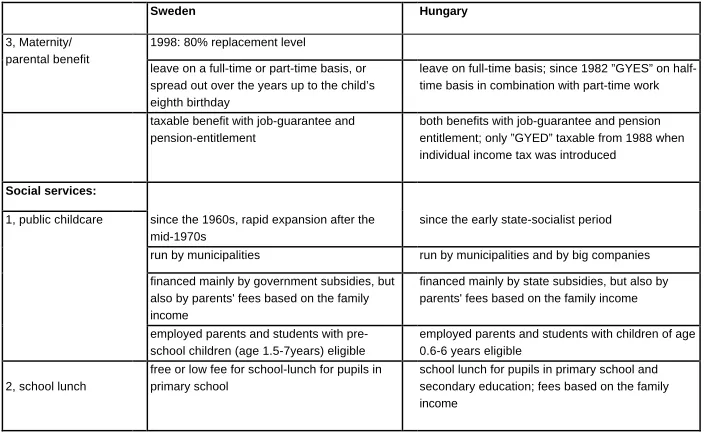
countries, and a wide range of social services have facilitated the combination of employment and parenthood for women (Table A). Some of these policy measures have induced and/or reinforced changes in gender relations. The parental-leave program is a clear example of this. In Sweden, fathers have been able to take parental leave on equal terms with mothers (with 90 per cent income-replacement) ever since 1974. In
mid-1980s, though they had barely a ten per cent share of the total number of benefit days (Sundström and Duvander 1999).
Fourth, on some other counts these countries have been very dissimilar. Beside their divergent histories, geographical positions, economic structures and political regimes (Baxter and Kane 1995, Panayotova and Brayfield 1997), their family formation patterns have also been quite different. In Hungary, childbearing was essentially restricted to marriage before the 1990s (Klinger 1991), while in Sweden, non-marital cohabitation has been very common at least since the 1970s, and births have increasingly occurred in such relationships. In fact, since the mid-1980s the majority of Swedish couples have been unmarried when they have become parents for the first time (Hoem 1996). As a number of studies have demonstrated that previous cohabitation and premarital children usually increase the risk of partnership disruption (for an overview see White 1990, Lillard et al. 1995), the difference in our countries’ family formation patterns may have implications for their trends in family stability.
Fifth, both Sweden and Hungary have a long history of liberal divorce legislation (Table B) and of rather high divorce rates also among families with children (Goode 1993). As for the economic consequences of divorce the rules have been based on the ”clean-break”-theory regarding spousal alimony (none), and property division (even). While such rules often lead to a severe deterioration of women’s economic situation after union dissolution (Voydanoff 1990, Holden and Smock 1991, Gähler 1998a) in other countries, this is not necessarily the case in Sweden and Hungary given the high level of female employment and extensive social support for families with children, including for solo mothers. In fact Hungarian fathers also experience economic hardship after family dissolution as mothers retain the right to live in the couple’s dwelling, while men, beside a rather high child-support obligation, have to find another place to live, which has been a hard task considering the housing shortage (Utasi 1999).
Sixth, legal rules allow divorced or separated parents to continue to have joint custody for their children in both countries (Table B). In Sweden, joint custody means that parents have to cooperate in important questions regarding their children, such as to agree on their residence, education, sports and other activities, even though they usually live in separate households after family break-up (SOU 1995). The joint-custody rule has led to increased involvement in the children by both parents even after the relationship ends (Bernhardt 1996), notwithstanding that relatively few parents choose to share also the physical custody of the children when the family dissolves. In
refuse to meet their fathers, sometimes under the influence of their mothers. So while in Sweden divorce or separation does not necessarily mean the loss of the parental status for either parent, Hungarian men often risk losing contact with their children permanently after a family break-up.
Based on their differences and similarities these countries provide us with an opportunity for a systematic comparative analysis of gender relations and family stability.
4. Data and method
The empirical analysis in this study is based on data extracted from the Swedish Survey of Family and Working Life, conducted by Statistics Sweden in 1992/93, and from the Hungarian Fertility and Family Survey, conducted by Statistics Hungary in the same years. Both surveys are part of the European Family and Fertility Surveys program, concerted by the Population Activities Unit of the United Nations Economic Commission for Europe. It aimed at providing data suitable for cross-country comparisons in demographic analyses. Both women and men, independently selected, were respondents in the Swedish as well as the Hungarian surveys. This allows us to study the influence of characteristics of both female partners and male partners on family dissolution. At the same time we recognize the limitations of the data, given that the true unit of analysis for family dissolution is couples, not individuals. We have little information on the partners of the respondents, as is the case for most event history data. Nevertheless, parallel histories from women and men provide a simulation of sorts of what we might expect had we information on both male and female partners’ characteristics for each union reported by a woman or by a man.
proportional sampling (for the capital and the largest cities) and partly through two-stage stratified sampling (for the rest of the country). In the first two-stage for the latter, sampling areas were stratified according to the number of inhabitants and municipalities were randomly selected from each stratum. The final sample was drawn at random, given sex and age constraints, using the National Population Register as the sampling frame for each stratum (Kamarás 1999).
For the purpose of the present study, we have selected respondents who have reported one or more marital or non-marital unions and have born at least one child in a union. Individuals who do not have a recorded union are excluded, as are those who were childless at interview or whose first child was born outside of a recorded partnership. From the sample for Sweden we have also excluded respondents who grew up outside of Scandinavia in order to avoid problems of cultural differences which could influence family dissolution risks. From the Hungarian sample we have excluded respondents who were below age 20 at the interview; only few of them had children anyway. Also, respondents with incomplete records on partnership or childbearing history are excluded. As the effects of changing gender relations on parental union disruption may be difficult to detect, we try to make the samples as homogeneous as possible. Therefore, we have also excluded respondents who have an adopted child in their first parental union or whose partner had a child from a previous relationship, as well as those whose first child in their first parental union died (Note 1) or whose union ended in the same month as they had their first child. Censoring occurs at sixteen years after first birth, when a union ends because the respondent’s partner dies, or at interview, whichever event comes first. A total of 2730 individuals (1869 women and 861 men) are included in the Swedish working sample and 3500 individuals (2430 women and 1070 men) in the Hungarian one. The proportion of respondents who experienced the disruption of their union is about 20 per cent for Sweden, and 13 per cent for Hungary. (For further details see Table 1 in Appendix A.)
The analysis is based on a piecewise-constant proportional-hazards model. Exposure is measured in months, starting from the birth of the first child of the respondents included and continued until the child turns 16 years old or until censoring for other reasons. We have divided this period into the following intervals: infancy (age below 1), toddler years (up to age 3), pre-school years (up to age 6), early and middle school-age years (up to age 12) (Note 2), and teenage years (up to age 16). We behave as if the disruption intensity is constant over each of these pre-selected time intervals, but let it vary between intervals. Information for those who did not experience the disruption of their first parental union during the period of observation is also taken into account.
calendar month, while changes in period variables occur at the beginning of a calendar month. The Windows-based software ”RocaNova”, developed at Statistics Sweden, is used to fit the model. The results, produced as maximum-likelihood estimates of the effect parameters of the model, are presented in the form of relative risks. We analyze women and men separately for each country in order to detect possible gender differences in the effects of partners’ characteristics on family disruption.
5. Variables
5.1 Gender relations
As we have discussed earlier (Section 2.1) changes in gender relations which are potentially influential on family stability have occurred both at the societal level and at the family level. We use therefore separate measures in our attempt to estimate their effects on union dissolution risks.
We start with our measure of changes in policies that affect gender relations at the societal level but also have implications at the family level. We use a period approach to define this variable, since policy changes that denote stages of development towards gender equality in society take place in clearly identifiable calendar years. Alternatively, we could have used two dichotomous factors for measuring the effects of changes in legislation around family dissolution (one for divorce laws and the other for custody rules) in combination with a variable which picks up changes in the parental leave program. However, even this solution would be period-based in some sense. Also, given the several policy measures involved it would not have simplified our task. Thus we have chosen to use a single factor which we call current policyperiod. It represents a partitioning of calendar time based on periods of major policy changes linked to gender equality and to family dissolution.
gender equality. Between mid-1983 and 1993 (our third period), the attention turned towards men. Policies aimed at increasing men’s involvement in parenting as the second main component of gender equality. For example, a reform in mid-1983 introduced joint custody as a general rule for children after the parents’ separation. In 1989, the parental leave was extended to 12 months. The longer leave provides better opportunities for men to strengthen their relations with their children by taking out parental leave after the end of the breastfeeding period. Thus the Swedish policy environment has not only been ”women-friendly” (Hernes 1987) but also has facilitated the transformation of the traditional male gender-role even though the changes in men’s behavior have been rather limited (Ruggie 1988, Lewis 1992).
For Hungary, our policy variable is based also on three periods but they mark much less radical policy changes than in Sweden, at least for gender relations. In the first period (from the mid-1960s to 1981), a long child-care leave (2 years) with a job-guarantee was introduced for mothers in Hungary (in 1967) as a recognition of women’s double role as mothers and workers in policy-making. Women’s economic provider role was also emphasized in the two relatively liberal divorce laws from that time (the first from 1952 and the second from 1974 (Note 3) that greatly limited the possibility of spousal alimony after divorce since both women and men were expected to be gainfully employed. In the second period (from 1982 to mid-1987) fathers’ right to use parental leave on a par with the mothers was introduced (in 1982), but only for children above age one. This rule was far from promoting Swedish-type equal parenting as it was not backed up with a policy discourse which would have encouraged men’s active participation in parenting. The third period (from mid-1987 to 1993) started with major changes in family law. Divorce procedures became more complicated and took longer because a compulsory pre-divorce court hearing was introduced. Unmarried fathers could get joint custody if they lived with their children’s mother. The latter is, again, a rule which strengthened men’s role as fathers. However, the lack of supportive policy discourse suggests that policy makers had no sincere intention to change traditional gender relations in Hungary (or in other Central and East European countries), notwithstanding that women’s labor-force participation on conditions similar to men’s was seen as the precondition of gender equality during the forty years of state socialism (Watson 1993).
gender equality is accepted by the partners, men tend to take parental leave both because they wish to spend more time with their children and also to take their share of parenting responsibilities and thus help the mothers. We do not distinguish according to the length of the leave taken by the father, as previous studies have shown that mothers are quite unwilling to let their partner use more than a small part of the parental leave (Haas 1992, Sundström and Duvander 1999). Thus father’s use of parental leave functions as a signal of whether he is prone to share family responsibilities with the mother or not, which can influence union stability.
For Hungary, we apply a gender-role-attitude variable. It is an index based on several questions regarding relationship and career. (For details, see Table H.5 in Appendix A.) Also, we use the information on the respondent’s attitude to parenthood provided in the data. These indirect measures should be more useful than information on paternal leave could have been, since Hungarian men hardly ever take such leave even when they have the opportunity (S. Molnár 1992). Such attitude variables may, however, be somewhat problematic as respondents might have adjusted their attitudes to their previous behavior (in a kind of ”post-hoc rationalization”). Since there is no additional information on gender relations in the data for Hungary, we apply these attitude measures, but we shall be cautious in our interpretation of the findings.
As women’s and men’s equal responsibility for both paid work and family work has been part of the everyday discourse (of both policy discussions and public debate) in Sweden since the 1960s (Sainsbury 1996), whereas there was no real effort to challenge traditional gender relations in the family in Hungary (Szalai 1991), we expect to find a stronger effect of changing gender relations on family stability in Sweden than in Hungary (Note 5). This should be the case not only for our societal-level variable but also for our family-level factor as traditional gender relations have changed very little within the family in Hungary while Swedish women expect their partners to take more responsibility for domestic duties. (For evidence of the latter see (SCB 1982, Roman 1999).)
5.2 Labor-force attachment
In order to test our second hypothesis on gender differences in the effects of the partners’ characteristics regarding labor-force attachment on family disruption, we use two factors, one to estimate the effect of schooling and the other for labor-market strategies.
of schooling the respondent had attained up to any month after the first birth. This is a multifaceted factor in union-disruption risks. Since improved education is likely to lead to a higher income, we expect men with higher education to be considered as more attractive partners and therefore to have stabler families. Also, highly educated men turn out to share childrearing responsibilities (Näsman 1992, McFarlane et al. 2000) and household tasks (Shelton and John 1996) with their partners more often than less educated men. This should make them even more desirable as partners in a union.
For women, the reverse relationship may obtain. On the one hand, the higher salary of highly educated women increases their attraction value on the partnership market too (Oppenheimer 1994). On the other hand, it also provides them with greater economic independence from their partners. Thus they may be more likely to leave a less satisfactory relationship than other women (see Hobson 1990), especially as they probably also are more certain about their abilities to live as single parents than less educated mothers are. Furthermore, highly educated women more often pursue gender equality in the division of domestic tasks (Presser 1994, Ahrne and Roman 1997) and probably are less likely to accept it if their partners fail to share the responsibilities of home life. On the other hand, one could also argue that given their higher salaries highly educated women can purchase domestic services more easily in the market (in the form of hiring domestic help) and thus need much less help from their partners than less educated women. In Sweden and Hungary such a solution was, however, rather atypical even among women with higher income in the period we study. Another aspect of higher education is that it can improve individual skills to find a good partner and to solve conflicts. This in turn would strengthen union stability.
Thus, while the dissolution risk is likely to decrease when a man’s educational level improves, we are uncertain about whether disruption risks increase or decrease with improving educational attainment for women when we take all these various items together. Only an empirical analysis can provide us with answers as to how these issues balance against each other in Sweden and Hungary.
As mothers are still the main carer for children, parenting probably has a stronger influence on their work strategies than that of fathers. Furthermore, doing part-time rather than full-time work is likely to have different implications for women than for men because of their differing family roles and particularly their differing labor market roles. For men, the rule is full-time employment in industrialized countries. By contrast, because women are expected to give priority to family responsibilities, they are allowed to follow a wider range of work strategies, often strongly related to the age of their children. Giving priority to labor market roles over family obligations is considered ”normal” for men, but much less so for women. This is very much the case in Sweden (see e.g. Lundén Jacoby and Näsman 1989, Ahrne and Roman 1997). Thus we expect to find differences between women’s and men’s risk patterns for employment status for family dissolution there. In Hungary, by contrast, opportunities for part-time work were extremely limited during our period of observation. (Only about 3 per cent of all jobs were part-time jobs, Frey 1993.) Consequently, full-time employment has been the rule for both women and men. Thus gender differences are less likely to show up in the pattern of dissolution risks by employment status for Hungary than for Sweden.
5.3 Analytic model
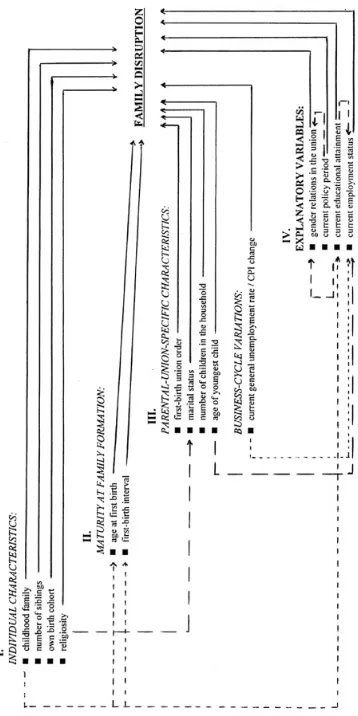
The analytic model we use to test our two main hypotheses includes then four explanatory variables, i.e. current policy period, gender relations in the union, current educational attainment, and current employment status. These are time-varying covariates with the exception of the ‘gender relations in the union’ measure, which is a fixed factor. The model also includes factors that are not of main interest to us but that have been found to greatly influence family disruption in previous studies, or that may otherwise reasonably be assumed to affect union dissolution (see Appendix A). We divide these control variables into the following groups:
1. Individual characteristics: Some of these refers to the respondents’ childhood family experiences (composition of family of origin, number of siblings), others relate to features such as the respondents’ own birth cohort and own religiosity.
2. Maturity at family formation: This group of factors is linked to the respondents’ maturity as an individual (age at first birth grouped according to educational level at first birth) and as a member of a couple at the time when the relationship became a parental union. (The latter is measured by taking into account the interval in months between (i) the start of the first parental union and (ii) the first birth. We call this factor ”first-birth interval”.)
in which the first birth occurs (called ”first-birth union order”), the marital status, the number of children in the household, and the current age of the youngest child.
4. Business-cycle variations: These are measured with country-specific factors (current unemployment rate for Sweden, changes in consumer price index for Hungary).
As our time variable we use the age of the first child (i.e. union duration since first birth). Our choice is based on the assumption that the birth of the first child radically changes the nature of a relationship. Individuals who are parents make calculations in their decisions on whether or not to dissolve their unions that are different from those of childless couples. Parenting tasks also change as the child grows older, as do parents’ perceptions on how harmful family disruption is to children. These in turn influence parents’ propensity to dissolve their families. We have taken these changes into account in the definition of categories of the time variable. We measure the age of the first child in months, but our age-categories are defined in years (see Section 4 for details) as this is easier to understand.
We use a stepwise approach for the model fitting. In a first step we include only individual characteristics. Next we add the group of covariates that represent maturity at family formation. Then we include the rest of the control variables. This stepwise introduction of factors into the model corresponds to the sequence in which they appear in the respondents’ life. This in turn determines their causal proximity to the current life situation of the respondents (see Figure 1). This procedure will also help us to see whether the inclusion of a factor at a later stage in this process influences the estimated effect of an earlier factor. When it does, the indirect effect of the early factor which works via the later factor disappears when we include the latter, and we can see more clearly the direct effect of the earlier factor. This allows us to exclude control variables that do not have a significant direct effect on first parental union dissolution. In our last step we keep the control variables that have proved to be important for the current analysis, and include our explanatory variables in the model.
6. Findings and discussion
6.1 Sweden
6.1.1 Gender relations
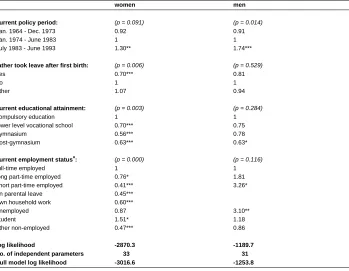
As we see for our societal-level variable (Table S; for the full model see Table S.II in Appendix B), public policies, measured as current policy period in our analysis, appear to influence family disruption. The effect is stronger in the male sample, in spite of its much smaller size as compared to the female sample. In both samples, however, the patterns of dissolution risks across policy periods are much alike.
The risk of disrupting a first parental union hardly changed over our first two periods (1965-1973, and 1974-middle of 1983), notwithstanding the large increase in female labor force participation which took place at that time in Sweden (Sundström 1987) and notwithstanding the introduction of one of the most liberal divorce laws of the world (in effect since 1974). Couples with children were apparently much less affected by these changes than childless couples (Note 6) were, at least when it comes to long-term effects. In the third period (July 1983-1993) however, the risk of family dissolution rose significantly among families with children, and we notice it particularly in the male sample. In this period, policy emphasis lay on increasing men’s involvement in parenting and joint custody for children after family break-up was introduced as a main rule. Perhaps as this rule gave both parents a better chance to remain active parents even if the children do not live in their households permanently after family dissolution, parents felt less obliged to stay in a union which they found unsatisfactory. In this sense, the joint custody reform may have reduced family stability. Yet, the fear of (oneself or the other parent) losing contact with the children is not a good basis for keeping a relationship intact as it may create an atmosphere in the family which is more harmful than a break-up for the children and also for the parents. Moreover, previous research has shown that a ”good divorce” may actually be better for the children than living in an intact family with a lot of tensions between the parents (see e.g. Amato et al. 1995, Gähler 1998b, Jekielek 1998, Morrison and Coiro 1999). An alternative explanation for the increase of disruption risks in the third policy period as compared to the previous periods points to women’s rising expectations of their partner sharing family responsibilities (see Nordenstam 1985, Roman 1999) and the gap between such expectations and men’s actual involvement in domestic tasks (Nermo 1994).
Looking at gender relations in the union (measured through the fathers’
the risk of union dissolution is lower than otherwise. This suggests that both partners’ engagement in economic and care responsibilities can strengthen their relationship, possibly because the sources of potential conflicts are reduced in such unions. Alternatively, this risk pattern may show a selection effect as men who take parental leave are likely to be more family-oriented than other fathers and thus may also have stabler unions.
We have also tested for possible interaction effects between current policy period and gender relations in the union. The results are not significant in the male sample (and are not presented here), again probably because of its smaller sample size and correspondingly greater random variation. In the female sample, the results are significant at the 6 per cent level and the pattern is quite interesting (Figure 2S). Before the early 1980s, the risk of family disruption in unions where the father took parental leave with the first child, was about half that of other unions. During the 1980s and early 1990s, however, the risk of family dissolution increased for all unions, and more so in partnerships where the father used parental leave. Their disruption risk was still well below that of unions where men did not engage in such active parenting. How can we interpret this pattern?
6.1.2 Combining parenthood and employment
As dual-earner families became prevalent in Sweden, the combination of parenting and paid work became an important aspect of parents’ family stability. Our analysis shows that factors related to mothers’ labor-market attachment influence family disruption risks significantly but this is not the case for fathers (Table S). This is in line with our expectations, given that women still have a larger share of parenting responsibilities than men do.
Parents’ current educational attainment proved to be rather important for family stability. Although mother’s education has a stronger effect than does father’s education, the patterns of dissolution risks are very similar. Those who have the lowest educational level have the highest risk of family disruption. There are no significant differences in the disruption risks between the various levels of those with more than compulsory education. This suggests a selection effect for those with the least education, but can also refer to their weaker labor market situation and lower incomes. These in turn can create serious conflicts between the partners in the relationship, who may also have less skills to solve them. In any case, we do not find important differences in effects of mother’s versus father’s education on the risk of family disruption in Sweden.
Current employment status also has a strong impact on family disruption risk. Compared to mothers employed full time, those who are students have a higher risk of disruption, while those who are employed part-time or on parental leave or not employed have the lowest risks. Men’s employment has nearly opposite effects, with higher risks of dissolution for fathers who are employed part time or unemployed (but not for those on parental leave which is included in the ”other non-employed” category). Male students do not have a higher disruption risk than do full-time employed fathers. These results taken together indicate that couples with a more traditional division of labor are less likely than couples in which the man’s and woman’s employment is similar or the couple has reversed traditional roles to end their first parental union. This is linked to societal expectations for men to be ”good providers” and for women to take the lion’s share in childrearing and household tasks in Sweden too (Björnberg 1992). Hence, the male gender role seems to change very slowly, while great changes in the female gender role in terms of labor-force participation are accepted as long as gender relations in the family concerning the division of responsibilities for domestic tasks are hardly affected.
least educated mothers have the higher risk of union disruption. Hence, being a student has a negative impact on family stability independently of educational level (Note 8), but full-time work does not automatically lead to reduced union stability for mothers who have more than compulsory education. This pattern is in line with findings of Swedish time-budget studies showing that the partners of more highly educated women are more likely to share domestic duties than is the case for women with compulsory education (Nermo 1994). Based on such findings and on our own results we may speculate that in families where parents share both economic and domestic responsibilities, changing gender relations would not have as detrimental effect on union stability as in families where only the woman follows the new gender behavioral pattern while her partner fails to change.
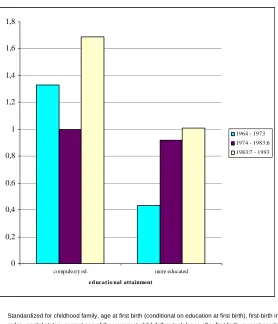
In addition, we tested for interactions with our variables measuring gender relations at the societal level and at the family level respectively. None of these interaction terms were found to be significant in the male sample. In the female sample, we found that women’s education interacted with policy period and paternal leave-taking in its effects on the disruption risk (significant at the 5 per cent level).
Figure 4S shows that mothers with the least education had the highest risk of family disruption in all three policy periods. However, the variation of dissolution risks over time is rather different for them than the pattern we see for mothers with more than compulsory education. Family instability decreased somewhat for less educated women between our first and second period, but it increased strongly thereafter. In contrast to this pattern, the risk of union disruption nearly doubled for mothers with more than compulsory education from the first to the second period, but it hardly changed in the decade from 1983 to 1993.
been more likely to remain part of their children’s life after family break-up (as has been shown for the US context (Stephens 1996) even before the introduction of the joint-custody rule. For less educated mothers this may not have been the case before the mid-1980s, thus the parents in those families may have been more likely to stay together ”for the sake of the children”. Such sacrifice became unnecessary for them when parents retained joint custody for their children after family dissolution as the general rule.
The interesting pattern seen for Figure 5S reveals a further aspect of the link between family-level gender relations and union stability. We notice that the risk of union disruption is lower for women at all educational levels when the father took parental leave with the first child than otherwise. Women with the lowest and the highest education whose partner did not take parental leave have the least stable families among all mothers. The risk of union disruption is twice as high for highly educated mothers whose partner proved to be a less engaged parent as for those whose partner took parental leave. The difference in disruption risks between those with a more caring partner and those with a less caring partner is much lower for women with less than higher education. This indicates that women with post-gymnasium education are less likely than other mothers to accept the failure of their partner to adjust to modern gender roles and not to engage in active parenting.
In sum, our findings for Sweden point to the importance of gender relations in family stability as well as to changes in gender perceptions over time. In addition, the disruption-risk patterns by employment status revealed substantial gender differences in the combination of parenting and employment and in its consequences on union stability.
6.2 Hungary
6.2.1 Gender relations
The higher disruption risk for the second period than in the first period suggests that men might have felt having a better bargaining position to keep contact with their children even after a divorce due to the new rules to strengthen their role as fathers. This may have made them more likely to accept an end of their union if they found it unsatisfactory. Alternatively, the higher disruption risk was connected to increasing individualism in the Hungarian population as Hungary became more open to ”Western influences” than other Central and East European countries, especially in the 1980s. As for the somewhat lower although not significantly different divorce risk in the third period, it seems that the more restrictive divorce law from 1987 could not strengthen family stability in the long run, possibly because of the dramatic changes of the political and economic system after 1989. The collapse of state socialism and the rapidly increasing unemployment level generated tensions which a large number of individuals and families had difficulties to cope with. This could counteract the more restrictive divorce law.
Not surprisingly, the impact of gender relations at the family level on union stability in Hungary is not significant either, quite unlike our findings for Sweden. For both gender-role attitude and attitude to parenthood, the disruption risk patterns are rather similar in both samples, and the risk profiles are in line with our expectations. For the former factor we find that those with a traditional gender-role attitude have lower risk of union dissolution than parents with egalitarian or intermediate gender-role attitudes. For the latter factor we see that the risk of family disruption is higher for self-centered parents than for others.
The lack of significant influence of these factors (i.e. attitude to parenthood and gender-role attitude) on family disruption in Hungary can also be connected to the fact that our gender-relation variables are attitude measures, while for Sweden we had a measure based on actual behavior (father’s participation in active parenting). As attitude and behavior do not always coincide, these measures may have been less adequate for the dimension we try to tap, though they were the best we could obtain from the Hungarian data. However, this measurement problem is unlikely to be of major importance as the effect coefficients are indeed meaningful in the Hungarian context.
We tested also for interaction effects between our gender-relations variables (i.e. between gender-role attitude and attitude to parenthood, and these separately with current policy period). None of these interaction terms were significant or interesting in either sample.
6.2.2 Combining parenthood and employment
While the gender-relations factors had no significant impact on parents’ family stability in Hungary, labor-market behavior appears to have stronger effect (Table H). Current educational attainment seems to be somewhat less important for union stability in Hungary than it is for Swedish parents, but effects of women’s and men’s education are similar. As is true in Sweden, those with low level of education have higher risk of family disruption than individuals with more schooling. However, the threshold for effects of men’s and women’s education differs in Hungary. Hungarian fathers with more than compulsory education have much lower risk of family disruption than the least educated men, while mothers have a reduced dissolution risk only at a gymnasium and higher level of schooling. The gender-specific thresholds may be connected to some gender-segregation in the labor market, and the disruption risk patterns relate to the relatively poorer economic situation of those with low education. It is thus a gender effect that for women more schooling was required for a job with decent earnings than for men for whom any education above the compulsory level could lead to a relatively good income. As individuals with the least education had fewer resources, their housing conditions were relatively poorer. This meant that they more often had to share a home with the parents of their spouse or with their own parents, which is likely to create tensions. Alternatively, the higher disruption risk for those with less schooling can be explained by their lower skills in solving conflicts that arise in the relationship.
and when men work less than full time. The lack of significant differences in disruption risks between housewives and employed women who work full time or part time can be related to the limited influence of women’s work strategies on gender relations within the family, especially regarding the persistent traditional division of domestic tasks in Hungary, unlike in Sweden. In addition, Hungarian women’s student status does not increase the risk of disruption, but instead reduces it, contrary to the Swedish case. On the other hand, Hungarian men who study have a high risk of union disruption but the effect is not significant. In any case, students represent a very small fraction of parents in Hungary as childbearing was usually postponed until one finished education and had a job. Similarly to the findings for Sweden, father’s part-time employment (and unemployment) greatly increases the risk of family break-up. As gender arrangements in the family remained traditional in Hungary, men’s role as the main economic provider of the family is even more emphasized there than in Sweden.
We also tested for interaction effects between the labor-market attachment factors, and for these with each of the factors of gender relations. None of these interaction terms proved to be significant or interesting in either the female or the male sample.
To sum up our findings for Hungary, traditional gender relations within the family have hardly changed there, unlike in Sweden, notwithstanding the societal acceptance of women’s full-time employment (also for mothers). Nevertheless, we found gender-specific disruption risk patterns for parents’ labor-market behavior in Hungary similarly to the results for Sweden.
7. Concluding remarks
Hungary remained a ”traditional society” in many ways and preserved a traditional gender hierarchy during state socialism in spite of the dominant position of a (full-time) dual-earner family model for over 40 years. In this country gender relations seem to be of much less importance for family stability than other factors. Perhaps economic constrains have been more severe for shaping family decisions in Hungary than in Sweden. In addition, there may be a threshold in individual awareness of the need to change traditional gender-behavior patterns also at the family level, and this threshold may not yet have been reached in Hungary. Such awareness has started to grow in the countries of Central and Eastern Europe in the transition period which followed the collapse of state socialism, while the conditions under which women combine paid work and family life have become harder (Watson 1993). A new wave of family surveys in the early 21st century may then provide us with data that help us further clarify the relationship between changing gender relations and family stability.
8. Acknowledgements
Notes
1. Both the death of a child and having the partner’s child from a previous relationship in the household can create tensions in the family which may lead to union dissolution. Such cases are not suitable for a study of the effect of changing gender relations on family stability.
2. In a preliminary analysis we distinguished also between the categories ‘years of school start’ (up to age 8) and ‘mid-school-age years’ (up to age 12). We decided to combine them into a single category (i.e. ‘early and middle school-age years’) based on their very similar disruption intensities.
3. We have seen in a previous analysis that the further liberalization of the Hungarian divorce legislation (in effect from 1974) had no significant long-term effect on family stability among families with children (Oláh 2000).
4. Swedish fathers’ eligibility for parental leave was limited before 1974, and under certain circumstances even later on. Thus we also include a category called ‘other’ for this variable.
5. One might think that Hungary being a more traditional society the effect of non-traditional gender attitudes should be stronger than in Sweden based on the greater selectivity of that group. However, the lack of change in the home sphere in Hungary in terms of labor division suggests that non-traditional attitudes were not accompanied by less traditional everyday practices. Thus the effect of attitudes were probably relatively limited. Therefore we expect to find stronger impact of changing gender relations in Sweden than in Hungary.
6. Andersson’s (1997) annual index of divorce-risk level for Sweden rose dramatically in the 1970s and 1980s. His study included only married couples, while we also include non-marital unions as we would have expected a bandwagon or contagion effect for cohabiting couples in times of radically increasing divorce indices. Yet as we found also in a previous analysis (Oláh forthcoming), the risks of family dissolution among families with children changed very little in the period before 1983 both for non-marital and for marital unions (and independently of whether a marriage started as a cohabiting relationship or not).
8. Sweden has a highly developed system of adult-education comprising all levels of education from primary to tertiary levels.
References
Adamik, Mária. (1991). ”Supporting parenting and child rearing: Policy innovation in Eastern Europe.” In S.B. Kamerman and A.J. Kahn (eds.) Childcare, Parental Leave, and The Under 3s: Policy Innovation in Europe. New York: Auburn House. pp. 115-144.
Ahrne, Göran and Christine Roman. (1997). Hemmet, barnen och makten. Förhandlingar om arbete och pengar i familjen. (Home, children and power.
Bargaining around work and money in the family) Statens Offentliga
Utredningar 1997:139. Stockholm: Arbetsmarknadsdepartementet (Ministry of Labor).
Amato, Paul R.; Spencer Loomis, Laura and Alan Booth. (1995). ”Parental divorce,
marital conflict, and offspring well-being during early adulthood.” Social Forces, 73 (3): 895-915.
Andersson, Gunnar. (1997). ”The impact of children on divorce risks of Swedish women.” EuropeanJournal of Population, 13 (2): 109-145.
Baude, Annika (ed.) (1992). Visionen om jämställdhet. (The vision of gender equality) Stockholm: SNS.
Baxter, Janeen and Emily W. Kane. (1995). ”Dependence and independence. A cross-national analysis of gender inequality and gender attitudes.” Gender & Society, 9 (2): 193-215.
Becker, Gary S. (1991). A Treatise on the Family. Cambridge, Massachusetts: Harvard University Press. Enlarged edition.
Bernhardt, Eva M. (1996). ”Non-standard parenting among Swedish men.” In U.
Björnberg and A-K. Kollind (eds.) Men’s Family Relations. Stockholm:
Björnberg, Ulla. (1992). ”Parents’ ideals and their strategies in daily Swedish life.” In
U. Björnberg (ed.) European Parents in the 1990s. Contradictions and
Comparisons. New Brunswick: Transaction Publishers. pp. 83-101.
Blair, Sampson Lee. (1993) ”Employment, family, and perceptions of marital quality among husbands and wives.” Journal of Family Issues, 14 (2): 189-212.
Braun, Michael; Alwin, Duane F. And Jacqueline Scott. (1998). ”Generational change in gender roles: Western industrialized and former socialist countries compared.” Paper presented at the ISA 14th World Congress of Sociology, July 26 - August 1, Montréal, Canada.
Da Vanzo, Julie and M. Omar Rahman. (1993). ”American families: Trends and correlates.” Population Index, 59 (3): 350-386.
Flood, Lennart and N. Anders Klevmarken. (1990). ”Arbete och fritid: Svenska hushålls tidsanvändning 1984.” (Work and Leisure: Time-Use of Households in Sweden in 1984). In A. Klevmarken at al. (eds.) Tid och Råd: om HUShållens ekonomi
(Time and Financial Resources: The Economy of the HOUSEhold) Stockholm: Almqvist and Wiksell. pp. 177-233.
Frey, Mária. (1993). ”Nök a munkaeröpiacon.” (Women at the labor market)
Társadalmi Szemle (Social Review), 3 (1): 26-36.
Gähler, Michael. (1998a). Life After Divorce. Economic, social and psychological well-being among Swedish adults and children following family dissolution. Ph.D. dissertation. Stockholm: Swedish Inst. for Social Research, Stockholm University.
Gähler, Michael. (1998b). ”Self-reported psychological well-being among adult children of divorce in Sweden.” Acta Sociologica, 41 (3): 209-225.
Goode, William J. (1993). World Changes in Divorce Patterns. New Haven, London: Yale University Press.
Greenstein, Theodore N. (1990). ”Marital disruption and the employment of married
women.” Journal of Marriage and the Family, 52 (3): 657-676.
Greenstein, Theodore N. (1995). ”Gender ideology, marital disruption and the employment of married women.” Journal of Marriage and the Family, 57 (1): 31-42.
Haas, Linda. (1992). Equal Parenthood and Social Policy. A Study of Parental leave in Sweden. Albany: State University of New York Press.
Hernes, Helga. (1987). Welfare State and Women Power: Essays in State Feminism. Oslo: Norwegian University Press.
Hobson, Barbara. (1990). ”No exit, no voice: Women’s economic dependency and the welfare state.” Acta Sociologica, 33 (3): 235-250.
Hoem, Britta. (1996). ”Some features of recent demographic trends in Sweden.”
Stockholm Research Reports in Demography No. 104, Stockholm: Stockholm University.
Holden, Karen C. and Pamela J. Smock. (1991). ”The economic costs of marital dissolution: Why do women bear a disproportionate cost?” Annual Review of Sociology, 17: 51-78.
Hoóz, István. (1995). ”A családképzés és a családfelosztás különbözö formáinak
alakulása.” (Various forms of family formation and family dissolution)
Demográfia, 38 (1): 22-47.
Jekielek, Susan M. (1998). ”Parental conflict, marital disruption and children’s emotional well-being.” Social Forces, 76 (3): 905-935.
Kaa, Dirk J. van de. (1987). ”Europe’s second demographic transition.” Population Bulletin, 42 (1), Washington: the Population Reference Bureau, Inc.
Kamarás, Ferenc. (1986). ”Egyszülös családok.” (One-parent families) Demográfia, 29 (2-3): 253-266.
Kamarás, Ferenc. (1999). Fertility and Family Surveys in Countries of the ECE Region. Standard Country Report. Hungary. New York and Geneva: United Nations.
Klinger, András. (1991). ”Magyarország demográfiai helyzete Európában.” (The
demographic situation of Hungary in Europe) Demográfia, 34 (1-2): 19-60.
Lesthaeghe, Ron. (1983). ”A century of demographic and cultural change in Western
Europe: An exploration of underlying dimensions.” Population and
Development Review, 9 (3): 411-435.
Lewis, Jane. (1992). ”Gender and the development of welfare regimes.” Journal of European Social Policy, 2 (3): 159-173.
Lillard, Lee A.; Brien, Michael J. and Linda J. Waite. (1995). ”Premarital cohabitation and subsequent marital dissolution: A matter of self-selection?” Demography, 32 (3): 437-457.
Lundén Jacoby, Ann and Elisabet Näsman. (1989). Mamma, pappa, jobb. Föräldrar
och barn om arbetets villkor. (Mummy, daddy, job. Parents and children talk about employment). Stockholm: Arbetslivscentrum.
Makkai, Toni. (1994). ”Social policy and gender in Eastern Europe.” In D. Sainsbury
(ed.) Gendering Welfare States. London: Sage. pp. 188-205.
McFarlane, Seth; Beaujot, Roderic and Tony Haddad. (2000). ”Time constraints and relative resources as determinants of the sexual division of domestic work.”
Canadian Journal of Sociology, 25 (1): 61-82.
Morrison, Donna Ruane and Mary Jo Coiro. (1999). ”Parental conflict and marital disruption: Do children benefit when high-conflict marriages are dissolved?”
Journal of Marriage and the Family, 61 (3): 626-637.
Näsman, Elisabet. (1992). ”Parental leave in Sweden - a workplace issue?” Stockholm Research Reports in Demography No. 73. Stockholm: Stockholm University.
Nermo, Magnus. (1994). ”Den ofullbordade jämställdheten” (The Uncompleted Gender
Levnadsförhållanden i Sverige under tre decennier (Everyday Conditions: Living Conditions in Sweden during Three Decades) Stockholm: Brombergs. pp. 161-183.
Nordenstam, Ulla. (1985). ”Mamma och pappa ska dela på hemarbetet.” (Mom and dad will share household work) Välfärdsbulletinen (Welfare bulletin), No. 2.
Oláh, Livia Sz. (2000). ”Disruption of the first ‘parental union’ in Sweden and Hungary. Focusing on policy and gender effects.” Paper presented at the FFS Flagship Conference, May 29-31, 2000, Brussels.
Oláh, Livia Sz. (fortcoming). ”Policy changes and family stability: The Swedish case.”
International Journal of Law, Policy and the Family.
Oppenheimer, Valerie Kincade. (1994). ”Women’s rising employment and the future of the family in industrial societies.” Population and Development Review, 20 (2): 293- 342.
Panayotova, Evelina and April Brayfield. (1997). ”National context and gender
ideology. Attitudes toward women’s employment in Hungary and the United States.” Gender& Society, 11 (5): 627-655.
Presser, Harriet B. (1994). ”Employment schedules among dual-earner spouses and the division of household labor by gender.” American Sociological Review, 59 (3): 348-364.
Presser, Harriet B. (2000). ”Nonstandard work schedules and marital instability.”
Journal of Marriage and the Family, 62 (1): 93-110.
Roman, Christine. (1999). ”Inte av kärlek allena: Makt i hemarbetets fördelning.” (Not
from love alone. Power and the division of housework) Sociologisk Forskning
(Sociological Research), 36 (1): 33-52.
Ruggie, Mary. (1988). ”Gender, work, and social progress: some consequences of interest aggregation in Sweden.” In J. Jenson et al (eds.) Feminization of the Labour Force: Paradoxes and Promises. Cambridge: Polity Press, pp. 173-188.
Sanchez, Laura and Constance T. Gager. (2000). ”Hard living, perceived entitlement to
great marriage, and marital dissolution.” Journal of Marriage and the Family, 62 (3): 708-722.
SCB. (1982). ”Kvinnor och barn: Intervjuer med kvinnor om familj och arbete.” (Women and children: interviews with women about family and work) rapport IPF 1982:4, SCB (Statistics Sweden), Stockholm.
Scott, Jaqueline; Alwin, Duane F. and Michael Braun. (1996). ”Generational changes in gender role attitudes: Britain in a cross-national perspective.” Sociology, 30 (3): 471-492.
Shelton, Beth Anne and Daphne John. (1996). ”The division of household labor.”
Annual Review of Sociology, 22: 299-322.
S. Molnár, Edit. (1992). ”A gyermekgondozási szabadság alternatívái kisgyermekes szülök véleményeinek tükrében.” (Alternatives to child-care leave according to parents with young children) Demográfia, 35 (2): 207-219.
SOU. (1995). Vårdnad, boende och umgänge. Betänkande av
Vårdnadstvistutredningen. (Custody, residence and access. Summary report of
the governmental inquiry on disputes concerning child custody) Statens
Offentliga Utredningar 1995:79. Stockholm: Justitiedepartementet (Ministry of Justice).
Stephens, Linda S. (1996). ”Will Johnny see daddy this week? An empirical test of three theoretical perspectives of postdivorce contact.” Journal of Family Issues, 17 (4): 466-494.
Sundström, Marianne. (1987). A Study in the Growth of Part-time Work in Sweden.
Stockholm: Arbetslivscentrum.
Sundström, Marianne and Ann-Zofie Duvander. (1999). ”Family division of child care: Why do - or don’t - Swedish fathers take parental leave?” Stockholm Research Reports in Demography No. 139. Stockholm: Stockholm University.
Szalai, Júlia. (1991). ”Some aspects of the changing situation of women in Hungary.”
Thompson, Linda. (1991). ”Family work: Women’s sense of fairness.” Journal of Family Issues, 12 (2): 181-196.
Utasi, Ágnes. (1999). ”Partnerkapcsolatok és individualizálódás (Házasok, együtt élök, elváltak 24 országban).” (Partner relations and individualism (Married, cohabiting, divorced in 24 countries)) Demográfia, 42 (1-2): 48-75.
Voydanoff, Patricia. (1990). ”Economic distress and family relations: A review of the Eighties.” Journal of Marriage and the Family, 52 (4): 1099-1115.
Watson, Peggy. (1993). ”Eastern Europe’s silent revolution: Gender.” Sociology, 27 (3): 471-487.
White, Lynn K. (1990). ”Determinants of divorce: A review of research in the eighties.”
Table A: Public support provided to families with children in Sweden and Hungary Sweden Hungary Cash benefits: 1, Child/family allowance
introduced in 1947 introduced in 1938
universal benefit until the 1970s employment in state sector required; 1990-1995: universal benefit; means-tested from 1996
paid to the mother paid to the father (or to the mother if ineligible father)
one-child families eligible from the start originally for large families; from 1983 also one-child families eligible
higher allowance for the third child (and additional children)
higher allowance for single parents, for those with disabled children, and for large families 2, Housing-related
benefit
introduced in the mid-1930s, for large families introduced in the 1970s
means-tested housing allowance "baby bonus" - part of the bank loan for young couples building or buying a dwelling transformed into a benefit if they had one child within three years or two children within six years one-child families eligible since 1958 only couples below age 35 eligible 3, Maternity/
parental benefit
1962: six months maternity leave with 65% income replacement
1967: child-care leave until the child becomes 2.5 years old; extended to the third birthday of the child in 1969. Flat-rate child-care allowance "GYES" (about 40% of the average earnings of a young female unskilled worker)
gradually extended parental leave since 1974 with income-related benefit (90% replacement level until the mid-1990s)
only mothers eligible at first; since 1982 also fathers after the first birthday of the child
1974: 6 months parental leave 1985: income-related child-care pay "GYED" (75% replacement level); only mothers eligible with children below age one
1975: 7 months parental leave 1986: "GYED" extended by half year; fathers eligible after the child's first birthday 1978: 8 months parental leave, plus one
month with flat-rate benefit
1987: "GYED" extended until the second birthday of the child
1980: 9 months parental leave, plus three months with flat-rate benefit; also 10 "daddy days" with 90% income replacement
"GYES" paid by the number of children below age three cared for at home; "GYED" is independent of the number of children
1989: 12 months parental leave, plus three months with flat-rate benefit
1996: "GYED" abolished, "GYES" means-tested
1995: one month leave reserved for the father and another for the mother with 90% income replacement, but only 80% for the other 10 months leave
1996: 75% replacement level
Table A (continuation):
Sweden Hungary
1998: 80% replacement level 3, Maternity/
parental benefit
leave on a full-time or part-time basis, or spread out over the years up to the child’s eighth birthday
leave on full-time basis; since 1982 ”GYES” on half-time basis in combination with part-half-time work
taxable benefit with job-guarantee and pension-entitlement
both benefits with job-guarantee and pension entitlement; only ”GYED” taxable from 1988 when individual income tax was introduced
Social services:
1, public childcare since the 1960s, rapid expansion after the mid-1970s
since the early state-socialist period
run by municipalities run by municipalities and by big companies
financed mainly by government subsidies, but also by parents' fees based on the family income
financed mainly by state subsidies, but also by parents' fees based on the family income
employed parents and students with pre-school children (age 1.5-7years) eligible
employed parents and students with children of age 0.6-6 years eligible
2, school lunch
free or low fee for school-lunch for pupils in primary school
Table B: Divorce legislation and child custody rules in Sweden and Hungary
Sweden Hungary
Divorce legislation: 1915: divorce on fault grounds; also some no-fault grounds acknowledged
1952: no-fault divorce introduced; a marriage could be dissolved if it had broken down irretrievably
1974: all fault grounds eliminated; no-fault divorce only 1974: more liberal law; divorce by mutual consent
shortened and simplified divorce procedure; a waiting period of six months required only for couples with minor children or if the couple disagreed on divorce
1987: more complicated divorce procedure; compulsory pre-divorce court-hearing aiming the reconciliation introduced
spousal alimony almost non-existent spousal alimony legally possible, in practice nearly non-existent property divided evenly between the former spouses
independently of its source; only the family home (if acquired for the couple's joint living) and the household goods divided evenly at separation from non-marital cohabiting relationships
property divided evenly between the former spouses independently of its source
non-resident parent obliged to pay child-support (relatively modest amount); if non-payment state-provided maintenance allowance (requested from the debtor later on)
non-resident parent obliged to pay child-support based on income (20% for one child, 40% for two children, 50% for three or more children)
Child custody: unmarried mother: sole custody; married parents: joint custody
unmarried mother: sole custody; married parents: joint custody
joint custody also on request of parents in non-marital consensual union through joint application to the court (since 1977) or to the local tax authority if both parents and the child Swedish citizens (since 1983)
joint custody also on request of the father in non-marital consensual union through application to the court (since 1987), mother's consent required mid-1983: divorced/separated parents retain joint custody
unless one of them files for its annulment
Table S: Relative risks of dissolution of the first parental union for Swedish women and men. Main results from the final model.
Standardized for childhood family, age at first birth (conditional on education at first birth), first-birth interval, first-birth union order, marital status, current age of the youngest child, and age of the first child#
.
women men
current policy period: (p = 0.091) (p = 0.014)
Jan. 1964 - Dec. 1973 0.92 0.91
Jan. 1974 - June 1983 1 1
July 1983 - June 1993 1.30** 1.74***
father took leave after first birth: (p = 0.006) (p = 0.529)
yes 0.70*** 0.81
no 1 1
other 1.07 0.94
current educational attainment: (p = 0.003) (p = 0.284)
compulsory education 1 1
lower level vocational school 0.70*** 0.75
gymnasium 0.56*** 0.78
post-gymnasium 0.63*** 0.63*
current employment status¤
: (p = 0.000) (p = 0.116)
full-time employed 1 1
long part-time employed 0.76* 1.81
short part-time employed 0.41*** 3.26*
on parental leave 0.45***
own household work 0.60***
unemployed 0.87 3.10**
student 1.51* 1.18
other non-employed 0.47*** 0.86
log likelihood -2870.3 -1189.7 no. of independent parameters 33 31 null model log likelihood -3016.6 -1253.8
*** significant at the 1%-level; ** at 5%; * at 10%
Note: For each variable, risks and their significance are given relative to the reference level, indicated by 1 (no decimals). The p-value of the entire factor is given in the row containing the variable name
#
For the full model, see Table S.II in Appendix B. ¤
Figure 2S: Relative risks of dissolution of the first parental union for Swedish women, by current policy period and according to whether the father took parental leave with the first child*.
0 0,5 1 1,5 2 2,5
1964 - 1983:6 1983:7 - 1993
current policy period
yes
no
* Standardized for childhood family, age at first birth (conditional on education at first birth), first-birth interval, first-birth union order, marital status, current age of the youngest child, current educational attainment, current employment status, and age of the first child.
Note: (p = 0.056)
Figure 3S: Relative risks of dissolution of the first parental union for Swedish women, by current educational attainment and current employment status*.
0 0,2 0,4 0,6 0,8 1 1,2
compulsory ed. more educated
educational attainment
full-time empl. long partt. empl. p.leave or short partt. empl. housewife student other non-empl.
* Standardized for childhood family, age at first birth (conditional on education at first birth), first-birth interval, first-birth union order, marital status, current age of the youngest child, father’s use of parental leave, current policy period, and age of the first child.
Note: (p = 0.123)