56
Evaluating and Prioritizing Asset
Management Excellence Model Based on
Critical Criteria Using the Combination
of DEMATEL and ANP Techniques
Manouchehr Vahedia, Mohammad Mehdi Movahedib*
Today for installations management in equipment-based industries, such as oil and gas industry, the physical asset management development based on the ISO-55000 requirements is generally the most common issue in the world and particularly in Iran. Since this standard only expresses the requirements, many physical asset management excellence models have been designed by researchers or research institutes around the world to develop and strengthen physical asset management. Therefore, due to the diversity of models, organizations face problems of choosing a suitable model. Based on this issue, the main purpose and innovation of this work is evaluating and prioritizing popular and sometimes reference physical asset management excellence models according to 6 critical criteria based on DEMATEL and ANP techniques. Cost, risk, performance, sustainability, simplicity, and
knowledge were identified as the critical criteria. First, 4 criteria were taken from the ISO-55000, and 2 critical criteria were then identified through
interviewing oil and gas experts. The approach of this research is quantitative, and the method of data collection is descriptive-survey. Uptime, Institute of Asset Management (IAM), life cycle engineering (LCE), and asset integrity management (AIM) models are the main popular and/or reference physical
asset management excellence models in the world. The finding shows that
the IAM, LCE, AIM, and uptime models are respectively prioritized based on these critical criteria.
A B S T R A C T Keywords:
PHYSICAL ASSET MANAGEMENT EXCELLENCE MODEL, ISO-55000 STANDARD SERIES, DMATEL, ANP
A R T I C L E I N F O
Received: 29 May. 2018
Revised: 20 July. 2018
Accepted: 11 Aug. 2018
1. Introduction
In 1976, the Alpha Platform was deployed at
PIPER’s Oilfield in the North Sea as one of the largest
offshore platforms in the world at that time. A sudden explosion on 6 July 1988 led to capsizing the platform and to the death of 167 operational personnel at an estimated cost of $4 billion. The Alpha catastrophe started with a preventive maintenance activity, and afterwards, a committee was set up to investigate the causes of this incident. Three errors, namely design error, human error, and system error, were reported as
the causes of this tragedy by this committee. All these errors relate to the platform’s lifecycle and show that asset lifecycle management is an important approach to obtaining the maximum values from physical asset (A. Schuman, Charles, 2015). Ultimately, this catastrophe led to the emerge of physical asset management which was derived from the name of catastrophe assessment committee (Explosion on North Sea oil rig, 2018).
After several years of research by IAM 1, finally the BSI- PAS552 standard for the asset management was published in 2004. IAM, through receiving feedback
a
Ph.D Student, Department of Industrial Management, Firoozkooh Branch, Islamic Azad University, Firoozkooh, Iran, Email: [email protected]
b
Assistant Professor, Department of Industrial Management, Firoozkooh Branch, Islamic Azad University, Firoozkooh, Iran, Email: m_m_movahedi@iaufb.
ac
*Corresponding Author
1. British Institute of Asset Management (IAM)
57
four years. A little later in 2014, the International Organization for Standardization published ISO-55000 standard as the International standard for asset management (PAS55-1, 2015). It should be noted that the ISO-55000 standard is taken from the PAS55 standard. A study shows that the difference between these two standards is less than 10% (A.F.van den Honert, J.S. Schoeman, and P.J. Vlok, 2015). Based on ISO-55000
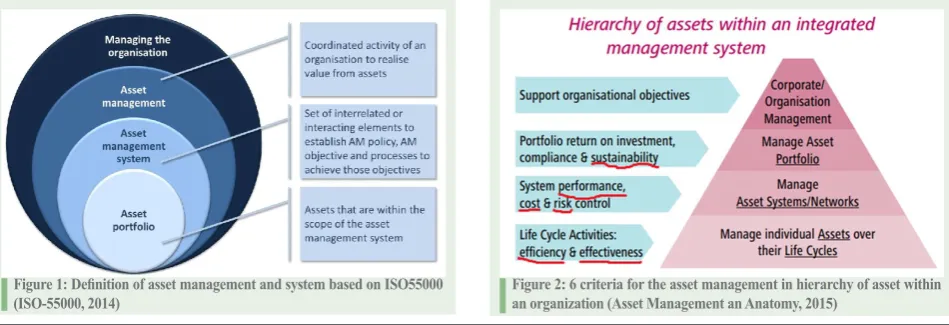
standard definition, the coordinated activity of an
organization to realize value from assets, is called PAM3 , and the set of interrelated or interacting elements to establish asset management policies, asset management objectives, and processes to achieve those objectives is called PAMS4 as illustrated in Figure-1 (ISO-55000, 2014). The key message of the ISO-55000 standard is the integrated management of all environmental risks over the equipment and management of all equipment risks over the environment in the four life cycle phases of a physical asset (Wilandri Basson, P.J. Vlok, and J.L. Jooste, 2016).
Accordingly, the life cycle of the physical asset
is classified into four periods, including acquisition
period, operating period, maintenance period, and disposals period (Canada Correctional service, 2018).
Excellence models are a systematic method of strengthening and developing process or managerial systems (Robin Mann, Musli Mohammad, Ma Theresa A. Agustin, 2010). Hence, AMEM5 is a systematic method for strengthening and developing the PAM to realize values through the physical asset (Asset Management Center, 2011).ISO-55000 standard has emphasized the PAM requirements but has not mentioned anything about the procedure (PAS55-1-2008, 2015). In other words, this standard talked about “what to do”, but it did not mention anything about “how to do” (see ISO-5500 collection, 2018). Therefore, various AMEM models have been designed and presented to industries for “how to do” around the world. The most common,
model in Canada by Campbell, IAM model in England
by John Woodhouse, LCE6 model by Life Cycle
Engineering Ltd. in the United States, and AIM7 model in the UK (Examining several examples of physical asset management models, 2018). These four models claim to have the ability to develop PAM based on ISO-55000.
Due to the variety of AMEM models at a world class level, choosing one will create confusion for asset managers in an organization. On the other hand, based on this fact that organizations compete for resources and markets, they must somehow assess the results of their decisions and selection (Alexander Veronese Bents, Jorge Carneir, Jorge Ferreira da Silva, 2011). Accordingly, evaluating and prioritizing these models from critical criteria aspects is an issue for asset managers. This is the main problem which researchers like to solve.
In this work, DEMATEL and ANP techniques are used for the assessment of the criteria and options. DEMATEL and ANP methods have the ability to measure the size and direct impact of the criteria on each other (Sheng-Li Si, Xiao-Yue You, Hu-Chen Liu, and Ping Zhang, 2018). Because the criteria are interdependent, it is necessary to use DEMATEL technique to determine the direction of dependency and to measure the weight of each criterion (Octavian A, Sumantri S.H, Ahmadi, 2017). On the other hand, ANP technique is used to prioritize AMEM based on a combination of six critical criteria.
To recognize the critical criteria, as shown in Figure 2, the development of the organizations in ISO-55000 standard at 4 levels through setting goals at the corporate level; managing asset portfolio through investment, compliance, and sustainability; managing asset system through risk, cost, and performance; and managing individual assets over their lifecycle through
efficiency and effectiveness has been conducted.
Figure 1: Definition of asset management and system based on ISO55000
(ISO-55000, 2014) Figure 2: 6 criteria for the asset management in hierarchy of asset within an organization (Asset Management an Anatomy, 2015)
٣
and to measure the weight of each criterion (Octavian A, Sumantri S.H, Ahmadi, 2017). On the other hand, ANP technique is used to prioritize AMEM based on a combination of six critical criteria. To recognize the critical criteria, as shown in Figure 2, the development of the organizations in ISO-55000 standard at 4 levels through setting goals at the corporate level; managing asset portfolio through investment, compliance, and sustainability; managing asset system through risk, cost, and performance; and managing individual assets over their lifecycle through efficiency and effectiveness has been conducted. This is a new approach to managing physical assets (IAM asset management an anatomy, 2015). Based on this explanation, 4 critical criteria of cost, risk, performance, and sustainability have been taken from ISO-55000 standard according to Figure 2. Because compliance criterion is related to the steps after the selection of AMEM, it was deleted from the list of criteria for AMEM evaluation. Next, 2 criteria were identified through interviewing oil and gas experts. As it is evident, a large number of criteria can be employed to assess a model. However, the three issues of simplicity of the model, knowledge of the model, and a number of documentary criteria needed for evaluation and selection are important. To evaluate AMEM models based on a limited number of criteria, to reduce the complexity of the problem, and to enhance the effectiveness of these criteria, ISO-55000 documents and industry experts’ interviews were used in this approach. Concerning the selection of interviewees, 2 issues were addressed. First, the experts should have been involved in the processes of four lifecycles of physical assets. Moreover, these people should also have a high profile in the management of equipment and installations. These issues have resulted in a maximum sample size of ten people. Also, to explain the criteria selection in detail, ISO 55000 states that asset management is based on four fundamentals of value, alignment, leadership, and assurance (ISO-55000, 2014). Assets have an actual or potential value to an organization, and the values of an organization are part of its operating context and act as constraints on or enablers for its activities.
Figure 2: 6 criteria for the asset management in hierarchy of asset within an organization (Asset Management an Anatomy, 2015)
Although individual assets can contribute value to an organization, when they are usually connected together as an asset system or a larger entity, they generate value for an organization. Figure 2 illustrates the contributions to value typically made at various levels of an asset hierarchy. Therefore, values at an asset portfolio level are investment, compliance, and sustainability, and values in an asset system are
3. Physical Asset Management (PAM) 4. Physical Asset Management System (PAMS) 5. Asset Management Excellence Model(AMEM)
58
This is a new approach to managing physical assets (IAM asset management an anatomy, 2015). Based on this explanation, 4 critical criteria of cost, risk, performance, and sustainability have been taken from ISO-55000 standard according to Figure 2. Because compliance criterion is related to the steps after the selection of AMEM, it was deleted from the list of criteria for AMEM evaluation. Next, 2 criteria were
identified through interviewing oil and gas experts. As it
is evident, a large number of criteria can be employed to assess a model. However, the three issues of simplicity of the model, knowledge of the model, and a number of documentary criteria needed for evaluation and selection are important. To evaluate AMEM models based on a limited number of criteria, to reduce the complexity of the problem, and to enhance the effectiveness of these criteria, ISO-55000 documents and industry experts’ interviews were used in this approach. Concerning the selection of interviewees, 2 issues were addressed. First, the experts should have been involved in the processes of four lifecycles of physical assets.
Moreover, these people should also have a high profile
in the management of equipment and installations. These issues have resulted in a maximum sample size of ten people. Also, to explain the criteria selection in detail, ISO 55000 states that asset management is based on four fundamentals of value, alignment, leadership, and assurance (ISO-55000, 2014). Assets have an actual or potential value to an organization, and the values of an organization are part of its operating context and act as constraints on or enablers for its activities.
Although individual assets can contribute value to an organization, when they are usually connected together as an asset system or a larger entity, they generate value for an organization. Figure 2 illustrates the contributions to value typically made at various levels of an asset hierarchy. Therefore, values at an asset portfolio level are investment, compliance, and sustainability, and values in an asset system are performance, cost, and risk;
in individual, assets over their life cycle are efficiency
and effectiveness. With this description, the critical
criteria at three levels of PAM consisting of individual asset, asset system, and asset portfolio are cost, risk, performance, sustainability, which are directly related to PAM development (Asset Management an anatomy, 2015). Next other criteria, as displayed in Figure 2, are related to the period after the selection of AMEM, so they are deleted.
In the current work, the main objective is evaluating and prioritizing AMEM based on the six critical criteria through DEMATEL and ANP techniques. The second goal of this study is to identify the capabilities of the four above models in each of the critical criteria alone. Why are some organizations more sensitive to some of these criteria sometime? For example, oil and gas production units are more sensitive to the risk. Thus, based on the research issue and the research objectives, the following are research questions and should be answered.
1- What is the AMEM prioritization based on six critical criteria?
2- What is the priority of the Uptime, IAM, LCE, and AIM models based on each of the cost, risk, performance, sustainability, simplicity, and knowledge criteria?
2. Research Literature
In 1994, Campbell and his Colleagues presented Uptime maintenance management excellence pyramid. This model, according Figure 1, is designated in 4 subjects and ten activates. Four subjects and 10 activities are considered to evaluate the maturity level of maintenance management in this model. The main subjects include leadership, control, continuous improvement, and quantum leaps. The main activities of the Uptime model are designed in ten groups. Each activity is assessed by a researcher-centered questionnaire (John D. Campbell, Andrew K. S. Jordin Joel McGlynn, 2015). A remarkable point in this model is the model approach. Uptime model approach is maintenance management and focuses on one of four
Figure 3: Uptime maintenance management excellence pyramid (John D. Campbell, Andrew K. S. Jordin Joel McGlynn, 2015)
performance, cost, and risk; in individual, assets over their life cycle are efficiency and effectiveness. With this description, the critical criteria at three levels of PAM consisting of individual asset, asset system, and asset portfolio are cost, risk, performance, sustainability, which are directly related to PAM development (Asset Management an anatomy, 2015). Next other criteria, as displayed in Figure 2, are related to the period after the selection of AMEM, so they are deleted.
In the current work, the main objective is evaluating and prioritizing AMEM based on the six critical criteria through DEMATEL and ANP techniques. The second goal of this study is to identify the capabilities of the four above models in each of the critical criteria alone. Why are some organizations more sensitive to some of these criteria sometime? For example, oil and gas production units are more sensitive to the risk. Thus, based on the research issue and the research objectives, the following are research questions and should be answered.
1- What is the AMEM prioritization based on six critical criteria?
2- What is the priority of the Uptime, IAM, LCE, and AIM models based on each of the cost, risk, performance, sustainability, simplicity, and knowledge criteria?
Research Literature
In 1994, Campbell and his Colleagues presented Uptime maintenance management excellence pyramid. This model, according Figure 1, is designated in 4 subjects and ten activates. Four subjects and 10 activities are considered to evaluate the maturity level of maintenance management in this model. The main subjects include leadership, control, continuous improvement, and quantum leaps. The main activities of the Uptime model are designed in ten groups. Each activity is assessed by a researcher-centered questionnaire (John D. Campbell, Andrew K. S. Jordin Joel McGlynn, 2015). A remarkable point in this model is the model approach. Uptime model approach is maintenance management and focuses on one of four life cycles of physical assets. However, an important part of the ISO-55000 requirements in the acquisition, utilization, and disposal period has not been addressed.
Figure 4: Uptime maintenance management excellence pyramid (John D. Campbell, Andrew K. S. Jordin Joel McGlynn, 2015)
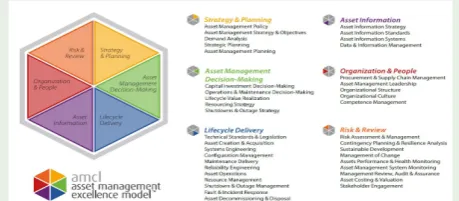
In 2004, IAM presented AMEM model in 6 main subjects according to Figure 5. IAM model includes strategy and planning; asset management decision-making; asset lifecycle delivery; asset information enabler; organization and people enabler; and risk and review. The IAM Institute’s AMEM is based on PAS55 standard, which was originally developed with 23 activities; after being reviewed in 2008, PAS55 standard was designed with 39 activities; these 39 activities are considered as PAM enablers. These enablers are defined at 5 levels of maturity. The IAM model is known as the reference model for
59
part of the ISO-55000 requirements in the acquisition, utilization, and disposal period has not been addressed.
In 2004, IAM presented AMEM model in 6 main subjects according to Figure 5. IAM model includes strategy and planning; asset management decision-making; asset lifecycle delivery; asset information enabler; organization and people enabler; and risk and review. The IAM Institute’s AMEM is based on PAS55 standard, which was originally developed with 23 activities; after being reviewed in 2008, PAS55 standard was designed with 39 activities; these 39 activities are
considered as PAM enablers. These enablers are defined
at 5 levels of maturity. The IAM model is known as the reference model for PAM worldwide. ISO 55000 standard is written in accordance with PAS55 standard. It should also be noted that this model covered all the periods of the lifecycle physical asset (AMCL Ltd., 2016).
From South Carolina, Life Cycle Engineering Company has been engaged in a reliability engineering approach in the United States for more than three decades. The LCE model has been designed and
developed business processes at five levels, including
principles, organizational culture, management processes, optimization, and sustainable states as shown in Figure 6 according ISO-55000 requirement.
This model begins at the first level with two
activities, including commitment management and functional partnership. The second level consists of 6 activities, including administrative principles; goals; organizational structure; budgeting and cost control; health and safety; and manpower management.
The third level includes 8 activities in maintenance operations, and the fourth level has 7 activities in the
field of optimization and methods; finally, the fifth level is composed of 6 activities in the field of sustainable
states according to Figure 6. In general, the focus of the LCE model is on reliability engineering, lifecycle management, and sustainability, and it has 27 activities
Based on the classical engineering approach,
reliability is defined as the ability of a system to perform the tasks required under specified conditions for a specified period of time. Accordingly, a more
comprehensive view is required to achieve a level of excellence. To this end, the traditional reliability of physical assets obtained through maintenance management should be expanded through increased business reliability, the reliability of work processes, and employee’s empowerment. Effective leadership and change management support these three basic concepts (Risk Management and Assessment for business, 2018). These three basic concepts are evident in the design of this model.
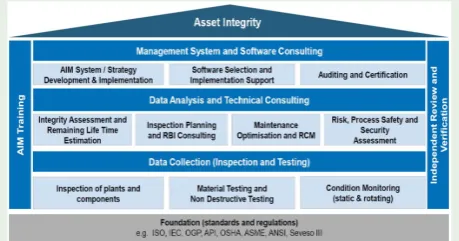
In 2006, AIMS has been developed in the UK under the name of asset integrity management house. In this plan, the asset integrity management house is considered in three subjects and 12 activities. The second subject dealing with integrity, reliability, and process safety assessment includes integrity assessment; risk and reliability management; process hazard analysis; and safety case analysis. The third subjects called performance assurance include maintenance; inspection; testing and data analysis; and performance improvement, and are generally developed under the title of asset integrity management house, as displayed in Figure 7.
The first topic is divided into four activities
consisting of asset integrity philosophy; asset integrity management system; process safety management system; and monitoring, auditing, and management. The AIM system was deployed to increase the safety
and efficiency of equipment through the integration of
technical systems in the organization (TUV Rhineland Group, Risktec Solutions, 2018).
In 2018, an investigation was conducted on a hybrid model for selecting the best project manager by Ekhtiar Khodadadi and his colleagues. Choosing the best executives from several suggested alternatives is one of
Figure 5: LCE asset management excellence model (The Reliability
60
the key factors in project success. The act of choosing a department depends on a number of parameters including qualitative and quantitative criteria which
may be ambiguous or create conflict. Therefore, the
complexity and importance of the problem require to use analytical methods rather than intuitive decisions (Ekhtiar Khodadadi, Mehdi Aghabeigi, 2018).
Another research entitled “Supplier Evaluation and Selection in Fuzzy Environments: A Review of MADM Approaches” was conducted by Mehdi Keshavarz Ghorabaee and his colleagues in 2017. They reported that the AHP and TOPSIS methods are the most popular approaches (Mehdi Keshavarz Ghorabaee, Maghsoud Amiri, Edmundas Kazimieras, 2017).
Another work entitled “Building Criteria for Evaluating Green Project Management: An Integrated Approach of DEMATEL and ANP” was performed at the Department of Business Administration in Tung Hai University in 2017. The empirical results show the interrelationship structure and the priority of each dimension and each criterion in a green project
management. The findings of this study provide
important implications for both managers and academic researchers (Ying-Chyi Chou, Chia-Han Yang, Ching-Hua Lu, Van Thac Dang, 2017).
The application of multi-criteria decision-making methodology to taking decision was also studied in
2016. In multi-criteria decision-making methodology, the material ranking method (called VIKOR) was introduced as an applicable method for implementation in MCDM; it was designed to optimize multi-purpose complex systems. However, few articles on contradictory (competitive) criteria are discussed
with affiliation to and feedback on the compromise
solution method. Therefore, this study proposes and presents applications of a new model using the VIKOR-based DEMATEL and ANP techniques to solve the
problem of conflicting metrics with dependency and
feedback. An example is also presented to illustrate the application of the proposed method. The results show that the proposed method is appropriate and effective in real world programs (Elena ROKOU, Konstantinos Kirytopolos and Dimitra Voulgaridou, 2016).
A work entitled “Evaluation of the Importance
of 39 Subjects Defined by the Global Forum for
Maintenance and Asset Management” was carried out at the Department of Engineering and Technology Management of University of Pretoria, South Africa in
2015. The results of the survey indicated that the five
most important subjects are asset management strategy and objectives; asset management policy; strategic planning; asset management planning; and asset management leadership from 39 subjects (J.K. Visser, T.A. Botha, 2015).
Ozer Uygun and his colleagues studied “An Integrated DEMATEL and Fuzzy ANP Techniques for Evaluation and Selection of Outsourcing Provider for a Telecommunication Company” at Zakary University, Turkey in 2015. The methodology was proposed for outsourcing provider selection and achieved useful results. First, DEMATEL method was used in order to suggest the interrelationship among the main criteria for the outsourcing selection process as determined in the study. Then, the local weights of the sub-criteria and sub-sub-criteria were calculated by fuzzy ANP approach on the basis of cause-effect relationships obtained by DEMATEL method (Ozer Uygun, Hassan Kacamak, Unal Ataken, 2015).
Another work titled “Applying DEMATEL-ANP to Assessing Organizational Information System Development Decision” was done in 2013. More and
more enterprises expect to improve operating efficiency
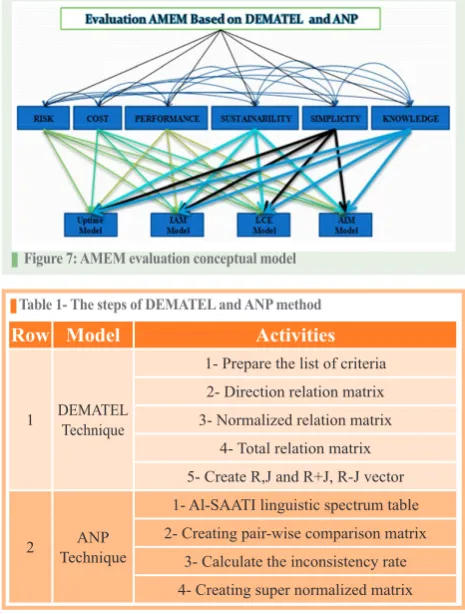
and managerial decision-making effectiveness by introducing information systems into the operational procedures. The results showed that companies with limited resources prefer to choose an outsourcing implementation model in order to save labor, cost, and time, while insuring the stability of the system Table 1- The steps of DEMATEL and ANP method
Activities Model
Row
1- Prepare the list of criteria
DEMATEL Technique 1
2- Direction relation matrix 3- Normalized relation matrix
4- Total relation matrix 5- Create R,J and R+J, R-J vector 1- Al-SAATI linguistic spectrum table ANP
Technique
2 2- Creating pair-wise comparison matrix 3- Calculate the inconsistency rate 4- Creating super normalized matrix
Figure 7: AMEM evaluation conceptual model
this evaluation process. Hence, the criteria are interrelated and linked to options. A conceptual model according to Figure 8 is designed for this meaningful relation.
It should be noted that, due to the relationship between the criteria, their weights should be calculated by DEMATEL method. Furthermore, because of the relationship between the options, ANP model is employed to rank them. As a result, we cannot use AHP model.
Figure 8: AMEM evaluation conceptual model
Research Method
This research is practical in terms of purpose, and, in terms of data collection method, it is a descriptive survey. In this work, the structure of excellence models is examined through documentary studies. The excellence models mentioned herein are evaluated based on six strategic criteria outlined in ISO-55000 and according to the interview with 10 experts in oil and gas industry. As it is predictable by intuition, these criteria are not independent and they interrelate. Hence, from DEMATEL5-degree method is used to determine the weight of each criteria and to detect the cause and effect criteria. In order to evaluate the relationship between the criteria and their relative weight according DEMATEL method, a pair-wise comparison matrix is required (Sheng-Li Si, Xiao-Yue You, Hu-Chen Liu, and Ping Zhang, 2018). These criteria will be compared by employing 10 experts in Iran oil and gas industry. The main reason for the limitation to the number of interviewees is the lack of experts in the field of physical asset management. The main indicators of the interviewees in this study are an experience of more than 25 years in the oil industry and familiarity with oil and gas repair and maintenance systems. Therefore, after identifying the relationships between the criteria by DEMATEL technique, ANP model is used to prioritize options based on these criteria.
The reason that ANP technique is used instead of AHP is the direct relationships between the options; in fact, AHP model is used for a one-way hierarchical state (Fikret K. Turan, Natalie M. Scala, Mary Besterfield-Sacre, 2009). The pair-wise comparison matrix of criteria and options are prepared through a questionnaire. The size of the sample is 10 experts in the physical asset management of the oil and gas industry according DEMATEL interviewees.
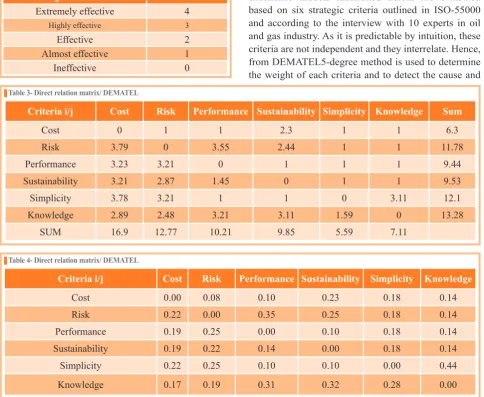
Based on the structure of DEMETL and ANP techniques, the related activities are done in accordance with Table 1.
61
advantages of sustainable operation can be enhanced (Kuang-Husn Shih, Wan-Rung Lin, Yi-Hsien Wang, Tzu-En Hung, 2013).
In 2013, Yu-PingOu Yang and his colleagues studied the evaluation of information security management and presented a risk assessment model for information security control, which can improve the security of information for companies and organizations. A MCDM model was proposed combining VIKOR, DEMATEL, and ANP techniques. In this research, evaluation criteria
have a significant relationship, and, to demonstrate
the proposed method, an empirical method is used to evaluate risk controls. The results state that the proposed method can help information technology (IT) managers to validate the effectiveness of risk control (Yu-PingOu Yang, How-MingShieh, Gwo-HshiungTzeng, 2013).
Based on the explanation in literature review, a
is presented in Figure 8. As mentioned in problem statement, we have 6 critical criteria and 4 options in this evaluation process. Hence, the criteria are interrelated and linked to options. A conceptual model according to Figure 8 is designed for this meaningful relation.
It should be noted that, due to the relationship between the criteria, their weights should be calculated by DEMATEL method. Furthermore, because of the relationship between the options, ANP model is employed to rank them. As a result, we cannot use AHP model.
3. Research Method
This research is practical in terms of purpose, and, in terms of data collection method, it is a descriptive survey. In this work, the structure of excellence models is examined through documentary studies. The excellence models mentioned herein are evaluated based on six strategic criteria outlined in ISO-55000 and according to the interview with 10 experts in oil and gas industry. As it is predictable by intuition, these criteria are not independent and they interrelate. Hence, from DEMATEL5-degree method is used to determine the weight of each criteria and to detect the cause and Table 2- DEMETEL and linguistic phrase
Definite Numbers
Linguistic Phrase
4 Extremely effective
3 Highly effective
2 Effective
1 Almost effective
0 Ineffective
Table 3- Direct relation matrix/ DEMATEL
Sum Knowledge
Simplicity Sustainability
Performance Risk
Cost Criteria i/j
6.3 1
1 2.3
1 1
0 Cost
11.78 1
1 2.44
3.55 0
3.79 Risk
9.44 1
1 1
0 3.21
3.23 Performance
9.53 1
1 0
1.45 2.87
3.21 Sustainability
12.1 3.11
0 1
1 3.21
3.78 Simplicity
13.28 0
1.59 3.11
3.21 2.48
2.89 Knowledge
7.11 5.59
9.85 10.21
12.77 16.9
SUM
Table 4- Direct relation matrix/ DEMATEL
Knowledge Simplicity
Sustainability Performance
Risk Cost
Criteria i/j
0.14 0.18
0.23 0.10
0.08 0.00
Cost
0.14 0.18
0.25 0.35
0.00 0.22
Risk
0.14 0.18
0.10 0.00
0.25 0.19
Performance
0.14 0.18
0.00 0.14
0.22 0.19
Sustainability
0.44 0.00
0.10 0.10
0.25 0.22
Simplicity
0.00 0.28
0.32 0.31
0.19 0.17
62
effect criteria. In order to evaluate the relationship between the criteria and their relative weight according DEMATEL method, a pair-wise comparison matrix is required (Sheng-Li Si, Xiao-Yue You, Hu-Chen Liu, and Ping Zhang, 2018).
These criteria will be compared by employing 10 experts in Iran oil and gas industry. The main reason for the limitation to the number of interviewees is the lack
of experts in the field of physical asset management.
The main indicators of the interviewees in this study are an experience of more than 25 years in the oil industry and familiarity with oil and gas repair and maintenance systems. Therefore, after identifying the relationships between the criteria by DEMATEL technique, ANP model is used to prioritize options based on these criteria.
The reason that ANP technique is used instead of AHP is the direct relationships between the options; in fact, AHP model is used for a one-way hierarchical
state (Fikret K. Turan, Natalie M. Scala, Mary
Besterfield-Sacre, 2009). The pair-wise comparison
matrix of criteria and options are prepared through a questionnaire. The size of the sample is 10 experts in the physical asset management of the oil and gas industry according DEMATEL interviewees.
Based on the structure of DEMETL and ANP techniques, the related activities are done in accordance with Table 1.
Al-Sati linguistic spectrum table of the pair-wise comparisons between the criteria, the linguistic phrase table,
and the definite numbers are defined according to Table 2.
4. Research Findings
According to Table 1, the following activities will be done in order to evaluate the excellence models in
7 steps, according to the following tables. The first and
sixth steps are presented in the research method; thus, here, we start from the third step.
Direction Relation Matrix: The numbers in Table 3 are
calculated based on geometric mean of questionnaire responses from 10 oil and gas industry experts interviewed to examine the relationship between the criteria.
Normalized Direct Relation Matrix: The normalized
direct-relation matrix is obtained by dividing all the elements of the direct relation matrix to the sum of each
Table 5- Direct relation matrix/ DEMATEL
R Knowledge Simplicity
Sustainability Performance
Risk Cost
Criteria i/j
4.03 1.01
0.96 1.18
0.93 1.05
1.07 Cost
7.43 1.52
1.40 1.74
1.63 1.54
1.87 Risk
5.76 1.18
1.11 1.27
1.01 1.40
1.45 Performance
5.89 1.19
1.11 1.18
1.14 1.38
1.45 Sustainability
7.5 1.77
1.26 1.64
1.43 1.76
1.88 Simplicity
8.21 1.54
1.61 1.96
1.73 1.87
2.00 Knowledge
6.03 5.40
6.74 6.04
6.95 7.66
J
Table 6- R, J, R+J, and R-J Vectors/DEMATEL
Knowledge Simplicity
Sustainability Performance
Risk Cost
Criteria i/j
8.21 7.5
5.89 5.76
7.43 4.03
R
6.03 5.40
6.74 6.04
6.95 7.66
J
14.24 12.90
12.63 11.80
14.38 11.69
R+J
2.18 2.10
-0.85 -0.28
0.48 -3.63
R-J Figure 8: Causal diagram of criteria
١٠
Knowledge 0.17 0.19 0.31 0.32 0.28 0.00
Total Relation Matrix: It is calculated by equation N (I-N)-1 according to Table 5.
Table 5: Total relation matrix /DEMATEL
Criteriai/j Cost Risk Performance Sustainability Simplicity Knowledge R
Cost 1.07 1.05 0.93 1.18 0.96 1.01 4.03
Risk 1.87 1.54 1.63 1.74 1.40 1.52 7.43
Performance 1.45 1.40 1.01 1.27 1.11 1.18 5.76 Sustainability 1.45 1.38 1.14 1.18 1.11 1.19 5.89 Simplicity 1.88 1.76 1.43 1.64 1.26 1.77 7.5 Knowledge 2.00 1.87 1.73 1.96 1.61 1.54 8.21
J 7.66 6.95 6.04 6.74 5.40 6.03
Measuring the R,J,R+J, and R-J Vectors
Table 6: R,J,R+J, and R-J Vectors/DEMATEL
Cost Risk Performance Sustainability Simplicity Knowledge
R 4.03 7.43 5.76 5.89 7.5 8.21
J 7.66 6.95 6.04 6.74 5.40 6.03
R+J 11.69 14.38 11.80 12.63 12.90 14.24
R-J -3.63 0.48 -0.28 -0.85 2.10 2.18
IfR>J, Then R-J>0 and the factor is a definitive influence and is considered as a causative variable.
IfR<J Then R-J<0 and the factor is definitive and is considered to be an impacted variable.
Therefore, the causal diagram can be obtained by plotting the ordered pairs (R+J,R-J) and is valuable for decision making, as displayed in Figure 8.
63
column according to Table 4.
Total Relation Matrix: It is calculated by equation N
(I-N)-1 according to Table 5.
Measuring the R, J, R+J, and R-J Vectors If R>J, Then R-J>0 and the factor is a definitive influence and is considered as a causative variable.
If R<J Then R-J<0 and the factor is definitive
and is considered to be an impacted variable.
Therefore, the causal diagram can be obtained by plotting the ordered pairs (R+J, R-J) and is valuable for decision making, as displayed in Figure 8.
Therefore, according to the diagram illustrated in Figure 8, the risk, simplicity, and knowledge criteria are the causative ones in the model, and the performance, sustainability, and cost are the effective criteria in this evaluation based on DEMATEL method. In other words, the analysis of DEMATEL method in the current study states that the cost, sustainability, and performance are cause variables, and knowledge, simplicity, and risk are effect variables in this evaluation. As also listed in Table 4, the cost, risk, performance, sustainability, simplicity, and knowledge criteria respectively have a weight of 12%, 19%, 14%, 15%, 19%, and 21%. Thus, as one
of the important findings of this work, we confirm that
knowledge has the highest impact and cost has the lowest impact on ranking asset management excellence model in oil and gas industries.
5. Creating Pair-Wise Comparison Matrix/ANP
In order to provide a pair-wise comparison matrix in ANP model, a questionnaire was designed which took into account the relationships of all the variables
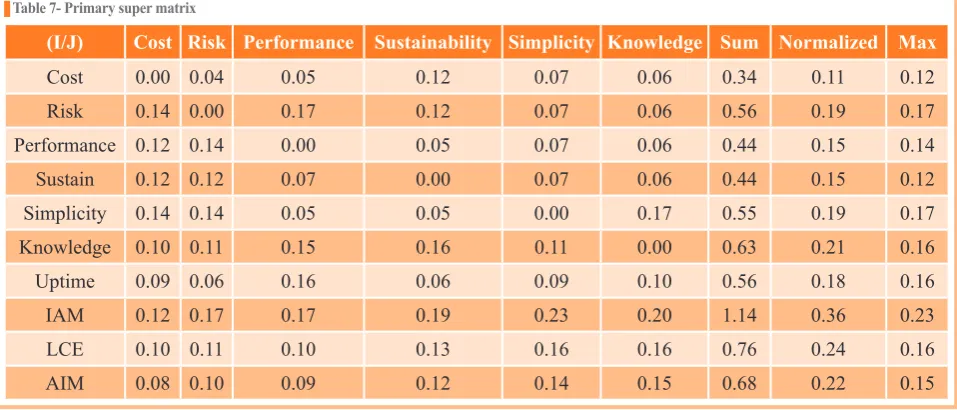
in the system. The relationship between the criteria was obtained from the DEMATEL questionnaire. At this point, the relations extracted in the DEMATEL phase are considered based on Table 7. The inconsistency
coefficient is calculated as 0.04, which is smaller than
0.1, so the consistency survey is acceptable.
6. Primary Super Matrix
In reply to the first research question, as shown in
Table 8, the ranking of AMEM models based on the calculation by ANP model are respectively IAM with a relative importance of 36%, LCE with a relative importance of 26%, AIM with a relative importance of 22%, and Uptime with a relative importance of 18%. Moreover, in answer to the second research question, Uptime with the greatest impact on performance, IAM with the greatest impact on simplicity, LCE with the greatest impact on knowledge, and AIM with the greatest impact on knowledge have the greatest impact on the criteria and are sensitive to them.
7. Conclusion
The aim of this work is evaluating and prioritizing asset management excellence models according to critical criteria based on DEMATEL and ANP multi-criteria decision-making techniques. The critical criteria consist of cost, risk, performance, sustainability,
simplicity, and knowledge. The first four criteria are
directly chosen based on ISO-55000 requirements, and the last two ones are selected according to the interview with oil and gas experts.
Table 7- Primary super matrix
Max Normalized Sum
Knowledge Simplicity
Sustainability Performance
Risk Cost (I/J)
0.12 0.11
0.34 0.06
0.07 0.12
0.05 0.04
0.00 Cost
0.17 0.19
0.56 0.06
0.07 0.12
0.17 0.00
0.14 Risk
0.14 0.15
0.44 0.06
0.07 0.05
0.00 0.14
0.12 Performance
0.12 0.15
0.44 0.06
0.07 0.00
0.07 0.12
0.12 Sustain
0.17 0.19
0.55 0.17
0.00 0.05
0.05 0.14
0.14 Simplicity
0.16 0.21
0.63 0.00
0.11 0.16
0.15 0.11
0.10 Knowledge
0.16 0.18
0.56 0.10
0.09 0.06
0.16 0.06
0.09 Uptime
0.23 0.36
1.14 0.20
0.23 0.19
0.17 0.17
0.12 IAM
0.16 0.24
0.76 0.16
0.16 0.13
0.10 0.11
0.10 LCE
0.15 0.22
0.68 0.15
0.14 0.12
0.09 0.10
64
In response to the first question, according to Table 7, IAM with a coefficient of 36%, LCE with a coefficient of 24%, AIM with a coefficient of 22%, and Uptime with a coefficient of 18% are respectively prioritized based
on the critical criteria. In reply to the second question, IAM, AIM, LCE, and Uptime models are respectively most sensitive to simplicity, knowledge, knowledge, and performance criteria.
According to Table 7, cost criteria affecting risk by 4%, performance by 5%, sustainability by 12%, simplicity by 7%, knowledge by 6%, and the system by a total of 11% is the one of the least effective criteria. However, knowledge criteria affecting cost by 10%, risk by 11%, performance by 15%, sustainability by 16%, simplicity by 11%, and the system by a total of 21% is the one of the most effective criteria.
Nowadays, equipment-based industries, such as oil and gas industry, need to use modern production support systems to create value for the stakeholders. Selection of support systems has become a major challenge for executives due to their diversity. One of the most important production support systems is the physical asset management system with a lifecycle management approach. Since the ISO Organization has published general standards for the physical assets management development in 2014, various executive models have been designed and introduced to the industries. Choosing the excellence model to develop and strengthen the physical asset management is one of the most important decisions managers face.
In the current work, a hybrid decision-making method based on DEMATEL and ANP techniques is presented to evaluate and prioritize the excellence models. These models, which are widely used in industries, consist of Uptime, IAM, LCE, and AIM. Therefore, where these six critical criteria are top priority for an organization, it can use the related models based on the available funds to manage its physical assets.
References
(AMEM) to achieve world class Asset Management, What is Asset Management Excellence, https://www. amcl.com/wp-content/uploads/AMEMBrochure-Version2-3ForEmail.pdf
Asset Management Center. (2011). Fundamental Resources for Asset Management Excellence, Emergency and Demand Maintenance.
Bentes, Alexandre Veronese & Carneiro, Jorge & da Silva, Jorge Ferreira & Kimura, Herbert, 2012.
“Multidimensional assessment of organizational performance: Integrating BSC and AHP,” Journal of Business Research, Elsevier, vol. 65(12), pages 1790-1799.
Canada Correctional service.(2018), Audit of Fleet Life Cycle Management Internal Audit 378-1-255.
Explosion on North Sea oil rig, (2018), retrieved from: https://www.history.com /this-day-in- history/ explosion -on-north-sea-oil-rig, Publisher A&E Television Networks.
Examining several examples of Physical Asset Management Excellence Models.(2019), Retrieve from Internet Site: www. http://ainfom.ir.
Fikret K. Turan, Natalie M. Scala, Mary
Besterfield-Sacre.(2009), An Analytic Network Process (ANP) Appr oach to the Project Portfolio Management for Organizational Sustainability, University of Pittsburgh USA, Department of Industrial Engineering.
Ghorabaee Mehdi, Amiri Maghsoud, Zavadskas Edmundas Kazimieras & Jurgita Antucheviciene (2017) Supplier evaluation and selection in fuzzy environments: a review of MADM approaches,
Economic Research-Ekonomska Istraživanja, 30:1,
1073-1118, DOI: 10.1080/1331677X.2017.1314828. ISO-55000. (2014). Asset Management – Review
principles and Terminology, Reference number: ISO-55000(2014(E)), page no: 4.
ISO-55001.(2014). Asset Management – Asset management — Management, systems — Requirements, Reference number: ISO-55001,2014(E).
ISO-55002.(2014), Asset management — Management systems — Guidelines for the application of ISO 55001, Reference number ISO-55002:2014(E)
John D. Campbell, Andrew K. S. Jordin Joel McGlynn. (2015). Asset Management Excellence Optimizing Equipment Life-Cycle Decisions third Edition.
Khodadadi Ekhtiar, Aghabeigi Mehdi. (2018), A Novel Hybrid MCDM Approach Based on Fuzzy DEMATEL, ANP, and Fuzzy VIKOR for Selecting the Best Project Managers, International Journal of Information Technology Project Management (IJITPM), DOI: 10.4018/IJITPM.2018040103.
Khodadadi Ekhtiar. (2018). ANP, and Fuzzy VIKOR for Selecting the Best Project Managers, International Journal of Information Technology Project Management (IJITPM), DOI: 10.4018/ IJITPM.2018040103.
65
standard: case study at rail industry
Octavian. A, Sumantri S.H, Ahmadi.(2017), The combination of DEMATEL, ANP methods for performance measurement system design: A case study in KOLAT KOARMATIM,DO -10.14257/ ijca.2017.10.8.14, International Journal of Control and Automation
PAS55-1-2008.(2015), The Institute Of Asset
Management, Part1: Specification for the optimized
management of Physical Aset, UK IAM Publisher, PAS55-2-2008. (2015), the Institute Of Asset
Management. Asset management, Guidelines for the application of PAS55-1, ISBN 978 0 580 5097 6. Robin Mann, Musli Mohammad,Ma Theresa, A.
Agustin,(2010), Understanding Business Excellence, An awareness guidebook for SME, Asian Productivity Organization, http://www.apo-tokyo.org.
Roko Elena, Konstantinos and Voulgaridou Dimitra, (2016) , Analytic Network Process, School of Mechanical Engineering, National Technical University of Athens, Greece b Hellenic Open University, Greece.
Risk Management and Assessment for business, 23 may 2018, the house of integrity: modern asset integrity management, Retrieved from internet; http://www. risktec.tuv.com/knowledge-bank/technical-articles/ the-house-of-integrity-modern-asset-integrity-management.aspx
Sheng-Li Si, Xiao-Yue You, Hu-Chen Liu, and Ping Zhang, (2018), DEMATEL Technique: A Systematic Review of the State-of-the-Art Literature on Methodologies and Applications, School of Economics and Management, Tongji University, Shanghai 200092, China, [email protected]. Sheng-Li Si, Xiao-Yue You, Hu-Chen Liu, and
Ping Zhang, (2018), DEMATEL Technique: A Systematic Review of the State-of-the-Art Literature on Methodologies and Applications, School of Economics and Management, Tongji University, Shanghai 200092, China, [email protected]. Shih Kuang-Husn, Lin Wan-Rung, Wang Yi-Hsien,
Hung Tzu-En. (2013). Applying DEMATEL-ANP for assessing Organizational Information System Development Decision, Knowledge Management and innovation, Zadora, Croatia, International Conference 19-21 June 2013.
Schuman, Charles. (2015). Asset life cycle management: Towards improving physical asset performance in the process industry, DO - 10.1108/01443570510599728 Take a look at the ISO-5500 collection. (2018). Retrieve
The Institute of Asset Management. (2015). Principals and Concept. Asset Management – an Anatomy Copyright December 2015 Version 3, Page No: 11. The Reliability Excellence Model, Retrieve 10 Feb
2018 from internet, www. LCE.COM/Reliability-Excellence-Model-15.html
TUV Rhineland Group, Risktec Solutions, (2018), Retrieve From internet: The house of integrity: modern asset integrity management, http://www. risktec.tuv .com/knowledge-bank/technical-articles/ the-house-of-integrity---modern-asset-integrity-management.aspx
Uygun Ozer, Kacamak Hassan, Ataken Unal.(2015), An integrated DEMATEL and Fuzzy ANP techniques for evaluation and selection of outsourcing provider for a telecommunication company, Computers and Industrial Engineering Jurnal, Volume 86 Issue C, August 2015, Pages:137-146, Pergamon Press, Inc. Tarrytown, NY, USA
Van den Honert, A.F., Schoeman, J.S., & Vlok, P.J. (2013). Correlating the content and context of PAS 55 with the ISO 55000 series. South African Journal of Industrial Engineering, 24(2), 24-32. Retrieved October 31, 2019, from http://www.scielo. org.za/scielo.php?script=sci_arttext&pid=S2224-78902013000200004&lng=en&tlng=en.
Visser J.K., Botha T.A., (2015). Evaluation of the
Importance of 39 Subjects defined by the Global
FORUM for Maintenance and Asset Management, South African Journal of Industrial Engineering May 2015 Vol 26(1), pp 44-58.
Wilandri Basson, Prof. P.J. Vlok, Jooste J.L.(2016), Risk Management Solutions Flow to Implement QuantitativeMethods as Part of ISO 55000 for Physical Asset Management, Department of Industrial Engineering,University of Stellenbosch,Private Bag X1, Matieland 7602, South Africa.
Ying-Chyi Chou, Chia-Han Yang, Ching-Hua Lu, Van Thac Dang, Pei-A Yang. (2017), Building Criteria for Evaluating Green Project Management: An Integrated Approach of DEMATEL and ANP, Sustainability (ISSN 2071-1050; CODEN: SUSTDE).
Yu-PingOu Yang, How-MingShieh, Gwo-HshiungTzeng, (2013), A VIKOR technique based on DEMATEL and.