DEMOGRAPHIC RESEARCH
VOLUME 28, ARTICLE 36, PAGES 1021-1052
PUBLISHED 17 MAY 2013
http://www.demographic-research.org/Volumes/Vol28/36/ DOI: 10.4054/DemRes.2013.28.36
Research Article
Daughter preference in Japan:
A reflection of gender role attitudes?
Kana Fuse
© 2013 Kana Fuse.
This open-access work is published under the terms of the Creative Commons Attribution NonCommercial License 2.0 Germany, which permits use, reproduction & distribution in any medium for non-commercial purposes, provided the original author(s) and source are given credit.
1 Background 1022
1.1 Gender preferences in East Asia 1023
1.2 Gender preference in Japan 1024
1.3 Women in Japan 1027
2 Theoretical perspectives in understanding daughter preference in Japan
1028
2.1 Hypotheses 1030
3 Data and methodology 1032
3.1 Single Persons Study of the 11th JNFS 1033
3.1.1 Dependent variable: Gender preference for children 1034
3.1.2 Gender role attitudes 1035
3.1.3 Background variables 1036
3.2 Analysis 1038
4 Results 1039
4.1 Gender role attitudes 1041
4.2 Background variables 1045
5 Discussion and conclusion 1045
6 Acknowledgments 1047
Daughter preference in Japan: A reflection of gender role attitudes?
Kana Fuse1
Abstract
BACKGROUND
Unlike other East Asian nations where preference for sons over daughters still prevails, gender preference for children in Japan has progressively shifted from son preference to a noticeable daughter preference over the past few decades. This emergence of daughter preference is surprising given that gender relations are more traditional in Japan than in other advanced countries.
OBJECTIVE
I focus on the extent to which individuals’ gender preferences are shaped by their gender role attitudes and evaluate whether daughter preference is a reflection of convergence or a persistent divergence in gender roles in Japan.
METHODS
I use data from the Single Persons subset of the 11th Japanese National Fertility Survey conducted by the National Institute of Population and Social Security Research in 1997. Using multinomial logistic regression, I estimate the relationship between Japanese singles’ gender role attitudes and their type of gender preference for children.
FINDINGS
Findings suggest that the effect of gender role attitudes on one’s child gender preference differs for men and women. Overall, while daughter preference is associated with nontraditional gender role attitudes for men, daughter preference is associated with traditional attitudes for women.
CONCLUSIONS
Traditionalism is still driving gender preference, though in a different way for men and women. Emerging daughter preference may not simply be a reflection of improvements in women’s status, but in fact it is likely that persistent divergence in gender roles remain in Japan.
1 National Institute of Population and Social Security Research, Department of Population Structure Research. Hibiya Kokusai Building 6th Floor, 2-2-3 Uchisaiwaicho, Chiyoda-ku, Tokyo 100-0011, Japan.
1. Background
In their report of the 12th Japanese National Fertility Survey (JNFS) conducted in 2002, the Japanese National Institute of Population and Social Security Research (2003; 2004) reported an overall daughter preference among the Japanese. Gender preference for children in Japan has progressively shifted from son preference to a discernible daughter preference over the past few decades. This may appear shocking to sociologists and demographers, as it has been long believed that a preference for sons over daughters prevails in populations of East Asia. In China and South Korea, gender preference has translated into adverse social and demographic issues such as widespread sex-selective abortions and skewed sex ratios at birth. Therefore, there is a large volume of published research that uncovers parental son preference in China (e.g. Arnold and Liu 1986; Coale 1991; Coale and Banister 1994; Johansson and Nygren 1991; Johnson, Huang, and Wang 1998; Li and Cooney 1993; Poston 2002; Zeng et al., 1993) and the Republic of Korea (e.g. Arnold 1985; Chung 2007; Chung and Das Gupta 2007; Park and Cho 1995). However, little research has been published on the state of gender preferences in Japan. Empirical studies attempting to examine motivations for gender preference among the Japanese are also limited. Such a chronic lack of interest is perhaps attributable to: (1) the fact that Japan does not have an abnormal demographic profile (e.g. skewed sex ratio at birth, gender imbalance in infant mortality); (2) the assumption that Japan is similar in its gender preferences for children to its neighbors because of its geographic proximity and a shared Confucius background; and/or (3) the presumption that the Japanese exhibit less or no son preference given its higher level of economic development, thereby making it less appealing to examine. However, because daughter preference has become evident in Japan, it merits more attention and an explanation for this unique phenomenon.
This paper has two goals. First, it contributes to the literature by presenting the state of gender preferences for children in Japan. Second, to investigate motivations for gender preference, I focus on context-specific explanations for gender preferences among single, young adults in Japan. Of particular interest is the extent to which individuals’ son/daughter preferences are shaped by their gender role attitudes. In investigating this association, I ultimately hope to evaluate whether daughter preference is a reflection of convergence or persistent divergence in gender roles in Japan.
1.1 Gender preferences in East Asia
Gender preferences for children have been widely observed around the globe. East Asia is one of the most rigorously examined regions, especially concerning the situation of China and South Korea, where son preference has brought adverse social and demographic consequences. Of the 102.2 million women ‘missing’ worldwide in the 1990s due to gender bias in mortality, 41.6 million were estimated to be from China, Taiwan, and South Korea (Klasen and Wink 2002). This region has also attracted attention for its abnormally masculine sex ratios at birth (the number of male live births per 100 female live births). Goodkind (1996) notes that sex ratios at birth rose sharply in the early 1980s as sex-testing technologies became widespread in Korea, China, Taiwan, Hong Kong, and among the Chinese populations of Singapore and Malaysia. The rise was especially sharp in China and Korea where sex ratios at birth exceeded 113 by the late 1980s2.
Son preference in China is widely known for its astonishing estimates of ‘missing’ women and the striking increases in sex ratios at birth over the past few decades. Klasen and Wilk (2002) estimated that the number of missing women in China has increased from 34.6 million (6.3% of all women alive) in 1990 to 40.9 million (6.7% of all women alive) in 2000. High sex ratios due to gender discrimination are also reported. Examining census and survey data, Coale and Banister (1994) report that increases in juvenile sex ratios reflect sex-selective abortions facilitated by widespread access to sex-screening equipment throughout China. Confucian values that promote patriarchal family systems and carrying on the family line are prevalent in China. These values, coupled with strict fertility regulation with the implementation of the national one-child policy in 1979, are assumed to have contributed to the adverse outcomes. Access to reproductive technology (e.g. ultrasound for sex screening) has further reinforced the Chinese inclination to ensure one child of the desired sex. Past studies of China also highlight the negative impact of son preference on the well-being of female children. Johnson, Huang, and Wang (1998), for example, found that the vast majority of abandoned children were reported to be girls, and that girls with one or more older sisters and with no brothers were the most likely to be abandoned. In rural China, girls are less likely than boys to be enrolled in school; among children who are enrolled, girls receive shorter periods of schooling than do boys (Wang 2005).
Another East Asian nation, South Korea, is also known for its pervasive son preference. As with China, widespread Confucian ideas that emphasize passing down
the family line and providing support for the elderly contribute to son preference in South Korea. Sex ratios at birth increased steadily between the 1970s and 1990s (Park and Cho 1995). Since the sex ratio of first-born children was observed to be particularly high, Park and Cho (1995) argue that there is a preference for the first child to be a son and that South Koreans may be applying sex choice technology. Son preference is particularly evident during the year of the Horse in the lunar calendar, in which women born in the year of the Horse are believed to possess undesirable traits and are destined to an unhappy life (Lee and Paik 2006). Considerable increases in the sex ratio at birth are detected every 12 years during each Horse year. However, there is some evidence of improvement in South Korea. Recent accounts show a decline in son preference in South Korea as indicated by a less masculine juvenile sex ratio in 2000 compared to 1990 (Chung and Das Gupta 2007). Also, the fact that the sex ratio of second births following a son is low indicates that families that already have a son are choosing to have a daughter for their second birth (Park and Cho 1995).
1.2 Gender preference in Japan
As with other East Asian nations, Japan has had a Confucius hierarchal social system that values the eldest son to maintain the family lineage and to take care of aged parents. Not surprisingly, son preference was the norm in Japan as well, but this has no longer been the case since late 1980s. Unlike China and South Korea, however, son preference has generally not impacted demographic outcomes in Japan, with the exception of the year of the fire horse in 1966 (Sakai 1987). Like South Korea, Japan observed an increase in its sex ratio at birth that year as it was considered unfavorable to give birth to a girl. The ratio rose to 107.6 in 1966, the highest recorded since 1955. Nonetheless, sex ratios at birth including that of 1966 have been in the tolerable range of 105 to 108 since 1955 (Sakai 1987). The reason why Japan has not received much international policy and academic attention on this subject is perhaps because gender preference has not translated into adverse outcomes and cannot be detected from aggregate demographic data.
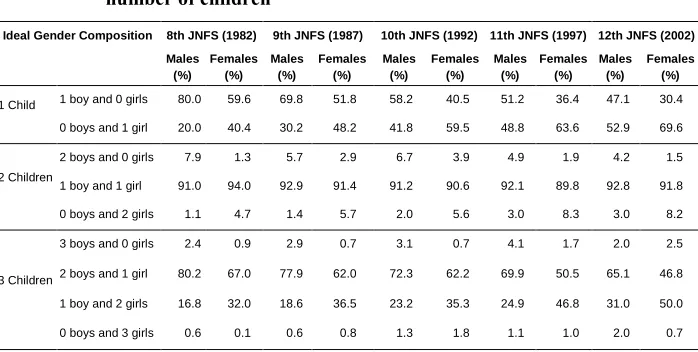
Several Japanese surveys have found a trend for daughter preference by asking respondents about their gender preference. The most prominent survey is the Japanese National Fertility Survey (JNFS), conducted every five years by the National Institute of Population and Social Security Research. It reveals that preference for daughters over sons has become increasingly common since the 1980s. The report of the Single Persons Study of the 12th JNFS illustrates a decline in son preference and an increase in daughter preference between 1982 and 2002 among single men (Table 1) and single women (Table 2) (National Institute of Population and Social Security Research 2004). For instance, in 1982, while only 20% and 40% of single men and women (respectively) whose ideal number of children was one child preferred a daughter, these percentages had increased to 53% and 70% in the 2002 survey.
Table 1: Ideal gender composition of children by survey year and ideal number of children
Ideal Gender Composition 8th JNFS (1982) 9th JNFS (1987) 10th JNFS (1992) 11th JNFS (1997) 12th JNFS (2002)
Males (%) Females (%) Males (%) Females (%) Males (%) Females (%) Males (%) Females (%) Males (%) Females (%) 1 Child
1 boy and 0 girls 80.0 59.6 69.8 51.8 58.2 40.5 51.2 36.4 47.1 30.4
0 boys and 1 girl 20.0 40.4 30.2 48.2 41.8 59.5 48.8 63.6 52.9 69.6
2 Children
2 boys and 0 girls 7.9 1.3 5.7 2.9 6.7 3.9 4.9 1.9 4.2 1.5
1 boy and 1 girl 91.0 94.0 92.9 91.4 91.2 90.6 92.1 89.8 92.8 91.8
0 boys and 2 girls 1.1 4.7 1.4 5.7 2.0 5.6 3.0 8.3 3.0 8.2
3 Children
3 boys and 0 girls 2.4 0.9 2.9 0.7 3.1 0.7 4.1 1.7 2.0 2.5
2 boys and 1 girl 80.2 67.0 77.9 62.0 72.3 62.2 69.9 50.5 65.1 46.8
1 boy and 2 girls 16.8 32.0 18.6 36.5 23.2 35.3 24.9 46.8 31.0 50.0
0 boys and 3 girls 0.6 0.1 0.6 0.8 1.3 1.8 1.1 1.0 2.0 0.7
Source: Adopted from Report on the Twelfth Japanese National Fertility Survey, Volume II: Attitudes Toward Marriage and the Family Among Japanese Singles. (National Institute of Population and Social Security Research 2004).
The Study of the Japanese National Character, a large-scale national survey of adults conducted every five years, includes a series of questions concerning perceptions of gender differences. One of these questions asks whether they want a boy or a girl if they were to have only one child. In 1988, more respondents preferred a boy (32%) than a girl (29%)3, whereas in 2003, the percentage of those preferring a girl (47%) was
greater than those reporting a preference for a boy (27%)4 (Institute of Statistical Mathematics 2004). Child gender preference differs for men and women, however. Among male respondents, although the percentage preferring a boy was higher (41%) than the percentage preferring a girl (28%) in 2003, the percentage gap had narrowed since the 1988 survey when 45% preferred a boy and 15% preferred a girl. Females tended to prefer a daughter even in the 1988 survey (40% preferred a daughter and 22% preferred a son), and this tendency had intensified by 2003 (64% preferred a girl and only 16% preferred a boy).
The Japanese General Social Survey (JGSS), a national public opinion survey of adults 20 years of age or older also asks respondents whether they want a boy or a girl if they were to have only one child. Survey results from 2000 indicated that among men, 61% wanted a boy and 35% wanted a girl, while among women, 26% preferred a boy and 70% wanted a girl child (Iwai and Sato 2002).
In addition, scholars have examined gender preference through analyses of demographic data. Sakai (1989) analyzed parity progression ratios using 1985 data of retrospective birth histories of married women 40 years of age or older. While his results suggested son preference among the oldest cohort in the sample (60+ years old), he found a pattern for balance preference among the younger cohorts (40+ years old cohort and 50+ years old cohort). In an analysis of pregnancy histories and reproductive intentions of married women in 1997, Sato and Iwasawa (1998) found that those who do not have any boys or any girls at any given pregnancy were more likely to have intended to become pregnant, suggesting a tendency for balance preference. A more recent study examining couples’ sex compositions of existing children and their intentions to have another child found that those whose first child was a son or first two children were sons were more inclined to intend to have another child, suggesting a desire for at least one daughter (Moriizumi 2008).
A slight daughter preference was observed as early as the 1980s in a study conducted by Sakai (1989). He analyzed retrospective pregnancy and birth histories of married women with at least one child using the 8th JNFS (conducted in 1982). Overall, an examination of parity progressions suggested considerable balance preference and a slight tendency for daughter preference. The sex of existing children influenced the probability of having another child even after controlling for other demographic variables such as the wife’s education, place of residence, and household income. In addition, the effect of having only sons on having another child was found to be greater among younger cohorts net of other demographic characteristics. In a later study, Sakai (1996) examined sex ratios of children being adopted, raised in foster homes, killed in accidents, and enrolled in special education (e.g. schools for the deaf). He found that
4
that the sex ratios of children being adopted and raised in foster homes have increased since the 1970s and suggested this is a clear indication of parents increasingly wanting to keep their biological daughters due to daughter preference.
These reports and studies are valuable in that they provide an overview of gender preference among the Japanese. Largely missing in the literature is empirical research that investigates the motivation for this unique shift from son to daughter preference. In particular, very little is known about who exhibits daughter preference and why they prefer daughters.
1.3 Women in Japan
In looking at gender preferences for children among the Japanese, it is imperative to understand gender relations in Japan. In this section, I provide an overview of Japanese women’s position in the family and in society. To put in perspective, I present how Japanese women compare to men as well as how Japanese women compare to women in other developed societies.
Although some differences exist between men and women, the Japanese have become more accepting of non-traditional gender roles over the past few decades. The Single Persons Study of the JNFS conducted every 5 years asks respondents whether they agree with the statement, “men should work outside and women should stay home after marriage.” In 1992, 62% of single men and 51% of single women agreed with the statement. This percentage dropped to 36% and 29% (men and women, respectively) in 2005 (National Institute of Population and Social Security Research 2007). Therefore, while the Japanese have become more liberal, about a third of single, young adults still have traditional gender attitudes with more men than women holding traditional views on women’s role in the family.
Compared to populations of other industrialized countries, the Japanese generally exhibited more traditional gender role attitudes in the 1990s. This is evident from a cross-national examination of attitudes towards women’s employment from 23 large Western and industrialized countries from the 1994 International Social Survey Program (Treas and Widmer 2000). Of the 23 countries analyzed, Japan had the lowest percentage of respondents reporting that women should work full-time after marriage and before having children. The percentage was 59% in Japan, a percentage much lower than the overall average of 80%. In addition, 63% of the Japanese reported that women with a preschool child should stay at home. This percentage was one of the highest among the 23 countries and well above the overall average of 52%.
findings from the International Social Justice Project that surveyed men and women from 12 Western nations and Japan in 1991/92 showed how little housework Japanese men perform (Davis and Greenstein 2004). Of the 12 countries examined, Japan by far had the largest percentage of husbands (63%) and wives (79%) reporting that the wife always does the housework. These percentages are considerably high given that the average percentage of respondents from all 12 nations reporting that the wife always does the housework was 22% and 38% (husbands and wives, respectively).
The Japanese also lag behind other developed countries in terms of opportunities for women outside the family. Although the percentage of women in Japan entering 4-year universities had steadily increased from 15% in 1990 to 32% in 2003, it had not caught up to that of men, which increased from 34% to 41% during the same time period (OECD 2004). Moreover, albeit the increase, it has been reported that the percentage of females pursuing higher education was one of the lowest among OECD countries in 2003 (OECD 2004).
Gender differences in educational attainment may explain in part why Japanese women are disadvantaged in the labor force compared to other developed countries. For example, the gender pay gap was larger in Japan than in most developed countries in 1998-2000 (e.g. 66% in Japan; 76% in the U.S.; 91% in Sweden) (ILO 2002). Moreover, in 2005, only 10% of managerial positions were held by women in the Japanese labor force compared to 38%, 32%, and 42% in the same year in Germany, Sweden, and the U.S., respectively (United Nations Statistics Division 2007).
2. Theoretical perspectives in understanding daughter preference in
Japan
While the focus of research on gender preferences for children in neighboring East Asian countries and other developing countries has been on the magnitude and consequences of son preference, the focus of research of developed countries with low fertility has been on the extent to which people have a balance preference (i.e. a preference to have one child of each sex). Both literatures, however, have generally approached the issue in relation to societal gender systems and both approaches have implications for understanding emerging daughter preference in Japan.
behavior including differences in motives for wanting sons and daughters.5 Overall, sons were mainly wanted for (1) continuity of the family line and (2) financial and practical help; whereas daughters were desired for (1) household and childcare help and (2) companionship (Arnold and Kuo 1984). These gender norms are especially emphasized in the literature on developing countries because the differences in the qualities sons and daughters contribute and their relative importance appear to be a significant factor in determining gender preferences. For instance, in developing societies where sons continue the family line and help ensure future economic returns, sons may be perceived to be worth more than daughters leading to son preference. Many studies on developing countries with son preference have in fact found that a strong son preference is a result of the high perceived worth of males and low perceived worth of females (e.g. Kishor 1993).
Research on developed countries, on the other hand, has examined parental gender preferences for children with respect to gender equality and convergence of gender roles. Literature of gender preference in developed countries, particularly in the U.S. and Europe, has long examined the extent to which people have a preference for at least one child of each sex. As reviewed by Williamson (1976), empirical studies of Americans and Europeans carried out in the early 1930s to mid-1970s overall showed “… evidence of slight boy preference especially for firstborns, desire for one of each sex, and preference for a predominance of boys over a predominance of girls if a balanced number of each was not chosen” (p. 63).
More recent literature on gender preferences for children in developed countries examines whether such a preference for one child of each sex (i.e. balance preference) still holds or has diminished in order to find out whether there is an emerging parental gender indifference. In investigating the phenomenon, research links alleviated gender preferences to changes in the gender system. In their analysis of U.S. time series data, Pollard and Morgan (2002) hypothesized that the sex-of-previous-child effect has disappeared over the decades and emphasized that “[s]uch a finding would provide strong evidence of emerging gender indifference among parents and clear evidence of gender equality in U.S. society” (p. 600). Their results supported this claim as they found that the effect of having two children of the same gender (i.e. two sons or two daughters) on having/intending to have a third child has attenuated over the decades. Based on their findings, the authors also suggested an emerging convergence in gender roles where sons and daughters are not necessarily perceived as irreplaceable.
To further test this gender equality argument, Andersson et al. (2006) replicated Pollard and Morgan’s work in Scandinavian contexts using population registrars from Denmark, Finland, Norway, and Sweden. Although the authors expected parental gender indifference in these countries for their high level of gender equality, they did not find any evidence for parental gender indifference but rather a clear preference for one child of each sex to this date. These results led them to conclude that the changing perception of women’s role in society does not explain shifts in gender preferences for children. Moreover, they found a preference for a daughter for third births in three of the countries examined which further suggests that modernization and gender equality does not lead to gender indifference. In fact, the authors imply that increasing gender equality may bring “new” sex preferences such as daughter preference (Andersson et al. 2006).
In sum, research on gender preference has approached the issue in relation to societal gender systems. In addition, although findings are inconclusive, recent literature of developed countries has examined how gender preferences are shaped by the extent to which gender roles diverge or converge. Therefore, in the present study, I explore gender preference for children among the Japanese in relation to one’s gender role attitudes and perception of women’s position in society.
2.1 Hypotheses
I derive several hypotheses that relate gender role attitudes to gender preferences for children in Japan. In line with Pollard and Morgan’s gender equality argument, if convergence in gender roles resulting from a higher level of gender equality causes gender indifference, I should find that individuals with non-traditional gender role attitudes tend to be indifferent about their child(ren)’s gender.
Hypothesis 1: Individuals with traditional gender role attitudes are more likely to have a specific gender preference for children, while individuals with non-traditional gender role attitudes tend to be indifferent about the matter.
More specifically, given that patriarchal gender systems promote son preferences as in other East Asian nations, it is likely that individuals with traditional gender role attitudes would tend to have son preference.
not observed in the most urban places such as Beijing and Shanghai (Arnold and Liu 1986). Since traditional attitudes are generally exhibited by those with less education and residing in rural areas (Kamano 1999), traditional attitudes may be associated with having son preference.
Hypothesis 2a: Individuals with traditional gender role attitudes tend to have son preference.
However, recent reports show an increasing preference for daughters among the Japanese (National Institute of Population and Social Security Research 2003; 2004) despite the fact that the Japanese are known to have more traditional gender role attitudes than other developed countries (Treas and Widmer 2000) and Japan lags in terms of gender relations in comparison to other industrialized countries. Thus, Hypothesis 2a does not sound plausible for the Japanese case. This brings me to consider an alternative hypothesis.
The Japanese may prefer to raise girls because of the perception that girls require less financial, psychological, and time investment than boys. While men enjoy an advantage over women in wages and opportunities for employment in Japan, they still strive to succeed in a competitive economy. Since the competition to enter top universities and obtain respectable jobs is high, it not only puts psychological stress, but also time constraints (e.g. to look after their child’s after-school activities) and economic pressure (e.g. to pay for quality education) on the parents to ensure their sons succeed. Receiving a university degree is also important for their marriage prospects. Poorly educated men have difficulty finding spouses, whereas highly educated men have relatively high marriage rates (Retherford, Ogawa, and Matsukura 2004). It is possible that the Japanese are unenthusiastic about raising boys because of all the pressure associated with raising a son successfully. Similarly, they may perceive that girls do not necessarily have to attend the best schools and build a promising career, and thus require less investment. Because the expectation for a girl to be successful is not very high in the first place, it is perhaps perceived as “easier” and “safer” to raise a girl. This may be especially true among more traditional-minded individuals who consider educational and occupational achievement to be more crucial for men.
parents living with a daughter increased from 11% to 14% between those years (Nishioka et al. 2010). Companionship for the mother has also been cited as one of the major reasons for women wanting a female child in countries examined in the Value of Children project including Japan in the 1970s (Arnold and Kuo 1984). Recently, there have been many media accounts that present close mother-daughter relationships as an emerging phenomenon. Such close mother-daughter representation in the media may have further triggered daughter preference among women in particular. It is conceivable that Japanese women with traditional gender role attitudes may be more likely to prefer a female child because they tend to expect such prescribed gender roles as old-age care and companionship. In sum, instead of convergence in gender roles, persistent divergence in gender roles shape people’s preference for daughters in Japan. Perhaps the relative importance of having a son or a daughter has changed in such a way that the Japanese find the unique contributions of a daughter more beneficial.
Based on the discussion above, I derive the following hypothesis that competes with the preceding hypothesis.
Hypothesis 2b: Individuals with traditional gender role attitudes, especially women, tend to have daughter preference.
This is not only because traditional-minded individuals perceive that girls are “easier” and “safer” to raise, but also because they see benefits of having a daughter for their prescribed gender roles such as old-age care and companionship. This may be the case among women in particular because traditional-minded women are less likely to be socially and economically independent and may foresee themselves wanting companionship and old-age support.
In the subsequent section of the paper, I examine these hypotheses by focusing on the extent to which individuals’ gender preferences for children are shaped by their gender role attitudes.
3. Data and methodology
I test my hypotheses using data from the 11th Japanese National Fertility Survey (JNFS) conducted by the National Institute of Population and Social Security Research in 19976. The JNFS is a highly regarded, government-funded survey that has been
conducted every 5 years since 1952. The JNFS has two subsets: the Married Couples Study, and the Single Persons Study, both of which are based on nationally representative samples. This paper analyzes the Single Persons Study of the 11th JNFS which was fielded in 1997.
The JNFS is well suited for my research purposes. It is unique in that it has attitudinal questions on gender preferences for children. Questions that directly ask for respondent’s gender preference have not been incorporated in recent major U.S. surveys on fertility or families (i.e. National Survey of Family and Households, National Survey of Family Growth, General Social Survey). While recent research on developed countries has used indirect behavioral measures to assess gender preference. such as the effect of sex of previous children on (intentions of) having another child (Brockmann 2001; Andersson et al. 2006; Hank and Kohler 2000; Hank and Kohler 2003; Pollard and Morgan 2002), I consider asking direct questions for their preference to be appropriate for the purposes of this study. Because the odds of wanting/having a third or even a second child are low due to social and economic constraints in very low fertility contexts, it is likely that a desire for an additional child in response to gender preference may not be translated into actual behavior. In other words, individuals’ actual preference may not be captured by indirect measures. Therefore, gender preferences for children as measured by direct survey questions allow us to assess gender preferences more broadly and are suited for examination in relation to other variables.
3.1 Single Persons Study of the 11th JNFS
endured a miscarriage or had an induced abortion, only about 2% of the sample appear to be single mothers or to have ever had children.7 In the analysis, I exclude these women who had ever had children since it might affect how they respond to gender preference questions. Also, although the survey was administered to singles age 18-49, I limit my sample to respondents who are age 18 to 44, as those who are 45 years old and above are unlikely to have any children in the future.
Analyzing the Single Persons Study of the 11th JNFS has its advantages and provides much insight to the association between gender role attitudes and gender preferences for children. First, because most respondents never had children (see footnote 7), their responses to gender preference questions are not contaminated by the presence of their own child(ren). Rather, their responses truly reflect their preference for the gender of their future child(ren). Second, as this sample of the Single Persons Study are not yet married and are in their reproductive years, they represent a group whose future reproductive behavior in response to their gender preference may have an impact on future demographic outcomes.8
3.1.1 Dependent variable: Gender preference for children
The focus of the analysis is to examine the extent to which individuals’ gender preferences for children are associated with their gender role attitudes. In my analysis of the Single Persons Study of the 11th JNFS, I work with a dependent variable with four categories in which each of the categories represents a different type of gender preference.
In the questionnaire, respondents were first asked, “We would like to ask about your thoughts on children after marriage. How many children would you like to have?” Response options were 0 (none), 1 child, 2 children, 3 children, 4 children, or 5 or more children. Those who responded as wanting 1 child or more were then asked, “Do you have preference for a certain gender configuration?” Response options to this question were (1) I have a preference, or (2) I have no particular preference. Lastly, respondents who indicating having preference for a specific gender composition were instructed to
7 According to the data, a total of 468 pregnancies have occurred among the 4,456 single women in the sample. Among these pregnancies, 100 of them ended in a miscarriage and 273 were aborted, resulting in a total of 95 pregnancies that were carried to term. Therefore, I estimate that approximately 2% of all single women have had children ((95/4,456)*100=2.13%).
provide an ideal gender composition of children that matches the number of children they wish to have. For example, respondents who preferred to have only one child and indicated having gender preference specified whether they want a boy or a girl, and those who desired two children and had gender preference specified whether they prefer two boys, a boy and a girl, or two girls.
Based on these responses, I create a categorical dependent variable. Those who reported not having a preference for a specific gender configuration are assigned to the “no gender preference” category. To those who indicated gender preference, I assign one of the three gender preference types: balance preference, son preference, or daughter preference. Respondents who preferred more children of a specific sex than the other are assigned to the appropriate category (either son preference or daughter preference), while respondents indicating a preference for an equal number of boys and girls are assigned to the balance preference category. This resulted in a dependent variable with four categories: (0) no gender preference, (1) balance preference, (2) son preference, and (3) daughter preference. “No gender preference” is a critical category that distinguishes those who exhibit gender indifference and are different from those who have a specific gender preference including balance preference, son preference, or daughter preference.
3.1.2 Gender role attitudes
My independent variable of interest is the extent to which individuals exhibit traditional gender role attitudes. The 11th JNFS includes a battery of items that assess attitudes toward gender roles, marriage, and family. Respondents indicated how much they agree or disagree on a 4-point scale (1=strongly agree, 2=somewhat agree, 3=somewhat disagree, 4=strongly disagree) with the following statements.9
a. Remaining single all life is not a preferable way of life (reverse coded) b. A man and a woman should get married if they want to live together
(reverse coded)
c. It is okay to have premarital sex if a man and a woman are in love d. Even after marriage, one should have their own life goals unrelated to
their marriage or family
e. After marriage, one is expected to make personal sacrifices for their family (reverse coded)
f. Men should work outside and women should take care of the home after marriage (reverse coded)
g. Once married, one should have children (reverse coded)
h. Once married, it is unacceptable to get a divorce for reasons such as incompatibility (reverse coded)
Responses are recoded so that larger values are assigned to more traditional responses. Taking the mean of the eight items, I create a measure for gender role attitudes. Cronbach’s alpha for this measure is .687 for male respondents and .735 for female respondents.10 This measure broadly captures one’s attitude toward gender roles, marriage, and family and will be referred to as gender role attitudes.
3.1.3 Background variables
I also examine the effects of several background variables in my analyses that are expected to be associated with one’s gender preference for children. I control for respondent’s gender, age, educational attainment, type of place of residence (urban/rural), and presence of brothers and/or sisters.11
Gender. Most importantly, I explore how the effect of gender role attitudes on gender preference differs for men and women. It is often cited that girls are wanted because they provide the mother with companionship, while boys are wanted for their companionship to the father (Williamson 1976). According to a review of gender preference in the U.S. and in Europe, men are generally found to have stronger son preference than women (Williamson 1976). Given this, men and women may not only differ in their gender preferences, but the mechanisms by which gender preferences are shaped may also differ for men and women. Therefore, I perform all analyses separately for men and women.12
10 I also preformed factor analyses on these items. While factor analyses results indicated a possible two-factor structure, I opted to use a single two-factor measure because it produced a high reliability coefficient. 11 As I hypothesized in Hypothesis 2b, if individuals, especially those with more traditional attitudes, are reluctant to have a boy partly because it requires more financial investment than a girl, I should control for a measure of affluence (i.e. income) to better test the hypothesis. However, because I am using a sample of singles age 18-44, I found that a substantial proportion of the sample are students (19.6% of males and 20.2% of females) and are not yet in the labor force. Therefore, I opted not to include any income measures in my analyses.
Age. Age is likely to be related to both gender role attitudes and gender preference. Age is a significant predictor in explaining variations in attitudes in various contexts. For instance, in the U.S., there is a linear age effect on sex-role attitudes in which older individuals of both sexes exhibit more traditional attitudes (Smith and Kluegel 1984). Age was also consistently positively associated with traditionalism in a comparative study of seven countries: West Germany, France, Great Britain, the U.S., Japan, Italy, and the Netherlands (Kamano 1999).
Education and Type of Residence. Research on gender preference in China found weaker son preference among individuals who are educated (particularly women) and in urban areas (Arnold and Liu 1986). The authors even found that son preference appears nonexistent in the most urban places, namely in Beijing and Shanghai. In Kamano’s (1999) comparative study, less traditional attitudes were exhibited by those with higher education (in West Germany, Great Britain, the U.S., Japan, and the Netherlands) and those residing in larger cities (in West Germany, the U.S., and Japan). In the JNFS, although respondents reported their completed level of education from a long list of specific types of educational institutions, I collapsed them into three categories: junior high/high school, junior college/vocational school, and college or above.13 I use junior high/high school graduates as the reference category. The JNFS has a variable that distinguishes whether a respondent’s current place of residence is urban (population concentrated area) or rural (population non-concentrated area). Rural residents serve as the reference category.
Presence of Siblings. Those who have a brother may be more likely to have son preference and those with a sister may be more enthusiastic about having a daughter. Taking data on respondent’s siblings, I create two variables to control for this. First is a dummy variable for presence of brothers: 0 means that the respondent has no brothers and 1 means that the respondent has one or more brothers. A similar dummy variable is created for presence of sisters.
interaction effects between gender and age on gender preference. I have also formally tested whether the coefficients in the model for men are statistically different from those in the women’s model employing a Chow test. Results of the test (Chow test, significant at p<.01) indicated that the coefficient for gender role attitudes is significantly different for men and women. Thus, the relationship between gender role attitudes and gender preferences differs by gender. Such preliminary findings led me to perform my analyses separately for men and women.
3.2 Analysis
My analyses are based on a sample of single males and females who were 18-44 years of age without any children and from whom I have data on all of the variables included in the analyses. Of all respondents from the survey, 8,773 people (4,658 men and 4,115 women) never had children and were within the age range of interest.14 Dropping cases that have missing values on one or more of the variables included in the study resulted in a sample of 5,859 cases (3,085 men and 2,774 women) to be analyzed.
One may perceive that a substantial number of cases have been omitted due to missing data (a total of 2,914 cases; 1,573 men and 1,341 women). The gender preference variable is largely responsible for this. There were 2,217 cases (1,187 men and 1,030 women) missing on this variable. The 430 respondents who stated that their ideal number of children is “0” (and thus were not followed-up on with the ideal gender composition questions) contribute to part of the missing number. Given that the gender preference variable is created based on responses from a set of questions, respondents who failed to respond (correctly) to any of those questions resulted in a missing value on the variable. The fact that the survey was administered via mail may have contributed to this high level of item non-response. One may question whether those who failed to respond (correctly) to those questions did so intentionally, and hence if they were different from the rest of the sample who responded (correctly). Questions about ideal family size and gender preferences can be sensitive for some married couples (e.g. couples who have difficulty conceiving, who have lost their children, who are unhappy with the gender composition of existing children, etc). However, because this survey was targeted towards singles, it merely asks about their ideal should they get married in the future. For this reason, nonresponse on these questions may have occurred somewhat randomly; hence it is unlikely that respondents with missing data constitute a unique population in a way that will bias my results.
Another variable that is responsible for loss of information is the gender role attitude variable. A total of 950 cases (539 men and 411 women) had missing data on this variable. However, respondents with missing data may not be different from respondents without any missing data in terms of their gender preference. The distribution of gender preference type of respondents with missing data on one or more of the independent variables was almost identical to that of respondents without any missing data on the independent variables with an insignificant chi-square test statistic. This was the case for both men and women. Therefore, with respect to gender
preferences, this sample represents childless Japanese singles between 18 and 44 who hope to have at least one child in the future.
With these data, first, I briefly present sample characteristics and bivariate associations between type of gender preference and my independent variables. Then, I use multinomial logistic regressions to predict one’s type of gender preference for children. I report the relative risk ratios representing the odds of having: (1) balance preference versus no gender preference, (2) son preference versus no gender preference, (3) daughter preference versus no gender preference, (4) son preference versus balance preference, (5) daughter preference versus balance preference, and (6) daughter preference versus son preference. In addition, I present how people’s gender role attitudes are related to their predicted probabilities of exhibiting different types of gender preferences by gender.
4. Results
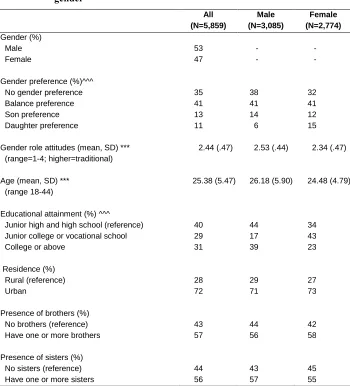
Characteristics of the respondents are summarized in Table 2. Among men, 38% have no gender preference, 41% have a balance preference, 14% have a son preference, and 6% have a daughter preference. The gender preference distribution is somewhat different for women than it is for men. 32% of women have no gender preference, 41% have a balance preference, and a larger percentage of women have a daughter preference (15%) than son preference (12%). On average men exhibit significantly more traditional gender role attitudes (2.53 for men, 2.34 for women). Since women marry at a younger age than men, single male respondents on average are slightly older (26.18 years) than females (24.48 years).
Table 2: Means and percentage distributions of selected characteristics by gender
All Male Female
(N=5,859) (N=3,085) (N=2,774)
Gender (%)
Male 53 - -
Female 47 - -
Gender preference (%)^^^
No gender preference 35 38 32
Balance preference 41 41 41
Son preference 13 14 12
Daughter preference 11 6 15
Gender role attitudes (mean, SD) *** 2.44 (.47) 2.53 (.44) 2.34 (.47)
(range=1-4; higher=traditional)
Age (mean, SD) *** 25.38 (5.47) 26.18 (5.90) 24.48 (4.79)
(range 18-44)
Educational attainment (%) ^^^
Junior high and high school (reference) 40 44 34
Junior college or vocational school 29 17 43
College or above 31 39 23
Residence (%)
Rural (reference) 28 29 27
Urban 72 71 73
Presence of brothers (%)
No brothers (reference) 43 44 42
Have one or more brothers 57 56 58
Presence of sisters (%)
No sisters (reference) 44 43 45
Have one or more sisters 56 57 55
Note: ***p≤.001 Significant mean difference between male and females.
Table 3: Means and percentage distribution by type of gender preference according to selected characteristics
Male (N=3,085) Female (N=2,774)
No gender pref. Balance pref. Son pref. Daughter pref.
Total Sig. No gender pref. Balance pref. Son pref. Daughter pref.
Total Sig.
Total (%) 38 41 14 6 100 32 41 12 15 100
Gender role attitudes
(means) 2.47 2.58 2.59 2.52 2.53 *** 2.30 2.35 2.29 2.41 2.34 *** (range=1-4;
higher=traditional)
Age (means) 26.28 26.12 26.11 26.12 26.18 25.07 24.08 23.79 24.89 24.48 *** (range 18-44)
Educational attainment (%) ^ ^
Junior high and high
school (reference) 37 42 14 8 100 32 42 12 14 100
Junior college or
vocational school 42 42 12 4 100 29 43 11 17 100
College or above 39 41 14 6 100 37 37 12 13 100
Residence (%)
Rural (reference) 40 41 14 5 100 33 41 11 15 100
Urban 37 42 14 7 100 31 42 12 15 100
Presence of brothers (%) ^ ^^^
No brothers (reference) 37 43 12 7 100 34 38 11 18 100 Have one or more
brothers 39 41 15 6 100 30 44 12 13 100
Presence of sisters (%) ^^^
No sisters (reference) 40 40 14 6 100 30 46 12 11 100
Have one or more
sisters 37 43 14 7 100 33 38 11 18 100
Note: ***p≤.001 Significant mean difference among type of gender preference.
^p≤.05, ^^^p≤.001 Significant overall chi-square for the association between type of gender preference and the predictor variable.
4.1 Gender role attitudes
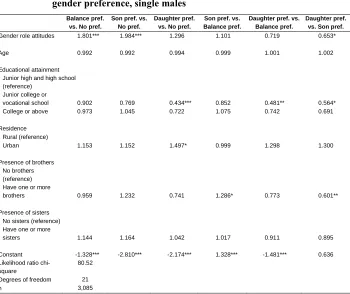
increased relative risk of having a balance or daughter preference than being gender indifferent. These findings are also evident in Figure 1 in that the predicted probabilities of exhibiting no gender preference are associated with scoring low on the gender role attitudes scale for both men and women.
Table 4: Relative risk ratios from multinomial logit model predicting type of gender preference, single males
Balance pref. vs. No pref.
Son pref. vs. No pref.
Daughter pref. vs. No pref.
Son pref. vs. Balance pref.
Daughter pref. vs. Balance pref.
Daughter pref. vs. Son pref.
Gender role attitudes 1.801*** 1.984*** 1.296 1.101 0.719 0.653*
Age 0.992 0.992 0.994 0.999 1.001 1.002
Educational attainment Junior high and high school (reference)
Junior college or
vocational school 0.902 0.769 0.434*** 0.852 0.481** 0.564*
College or above 0.973 1.045 0.722 1.075 0.742 0.691
Residence Rural (reference)
Urban 1.153 1.152 1.497* 0.999 1.298 1.300
Presence of brothers No brothers (reference) Have one or more
brothers 0.959 1.232 0.741 1.286* 0.773 0.601**
Presence of sisters No sisters (reference) Have one or more
sisters 1.144 1.164 1.042 1.017 0.911 0.895
Constant -1.328*** -2.810*** -2.174*** 1.328*** -1.481*** 0.636 Likelihood ratio
chi-square
80.52
Degrees of freedom 21
n 3,085
Note: *p≤.05, two tailed test; **p≤.01, two tailed test; ***p≤.001, two tailed test.
These findings provide some support for the first hypothesis in that individuals with relatively traditional gender role attitudes are likely to have a gender preference, while those with relatively less traditional attitudes tend to be indifferent about the matter.
attitudes reduce the odds of having a daughter preference compared to son preference. In other words, traditional-minded men are more likely to have a son preference than a daughter preference. This provides support for my second hypothesis (Hypothesis 2a) in that among Japanese single men, individuals with traditional attitudes tend to have a son preference.
Figure 1: Predicted probabilities against gender role attitudes by gender for different types of gender preferences
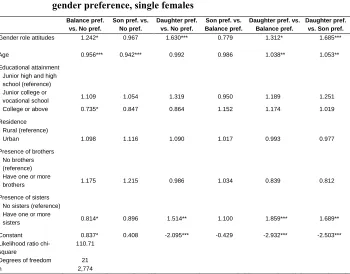
preference compared to balance and boy preference. In addition, the odds of having a daughter preference than being gender indifferent are higher for more traditional women. This suggests that Japanese women exhibiting traditional attitudes are more likely to have a daughter preference than any other type of gender preference and lends support to my competing hypothesis (Hypothesis 2b). Clear gender differences in the relationship between gender role attitudes and son/daughter preference are also evident in Figure 1. Among men, the higher they score on the gender role attitudes scale, the greater their probability of exhibiting a son preference. For women, measuring higher on the gender role attitudes scale is associated with a higher predicted probability of having a daughter preference.
Table 5: Relative risk ratios from multinomial logit models predicting type of gender preference, single females
Balance pref. vs. No pref.
Son pref. vs. No pref.
Daughter pref. vs. No pref.
Son pref. vs. Balance pref.
Daughter pref. vs. Balance pref.
Daughter pref. vs. Son pref.
Gender role attitudes 1.242* 0.967 1.630*** 0.779 1.312* 1.685***
Age 0.956*** 0.942*** 0.992 0.986 1.038** 1.053**
Educational attainment
Junior high and high
school (reference)
Junior college or
vocational school 1.109 1.054 1.319 0.950 1.189 1.251
College or above 0.735* 0.847 0.864 1.152 1.174 1.019
Residence
Rural (reference)
Urban 1.098 1.116 1.090 1.017 0.993 0.977
Presence of brothers
No brothers
(reference)
Have one or more
brothers 1.175 1.215 0.986 1.034 0.839 0.812
Presence of sisters
No sisters (reference)
Have one or more
sisters 0.814* 0.896 1.514** 1.100 1.859*** 1.689**
Constant 0.837* 0.408 -2.095*** -0.429 -2.932*** -2.503***
Likelihood ratio chi-square
110.71
Degrees of freedom 21
n 2,774
4.2 Background variables
While age is not related to type of gender preference for men, it is for women. Older single women tend to have a daughter preference or have no preference. Findings suggest an interesting association between educational attainment and type of gender preference for men. Compared to single men with a junior college/vocational school degree, men with a junior high or high school diploma tend to exhibit a daughter preference more than any other type of preference. In terms of place of residence, urban male residents are more likely than their rural counterparts to have a daughter preference than to be gender indifferent. Finally, men with brothers tend to have a son preference but the existence of a sister does not influence their preference. On the other hand, for women, while having brothers is unrelated, having a female sibling strongly influences their desire to have a daughter.
5. Discussion and conclusion
This study builds upon previous research on gender preference for children by presenting the state of gender preferences in Japan. It also extends our understanding of how gender preference is shaped by societal gender systems by examining the link between Japanese singles’ gender role attitudes and their gender preferences for children.
My results suggested that there is evidence for all three of my hypotheses. First, I found ample support for my first hypothesis that individuals with traditional gender role attitudes are likely to have a specific gender preference, while individuals with egalitarian views tend to be indifferent about the gender of their future offspring. Findings show that this is generally the case for both men and women and suggest that gender indifference could be a reflection of perceived convergence in gender roles.
improved but because there continues to be divergence in gender roles and these traditional women desire the qualities daughters bring.
Therefore, results suggest that traditionalism still drives gender preference, though in a different way for men and women. Traditional men tend to be keen on prescribed sex roles and may want sons for continuity of the family line and name, as well as other qualities sons may provide to a traditional patriarchal family. For these men, having a son may also be perceived as a sign of masculinity. For women, traditionalism is linked to daughter preference. Traditional women may be more likely to see the obstacles associated with raising a son successfully. Also, since traditional-minded women may be less likely to be socially and economically independent, they may foresee themselves wanting companionship and old-age support from a daughter.
In sum, emerging daughter preference may not simply be a reflection of improvements in women’s status. In fact, it is likely that persistent divergence in gender roles remain in Japan. In the past, the qualities sons bring to the family, especially continuing the family line, may have been important. However, with a decline in extended families and the nuclearization of the family, it can be speculated that continuation of the family name has become no longer so critical. Given changes in family structure, there may be less pressure from in-laws to have sons, contributing to less preference for sons. Today, people may perceive that the qualities daughters contribute (i.e. companionship, old-age care) are relatively attractive instead. It is not bad news that daughters are valued. However, continued efforts to improve women’s position in the family and in society may be needed so that daughters are not merely desired for their traditional contributions.
Although gender preferences have not translated into skewed sex ratios in Japan, it needs to be watched out for. In the context of Japan’s very low fertility, it may become crucial for their first or only child to be of the gender they desire. There are no signs that Japanese couples are currently using sex-selection technology or will consider such options in the near future. However, less technologically sophisticated methods to become pregnant with the preferred sex of the child appear to be gaining popularity among interested individuals. For example, numerous books concerning sex-selective pregnancy by means of more accessible methods (e.g. “timing” methods) are carried by most Japanese bookstores, suggesting there is a demand for sex selection. If couples begin trying to become pregnant sex-selectively, it may eventually produce a skewed sex ratio at the aggregate level.
demographic outcomes. Another major limitation to the study is that I was not able to test my third hypothesis more directly by introducing measures of affluence. Thirdly, given that the JNFS is difficult to obtain, I was not able to exploit more recent waves of the JNFS. Should data become more widely available, there would be potential not only for more up-to-date research, but also for a rigorous time-series study looking at changes in gender preferences over time. Finally, as I have found that the effect of traditionalism on gender preferences differs for men and women, I suggest future research to clarify why there is a gender difference in the mechanisms by which gender preferences are shaped.
6. Acknowledgments
References
Andersson, G., Hank, K., Rønsen, M., and Vikat, A. (2006). Gendering family composition: Sex preferences for children and childbearing behavior in the Nordic countries. Demography 43(2): 255-267. doi:10.1353/dem.2006.0010.
Arnold, F. (1985). Measuring the effect of sex preference on fertility: The case of Korea. Demography 22(2): 280-288. doi:10.2307/2061182.
Arnold, F., Bulatao, R.A., Buripakdi, C., Chung, B.J., Fawcett, J.T., Iritani, T., Lee, S.J., and Wu, T.S. (1975). The value of children, A cross-national study: Introduction and comparative analysis. Honolulu, HI: University of Hawaii Press.
Arnold, F. and Kuo, E.C.Y. (1984). The value of daughters and sons: A comparative study of the gender preferences of parents. Journal of Comparative Family Studies 15: 299-318.
Arnold, F. and Liu, Z. (1986). Sex preference, fertility, and family planning in China. Population and Development Review 12(2): 221-246. doi:10.2307/1973109.
Brockmann, H. (2001). Girls preferred? Changing patterns of sex preferences in the two German states. European Sociological Review 17(2): 189-202. doi:10.1093/esr/17.2.189.
Chung, W. (2007). The relation of son preference and religion to induced abortion: The case of South Korea. Journal of Biosocial Science 39(05): 707-719.
doi:10.1017/S0021932007001988.
Chung, W. and Das Gupta, M. (2007). The decline of son preference in South Korea: The role of development and social policy. Population and Development Review 33(4): 757-783. doi:10.1111/j.1728-4457.2007.00196.x.
Coale, A.J. (1991). Excess female mortality and the balance of the sexes in the population: An estimate of the number of “missing females”. Population and Development Review 17(3): 517-523. doi:10.2307/1971953.
Coale, A.J. and Banister, J. (1994). Five decades of missing females in China. Demography 31(3): 459-479. doi:10.2307/2061752.
Davis, S.N. and Greenstein, T.N. (2004). Cross-national variations in the division of household labor. Journal of Marriage and Family 66(5): 1260-1271.
Goodkind, D. (1996). On substituting sex preference strategies in East Asia: Does prenatal sex selection reduce postnatal discrimination? Population and Development Review 22(1): 111-125. doi:10.2307/2137689.
Hank, K. and Kohler, H.P. (2000). Gender preferences for children in Europe: Empirical results from 17 FFS countries. Demographic Research 2(1): 255-267. doi:10.4054/DemRes.2000.2.1.
Hank, K. and Kohler, H.P. (2003). Sex preferences for children revisited: New evidence from Germany. Population (English edition) 58(1): 133-144.
doi:10.3917/pope.301.0133.
ILO (2002). Yearbook of labour statistics. Geneva, Switzerland: ILO.
Institute of Statistical Mathematics (2004). A study of the Japanese National Character – The eleventh nationwide survey. Tokyo, Japan: Tokei Suri Kenkyujo. (In Japanese).
Iwai, N. and Sato, H. (2002). Japanese values and behavioral patterns seen in the Japanese General Social Survey. Tokyo, Japan: Yuhikaku. (In Japanese). Johansson, S., and Nygren, O. (1991). The missing girls of China: A new demographic
account. Population and Development Review 17(1): 35-51.
doi:10.2307/1972351.
Johnson, K., Huang, B., and Wang, L. (1998). Infant abandonment and adoption in China. Population and Development Review 24(3): 469-510.
doi:10.2307/2808152.
Kamano, S. (1999). Comparing individual attitudes in seven countries. Social Science Research 28(1): 1-35. doi:10.1006/ssre.1998.0630.
Kishor, S. (1993). “May God Give Sons to All”: Gender and child mortality in India. American Sociological Review 58(2): 247-265. doi:10.2307/2095969.
Klasen, S. and Wink, C. (2002). A turning point in gender bias in mortality? An update on the number of missing women. Population and Development Review 28(2): 285-312. doi:10.1111/j.1728-4457.2002.00285.x.
Lee, J. and Paik, M. (2006). Sex preferences and fertility in South Korea during the year of the horse. Demography 43(2): 269-292. doi:10.1353/dem.2006.0015.
Li, J. and Cooney, R.S. (1993). Son preference and the one child policy in China: 1979– 1988. Population Research and Policy Review 12(3): 277-296.
Moriizumi, R. (2008). An empirical study of sex preferences for children in Japan. Journal of Population Problems 64(1):1-20. (In Japanese).
National Institute of Population and Social Security Research (2003). Report on the twelfth Japanese National Fertility Survey, volume I: Marriage process and fertility of Japanese married couples. Tokyo, Japan: National Institute of Population and Social Security Research. (In Japanese).
National Institute of Population and Social Security Research (2004). Report on the twelfth Japanese National Fertility Survey, Volume II: Attitudes toward marriage and family among Japanese singles. Tokyo, Japan: National Institute of Population and Social Security Research. (In Japanese).
National Institute of Population and Social Security Research (2007). Report on the thirteenth Japanese National Fertility Survey, 2005, Volume II: Attitudes toward marriage and family among Japanese singles. Tokyo, Japan: National Institute of Population and Social Security Research. (In Japanese).
Nishioka, H., Suzuki, T., Koyama, Y., Shimizu, M., and Yamauchi, M. (2010). The household changes in contemporary Japan: Overview of the results of the fifth national survey on household changes. The Japanese Journal of Population 8(1): 34-66.
OECD (2004). Education at a glance: OECD indicators. Paris, France: Organisation for Economic Co-operation and Development. doi:10.1787/eag-2004-en.
Park, C.B. and Cho, N.-H. (1995). Consequences of son preference in a low-fertility society: Imbalance of the sex ratio at birth in Korea. Population and Development Review 21(1): 59-84. doi:10.2307/2137413.
Pollard, M.S. and Morgan, S.P. (2002). Emerging parental gender indifference? Sex composition of children and the third birth. American Sociological Review 67(4): 600-613. doi:10.2307/3088947.
Poston, D.L. Jr. (2002). Son preference and fertility in China. Journal of Biosocial Science 34(3): 333-347. doi:10.1017/S0021932002003334.
Retherford, R.D., Ogawa, N., and Matsukura, R. (2004). Late marriage and less marriage in Japan. Population and Development Review 27(1): 65-102. doi:10.1111/j.1728-4457.2001.00065.x.
Sakai, H. (1989). Child-sex effects on further births. Journal of Population Problems 184: 78-83. (In Japanese).
Sakai, H. (1996). Some determinants and influences of daughter preference. Journal of Population Studies 19: 33-38. (In Japanese).
Sato, R. and Iwasawa, M. (1998). Reproductive intentions and fertility control behavior of Japanese married couples: Analysis of pregnancy histories. Journal of Population Problems 54(4): 19-45. (In Japanese).
Smith, E.R. and Kluegel, J.R. (1984). Beliefs and attitudes about women's opportunity: Comparisons with beliefs about blacks and a general perspective. Social Psychology Quarterly 47(1): 81-95. doi:10.2307/3033891.
Treas, J. and Widmer, E.D. (2000). Married women's employment over the life course: Attitudes in cross-national perspective. Social Forces 78(4): 1409-1436. doi:10.2307/3006179.
United Nations Statistics Division (2007). Statistics and indicators on women and men. Women legislators and managers [electronic resource]. New York: United Nations. http://unstats.un.org/unsd/demographic/products/indwm/tab5d.htm. Waldron, I. (1998). Sex differences in infant and early childhood mortality: Major
causes of death and possible biological causes. In: United Nations (ed.). Too young to die: Genes or gender. New York, NY: United Nations: 64-83.
Wang, W. (2005). Son preference and educational opportunities of children in China— “I wish you were a boy!” Gender Issues 22(2): 3-30. doi:10.1007/s12147-005-0012-4.
Williamson, N.E. (1976). Sons or daughters: A cross-cultural survey of parental preferences. Beverly Hills, CA: Sage Publications, Inc.