International Journal of Automotive Engineering Vol. 2, Number 2, April 2012 1. INTRODUCTION
DI diesel engines are today as the main power units for heavy duty vehicles. Diesel engines have high thermal efficiencies, resulting from their high compression ratio and fuel lean operation. The high compression ratio produces the high temperatures required to achieve auto-ignition, and the resulting high expansion ratio makes the engine discharge less thermal energy in the exhaust. The extra oxygen in the cylinders is necessary to facilitate complete combustion and to compensate for non-homogeneity in the fuel distribution. However, high flame temperatures predominate because there are locally stoichiometric air–fuel ratios in such heterogeneous combustion processes. Consequently, Diesel engine combustion generates large amounts of NOx because of the high flame temperature in the presence of
abundant oxygen and nitrogen [1].
NOX reacts with ammonia, moisture, and other compounds to form nitric acid vapor and related particles. Small particles can penetrate deeply into sensitive lung tissue and damage it, causing premature death in extreme cases. Inhalation of such particles may cause or worsen respiratory diseases such as emphysema, bronchitis it may also aggravate existing heart disease. NOX reacts with volatile organic compounds in the presence sunlight to form Ozone. Ozone can cause adverse effects such as damage to lung tissue and reduction in lung function mostly in susceptible populations (children, elderly and asthmatics). NOXdestroys ozone in the stratosphere. Ozone in the stratosphere absorbs ultraviolet light, which is potentially damaging to life on earth. [2,3]
External exhaust gas recirculation (EGR) is a well known in-cylinder method to reduce NOx emissions,
Performance Evaluation and Emissions improving of
Turbocharged DI Diesel Engine with Exhaust Gas
Recirculation (EGR)
A. Mohebbi1, S. Jafarmadar2and J. Pashae3
1Ph.D Student , 2Associated Professor , Mechanics of Farm Machinery Engineering Department, University of Urmia, Iran. 3MSc graduated , Engineering Research Department of Motorsazan Company, Tabriz, Iran.
Abstract
Nitrogen oxides (NOx) contribute to a wide range of environmental effects including the formation of acid rain and destroy ozone layer. In-cylinder high temperature flame and high oxygen concentration are the parameters which affect the NOx emissions. The EGR system is a very effective way for reducing NOx emission from a diesel engine (via reduction of these parameters), particularly at the high load of engine operation condition. In this study, the influence of EGR on diesel engine combustion, NOx/PM emissions, brake specific fuel consumption (BSFC), engine thermal efficiency, cylinder pressure and heat release rate (HRR) are analyzed and presented. The experiments have been conducted on a turbocharged DI diesel engine under full load condition at two different injection timings in order to distinguish and quantify some effects of Hot and Cooled EGR with various rates on the engine parameters. Experimental results showed that increase of EGR rate has a negative effect on air-fuel ratio. For a premixed combustion at constant boost pressure, ignition delay is increased leading to retardation of all combustion process, a low HRR peak and reduce of in-cylinder peak temperature. Using of Hot EGR reduces NOX emissions whereas PM emissions are increased. The advance of injection timing resulted in the reduction PM while both NOX emissions and fuel consumption were increased. The use of cooled EGR was more effective compared to the hot EGR. As a result, the EGR temperature has no significant impact on NOx emissions. With increasing EGR rate, unequal EGR distribution was increased in inlet port of cylinders while the reducing EGR temperature (cooled EGR) improved its distribution among the engine cylinders and decreased the EGR cylinder-to-cylinder variations.
Keywords: Diesel Engine, Exhaust Gas Recirculation, EGR temperature, Injection timing, Combustion, Emissions
96 Performance Evaluation and Emissions improving of Turbocharged ...
particularly on modern direct injection (DI) diesel engine, and offers the possibility to decrease temperature during combustion [1,4,5]. The decrease in NOx emissions with the increase of EGR rate is the result of various effects:
• The thermal effect: Increase of inlet heat capacity due to higher specific heat capacity of recirculated CO2 and H2O compared with O2 and N2 (at constant boost pressure) resulting in lower gas temperatures during combustion, and particularly in a lower flame temperature [6-8]. • The dilution effect: Decrease of inlet O2 concentration, whose principal consequence is the deceleration of the mixing between O2and fuel resulting in the extension of flame region. Thus, the gas quantity that absorbs the heat release is increasing, resulting in a lower flame temperature [6-8]. As a result, one consequence of the dilution effect is the reduction of local temperatures that can be considered as a thermal effect too (‘‘local’’ thermal effect). Another consequence of the dilution effect is the reduction of the oxygen partial pressure and its effect on kinetics of the elementary NO formation reactions [8].
• The chemical effect: The recirculated water vapor and CO2 are dissociated during combustion, modifying the combustion process and the NOx formation. In particular, the endothermic dissociation of H2O results in a decrease of the flame temperature [6-8].
On the other hand, although maybe EGR gases be cooled with an EGR cooler, the inlet air temperature after mixing with recirculated gases increases, thus reducing the inlet gas density (at constant boost pressure) and in-cylinder trapped mass (‘‘thermal throttling’’). This temperature increase tends to increase NOx emissions, although it is compensated by other effects of EGR listed above. These various effects of EGR on inlet gas conditions at inlet valve closure (IVC) (temperature, heat capacity, etc.) and on the overall combustion process make the understanding of EGR particularly difficult [8].
The implementation of EGR is straightforward for naturally aspirated Diesel engines because the exhaust tailpipe backpressure is normally higher than the intake pressure. The pressure differences generally are
sufficient to drive the EGR flow of a desired amount. Modern Diesel engines, however, are commonly turbocharged, and the implementation of EGR is, therefore, more difficult. A low pressure loop EGR, is achievable because a positive differential pressure between the turbine outlet and compressor inlet is generally available. But sometimes, in turbocharged diesel engines a high pressure loop EGR is not applicable when the turbine upstream pressure is not sufficiently higher than the boost pressure. In case the pressure difference cannot be met with the original matching between the turbocharger and the engine, exhaust tailpipe pressure can be elevated by partial throttling that ensures sufficient driving pressure for the EGR flow [1].
However, as NOx reduces by adding EGR, particulate matter (PM) increases, resulting from the lowered combustion temperature and oxygen concentration. When EGR further increases, the engine operation reaches zones with higher instabilities, increased carbonaceous emissions (such as soot), brake specific fuel consumption (BSFC) and even torque and power losses. For this reason, the use of high EGR rates creates the need for EGR gas cooling in order to minimize its negative impact on soot emissions especially at high engine load where the EGR flow rate and exhaust temperature are high. It was examined, using a multi-zone combustion model, the effect of cooled EGR gas temperature level for various EGR percentages on performance and emissions of a turbocharged DI heavy duty diesel engine operating at full load. Results reveal that the decrease of EGR gas temperature has a positive effect on BSFC, soot (lower values) while it has only a small positive effect on NO. The effect of low EGR temperature is stronger at high EGR rates [9]. From the analysis of theoretical and experimental findings it is revealed the required percentage of EGR at various engine operating conditions to maintain NO at acceptable levels. The use of EGR causes a sharp reduction of NO and an increase of soot emissions, which is partially compensated by its reduction due to the more advanced injection timing. On the other hand EGR results to a slight reduction of engine efficiency and maximum combustion pressure which in any case does not alter the benefits obtained from the high injection timing. It is possible to increase brake efficiency considerably for the specific engine using a combination of more advanced injection timing and
International Journal of Automotive Engineering Vol. 2, Number 2, April 2012 EGR while maintaining pollutants at acceptable levels
[10].
Results of a study indicate that [11]: The EGR increases the premixed combustion portion and reduces the maximum rate of heat release at high load respectively increases the maximum rate of heat release at low load. EGR increases the ignition delay and the combustion duration. The NOx emissions decrease almost linearly with the EGR. By using the KIVA-3V code and experimental data obtained, it was found that there exists a set of optimal injection timing, EGR and swirl ratio for simultaneously reduction in both NOX and soot under a particular load [12].
The aim of this study is to distinguish some effects of EGR (the increase of intake temperature, the delay of heat release rate and the decrease in air-fuel ratio) on combustion, performance and NOX/PM emissions on a typical turbocharged direct injection diesel engine at full load condition under premixed combustion because where the highest EGR mass flow rate is required. For this purpose, are examined various EGR percentage and temperatures to determine its effect on the diesel operations then limits to reduce NOx emissions from diesel engines are briefly presented.
2. METHODOLOGY
The experiments were carried out on a semi-heavy duty Motorsazan MT4.244 agricultural engine mainly used for tractors. The engine is a 3.99 litters,
turbocharged, four-cylinder direct injection diesel engine. The main specifications of the engine are given in Table 1. Details regarding turbocharger are; 72 Trim, 0.50 A/R and 48 Trim, 0.51 A/R for wastegated turbine and compressor, respectively.
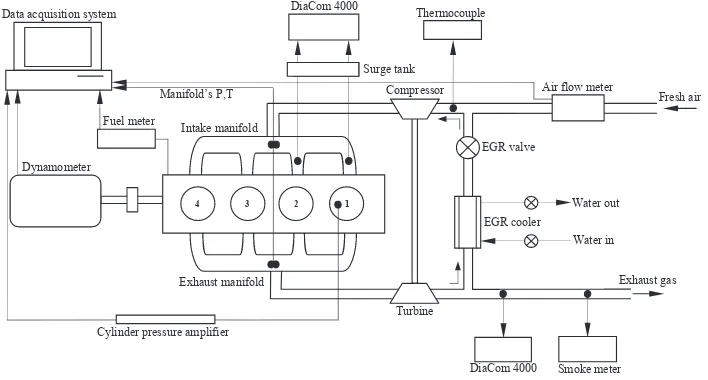
An eddy current dynamometer with a load cell was coupled to the engine and used to load the engine (see Fig 1). An AVL GU 13G pressure transducer, mounted at the cylinder head and connected via an AVL Micro IFEM piezo amplifier to a data acquisition board, was used to record the cylinder pressure. The crankshaft position was measured using an AVL 365C digital shaft encoder. The test rig included other standard engine instrumentation such as K type thermocouples to measure lubricating oil, air inlet, engine coolant inlet and outlet, inlet manifold and exhaust temperatures and pressure gauges mounted at relevant points. Normal engine test bed safety features were also included. Atmospheric conditions (humidity, temperature, pressure) were monitored during the tests. The maximum fuel injection pressure was measured using another pressure transducer that is fitted to the high pressure fuel pipe between the pump and the injector. Data acquisition and combustion analysis were carried out using in-house developed Lab VIEW-based software. An AVL DiCom4000 gas analyzer was used to measure NOX, CO, and CO2, by NDIR (non-dispersive infrared gas analysis), and oxygen (O2) concentrations in the exhaust manifold (electrochemical method). Another AVL DiCom4000 analyzer was used to measure CO2concentrations in
Surge tank
Manifolds P,T
Smoke meter DiaCom 4000
EGR valve Dynamometer
Compressor
Turbine
Exhaust gas Fresh air Air flow meter
Intake manifold
Exhaust manifold
DiaCom 4000
4 3 2 1
Water in Water out EGR cooler
Cylinder pressure amplifier
Data acquisition system Thermocouple
Fuel meter
Fig. 1.Experimental setup.
98
the cross-section of 1 and 2 cylinder intake ports in order to calculate EGR rate. Since, this analyzer could not measure CO2of high positive pressure gases, for this reason, a surge tank was used in order to reduce pressure of inlet gas into analyzer. Smoke measured using an AVL 415S smoke meter. Table 2 shows measurement accuracy of instruments involved in the experiment for various parameters.
As mentioned in introduction, that is more difficult using EGR in common turbocharged diesel engine. Since, the turbine upstream pressure was not sufficiently higher than the boost pressure (downstream of compressor) for this reason, a low pressure loop EGR system (long route) was chosen for this study. However, space limitation between intake and exhaust manifolds was associated in this selection too. Any exhaust sub-systems such as exhaust brake (chocking) and aftertratment were used for increasing of exhaust gas backpressure. For controlling EGR rate manually an EGR control valve was provided. To lower the temperature of the recycled exhaust gases, a cross-counter heat exchanger (EGR cooler) containing 80 tubes was installed in the low pressure EGR loop. The length and diameter of the tubes are 50 cm and 5 mm, respectively. The hot exhaust gases were passed through the individual tubes, while cool city water was passed through the main body of the heat exchanger. EGR valve and the section of duct from the engine exhaust to heat exchanger were also resistant to
exhaust temperatures that are commonly in a range of 100-600 °C.
When EGR is applied, the engine intake consists of fresh air and recycled exhaust. The percentage of recycled gases is commonly represented by an EGR ratio, i.e. the mass ratio of recycled gases to the whole engine intake. The fresh air intake contains negligible amounts of CO2while the recycled portion carries a substantial amount of CO2 that increases with EGR flow rate and engine loads. Notably, CO2is merely a combustion product. Thus, it is intuitive and practical, to measure EGR ratio by comparing the CO2 concentrations between the exhaust and intake of the engine [1,8,13]:
When a standard engine’s EGR system is applied, there is a high inhomogeneous EGR concentration field within the inlet manifold (in particular in the cross-section of each intake port) and produces temporal variations in the EGR concentration during the intake stroke, that are different for each cylinder because of the pulsating flow induced by inlet valve opening and closure [13]. As a consequence, it is necessary obtain CO2temporal value in port of each cylinder during the intake stroke. Therefore, for measuring inlet and exhaust CO2 concentrations separately, two gas analyzers were used. CO2
EGR ratio =
Performance Evaluation and Emissions improving of Turbocharged ...
Type Turbocharged
Maximum power 61kW@2000rpm
Maximum torque 360N.m@1300rpm
Minimum speed 800 rpm
Maximum speed 2100 rpm
Bore × stroke 100 × 127 mm
Compression ratio 17.5:1
Number of cylinders 4
Number of valves per cylinder 2
Combustion chamber type Bowl-in-piston
Injection system Pump-line-nozzle
Number of injection holes 4
Opening pressure of nuzzles 250 bars
Cooling system Water cooling
Coolant capacity 9.4 liters
Fuel Diesel
Table 1.Specifications of test engine
NOX (AVL DiCom4000) 1 ppm
Smoke (AVL 415S smoke meter) 0.1 %
CO (AVL Digas4000) 0.01 %
Inlet & exhaust CO2 (AVL Digas4000 Light) 0.01 %
In-cylinder pressure (AVL GU13G) 1%
Table 2. Measurement accuracy
International Journal of Automotive Engineering Vol. 2, Number 2, April 2012 concentrations of intake manifold are mean of CO2
concentration measured just before entry exhaust gas-fresh air mixture into the combustion chamber of cylinders 1 and 2. Due to symmetrical configuration of intake manifold, it is seem that CO2concentrations in inlet ports 3 and 4 are similar to 1 and 2.
Since, the tractors engine usually are designed for operating at maximum power mode, for this reason, all the experiments were conducted at full load; a rated speed of 1900 rpm. These experiments were carried out in two different injection timings; 5 °CA BTDC as base (conventional) injection timing and 12 °CA BTDC as advanced injection timing, with hot and cooled EGR and various EGR rates from 0 up to 10%. EGR temperatures were maintained at range 460-480 °C and 100-120 °C for hot EGR and cooled EGR, respectively.
Before the main tests, the engine base-line performance tests and 8-Mode tests of ECE-R96 standard were conducted in order to indicating of engine’s behaviors at various speeds and loads in both different injection timings (5 and 12 °CA BTDC) without the EGR.
3. RESULTS AND DISCUSSION
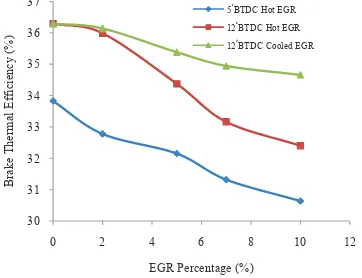
3. 1. Effect of EGR Parameters on Engine Performance As it is expected using of hot EGR has a negative effect on brake specific fuel consumption (BSFC) and engine brake efficiency. For this reason it is examined in Figs. 2 and 3 its effect on BSFC and brake thermal efficiency for various EGR rates and temperatures at
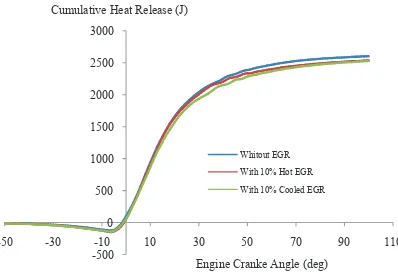
full load. As shown, BSFC is increased with increasing EGR rate resulting to brake thermal efficiency is sharply reduced but this reduction is smoother when that the cooled EGR is applied. The decrease of brake thermal efficiency is due mainly to the reduction of ë (lack of O2 in intake charge) resulting from thermal throttling effect, which affects the combustion rate of fuel. This obviously has a negative effect on combustion. At the same time, as is showed in Fig 4, cumulative heat release is lower in cases of EGR with respect to the without EGR case. However, this reduction is more when that cooled EGR is used. Hence, the average temperature level of the cylinder contents increases due to the high EGR temperature resulting to an increase of heat losses. Thus combination of these effects presence of EGR, create a significant reduction in brake thermal efficiency. At injection timing 12 °CA BTDC, the reduction of brake thermal efficiency is 4.5 and 10.7% (relative to the value without EGR), for 10% cooled and hot EGR, respectively. This is important when considering the fuel penalty associated with the use of EGR to reduce NOx emissions.
Fig 5 shows the comparison of engine brake power for both hot and cooled EGR in various EGR rates at 1900rpm engine speed, full load and two injection timings. Resulting from above mentioned reasons, with increasing EGR rate and temperature, engine torque and hence brake power is reduced. Thus using of the cooled EGR relative to the hot EGR, improves engine brake power due to increasing amount of oxygen and volumetric efficiency during the inlet stroke.
230 240 250 260 270 280
0 2 4 6 8 10 12
B
S
FC
(
g
r/
k
W
-h
r)
EGR Percentage (%)
5BTDC Hot EGR
12BTDC Hot EGR
12BTDC Cooled EGR
Fig. 2.Effect of EGR temperature on BSFC for various EGR rates at 1900 rpm engine speed, 100% load and 5 and
12 °CA BTDC injection timings.
30 31 32 33 34 35 36 37
0 2 4 6 8 10 12
B
ra
k
e
T
h
er
m
al
E
ff
ic
ie
n
cy
(
%
)
EGR Percentage (%) 5BTDC Hot EGR 12BTDC Hot EGR 12BTDC Cooled EGR
Fig. 3.Effect of EGR temperature on brake thermal efficiency for various EGR rates at 1900 rpm engine speed,
100% load and 5 and 12 °CA BTDC injection timings.
100
The effect of EGR rate on the exhaust gas temperatures is presented in Fig 6. The exhaust gas temperatures were increased continuously with increasing EGR rate for both 5 and 12 °CA BTDC injection timings. Higher exhaust temperature is an effect of more late-cycle combustion duration the expansion stroke since combustion ended later. With increasing EGR, combustion duration becomes longer. In other words, whole combustion phase is retarded into the expansion stroke (see section 3.2.). This effect is more in case of 5 °CA BTDC with respect to 12 °CA BTDC. In the same EGR rate, the EGR temperature has no significant effect on exhaust gas temperature. This is probably due to the same combustion condition at these cases, as is mentioned in section 3.2.
3. 2. Effect of EGR Parameters on Engine Combustion
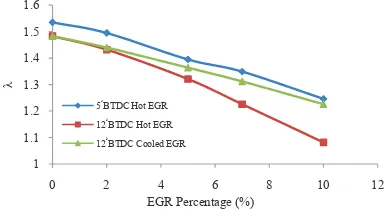
In Fig. 7 it is given the comparison between cylinder pressure traces for 0 and 10% hot and cooled EGR at 1900 rpm engine speed, 100% load using two injection timings of 5 and 12 °CA BTDC. As observed there is a significant effect of hot EGR on the cylinder pressure curves in both injection timings mode, which results to a more reduction of cylinder pressure during combustion and expansion. This results from the increase of charge specific heat capacity due to the presence of exhaust gas, to the reduction of O2 availability and also the dissociation of CO2and H2O that these factors have a negative effect on the combustion rate. It should be mentioned that for the cases examined (full load) relative air-fuel ratio (ë) values are close to their lowest limit (obtained from 8-Mode test results). Thus the presence of recirculated exhaust gas in the engine intake reduces further oxygen availability due to thermal throttling effect (reduced amount of charge to the cylinder), which in the present case is an important factor in the reducing of progress of the combustion process (retarded combustion). Because of this, peak cylinder pressure values are reduced, as the percentage of EGR inside the engine cylinder increases. However, the effect of thermal throttling is small when the cooled EGR is used. It is evident that the increase of EGR percentage at constant boost pressure results to a decrease of the amount of fresh air inducted per cycle. Consequently since the amount of fuel injected per cycle remains practically constant, ë should decrease. A similar Performance Evaluation and Emissions improving of Turbocharged ...
-500 0 500 1000 1500 2000 2500 3000
-50 -30 -10 10 30 50 70 90 110
Cumulative Heat Release (J)
Engine Cranke Angle (deg) Whitout EGR
With 10% Hot EGR
With 10% Cooled EGR
Fig. 4.Effect of EGR temperature on cumulative heat release for zero and 10% EGR rates at 1900 rpm engine speed, 100% load and 12 °CA BTDC injection timings.
30 35 40 45 50 55 60 65 70
0 2 4 6 8 10 12
E
n
g
in
e
B
ra
k
e
P
o
w
er
(
k
W
)
EGR Percentage (%)
5BTDC Hot EGR
12BTDC Hot EGR
12BTDC Cooled EGR
Fig. 5.Effect of EGR temperature on engine brake power for various EGR rates at 1900 rpm engine speed, 100%
load and 5 and 12 °CA BTDC injection timings.
540 550 560 570 580 590 600 610 620 630
0 2 4 6 8 10 12
E
x
h
au
st
G
as
T
e
m
p
ra
tu
re
(
°C
)
EGR Percentage (%) 5BTDC Hot EGR
12BTDC Hot EGR
12BTDC Cooled EGR
Fig. 6.Effect of EGR temperature on engine exhaust gas temperature for various EGR rates at 1900 rpm engine
speed, 100% load and 5 and 12 °CA BTDC injection timings.
effect is expected when increasing EGR gas temperature at a given EGR rate. Fig. 8 shows the variation of ë with EGR gas temperature at various EGR rates for cases examined. As observed, the negative effect of EGR on ë increases with the increase of EGR temperature particularly in high EGR rates. Thus at full load the effect of thermal throttling is significant and increases as EGR temperature is increased to higher values.
The advanced injection timing (12 °CA BTDC) shows higher peak pressure and hence temperature with respect to the base injection timing (5 °CA BTDC). The peak cylinder pressure obtained for the two injection timings in cases 0 and 10% hot and cooled EGR are summarized in Table 3. As the injection timing is advanced, pressure and temperature inside the cylinder is not sufficient to ignite the fuel as a result a large amount of evaporated fuel is accumulated during the ignition delay period. However, in the case of base injection timing, pressure and temperature inside the cylinder is sufficient to ignite the fuel and a relatively small amount of evaporated fuel is accumulated during the ignition delay period. The longer ignition delay leads to rapid
burning rate and the pressure and temperature inside the cylinder rises suddenly. Hence, most of the fuel burns in premixed mode causes maximum peak heat release rate, maximum cumulative heat release and shorter combustion duration. In the case of base injection timing, the accumulation of evaporated fuel is relatively less resulting in shorter ignition delay. The shorter ignition delay leads to slow burning rate and slow rise in pressure and temperature. Hence, most of the fuel burns in diffusion mode rather than
International Journal of Automotive Engineering Vol. 2, Number 2, April 2012
0 20 40 60 80 100 120 140 160
-60 -50 -40 -30 -20 -10 0 10 20 30 40 50 60 Cylinder Pressure (bar)
Engine Crank Angel (deg) 0%EGR at -5BTDC
0%EGR at -12BTDC 10% Hot EGR at -5BTDC 10% Hot EGR at -12BTDC 10% Cooled EGR at -12BTDC
Fig. 7.Comparison between cylinder pressure diagrams for without EGR and 10% hot and cooled EGR at 1900 rpm engine speed, 100% load and 5 and 12 °CA BTDC injection timings.
1 1.1 1.2 1.3 1.4 1.5 1.6
0 2 4 6 8 10 12
EGR Percentage (%)
5BTDC Hot EGR
12BTDC Hot EGR
12BTDC Cooled EGR
Fig. 8.Effect of EGR temperature on ë for various EGR rates at 1900 rpm engine speed, 100% load and 5 and 12
°CA BTDC injection timings.
Modes of test Peak Pressure (bar) @ Crank Angle (deg ATDC)
5 °CA BTDC, Without EGR 111.76 @ 10.5 12 °CA BTDC, Without EGR 141.91 @ 8.3 5 °CA BTDC, With 10% Hot EGR 98.10 @ 10.8 12 °CA BTDC, With 10% Hot EGR 118.67 @ 9.7 12 °CA BTDC, With 10% Cooled EGR 138.29 @ 7.7
Table 3.Peak cylinder pressure for modes of test.
102
premixed mode resulting in lower peak heat release rate, lower cumulative heat release and longer combustion duration [5,14].
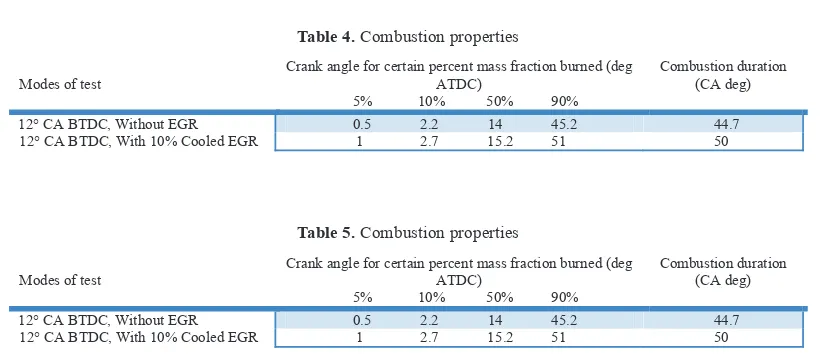
Table 4 gives the crank angle corresponding to certain percent of mass fraction burned and also combustion duration at advanced start of injection under two EGR conditions. The difference of the crank angles between two EGR conditions for 5%, 10% and 50% mass fraction burned are about half or one crank angle, while that of 90% are about six crank angles. This means that the former half of combustion duration is almost the same for cases of zero and 10% EGR rates, but the later half is longer for case with EGR rate. Therefore, it can be seen that the whole combustion phase (ignition delay, premixed combustion, diffusion and late diffusion combustion) is retarded into the expansion stroke (further away from TDC) in presence of EGR, leading to significant lower combustion pressures (see Fig 7) and hence temperatures. Peak of heat release rate (HRR) with amount of the cumulative heat release rate are shown in Table 5. When 10% whether hot or cooled EGR is used, a decrease of 6.33% peak of HRR and 2.5% reduction in cumulative heat release are obtained with reference to the without the EGR case. As is observed, peak of HRR for EGR cases is shifted about three or four degrees of engine crank angle into the expansion stroke (delayed combustion) compared to 0% EGR. As explained earlier, at constant boost pressure, the fuel jet entrains less fresh air with increased EGR rate, resulting in a lower oxygen-fuel mixing, longer ignition delay and hence lower HRR. Furthermore, with the EGR, combustion duration is longer with respect to case of without EGR. Hence this can be
another reason for reducing brake thermal efficiency in using of the EGR.
For a premixed combustion, as the EGR rate is increased at constant boost pressure, the intake gas temperature increases (due to the higher temperature of EGR gases relative to inlet air) and the cylinder trapped mass decreases (thermal throttling effect), which increase the cylinder gas temperature at inlet valve closure. Having a higher cylinder gas temperature can enhance the vaporization of the injected fuel and reduces physical phase of ignition delay before premixed stage of combustion. But the chemical reaction rate of ignition delay also slows down a little bit with the higher EGR rate (more dilution effect). The above two effects compensate one another. However, when the EGR rate increases the second effect is more pronounced. Actually, the first effect is enhanced by hot EGR and the second effect is boosted when that cooled EGR is entered. Thus, as is observed in Table 5, there is no significant difference between the HRR peak of hot and cooled EGR so that the HRR slightly decreases (due to more dominant of the second effect) as the EGR rate whether hot or cooled is increased at high engine load.
3. 3. Effect of EGR Parameters on Engine Emissions As mentioned the use of EGR was examined as a mean to control NOx emissions since advanced injection timing was used to improve engine power and efficiency. Fig 9 shows the variation of NOx as function of EGR temperature for various EGR rates and injection timings. Actually, NOx production is more at advanced injection timing compared to the Performance Evaluation and Emissions improving of Turbocharged ...
Modes of test
Crank angle for certain percent mass fraction burned (deg ATDC)
5% 10% 50% 90%
Combustion duration (CA deg) 12° CA BTDC, Without EGR 0.5 2.2 14 45.2 44.7 12° CA BTDC, With 10% Cooled EGR 1 2.7 15.2 51 50
Table 4.Combustion properties
Modes of test
Crank angle for certain percent mass fraction burned (deg ATDC)
5% 10% 50% 90%
Combustion duration (CA deg)
12° CA BTDC, Without EGR 0.5 2.2 14 45.2 44.7 12° CA BTDC, With 10% Cooled EGR 1 2.7 15.2 51 50
Table 5. Combustion properties
base one (due to higher pressure and temperature). Furthermore, the increase of EGR rate in both injection timings causes the reduction of NOx emissions. This decrease in NOx emissions is attributed to the decrease in peak cylinder pressure (also peak of HRR) and flame temperature as was already explained. As is observed, for a given start of injection, NOx emissions at full load remain almost constant when altering EGR temperature. Only, a little bit increase is observed for the cooled EGR compared to the hot EGR. In the other words, in the case of hot EGR the increase of charge temperature would be significant and is expected to lead to an increase of NOx compared to the cooled EGR case. Whereas, the formation of nitrogen oxide is in high temperature and high O2 concentration zones, it is concluded that the temperature increase inside the combustion chamber at inlet valve closure, due to the increase of EGR temperature is compensated by the reduction of air-fuel ratio because of the thermal throttling effect. With observing the results of NOx variation with EGR rate and temperature for a given start of injection, it is verified that EGR temperature, has no significant effect on NOx emissions. This, results from the same peak HRR and cumulative heat release observed at these conditions, as already mentioned in Table 5. However, the results obtained of these two adverse mechanisms showed a very small (about 10 ppm for all of EGR rate) increase of NOx with the cooled EGR (in the range examined), which is indicating a low dominance of thermal throttling effect relative to the increase of mean gas temperature during the combustion period.
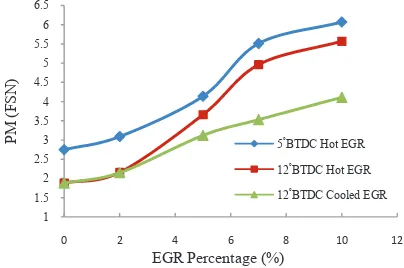
The main drawback of the EGR is the increase of PM emission. In all the test conditions, an increase of their value is observed when increasing EGR rate, as demonstrated in Fig. 10. This results mainly from the reduction of air-fuel ratio. Oxygen concentration is reduced so that affects on PM oxidation. In the same figure is shown the difference between hot and cooled EGR traces. As is observed, for a given start of injection, when running with cooled EGR, PM values are reduced compared to the hot EGR case, particularly in high EGR rate. It could be expected that using a higher EGR temperature would enhance PM oxidation leading to a reduction of emitted PM. This may be the case for a heavy duty diesel engine operating at low load since in this case oxygen availability even when using EGR is high due to the air-fuel values used. However, for full load operation this is not the case [9]. As EGR temperature increases, increase of intake charge temperature compensating the negative effect of CO2and H2O dissociation. But it cannot compensate for the lack of O2 availability through PM oxidation resulting from thermal throttling leading to an increase of PM emissions. Therefore it is evident that when using high EGR gas temperature PM oxidation pulls in earlier during the expansion stroke due to lack of O2. This provides an explanation for the negative effect of EGR gas temperature increase on PM emissions.
Figs.11 and 12 show substantial trade-offs between NOx-PM and NOx-BSFC. Unfortunately, the increase of EGR rate in order to reduction NOx has a negative effect on PM, BSFC and hence, engine thermal efficiency. However, as a consequence, NOx-PM and NOx-BSFC trade-offs are better in the case of cooled
International Journal of Automotive Engineering Vol. 2, Number 2, April 2012
600 800 1000 1200 1400 1600 1800 2000 2200
0 2 4 6 8 10 12
N
O
x
(
p
p
m
)
EGR Percentage (%) 5BTDC Hot EGR 12BTDC Hot EGR 12BTDC Cooled EGR
Fig. 9.Effect of EGR temperature on NOx emission for various EGR rates at 1900 rpm engine speed, 100% load
and 5 and 12 °CA BTDC injection timings.
1 1.5 2 2.5 3 3.5 4 4.5 5 5.5 6 6.5
0 2 4 6 8 10 12
P
M
(
F
S
N
)
EGR Percentage (%)
5BTDC Hot EGR
12BTDC Hot EGR
12BTDC Cooled EGR
Fig. 10.Effect of EGR temperature on PM emissions for various EGR rates at 1900 rpm engine speed, 100% load
and 5° and 12° CA BTDC injection timings.
104 EGR 1 2 3 4 5 6 7
600 900 1200 1500 1800 2100
P M ( F S N ) NOx (ppm)
5 deg BTDC Hot EGR
12 deg BTDC Hot EGR
12 deg BTDC Cooled EGR
Fig. 11.NOx-PM trade-off while varying EGR rates and temperature at 1900 rpm engine speed, 100% load and 5
and 12 °CA BTDC injection timings.
Hot EGR Cooled EGR
0.2 0.2 0 0.4 0.8 1.2 1.6 2 2.4
Cylinder 1 Cylinder 2
[C O 2 ]i, j 2% EGR 0.2 0.2 0 0.4 0.8 1.2 1.6 2 2.4
Cylinder 1 Cylinder 2
[C O 2 ]i, j 2% EGR 0.6 0.6 0 0.4 0.8 1.2 1.6 2 2.4
Cylinder 1 Cylinder 2
[C O 2 ]i ,j 5% EGR 0.5 0.7 0 0.4 0.8 1.2 1.6 2 2.4
Cylinder 1 Cylinder 2
[C O 2 ]i ,j 5% EGR 0.8 1.1 0 0.4 0.8 1.2 1.6 2 2.4
Cylinder 1 Cylinder 2
[C O 2 ]i, j 7.5% EGR 0.9 0.8 0 0.4 0.8 1.2 1.6 2 2.4
Cylinder 1 Cylinder 2
[C O 2 ]i, j 7.5% EGR 1.2 1.6 0 0.4 0.8 1.2 1.6 2 2.4
Cylinder 1 Cylinder 2
[C O 2 ]i, j 10.5% EGR 1.3 1.1 0 0.4 0.8 1.2 1.6 2 2.4
Cylinder 1 Cylinder 2
[C O 2 ]i, j 10.5% EGR 1.4 2.2 0 0.4 0.8 1.2 1.6 2 2.4
Cylinder 1 Cylinder 2
[C O 2 ]i, j 13.5% EGR 1.7 1.5 0 0.4 0.8 1.2 1.6 2 2.4
Cylinder 1 Cylinder 2
[C O 2 ]i ,j 13.5% EGR
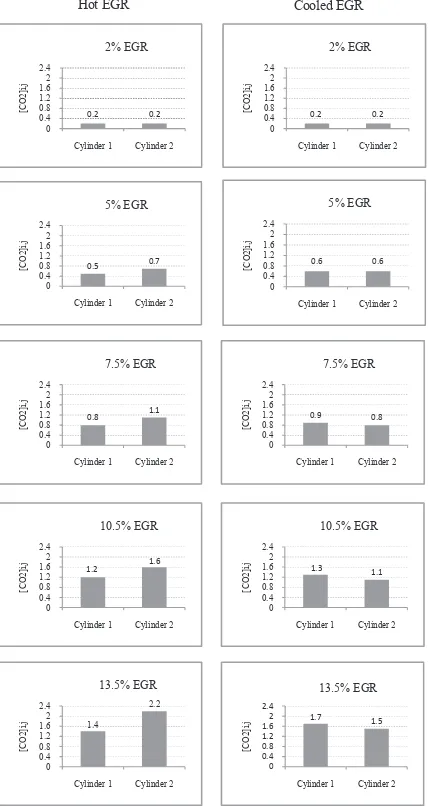
Fig. 12.CO2concentration at each inlet port in cases of hot and cooled EGR for various EGR rates at 1900 rpm engine speed, 100% load.
EGR 230 235 240 245 250 255 260 265 270 275 280
600 900 1200 1500 1800 2100
B SF C ( g r/ k W -h r) NOx (ppm)
5 deg BTDC Hot EGR
12 deg BTDC Hot EGR
12 deg BTDC Cooled EGR
Fig. 12.NOx-BSFC trade-off while varying EGR rates and temperature at 1900 rpm engine speed, 100% load and 5
and 12 °CA BTDC injection timings Performance Evaluation and Emissions improving of Turbocharged ...
EGR compared to hot EGR. Obviously, this is because of positive effect of the cooled EGR on reduction of thermal throttling effect on cylinder intake charge.
By separate measuring of CO2 concentration at each inlet port in cases of hot and cooled EGR for various EGR rates, it is revealed that there is an EGR maldistribustion among engine cylinders, especially in the high EGR rates. The results are given in Fig. 13. This is due to symmetric shape of intake manifold that causes the central cylinders (2 and 3) admit much more recirculated gases relative to lateral cylinders (1 and 4). The cylinder-to-cylinder variations in EGR distribution results in increased NOx/PM emissions especially when running with high EGR rates that is due to cylinder-to-cylinder variations in both gas composition and intake temperature. Therefore, an optimized air-EGR connection will be one of the ways to achieve future emissions standards [13]. However, as is observed in Fig. 12, unequal EGR distributions are low when using the cooled EGR compared to hot EGR. This is probably due to higher volumetric efficiency and hence the increase of mass intake air in the case of cooled EGR.
4. CONCLUSIONS
In this study, the influence of EGR rates and temperatures on combustion, performance and NOx/PM emissions were experimentally investigated on a semi heavy duty direct injection diesel engine at full load whereas advanced injection timing was used to improve engine power and efficiency. The following results were obtained:
1. Use of EGR has negative effect on BSFC, brake thermal efficiency and engine power but this negative effect is less when cooled EGR is used. The EGR temperature has no significant effect on exhaust gas temperature.
2. At the constant boost pressure, the adding of EGR reduces air-fuel ratio and hence oxygen availability due to thermal throttling effect, which is an important factor in the reducing of progress of whole combustion processes. In the other hand, for a premixed combustion, ignition delay increases when increasing EGR rate and this, causes that all of the combustion occurs later in the cycle during expansion, at a lower in-cylinder pressure and temperature, thus
reducing HRR and cumulative release rate peaks. However, the cooled EGR affects lower on thermal throttling of intake charge compared to the hot EGR.
3. Although EGR is effective to reduce NOx by lowering peak of cylinder pressure and temperature, there is a substantial trade-off in increased bsfc and PM emissions due to the reduction of oxygen concentration in the cylinder intake air. The cooled EGR improves O2 concentration and hence the trade-offs between NOx-PM and NOx-BSFC will be decreased. As a consequence, the cooled EGR is more effective than the hot EGR in terms of improving performance and reduction of engine emissions.
4. Because of compensating for the increase of temperature inside the combustion chamber at inlet valve closure, due to the increase of EGR temperature by the reduction of air-fuel ratio (thermal throttling effect), it was proven that EGR temperature, has no significant impact on NOx emissions. This, results from the same peak HRR and cumulative heat release observed in both hot and cooled EGR cases. 5. Unequal EGR distributions, which have
negative effect on the EGR cylinder-to-cylinder variation, are low when using the cooled EGR compared to the hot EGR.
ACKNOWLEDGEMENTS
The authors wish to express their appreciation to the Engineering Research Department of Tabriz Motorsazan Company for supporting financially and the guidelines during the coordination of this project.
REFERENCES
[1] Zheng M, Reader GT, Hawley JG. Diesel engine exhaust gas recirculation-a review on advanced and novel concepts. Energy Conversion and Management 2004;45:883-900.
[2] How nitrogen oxides affect the way we live and breathe. Environmental protection agency. Archived from the original on 2008-07-16. [3] Mauzerall D.L, Sultan B, Kim N, David F,
Bradfor D.L. NOx emissions from large point sources: variability in ozone production,
International Journal of Automotive Engineering Vol. 2, Number 2, April 2012
106
resulting health damages and economic costs. Atmospheric Environment 39 (2005) 2851–2866.
[4] Abd-Alla GH.Using exhaust gas recirculation in internal combustion engines: a review. Energy Conversion and Management 43 (2002) 1027-1042.
[5] Heywood J.B., Internal Combustion Engine Fundamentals, McGraw-Hill, New York, 1988. [6] Ladommatos N, Abdelhalim SM, Zhao H, Hu
Z. The dilution, chemical, and thermal effects of exhaust gas recirculation on diesel engine emissions-part 4: effects of carbon dioxide and water vapor. SAE paper no. 971660, Society of automotive Engineers Inc, Warrendale, PA, 1997.
[7] Ladommatos N, Abdelhalim SM, Zhao H, Hu Z. Effects of EGR on heat release in diesel combustion. SAE paper no. 980184, Society of automotive Engineers Inc., Warrendale, PA, 1998.
[8] Maiboom A, Tauzia X, He´tet JF. Experimental study of various effects of exhaust gas recirculation (EGR) on combustion and emissions of an automotive direct injection diesel engine. Energy 2008;33:22-34
[9] Hountalas DT, Mavropoulos GC, Binder KB. Effect of exhaust gas recirculation (EGR) temperature for various EGR rates on heavy duty DI diesel engine performance and emissions. Energy 2008;33:272-83.
[10] Kouremenos DA, Hountalas DT, Binder KB, Raab A, Schnabel MH. Using Advanced Injection Timing and EGR to Improve DI Diesel Engine Efficiency at Acceptable NO and Soot Levels. SAE paper 2001-01-0199, 2001. [11] Schubiger R, Bertola A, Boulouchos K.
Influence of EGR on Combustion and Exhaust Emissions of Heavy-Duty Di Diesel Engines Equipped With Common-Rail Injection Systems. SAE paper 2001-01-3497,2001. [12] Zhu Y, Zhao H, Ladommatos N. Computational
Study of the Effects of Injection Timing, EGR and Swirl Ratio on a HSDI Multi-Injection Diesel Engine Emission and Performance. SAE paper 2003-01-0346,2003.
[13] Maiboom A, Tauzia X, He´tet JF. Influence of EGR unequal distribution from cylinder to cylinder on NOx-PM trade-off of a HSDI
automotive Diesel engine. Applied Thermal Engineering 29 (2009) 2043-2050, 2009. [14] Jayashankara B, Ganesan V. Effect of fuel
injection timing and intake pressure on the performance of a DI diesel engine - A parametric study using CFD. Energy Conversion and Management 51 (2010) 1835–1848, 2010.
Performance Evaluation and Emissions improving of Turbocharged ...