DEMOGRAPHIC RESEARCH
VOLUME 32, ARTICLE 10, PAGES 311–340
PUBLISHED 3 FEBRUARY 2015
http://www.demographic-research.org/Volumes/Vol32/10/ DOI: 10.4054/DemRes.2015.32.10
Research Article
Risk-avoidance or utmost commitment?
Dutch focus group research on cohabitation and
marriage
Nicole Hiekel
Renske Keizer
This publication is part of the Special Collection on “Focus on Partnerships: Discourses on cohabitation and marriage throughout Europe and Australia,” organized by Guest Editors Brienna Perelli-Harris and Laura Bernardi.
© 2015 Nicole Hiekel and Renske Keizer.
This open-access work is published under the terms of the Creative Commons Attribution NonCommercial License 2.0 Germany, which permits use, reproduction & distribution in any medium for non-commercial purposes, provided the original author(s) and source are given credit.
1 Introduction 312
2 Theoretical background 314
2.1 Cohabitation and marriage and their legal context in the Netherlands
314
2.2 The notion of “free choice” and “pure relationships” 315 2.3 Why cohabit in individualized societies? 316 2.4 Why marry in individualized societies? 318
3 Data and methods 319
3.1 Method and procedure 319
3.2 Recruitment 321
3.3 Sample characteristics 322
4 Results 324
4.1 Cohabitation, marriage and individualization: Free choices and pure relationships
324
4.2 Cohabitation as a risk-reduction strategy 327 4.2.1 Cohabitation as a strategic long term response to high marital
instability
328
4.2.2 Cohabitation as a testing ground for marriage 329 4.2.3 Marriage as a way to safeguard financial and legal issues 330 4.3 Marriage as the „utmost commitment‟ 331
5 Conclusion and discussion 332
6 Acknowledgement 335
Risk-avoidance or utmost commitment?
Dutch focus group research on cohabitation and marriage
Nicole Hiekel1
Renske Keizer2
Abstract
BACKGROUND
Dutch adults grew up in a highly individualized country, characterized by high divorce rates, which may have influenced their views on cohabitation and marriage.
OBJECTIVE
We examine Dutch adults‘ perceptions of how similar or different cohabitation and marriage are, whether they believe that cohabitation would be a strategy to avoid the risk of divorce, as well as their views on why people marry in individualized societies. METHODS
We analyze seven focus group interviews with 40 Dutch participants, collected in 2012 in Rotterdam, the Netherlands.
RESULTS
Many participants discussed differences and similarities between cohabitation and marriage in a context of high divorce rates, and frequently viewed cohabitation as a risk-reduction strategy. At the same time, marriage was often seen as ―the real deal‖, in terms of legal arrangements, but also as a symbol of utmost commitment. Less educated participants viewed more financial advantages in cohabitation compared to marriage, and felt more strongly about the symbolic value of marriage than their highly educated counterparts. There was strong consensus that there is not, and should not be, a social norm to marry.
1 Netherlands Interdisciplinary Demographic Institute (NIDI-KNAW)/ University of Groningen. Lange
Houtstraat 19, 2511CV The Hague, The Netherlands.
CONCLUSIONS
In a context of high relationship instability, cohabitation has become a risk-reduction strategy. When norms to marry are weak, people may marry in order to emphasize the uniqueness of their relationship. However, the individualistic nature of Dutch society is mirrored in respondents‘ reluctance to set standards or proscribe norms on why and when to marry and their emphasis that cohabitation can also imply high levels of commitment.
1. Introduction
The Netherlands is one of the most individualized countries in the world (Nevitte and Cochrane 2006). Individualization means that young adults flexibly and autonomously make their individual life choices and are no longer bound by traditional institutions or rigid social norms. Relationship formation is one life domain in which individuals are free to make their own decisions. In this paper we study how Dutch adults view cohabitation and marriage, and their role in union and family formation processes. The increasing popularity of unmarried cohabitation has been viewed as one indicator of individualization (Bauman 2003). In the Netherlands, cohabitation has become customary (Kiernan 2002a) or even a normative step on the road to marriage (Elzinga and Liefbroer 2007). Only a minority of Dutch men and women marry without having cohabited first (Statistics Netherlands 2006). The Dutch legal system has also challenged the primacy of the institution of marriage by introducing registered partnerships in 1998. In 2012, 9,000 couples registered their cohabiting relationship (Statistics Netherlands 2013). In addition, the institution of marriage has been confronted with divorce; currently every third marriage ends in divorce (ibid.). Nonetheless, marriage has not gone out of style. In 2012, 69,000 marriages were formed (ibid.). These trends in union formation patterns raise questions about how people in individualized societies perceive cohabitation and marriage, and to what extent these views are shaped by the process of individualization and the context of high divorce rates.
reference in peoples‘ views on cohabitation. Some cohabitors view cohabitation as a preparatory stage for marriage and thereby perceive it as inferior to marriage, for instance in terms of commitment. Yet others view cohabitation as an alternative to marriage or a substitute for it. In highly individualized societies in which cohabitation is prevalent and socially accepted, people may view cohabitation and marriage as serving similar functions in couple and family life (Kiernan 2001). The present qualitative study draws on focus group data from 40 women and men living in Rotterdam, providing us with deeper insights about the meaning of cohabitation and marriage in a highly individualized context. It explores whether young adults in the Netherlands talk similarly about cohabitation and marriage, for instance, with regard to commitment between the partners or cohabitation being a suitable context for raising children. Our first research question therefore is: (1) how do Dutch young adults view cohabitation and marriage, and how do they articulate similarities and differences between the two relationship types?
Sociologists have argued that marriages in individualized societies run a higher risk of divorce because people put higher emotional expectations on their relationships and are likely to be disappointed (Beck and Beck-Gernsheim 1990). Nonetheless, although people may feel free to leave an unhappy marriage, the emotional, financial, social, and legal consequences of a divorce are often severe. The concern over the risk of a divorce, however, is not only influenced by peoples‘ own experience; the divorce of parents, friends and colleagues may also shape peoples‘ views of marriage. As masters of their own biography, people in individualized societies may want to reduce the risk of relationship failure. One way to do so is by cohabiting. Qualitative studies from the United States found that people who chose to cohabit rather than marry explain their choice as having no faith in the life-long commitment of the marriage vow and fearing the apparent inevitability of divorce (Miller, Sassler, and Kusi-Appouh 2011). Others argued that people may want to test their relationship before contemplating marriage (Klijzing 1992). We aim at exploring whether a context of high divorce prevalence colors peoples‘ views on cohabitation and marriage. Specifically, we investigate the prevalence of a perception that cohabitation could reduce the risk of divorce by avoiding marriage altogether (i.e., cohabitation as a strategic long-term response to the divorce culture in the Netherlands) or as a means to test the relationship in order to increase the chances of future marital success (i.e., cohabitation as a test for marriage). Our second research question therefore is: (2) do Dutch young adults view cohabitation as a risk-reduction strategy and if so, how do they think cohabitation would reduce the risk of divorce?
highly intertwined; couples being more likely to marry before or around the birth of a first child (Hiekel and Castro-Martín 2014; Musick 2007; Perelli-Harris et al. 2012). Having a child together (or having plans to have a child) increases the commitment of both partners to the relationship, and could trigger the emotional desire to marry. Strategic considerations such as parental rights, tax benefits, or joint economic investments may also play a role in decisions to marry. Marriage could thus also be a strategy to reduce the risk of divorce. Rather than avoiding marriage, people may be of the opinion that the marriage contract would protect individuals from the negative consequences of divorce. Our third research question is therefore: (3) do Dutch young adults view certain life circumstances as creating a need to marry, and if so, what are the life events that trigger marriage?
In sum, in this study we analyze qualitative data from focus group discussions to examine peoples‘ views on cohabitation and marriage in the highly individualized context of the Netherlands. We study whether both the notion of 'free choice' and 'risk reduction' emerge from these discussions on the meaning of cohabitation. Moreover, we investigate how the remaining popularity of marriage fits the individualized nature of Dutch society by exploring peoples‘ views on life events that trigger marriage.
2. Theoretical background
2.1 Cohabitation and marriage and their legal context in the Netherlands
The Netherlands has been one of the forerunners in the spread of new demographic behaviors described as classic features of the Second Demographic Transition (SDT) (Lesthaeghe 1995; Lesthaeghe and van de Kaa 1986; van de Kaa 1987). Our analyses of Dutch survey data (Family Formation Survey 2008) show significant cohort changes in cohabitation patterns in the Netherlands. First, men and women now more frequently live together without being married. Fewer than 2 of every 10 Dutch individuals born in the 1940s cohabited prior to marriage, compared to 9 in 10 born in the 1970s. Second, the Dutch also stay cohabiting longer than in the past. Six in 10 cohabitors born in the 1940s married their partner within five years, whereas in the birth cohort 1971-1980 this proportion declined to 3 in 10 cohabitors. Finally, more children are born to cohabiting parents than in the past. Whereas virtually all (92%) Dutch women born in the 1940s were married at the moment of their first child‘s birth, 3 in 10 women born thirty years later were cohabiting when they had their first child.
There are some similarities between a marriage and a cohabitation agreement, but often people also need to make a will and arrange other legal documents before they get close to having the same legal benefits as marriage. Cohabitors without any legal arrangements have no legal ties to one another. When a couple in the Netherlands decides to marry, the partners have two options: to marry on common grounds or in separate estate. When a couple marries on common grounds, all properties are shared between the spouses. When couples marry in separate estate, own properties and debts remain to each partner. Thus, the Dutch legal system provides a variety of options, allowing couples greater flexibility in living arrangements.
2.2 The notion of “free choice” and “pure relationships”
Within the theoretical framework of the Second Demographic Transition, changes in cohabitation and marriage patterns can be explained by a shift in values and attitudes that emphasize self-realization, autonomy and tolerance towards the diversity of life choices (Lesthaeghe and Surkyn 1988). These changes in values have driven processes of individualization, emancipation and secularization which in turn liberated young adults from following prescribed life schemes imposed by society in general, the family of origin, or the Church (Beck and Beck-Gernsheim 1990). Indeed, the Netherlands is one of the most secular countries in the world. In 2008, 42 percent of the Dutch adult population reported having no religious affiliation and only 2 in every 10 Dutch adults reported visiting religious services once a month or more often (Statistics Netherlands 2009).
general (Baker and Elizabeth 2014; Stanley, Rhoades, and Markman 2006). As such, the prevalence of long term cohabitation in the Netherlands could result in completely new forms of intimate relationships that do not rely on externally imposed codes (Giddens 1992).
But individualization processes might not only evoke the emergence of ―pure (cohabiting) relationships‖ but may also change the meaning of marriage. ―Pure marriages‖ may emerge in which gender roles and power dynamics between the spouses differ from traditional marriage. Hence, it could be that in individualized societies, there might not be a need to oppose marriage as long as the decision to marry reflects a personal and free choice. Cohabitation and marriage could then be two interchangeable labels for a committed relationship and everyone is free to pick the label he or she prefers.
According to the SDT, the highly educated and economically more advantaged individuals are at the vanguard of ideational shifts leading to new preferences in the way intimate relationships are designed (Lesthaehe and Surkyn 1988). The diffusion of cohabitation in the Netherlands in the late 1960s indeed started among the highly educated, who viewed cohabitation as an ideological rejection of the legal and social institution of traditional marriage (Manting 1996). Perelli-Harris et al (2010) however showed that in recent birth cohorts, the highly educated are more likely to be married at the birth of their first child than their less educated counterparts. Thus, although cohabitation has spread to all social strata in the Netherlands, we might still find differences in the way people from different social groups view cohabitation and marriage.
2.3 Why cohabit in individualized societies?
may not be fulfilled. This risk awareness may be intensified by their own previous experience with relationship dissolution, but also by being conscious of the high prevalence of divorce (e.g., through mass media, conversations with kin, friends, or colleagues).
As captains of their own life course, people may want to reduce the risk of committing to a possibly unfulfilling relationship that may end in divorce. People may view cohabitation as a reduction of the risk of divorce in two ways.
First, people in individualistic societies could be disillusioned or even cynical about the lifelong commitment promised in the marriage vow, as it seems increasingly at odds with the social reality of high divorce rates and the individualistic values embraced by modern society. One strategy might be to avoid marriage and the implied risk of a divorce by cohabiting instead (Miller, Sassler, and Kusi-Appouh 2011). People might argue that the consequences of ending a cohabiting relationship might be less devastating than going through an expensive and lengthy legal divorce procedure.
2.4 Why marry in individualized societies?
If the high level of individualization of relationships continues, the question arises whether marriage will lose its relevance (Liefbroer and Fokkema 2008). Given that the majority of cohabitors still marries in most individualized European societies (Kiernan 2002b; Wiik, Bernhardt, and Noack 2009) marriage may not disappear in the future, but the reasons to marry might change. People may feel that life course transitions that were normatively connected to marriage (i.e., reaching a certain age, finishing education, having a child) are no longer compulsory for a couple to proceed to marriage. The question then arises: what triggers marriage in individualized societies?
We have argued earlier that individualization means that people are more aware of the fragility of intimate relationships. Strategic, hence risk-reducing, considerations may thus also be part of how people view marriage. Such considerations can be economically or legally motivated and include the protection of property, tax and social benefits, parental rights and alimonies in case of union dissolution. The risk reduction strategy is thus not oriented towards avoiding divorce, but protecting the individual from the negative consequences of divorce. As in many Western countries, cohabitors in the Netherlands who have not registered their partnership have no rights and obligations towards each other upon separation. Legal and economic considerations might explain why many cohabitors marry around the birth of a child, even though childbearing is not normatively tied to marriage. It is interesting to explore whether people with high and low levels of economic resources differ in whether they discuss marriage as a risk-reduction strategy. One could argue that people with less economic resources are more dependent on their partners to make ends meet, which could increase the awareness that without any legal arrangements they might be worse off after separation. Then again, people with more economic resources might feel a stronger need to define clear legal arrangements with their partners in order to protect their property in case of divorce. They might also be more informed about differences in their rights in case of divorce compared to separation.
of reach. Qualitative research from the United States has shown that economic convenience is a prominent reason for cohabitation among the working class, and is therefore one of the factors explaining the faster transition from dating to cohabiting relationships in the working-class compared to more highly educated individuals (Sassler and Miller 2011). However, people with fewer economic resources may not only face permanent economic obstacles to getting married, but may also view fewer material benefits in getting married. Studies showed that women from lower social backgrounds in the United States may be reluctant to marry their partner because their partners‘ low employment outlook does not constitute a promising gain of marriage, and it would imply a loss of control over finances or entitlements to welfare benefits (Edin 2000; Edin and Kefalas 2005; Reed 2006).
In sum, in individualized societies such as the Netherlands, people may perceive cohabitation and marriage to be similar union types with regard to their social functions and normative expectations. The choice of one or the other may be regarded as a strongly personal matter rather than something externally imposed. People may consider that there are two ways in which cohabitation reduces the risk of divorce: by allowing individuals to avoid marriage altogether, or to test compatibility with a partner before committing more seriously (by getting married). Marriage might also be a risk-reduction strategy in individualized societies by economically and legally protecting individuals in a context of high union instability. Individuals from higher social classes may look differently upon cohabitation, marriage, and strategies to reduce the risk of divorce than their less advantaged counterparts.
3. Data and methods
3.1 Method and procedure
focus group interactions and discussions elicit context-specific social norms – in our case, regarding cohabitation and marriage (e.g., Morgan 1997; 1998).
In the project ―Focus on partnerships‖, researchers from 12 countries collaborated to develop a standardized focus group discussion guideline and to conduct focus groups in their countries (Perelli-Harris et al. 2014). The guidelines covered several topics, including ‗Advantages of cohabitation compared with marriage, disadvantages of cohabitation compared with marriage, motivations for marriage, barriers to marriage, whether there exists a need for marriage, and preferred timing of marriage‘. To tap general perceptions, questions and probes were typically phrased in broad, rather than specific, terms; for example: ―Why do you think some people decide to move in together without getting married?‖
Each focus group session ran for about two hours, and was led by one of two trained moderators (one of which was the second author). We matched the moderators to the gender composition of the focus group because we assumed that having a moderator of the same sex might elicit a more open discussion among the participants. We asked the participants to share their own personal views and to also share the experiences of friends or relatives when relevant. All seven focus groups were very informative and participants were talkative.
However, there were strong differences in the type of opinions, ideas and feelings shared, and these differences were related to educational attainment: more highly educated participants discussed their ideas regarding general social norms in the Netherlands, whereas the less educated participants, especially the women, mostly talked about their own experiences with cohabitation, marriage and divorce. These differences by educational attainment might be driven by whether the participants had experienced marriage and/or divorce themselves.
We decided not to stratify by partnership and parenthood status, because partnership histories can be inherently complex and hence categorization would be arbitrary. As our main goal was to capture social norms rather than to explain individual biographies, we decided to keep stratification as simple as possible and only use gender and educational attainment as the basis for stratification.
end of each quotation is followed by the number and the composition of the focus group, in terms of gender and educational level.
3.2 Recruitment
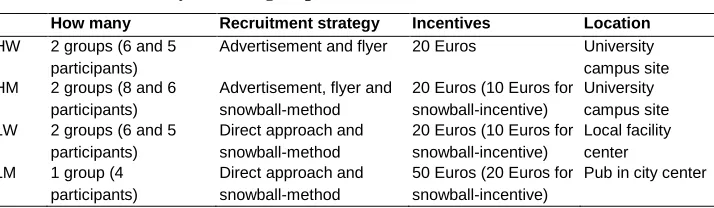
We recruited the Dutch focus group participants in Rotterdam through advertisements in local and university papers, flyers posted in community centers, supermarkets, job recruitment agencies, and unemployment agencies (in order to reach participants with lower levels of education), online recruitment adds, and face-to-face recruitment. At the start of the recruitment period, we provided a 20 Euro cash incentive to all participants. Potential participants were screened for inclusion on four socio-demographic criteria: age, gender, partner status, and educational attainment.
We used educational attainment to distinguish respondents with different socio-cultural and economic background. Compared to other Western countries, differences by social classes are less visible and evident in the Netherlands. Scholars agree that in the Dutch society, stratification is based on educational attainment rather than social class (e.g., Bovens 2012). There are powerful differences by educational attainment in terms of partner status, attitudes, and income (Coumans 2012). In the Dutch society, therefore, education seems the best suitable indicator of social stratification.
Table 1: Summary of focus group recruitment information
How many Recruitment strategy Incentives Location
HW 2 groups (6 and 5
participants)
Advertisement and flyer 20 Euros University
campus site
HM 2 groups (8 and 6
participants)
Advertisement, flyer and snowball-method
20 Euros (10 Euros for snowball-incentive)
University campus site
LW 2 groups (6 and 5
participants)
Direct approach and snowball-method
20 Euros (10 Euros for snowball-incentive)
Local facility center
LM 1 group (4
participants)
Direct approach and snowball-method
50 Euros (20 Euros for snowball-incentive)
Pub in city center
Note: H=Higher educated; L=lower educated; W=women; M=men.
3.3 Sample characteristics
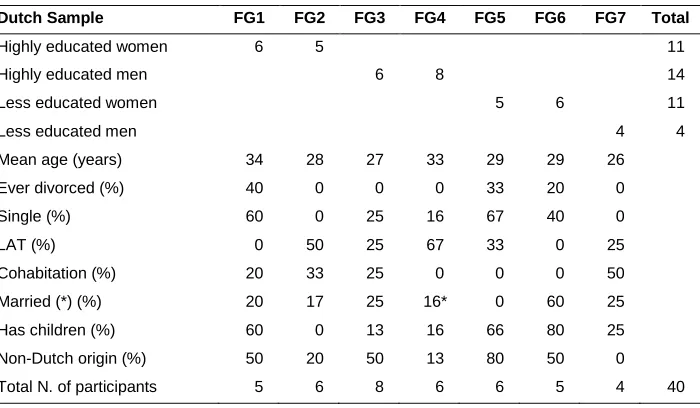
As shown in Table 2, the focus groups included 11 highly educated women, 14 highly educated men, 11 less educated women and 4 less educated men. A total of 7 focus groups, stratified by gender and educational attainment, were conducted. The mean age of the focus group participants ranged from 26 to 34 years across the four groups. As desired, there is substantial variation in terms of union statuses and experiences among the focus group participants. The Rotterdam population, however, differs in the educational composition from our sample. Compared to the other three large cities in the Netherlands (Amsterdam, Utrecht, and The Hague), Rotterdam has the highest percentage of school leavers with low levels of education, and particularly among the native Dutch; differences, compared to the national average, are striking (Municipality Rotterdam 2013).
Table 2: Summary of demographic information focus group participants
Dutch Sample FG1 FG2 FG3 FG4 FG5 FG6 FG7 Total
Highly educated women 6 5 11
Highly educated men 6 8 14
Less educated women 5 6 11
Less educated men 4 4
Mean age (years) 34 28 27 33 29 29 26
Ever divorced (%) 40 0 0 0 33 20 0
Single (%) 60 0 25 16 67 40 0
LAT (%) 0 50 25 67 33 0 25
Cohabitation (%) 20 33 25 0 0 0 50
Married (*) (%) 20 17 25 16* 0 60 25
Has children (%) 60 0 13 16 66 80 25
Non-Dutch origin (%) 50 20 50 13 80 50 0
Total N. of participants 5 6 8 6 6 5 4 40
Note: * = registered partnership
4. Results
The analyses of the seven focus group discussions revealed that views on cohabitation and marriage in the Netherlands are diverse but still reflect the high level of individualization in Dutch society. The participants were very reluctant to prescribe norms or set standards for others in terms of the ‗right‘ kind of relationship. In all discussions, participants stressed that the context of high relationship instability, and divorce in particular, would influence people‘s decisions about cohabitation and marriage. We found evidence for the different ways in which cohabitation (and marriage) may protect people from the negative consequences of divorce that we introduced in the theoretical framework: Cohabitation as an avoidance of marriage, as a test for marriage, and marriage as a legal ―package deal‖. We also found differences across the educational groups in how prominently these opinions were expressed. Surprisingly, in some of the discussions, we found a strong emphasis on marriage as an expression of utmost commitment, a concept not derived from the theoretical framework of individualization theory. In the following, we elaborate on these findings.
4.1 Cohabitation, marriage and individualization: Free choices and pure relationships
The increasing popularity of unmarried cohabitation was mainly discussed in light of the individualization, secularization, and emancipation of Dutch society. In the focus group of highly educated men, a discussion among the participants exemplifies this view:
Society has become much more individualistic, so yes, that is what is going on. Look at the incomes, it [marriage] is of course not that necessary anymore, people have also become a little bit more mature, women are a little more emancipated, and if you put all these puzzle pieces together, you get that result.
— I think because society has of course also become more secular, the influence of the Church has decreased.
— I think that there are fewer marriages because there is no pressure anymore from society to do so. [FG3, male, highly educated]
One leaves traditions and dogmas behind and, yes, chooses for self-interest, materialism, this kind of social developments are at play…yes, and therefore people want to develop themselves, study, have a career, be more focused on designing their own life path. [FG4, man, highly educated]
One female participant suggested that the traditional institution of marriage is at odds with modern values, such as women‘s autonomy and equality.
The history of marriage for me… I cannot identify myself with it. I want my own independence. I want equality for men and women. If you enter a marriage, seen from the past, the woman becomes economically dependent on the man. The woman has to follow the orders. [FG2, woman, highly educated]
Given the absence of external pressure, for many participants the need to marry is no longer evident in the Netherlands. Consequently, there was broad agreement that interpersonal commitment within a couple can be equally high within cohabitation and marriage.
You no longer need to marry in order to live together. This is also how I see it, it is not very relevant anymore whether you are married or not when living together. [FG3, man, highly educated]
Even when children are present, Dutch focus group participants stressed that the specific type of relationship was quite irrelevant.
Having a happy mom and dad is much more important than having a married mom and dad [FG3, man, highly educated]
The most important thing for children is just being there physically. The rest is just…how to say this….decoration. [FG3, man, highly educated]
No [to question whether children would be happier if their parents were married], because children do not care whether their parents are married or just living together. [FG5, woman, low educated]
different educational backgrounds expressed varying views on the consequences of individualization processes for the nature and stability of relationships. In line with the notion that the highly educated would be at the vanguard of viewing cohabitation as the ultimate form of a ―pure relationship‖ (Giddens 1992), the highly educated, and particularly the female participants, emphasized that the absence of legal ties in a cohabiting relationship would express their emotional bond with their partner. They argued that cohabitors stay together because they intentionally choose to be together, not because they are ‗tied to each other‘ in marriage.
In a different way…even when you are not married, you are with your partner, because you really want to be with each other and not because you are afraid to divorce ‘because we made the vows in the past, now I am stuck with you and I can’t go back’. I think that a lot of people appreciate just that they are with each other because they want to be every single day, because you can leave if you want to. [FG1, woman, highly educated]
Another difference in the way in which the highly educated differed from less educated participants was the way in which the consequence of women‘s emancipation was discussed. For those with higher education, the advantages of economic independence predominantly facilitated alternatives to traditional marriage. Women who are financially independent would no longer need to rely on their partner.
Why should I get married? Plus, I have my own income. Twenty years ago that wasn’t the case. In those days, you depended on your husband, while nowadays the majority of women is employed and no longer have to wait for the monthly household money to come in… they are independent. [FG1, woman, highly educated]
Those with lower education argued that traditionally, social expectations for women‘s and men‘s roles were clear and distinct. Increasing gender equity would have led to men and women competing for similar gender roles.
It used to be quite different, for instance it was like that: the woman stayed at home, with the children, the man went out for work, now it is different, it is really shared. Now it is like: What you can, I can do as well. And what you can, I can do better. [FG6, woman, low education]
no longer be willing to work out their relationship problems, the increased conflict potential would ultimately cause more relationships to dissolve.
[Interviewer:] Why do you think is it that fewer people marry these days? — Because people are too lazy to make their relationships work. [FG6, woman, low education]
In sum, all focus group participants agreed that changes in the meaning of cohabitation and marriage are a consequence of broader societal change towards more personal freedom in making choices about with whom and how to live as a couple. With the exception of religious participants, who were more reluctant to view cohabitation as a true alternative to legal marriage, participants agreed that interpersonal commitment within cohabitation may be as high as within marriage, and ultimately, the quality and not the label of a relationship would be what really counts. They perceived long term cohabiting unions and marriages as largely similar in their function for couple and family life. However, when discussing the advantages and disadvantages of cohabitation and marriage, the discussions evoked clear dissimilarities of both union types. These were often discussed in the light of high divorce rates in the Netherlands.
4.2 Cohabitation as a risk-reduction strategy
In our theoretical framework we argued that people in individualized societies would be aware of the increased risk of union instability due to increasing conflict-potential in modern relationships. The high context of divorce in the Netherlands was a prominent reason mentioned to explain why people would prefer cohabitation rather than marriage.
I think it is because of everything they [people] have experienced in their surrounding, the experiences of their loved ones, divorces and problems and that kind of things [FG5, woman, low education]
4.2.1 Cohabitation as a strategic long term response to high marital instability
People might refrain from marriage because they worry about subsequent divorce and chose to cohabit instead (Miller, Sassler, and Kusi‐Appouh 2011). Indeed, we found evidence that there is a general worry about divorce that colors people‘s views on cohabitation and marriage.
People have become very cynical about marriage and, also problems within a marriage. People do not take risks anymore. [FG2, woman, highly educated]
Perhaps it is our generation that is brought up with the idea that [marriage] often goes wrong, that that is a catalyzing factor… this is of course not the initial factor why people start living together unmarried. But if it [marriage] goes wrong more often, you might think ‘well ….I’d better not risk a failure, because I will experience a lot of negative consequences’. [FG3, man, highly educated]
Across educational groups we identified differences in the fears associated with marital divorce. For the higher educated, these fears were related to a public confession of personal failure if a marriage ends in divorce.
I think that it would be some kind of a failure in public, if you get divorced. It’s a bigger failure, so to say, than when you separate while living together or while just having a relationship [FG4, man, highly educated]
This quote also reveals the personal perception of divorce as a greater personal failure than merely separating from a cohabiting partner. There was, however, vivid discussion within some of the groups (across the educational spectrum) of whether or not a divorce would be more severe than separation from a cohabiting partner. Participants usually agreed that the legal consequences of a marital separation would be more severe in terms of time it takes to divorce as well as the number of things that need to be sorted out, whereas the emotional consequences may be as severe when a cohabiting relationship dissolves.
Yes, the money, it’s a frustration in principle, the money is a need, here in the Netherlands, well, in a lot of countries, but at a certain moment, it starts eating you up, you start blaming each other, like ‘but you wanted that, and you wanted this’ and then at a certain moment….things get all worked up, a thing you don’t want…and before things really get out of hand, people get divorced. You don’t want this situation. [FG5, woman, low educated]
Financial problems may also be part of the negative consequences of divorce. Cohabitation thus would imply a lower financial risk compared to marriage. Debts of the partner that would become joint debts in case of marriage (and divorce) would hold them back from getting married.
I have just learned that a lot of things can go wrong by getting married. Because then it is no longer your things, but your joint things. And when he does something wrong, you automatically do something wrong. Debts for instance, that will then also be your responsibility, and may stay your responsibility even when you are divorced. [FG5, woman, low education]
4.2.2 Cohabitation as a testing ground for marriage
Participants also discussed how cohabitation was a way to reduce the risk of divorce by allowing couples to test the marriage potential of the relationship. While this theme was discussed throughout the focus groups, the respondents with higher education respondents focused on it more. Although participants did not always agree whether the emotional consequences of dissolving a cohabiting relationship would be less severe, participants repeatedly argued that a big advantage of cohabitation is that it is easier to leave than marriage.
People prefer to live together unmarried. It’s like a subscription, you can easily quit it and move on with your life. It’s without obligations. [FG3, man, highly educated]
One female participant argued in favor of this strategy as a response to another (religious) participant who planned to marry straight from her parental home:
Especially when you [as a couple] have to start running your own little household. It might be the case that you do not like it at all and then you have to divorce and then you get all the fuss. [FG2, woman, highly educated]
4.2.3 Marriage as a way to safeguard financial and legal issues
As discussed in the theoretical section, marriage can also be seen as a risk-reduction strategy, in terms of the protection of property, tax and social benefits, parental rights, and the assurance of alimonies in case of divorce. Especially among the highly educated male participants, there was consensus that marriage has a lot of legal benefits that come ―in a package‖.
We then thought, you know what, we will have a registered partnership, because [marriage]…the fuss. But then we started to look closely at all the arrangements and yes, marriage is a good institution. Everything is covered at once and everything is cared for. [FG3 man, highly educated]
Participants felt that taking advantage of these benefits is a legitimate reason to marry, particularly when expecting a child.
That’s the big advantage of marrying in the context of children, in legal terms it’s a good match. In a moral sense, well, I don’t really care, but it is a lot more practical to marry before. [FG4, man, highly educated]
Marriage as a risk-reduction strategy was only lightly touched upon by highly educated women when discussing whether marriage should happen on common grounds or in separate estate. They took a strategic stance, and thought marrying in a separate estate was a better solution than marrying on common grounds when partners differed strongly in financial resources or when one of the partners owned a company.
Less educated male participants most explicitly discussed marriage as a risk-reduction strategy. Interestingly, however, they were strongly disapproving of marrying solely for strategic reasons. They felt that getting married to gain custody over one‘s children and to secure one‘s rights to one‘s children would be awkward and too strategic and people who would do so would not approach their relationship in the way they should.
marry for the child, not because you yourself are ready. [FG7, man, low education].
The less educated male participants felt that ―all or nothing‖ was part of the symbolism of marriage. In contrast to more educated women who approved marriage in separate estate under certain circumstances, less educated men perceived that as a signal of lacking commitment. For them it was either marrying ―all the way‖ or not marrying at all and perhaps simply registering the partnership.
Yes, otherwise you start the commitment [marrying in separate estate] a little paranoid ‘hey, just in case’. ‘Sweetheart, I love you, let’s get married’. ‘On equal terms?’ ‘No, no because when the relationship fails, well…then….’. When you are there on one knee, you can’t say that (laughs). [FG7, man, low education]
In sum, whereas higher educated respondents, and in particular men, approved marriage as a strategy to secure legal and financial rights, lower education men evaluated such an approach as a devaluation of the institution of marriage.
4.3 Marriage as the „utmost commitment‟
Even though the less educated male respondents were quite exceptional in their attitude towards marriage as a risk-reduction strategy, they were not the only group holding the opinion that marriage would be the ‗real deal‘ in terms of commitment. Most participants, both the higher and lower educated, viewed marriage as an indication that the couple is very serious about making the relationship work.
The costs of breaking up are just so much higher, in both a symbolic, a financial and in an emotional way when you get married. When you decide to marry and to propose, it has to be something magical. You then say ‘I am really, really sure that I want to be with you for a very long time. I am sure to such an extent that I want to commit myself to you, a commitment which when ended, will costs us both a lot’. [FG4, man, highly educated]
Marriage has a symbolic meaning….people make a statement to society ‘this man belongs to me.’ [FG3, man, highly educated]
Less educated male respondents took this notion even further. They felt that couples should only marry when the relationship is truly ready for this. The birth of a child should not be a trigger for marriage as this may even increase the risk of relationship dissolution.
Then you only marry, because you have a child, and what if….But I think that the chance, if you only do it [enter marriage] for your child, then it is more likely that, because you have rushed into marriage, you eventually split up. [FG7, man, low education]
The finding that children are not an adequate reason to marry is in line with conclusions drawn from qualitative studies in the United States (e.g., Sassler, Miller, and Favinger 2009). The couple‘s relationship is paramount, and only the level of commitment between the partners should be a reason to enter marriage. In the Dutch context, where cohabitors have the option of registering their relationship, less educated male participants also argued that if a couple wants to take care of legal matters and does not yet feel ready to marry, they should register the union. This statement suggests that registering a partnership would imply less commitment than getting married. It also suggests that less educated participants view the option of entering a registered partnership as a way to protect the value of marriage.
5. Conclusion and discussion
Remarkably, in all focus group discussions, the increased popularity of cohabitation in the Netherlands was also discussed as a consequence of the growing instability of relationships in individualized societies. This finding is in line with studies from the United States that showed that views on cohabitation and marriage reflect the context of high relationship instability in which people have been socialized (Miller, Sassler, and Kusi‐Appouh 2011).
Some participants, mostly highly educated, explicitly stated that avoiding economic and legal dependence from the partner by cohabiting rather than marrying would express the voluntary intention of staying in a relationship. Others pointed out that the content of the relationship would count more than the label. In that sense, we found evidence that cohabitation in the Netherlands is viewed as a relationship type in which interpersonal commitment can be as high as in marriage, for instance when cohabitors live together for a long time and have children together. Beyond that, however, we found little evidence that cohabitation and marriage were perceived as similar. Participants viewed cohabitation as generally inferior to marriage in terms of interpersonal commitment and economic dependence, and consequently as having less severe emotional and legal consequences in case of union dissolution.
Second, we studied whether Dutch adults view cohabitation as reducing the risk of relationship dissolution and if so, how they think cohabitation would reduce that risk. We identified two strategies. On the one hand, participants argued that fearing a divorce might permanently discourage people from marrying. Whereas the highly educated were more likely to fear personal failure if a marriage does not last, less educated women mentioned financial loss as a reason to forego marriage. Specifically, they felt that the costs of a wedding would be a waste if the marriage ended, but they also feared being liable for the debts of their partner after divorce. On the other hand, participants viewed cohabitation as a strategy to test the compatibility between partners before moving to more serious legal commitment.
divorce. The argument that marriage rather than cohabitation will protect them from the negative consequences of separation was strongly linked to the presence of children. We were surprised that many participants stressed the emotional and symbolic distinctiveness of marriage. In a context in which all legal matters can be arranged outside marriage, incentives and norms to marry are weak, and divorce is prevalent, the choice for a ―real marriage‖ might be a more conscious decision that is of great symbolic value for those who choose it. Based on the discussions in our focus groups, we can conclude that people are aware of the potentially severe consequences of divorce. Marriage may therefore signal an ultimate commitment and the confidence that one will defy the odds (Miller, Sassler, and Kusi‐Appouh 2011). This notion was emphasized more strongly by the less educated participants.
This study provides important insights in the diverse views on cohabitation and marriage in the Netherlands, but it does not come without limitations. First of all, the data are not representative of the Netherlands as a whole. Sample sizes of focus group discussions are generally too small to draw conclusions about the whole population. The participants live in Rotterdam, one of the largest urban areas of the Netherlands.
We moreover encountered difficulties in recruiting some of the lower educated participants and had to add snowball methods to our recruitment strategy to ensure a sufficient number of participants to conduct a focus group discussion. Although we succeeded in conducting focus group discussions among low educated and hard to reach participants, the men with low education in our sample are more highly educated than their counterparts at the national level. Furthermore, during the discussion, participants were explicitly encouraged to think about reasons ―others‖ may have to cohabit or to marry, rather than explaining their own behavior. Consequently, the participants‘ own behaviors might contradict their expressed views and attitudes. For instance, even though the less educated discussed many advantages of unmarried cohabitation, they personally strongly preferred marriage to (registered) cohabitation. At the same time, many less educated women in our sample had been married in the past, but as a result of having personally experienced a divorce often strongly opposed marriage.
received more nuanced views if the focus had been on processes that may make marriage eventually the right union status. For example, after several years of cohabitation, a relationship can grow into a stage were marriage is thought to be appropriate. If this is the case, we most likely were not successful in detecting whether people hold such attitudes about when to marry, and focus groups as such may not be the best setting to elicit reasons for marrying, because these decisions are made by individuals or couples.
Despite these limitations, this study has shed light on Dutch adults‘ views on cohabitation and marriage, how the specific societal context has shaped these perceptions and more generally which role individualization processes play in people‘s intimate lives. Increasing relationship instability has increased people‘s fear of divorce to which they respond by choosing to cohabit as a risk-reduction strategy. Hence, in individualized societies, people may not simply cohabit as a substitute for marriage, but may also view cohabitation as a safeguard against relationship failure. Nonetheless, people might also perceive marriage as risk reducing in a context of high divorce rates, as it can protect an individual‘s economic situation upon separation. Hence, in individualized societies, people do not completely dismiss the concept of interpersonal commitment and the symbolic meaning of marriage, they employ strategies to protect themselves when making decisions about union formation. This study has revealed that family scholars should take into consideration such risk-reduction strategies when studying new patterns of union formation and the emergence of cohabitation.
6. Acknowledgments
References
Baker, M. and Elizabeth, V. (2014). Marriage in an age of cohabitation. How and when people tie the knot in the twenty-first century. Canada: Oxford University Press.
Bauman, Z. (2003). Liquid Love: On the Frailty of Human Bonds. Cambridge: Polity Press.
Beck, U. and Beck-Gernsheim, E. (1990). Das ganz normale Chaos der Liebe. Frankfurt am Main: Suhrkamp.
Blossfeld, H.-P. and Huinink, J. (1991). Human capital investments or norms of role transition? How women's schooling and career affect the process of family-formation. American Journal of Sociology 97(1): 143–168. doi:10.1086/ 229743.
Bovens, M. (2012). Opleiding als scheidslijn. Van oude en nieuwe maatschappelijke breukvlakken. [Educational attainment as line of demarcation. Of old and new societal fracture areas]. Van Doornlezing: Erasmus Universiteit Rotterdam. Coumans, M. (2012). Sociale uitsluiting, beschrijvende analyses.[Social exclusion.
Descriptive results]. The Hague: Statistics Netherlands
Edin, K. (2000). What do low-income single mothers say about marriage? Social Problems 47(1): 112–133. doi:10.2307/3097154.
Edin, K. and Kefalas, M. (2005). Promises I can keep: Why poor women put motherhood before marriage: Berkeley: University of California Press.
Elzinga, C.H. and Liefbroer, A.C. (2007). De-standardization of family-life trajectories of young adults: A cross-national comparison using sequence analysis. European Journal of Population 23(3–4): 225–250. doi:10.1007/s10680-007-9133-7.
Family Formation Survey [Onderzoek Gezinsforming] (2008). Data collection 2008. http://www.scp.nl/Onderzoek/Bronnen/Beknopte_onderzoeksbeschrijvingen/On derzoek_gezinsvorming_OG
Garssen, J., de Beer, J., Cuyvers, P., and de Jong, A. (2001). Samenleven, Nieuwe feiten over relaties en gezinnen [Living together. New facts concerning relationships and families]. Voorburg: Statistics Netherlands
Heuveline, P. and Timberlake, J.M. (2004). The role of cohabitation in family formation: The United States in comparative perspective. Journal of Marriage and the Family 67(2): 1214–1230. doi:10.1111/j.0022-2445.2004.00088.x. Hiekel, N. and Castro-Martín, T. (2014). Grasping the diversity of cohabitation:
Fertility intentions among cohabiters across Europe. Journal of Marriage and Family 76(3): 489–505. doi:10.1111/jomf.12112.
Hiekel, N., Liefbroer, A.C., and Poortman, A.-R. (2014). Understanding diversity in the meaning of cohabitation across Europe. European Journal of Population 30(4): 391–410. doi:10.1007/s10680-014-9321-1.
Hoem, B. and Hoem, J.M. (1992). The disruption of marital and non-marital unions in contemporary Sweden. In: Trussel, J., Hankinson, R., and Tilton, J. (eds.). Demographic applications of event history analysis. Oxford: Clarendon Press: 61–93
Kalmijn, M. (2011). The influence of men‘s income and employment on marriage and cohabitation: Testing Oppenheimer‘s theory in Europe. European Journal of Population 27(3): 269–293. doi:10.1007/s10680-011-9238-x.
Kiernan, K. (2001). The rise of cohabitation and childbearing outside marriage in western Europe International Journal of Law, Policy and the Family 15(1): 1– 21. doi:10.1093/lawfam/15.1.1.
Kiernan, K. (2002a). Cohabitation in Western Europe. Trends, issues, and implications. In: Booth, A. and Crouter, A.C. (eds.). Just living together. Implications of Cohabitation on Families, Children, and Social Policy. Lawrence Erlbaum Associates, Inc: 3–31.
Kiernan, K. (2002b). The state of European unions: An analysis of partnership formation and dissolution. In: Macura, M. and Beets, G. (eds.): Dynamics of fertility and partnership in Europe: insights and lessons from comparative research. New York and Geneva: UN: 57–76.
Klijzing, E. (1992). 'Weeding' in the Netherlands: First union disruption among men and women born between 1928 and 1965. European Sociological Review 8(1): 53–70.
Kravdal, O. (1999). Does marriage require a stronger economic underpinning than informal cohabitation? Population Studies 53(1): 63–80. doi:10.1080/
Lesthaeghe, R. (1995). The Second Demographic Transition in Western countries: An interpretation. In: Mason, K.O. and Jensen, A.-M. (eds.). Gender and family change in industrialized countries. Oxford: Clarendon Press: 17–62.
Lesthaeghe, R. and Surkyn, J. (1988). Cultural dynamics and economic theories of fertility change. Population and Development Review 14(1): 1–45.
doi:10.2307/1972499.
Lesthaeghe, R. and van de Kaa, D.J. (1986). Twee demografische transities? (Two demographic transitions?). In: van de Kaa, D.J. and Lesthaeghe, R. (eds.). Bevolking: Groei en Krimp (Population: Growth and Decline). Deventer: Van Loghum Slaterus: 9–24.
Liefbroer, A.C. and Fokkema, T. (2008). Recent trends in demographic attitudes and behaviour: is the Second Demographic Transition moving to Southern and Eastern Europe. In: Surkyn, J. Deboosere, P., and van Bavel, J. (eds). Demographic Challenges for the 21st Century. Brussels: ASP.
Manting, D. (1994). Dynamics in Marriage and Cohabitation: An Inter-Temporal, Life Course Analysis of First Union Formation and Dissolution. Amsterdam: Thesis Publishers.
Manting, D. (1996). The changing meaning of cohabitation and marriage. European Sociological Review 12(1): 53–65. doi:10.1093/oxfordjournals.esr.a018177. Miller, A.J., Sassler, S., and Kusi-Appouh, D. (2011). The specter of divorce: Views
from working- and middle-class cohabitors. Family Relations 60(5): 602–616.
doi:10.1111/j.1741-3729.2011.00671.x.
Morgan, D.L. (1997). Focus groups as qualitative research. Thousand Oaks, CA: Sage. Morgan, D.L. (1998). The focus group guidebook. Thousand Oaks, CA: Sage
Municipality Rotterdam (2013). De staat van Rotterdam. [The state of Rotterdam]. Rotterdam: Bestuursdienst, Gemeente Rotterdam.
Musick, K. (2007). Cohabitation, nonmarital childbearing, and the marriage process. Demographic Research 16(9): 249–286. doi:10.4054/DemRes.2007.16.9. Nevitte, N. and Cochrane, C. (2006). Individualization in Europe and America:
Connecting religious and moral values. Comparative Sociology 5(2-3): 203– 230. doi:10.1163/156913306778667339.
Oppenheimer, V.K. (2003). Cohabiting and marriage during young men's career-development process. Demography 40(1): 127–149.
Perelli-Harris, B., Kreyenfeld, M., Sigle-Rushton, W., Keizer, R., Lappegard, T., Jasilioniene, A., Berghammer, C., and Di Guilio, P. (2012). Changes in union status during the transition to parenthood in eleven European countries, 1970s to early 2000s. Population Studies 66(2): 167–182. doi:10.1080/
00324728.2012.673004.
Perelli-Harris, B., Mynarska, M., Berrington, A, Berghammer, C., Evans, A., Isupova, O., Keizer, R., Klaerner, A., Lappegård, T., and Vignoli, D. (2014). Towards a new understanding of cohabitation: Insights from focus group research across Europe and Australia. Demographic Research 31(34): 1043–1078.
doi:10.4054/DemRes.2014.31.34.
Perelli-Harris, B., Sigle-Rushton, W., Kreyenfeld, M., Lappegard, T., Keizer, R., and Berghammer, C. (2010). The educational gradient of childbearing within cohabitation in Europe. Population and Development Review 36(4): 775–801.
doi:10.1111/j.1728-4457.2010.00357.x.
Poortman, A.-R. and Liefbroer, A.C. (2010). Singles' relational attitudes in a time of individualization. Social Science Research 39(6): 938–949. doi:10.1016/ j.ssresearch.2010.03.012.
Reed, J.M. (2006). Not crossing the "extra line": How cohabitors with children view their unions. Journal of Marriage and Family 68(5): 1117–1131. doi:10.1111/ j.1741-3737.2006.00318.x.
Sassler, S., Miller, A.J., and Favinger, S.M. (2009). Planned parenthood? Fertility intentions and experiences among cohabiting couples. Journal of Family Issues 30(2): 206–232. doi:10.1177/0192513X08324114.
Sassler, S. and Miller, A.J. (2011). Class differences in cohabitation processes. Family Relations 60(2): 163–177. doi:10.1111/j.1741-3729.2010.00640.x.
Smock, P. (2000). Cohabitation in the United States: An appraisal of research themes, findings, and implications. Annual Review of Sociology 26: 1–20. doi:10.1146/ annurev.soc.26.1.1.
Sobotka, T. and Toulemon, L. (2008). Changing family and partnership behaviour: Common trends and persistent diversity across Europe. Demographic Research 19(6): 85–138. doi:10.4054/DemRes.2008.19.6.
Stanley, S.M., Rhoades, G.K., and Markman, H.J. (2006). Sliding vs. deciding: Inertia and the premarital cohabitation effect. Family Relations 55(4): 499–509.
doi:10.1111/j.1741-3729.2006.00418.x.
Statistics Netherlands (2006). Minder huwelijk na samenwonen [Less marriages after cohabitation]. In: CBS (ed.). Webmagazine 27. Den Haag.
Statistics Netherlands (2009). Religie aan het begin van de 21ste eeuw [Religion at the beginning of the 21st century]. Den Haag: Heerlen.
Statistics Netherlands (2013). Maandag steeds vaker trouwdag [Monday increasingly often wedding day]. In: CBS (ed.). Webmagazine. Den Haag.
Teachman, J.D., Thomas, J., and Paasch, K. (1991). Legal status and the stability of coresidential unions. Demography 28(4): 571–586. doi:10.2307/2061423. Thornton, A., Axinn, W.G., and Xie, Y. (2007). Marriage and cohabitation. Chicago:
Chicago University Press. doi:10.7208/chicago/9780226798684.001.0001. Thornton, A. and Philipov, D. (2009). Sweeping changes in marriage, cohabitation, and
childbearing in Central and Eastern Europe: New insights from the Developmental Idealism framework. European Journal of Population 25(2): 123–156. doi:10.1007/s10680-009-9181-2.
Trussell, J., Rodríguez, G., and Vaughan, B. (1992). Union Dissolution in Sweden. In Trussell, J., Hankinson, R., and Tilton, J. (eds.), Demographic applications of Event History Analysis. Oxford: Clarendon Press.
van de Kaa, D.J. (1987). Europe‘s Second Demographic Transition. Population Bulletin 42(1):1–59.
Wiik, K.A., Bernhardt, E., and Noack, T. (2009). A study of commitment and relationship quality in Sweden and Norway. Journal of Marriage and Family 71(3): 465–477. doi:10.1111/j.1741-3737.2009.00613.x.