_____________________________________________________________________________________________________
ISSN:2457-0125
Biosynthesis of Lovastatin, an Anti-cholesterol Drug
by
Aspergillus wentii
NCIM 661 from Palm Kernel
Cake via Solid-state Fermentation
Chanakya Pallem
1*, Gayathri Parasa
2and Srikanth Manipati
21Ganesh Scientific Research Foundation (GSRF), Kirti Nagar, New Delhi-110015, India. 2NRI Academy of Sciences, Mangalagiri Road, Chinakakani, Andhra Pradesh-522503, India.
Authors’ contributions
This work was carried out in collaboration between all authors. Authors CP and SM designed the study, carried out literature searches, performed the statistical analysis and wrote the first draft of the manuscript. Author GP carried out the laboratory work and managed the analyses of the study. All authors read and approved the final manuscript.
Article Information
DOI: 10.9734/AJB2T/2018/46079 Editor(s): (1) Dr. Pasquale Russo, Professor, Department of Science of Agriculture, Food and Environment, University of Foggia, Italy. Reviewers: (1)Chin-Fa Hwang, Hungkuang University, Taiwan. (2)Ahmad Firdaus B. Lajis, Universiti Putra Malaysia,Malaysia. Complete Peer review History:http://www.sdiarticle3.com/review-history/46079
Received 27 October 2018 Accepted 11 January 2019 Published 30 January 2019
ABSTRACT
Over the past few years, the utilization of various agricultural residual wastes for the production of bioactive metabolites of industrial significance has been increased under solid-state fermentation in converting waste to wealth. In this context, present investigation presents the biosynthesis of an anti-cholesterol drug, lovastatin from palm kernel cake (PKC), a by-product obtained during the palm oil processing as a potential substrate, using Aspergillus wentii NCIM 661 under solid state fermentation (SSF). All the crucial process parameters such as initial moisture content, pH, incubation temperature, fermentation time and the effect of additional nutritional sources were optimized using single-parameter optimization to enhance the lovastatin production. A yield of 2.71 mg of lovastatin per gram dry substrate was obtained with palm kernel cake under the optimized fermentation parameters respectively. This study successfully and productively utilized both the agro-waste and fungal strain for the biosynthesis of lovastatin at their best and demonstrated the feasibility of solid-state fermentation for the commercial production of metabolites with therapeutic
significance. Findings from this study are very much promising for the economic utilization and value addition of these important agro residues, which are abundantly available in many developing countries like India.
Keywords: Aspergillus wentii; mevinolin; lovastatin; optimization; palm kernel cake; solid-state fermentation.
1. INTRODUCTION
Lovastatin (C24H36O5; also known Monacolin K or Mevinolin) belongs to the class of natural statins, which is most widely and effectively used to control hypercholesterolemia (accumulation of cholesterol in blood plasma). It competitively inhibits 3-hydroxy-3-methylglutaryl coenzyme-A (HMG-CoA) reductase, the rate-limiting enzyme of cholesterol biosynthesis [1-3]. Of all the statins available, lovastatin was the first natural statin approved by United States Food and Drug Administration (USFDA) in the year 1987 [4,5]. Moreover, lovastatin has also been reported to possess other therapeutic applications such as an anti-tumor agent against various forms of cancer, anti-inflammatory activity and also plays a vital role in the prevention of neurological disorders; bone disorders etc [6-8].
Lovastatin is mostly biosynthesized from various fungal genus and species as a secondary metabolite. Several fungal genera such as
Aspergillus, Monascus, Phoma, Penicillium Trichoderma, Pleurotus, Hypomyces are reported as potential lovastatin producers [9,10]. Earlier, commercial production of lovastatin by fungi was achieved by employing submerged fermentation (SmF) using Aspergillus terreus
[11-14]. Over the past few years, solid-state fermentation (SSF) has emerged as an alternative to submerged fermentation, because of several advantages it offers such as easy control of process contamination, requires fewer processing and down-streaming stages, utilizes lesser power and generates lesser effluent [15,16]. Another important feature of SSF is its ability to use inexpensive substrates in the form of agro-waste residues for the production of valuable metabolites of industrial importance [17-19]. Very limited documented data is available on lovastatin production under solid-state fermentation using various microbial genera [20-32].
Palm kernel cake (PKC) is the by-product of oil palm industry; generated after the processing of oil from kernel. It is nutritionally rich containing (% w/w) dry matter 90; crude protein 16.1; ether extract 0.8; crude fibre 15.2; Ash 4; N-free
extract 63; calcium 0.29; phosphorous 0.71 and metabolized energy 6.2 [33]. In the current work, the potentiality of palm kernel cake (PKC) was evaluated to see whether the residual waste could be used as a promising substrate in SSF using the fungal strain A. wentii NCIM 661 for the biosynthesis of therapeutic drug-lovastatin. To the best of our knowledge, this is the first paper reporting palm kernel cake for lovastatin production using A. wentii NCIM 661.
2. MATERIALS AND METHODS
2.1 Chemicals
Used chemicals are of analytical grade and were purchased from Loba Chemie Pvt. Ltd, Mumbai, India. Culture media was purchased from Hi-media Laboratories, Mumbai, India.
2.2 Microorganism and Inoculum
Preparation
Fungal strain, Aspergillus (A.) wentii NCIM 661, received from National Collection of Industrial Microorganisms (NCIM), Pune was used in the present study. The culture was maintained on potato dextrose agar (PDA) slants at 28C, stored at 4C and sub-cultured monthly. To a well-sporulated slant of A. wentii, 10 ml of sterilized Tween-80 solution (0.1% v/v) was added. The spore surface was dislodged with an inoculation needle and agitated thoroughly using cyclomixer (REMI: CM-101 PLUS, Mumbai, India) to suspend the spores uniformly. This was used as inoculum throughout the study.
2.3 Substrate
Palm kernel cake (PKC) was collected from nearby palm oil processing mill in Guntur, Andhra Pradesh, India. Before use, the substrate was sun-dried to remove any extra moisture content and sieved to particle size of 0.5 mm. The substrate was used in SSF without any pre-treatment.
2.4 Solid-state Fermentation
maintained at 60% using the moistening medium. The contents in the flasks were autoclaved at 121C (15 lb) for 20 min, cooled to room temperature and inoculated with 1 ml of the fungal spore suspension. The contents were uniformly mixed thoroughly and incubated at 28C in an incubator for desired period of time (i.e. one week).
2.5 Lovastatin Extraction and Assay
After completion of fermentation time, the flasks were dried at 40C for 24 h and crushed into powder form. About 2 g of the powdered material was taken and extracted with 100 ml of methanol: water (1:1, v/v) mixture (pH 7.7) in 250 ml Erlenmeyer flask and keeping the flasks at 30C in rotary shaker at 180-200 rpm for 2 h. After 2 h, the mixture was centrifuged at 10,000 rpm for 10 min and the supernatant was filtered through 0.45 m membrane filter. The obtained filtrate was collected in vials and preserved at 4C for further analysis. Lovastatin in the clear extract was estimated by high performance liquid chromatography (HPLC) using a C18 column (250 mm x 4.6 mm x 5 mm internal diameter). A mixture of 0.02 M phosphate buffer (pH 7.7) and acetonitrile in the ratio of 65:35 (v/v) was used as mobile phase. The mobile phase flow rate was maintained at 1.0 ml/min and lovastatin was detected at 238 nm with an injection volume of 20 L [20]. The yield of lovastatin was calculated [34]. The obtained lovastatin yield was expressed as milligram per gram of the dry substrate (mg/gds).
2.6 Optimization of Fermentation
Conditions
All the essential physicochemical and nutritional variables that influence the lovastatin yield were optimized using single-parameter optimization over a wider range. The parameters such as moisture content (40-80%), pH (4-11, adjusted with 1N HCl/NaOH), incubation temperature (22-40C), fermentation time (24-168 h). In addition, the impact of various carbon sources (glucose, lactose, maltose, fructose, sucrose, soluble starch, xylose, and cellulose) and nitrogen sources (ammonium sulphate, ammonium nitrate, yeast extract, malt extract, urea and peptone) were also assessed. All the SSF experiments along with analytical assays were run in three sets and the results reported were mean value of the three sets and standard deviation was ±<5%.
3. RESULTS AND DISCUSSION
Since one of the primary motivations for SSF bioprocesses is its economical advantage in utilizing cost-effective agro-wastes for the production of valuable metabolites. So, based on the chemical and nutritional factors, cost and availability, palm kernel cake (PKC) was chosen as a promising substrate in this SSF to carry out optimization experiments for lovastatin enhancement.
3.1 Optimization of Fermentation Time
The maximum lovastatin yield of 1.19 mg/g of dry substrate was achieved after 72 h of fermentation time (Fig. 1). The lovastatin yield increased up to 72 h which explained that lovastatin is a kind of fungal secondary metabolite and its accumulation in mycelia seems growth relatedness.
After 96 h, there is a drastic decrease in lovastatin yield by the fungal strain. The reason for this decrement might be due to the onset of microbial death phase or the micro organism has attained a stage, from which it could not balance its steady growth with the available nutritional sources [35].
3.2 Optimization of Moisture Content
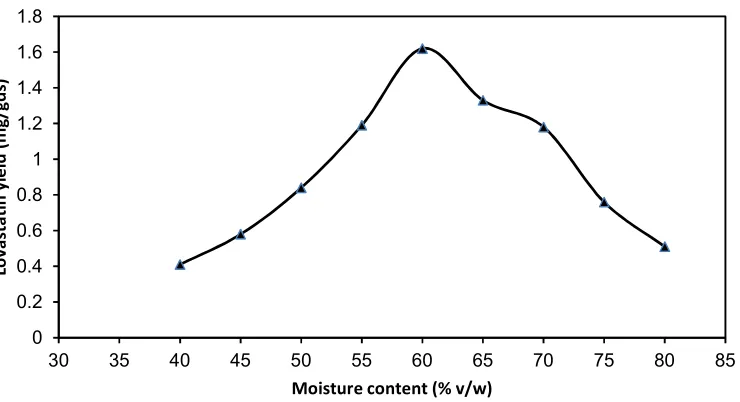
Optimal yield of lovastatin (1.62 mg/g dry substrate) was achieved at 60% moisture content (Fig. 2.). Moisture content is one of the critical factors that determine the success of SSF. Other than the optimized value, metabolite yield was lower on either side. With an increase in moisture level, there is a decrease in porosity, change in the substrate particle structure, lowers oxygen transfer, enhancement of bacterial growth and formation of aerial mycelia [36]. On the other hand, lower moisture content reduces the solubility of substrate nutrients, lowers degree of swelling and higher water tension [37]. The same 60% moisture content was also observed with Aspergillus fischeri under solid-state fermentation using coconut oil cake [25].
3.3 Optimization of Initial pH
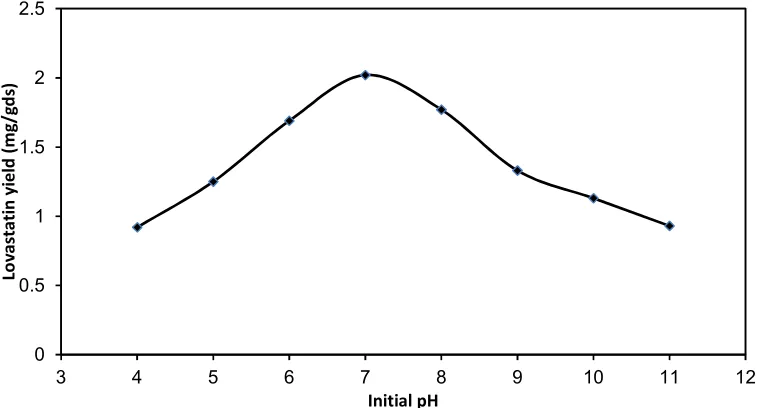
The profound effect of initial pH on the lovastatin production was as shown in Fig. 3. Maximum lovastatin yield (2.02 mg/g dry substrate) was recorded at pH 7.0.
strongly influences the transport of various components across the cell membrane and in turn support the cell growth and product formation. Basically agro-residual wastes utilized in SSF possess excellent buffering capacity. Most of the fungal species are active in the pH range of 3.5-7 and also lower pH avoids the contamination by other microbes [35,38].
3.4 Optimization of Incubation
Temperature
Results indicated that maximum lovastatin production (2.47 mg/g dry substrate) was obtained when SSF was run at 30°C (Fig. 4).
However, lovastatin yield reduced after optimal incubation temperature of 30°C. Generally, most of the fungal strains grow well in a temperature range between 25-32°C and any variation in their growth temperature results in poor metabolite production [39]. Moreover, higher temperatures could lead to poor growth of microorganisms during fermentation due to the thermal denaturation of microbial bio-actives for metabolic pathways [40]. These results are
coinciding with those previously reported for lovastatin production by Monascus ruber
[23].
Fig. 1. Effect of fermentation time on lovastatin yield. The maximum yield obtained after 72 h of fermentation time
Fig. 2. Effect of moisture content on lovastatin yield. At 60%, the lovastatin yield was maximum
0 0.2 0.4 0.6 0.8 1 1.2 1.4
0 20 40 60 80 100 120 140 160 180
Lo
va
st
at
in
y
ie
ld
(
m
g/
gd
s)
Fermentation time (h)
0 0.2 0.4 0.6 0.8 1 1.2 1.4 1.6 1.8
30 35 40 45 50 55 60 65 70 75 80 85
Lo
va
st
at
in
y
ie
ld
(
m
g/
gd
s)
Fig. 3. Effect of initial pH on lovastatin production. At pH 7.0, the yield of lovastatin was optimal
Fig. 4. Effect of incubation temperature on lovastatin production. The lovastatin yield was high
at 30C
3.5 Effect of Nutritional Sources
The nutritional (both carbon and nitrogen) sources were supplemented to the SSF medium in the range of 0.25-2.0% (w/w). None of the nutritional sources, other than glucose as carbon source at 0.5% (w/w), had shown profound impact on the microbial growth and lovastatin yield (data not presented). The optimal yield of lovastatin reported was 2.71 mg/g dry substrate. The reason might be due to the reason that the utilized substrate, palm kernel cake is already a rich source of energy and protein which is
self-sufficient in nourishing the fungal strain without any external nutrient requirement.
4. CONCLUSION
The findings from this study clearly demonstrated that the lovastatin production process based on palm kernel cake, as a potential substrate in SSF is economically feasible and attractive as it is a cheap and readily available agro-residual byproduct in India. This result is of significant interest due to the productive utilization of low cost and abundant availability of residues for the 0
0.5 1 1.5 2 2.5
3 4 5 6 7 8 9 10 11 12
Lo
va
st
at
in
y
ie
ld
(
m
g/
gd
s)
Initial pH
0 0.5 1 1.5 2 2.5 3
20 22 24 26 28 30 32 34 36 38 40 42
Lo
va
st
at
in
y
ie
ld
(
m
g/
gd
s)
production of value-added compounds of industrial importance.
COMPETING INTERESTS
Authors have declared that no competing interests exist.
REFERENCES
1. Alberts AW, Chen J, Kuron G, Hunt V, Huff J, Hoffman C, et al. Mevinolin: A highly potent competitive inhibitor of hydroxy methylglutaryl-coenzyme A reductase and a cholesterol-lowering agent. Proc Natl Acad Sci USA. 1980;77(7):3957-3961. 2. Alberts AW. Lovastatin and
Simvastatin-inhibitors of HMG CoA reductase and cholesterol biosynthesis. Cardiology 1990; 77:14- 21.
3. Schimmel TG, Borneman WS, Conder MJ. Purification and characterization of a lovastatin esterase from Clonostachys compactiuscula. Appl Environ Microb. 1997;63(4):1307-1311.
4. Manzoni M, Rollini M. Biosynthesis and biotechnological production of statins by filamentous fungi and application of these cholesterol lowering drugs. Appl Microbiol Biotechnol. 2002;58(5):555-564.
5. Radha KV, Lakshmanan D. A review: Lovastatin production and applications. Asian J Pharma Clinical Res. 2013;6(3): 21-26.
6. Seenivasan A, Subhagar S, Aravindan R, Viruthagiri T. Microbial production and biomedical applications of lovastatin. Ind J Pharm Sciences.2009;701-709.
7. Barrios GJ, Miranda RU. Biotechnological production and applications of statins. Appl Microbiol Biotechnol. 2010;85(4):869-883. 8. Praveen VK, Savitha J. Solid state
fermentation: An effective method for lovastatin production by Fungi-a mini review. The Open Tropical Medicine Journal. 2012;5:1-5.
9. Chakravarti R, Sahai V. Compactin-a review. Appl Microbiol Biotechnol. 2004; 64(5): 618-624.
10. Upendra RS, Pratima K, Amiri ZR, Shwetha L, Ausim M. Screening and molecular characterization of natural fungal isolates producing lovastatin. J Microb Biochem Technol. 2013;5(2):25-30. 11. Kumar MS, Jana SK, Senthil V,
Shashanka S, Kumar SV, Sadhukhan AK. Repeated fed batch process for improving
lovastatin production. Process Biochem. 2000;36(4):363-368.
12. Jia Z, Zhang X, Zhao Y, Cao X. Enhancement of lovastatin production by supplementing polyketide antibiotics to the submerged culture of Aspergillus terreus. Appl Biochem Biotechnol. 2010;160(7): 2014-2025.
13. Subhan M, Faryal R, Macreadie I. Exploitation of Aspergillus terreus for the production of natural statins. J Fungi (Basel). 2016;2(2):1-13.
14. Azeem M, Saleem Y, Hussain Z, Javed MM. Optimization of culture conditions for the production of lovastatin by Aspergillus terreus in submerged fermentation. Pharm Chem J. 2018;52:284-289.
15. Bhargav S, Panda BP, Ali M, Javed S. Solid-state fermentation: An overview. Chem Biochem Eng Q. 2008;22(1):49-70. 16. Abdul Manan M, Webb C. Modern
microbial solid state fermentation technology for future biorefineries for the production of added-value products. Biofuel Research Journal. 2017;4(4):730-740.
17. Lizardi-Jiménez MA, Hernández-Martínez R. Solid state fermentation (SSF): Diversity of applications to valorize waste and biomass. 3 Biotech. 2017;7(1):44.
18. Abu Yazid N, Barrena R, Komilis D, Sánchez A. Solid-state fermentation as a novel paradigm for organic waste valorization: A review. Sustainability. 2017;9(2):224.
19. Sadh PK, Duhan S, Duhan JS. Agro-industrial wastes and their utilization using solid state fermentation: A review. Bioresour Bioprocess. 2018;5(1):1-15. 20. Valera HR, Gomes J, Lakshmi S, Gurujara
R, Suyanarayan S, Kumar D. Lovastatin production by solid-state fermentation using Aspergillus flavipes. Enzyme Microbiol Technol. 2005;37(5):521-526. 21. Xu BJ, Wang QJ, Jia XQ, Sung CK.
Enhanced lovastatin production by solid state fermentation of Monascus ruber. Biotechnol Bioproc E. 2005;10(1):78-84. 22. Wei P, Xu Z, Cen PJ. Lovastatin
production by Aspergillus terreus in solid-state fermentation. J Zhejiang Univ. 2007;8(9):1521-1526.
and Monascus ruber. Food Bioprocess Technol. 2008;53:342-346.
24. Pansuriya RC, Singhal RS. Response surface methodology for optimization of production of lovastatin by solid-state fermentation. Braz J Microbiol. 2010;41: 164-172.
25. Madhu Latha P, Chanakya P, Srikanth M. Lovastatin production by Aspergillus fischeri under solid-state fermentation from coconut oil cake. Nepal J Biotechnol. 2012;2(1):26-36.
26. Faseleh Jahromi M, Liang JB, Ho YW, Mohamad R, Goh YM, Shokryazdan P. Lovastatin production by Aspergillus terreus using agro-biomass as substrate in solid state fermentation. J Biomed Biotech. 2012;196264.
27. Kavitha V, Janani B, Jayaraman A. Optimization of process parameters for lovastatin production from red gram husk by solid-state fermentation. Int J of Sci Tech. 2014;3(9):1413-1418.
28. Kamath PV, Dwarakanath BS, Chaudhary A, Janakiraman S. Optimization of culture conditions for maximal lovastatin production by Aspergillus terreus
(KM017963) under solid state fermentation. HAYATI J Biosciences. 2015;22(4):174-180.
29. Bhargavi S, Praveen V, Marium S, Sreepriya M, Savitha J. Purification of lovastatin from Aspergillus terreus
(KM017963) and evaluation of its anticancer and antioxidant properties. purification of lovastatin from Aspergillus terreus (KM017963) and evaluation of its anticancer and antioxidant properties. 2016;17(8):3797-3803.
30. Javed S, Meraj M, Mahmood S, Hameed A, Naz F, Hassan S, Irfan R. Biosynthesis of lovastatin using agro-industrial wastes as carrier substrates. Trop J Pharm Res. 2017;16(2):263-269.
31. Munir N, Asghar M, Murtaza MA, Akhter N, Rasool G, Shah SM, Tahir IM, Khan FS, Riaz M, Sultana S, Rashid A. Enhanced production of lovastatin by filamentous
fungi through solid state fermentation. Pak J Pharm Sci. 2018;31(4):1583-1589. 32. Balraj J, Jairaman K, Kalieswaran V,
Jayaraman A. Bioprospecting lovastatin production from a novel producer
Cunninghamella blakesleeana. 3 Biotech. 2018;8(8):359.
33. Sabu A, Pandey A, Daud MJ, Szakacs G. Tamarind seed powder and palm kernel cake: Two novel agro residues for the production of tannase under solid state fermentation by Aspergillus niger ATCC 16620. Bioresource Technol. 2005;96(11): 1223-1228.
34. Muthumary J, Sashirekha S. Detection of taxol, an anticancer drug, from selected
coelomycetous fungi. Indian J Sci Technol. 2007;1:1-10.
35. Nampoothiri KM, Baiju TV, Sandhya C, Sabu A, Szakacs G, Pandey A. Process optimization for antifungal chitinase production by Trichoderma harzianum. Process Biochem. 2004;39(11):1583-1590. 36. Singhania RR, Patel AK, Soccol CR,
Pandey A. Recent advances in solid-state fermentation. Biochem Eng J. 2009;44(1): 13-18.
37. Rashid JI, Samat N, Yusoff WM. Optimization of temperature, moisture content and inoculum size in solid state fermentation to enhance mannanase production by Aspergillus terreus SUK-1 using RSM. Pak J Biol Sci. 2011;14(9): 533-539.
38. Raimbault M. General and microbiological aspects of solid substrate fermentation. Electron J Biotechnol. 1998;1(3):174-188. 39. Bharti AK, Kumar A, Kumar A, Dutt D.
Exploitation of Parthenium hysterophorous
biomass as low-cost substrate for cellulase and xylanase production under solid-state fermentation using Talaromyces stipitatus
MTCC 12687. J Radiat Res App Sci. 2018;11:271-280.
40. Gautam A, Kumar A, Dutt D. Production of cellulase-free xylanase by Aspergillus flavus ARC-12 using pearl millet stover as the substrate under solid-state fermenta-tion. J Adv Enzy Res. 2015;1:1-9.
_________________________________________________________________________________ © 2018 Pallem et al.; This is an Open Access article distributed under the terms of the Creative Commons Attribution License (http://creativecommons.org/licenses/by/4.0), which permits unrestricted use, distribution, and reproduction in any medium, provided the original work is properly cited.
Peer-review history: